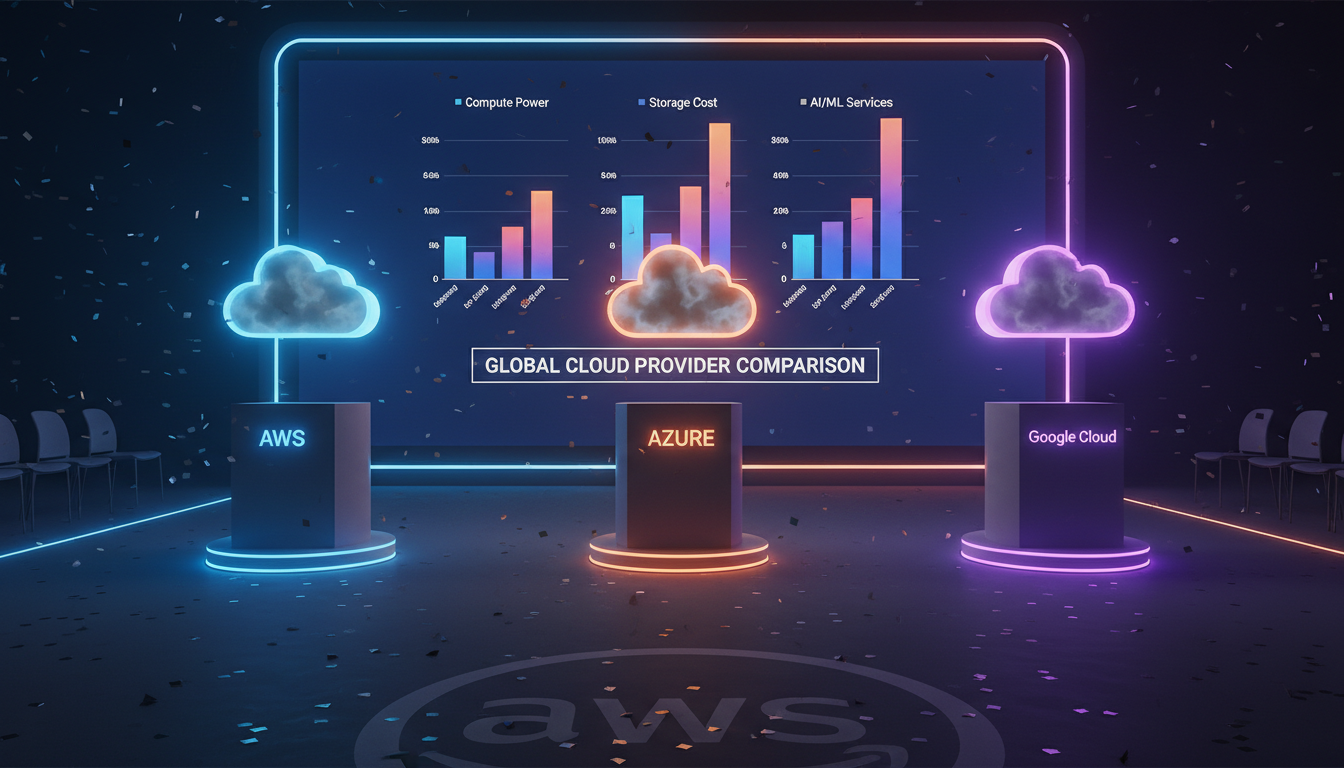
Choosing a cloud provider is one of the most consequential technology decisions a UK business will make. The three dominant platforms - Microsoft Azure, Amazon Web Services (AWS), and Google Cloud Platform (GCP) - each offer hundreds of services spanning compute, storage, databases, AI, networking, and security. Yet beneath the marketing material, these platforms have meaningfully different strengths, pricing models, and ecosystem advantages that matter enormously depending on your organisation's specific needs.
At Cloudswitched, we help UK businesses navigate this decision every day. Whilst we are a Microsoft partner and deploy Azure extensively, we take a pragmatic, vendor-informed approach. The right choice depends on your existing technology stack, your team's skills, your compliance requirements, and your long-term strategy. This guide provides an honest, detailed comparison to help you make an informed decision.
Market Position and UK Presence
All three hyperscale cloud providers operate data centres in the United Kingdom, which is essential for UK businesses with data residency requirements under UK GDPR. However, the scale and maturity of their UK presence differs.
AWS remains the global market leader with approximately 31% of worldwide cloud infrastructure spend. Azure has been closing the gap rapidly and now holds roughly 25% market share, with particularly strong growth in enterprise accounts. GCP sits at around 11% but is growing quickly, especially among organisations with data analytics and machine learning workloads.
For UK businesses, Azure's market position is particularly notable. Microsoft's existing relationships through Microsoft 365, Dynamics 365, and Windows Server mean that many UK organisations already have Microsoft Enterprise Agreements and can leverage these for Azure credits and discounted pricing. This pre-existing ecosystem integration is a significant practical advantage that goes beyond raw technical capability.
Growth Trajectories and Strategic Investment
Understanding each provider's growth trajectory and investment priorities helps UK businesses anticipate where the platforms are heading, not just where they are today. Microsoft has been investing aggressively in AI infrastructure, committing billions of pounds to data centre expansion across the UK and Europe. Azure's partnership with OpenAI gives it a unique position in the enterprise AI space that neither AWS nor GCP can replicate directly, and this advantage is attracting significant enterprise migration activity among UK organisations that see AI as a strategic priority.
AWS continues to broaden its service catalogue and maintain its lead in infrastructure maturity. Its ecosystem of third-party integrations, marketplace offerings, and community support is the largest of the three platforms. For UK businesses that need a wide variety of managed services or that rely heavily on open-source tooling, AWS offers the most comprehensive catalogue, though this breadth can also create complexity when navigating options and making architectural decisions.
Google Cloud has focused its UK growth strategy on data analytics, AI, and sustainability. Its carbon-neutral cloud operations appeal to UK organisations with environmental commitments, and its investment in custom silicon for AI workloads gives it a technical edge in machine learning performance. The competitive dynamics between these three providers benefit UK businesses directly, as each platform invests heavily in UK data centre infrastructure, pricing improvements, and local compliance certifications to win enterprise customers.
Compute Services Compared
At the heart of any cloud platform is its compute offering. All three providers offer virtual machines (VMs), containers, serverless functions, and managed Kubernetes, but the specifics differ in important ways.
| Capability | Microsoft Azure | Amazon Web Services | Google Cloud Platform |
|---|---|---|---|
| Virtual Machines | Azure VMs (broad range) | EC2 (widest range) | Compute Engine |
| Managed Kubernetes | AKS (Azure Kubernetes) | EKS (Elastic Kubernetes) | GKE (Google Kubernetes) - market leader |
| Serverless Functions | Azure Functions | AWS Lambda (most mature) | Cloud Functions |
| Container Instances | Azure Container Instances | Fargate / ECS | Cloud Run (excellent developer experience) |
| Windows Workloads | Excellent (native support) | Good (EC2 Windows AMIs) | Limited (Linux-focused) |
| Spot/Preemptible Pricing | Spot VMs (up to 90% off) | Spot Instances (up to 90% off) | Spot VMs (up to 91% off) |
AWS offers the widest range of EC2 instance types, making it the most flexible choice for specialised compute requirements. Azure provides the best native support for Windows workloads and has the tightest integration with Active Directory and Entra ID. GCP's Compute Engine is notable for its custom machine types, which allow you to specify exact CPU and memory ratios rather than choosing from predefined sizes - a feature that can deliver meaningful cost savings for workloads that do not fit standard VM sizes neatly.
Containers, Serverless, and Modern Application Architectures
Beyond traditional virtual machines, the container and serverless capabilities of each platform are increasingly important for UK businesses modernising their application architectures. Google Kubernetes Engine (GKE) is widely regarded as the best managed Kubernetes offering, which is unsurprising given that Google originally created Kubernetes. GKE offers features like Autopilot mode, which abstracts away node management entirely, and its integration with Google's networking infrastructure delivers excellent performance for containerised workloads.
Azure Kubernetes Service (AKS) has matured significantly and offers the best integration with Entra ID for role-based access control, making it the natural choice for organisations already using Microsoft identity infrastructure. AWS Elastic Kubernetes Service (EKS) sits somewhere between the two, offering solid Kubernetes support with the broadest range of complementary AWS services available alongside it.
For serverless computing, AWS Lambda remains the most mature offering with the widest language support and the deepest integration with other AWS services. Azure Functions provides comparable functionality with the added benefit of supporting long-running orchestrations through Durable Functions, which is particularly useful for business process automation. Google Cloud Functions and Cloud Run offer an excellent developer experience with minimal configuration required. UK businesses should consider their existing skills and tooling when evaluating these options, as the operational overhead of managing containers varies significantly between platforms.
Identity and Access Management
For UK businesses, identity and access management (IAM) is a critical differentiator. The way each platform handles user authentication, authorisation, and integration with your existing directory services has a profound impact on operational complexity and security posture.
Microsoft Azure
AWS / GCP
This is where Azure's advantage for most UK businesses becomes most apparent. The vast majority of UK mid-market and enterprise organisations use Microsoft 365 for email, collaboration, and productivity. Azure's native integration with Entra ID (formerly Azure Active Directory) means that the same identity platform governing Microsoft 365 access also governs Azure resource access. Users get single sign-on across both environments, Conditional Access policies apply consistently, and there is no additional identity infrastructure to manage.
Compliance and Governance at Scale
For UK businesses managing multiple cloud subscriptions or accounts, governance tooling becomes essential. Azure's Management Groups hierarchy allows organisations to apply policies, access controls, and compliance requirements across hundreds of subscriptions from a single point. Azure Policy can enforce rules such as requiring all resources to be deployed in UK regions, mandating encryption on all storage accounts, or preventing the creation of oversized VMs without approval. This governance framework is particularly mature and well-suited to UK enterprises with complex organisational structures.
AWS provides similar capabilities through AWS Organizations and Service Control Policies, which can restrict actions across multiple AWS accounts. AWS Config continuously monitors resource configurations and flags deviations from desired state, making it a powerful tool for maintaining compliance. Google Cloud's Organisation Policy Service offers comparable functionality but with fewer granular controls compared to Azure Policy or AWS Service Control Policies.
For UK businesses subject to industry-specific regulations - such as firms regulated by the Financial Conduct Authority or NHS trusts operating under the Data Security and Protection Toolkit - the depth of built-in compliance tooling can significantly reduce the cost and complexity of achieving and maintaining compliance. Azure's Compliance Manager provides pre-built assessment templates for UK GDPR, ISO 27001, Cyber Essentials, and NHS DSPT, guiding organisations through the specific controls they need to implement and providing an ongoing compliance score.
Data and Analytics
Data analytics is an area where the three providers diverge significantly. AWS offers the broadest range of analytics services, Google Cloud has the deepest heritage in data processing (BigQuery is arguably the most powerful serverless data warehouse available), and Azure provides the tightest integration with Microsoft's business intelligence tools.
For UK businesses that use Power BI for reporting (and many do, given its inclusion in Microsoft 365 E5 licences), Azure Synapse Analytics provides the most seamless data warehouse experience. For organisations with massive data volumes and complex analytical queries, Google BigQuery's serverless, pay-per-query model can be both simpler and more cost-effective than provisioned alternatives.
Real-Time Analytics and Business Intelligence Integration
The integration between cloud data services and business intelligence tools is a critical consideration for UK businesses that rely on data-driven decision making. Azure's native integration with Power BI is arguably its strongest differentiator in the data space. Data flowing from Azure Synapse, Azure Data Lake, or Azure SQL Database into Power BI dashboards is seamless, with features like DirectQuery enabling real-time reporting without the need to import and refresh data sets manually.
AWS offers integration with Amazon QuickSight, its own business intelligence service, which provides good functionality at competitive pricing but lacks the market penetration and feature depth of Power BI. Many AWS customers end up using third-party BI tools like Tableau or Looker alongside their AWS data infrastructure, which adds cost and integration complexity. Google Cloud acquired Looker and has integrated it deeply with BigQuery, creating a compelling data-to-insight pipeline for organisations committed to the Google ecosystem.
For UK businesses already invested in the Microsoft ecosystem - with Power BI licences included in their Microsoft 365 E5 agreements - the value proposition of Azure's data services is particularly compelling. The ability to move data from operational systems into analytical dashboards without leaving the Microsoft ecosystem reduces complexity, lowers cost, and accelerates time to insight. Organisations that have standardised on Power BI for reporting should weigh this integration advantage heavily when comparing cloud platforms.
Pricing and Cost Management
Cloud cost management is one of the biggest challenges UK businesses face, regardless of which provider they choose. All three platforms use usage-based pricing, but the pricing structures, discount mechanisms, and billing complexity vary significantly.
Cloud pricing is not simply “per hour per VM.” Costs accumulate across compute, storage, networking (especially egress charges), managed services, support plans, and licensing. Data egress - the cost of transferring data out of the cloud - is a particularly common surprise for UK businesses. All three providers charge for egress, but the rates vary. Google Cloud has historically offered the most competitive egress pricing, whilst AWS and Azure charge broadly similar rates. Always model your expected data transfer volumes when comparing costs.
Azure offers significant cost advantages for organisations with existing Microsoft Enterprise Agreements through Azure Hybrid Benefit (which allows you to reuse existing Windows Server and SQL Server licences in the cloud, saving up to 40–80% on those workloads). AWS counters with the most mature reserved instance and savings plan programmes, which can deliver 30–72% savings for committed usage. GCP offers sustained use discounts that apply automatically without requiring upfront commitment - a simpler model that benefits organisations with unpredictable workloads.
Security and Compliance
For UK businesses, regulatory compliance is a non-negotiable requirement. All three providers hold extensive compliance certifications including ISO 27001, SOC 2, and Cyber Essentials. However, the depth of UK-specific compliance support differs.
| Compliance Area | Azure | AWS | GCP |
|---|---|---|---|
| UK GDPR | Full compliance tools + DPA | Full compliance tools + DPA | Full compliance tools + DPA |
| UK Government (G-Cloud) | Extensive G-Cloud listing | Extensive G-Cloud listing | G-Cloud listed |
| NHS DSPT | NHS-specific compliance packs | Available | Limited |
| FCA Regulated Workloads | Strong (many UK banks on Azure) | Strong (many fintechs on AWS) | Growing |
| Cyber Essentials Plus | Certified | Certified | Certified |
| UK Data Residency | UK South + UK West regions | London region | London region |
Azure's compliance story is particularly strong for UK public sector and NHS organisations, where Microsoft's long-standing relationship with UK government buyers and NHS trusts provides confidence and pre-built compliance frameworks. AWS is the platform of choice for many UK fintech and startup companies, whilst GCP is gaining ground with data-intensive organisations that value its analytics and machine learning capabilities.
Security Tooling and Threat Detection
Beyond compliance certifications, the native security tooling built into each platform varies in sophistication and integration. Microsoft Defender for Cloud provides a unified security management and threat protection platform that spans Azure resources, on-premises servers, and even workloads running on AWS and GCP. For UK organisations pursuing a hybrid or multi-cloud strategy, this cross-platform visibility is a significant advantage that simplifies security operations.
AWS offers a comprehensive security toolkit including GuardDuty for threat detection, Security Hub for centralised security findings, and Inspector for vulnerability assessment. These services are individually capable but require manual integration to achieve the unified view that Microsoft Defender for Cloud provides by default. Google Cloud's Security Command Center offers similar capabilities, with particular strength in detecting misconfigurations and public exposure of cloud resources.
For UK businesses concerned about sophisticated cyber threats, the integration between Azure security tooling and Microsoft's broader security ecosystem is noteworthy. Microsoft Sentinel, Azure's cloud-native SIEM platform, ingests security signals from Microsoft 365, Entra ID, Azure resources, and third-party sources to provide a holistic view of an organisation's security posture. UK businesses using Microsoft 365 and Azure together benefit from pre-built connectors and detection rules that would require significant custom development on competing platforms. Given the increasing frequency of cyber attacks targeting UK businesses, this integrated security approach provides meaningful risk reduction.
Artificial Intelligence and Machine Learning
AI and ML capabilities have become a key battleground for cloud providers, and all three invest billions in this area. For UK businesses exploring AI adoption, the choice of cloud platform has significant implications for what is possible and how quickly you can get there.
Azure offers Azure OpenAI Service, providing access to GPT-4, DALL-E, and other OpenAI models through Azure's enterprise-grade infrastructure and compliance framework. This is a significant differentiator for UK businesses that want to leverage cutting-edge AI within a governed, compliant environment. AWS counters with SageMaker (the most comprehensive ML development platform) and Bedrock (managed access to multiple foundation models). Google Cloud leads in custom ML model training through Vertex AI and offers the most advanced natural language and vision APIs.
Support and Professional Services
The quality and availability of technical support matters greatly, particularly for UK businesses without large internal cloud engineering teams. All three providers offer tiered support plans, but the experience differs. Azure benefits from Microsoft's extensive UK partner ecosystem - there are thousands of Microsoft-certified partners across the UK who can provide implementation, migration, and ongoing support. AWS has a strong partner network but it tends to be more focused on larger enterprises and born-in-the-cloud companies. GCP's partner ecosystem in the UK is smaller but growing.
For UK mid-market businesses, the ability to find local, certified support is a practical consideration that should not be underestimated. Working with a UK-based Microsoft partner like Cloudswitched means you get Azure expertise combined with local knowledge, UK business hours support, and an understanding of UK regulatory requirements.
Training, Community, and Long-Term Skills Development
The availability of training resources, certifications, and community support influences how quickly your team can build expertise on a chosen platform. Microsoft Learn provides extensive free training for Azure, with clear certification pathways from fundamentals (AZ-900) through to expert-level specialisations. The sheer volume of Azure-trained professionals in the UK, driven by Microsoft's dominant position in enterprise IT, means that recruiting Azure-skilled staff is generally easier than finding equivalent AWS or GCP expertise, particularly outside London.
AWS Training and Certification is equally comprehensive, with the AWS Solutions Architect certification being one of the most recognised cloud credentials globally. AWS documentation is widely regarded as the most thorough of the three providers, and the AWS community - including user groups, forums, and open-source projects - is the largest and most active. For UK businesses with technically sophisticated teams who value community-driven learning, this ecosystem depth is valuable.
Google Cloud certifications have gained recognition rapidly, but the talent pool remains smaller than Azure or AWS in the UK market. Google Cloud documentation tends to be more concise and developer-friendly, reflecting its heritage as a platform built by and for engineers. For UK businesses evaluating platforms, it is worth considering not just the technical capabilities today but the long-term availability of skilled professionals who can manage and extend your cloud environment. In most UK regions, Azure and AWS skills are more readily available than GCP expertise, which may influence your total cost of ownership calculation when factoring in staffing and training costs.
Making the Right Choice for Your UK Business
There is no universally “best” cloud provider. The right choice depends on your specific circumstances. If your organisation is built on Microsoft technology - using Microsoft 365, Active Directory, Windows Server, SQL Server, and .NET applications - then Azure is almost certainly the strongest choice. The integration benefits, identity management advantages, and licensing synergies make it the natural platform for Microsoft-centric organisations.
If your organisation is primarily running Linux workloads, using open-source technologies, and needs the widest possible range of cloud services, AWS offers the most mature and comprehensive platform. And if your primary focus is data analytics, machine learning, or you need the best Kubernetes experience, GCP deserves serious consideration.
Many larger UK organisations adopt a multi-cloud strategy, using different providers for different workloads based on their relative strengths. However, for most UK mid-market businesses, the operational overhead of managing multiple cloud platforms outweighs the theoretical benefits. Our recommendation is to choose a primary platform, invest in building expertise on it, and use other platforms only where there is a compelling, specific reason.
Need Help Choosing the Right Cloud Platform?
Our cloud consultants can assess your current infrastructure, applications, and requirements, then provide a clear recommendation on which platform best fits your UK business. From migration planning to ongoing management, we make cloud work for you.
GET IN TOUCH
CloudSwitched
London-based managed IT services provider offering support, cloud solutions and cybersecurity for SMEs.


