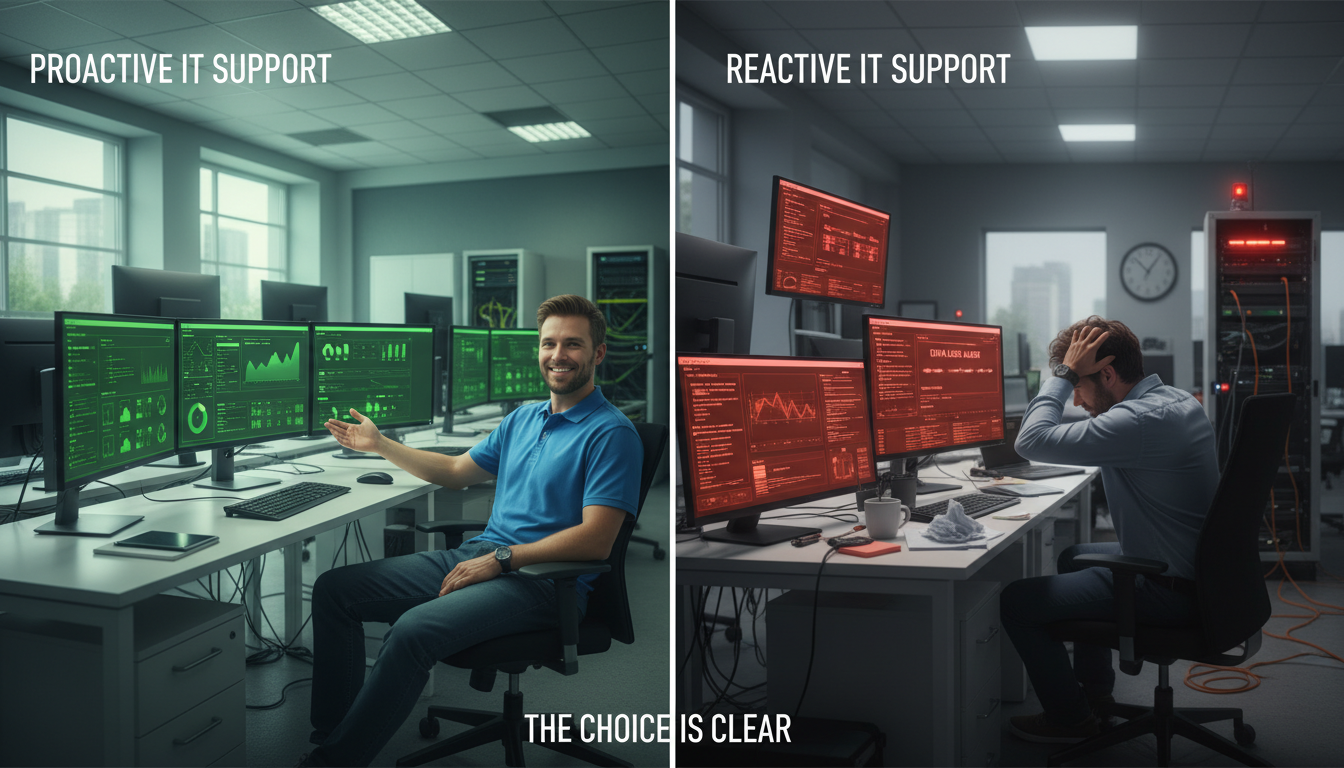
Every business relies on technology, but not every business manages it the same way. Some organisations wait for things to break before calling for help. Others invest in preventing problems before they occur. The difference between these two approaches - reactive and proactive IT support - can mean the difference between a minor inconvenience and a catastrophic business disruption.
For UK SMEs operating in competitive markets, the choice between reactive and proactive IT support isn't merely a technical decision. It's a strategic one that affects productivity, profitability, staff morale, and even your ability to win new business. In this comprehensive head-to-head comparison, we'll examine both approaches through real-world scenarios, financial analysis, and practical decision frameworks to help you determine which model is right for your organisation.
Understanding the Two Approaches
Before diving into comparisons, let's establish clear definitions. These two support models represent fundamentally different philosophies about how technology should be managed.
Reactive IT Support: The Break-Fix Model
Reactive IT support operates on a simple principle: when something breaks, you fix it. There is no ongoing monitoring, no scheduled maintenance, and no forward planning. Your IT provider (or internal resource) responds to problems as they arise, typically charging per incident or per hour.
This was the dominant model for decades. In the early days of business computing, systems were simpler, threats were fewer, and the cost of downtime was lower. For many businesses, calling someone when the printer jammed or the email stopped working was perfectly adequate.
Proactive IT Support: The Managed Service Model
Proactive IT support takes the opposite approach. Through continuous monitoring, regular maintenance, strategic planning, and preventive measures, problems are identified and resolved before they impact your business. This model typically operates on a fixed monthly fee, covering all support, monitoring, and maintenance activities.
The proactive model emerged as businesses became increasingly dependent on technology and the cost of failures grew exponentially. Today, with cyber threats evolving daily and remote working adding complexity, proactive support has become the standard recommendation for businesses of all sizes.
Head-to-Head: The Complete Comparison
Let's examine how these two approaches compare across every dimension that matters to your business.
Proactive IT Support
Reactive IT Support
Real-World Scenario: Server Failure on a Monday Morning
Nothing illustrates the difference between reactive and proactive IT support better than a real-world scenario. Let's walk through what happens when a critical server begins to fail at a 30-person accountancy firm in London.
Scenario A: Under Reactive Support
Friday 4:30 PM: The server's hard drive begins developing bad sectors. No one notices because there is no monitoring in place. Staff leave for the weekend as usual.
Saturday & Sunday: The drive continues to degrade. Automated backup jobs fail silently because no one checks them. The last verified backup is from three weeks ago.
Monday 8:15 AM: Staff arrive and can't access shared files, the accounting software, or client records. The office manager calls the IT support company.
Monday 9:00 AM: After 45 minutes on hold, a ticket is raised. The engineer is currently at another client site.
Monday 11:30 AM: An engineer arrives on-site. Diagnosis begins. The hard drive has failed completely.
Monday 2:00 PM: A replacement drive is sourced from a supplier. Emergency courier arranged - additional £85 charge.
Monday 5:30 PM: New drive installed. Attempting to restore from backup. The most recent successful backup is 19 days old.
Tuesday 10:00 AM: Partial restoration complete. Three weeks of client work, invoices, and correspondence are permanently lost.
Total impact: 1.5 days of complete downtime for 30 staff. 19 days of data lost. Emergency call-out fees of £1,800. Lost productivity estimated at £12,600. Client trust damaged. Potential GDPR implications from lost records.
Scenario B: Under Proactive Support
Wednesday (Previous Week): Automated monitoring detects early signs of drive degradation - increasing S.M.A.R.T. errors and rising read latency. An alert is automatically generated.
Wednesday 3:00 PM: The support team reviews the alert, confirms the drive is beginning to fail, and orders a replacement. The client is notified by email.
Thursday 7:00 PM: After business hours, an engineer arrives on-site. The failing drive is replaced and data is migrated using the RAID mirror. Total downtime: zero.
Thursday 8:30 PM: The engineer verifies that backups are running correctly and confirms the new drive is healthy. A summary report is emailed to the client.
Friday Morning: Staff arrive to find everything working normally. Most never even know there was an issue.
Total impact: Zero downtime. Zero data loss. Zero emergency fees. The replacement drive cost was included in the monthly support agreement. Staff productivity was completely unaffected.
Financial Analysis: The True Cost Comparison
One of the most common arguments for reactive support is that it's "cheaper." On the surface, paying only when something breaks seems more economical than a fixed monthly fee. But this reasoning ignores the hidden costs that accumulate under a reactive model.
Annual Cost Comparison by Business Size
Reactive costs include: average call-out fees, hourly engineer rates, emergency surcharges, hardware markup, lost productivity during downtime, and at least one major incident per year. Proactive costs reflect typical managed service agreements including all monitoring, maintenance, support, and strategic planning. Actual costs vary based on infrastructure complexity, industry, and specific requirements.
The Hidden Costs of Reactive Support
The call-out fee is only the tip of the iceberg. Here's what reactive support actually costs when you account for everything.
Response Time: When Every Minute Counts
In a reactive model, response times are unpredictable. Your IT provider may be busy with other clients, the engineer might be across London, or it could be outside business hours with no on-call cover. Under proactive support, response times are contractually guaranteed through Service Level Agreements (SLAs).
Risk Assessment: Where Each Model Leaves You Exposed
Understanding risk is crucial to making the right decision. Here's how each support model performs against the most common IT threats and challenges facing UK businesses.
| Risk Category | Reactive Support | Proactive Support | Risk Reduction |
|---|---|---|---|
| Ransomware Attack | Critical - No advance protection, no monitoring for intrusion attempts, backups often compromised | Low - Endpoint protection, email filtering, patch management, verified backups, incident response plan | 92% |
| Hardware Failure | High - No early warning, emergency procurement, extended downtime | Low - Health monitoring detects degradation, replacement arranged proactively | 85% |
| Data Loss | Critical - Backups rarely tested, long gaps between successful backups | Minimal - Automated backups with daily verification, tested restore procedures | 97% |
| Phishing / Social Engineering | High - No staff training, no email filtering, no reporting procedures | Moderate - Security awareness training, advanced email filtering, simulated phishing tests | 71% |
| Compliance Breach (GDPR) | High - No audit trail, no policy enforcement, no regular reviews | Low - Regular compliance audits, policy enforcement, data protection measures | 88% |
| Software Vulnerabilities | Critical - No patch management, systems running outdated software indefinitely | Low - Automated patching, vulnerability scanning, update scheduling | 94% |
| Network Outage | High - No redundancy planning, no bandwidth monitoring | Low - Network monitoring, redundancy planning, ISP management | 78% |
Case Study: A London Law Firm's Transition
"We used reactive IT support for six years. We thought we were saving money. Then we were hit by a ransomware attack that encrypted every file on our server. Our backups hadn't been working for five months and nobody knew. We lost three months of case files and billing records. The total cost, including emergency recovery, lost billable hours, and client remediation, exceeded £85,000. We switched to Cloudswitched's proactive support the following week. In the 18 months since, we haven't had a single hour of unplanned downtime." - Managing Partner, 22-person law firm, City of London
The Numbers Behind the Transition
Case Study: An E-Commerce Business in Shoreditch
"Our website went down on Black Friday. Under our old reactive support, it took four hours to get an engineer on the phone. By the time the site was back up, we'd lost an estimated £23,000 in sales. After switching to proactive monitoring, our provider actually called us at 2 AM on a Saturday to say they'd detected unusual load patterns and had already scaled our infrastructure. We didn't even notice." - Operations Director, online retail company, Shoreditch
When Reactive Support Might Be Acceptable
We'd be doing you a disservice if we didn't acknowledge that proactive support isn't always the right answer. There are specific, limited circumstances where a reactive approach may be adequate.
You have 1–3 employees with minimal technology needs (basic email, web browsing, simple documents). The cost of downtime is genuinely low, and you can afford to wait hours or days for resolution.
Your business doesn't depend on technology. If your IT systems are purely supplementary - perhaps a small trades business that primarily operates through phone calls and in-person work - the impact of a system failure is an inconvenience, not a crisis.
You have strong internal IT skills. If a founder or team member has genuine IT expertise and can handle routine maintenance, security updates, and basic troubleshooting, you may only need external support for complex issues.
Your systems are entirely cloud-based. If you use only SaaS applications (Google Workspace, Xero, etc.) with no on-premise infrastructure, many hardware-related risks are eliminated. However, you still need someone managing security, access controls, and backups of cloud data.
Even in these scenarios, reactive support leaves you exposed to cyber threats, data loss, and compliance failures. No business is truly immune to these risks. If you handle any personal data (client names, email addresses, payment details), GDPR obligations apply regardless of your company size.
The Decision Framework: Which Model Is Right for You?
Use this scoring system to evaluate which support model best fits your business. Score each statement honestly, then total your points at the end.
Business Dependency Assessment
| Question | Yes = Points | Your Answer |
|---|---|---|
| Could your staff continue working if all IT systems were down for a full day? | No = 3 points | □ |
| Do you store sensitive client or customer data? | Yes = 3 points | □ |
| Do you have more than 5 employees? | Yes = 2 points | □ |
| Do you operate in a regulated industry (finance, legal, healthcare)? | Yes = 3 points | □ |
| Have you experienced more than 2 IT issues in the past 6 months? | Yes = 2 points | □ |
| Do you use any on-premise servers or network infrastructure? | Yes = 2 points | □ |
| Does your business rely on email, video calls, or cloud platforms daily? | Yes = 2 points | □ |
| Do you support remote or hybrid workers? | Yes = 2 points | □ |
| Would losing a week of data cause significant financial or legal harm? | Yes = 3 points | □ |
| Are you planning to grow your team in the next 12 months? | Yes = 1 point | □ |
0–6 points: Reactive support may be sufficient for your current needs, but consider reviewing annually as your business evolves.
7–14 points: You're in a grey area. Proactive support would provide meaningful benefits, but a basic managed service tier may be more appropriate than a comprehensive package.
15–23 points: Proactive support is strongly recommended. Your business has significant dependency on technology and meaningful exposure to risk without proper management.
Myths About Proactive IT Support - Debunked
Despite the clear advantages, several misconceptions prevent businesses from making the switch. Let's address the most common myths head-on.
Myth 1: "Proactive support is just paying for problems that haven't happened"
Reality: This is like saying home insurance is paying for fires that haven't happened. The value isn't in the absence of incidents - it's in the monitoring, maintenance, and strategic planning that prevents them. You're also paying for guaranteed response times, a team that knows your systems intimately, and technology planning that aligns IT with your business goals. The data consistently shows that proactive support reduces total IT spend by 30–50% over a three-year period.
Myth 2: "We're too small for managed IT support"
Reality: Modern managed service providers offer tiered plans that scale to businesses of all sizes. A five-person company doesn't need the same level of service as a 200-person enterprise, and pricing reflects that. More importantly, small businesses are disproportionately targeted by cyber criminals precisely because they're perceived as having weaker defences. The UK Government's Cyber Security Breaches Survey found that 38% of small businesses identified a cyber attack in the past 12 months.
Myth 3: "Our IT guy handles everything fine"
Reality: A single IT person, no matter how talented, cannot provide 24/7 monitoring, stay current on every cyber threat, manage vendor relationships, plan strategic upgrades, and handle day-to-day support tickets simultaneously. They also create a dangerous single point of failure. What happens when they're on holiday, off sick, or leave the company? A managed service provider offers a full team with diverse specialisations and built-in redundancy.
Myth 4: "We'll switch to proactive when we can afford it"
Reality: This reasoning is backwards. As we've demonstrated in the financial analysis above, reactive support typically costs more in total when you factor in downtime, emergency fees, data loss, and productivity impact. The question isn't whether you can afford proactive support - it's whether you can afford not to have it. A single major incident under reactive support can cost more than several years of proactive management.
Myth 5: "All managed service providers are the same"
Reality: The quality of managed IT providers varies enormously. Some offer little more than reactive support repackaged with a monthly fee. When evaluating providers, look for genuine proactive features: 24/7 monitoring dashboards you can access, regular technology review meetings, documented maintenance schedules, clear SLAs with penalties, and a strategic roadmap for your technology evolution. A genuine proactive provider should be able to tell you about problems they prevented, not just problems they fixed.
Industry-Specific Comparison
The impact of choosing reactive versus proactive support varies significantly by industry. Here's how the comparison plays out across sectors common among UK SMEs.
| Industry | Reactive Risk Level | Key Concern | Proactive Benefit |
|---|---|---|---|
| Legal | Extreme | Client confidentiality, SRA compliance, billable hours lost | Encrypted backups, access controls, compliance auditing |
| Financial Services | Extreme | FCA regulations, transaction security, data integrity | Continuous monitoring, audit trails, disaster recovery |
| Healthcare / Clinics | Extreme | Patient data (NHS DSPT), appointment systems, clinical safety | DSPT compliance support, encrypted systems, verified backups |
| Professional Services | High | Client deliverables, project data, communication systems | Productivity optimisation, collaboration tools, cloud management |
| E-Commerce / Retail | High | Website uptime, payment processing, stock management | Uptime monitoring, PCI compliance, performance optimisation |
| Property / Estate Agents | Moderate–High | CRM systems, client communications, portal access | System integration, mobile support, data protection |
| Creative / Media | Moderate | Large file storage, collaboration, deadline-driven work | Storage management, cloud backup, performance tuning |
| Trades / Construction | Low–Moderate | Quoting systems, email, basic admin | Mobile device management, cloud access, basic security |
The Transition: What Switching Actually Looks Like
If you're currently on reactive support and considering the switch, here's what a typical transition to proactive managed services involves.
Phase 1 - Discovery & Audit: Your new provider conducts a thorough audit of your entire IT environment. Every device, every piece of software, every user account, every security setting is documented. This creates a baseline and identifies immediate risks.
Phase 2 - Remediation & Stabilisation: Critical vulnerabilities are addressed immediately. This might include applying months of missing security patches, fixing misconfigured firewalls, repairing broken backup systems, or replacing end-of-life hardware. This phase often reveals how much risk had been silently accumulating.
Phase 3 - Monitoring & Security Deployment: Remote monitoring agents are installed on all devices. Endpoint protection is deployed. Email security is configured. Alerting thresholds are set. Your systems are now being watched 24/7.
Phase 4 - Documentation & Process Setup: Network diagrams, password management, disaster recovery procedures, and escalation processes are formalised. Your team receives guidance on how to raise support requests and what to expect.
Phase 5 - Handover & Ongoing Management: The transition is complete. Regular maintenance windows are scheduled. Quarterly technology review meetings are diarised. Your IT is now being managed, not just maintained.
Downtime Impact: What an Hour Really Costs
Many businesses underestimate the true cost of downtime because they only think about the direct impact. Here's a more complete picture of what a single hour of unplanned downtime costs across different business sizes.
These figures include: average hourly salary costs for idle staff, estimated revenue loss based on UK SME averages, management overhead for incident coordination, customer service impact, and recovery costs. They do not include potential regulatory fines, legal liability, or long-term reputational damage, which can multiply these figures significantly.
Security Posture: The Starkest Difference
If there's one area where the gap between reactive and proactive support is most dangerous, it's cyber security. The UK's National Cyber Security Centre (NCSC) consistently warns that the threat landscape is evolving faster than most businesses can respond to independently.
Proactive Security
Reactive Security
Staff Experience & Productivity
An often-overlooked dimension of this comparison is the impact on your team. Under reactive support, staff become accustomed to working around IT problems - rebooting computers multiple times a day, using personal devices when work systems are slow, sharing passwords because account management is ad hoc. These workarounds aren't just inefficient; they create security vulnerabilities and damage morale.
For a 25-person company, the difference in lost productivity alone - 79 hours per employee per year - equates to approximately £49,000 in salary costs spent on dealing with IT problems instead of productive work.
The Verdict: A Comprehensive Summary
| Dimension | Reactive | Proactive | Winner |
|---|---|---|---|
| Upfront Cost | £0 until something breaks | Fixed monthly fee | Reactive (short term) |
| Total Cost of Ownership | 30–55% higher over 3 years | Predictable & lower overall | Proactive |
| Downtime | Average 42 hours/year | Average 3.5 hours/year | Proactive |
| Security | Minimal protection | Multi-layered defence | Proactive |
| Response Time | Hours to days | Minutes to hours (SLA) | Proactive |
| Data Protection | Unreliable backups | Verified, tested backups | Proactive |
| Compliance | Business responsibility | Managed & audited | Proactive |
| Scalability | No forward planning | Strategic growth planning | Proactive |
| Staff Productivity | 91 hrs lost/employee/year | 12 hrs lost/employee/year | Proactive |
| Business Continuity | No disaster recovery plan | Full DR & BCP | Proactive |
| Flexibility | No commitment | Monthly or annual contracts | Tie |
Frequently Asked Questions
How quickly can we switch from reactive to proactive support?
A typical transition takes 4–6 weeks from initial audit to full managed service. Critical vulnerabilities are usually addressed within the first week. During the transition, your existing reactive support arrangements can remain in place as a safety net, so there's no gap in coverage.
Will proactive support work with our existing software and systems?
Yes. A good managed service provider supports all mainstream business platforms including Microsoft 365, Google Workspace, industry-specific applications, and legacy systems. Part of the onboarding process involves documenting and understanding every application and system in your environment.
What if we already have an internal IT person?
Proactive managed support works brilliantly alongside internal IT staff. Your in-house resource can focus on strategic projects, user training, and business-specific applications while the managed service provider handles monitoring, security, backups, and infrastructure management. This is often called a co-managed IT model and is increasingly popular among growing businesses.
What's included in a typical proactive support agreement?
Most managed service agreements include: 24/7 monitoring, unlimited remote support, regular on-site visits, patch management, backup management, security management, vendor liaison, quarterly technology reviews, and strategic IT planning. Hardware, major projects, and new deployments are typically quoted separately.
Can we try proactive support without a long-term commitment?
Many providers, including Cloudswitched, offer monthly rolling contracts. This allows you to experience the benefits of proactive support without being locked into a lengthy commitment. Most businesses that try proactive support never go back to reactive - the difference is that tangible.
How do you measure the ROI of proactive IT support?
Key metrics include: reduction in downtime hours, decrease in support tickets, fewer security incidents, improved staff productivity scores, and total IT spend compared to previous years. A good provider will present these metrics in regular review meetings, demonstrating tangible value. Most businesses see positive ROI within the first 6–9 months.
Is proactive support suitable for businesses with remote workers?
Absolutely - in fact, proactive support is even more valuable for businesses with remote or hybrid workforces. Remote workers face unique security challenges (home networks, personal devices, public Wi-Fi) and rely entirely on technology to do their jobs. Proactive management ensures their devices are secure, updated, and properly configured regardless of location.
What happens outside of business hours?
Under proactive support, monitoring runs 24/7/365. Critical alerts are escalated immediately, even at 3 AM on a bank holiday. Scheduled maintenance is typically performed outside business hours to avoid disruption. Under reactive support, out-of-hours coverage is either unavailable or charged at premium emergency rates.
Making the Switch: Your Next Steps
If this comparison has highlighted gaps in your current IT support arrangements, the next step is straightforward. Cloudswitched offers a free, no-obligation IT audit for London businesses. We'll assess your current setup, identify risks, and provide a clear recommendation - whether that's proactive support, a hybrid approach, or simply tightening up your existing arrangements.
As a London-based IT support provider, we work exclusively with SMEs across the city. We understand the unique challenges of London businesses - from the fast pace and high expectations to the regulatory requirements and competitive pressures. Our proactive managed service plans start from just £45 per user per month, with no hidden fees and no long-term lock-in. Every client receives a dedicated account manager, guaranteed SLA response times, and quarterly strategic technology reviews.
Ready to Get Started?
Whether you’re looking to move from reactive break-fix to fully managed proactive IT support, or you simply want to strengthen your existing arrangements, our London-based team is ready to help.
Explore Our IT Support PlansThe evidence is clear: for the vast majority of UK SMEs, proactive IT support delivers better reliability, stronger security, higher productivity, and lower total costs than the reactive alternative. The only question is how much longer you're willing to gamble on the break-fix approach before a major incident forces the decision for you.
Don't wait for a crisis to expose the weaknesses in your IT support. Contact Cloudswitched today to arrange your free IT audit and discover how proactive managed support can transform your business technology. You can also explore our IT support services, cyber security solutions, and cloud services to see how we help London businesses thrive.

CloudSwitched
London-based managed IT services provider offering support, cloud solutions and cybersecurity for SMEs.


