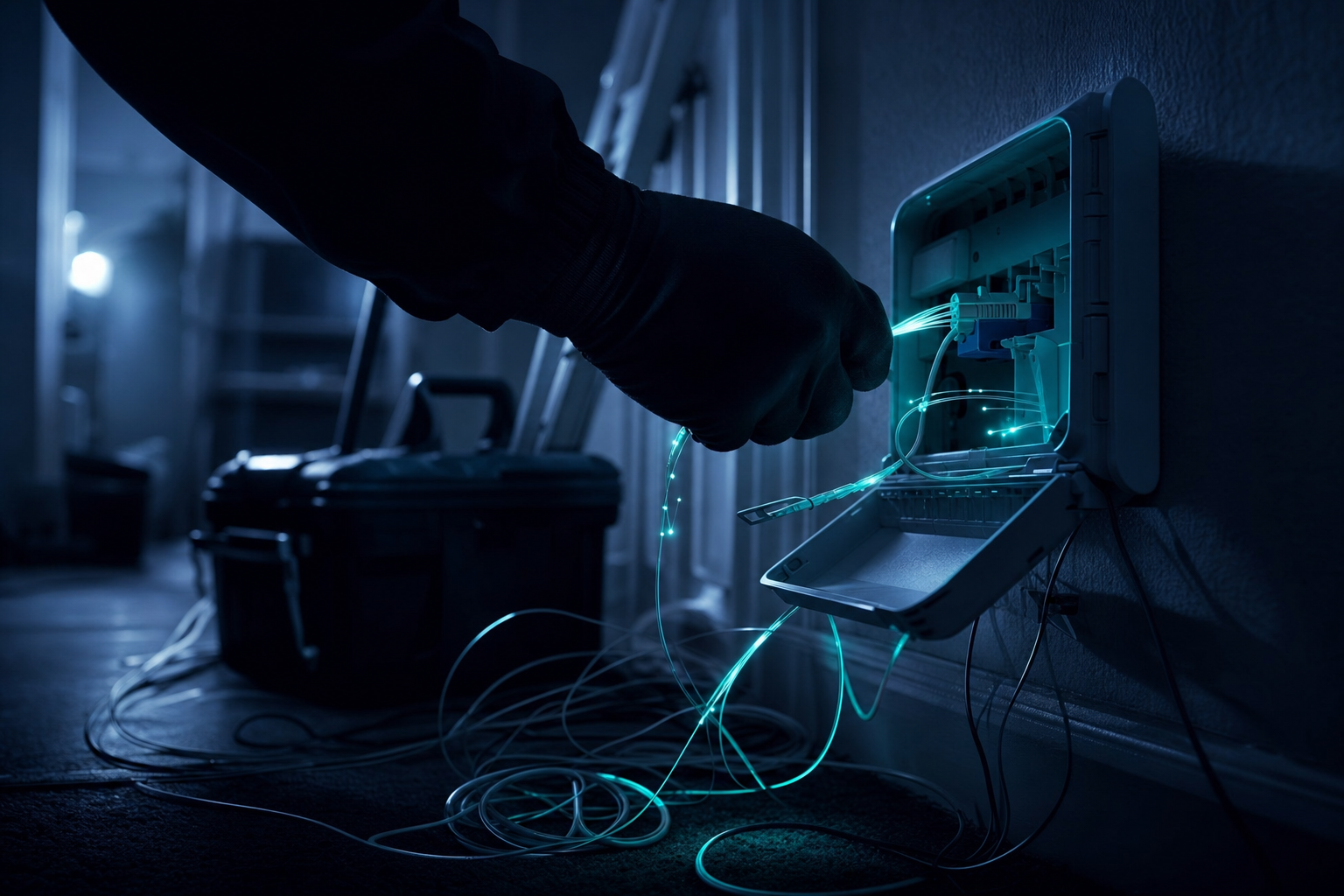
On 3 August 2026 the UK full-fibre gold rush produced one of its most instructive cautionary tales to date, and it happened not in a data centre or a boardroom but on the wall of an ordinary home in Ilkeston, Derbyshire. A YouFibre installation engineer, working on behalf of alternative network operator Netomnia, arrived to connect a new full-fibre (FTTP) service. What he left behind was a customer with no working broadband on either of the two fibre lines running into the property, a rival Openreach optical network terminal torn off the wall, a second and entirely unrelated internet service provider knocked offline for four days, and drill holes bored through the fabric of the building. Netomnia has since apologised, its contractor NanoFibre has agreed to pay for the repairs, and the customer has cancelled his YouFibre contract in disgust. For any UK small or medium-sized business that relies on connectivity to trade - which, in 2026, is very nearly all of them - the incident is a sharp reminder that the single most dangerous moment for a network is the day someone with a drill and a schedule turns up to change it.
The details, first reported by ISPreview, matter because they are so mundane. This was not a cyber-attack, a cable theft, or an act of God. It was a routine provisioning job carried out by a subcontracted engineer who apparently could not tell his own operator’s equipment from a competitor’s, and who reached for the fastest way to get a signal rather than the correct one. The story sits squarely at the intersection of three things Cloudswitched deals with every week for UK SMEs: office moves and new-site connectivity, resilient multi-line network design, and the unglamorous discipline of controlling exactly who is allowed to touch your infrastructure and when. This article walks through what happened, why the rapid multi-operator rollout of full fibre makes this kind of collision more likely rather than less, and what a business should put in place so that a botched install on the street outside never becomes a four-day outage inside.
What actually happened in Ilkeston
According to the account published by ISPreview, the customer had ordered a full-fibre service from YouFibre, the retail brand of alternative network builder Netomnia. On the day of installation in July 2026, the engineer - working through Netomnia’s contractor NanoFibre - needed to get an optical signal to the property and mount Netomnia’s own optical network terminal (ONT), the small box that converts light on the fibre into an Ethernet connection your router can use. What he did instead of running a fresh Netomnia fibre was to take the path of least resistance with hardware that was never his to touch.
He removed an existing Openreach ONT from the wall - a working piece of a rival network’s equipment - and replaced it with Netomnia’s own unit, then reused the Openreach fibre cable already running into the building to complete the YouFibre install. That alone would have been a serious error. But the damage did not stop at the wall. At the roadside, the engineer went to the Connectorised Block Terminal (CBT) - the small sealed enclosure on a pole or in a chamber where Openreach splits fibre out to individual premises - disconnected an Openreach fibre there, and patched it into Netomnia’s network. In doing so he severed a second, completely separate FTTP line serving the property, delivered over Openreach by a different retail ISP called Olilo. That line had nothing to do with the YouFibre order at all.
The immediate result was the worst of both worlds. The customer was initially left with zero working broadband on either line: the new YouFibre service did not come up cleanly, and the pre-existing Olilo service - the one the household was actually relying on - was now dead at the street. Diagnosing the mess required a subcontractor visit followed by a separate Openreach engineer visit to work out what had been done, and the picture that emerged included drill holes left inside the property and cabling patched into the wrong network. The Olilo line, riding Openreach’s infrastructure, stayed down for four days before it was restored, and correcting the damage ultimately required a full new fibre installation rather than a quick reconnection.
Running two live fibre lines into one premises - often from two different networks - is a standard resilience pattern. It is precisely how a business eliminates a single point of failure: if one carrier has an outage, the second keeps you trading. The Ilkeston incident inverts that logic in the cruellest way. An uncontrolled visit to install line B destroyed line A, so the redundancy that was supposed to protect the customer became the thing that got broken. A shared physical layer - the same pole, the same duct, the same roadside terminal - means an engineer with the wrong instructions can take out a service he was never sent to touch. Redundancy on paper is worthless if both paths can be severed by one careless afternoon.
The timeline: from install slot to cancelled contract
The sequence matters because it shows how a single provisioning error compounds into a multi-day outage and a lost customer - and how much of the delay came not from the physical fix but from the complaints process that followed.
Why the full-fibre land grab makes this more likely
It would be comforting to treat Ilkeston as a freak event - one rogue engineer, one bad day. The uncomfortable truth is that the conditions that produced it are becoming more common across the United Kingdom, not less. The country is in the middle of the largest civil-engineering push in the history of its telecoms network, with Openreach and dozens of alternative network operators (altnets) laying fibre past millions of homes and businesses in overlapping footprints. Netomnia alone has now extended its network to more than three million UK premises and around 500,000 customers, backed by over £1.6bn of investor funding. Where two, three, or even four networks pass the same street, the physical infrastructure - poles, ducts, chambers and roadside terminals - becomes densely shared and easy to confuse.
The chart below sketches the pressures that push a rushed install towards a mistake. It is an illustration of the contributing factors behind incidents of this type rather than a precise measurement of any single company, but the relative weighting reflects how connectivity professionals talk about the risk.
Two of those factors deserve particular attention for a business audience. The first is subcontracting. To hit the pace and scale investors are paying for, altnets and Openreach alike lean heavily on contractor firms - here, NanoFibre working for Netomnia - who in turn field large, fluctuating crews. Standards on any given doorstep depend on the training and diligence of whoever happens to be holding the drill that morning. The second is the sheer density of shared physical infrastructure. When your fibre and a competitor’s fibre terminate in the same sealed roadside box, the only thing stopping a mix-up is process and labelling, and neither is foolproof under time pressure.
How much of an outage is self-inflicted at the last metre
When UK SMEs think about connectivity risk, they tend to picture spectacular, distant failures: a subsea cable cut, a core network meltdown, a regional cloud outage of the kind we covered in the Azure West US incident. Those happen, but they are not where most avoidable downtime lives. A large share of real-world business outages originate in the last few metres of the network and in the human activity around it - a mislabelled port, an engineer at the wrong terminal, a change made without anyone recording it. The Ilkeston case is a textbook example: nothing failed in the network core; a person made a physical change to the wrong thing.
The figure is illustrative rather than audited, but the direction is what counts. If the majority of the downtime that actually hurts a business is caused by human activity at or near the building - installs, moves, patching, cross-connects - then the highest-return investment is not another exotic redundancy layer. It is control over the last metre: knowing what is connected where, who is allowed to touch it, and how any change is authorised, executed and verified. That is unglamorous work, and it is exactly the kind of discipline that separates a resilient site from one that is one visit away from four days of silence.
Where SME connectivity resilience most often falls down
Drawing the lessons of Ilkeston into a checklist a business can actually use, here is where we most commonly see UK SME connectivity resilience break under pressure. Each row is rated by how frequently it is the thing that turns a minor event into a serious outage.
What connectivity resilience costs a UK SME
The obvious objection to all of this is cost. Resilience is not free, and a small business has to weigh the monthly spend against the probability and impact of an outage. The table below sets out indicative UK monthly figures for connectivity resilience by business size. They are planning ballparks to frame a conversation, not quotes - real pricing depends on location, the networks available at the postcode, and the criticality of the workload.
| Business size | Typical resilience setup | Indicative monthly cost | Cost of a 4-day outage |
|---|---|---|---|
| Micro (1–9 staff) | Single FTTP plus 4G/5G automatic failover router | £60–£120 | Lost trading, missed orders, reputational damage |
| Small (10–49 staff) | Two lines on genuinely diverse networks, auto-failover | £150–£400 | Halted operations across a whole site for days |
| Medium (50–249 staff) | Dual diverse fibre, SD-WAN, managed monitoring and SLA | £500–£1,500 | Multi-site disruption, contractual and SLA exposure |
| Multi-site/critical | Leased line plus diverse backup, guaranteed fix times | £1,500+ | Severe: revenue, compliance and customer-trust impact |
Set the monthly figures against the right-hand column and the maths usually settles itself. For most trading businesses, four days without connectivity - no card payments, no email, no cloud applications, no phones if they are VoIP - costs far more than a year of the resilience that would have prevented it. The Ilkeston customer was a residential subscriber and could absorb the disruption personally; a business in the same position would have been counting the cost in lost revenue from the first hour.
Reactive versus proactive connectivity management
The difference between a business that rides out an incident like this and one that loses four days of trading is rarely the technology. It is the posture. Below is the contrast we see between the reactive default most SMEs live with and the proactive stance a managed connectivity partner puts in place.
Reactive posture
What most SMEs do today
- One line, or two lines quietly sharing the same physical path
- Nobody knows which box or port belongs to which provider
- Install engineers are let in and left to work unsupervised
- Failover, if it exists, has never been tested under load
- Faults are discovered by staff when things stop working
- Escalation means joining the same queue as every consumer
Proactive posture
Where Cloudswitched takes you
- Genuinely diverse networks with verified separate physical paths
- A documented, photographed map of every line, ONT and port
- Change control: no third party touches the comms room unescorted
- Automatic failover that is tested on a schedule, not on faith
- Proactive monitoring that spots a dropped line before staff do
- A named escalation path and pre-agreed fix-time expectations
Notice that most of the proactive column is not about spending more on bandwidth. It is about discipline: documentation, change control, testing and monitoring. Those are the controls that would have stopped an engineer patching the wrong fibre at the CBT, or would at least have caught it within minutes rather than leaving a line dead for four days.
In our experience the average unmanaged UK SME sits well below the halfway mark on connectivity resilience: a single line or an untested second one, no documentation of the physical layer, no change control over who touches it, and no monitoring to catch a silent failure. The gauge above reflects that typical starting point. The encouraging part is that most of the distance to a genuinely resilient posture is covered by process, not capital - the fixes are affordable, and they are within reach of a business of any size.
Before your next install, office move or line addition, insist on a simple written scope for the visiting engineer that names exactly which line and which equipment the visit concerns - and states in plain terms that no other line, ONT, cable or roadside terminal is to be disconnected, reused or repatched. Photograph your comms cabinet and roadside terminal beforehand so you have a baseline. Have a member of staff, or your IT partner, present or reachable during the work. It costs nothing, and it is the single most effective guard against exactly the kind of cross-network mistake that unfolded in Ilkeston.
The Ilkeston incident at a glance
| Detail | What happened |
|---|---|
| Location | Ilkeston, Derbyshire |
| Operator installing | Netomnia (retail brand YouFibre) |
| Contractor on site | NanoFibre, working for Netomnia |
| Error at the wall | Openreach ONT torn off; Netomnia ONT fitted; Openreach fibre reused |
| Error at the roadside | Openreach fibre disconnected at the CBT and patched into Netomnia’s network |
| Collateral victim | An unrelated FTTP line from ISP Olilo, delivered over Openreach |
| Initial state | Zero working broadband on either line |
| Olilo line downtime | Four days |
| Property damage | Drill holes left inside the premises |
| Diagnosis needed | Subcontractor visit plus a separate Openreach engineer visit |
| Fix required | A full new fibre installation |
| Complaint logged | 17 July 2026; no response for weeks despite a promised 48-hour callback |
| Resolution | NanoFibre agreed to pay Openreach for repairs only after publicity; customer cancelled YouFibre |
| Wider context | Netomnia passes 3M+ premises, 500k customers, £1.6bn funding |
How this connects to wider business-continuity risk
Connectivity failures rarely arrive in isolation, and the theme running through much of 2026 is the same: business continuity depends on eliminating single points of failure, whether they sit in the network, the cloud or the supply chain. Our analysis of the Azure West US outage of July 2026 made the same core point from the cloud side - a single region, like a single line, is a single point of failure. The people risk is just as real: the Scattered Spider TfL sentencing showed how a determined human, not a clever exploit, is often the weakest link, much as a single engineer at the wrong terminal was here. And as automation spreads, the rise of rogue AI agents underlines why change control and human oversight of who - or what - is allowed to alter your systems has never mattered more. Resilience is one discipline applied across every layer, not a product you buy once.
Make sure your connectivity survives the next site visit
Cloudswitched designs, documents and manages resilient connectivity for UK SMEs - genuinely diverse lines, tested failover, change control over who touches your infrastructure, and proactive monitoring that catches a dropped line before your staff do.
Talk to us about ConnectivityFrequently asked questions
Turn connectivity from a single point of failure into a strength
Whether you are moving office, adding a resilience line, or simply unsure what is really connected in your comms room, Cloudswitched can design and manage connectivity that is documented, diverse, monitored and protected by proper change control - so the next site visit is routine, not a risk.
Talk to us about Connectivity
CloudSwitched
London-based managed IT services provider offering support, cloud solutions and cybersecurity for SMEs.