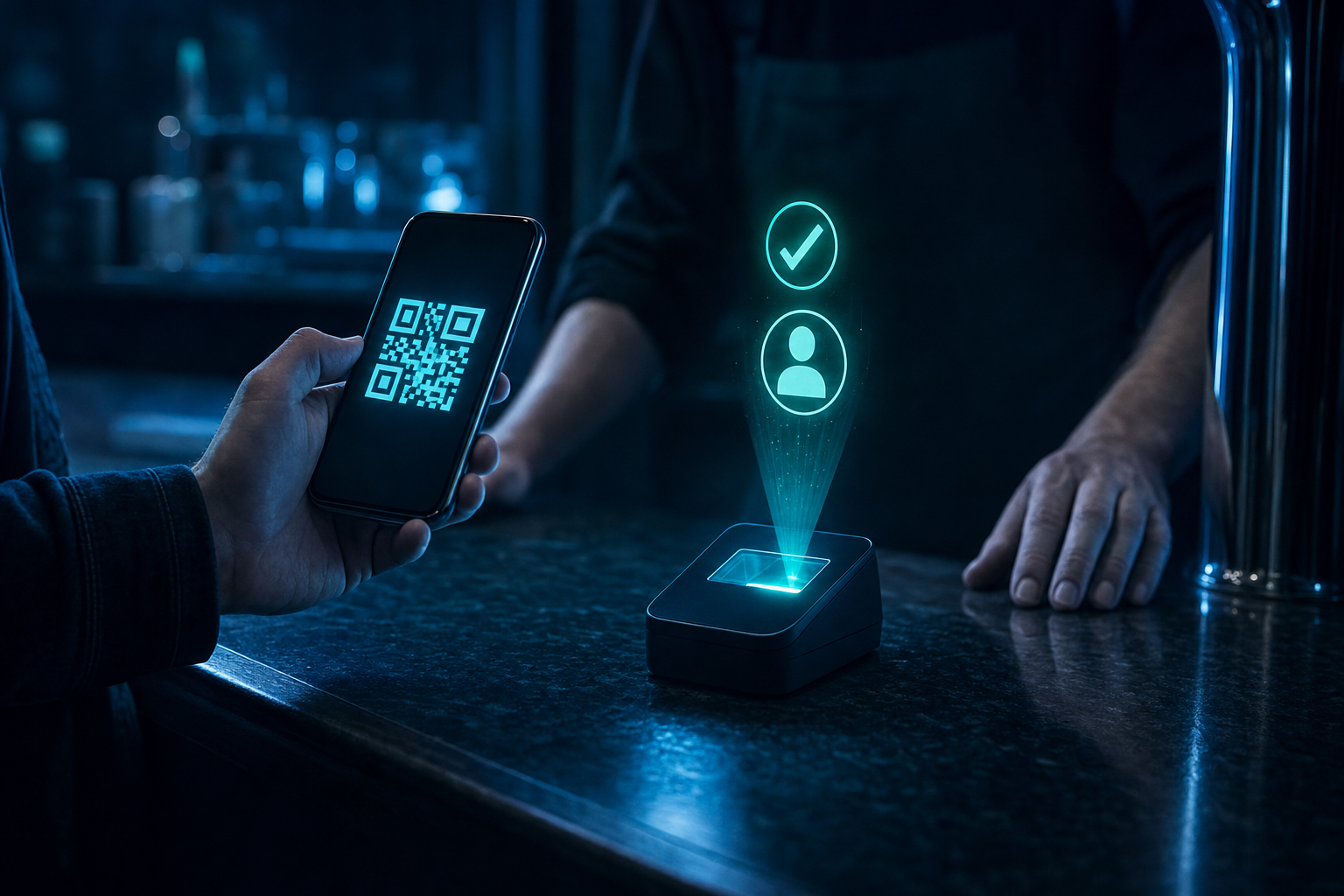
From this week, a pub in Cardiff, an off–licence in Leeds and a nightclub in Bristol can all legally accept a phone instead of a passport. Changes to the Section 182 statutory guidance under the Licensing Act 2003 came into force in England and Wales, allowing hospitality and retail businesses to accept certified digital ID apps as proof of age when selling alcohol. Physical identity documents remain entirely valid. Nothing about the change compels a single business to buy anything. But for anyone who runs the technology behind a bar, a till or a door, 16 September 2026 is the date a long–standing operational assumption quietly stopped being the only option.
The commentary so far has concentrated on the customer experience — shorter queues, no more handing a driving licence across a crowded bar, less sensitive personal data changing hands for no good reason. That is the visible half of the story. The half that lands on an IT budget is different: certified readers or scanning devices at each point of sale, an EPOS system that can talk to them, network coverage at the exact spot where the transaction happens, staff who have been trained on a new refusal workflow, and a data protection position that survives contact with the ICO. None of that is difficult. All of it is work, and almost none of it is on anyone’s roadmap yet. This article sets out what actually changed, what it means for a UK business with a licence, and how to decide whether to adopt now, later or not at all.
What actually changed this week
The legal mechanism is narrower than the headlines suggest, and the narrowness matters. The Licensing Act 2003 has not been rewritten. What changed is the Section 182 guidance — the statutory guidance that licensing authorities, police and premises licence holders treat as the operational reference for what a licensed business is expected to do. Age verification policy sits there. Amending it is how the government adjusts what counts as acceptable practice without reopening primary legislation, and it is why the change could take effect this week rather than waiting for parliamentary time.
The substance is that a licensed premises in England and Wales may now accept digital proof of age issued through a certified digital verification service. Certification is the load–bearing word. A business cannot accept any app that displays a date of birth. The provider must appear on the statutory register published on Gov.uk, having been shown to meet the standards set out in the UK’s digital verification services trust framework. That register is the entire trust model: it is what allows a licensee to argue, in front of a licensing officer or a court, that they took reasonable steps. An uncertified app is not a lesser form of evidence. It is not evidence at all.
Mechanically, the transaction is simple. The customer presents a QR code on their phone, or taps the device against a compatible reader. Behind that gesture, a certified provider has already done the work that used to happen at the bar: checked that an identity document is genuine, and checked — usually biometrically — that it belongs to the person holding the phone. What the member of staff sees is a confirmation that the customer is over eighteen. What they do not see is the customer’s name, address, full date of birth or document number. Yoti, which previously worked with the Post Office on the EasyID app, is among the first certified providers. Its co–founder and chief executive Robin Tombs described the change as “a landmark moment for digital identity in Britain”.
That data minimisation is the point the government has chosen to lead on. Digital government minister Stephanie Peacock framed it in terms of what customers no longer have to give away: sensitive personal information such as a name or a home address, handed over to a stranger in a loud room, purely to establish a single binary fact about age. Seen through a data protection lens rather than a convenience one, the existing practice of passing a driving licence across a bar has always been a substantial over–disclosure. It persisted because there was no alternative. Now there is one.
The dangerous position is not refusing digital ID, and it is not adopting it properly. It is the middle state that many businesses will drift into by accident: staff have heard that phones are “allowed now”, no certified reader has been bought, no policy has been updated, and a member of staff on a Friday night accepts a screenshot, a photo of a driving licence or an uncertified app because it looks official enough. That is not compliance with the new guidance — it is a failed age check with a modern veneer, and it carries the same consequences it always did: a failed test purchase, a licence review, a personal liability exposure for the designated premises supervisor. The change makes it more important, not less, that premises define exactly which forms of proof are acceptable and train to that definition. An unwritten policy plus a new technology is the worst combination available.
How a twenty–three year old licensing regime got a digital option
This week’s change did not arrive suddenly. It is the end of a long sequence in which a statutory framework built entirely around physical documents was gradually fitted with a digital equivalent, and the chronology explains why the result looks the way it does — voluntary, certified, and deliberately limited in scope.
Read as a whole, the sequence describes a policy that has been designed to be reversible and to fail safe. Nothing is mandated; the existing method remains fully valid; the new method only counts when it comes through a provider the government has certified and published. For a licensee, that design has one immediate consequence worth internalising: the burden of knowing what is acceptable has not been lifted from the premises. It has been made checkable — but only by someone who checks.
Where the work actually falls for a licensed business
The instinct on reading a story like this is to treat it as a procurement question: buy a scanner, done. The implementation profile is less tidy than that, and the hardware is rarely the largest part of it. The chart below sets out an indicative distribution of implementation effort for a typical multi–till licensed business adopting certified digital ID — not survey data, but a planning model of where the hours and the attention go.
The ordering is the useful part. Training sits at the top because the failure mode in age verification has always been human and always will be: the question is not whether a device can read a QR code but whether a nineteen–year–old member of bar staff, at half past eleven on a Saturday, knows precisely which forms of proof they are permitted to accept and feels supported in refusing everything else. Adding a new acceptable format to that list without retraining is how a premises ends up in a worse position than before it adopted anything.
Network coverage is the item most often missed entirely. A digital ID check is not a purely local operation: the reader and the customer’s phone both need to reach a service. The places where age checks happen are frequently the places with the worst connectivity in the building — a cellar bar, a door supervisor’s position in a lobby, a beer garden with a service hatch, a nightclub entrance behind a metre of brick. Whatever coverage exists at those specific points is now part of the sales process rather than a convenience for staff. Anyone planning an adoption should walk the premises with a phone and check signal and Wi–Fi at every position where a check will actually take place, before ordering hardware for those positions.
The final bar — supplier due diligence — looks small and is the one with the sharpest edge. It is a single recurring task: confirm that the provider you accept is on the Gov.uk statutory register, and confirm it again periodically rather than once at purchase. Certification is a status, not a permanent property. A business that checked once in 2026 and never again has quietly reverted to accepting an app on trust.
The 72% that unlocked the change — and the part it does not settle
Every policy change of this kind rests on a number, and this one rests on the 2024 consultation. Just under three quarters of respondents backed the use of digital ID for age verification when buying alcohol. In consultation terms that is a decisive result: strong enough to act on, and strong enough to justify acting quickly through guidance rather than legislation.
What the number does not settle is adoption. Public support for a capability existing is a different proposition from a licensee deciding to buy readers for eleven tills, and different again from a customer at the bar having a certified app already installed. The consultation answers the question “should this be allowed?”. It says nothing about the two questions that determine whether any of it happens in practice: will enough customers carry a certified digital ID for a premises to see a return on the hardware, and will enough premises accept it for a customer to bother installing one? That is a classic two–sided adoption problem, and it is the reason the government’s stated intention to bring digital driving licences and the Gov.uk Wallet into scope matters far more than the launch itself.
The strategic read for a UK business is therefore about sequencing rather than enthusiasm. If a large proportion of adults eventually carries government–issued digital identity in a wallet app they did not have to seek out, the customer–side problem disappears and acceptance becomes an expectation rather than a differentiator. The premises that will handle that transition well are not necessarily the ones that adopt in September 2026. They are the ones that use the voluntary period to establish which providers they accept, how staff verify them, and what the data protection position is — so that scaling up later is a hardware order rather than a policy project.
Allen Simpson’s framing at UKHospitality is the sector’s version of the same point. Welcoming the change as “a positive step for hospitality” while insisting the roll–out be “cost–efficient and not burdensome”, with multiple supplier options, is a request for exactly the conditions that make later adoption cheap: competition between certified providers, no single vendor able to price a licensing requirement, and no proliferation of incompatible readers. A business making an early commitment to one provider’s proprietary hardware is taking a position on a market that the sector’s own trade body is openly trying to keep open.
Where licensed businesses are least ready
The readiness gaps below are drawn from the pattern of how UK SMEs typically handle point–of–sale change, mapped against what certified digital ID actually requires. The badges indicate how much attention each item usually needs before a premises is in a defensible position.
The four items marked high share a characteristic: they are all things that a licensing officer, a police licensing team or a test purchase can expose directly, and none of them is fixed by buying equipment. The written policy is the foundation. A premises that cannot produce a current document stating which forms of proof it accepts has no position to defend, whether or not it has adopted digital ID, and adding a new format to an undocumented practice makes the gap wider rather than narrower.
The fallback procedure is marked low not because it is unimportant but because it is genuinely easy to resolve: physical ID remains fully valid, so the fallback for every digital failure is the process the premises already runs. That is one of the quieter strengths of a voluntary scheme. There is no failure mode in which a licensee is stuck, because the old method never went away. The discipline required is simply to say so explicitly in the policy, so that staff facing a flat phone battery at the door do not improvise.
What adoption is likely to cost
Costs here are indicative planning bands for UK businesses, covering the first year of adoption — hardware, configuration, training time and the policy work — rather than quotes. The figures assume certified reader hardware or compatible scanning devices at the positions where checks actually happen, not at every till in the building, which is the distinction that moves the number most.
| Business size | Typical scope | Indicative first–year cost | What you get for it |
|---|---|---|---|
| Single–site pub or off–licence, 1 – 3 service points | One or two certified readers or compatible devices, policy update, half a day of staff training, a documented provider check | £700 – £2,200 | A defensible written policy, a working check at the main bar or counter, and staff who know what they are permitted to accept |
| Restaurant or bar group, 2 – 5 sites | Readers at each site’s primary service points, EPOS compatibility check, group–wide policy, network survey at check positions, training per site | £2,500 – £8,000 | Consistency across sites, so a customer and a licensing officer get the same answer everywhere, and one policy rather than five local habits |
| Multi–site operator, 6 – 20 premises | Standardised hardware across sites, EPOS integration so checks are logged against transactions, data protection assessment, managed device rollout and support | £8,000 – £30,000 | Centrally evidenced compliance, remote visibility of device health, and a rollout that does not depend on individual managers getting it right |
| Late–night venue or nightclub with door–entry checks | Ruggedised or handheld devices at the door, verified connectivity at the entrance, integration with door supervision procedures, higher training volume and staff turnover allowance | £4,000 – £18,000 | Faster entry throughput at the point where queue length is a real commercial cost, with the check evidenced rather than remembered |
| Retail chain, 20+ stores with alcohol licences | EPOS–integrated verification across the estate, central provider management, till software update programme, estate–wide training and audit | £30,000 – £120,000 | Age verification as a controlled, reportable process across the estate instead of a per–store practice that varies by shift |
Two things stand out when these numbers sit next to the licensing reality. The first is that the cost of not adopting is zero and remains zero, which is unusual in a compliance story and worth saying plainly: a premises that continues to check driving licences and passports has not fallen behind on any legal requirement. The second is that the largest line in every band is not the device. It is the work around the device — policy, training, evidence — which is precisely the work that a premises should be doing to a good standard regardless of whether it ever accepts a phone.
Two postures towards the change
Reactive posture
What most licensed businesses will do by default
- Staff hear that “digital ID is allowed now” from a customer or a news headline, with no instruction from management either way
- No written statement of which providers are acceptable, so each shift makes its own judgement at the point of refusal
- Screenshots, photos of documents and uncertified apps get accepted because they look close enough under pressure
- The Gov.uk statutory register is never consulted, because nobody has been told it is the thing that decides the question
- Hardware bought, if at all, on a single supplier’s recommendation without checking EPOS compatibility or signal at the check position
- No assessment of what the reader records, so the data protection position is discovered during a subject access request or an ICO enquiry
- Evidence of a compliant process assembled retrospectively after a failed test purchase, from memory and the refusals book
Proactive posture
Where Cloudswitched IT Support takes you
- A current age verification policy naming exactly which physical documents and which certified digital providers are accepted, and nothing else
- Staff trained on the specific accepted apps, with a clear instruction to refuse anything not on the list — including a screenshot of an accepted one
- A scheduled, recorded check that each accepted provider remains on the Gov.uk statutory register
- Connectivity verified at every position where a check happens, including cellar bars, doors and outdoor service points
- Reader hardware chosen for EPOS compatibility and supportability, with a documented replacement path when a device fails
- A data protection position established up front: what is captured, where it is held, for how long, and on what lawful basis
- An explicit fallback to physical ID written into the policy, so a flat battery or a dropped connection is a routine event rather than a decision
The distance between those columns is mostly documentation and instruction, not spending. Several items in the right–hand column cost nothing at all: writing down the accepted list, telling staff to refuse everything else, checking the register on a schedule. What separates the two positions is whether anyone in the business owns the question. In most licensed premises, age verification is owned in principle by the designated premises supervisor and in practice by whoever happens to be on the door, which works until the format of acceptable proof changes — as it just did.
Before any purchase decision, answer four questions in writing and keep the answers with your licence documentation. One: does our premises accept digital ID at all, and if so, exactly which certified providers — named, not described? Two: have the staff who perform age checks been told that answer, and told explicitly to refuse everything else including screenshots? Three: who checks, and how often, that our accepted providers are still listed on the Gov.uk statutory register? Four: if we accept digital ID, what does the reader record, where does that data go, and how long is it kept? A premises that answers “we do not accept digital ID, physical documents only” to the first question and can show that in a current policy is in a perfectly defensible position and has finished. A premises that cannot answer the first question has a problem that predates this week’s change.
The data protection question nobody has asked yet
The government’s framing of this change is a privacy improvement, and on the customer side that is straightforwardly correct. Stephanie Peacock’s point stands: a system that returns “this person is over 18” discloses radically less than one that hands a document containing a full name, address, date of birth and licence number to a stranger. The certified provider has done the identity checking in advance, and the premises receives an assertion rather than a dossier.
The obligation that lands on the business is different and more subtle. A premises accepting digital ID is processing personal data at the moment of the check, even if what it sees is minimal. The questions that follow are ordinary UK GDPR questions with unfamiliar answers: what does the reader or app capture and retain — a pass/fail result, a timestamp, a transaction reference, a device identifier, an image? Where is that held, on the device or in a supplier’s cloud? For how long, and who decided that? Is the provider a processor acting on the premises’s instructions, or a controller in its own right, and is there a contract that says so? Under what lawful basis is the check performed — almost certainly legal obligation or legitimate interests, but it needs to be stated rather than assumed.
None of this is onerous, and for most single–site businesses it amounts to a short assessment and a retained supplier document. It becomes significant at estate scale, where the same check runs thousands of times a day and any retained record becomes a substantial data set with a retention schedule, an access control question and a breach exposure. The organisations that get this wrong will not get it wrong through negligence. They will get it wrong by treating a reader as a peripheral rather than as a processing system, and therefore never asking the question at the point where it is cheap to answer.
There is a useful comparison with Cyber Essentials here. The scheme works not because its technical controls are demanding but because it forces an organisation to enumerate what it actually has — the devices, the accounts, the software, the boundaries. Age verification hardware is exactly the kind of asset that escapes that enumeration: it sits at a till, it is bought by an operations manager rather than an IT function, it connects to the network, it runs firmware that will need updating, and nobody thinks of it as part of the estate. A digital ID reader is a networked endpoint holding a security function. It belongs in the asset inventory, in the patching schedule and in the scope conversation, from the day it arrives.
The story at a glance
| Item | Detail |
|---|---|
| What changed | Changes to the Section 182 statutory guidance under the Licensing Act 2003 came into force this week, permitting certified digital ID for age verification on alcohol sales |
| Where it applies | England and Wales, covering pubs, off–licences, nightclubs and restaurants |
| Is it mandatory | No. The scheme is voluntary; no business is required to adopt digital verification technology |
| Does physical ID still work | Yes. Driving licences and passports remain fully valid, with no change to existing practice |
| How the check works | The customer shows a QR code or taps a device on a compatible reader; the certified service has already verified the document is genuine and belongs to the holder |
| What staff see | Confirmation that the customer is over 18 — not their name, address or full date of birth |
| Who may issue it | Only a certified digital verification service listed on the statutory register on Gov.uk |
| Certification standard | Providers must be shown to meet the standards of the UK’s digital verification services trust framework |
| Early providers | Yoti, which previously worked with the Post Office on the EasyID app, is among the first certified |
| Evidence base | A 2024 government consultation in which 72% of respondents supported digital ID for age verification when buying alcohol |
| Industry view | Yoti’s Robin Tombs: “a landmark moment for digital identity in Britain”. UKHospitality’s Allen Simpson: “a positive step for hospitality”, provided the roll–out is “cost–efficient and not burdensome” |
| Government view | Digital government minister Stephanie Peacock: customers no longer need to hand over sensitive personal information such as name or address just to prove their age |
| Gov.uk Wallet | Digital proof of age is currently separate from digital driving licences and the Gov.uk Wallet, though the government hopes to bring these into scope over time |
| Main IT impact | Reader hardware at check positions, EPOS compatibility, verified connectivity at the bar and door, staff training, and a data protection assessment |
| Cheapest first step | Write down which forms of proof your premises accepts — physical only, or physical plus named certified providers — and train staff to refuse everything else |
This story connects to several we have covered recently, and read together they sketch the same underlying shift rather than separate incidents. Our note on LINX’s LON2 fabric passing 1Tbps is the infrastructure half of this one: a digital age check is a network transaction, and the connectivity you have at the door is now part of the sales process. The piece on the end of security through obscurity makes the same argument in a different domain — assumptions that used to be load–bearing no longer are, and an app that merely looks official is exactly the kind of assumption that needs replacing with a checkable fact. VMO2’s cost cuts and the continuity risk they create is worth reading alongside any decision that adds a new dependency on a connection at the point of sale. And both the PaperCut mass exploitation campaign and the rapid exploitation of JFrog Artifactory are reminders of what happens to networked devices that nobody counted as part of the estate — which is precisely the category a till–side ID reader falls into unless someone puts it in the inventory on the day it is installed.
Thinking about digital ID at your tills or your door?
Cloudswitched provides managed IT support for UK hospitality and retail businesses — EPOS and point–of–sale systems, verified connectivity at the positions where transactions actually happen, device management for networked endpoints, and the documentation that makes a compliance position defensible rather than assumed. If you are weighing up whether to adopt certified digital ID now or wait for the Gov.uk Wallet, we can help you work out which parts of the decision are technical and which are simply a policy you have not written yet.
Talk to us about IT SupportFrequently asked questions
Make the decision once, properly, and stop worrying about it
Whether you adopt certified digital ID this month or decide to wait for the Gov.uk Wallet, the work that makes the position defensible is the same: a written policy, trained staff, verified connectivity where the checks happen, and every networked device accounted for. Cloudswitched’s IT support team works with UK hospitality and retail businesses on exactly this kind of point–of–sale change — the systems, the network and the documentation, handled together rather than discovered separately after a test purchase.
Talk to us about IT Support
CloudSwitched
London-based managed IT services provider offering support, cloud solutions and cybersecurity for SMEs.