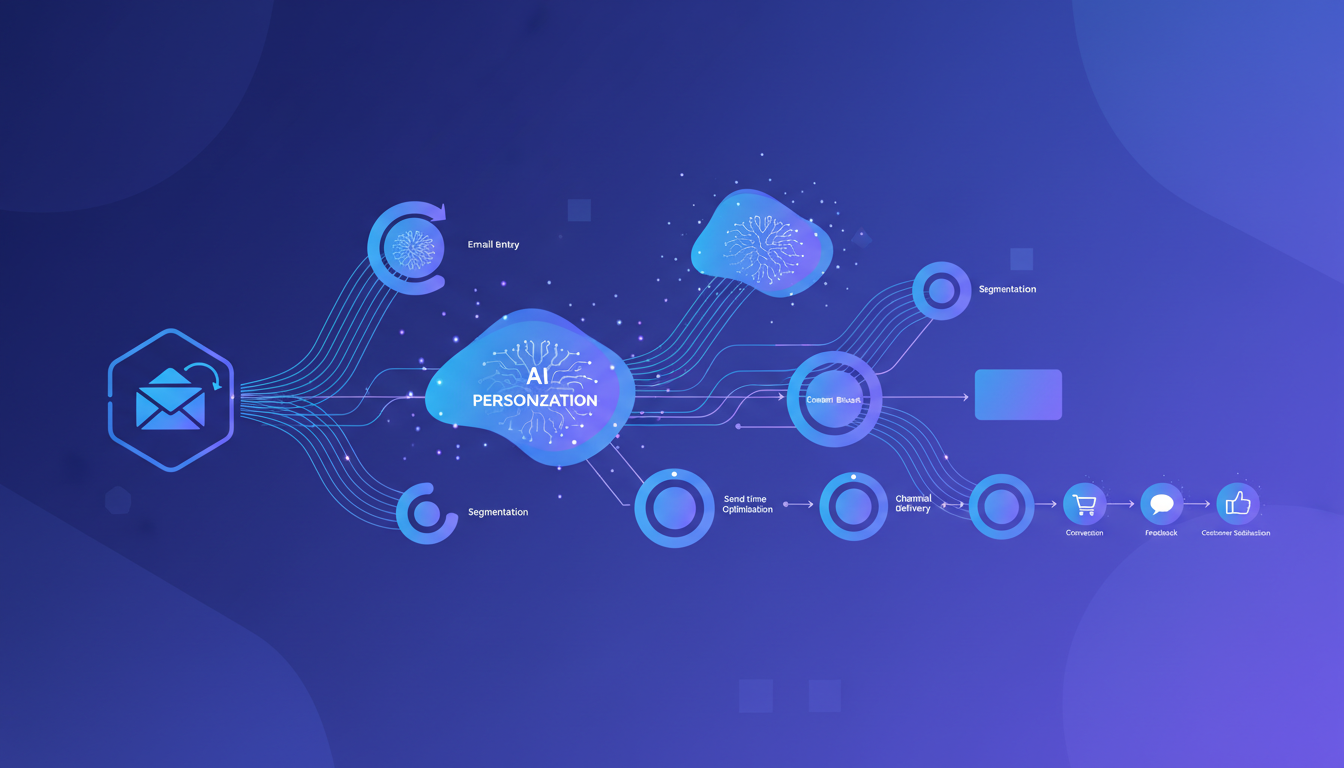
Email marketing remains one of the highest-ROI channels available to UK businesses, consistently delivering £35-42 for every £1 spent according to the Data and Marketing Association. Yet for most SMEs, running effective email campaigns is a time-consuming grind of list management, content creation, scheduling, and manual segmentation. The result is that campaigns go out late, personalisation is superficial at best, and the team responsible is usually juggling email alongside a dozen other responsibilities.
AI-powered email automation changes this equation fundamentally. Modern platforms can now write subject lines, personalise content at scale, determine optimal send times for individual recipients, run sophisticated A/B tests, and segment audiences based on behavioural patterns that no human could track manually. The technology has matured to the point where even a one-person marketing operation can run campaigns that rival those of businesses with dedicated email teams.
What AI Actually Does in Email Marketing
Before diving into platforms and implementation, it's worth understanding the specific capabilities AI brings to email marketing. These aren't futuristic promises; they are features available today in mainstream platforms that UK SMEs are already using.
Subject Line Generation and Optimisation
AI analyses your historical open rate data alongside broader industry patterns to generate subject lines predicted to perform well with your specific audience. Rather than relying on a marketer's instinct about what sounds compelling, the AI tests linguistic patterns, emotional triggers, length, and formatting to identify what actually drives opens. Some platforms generate multiple variants automatically and select the winner in real time as the campaign sends.
Send-Time Optimisation
Every recipient in your database has different email habits. Some check their inbox first thing at 7am, others during their lunch break, and some in the evening. AI send-time optimisation analyses each contact's historical engagement patterns and delivers your email at the moment they're most likely to open it. Rather than sending to your entire list at 10am on Tuesday, the same campaign might be delivered across a 24-hour window, with each recipient receiving it at their personal optimal time.
Predictive Segmentation
Traditional segmentation relies on explicit data: demographics, purchase history, stated preferences. AI segmentation goes further by analysing behavioural signals such as browsing patterns, email engagement history, purchase frequency trends, and content preferences. It can identify segments you didn't know existed, such as a group of customers who consistently buy after receiving a third email in a sequence, or those who engage heavily with video content but ignore text-heavy messages.
Content Personalisation at Scale
Beyond inserting a first name, AI can personalise entire email sections based on individual recipient profiles. Product recommendations, content blocks, imagery, and calls-to-action can all be dynamically assembled for each recipient. A fashion retailer might send the same campaign framework to 10,000 subscribers, but each email features different product recommendations based on that individual's browsing and purchase history.
Adoption rates of AI email features among UK SMEs currently using email marketing platforms, 2025.
AI-Powered Email Automation
Manual Campaign Management
Platform Comparison: AI Email Tools for UK SMEs
The three platforms most commonly used by UK small businesses for AI-powered email marketing are Mailchimp, Klaviyo, and HubSpot. Each has distinct strengths depending on your business type, list size, and technical comfort level.
| Feature | Mailchimp | Klaviyo | HubSpot |
|---|---|---|---|
| Best For | General SMEs, beginners | E-commerce businesses | B2B, service businesses |
| AI Subject Lines | Yes (Intuit Assist) | Yes (built-in) | Yes (Breeze AI) |
| Send-Time Optimisation | Yes (Standard plan+) | Yes (Smart Send Time) | Yes (Professional+) |
| Predictive Segmentation | Basic | Advanced (predictive analytics) | Advanced (predictive lead scoring) |
| A/B Testing | Up to 3 variants | Up to 8 variants with auto-winner | Up to 5 variants |
| E-commerce Integration | Good | Excellent (deep Shopify/WooCommerce) | Moderate |
| Starting Price (5k contacts) | £45/month | £50/month | £75/month |
| UK Data Hosting | US-hosted (GDPR compliant) | US-hosted (GDPR compliant) | EU hosting available |
Mailchimp: The Accessible Starting Point
Mailchimp's AI features, branded as Intuit Assist, are designed for ease of use. The platform can generate complete email drafts from a brief description, suggest subject lines based on your campaign history, and optimise send times. For SMEs sending their first AI-assisted campaigns, Mailchimp offers the gentlest learning curve. Its free tier supports up to 500 contacts, making it viable for very early-stage businesses to experiment without cost.
Klaviyo: The E-Commerce Powerhouse
Klaviyo's AI capabilities are heavily oriented towards e-commerce businesses. Its predictive analytics can forecast individual customer lifetime value, predicted next order date, and churn risk. These predictions feed directly into automated flows: a customer flagged as high churn risk might automatically receive a win-back sequence with a personalised discount. For Shopify and WooCommerce sellers, Klaviyo's deep integration means product recommendations, abandoned cart sequences, and post-purchase flows can be set up with minimal configuration.
HubSpot: The B2B Specialist
HubSpot's Breeze AI features are strongest for B2B and service businesses. Its predictive lead scoring assigns AI-generated scores to contacts based on their likelihood to convert, enabling sales teams to prioritise follow-ups. The platform also generates email content, A/B tests subject lines, and offers sophisticated workflow automation that spans email, CRM, and sales activities. The higher price point reflects its positioning as an all-in-one marketing and sales platform.
ActiveCampaign offers strong AI automation at competitive pricing (from £25/month), with particularly good conditional workflow builders. Brevo (formerly Sendinblue) provides AI send-time optimisation and transactional email capabilities from £19/month, making it attractive for businesses with tight budgets. For larger SMEs with 20,000+ contacts, platforms like Drip and Omnisend offer sophisticated e-commerce AI features. The key is matching the platform's strengths to your business model rather than defaulting to the most popular option.
Building AI-Powered Email Workflows
The shift from one-off campaign thinking to automated workflow design represents a fundamental change in how your business approaches email marketing. Rather than treating each email as an isolated event, workflows create interconnected journeys that respond to individual subscriber behaviour in real time. This shift demands upfront investment in planning and configuration, but the long-term returns are substantial - businesses running automated workflows typically generate three to five times more revenue per email than those relying on manual broadcast campaigns alone. The most successful UK SMEs start by mapping their customer lifecycle stages and identifying the key moments where automated communication can accelerate a prospect toward conversion or re-engage an existing customer who is showing signs of lapsing.
The real power of AI email automation emerges when you move beyond one-off campaigns to automated workflows, sequences that trigger based on customer behaviour and adapt based on engagement. Here are the workflows that deliver the highest ROI for UK SMEs.
Welcome sequences. When a new subscriber joins your list, AI can determine the optimal number of welcome emails, their spacing, and the content of each based on the subscriber's source, demographics, and early engagement signals. A subscriber who opens every email might receive five messages over ten days; one who ignores the first two might be diverted to a shorter, more aggressive sequence.
Abandoned cart recovery. AI-optimised cart abandonment emails can recover 10-15% of abandoned carts, compared to 5-8% for standard templates. The AI personalises the timing, offer amount, and product imagery based on the specific items abandoned and the customer's purchase history.
Re-engagement campaigns. Rather than blasting your entire inactive segment with a generic "we miss you" email, AI identifies the optimal re-engagement approach for each lapsed contact. Some respond to discount offers, others to new product announcements, and some simply need a different send time. The AI tests and adapts automatically.
Post-purchase nurture. AI sequences that follow up after purchase can increase repeat purchase rates by 20-35%. The timing and content adapt based on the product purchased, the customer's order history, and their engagement with previous post-purchase emails.
A/B Testing with AI: Beyond Simple Splits
Effective A/B testing is the engine that drives continuous improvement in email marketing, yet most UK SMEs either skip testing entirely or implement it so superficially that the results lack statistical meaning. AI transforms this dynamic by automating the entire test design, execution, and analysis cycle - removing the manual bottleneck that prevents small teams from testing at all. The result is that even a sole marketing manager can run sophisticated multi-variant experiments that would traditionally require a dedicated analytics team to manage and interpret. What makes AI-driven testing particularly powerful is its ability to detect meaningful patterns from smaller sample sizes, making it viable even for businesses with modest subscriber lists of a few thousand contacts.
Traditional A/B testing sends variant A to half your list and variant B to the other half, then declares a winner after a set period. AI-powered testing is far more sophisticated. Platforms like Klaviyo and HubSpot can test multiple variants simultaneously, automatically allocating more traffic to better-performing versions in real time, a technique known as multi-armed bandit testing.
For UK SMEs with smaller lists, this matters. With a list of 5,000 contacts, a traditional A/B test might not reach statistical significance. An AI-powered system can test subject lines, preview text, sender names, and content variants across smaller samples and apply the learnings across the broader send, effectively giving you the testing power of a much larger list.
UK SME adoption rate of each A/B testing type, ordered by ease of implementation and typical impact.
GDPR and UK Data Protection Compliance
The intersection of AI and data protection law is one of the most actively evolving areas of UK regulation. As email platforms incorporate increasingly sophisticated AI capabilities - from behavioural prediction to automated content generation - the compliance landscape grows more complex. Businesses that establish robust data protection practices now will be better positioned to adopt future AI capabilities without compliance friction, while those that treat regulation as an afterthought risk both financial penalties and reputational damage that can undermine years of brand building. The Information Commissioner’s Office has been particularly active in issuing guidance on automated decision-making, which directly applies to AI-driven email personalisation and segmentation strategies.
AI email automation must operate within the UK GDPR and the Privacy and Electronic Communications Regulations (PECR). This is non-negotiable and any AI tool you adopt must support your compliance requirements. Key considerations include:
Consent management. AI personalisation relies on processing personal data, so your consent mechanisms must clearly cover AI-driven profiling and personalisation. Ensure your sign-up forms and privacy policy explain that you use automated analysis to personalise email content. Under UK GDPR, recipients have the right to opt out of automated profiling.
Data storage and transfer. Most major email platforms store data in the US. While this is permissible under appropriate transfer mechanisms, some UK businesses prefer EU or UK-hosted solutions. HubSpot offers EU data hosting; for maximum data sovereignty, consider UK-hosted alternatives like Websand or Enabler.
List hygiene. AI tools can help maintain compliance by automatically suppressing bounced addresses, honouring unsubscribe requests in real time, and flagging contacts who haven't engaged in extended periods. Regular list cleaning isn't just good practice; it directly improves your deliverability and AI model accuracy.
The Information Commissioner's Office has issued guidance confirming that AI-driven marketing personalisation is permissible provided businesses have appropriate lawful basis (typically legitimate interest or consent), provide clear transparency about how personal data is used for personalisation, offer easy opt-out mechanisms, and conduct regular data protection impact assessments for high-risk processing activities. SMEs should document their AI email practices as part of their data protection records of processing.
Measuring Results: The Metrics That Matter
Measuring the impact of AI email automation requires a more nuanced approach than simply tracking open rates. While traditional metrics remain important, AI introduces new dimensions of performance that should be monitored to understand the full value of your investment. Revenue attribution becomes critical: rather than crediting a sale to the last email clicked, AI-powered platforms can track the entire sequence of touchpoints that led to a conversion, giving you a far more accurate picture of which campaigns and workflows are driving real commercial value. This multi-touch attribution is particularly important for B2B businesses with longer sales cycles, where a single conversion might follow a sequence of six or eight email interactions over several weeks.
| Metric | Industry Average | With AI Optimisation | What It Tells You |
|---|---|---|---|
| Open Rate | 21-25% | 30-38% | Subject line and send-time effectiveness |
| Click-Through Rate | 2.5-3.5% | 4.5-7% | Content relevance and personalisation quality |
| Conversion Rate | 1-2% | 2.5-5% | Overall campaign effectiveness |
| Unsubscribe Rate | 0.3-0.5% | 0.1-0.2% | Audience fatigue and relevance |
| Revenue Per Email | £0.08-0.15 | £0.20-0.45 | Direct commercial impact |
Getting Started: A 30-Day Plan
Week 1: Audit your current email performance. Document your open rates, click-through rates, and revenue per campaign. Choose a platform based on the comparison above and activate a trial.
Week 2: Import your list and connect your e-commerce or CRM system. Set up your first AI-optimised campaign using the platform's subject line generator and send-time optimisation. Send to a small segment to test.
Week 3: Build your first automated workflow. For e-commerce, start with abandoned cart recovery. For B2B, start with a lead nurture sequence. Enable AI A/B testing on subject lines.
Week 4: Review initial results against your baseline. Expand AI features to your full list. Set up predictive segmentation and begin personalising content blocks based on engagement data.
AI email automation isn't about replacing your marketing judgement; it's about amplifying it. The platforms handle the repetitive optimisation work, leaving you to focus on strategy, brand voice, and creative direction. For UK SMEs looking to improve email performance without adding headcount, Cloudswitched can help you select the right platform, configure AI features, and build automated workflows that deliver measurable results from day one.
Transform Your Email Marketing with AI
Cloudswitched helps UK businesses implement AI-powered email automation that drives measurable improvements in open rates, click-through rates, and revenue per campaign. We handle platform selection, workflow configuration, and ongoing optimisation so your team can focus on strategy and creative direction.

CloudSwitched
London-based managed IT services provider offering support, cloud solutions and cybersecurity for SMEs.


