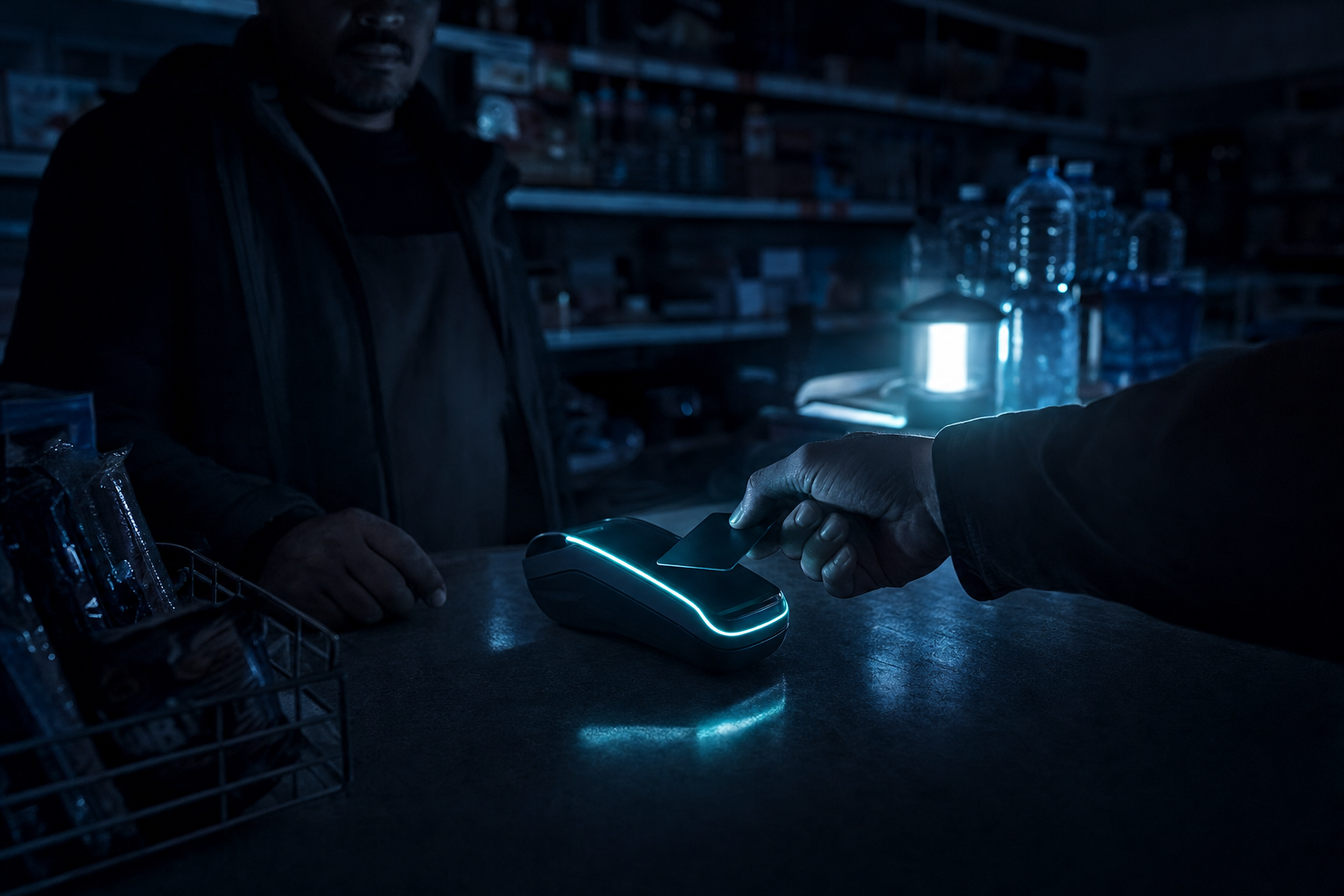
Mastercard is rolling out offline payment capability across Europe, including the UK, so that chip–and–PIN transactions of up to €200 can still go through when power or network connections fail. From February 2027, all new Mastercard payment cards will support offline payments, which are cleared automatically once connectivity is restored, and all new payment terminals must support the capability by May 2027. The technology has already been piloted in Denmark, Sweden, Estonia and Latvia, where it kept shops trading through real outages.
The trigger is not hypothetical. In April 2025, a 16–hour power outage across Spain and Portugal left millions unable to make digital payments, use card terminals or withdraw cash from ATMs. Grid operator ENTSO–E called it “the most severe and unprecedented blackout that had occurred in Europe in the past 20 years”. The lesson Mastercard has drawn — that a critical system needs a fallback which does not depend on the same infrastructure it normally runs on — applies far beyond card payments, and to businesses far smaller than a card scheme. Most UK SMEs take payments, answer phones and run their systems over a single broadband line powered from the same mains supply as everything else. When either goes, all of it goes together. Offline payments solve one part of that problem, and only one part: as the Nordic pilot showed, the shops that kept trading were the ones whose terminals still had power.
How offline payments work, and what they will and will not do
The mechanism is straightforward. Spending limits are stored directly on the card’s chip, so when a terminal loses its connection it can still check the card, approve the transaction locally within those limits, and store it. When the network comes back, the terminal submits the stored transactions for clearing. Nothing about the customer’s experience changes much: they insert the card, enter a PIN, and the sale completes. The difference is that the terminal no longer needs a live round trip to the payment network to say yes.
Once implemented, offline payments will be usable at supermarkets, grocery stores, service stations, pharmacies, and travel and ticket machines during an outage — the merchants whose ability to keep trading matters most when something has gone wrong. Mastercard executive vice–president Brice van de Walle put the rationale simply: “When the power or network goes down, people still need to buy food, fuel and medicine. By expanding this technology across Europe, we can help people keep paying for the things they need, even when the unexpected happens.”
Three limits are worth stating clearly. First, the capability arrives with new cards from February 2027 and is required of new terminals by May 2027; coverage across the cards in people’s wallets and the terminals on shop counters will therefore build up as both are replaced. Whether a business’s existing terminal supports it is a question for its payment provider, and worth asking. Second, the limit is €200 per transaction, as Mastercard has expressed it; how that translates to sterling transactions in the UK is a detail to confirm with your acquirer rather than assume. Third, and most important, offline payments remove the dependency on the network. They do not remove the dependency on power. A terminal that is switched off cannot approve anything, offline or otherwise.
The Nordic pilot illustrates both sides. During a storm–related network outage in Latvia, offline payments kept working in shops powered by local generators. In Denmark, a separate technical outage isolated terminals from the wider payment system, and offline capability allowed transactions to continue at critical merchants. In the Danish case the terminals had power and lost the network; in the Latvian case the shops that kept trading had made their own arrangements for power. Offline payments were necessary in both. They were sufficient only where electricity was still available.
This is the principle behind Mastercard’s decision, and it is the one most small businesses get wrong. A 4G backup router is a good idea — until you notice it plugs into the same wall socket as the broadband router it is backing up. A second internet line is sensible — until it turns out to share the same duct, the same street cabinet or the same upstream network. A card terminal that fails over to Wi–Fi is useful — unless the Wi–Fi depends on the same connection that has just dropped. Each of those looks like resilience on paper and fails at exactly the moment it is needed, because the event that takes out the primary takes out the backup too. Before relying on any fallback, ask the single question that matters: what event could plausibly stop both at once? If the answer is “a power cut” or “the broadband going down”, you have one system with two names, not two systems.
From a blackout to a Europe–wide rollout
The chronology below follows the reported events. It moves from a single severe outage, through a pilot that proved the idea, to deadlines that will reach UK shop counters next year.
The pilot results are the most useful part of that sequence for an ordinary business, because they show two quite different failures handled by the same capability. In Denmark the problem was connectivity: terminals had power but could not reach the payment system. In Latvia the problem was broader, and the shops that coped were the ones with their own power. A business planning for continuity needs to think about both, and to recognise that they call for different measures.
How well different payment setups survive an outage
The chart below is an indicative planning model — not measured data — ranking common UK small–business payment setups by how likely they are to keep taking card payments through a combined loss of mains power and fixed broadband lasting several hours.
The pattern is that each step up removes a shared dependency. A countertop terminal on office broadband depends on the broadband, the router and the mains — all of which fail together in a power cut. Adding a 4G backup router helps with a broadband fault but not with a power cut, because the backup router needs the same mains. A portable terminal with its own SIM and a charged battery removes the dependency on the building’s network and power entirely, but still needs the mobile network. Offline mode removes that last dependency, within its limits. A cash float and a written procedure cover whatever remains.
The bottom row deserves a specific note because it is increasingly common among small and mobile businesses. Taking payment by sending a link or displaying a QR code is cheap and convenient, and it depends completely on both the merchant and the customer having working connectivity. In a regional outage of the kind Spain and Portugal experienced, it stops working entirely. That is not a reason to avoid it — it is a reason not to rely on it as the only way to get paid.
Sixteen hours is most of a trading day
Put the Iberian outage in terms a business owner thinks in.
Most business continuity planning in small organisations quietly assumes that outages are short: a router reboot, a blip on the line, half an hour without power while an engineer resets a breaker. Plans built on that assumption tend to consist of “wait for it to come back”. Sixteen hours breaks the assumption completely. It is a whole day’s trading lost for a shop with no fallback, a day of missed calls for a business on hosted telephony, and a day when staff cannot reach cloud systems from an office that has lost both power and connection.
Tuomas Valimaki’s observation is the reason to take the long tail seriously rather than treating Iberia as a freak event. His point was that “the likelihood of major disruptions has increased because the geopolitical situation has changed worldwide”, including hybrid threats and deliberate disruption of connections. Whether or not that view is shared in full, the planning implication is modest and sensible: a business should know what it would do if power and connectivity were unavailable for a full day, not only for an hour.
It is also worth recognising what changed for UK businesses specifically over the past two years. The retirement of the analogue phone network has moved card terminals, alarm signalling and business telephony onto IP connections that depend on broadband and local power. Under the old arrangement, a telephone line carried its own power from the exchange and kept working in a power cut. Many card terminals once dialled out over that line. That built–in resilience is disappearing, and it has to be replaced deliberately — with battery backup, mobile alternatives and offline capability — because it no longer comes free with the infrastructure.
Where UK businesses are exposed
The rows below reflect where payment and operational continuity risk typically sits in a UK small business, with badges indicating how much attention each usually needs.
The second row is the one most often found in businesses that believe they have already dealt with resilience. A 4G backup router is a genuinely good addition — it covers broadband faults, which are far more common than power cuts. But if it plugs into the same power strip as the primary router, a power cut takes out both, and the business discovers its “backup” only covered one of the two failures it needed to. A small uninterruptible power supply on the router, switch and terminal is inexpensive and turns that partial fallback into a real one for the length of most outages.
The seventh row is the cheapest to fix and the most consistently neglected. Fallbacks that have never been exercised fail in surprising ways: the backup SIM has expired, the battery on the portable terminal has degraded, the failover was configured but never actually switches, nobody remembers the procedure. The Nordic pilot worked because it was used in real outages and shown to work. A business can get much of the same assurance by deliberately unplugging its router during a quiet period and seeing what still functions.
What building a real fallback costs
The bands below are indicative planning figures for UK businesses improving payment and operational continuity — not quotes. Terminal and payment provider fees are additional and vary by provider.
| Business profile | Typical scope | Indicative cost | What you get for it |
|---|---|---|---|
| Small shop or café, single site | Confirm terminal offline support with provider, small UPS on router and terminal, portable terminal with own SIM as standby, cash float and written procedure | £200 – £900 | The ability to keep taking payments through a broadband fault and most short power cuts |
| Office–based business taking occasional payments | Map what depends on the office connection, UPS for core network kit, mobile backup that does not share power with the primary, cloud access from staff phones | £400 – £2,000 | Staff able to keep working and reach critical systems when the office connection or power fails |
| Multi–till retailer or hospitality venue | Offline–capable terminals, resilient network design with genuinely independent backup path, UPS across tills and network, tested outage procedure | £2,500 – £12,000 | Trading continues across every till through the common failures, with staff who know what to do |
| Essential retailer — grocery, pharmacy, fuel | All of the above plus generator readiness, a full–day outage plan, and documented recovery and reconciliation of offline transactions | £8,000 – £40,000 | The position the Latvian shops were in: able to keep serving customers during a prolonged outage |
| Any business, immediately | Ask your payment provider whether your terminal supports offline transactions, check what your backup router plugs into, and unplug your broadband for ten minutes to see what still works | £0 | The three facts that tell you how exposed you actually are |
The final row costs nothing and answers most of the important questions. Many businesses that try it discover that their card terminal, phones and cloud access all stop at once, that the backup they thought they had shares a power supply with what it was meant to back up, and that nobody knows whether the terminal can work offline. None of those discoveries is expensive to act on. All of them are expensive to make for the first time during a real outage.
Two ways to prepare for the day everything stops
Reactive posture
How most small businesses are set up
- Card terminal, phones and cloud access all running over one broadband line
- A backup router plugged into the same power strip as the main one
- No knowledge of whether the terminal can approve transactions offline
- Outage plan amounts to waiting for the connection to come back
- No battery backup on any network equipment
- Fallbacks set up once and never tested
- No cash float and no way to record sales manually
Proactive posture
Where Cloudswitched continuity work takes you
- A map of everything that depends on the office connection and the office power
- Backup connectivity that does not share a power supply, duct or network with the primary
- Offline–capable terminals, confirmed with the provider before they are needed
- A written outage procedure covering a full day, not just a short blip
- A UPS on the router, switch and terminals, sized for realistic outages
- Fallbacks tested on a schedule by actually disconnecting the primary
- A cash float and a manual record so trading never fully stops
The difference between those columns is surprisingly small in cost and large in effect. The expensive items — generators, genuinely independent secondary circuits, fully redundant network designs — are needed only by businesses where a day’s outage would be serious. For most small businesses, the important moves are a UPS, a portable terminal with its own SIM, a check on offline support, a written procedure and a test. Those cover the overwhelming majority of real outages, which are short broadband faults and brief power interruptions rather than sixteen–hour blackouts.
Pick a quiet period — first thing in the morning, or after closing — and switch off your main broadband router. Then try the things your business depends on. Can the card terminal take a payment? Do the phones ring? Can staff reach email and shared files from their phones or laptops? Does the backup router take over, and if so, how long does it take? Now repeat the exercise imagining the power has gone as well: anything plugged into the mains without a battery will stop, including any backup router sharing a socket with the primary. Write down what worked and what did not. Then make one phone call: ask your payment provider whether your current terminal supports offline transactions, and whether it will support the Mastercard capability arriving in 2027. Most businesses that do this learn more about their real resilience in ten minutes than in years of assuming it would be fine.
The wider lesson: fallbacks must not share the failure
Mastercard’s approach is a particularly clean example of a principle that applies to every critical system a business runs. The company did not respond to the Iberian blackout by making the payment network more reliable, though it presumably works on that too. It added a way for payments to complete without the network. The fallback works precisely because it does not depend on the thing that failed. That is the property every continuity measure should be tested against.
The same logic applies well beyond payments. Cloud–hosted systems are excellent at surviving failures inside the provider’s data centres and useless if your office cannot reach them; the relevant fallback is a way for staff to connect that does not depend on the office line, such as mobile access. Backups held in the same account, behind the same credentials, as the data they protect share a failure mode with it; the relevant fallback is a copy held independently. Two internet circuits from different providers can share a duct, a cabinet or an upstream network; the relevant check is physical and network diversity, confirmed in writing. In each case the question is the same: what single event could take out both?
The analogue telephone switch–off makes this more pressing for UK businesses specifically. Copper lines carried their own power and kept phones and many card terminals working through a local power cut. Digital replacements depend on broadband and mains power at the premises. That trade–off is sensible and the switch–off is necessary, but the resilience the old network provided for free now has to be provided deliberately — and most businesses have not yet noticed that it has gone.
Finally, the honest caveat. Offline payments are a meaningful improvement for retailers and the people who depend on them during a crisis, and the pilot evidence is genuinely encouraging. They are also bounded: a per–transaction limit, a requirement for both the card and the terminal to support the capability, and no help at all if the terminal has no power. They are one layer of continuity, not the whole of it. A business that treats the 2027 rollout as having solved its outage problem has misread the lesson Mastercard itself drew from Iberia.
The story at a glance
| Item | Detail |
|---|---|
| What is happening | Mastercard is enabling offline payment capability across Europe, including the UK |
| Transaction limit | Up to €200 per offline transaction, cleared automatically once connectivity returns |
| New cards | All new Mastercard payment cards support offline payments from February 2027 |
| New terminals | All new payment terminals must support the capability by May 2027 |
| How it works | Spending limits stored on the card chip; the terminal approves and stores transactions locally, then submits them for clearing when the network returns |
| Pilot countries | Denmark, Sweden, Estonia and Latvia |
| Pilot in Latvia | Offline payments kept working in shops powered by local generators during a storm–related network outage |
| Pilot in Denmark | Transactions continued at critical merchants during a technical outage that isolated terminals from the payment system |
| The trigger | The April 2025 Spain and Portugal blackout — 16 hours, leaving millions unable to pay digitally or use ATMs |
| ENTSO–E’s description | “The most severe and unprecedented blackout that had occurred in Europe in the past 20 years” |
| Risk outlook | Bank of Finland’s Tuomas Valimaki: the likelihood of major disruptions has increased as the geopolitical situation has changed |
| Mastercard’s rationale | Brice van de Walle: people still need to buy food, fuel and medicine when the power or network goes down |
| Where it will be used | Supermarkets, grocery stores, service stations, pharmacies, and travel and ticket machines |
| What it does not fix | Loss of power at the terminal — offline mode needs a terminal that is switched on |
| Free first step | Ask your provider whether your terminal supports offline transactions, and unplug your broadband for ten minutes to see what still works |
This story connects to several we have covered recently, all of them about fallbacks that share a failure mode with the thing they back up. Microsoft’s maintenance breaking Azure hybrid connectivity showed two connectivity products from one provider failing together. LINX’s LON2 fabric passing 1Tbps explains why a second path is only worth what its independence from the first is worth. The PSTN switch–off and Vodafone’s copper switch–off cover the loss of the self–powered phone line that used to keep terminals and alarms working in a power cut. Microsoft’s OneDrive storage changes make the parallel point that sync is not a backup. And the NCSC advisory on Integrity Tech is a reminder that the same routers businesses rely on for connectivity are worth looking after properly.
What would still work if your power and broadband went at once?
For most UK small businesses the honest answer is very little — the card terminal, phones and cloud access usually share one line and one plug. Cloudswitched helps businesses build continuity that does not depend on the infrastructure it is meant to cover: backup connectivity with its own power, battery support for core network kit, an independent backup of business data held outside the systems it protects, and a tested plan for keeping going when the office goes dark. Mastercard is adding a fallback to payments. It is worth asking where yours are.
Talk to us about Hybrid Cloud BackupFrequently asked questions
Build the fallback before the outage tests it
The shops that kept trading in Latvia had two things in place before the storm: payment technology that did not need the network, and power that did not need the grid. Every business has its own version of that question. Cloudswitched works with UK organisations to answer it — mapping what depends on your office connection and power, adding backup paths that do not share a failure mode with the primary, protecting your data with an independent backup, and testing it all so that the first real outage is not the first time anything is tried.
Talk to us about Hybrid Cloud Backup
Cloudswitched
London-based managed IT services provider offering support, cloud solutions and cybersecurity for SMEs.