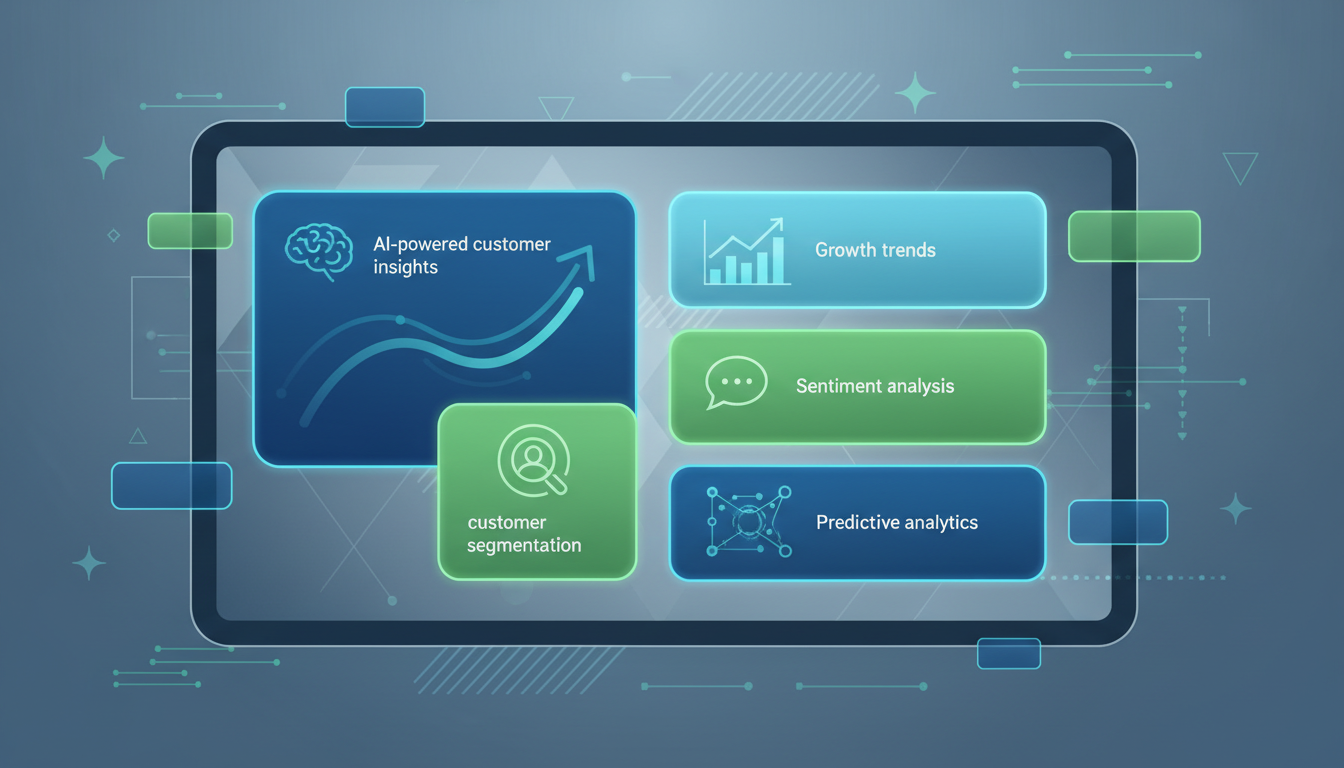
Customer relationship management has always been about understanding people - their needs, their patterns, their likelihood to buy, stay, or leave. What has changed is the sheer volume of signals available and the speed at which they need to be processed. A modern UK business might receive customer interactions across email, phone, live chat, social media, and web forms, generating thousands of data points daily. No human sales team, however talented, can synthesise all of that into actionable insight quickly enough to matter.
This is precisely where AI-powered CRM comes in. The leading platforms - HubSpot, Salesforce, and Zoho - have embedded artificial intelligence deeply into their core functionality, transforming CRM from a sophisticated address book into a predictive system that tells your team who to contact, when, what to say, and how likely it is to result in a sale. For UK SMEs, these capabilities were previously available only to enterprises with dedicated data science teams. Now they are built into platforms costing as little as £15 per user per month.
According to the UK CRM Industry Report 2025, adoption of AI-enhanced CRM platforms among British businesses with 10–250 employees grew by 38% year on year, driven by improvements in lead scoring accuracy and the reduction in manual data entry. The same report found that UK companies using AI CRM features reported an average revenue uplift of 23% within 18 months of activation - a figure that rises to 31% for businesses that also invested in data quality initiatives before enabling AI capabilities.
AI Capabilities Transforming CRM
Before comparing platforms, understand the core AI capabilities reshaping customer management.
Predictive Lead Scoring
Traditional scoring assigns static points: +10 for visiting the pricing page, +5 for opening an email. AI-powered scoring analyses your historical conversion data to identify patterns that actually predict deals. It might discover that leads visiting case studies twice within 48 hours convert at 5x the average rate. These patterns are often non-obvious and impossible for humans to identify across thousands of leads.
In a UK context, predictive lead scoring has proven especially valuable for B2B companies navigating longer sales cycles. A 2025 survey by the Chartered Institute of Marketing found that UK businesses using AI lead scoring reduced their average time-to-qualification by 42%, freeing sales development representatives to focus on high-probability opportunities rather than manually sifting through inbound enquiries. For companies selling into the public sector - where procurement cycles can stretch to six months or longer - this acceleration has a measurable impact on quarterly pipeline health.
Sales Forecasting
AI forecasting moves beyond simple pipeline arithmetic to analyse deal velocity, stakeholder engagement, email sentiment, meeting frequency, and historical seasonality. The result is dramatically more accurate revenue predictions - direct financial value for UK businesses managing cash flow carefully.
For UK SMEs, where cash flow management is consistently cited as the number one operational challenge, accurate forecasting is not a nice-to-have - it is essential. A study by Xero in partnership with UK small business groups found that 62% of SMEs that experienced cash flow crises in 2024 attributed the problem to inaccurate revenue forecasting. AI-powered sales forecasting addresses this directly by incorporating signals that humans miss: the gradual slowdown in email response times that predicts a deal stalling, or the seasonal patterns specific to your industry vertical.
Conversation Intelligence
AI analyses sales calls to extract coaching insights: talk-to-listen ratios, objection handling, competitor mentions, and agreed next steps. This transforms sales management from gut-feel judgement to data-driven coaching.
Automated Data Capture
AI automates email logging, contact extraction from signatures, activity records from call transcripts, and post-meeting summaries. For UK sales teams spending an estimated 5.5 hours weekly on CRM admin, this alone justifies the investment.
AI CRM features are only as good as your CRM data. If your team has poor data hygiene - incomplete records, duplicates, outdated information - AI will produce unreliable outputs. Before enabling AI features, invest 2–4 weeks cleaning your data: remove duplicates, standardise names and categories, ensure key fields are populated, and implement quality processes going forward.
AI-Powered CRM vs Traditional CRM: A Direct Comparison
To appreciate the transformative impact of artificial intelligence in CRM, consider how fundamentally different the two approaches are across every key dimension of customer management. Traditional CRM platforms serve as reliable databases and workflow tools, but they require manual interpretation and offer no predictive capability. AI-powered CRM fundamentally changes the relationship between your team and your data.
AI-Powered CRM
Traditional CRM
The distinction is not merely about feature availability - it is about capability. Traditional CRM requires a human to decide which leads are worth pursuing, what to say in outreach emails, and when to follow up. AI-powered CRM makes these decisions algorithmically, drawing on patterns across your entire customer history, and improves its recommendations continuously as new data flows in. For UK businesses operating in competitive markets where response speed directly correlates with win rates, this difference is decisive.
Platform Comparison: HubSpot, Salesforce, and Zoho
| Feature | HubSpot (Breeze AI) | Salesforce (Einstein) | Zoho (Zia) |
|---|---|---|---|
| Predictive Lead Scoring | Professional+ (automated) | Enterprise+ (Einstein) | Enterprise+ (Zia Prediction) |
| AI Email Drafting | All paid tiers (Copilot) | Enterprise+ (Einstein Copilot) | Professional+ (Zia Compose) |
| Sales Forecasting AI | Professional+ | Enterprise+ | Enterprise+ |
| Conversation Intelligence | Sales Hub Enterprise | Einstein Conversation Insights | Zia Voice (limited) |
| Customer Health Score | Service Hub Professional+ | Customer Success add-on | Enterprise+ custom scoring |
| Typical UK SME Cost | £360–£1,080/month | £600–£2,400/month | £180–£540/month |
HubSpot: Breeze AI
HubSpot’s AI is rebranded under “Breeze”: Breeze Copilot (AI assistant), Breeze Agents (autonomous workflows), and Breeze Intelligence (data enrichment). For UK SMEs, HubSpot’s strength is accessibility - AI features integrate directly into the interface without configuration. Predictive lead scoring learns from your data automatically, and Breeze Copilot drafts emails, summarises contacts, and suggests next actions contextualised by CRM data.
The limitation is depth. HubSpot’s AI prioritises ease of use over customisation. Businesses with complex sales processes may find the ceiling frustrating as they mature.
Salesforce: Einstein AI
Einstein is the most comprehensive AI CRM platform: predictive scoring, opportunity insights, automated activity capture, email sentiment, forecasting, conversation intelligence, and generative AI through Einstein Copilot. For UK businesses with resources to configure it, Einstein delivers exceptional results.
The reality for SMEs: Einstein’s powerful features require Enterprise Edition (£130+ per user monthly) plus significant configuration. Many SMEs purchase Salesforce for AI promises but lack expertise to configure Einstein effectively. Budget for implementation support from a certified partner.
Zoho: Zia AI
Often overlooked, Zia offers lead scoring, deal prediction, anomaly detection, email sentiment, and conversational AI at a fraction of competitors’ costs. Zia’s standout feature is anomaly detection - monitoring sales metrics and alerting you when something deviates significantly from expected patterns.
The trade-off is ecosystem integration. Zoho’s Microsoft 365 integration is less seamless, and the UK partner network is smaller. However, for businesses running Zoho One, the AI capabilities across CRM, analytics, and marketing are impressively cohesive.
Chart: Platform strengths by category (leading platform shown, scored out of 100%)
AI-Powered Automation Beyond Basic Workflows
Traditional CRM automation follows simple if-then rules. AI-powered automation makes decisions based on predicted outcomes.
Intelligent Lead Routing
Rather than round-robin distribution, AI matches leads to the rep most likely to close based on historical success with similar company sizes and industries. A UK technology consultancy saw lead-to-opportunity conversion increase by 34% within three months.
Predictive Next-Best-Action
AI recommends the optimal next action for each deal - send a case study, schedule a call, involve a specialist - based on what historically worked for similar deals. For junior reps, this functions as an always-available AI coach.
Automated Customer Health Monitoring
AI continuously monitors engagement signals, generating health scores. A dropping score triggers automated interventions: alerts to the success manager, personalised check-in emails, or renewal discount preparation.
AI features making automated decisions about customers - lead scoring, segmentation, personalised pricing - may constitute automated decision-making under GDPR Article 22. UK businesses must have a lawful basis for processing, inform customers that automated profiling takes place, and provide a mechanism for human review of significant decisions. Review your CRM’s AI features against data protection obligations before activation.
UK Business Results
| Business | Platform | AI Feature Used | Result |
|---|---|---|---|
| UK SaaS company (45 staff) | HubSpot | Lead scoring + Breeze Copilot | 41% increase in qualified pipeline |
| London recruitment (28 staff) | Salesforce | Activity Capture + Opportunity Scoring | 31% improvement in forecast accuracy |
| Birmingham manufacturing (120 staff) | Zoho | Zia anomaly detection + deal prediction | Early warning on £340K at-risk accounts |
| Edinburgh consultancy (15 staff) | HubSpot | AI email drafting + scheduling | 28% more client meetings booked |
| Manchester e-commerce (60 staff) | Salesforce | Einstein Commerce recommendations | 18% increase in average order value |
| Bristol professional services (35 staff) | Zoho | Zia lead scoring + email sentiment | 44% improvement in lead conversion |
Calculating Return on Investment for UK Businesses
One of the most common questions UK decision-makers ask before committing to AI CRM features is whether the investment genuinely pays for itself. The answer, based on aggregate data from UK implementations, is overwhelmingly positive - but the return depends heavily on how the technology is deployed and what baseline you are measuring against.
The most straightforward ROI calculation compares the cost of AI CRM features (licensing premium, implementation, training) against the measurable gains in revenue, efficiency, and retention. For a typical UK SME with 15 sales representatives, the numbers look something like this:
| Cost Category | Annual Investment | Notes |
|---|---|---|
| AI feature licensing premium | £8,400–£18,000 | Difference between standard and AI-enabled tiers across 15 users |
| Implementation and configuration | £3,000–£8,000 | One-time cost, typically amortised over 3 years |
| Team training | £1,500–£3,000 | Initial training plus quarterly refreshers |
| Data quality remediation | £2,000–£5,000 | One-time cleanup before AI activation |
Against these costs, UK businesses consistently report measurable improvements across multiple dimensions. The British Chambers of Commerce Digital Adoption Survey 2025 found that businesses with AI CRM capabilities saw a median 23% improvement in qualified pipeline volume, a 19% reduction in sales cycle length, and a 15% improvement in customer retention rates. For a business generating £2 million in annual revenue with 35% gross margin, these improvements translate to approximately £140,000–£210,000 in additional annual gross profit - a return of 5x to 12x on the total AI CRM investment.
However, the businesses that see the strongest returns share a common pattern: they invest in data quality before enabling AI, they start with a single high-impact feature rather than activating everything simultaneously, and they measure AI performance rigorously rather than assuming it works. The bottom 25% of adopters - those who enable features without preparation or training - report returns of less than 2x, often because the AI models are trained on incomplete or inaccurate data and produce unreliable predictions.
Implementation Best Practices
Start with One Feature: Pick the single feature with the clearest ROI - typically lead scoring for sales-led organisations or health scoring for subscription businesses. Deploy it thoroughly before expanding.
Invest in Data Quality First: Spend the first 2–4 weeks on data cleanup. AI models trained on messy data produce messy predictions. A CRM with 500 clean records outperforms one with 5,000 incomplete records.
Train on Outputs, Not Just Tools: Teaching reps to access a lead score is easy. Teaching them to interpret and act on it is harder but more important. Focus training on decision-making with AI insights.
Measure and Iterate: Track whether predictions are accurate in practice. Set a monthly review cadence for AI performance and adjust configuration accordingly.
Assign an Internal Champion: Designate one team member as the AI CRM champion responsible for monitoring feature performance, gathering feedback from the sales team, liaising with the platform vendor on configuration questions, and reporting results to leadership. UK businesses with a dedicated champion see 2.3x higher adoption rates and 40% faster time-to-value compared to those that treat AI CRM as a fire-and-forget technology purchase.
Choosing the Right Platform for Your Business
The right CRM depends on more than AI features. Consider your total environment when making a decision.
Choose HubSpot if: You are a growth-stage SME with 5–50 employees, your team values ease of use over deep customisation, you want AI features that work out of the box without configuration, and your budget is moderate (£400–£1,000/month). HubSpot’s free CRM tier also provides an excellent low-risk entry point for businesses not yet ready to commit to a paid platform.
Choose Salesforce if: You have complex, multi-stage sales processes, your team exceeds 30 sales staff, you need deep customisation and enterprise integrations, and you have budget for both the platform and professional implementation. Salesforce is the long-term choice for businesses that expect to scale significantly.
Choose Zoho if: Budget efficiency is a primary concern, you want a broad suite beyond just CRM (marketing, support, finance), you are comfortable with a less established UK partner ecosystem, or you are already using other Zoho products. Zoho One at approximately £30 per user per month provides extraordinary value for businesses willing to invest in the broader platform.
Integration with UK Business Systems
For UK businesses, CRM does not exist in isolation. It connects to your accounting platform, your email and calendar infrastructure, your marketing tools, your customer support systems, and increasingly your ERP and project management platforms. The quality of these integrations matters as much as the AI features themselves, because a CRM that generates brilliant predictions but cannot synchronise with your invoicing system creates operational friction that erodes adoption.
Microsoft 365 and Google Workspace
The overwhelming majority of UK businesses run on either Microsoft 365 or Google Workspace. HubSpot and Salesforce both offer mature integrations with both platforms, including bi-directional email sync, calendar integration, and contact synchronisation. Zoho’s Google integration is strong, but its Microsoft 365 integration lags behind - a meaningful consideration given that approximately 68% of UK businesses with 10+ employees use Microsoft 365 as their primary productivity suite.
Accounting and Finance Platforms
For UK businesses, the critical accounting integrations are Xero, Sage, and QuickBooks. HubSpot offers native integrations with all three through its marketplace, enabling automatic invoice generation from closed deals, revenue recognition, and financial reporting that aligns CRM pipeline data with actual accounting records. Salesforce achieves this through third-party connectors like Breadwinner or native AppExchange packages. Zoho’s advantage here is Zoho Books, its own accounting platform, which integrates seamlessly with Zoho CRM - though businesses already committed to Xero or Sage will need middleware.
Data Residency and Sovereignty
Post-Brexit UK data protection law (the UK GDPR and Data Protection Act 2018) requires businesses to understand where their customer data is processed and stored. All three platforms offer data hosting within the EU or UK, but the specifics vary by tier and configuration. Salesforce offers dedicated UK data centres for enterprise customers. HubSpot hosts EU data in Frankfurt. Zoho offers data centres in the EU but not specifically in the UK. For businesses handling sensitive personal data - particularly those in financial services, healthcare, or legal sectors - clarifying data residency arrangements should be part of the platform evaluation process.
The Future of AI in CRM
Several developments are emerging that UK businesses should watch.
Autonomous AI Agents: All three platforms are developing agents that qualify leads, schedule meetings, draft proposals, and follow up independently, with human oversight at decision points. HubSpot’s Breeze Agents and Salesforce’s Agentforce are already in market.
Voice-First CRM: Natural language interfaces for updating records and querying pipeline data through voice commands while on the move.
Predictive Revenue Operations: AI connecting CRM data with financial forecasting and resource planning - automatically flagging capacity needs when deal surges are predicted.
Hyper-Personalisation: Combining CRM data with generative AI for genuinely different messages tailored to each customer’s specific context and journey stage.
Cross-Platform Intelligence: The next generation of AI CRM will break down silos between sales, marketing, and customer success data, providing a unified intelligence layer that tracks the entire customer lifecycle from first website visit through to long-term advocacy. For UK businesses currently managing customer data across multiple disconnected systems, this convergence represents a significant opportunity to eliminate blind spots and create genuinely joined-up customer experiences.
For UK businesses, the question is no longer whether to adopt AI CRM but when and how. The early movers are seeing significant competitive advantages in conversion rates, retention, and efficiency. The right approach is pragmatic: choose the platform that fits your size and budget, start with clean data and a single high-value feature, train your team to work with AI insights, and expand as you prove value. AI-powered CRM is not a magic wand. It is a compound advantage that grows with your data, your team’s proficiency, and your willingness to let intelligent automation handle the tasks that should never have required human attention in the first place.
Transform Your Customer Relationships with AI
Cloudswitched helps UK businesses select, implement, and optimise AI-powered CRM platforms. From initial data quality assessment through platform configuration and ongoing team training, we ensure your AI CRM investment delivers measurable results from day one.

CloudSwitched
London-based managed IT services provider offering support, cloud solutions and cybersecurity for SMEs.


