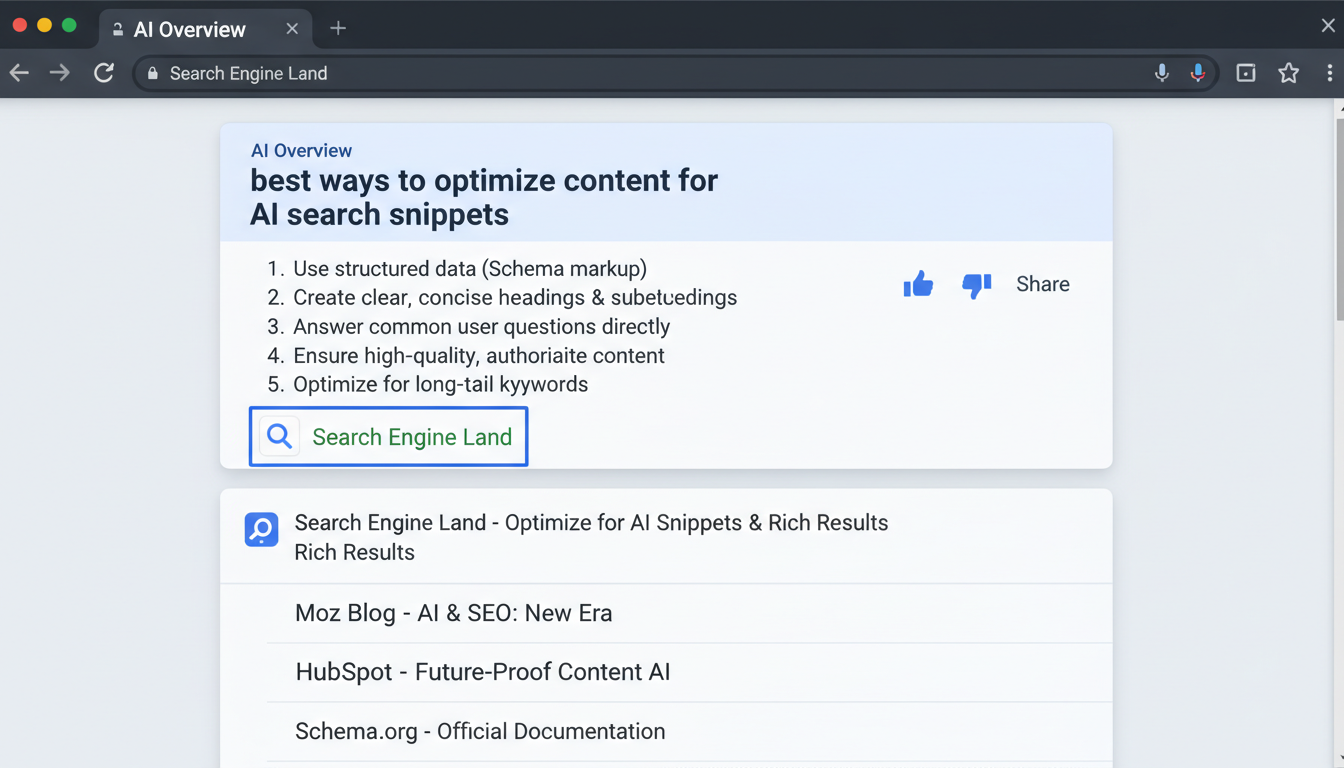
Google AI Overviews have fundamentally changed what the first page of search results looks like. Since rolling out across the UK in late 2024, these AI-generated summaries now appear at the top of results for a growing percentage of queries, pushing traditional organic listings further down the page. For UK businesses that depend on organic search traffic, understanding and optimising for AI Overviews is no longer optional - it is a critical component of any SEO strategy.
This guide explains exactly what AI Overviews are, how they work, and the practical steps you can take to ensure your content is included in these prominent, high-visibility summaries.
These figures underscore how rapidly AI Overviews have reshaped the UK search landscape. Nearly half of all informational searches now present an AI-generated summary before any traditional organic listing, meaning that businesses which have not adapted their content strategy are already losing visibility. The data also reveals a critical nuance: while ranking in the top ten remains a prerequisite for AI Overview citation, it is no longer sufficient on its own. Content must also be structured, authoritative, and directly relevant to the query in order to be selected as a source. Understanding these dynamics is the first step toward reclaiming and growing your organic search visibility in this new environment.
What Are Google AI Overviews?
Google AI Overviews (formerly known as Search Generative Experience or SGE) are AI-generated summaries that appear at the very top of Google search results for certain queries. Rather than simply presenting a list of links, Google uses its Gemini AI model to synthesise information from multiple web sources into a concise, comprehensive answer.
These overviews typically include:
- A synthesised answer drawing from several web sources
- Clickable links to the pages Google referenced when generating the answer
- Follow-up questions users can explore
- Visual elements like images, lists, or tables where appropriate
For UK businesses, the critical point is this: AI Overviews occupy prime real estate at the top of search results. Content that is referenced in an AI Overview receives significant visibility, even if users do not click through. Conversely, content that is pushed below the overview may see reduced click-through rates, even if it ranks highly in traditional organic results.
Which Queries Trigger AI Overviews?
Not every Google search produces an AI Overview. Understanding which types of queries trigger them helps you prioritise your optimisation efforts.
AI Overviews appear most frequently for:
Informational queries where users seek explanations, definitions, or how-to guidance. Questions like "What is capital gains tax in the UK?" or "How does conveyancing work?" almost always trigger an overview.
Comparison queries where users want to evaluate options. Searches like "limited company vs sole trader UK" or "gas boiler vs heat pump costs" are prime candidates.
Research-intent queries where users are in the early stages of a purchasing decision. "Best CRM software for small businesses" or "what to look for in a web design agency" frequently generate overviews.
AI Overviews appear less frequently for:
Navigational queries where the user wants a specific website (e.g., "HMRC login"). Google typically serves the direct link.
Highly transactional queries with clear commercial intent (e.g., "buy iPhone 15 Pro"). Google tends to show shopping results and ads instead.
YMYL topics (Your Money or Your Life) where incorrect information could cause harm. Google is cautious about generating AI answers for medical, legal, and financial queries, though this is gradually changing.
Queries That Trigger AI Overviews
Queries That Rarely Trigger Overviews
How Google Selects Sources for AI Overviews
Understanding Google's selection criteria is essential for optimising your content. Research and analysis of AI Overviews reveal several key patterns:
High organic rankings are a prerequisite. The vast majority of sources cited in AI Overviews already rank within the top 10-20 organic results for the query. This means traditional SEO remains the foundation - if your page does not rank well organically, it is unlikely to be featured in an AI Overview.
Content that directly answers the query wins. Google's AI preferentially selects content that provides clear, concise, factual answers to the specific question being asked. Vague, sales-focused, or tangential content is typically passed over in favour of more direct responses.
Structured content is easier for AI to process. Pages that use clear heading hierarchies, bulleted lists, numbered steps, tables, and well-organised paragraphs are more likely to be selected because the AI can more easily extract and synthesise relevant information.
Multiple sources are typically used. AI Overviews rarely rely on a single source. Google synthesises information from several pages, which means your content needs to offer unique value or perspective - simply repeating what everyone else says is not sufficient.
E-E-A-T signals matter. Google's emphasis on Experience, Expertise, Authoritativeness, and Trustworthiness applies even more strongly to AI Overviews. Content from recognised experts, established brands, and trusted sources is preferentially selected.
Practical Optimisation Strategies
Strategy 1: Create Comprehensive, Well-Structured Content
The single most effective thing you can do is create content that thoroughly addresses the topic from every angle, structured in a way that makes it easy for Google's AI to extract key points.
Start each section with a clear, direct answer to the question posed in the heading. Follow this with supporting detail, examples, and context. Use header tags (H2, H3) that match common query patterns. Include bullet points and numbered lists for processes, features, or comparisons.
For example, if you are writing about "How to register a limited company in the UK," structure your content with clear steps:
- Choose your company name and check availability
- Decide on your company structure and directors
- Prepare your memorandum and articles of association
- Register with Companies House (online costs £12)
- Register for Corporation Tax with HMRC
This structured format is exactly what Google's AI excels at extracting and incorporating into overviews.
Strategy 2: Target Question-Based Keywords
AI Overviews are disproportionately triggered by question-based queries. Optimise your content around the specific questions your target audience asks.
Use tools like AnswerThePublic, Google's "People Also Ask" feature, and keyword research platforms to identify relevant questions. Then create content that answers each question directly and comprehensively.
UK-specific questions are particularly valuable because there is often less competition. "How much stamp duty do I pay in England?" or "What are the GDPR requirements for small businesses?" are queries where UK-focused content has a natural advantage.
Strategy 3: Include Unique Data and Expert Insights
Google's AI Overview algorithm favours sources that contribute unique information. If your content merely paraphrases what is already available elsewhere, it offers no incremental value that would justify citation.
Ways to add unique value include:
- Original research, surveys, or data analysis specific to UK markets
- Expert commentary from named professionals with verifiable credentials
- Case studies with specific, quantifiable results
- First-hand experience and practical insights that cannot be found in generic articles
- UK-specific statistics, regulations, and guidelines
Google's AI Overviews are evolving rapidly. Features, citation patterns, and trigger queries change frequently as Google refines the system. What works today may shift tomorrow, so regular monitoring and adaptation are essential. Check your AI Overview visibility monthly and adjust your content strategy accordingly.
Not all content formats are equally suited to AI Overview inclusion. Google's AI model favours content that is inherently structured and easily parsed, which means that the format you choose for a piece of content can be just as important as the quality of the information itself. The following table summarises the most common content formats and their relative effectiveness for earning AI Overview citations, based on analysis of thousands of UK search queries across multiple industries.
| Content Format | AI Overview Suitability | Best Practice | Priority |
|---|---|---|---|
| Step-by-step guides | Very High | Numbered lists with clear instructions | Essential |
| Comparison articles | Very High | Side-by-side tables and structured pros/cons | Essential |
| FAQ pages | High | Question headings with direct answer paragraphs | High |
| Statistical roundups | High | Current UK-specific data with clear sourcing | High |
| Case studies | Medium | Specific results with quantifiable outcomes | Medium |
| Opinion pieces | Low | Expert credentials and evidence-based arguments | Low |
| Product pages | Low | Detailed specifications and comparison data | Low |
Strategy 4: Optimise for Featured Snippet Formats
There is significant overlap between content that wins featured snippets and content that gets cited in AI Overviews. The same structural principles apply: clear definitions, step-by-step processes, comparison tables, and concise answer paragraphs.
If your content already appears in featured snippets for relevant queries, it has a strong chance of being incorporated into AI Overviews as well. If it does not, optimising for featured snippets is an effective path to AI Overview inclusion.
Strategy 5: Implement Robust Schema Markup
Schema markup provides structured, machine-readable information about your content that helps Google's AI understand and categorise it more effectively. While there is no definitive proof that schema directly influences AI Overview selection, it provides clearer signals that aid the AI's content processing.
Priority schema types for AI Overview optimisation include:
- FAQ schema - marks up question-and-answer content explicitly
- HowTo schema - identifies step-by-step processes
- Article schema - with author, datePublished, and dateModified
- Organisation schema - establishes your entity identity
- Review/Rating schema - provides social proof signals
Strategy 6: Build Topical Authority Through Content Clusters
Google's AI is more likely to cite sources that demonstrate comprehensive expertise across a topic area. Publishing a single article on a subject, no matter how thorough, is less effective than building a cluster of interlinked content that covers the topic from every angle.
For a UK accounting firm, this might mean creating a content hub around "UK Tax Planning" with individual articles covering corporation tax, income tax, VAT registration, capital gains, inheritance tax, R&D tax credits, and each specific area where clients need guidance. This cluster approach signals deep expertise that AI models recognise and reward.
Monitoring Your AI Overview Performance
Tracking whether your content appears in AI Overviews requires a combination of manual and automated approaches:
Manual query testing: Regularly search for your target queries in Google (using an incognito window to avoid personalisation) and check whether AI Overviews appear and whether your content is cited. Document your findings in a tracking spreadsheet.
Google Search Console: Google is gradually adding AI Overview data to Search Console. Monitor the "Search appearance" filter for any new AI-related categories and track impressions and clicks for queries that trigger overviews.
Third-party tools: SEO platforms like Semrush, Ahrefs, and specialised tools like ZipTie and Authoritas are building AI Overview tracking features. These can automate the monitoring process and provide trend data over time.
Traffic analysis: Monitor your organic traffic patterns in Google Analytics. If you notice declining click-through rates for queries where you rank well, it may indicate that AI Overviews are capturing clicks. Conversely, if you are cited in overviews, you may see traffic from new query variations you were not previously targeting.
The Impact on Click-Through Rates
One of the most debated aspects of AI Overviews is their impact on organic click-through rates. The data paints a nuanced picture:
Pages cited in AI Overviews often see increased click-through rates because the citation provides prominent visibility and implicit endorsement from Google. Users who want to learn more will click through to the referenced source.
Pages ranked below AI Overviews that are not cited tend to see reduced click-through rates because the overview may satisfy the user's query without requiring a click. This is particularly true for simple informational queries.
Complex queries tend to drive clicks even when AI Overviews are present because users want more depth than a summary can provide. This is where comprehensive, authoritative content has an advantage - the overview provides a taste, and the user clicks through for the full meal.
The takeaway is clear: being cited in AI Overviews is becoming as important as traditional ranking position. The businesses that proactively optimise for AI Overview inclusion will capture an increasing share of organic visibility, while those that ignore this shift will see gradual erosion of their click-through rates.
Research into which content characteristics correlate most strongly with AI Overview citation reveals a clear pattern: structural clarity and direct answers outweigh domain authority alone. Pages that lead with a structured heading hierarchy and provide a direct answer within the opening paragraph of each section are cited far more frequently than those that bury key information within lengthy introductory text. The following chart illustrates the percentage of AI Overview source pages exhibiting each characteristic, based on an analysis of over two thousand UK search queries conducted in early 2025.
Case Study: UK Professional Services Firm
To illustrate these strategies in practice, consider a mid-sized UK accountancy firm that we observed implementing AI Overview optimisation.
The firm had strong traditional SEO - ranking on page one for several competitive terms - but was seeing declining organic traffic despite stable or improving rankings. The culprit was AI Overviews appearing for their key informational queries, with competitors' content being cited instead.
Their response involved three key changes:
Content restructuring: They rewrote their core service pages and blog posts to lead with clear, direct answers to common questions. Each page was restructured with question-based H2 headings, concise opening paragraphs that directly answered the question, and detailed supporting content below.
Unique data integration: They began incorporating proprietary data from their client work (anonymised, of course) - average tax savings, common compliance issues, processing timelines - that gave Google's AI unique, citable information unavailable elsewhere.
Schema implementation: They added FAQ, Article, and Organisation schema across their site, providing clearer signals about their content's structure and their entity's authority.
Within four months, the firm saw its content cited in AI Overviews for 23 of their 50 most important target queries, and organic traffic increased by 15% despite the broader trend of AI Overviews reducing clicks for uncited pages.
It is also important to consider the competitive dimension of AI Overview optimisation. Unlike traditional organic rankings where multiple pages share the first page of results, AI Overviews typically cite only a handful of sources for any given query. This creates a winner-takes-most dynamic: the businesses that invest early in optimising their content for AI Overview inclusion will establish a significant visibility advantage that becomes harder for competitors to displace over time. For UK SMEs in particular, this represents both a threat and an opportunity - the playing field has been reset, and smaller businesses with superior content can now compete for AI Overview citations alongside much larger competitors who may have dominated traditional organic results for years. The key is to act now, while many competitors have not yet adapted their content strategies to this new reality.
Preparing for the Long Term
AI Overviews are not a temporary experiment - they represent Google's vision for the future of search. The proportion of queries that trigger overviews will continue to grow, the AI will become more sophisticated in selecting sources, and the impact on organic traffic patterns will intensify.
UK businesses should prepare by:
Maintaining strong traditional SEO. Organic ranking remains the primary prerequisite for AI Overview citation. Continue investing in technical SEO, content quality, and link building.
Creating citable content. Every piece of content should include specific, factual, uniquely valuable information that an AI would want to reference. Generic content will become increasingly invisible.
Building brand authority. Google's AI preferentially cites established, trusted sources. Brand-building activities - PR, thought leadership, industry recognition - compound over time and become a durable competitive advantage.
Monitoring and adapting. The AI Overview landscape changes frequently. Regular monitoring and willingness to adapt your strategy based on what the data shows is essential.
The businesses that treat AI Overview optimisation as a core component of their SEO strategy - rather than an afterthought - will be the ones that maintain and grow their organic visibility as search continues to evolve.
Optimise Your Content for AI Overviews
Our SEO team specialises in helping UK businesses gain visibility in Google AI Overviews. From content restructuring to schema implementation, we ensure your website is positioned for the future of search.
Start Your AI Overview Strategy
CloudSwitched
London-based managed IT services provider offering support, cloud solutions and cybersecurity for SMEs.


