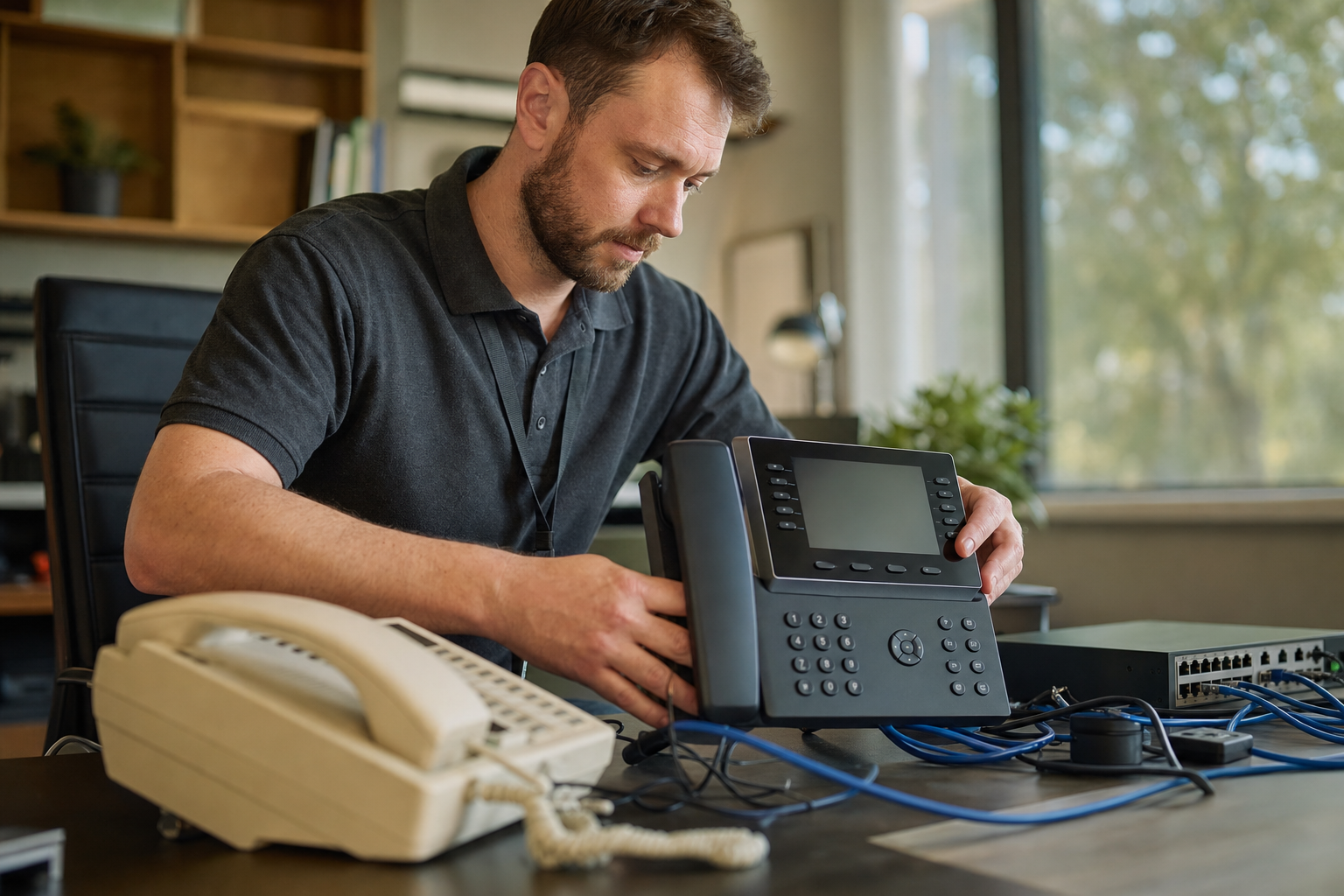
The PSTN switch-off is the retirement of the copper telephone network that has carried British business calls for more than a century, and it now has a fixed end date: 31 January 2027. Every analogue line, every ISDN2 and ISDN30 circuit, every device quietly dialling out over a copper pair - the lift phone, the alarm signalling unit, the card terminal in the back office, the fax machine nobody admits to using - stops working on the public switched telephone network when the exchanges are turned off. New PSTN and ISDN lines have not been available to order anywhere in the UK since the national stop-sell completed in September 2023, so there is no version of this where a business waits it out and orders one more line.
This guide is written for the organisations that have not moved yet, and there are still a great many of them. It starts with what the switch-off actually means in practice and what happens to a business that leaves the migration until the final quarter. It then works through the two realistic replacement architectures, the full inventory of things that break when copper goes away, how to size and cost a hosted voice platform without buying capacity you will never use, what the network in your building has to look like before a single handset is plugged in, and how a phased ISDN to VoIP migration is actually sequenced across a live business that still has to answer the phone every morning. There is a twelve-point VoIP migration checklist at the end of the technical sections, a costed set of 2026 UK pricing bands, and a frank list of the mistakes that turn a routine business phone system upgrade into three weeks of missed calls.
What the PSTN switch-off actually is - and what it is not
The Public Switched Telephone Network is the circuit-switched voice network built on copper pairs running from a customer’s premises back to a local exchange. It is genuinely old technology: the underlying design predates the internet, the components are no longer manufactured, and the engineering skills needed to maintain it are retiring faster than they can be replaced. Openreach, which owns and maintains most of the physical access network in the UK, took the decision to withdraw the platform entirely rather than continue patching it, and Ofcom-regulated wholesale products built on it - Wholesale Line Rental, ISDN2, ISDN30 - go with it. All voice services move to IP, carried over a broadband or fibre connection, which is why the programme is usually described in the industry as the “all-IP migration” rather than the switch-off.
It is worth being precise about the boundaries, because the switch-off is regularly confused with two other things. First, it is not the same as the copper broadband retirement. ADSL and FTTC services will continue to exist in various forms after January 2027, and in many buildings the physical copper pair will still be in the wall carrying data. What ends is the voice service delivered over that pair by the exchange. Second, it is not the same as the full-fibre rollout. You do not need FTTP in the building to complete a migration; a business on FTTC with a SoGEA service or even a well-managed superfast connection can run hosted voice perfectly well. Waiting for fibre before starting the phone migration is one of the most common reasons a business ends up out of time, and it is an avoidable one.
What the switch-off is, from a business planning perspective, is a hard deadline on a dependency most organisations have never inventoried. Voice is not the difficult part - replacing desk phones with a hosted platform is routine work that a competent provider completes in a few weeks. The difficult part is everything else that shares those copper lines and was installed by a different contractor, in a different decade, on a line nobody in the current finance team recognises on the bill. Lift emergency phones, intruder and fire alarm signalling, door entry panels, PDQ terminals, gate intercoms, franking machines, building management modems, CCTV dialers and analogue paging systems all have their own migration path, their own supplier and their own lead time, and none of them are handled by the company that sells you VoIP seats.
Before you speak to a single voice provider, request a full line inventory from your current supplier - every CLI, the product type against each one, and the install address. Businesses that have been through mergers, office moves or a change of finance system routinely discover between 15% and 40% more active lines than anyone in the building could account for, and the surprises are almost never the desk phones.
Why the remaining window is shorter than the calendar suggests
From late August 2026, there are roughly twenty-two working weeks until 31 January 2027. That number sounds comfortable until it is decomposed. A typical multi-site SME migration involves a discovery and audit phase of two to three weeks, a provider selection and contracting phase of two to four weeks, a network remediation phase that depends entirely on what the audit found, a pilot group of two weeks, number porting with regulated lead times measured in working days per batch, a cutover window, and a decommissioning phase to stop paying for lines that are no longer carrying anything. Run sequentially with normal business interruptions, that is a twelve to sixteen week programme before any third-party device replacement is factored in.
Then there is the queue. Every UK business in the same position is buying from the same finite pool of installers, and the pattern of every regulated telecoms deadline is the same: demand is flat for years and then vertical in the final quarter. Alarm receiving centres, lift maintenance companies and payment terminal providers are all working through their own migration backlogs, and their engineer availability in the final months of a switch-off is the binding constraint for a lot of buildings. A lift emergency line that needs a new GSM communicator is not a same-week job in December when every other building manager in the county has just realised the same thing.
The final consideration is what happens to a line that has not been migrated when the date arrives. It stops working. There is no grace period negotiated per customer and no service to fall back on, because the platform it ran on has been switched off. For a desk phone that is an inconvenience; for a lift emergency line it is a compliance failure under the relevant lift safety standards, for a monitored alarm it can invalidate an insurance condition, and for a card terminal it is a direct revenue stop. This is why the sensible planning posture in 2026 is to treat the switch-off as an infrastructure project with a fixed regulatory end date rather than as a telecoms procurement exercise. If your organisation runs any kind of formal change calendar, the migration belongs on it now, with an owner and a budget line, in the same way a planned office relocation would be.
The two realistic replacement architectures - hosted VoIP versus SIP trunking
Once copper voice is off the table there are two mainstream destinations, and the choice between them is driven less by technology preference than by what the business already owns. Hosted VoIP - also sold as cloud telephony or UCaaS - puts the entire telephone system in a provider’s data centre and delivers it per user, per month. Handsets, softphones and mobile apps register across the internet to that platform, and the business owns no call-processing equipment at all. SIP trunking keeps an on-premises phone system in place and simply replaces its ISDN circuits with IP channels delivered over the data connection, so the PBX in the comms room continues to run the dial plan, the call groups and the voicemail exactly as it did before.
SIP trunking makes sense when there is a modern, IP-capable PBX with genuine remaining life - a system bought in the last five or six years, still under manufacturer support, with a dial plan that has been customised heavily enough that recreating it would be a project in its own right. Contact centres with bespoke routing, organisations with integrated call recording obligations, and sites with a large installed base of proprietary handsets all have a rational case for keeping the estate and changing only the trunk. The economics work particularly well at higher extension counts, because SIP channels are priced by concurrent call rather than by user, and a 90-person office rarely needs more than 20 to 25 simultaneous channels.
Hosted VoIP makes sense for almost everyone else, and it is the destination for the large majority of UK SMEs completing a migration in 2026. The case rests on three things: there is no hardware refresh cycle to fund every seven years, homeworking and mobile working are native rather than bolted on, and the platform is patched and upgraded by the provider rather than by whoever last held the maintenance contract. The trade-off is a per-user monthly cost that never goes away and a hard dependency on the quality of the internet connection into each site, which is precisely why the resilience work described in our guide to business broadband failover and redundancy stops being optional the moment the phones move onto the data circuit.
SIP trunking
Keep the on-premises PBX, replace the ISDN
Hosted VoIP / UCaaS
Full platform replacement, per user per month
There is a third option that is often overlooked and occasionally the right answer for a very small number of lines: a like-for-like analogue replacement product. Openreach and the major wholesalers offer transitional single-line services that present an analogue port to the customer over a fibre or broadband tail, effectively an operator-managed adapter for premises that genuinely still need a physical analogue socket. These products exist for lift lines, alarm panels and similar special services rather than as a way of avoiding the migration, they carry their own monthly rental, and they should be treated as a targeted tool for the two or three devices that cannot be moved any other way - not as a strategy.
Switch-off readiness scoring - where most UK businesses actually sit
Readiness for the switch-off is not a single yes or no. It breaks into three assessable domains: the voice estate itself, the network the replacement will run on, and the non-voice devices sharing the copper. Businesses tend to be strong in one and weak in the others, and the pattern is remarkably consistent - the desk phones get all the attention because they are visible, the network gets some attention because IT owns it, and the special-services devices get none because nobody in the room owns them. The grid below is the assessment framework we use on a first site survey, with the risk banding that a typical unmigrated 2026 SME estate produces.
The scoring exercise is worth doing formally rather than in conversation, because it produces the two artefacts that make the rest of the project manageable: a list of items with an external supplier dependency, which drives the critical path, and a list of items the internal IT team can fix, which drives the remediation budget. Organisations without in-house IT leadership frequently find this is the point at which they need an external view of the whole estate rather than a quote for handsets - the kind of oversight discussed in our piece on when a UK SME needs a virtual CIO.
The switch-off in numbers - the four figures that set the plan
Most switch-off conversations get lost in technology comparisons when the decision is actually governed by four simple quantities: the deadline, the time remaining, the price of the replacement and the availability of the thing being replaced. Everything else is detail that follows from those.
The third figure is the one that changes behaviour when it lands. A business that discovers in November that it needs one more analogue line for a new alarm panel cannot buy one. That constraint has been in force since September 2023, and it applies to line moves and re-provisions as well as new orders, which means the switch-off has already been shaping what is possible during office fit-outs and site expansions for three years. The fourth figure is deliberately a band rather than a number, because per-user pricing varies by roughly a factor of three depending on feature tier, contract length and whether call bundles are included - and because the headline seat price is not where migrations go over budget.
What actually breaks when the copper goes
The desk phone is the least interesting casualty of the switch-off. It is visible, it belongs to a department with a budget, and replacing it is a solved problem. The risk sits in the devices that were installed by a contractor, commissioned once, and have worked without intervention ever since - which is exactly why nobody thinks about them. Every one of the following has a copper dependency in a meaningful number of UK buildings, and every one of them has a different owner, a different supplier and a different lead time.
Lift emergency telephones. Passenger lifts are required to have a means of two-way emergency communication from the car to a monitored point, and in older installations that is an analogue line terminated in the motor room. When the PSTN goes, that line goes silent, and a lift with no working emergency communication should not be in service. The replacement is normally a GSM or 4G communicator fitted by the lift maintenance company, occasionally an IP-based unit, and the work has to be scheduled with the lift contractor rather than the telecoms provider. Lead times lengthen sharply as the deadline approaches, and this is consistently the single item most likely to be discovered too late.
Intruder, fire and personal alarm signalling. Monitored alarms have historically signalled to an Alarm Receiving Centre over a dedicated line, in many cases using a digital communicator or a legacy line-monitoring service. Insurers frequently specify a signalling grade in the policy, and a change of signalling path can affect that grading, so the conversation is with the alarm company and the insurer as well as the ARC. Modern replacements use dual-path signalling over IP with a mobile fallback, which is generally a better arrangement than the line it replaces - but it needs a network port, a firewall rule and a commissioning visit.
Card payment terminals. Dial-up PDQ terminals still exist in hospitality, veterinary practices, garages and independent retail, usually as a backup path rather than the primary one. When the analogue line goes, that fallback goes with it, and the failure only becomes visible on the day the broadband has a problem - which is the worst possible day to discover it. Acquirers and terminal providers have IP and mobile-connected replacements, and the swap is usually straightforward, but it is a separate supplier conversation with its own contract implications.
Door entry, gate intercoms and barrier phones. Anything that lets a visitor or delivery driver speak to reception from outside the building may well be doing it over a copper pair, particularly on sites where the entrance is a long way from the main office. These are typically owned by facilities or the landlord, and on multi-tenant estates the responsibility can be genuinely ambiguous. Establish early whether the line is on your bill or the building’s.
Fax, franking machines, BMS and telemetry modems. The long tail. Legal and healthcare organisations still receive faxes from correspondents who have not moved on; franking machines dial out to top up postage credit; building management systems, heating controls, lift auto-diallers and remote telemetry units in plant rooms all use modems that were configured once, in a decade nobody remembers. Each of these has a cheap modern replacement - a fax-to-email service, an IP-connected franking machine, a 4G telemetry router - but only if somebody finds it before the line dies.
Analogue extensions inside the building. Finally, there are the analogue devices behind your own PBX rather than on a dedicated exchange line: the warehouse phone in a plastic weatherproof box, the site paging amplifier, the overhead ringer in a noisy workshop, the courtesy phone in a meeting room. These survive a migration only if the new platform has an ATA - an analogue telephone adapter - provisioned for them, and they are almost always missing from the seat count in the first quote.
How often each device turns up during a site survey
The chart below reflects how frequently each category of legacy device is found still connected to a copper line during a pre-migration survey of an unmigrated UK SME site. The figures are indicative rather than statistical - the point is the ordering, not the decimal place. Read it as a prompt list: if you have not explicitly confirmed the status of the top four on your own site, you have not finished the audit.
The top row is the most instructive. Orphaned lines - live, billed, and not attached to anything anyone can identify - are close to universal in businesses that have been trading for more than a decade. Some are genuinely dead and represent recoverable spend; some turn out to be the alarm line for a stockroom that was reconfigured in 2014. The only reliable way to tell them apart is to have the supplier confirm the product type and install address against each CLI, then physically trace the ones that remain unexplained before the switch-off does it for you.
Network readiness - what has to be true before the first handset is plugged in
Voice over IP is unforgiving in a way that most business applications are not. An email that arrives 400 milliseconds late is an email that arrived; a voice packet that arrives 400 milliseconds late is a conversation where two people talk over each other. The three measurements that matter are latency, jitter and packet loss, and the practical thresholds are well established: one-way latency under 150 ms, jitter under 30 ms, packet loss under 1%. Above those figures call quality degrades in ways users describe as “the phones are rubbish” and providers describe as “a network issue”, and the argument that follows tends to outlast the project.
Bandwidth is rarely the constraint people expect it to be. A single concurrent call using the G.711 codec consumes roughly 85–100 kbps in each direction including overhead; G.729 or Opus at a lower bitrate uses considerably less. Twenty simultaneous calls is therefore around 2 Mbps - trivial for any modern business connection. What actually causes poor call quality is contention and prioritisation: a large cloud backup running at full tilt, a software update pushing to forty machines, or a video call filling the uplink at the exact moment somebody dials out. The fix is not more bandwidth, it is quality of service configuration that identifies voice traffic and gives it priority, particularly on the upstream path where consumer-grade and FTTC services are asymmetric and therefore constrained.
Inside the building, three items do most of the work. A dedicated voice VLAN keeps handset traffic logically separate from data, which simplifies both QoS and troubleshooting and is a sensible security control in its own right - the same segmentation logic set out in our guide to network segmentation for UK SMEs. Power over Ethernet with an adequate switch power budget removes forty individual power bricks and makes UPS protection practical. And an uninterruptible power supply covering the router, the switch and the ONT is what stops a brief power interruption from taking the telephone system down, which is a genuine change from the copper world where the exchange powered the phone. That last point deserves emphasis with any organisation that has staff or visitors who might need to call 999 during a power cut.
Pre-migration network readiness - typical scores before remediation
The shape of that profile is the useful part. Bandwidth and hardware are usually adequate; the gaps sit in configuration and in verification. The last row is the one worth acting on immediately, because it costs nothing but attention: run a call-quality assessment from inside the network for a full working week before you commit to a provider, so that when something sounds wrong afterwards there is a baseline to compare against rather than a disagreement about whether it was always like that.
A realistic phased migration timeline
Below is how a fourteen-week migration for a single-site business of forty to eighty users is normally sequenced. Multi-site organisations run the same sequence but stagger the cutover phases site by site, typically starting with the smallest and least complex location so that the process is proven before it touches head office. The phases overlap deliberately - network remediation and provider selection can run in parallel, and the special-services workstream must start on day one because it is the longest pole in the tent.
Two phases in that sequence are routinely compressed by businesses under time pressure, and both compressions are false economies. Skipping the pilot moves discovery of every dial-plan error from a controlled group of twelve people to the entire organisation on cutover morning. Skipping decommissioning is how businesses end up paying for ISDN30 channels months after the last call traversed them - the platform being switched off nationally does not automatically terminate your billing relationship, and cessation requests still have to be raised and confirmed.
Scoring your own readiness - a 100-point self-assessment
Readiness is easier to act on when it is a number. The scale below allocates 100 points across the four things that determine whether a migration lands comfortably or turns into a scramble, and it can be completed honestly in about twenty minutes by whoever knows the estate best. Score 25 points for a complete line inventory with every device identified and its owner named; 25 for network readiness - VLAN, QoS, PoE, UPS and a tested second path; 25 for special services, awarded only where a written replacement plan and a booked engineer date exist for every device; and 25 for commercial readiness, meaning contract end dates known, notice periods calculated, numbers confirmed portable and a budget approved.
A score above 75 means the migration is a scheduling exercise and can comfortably be completed inside the remaining window. Between 50 and 75, the work is achievable but the special-services workstream needs to start this month rather than next quarter. Below 50 - which is where most unmigrated businesses land in 2026, because the special-services quarter is almost always a zero - the honest reading is that the audit has not been done, and no amount of provider comparison is a substitute for doing it. The good news is that the first 25 points are the cheapest to earn: a line inventory costs a few emails and an afternoon of tracing, and it usually pays for itself in cancelled orphan lines before the migration even begins.
What migration actually costs - UK pricing bands for 2026
Switch-off migrations are quoted on seat price and delivered on total cost, and the gap between the two is where budgets fail. The table below sets out the components that appear in a realistic 2026 UK migration for a business of forty to eighty users, with the bands that competent providers quote within. Prices vary with contract length, volume and feature tier, and anything materially below these bands usually indicates a component that has been excluded rather than a bargain.
| Cost component | Typical UK range (2026) | Basis | Notes |
|---|---|---|---|
| Hosted VoIP user licence | £6–£18 | Per user, per month | Entry tiers cover calls and voicemail; higher tiers add call recording, analytics and CRM integration |
| SIP trunk channel | £4–£8 | Per concurrent channel, per month | Only relevant if you are keeping an on-premises PBX |
| IP handsets | £70–£220 | One-off, per device | Entry desk phone to executive colour-screen model; can often be rented within the seat price |
| DECT or Wi-Fi cordless handsets | £140–£380 | One-off, per device plus base stations | Warehouse and multi-floor coverage adds base stations and a site survey |
| Analogue telephone adapter (ATA) | £50–£120 | One-off, per port | For retained analogue devices - door phones, overhead ringers, some fax use |
| Number porting | £0–£15 | Per number or per batch | Often waived on multi-year contracts; large DDI ranges are usually cheaper per number |
| Network remediation | £400–£6,000 | One-off project | PoE switch replacement, cabling, UPS, firewall configuration - entirely dependent on the audit |
| Secondary internet path | £25–£90 | Per site, per month | 4G/5G backup at the lower end, a diverse fixed circuit at the upper |
| Lift line replacement | £350–£900 | One-off, per lift | GSM communicator supplied and commissioned by the lift maintainer; may add a monthly SIM charge |
| Alarm signalling upgrade | £250–£800 | One-off, per panel | Dual-path IP and mobile signalling; confirm the grading implication with your insurer |
| Project and professional services | £0–£3,500 | One-off | Frequently bundled into a multi-year contract; be clear what “free installation” excludes |
For a sixty-user single-site business with one lift, one alarm panel and a modest amount of network remediation, that arithmetic typically produces a one-off cost in the region of £6,000–£12,000 and a recurring cost of £500–£1,000 per month before call charges. Set against that, the outgoing spend is rarely zero: line rental across a legacy estate, ISDN30 channel rental, PBX maintenance contracts and orphaned lines routinely add up to a monthly figure that is closer to the new one than businesses expect. The comparison to make is total cost against total cost over a three-year horizon, not new monthly cost against nothing.
How to choose a provider without overpaying for capacity you will not use
The most common commercial error in a switch-off migration is buying the estate you have rather than the estate you need. Legacy voice was provisioned in fixed blocks - ISDN30 came in multiples of channels, so a business that needed 18 concurrent calls bought 30 and paid for 30 for a decade. Hosted platforms are elastic, and there is no engineering reason to carry that overprovisioning forward. Look at the call statistics from the existing system: peak concurrent calls, not total call volume, is the number that sizes a SIP deployment, and for most offices it lands between 20% and 35% of headcount.
The same principle applies to user licensing. Hosted providers sell tiers, and the temptation is to put every employee on the tier that includes everything so that nobody is disadvantaged. In practice a warehouse operative who receives internal calls and a contact-centre supervisor who needs call recording, wallboards and supervisor barge-in do not need the same licence, and a mixed-tier estate is normal and supported. Assign tiers by role from the call-flow document, not by seniority, and review them at the first anniversary when actual usage data exists.
Beyond price, six questions separate providers that will be straightforward to live with from those that will not:
- What is the contract term and what happens at renewal? Thirty-six months is common and often buys hardware and installation; the important detail is whether the price is fixed for the term and what the auto-renewal behaviour is.
- Who owns the numbers? Confirm in writing that the business can port its numbers away at the end of the contract, and what that costs. This is the single most important commercial term in a voice contract.
- Are calls bundled or metered? Bundled UK landline and mobile minutes suit most businesses; metered pricing suits low-volume estates. Check the treatment of 03, 084 and international destinations, and whether the bundle is per user or pooled.
- What are the support hours and the escalation path? A voice fault at 08:30 on a Monday is a different problem from an email fault. Ask what the target response time is and who answers outside office hours.
- How is 999 handled and how is the address registered? The provider must be able to explain how emergency calls are routed, what address is passed, and how it is updated when someone moves desk or site.
- What happens when the internet at a site fails? Automatic diversion of inbound calls to mobiles is a standard platform feature, but it needs configuring before it is needed, not during the outage.
Finally, resist the urge to make the decision purely on the monthly figure in the proposal. The variables that determine whether the platform is a good fit - how the dial plan is built, how transfers behave, whether the mobile app hands over cleanly, how quickly a change request is actioned - are all things the pilot phase exists to test. A provider that is comfortable with a two-week paid pilot before a three-year commitment is telling you something useful about their confidence in the product.
How much of the migration window has already gone
The national stop-sell of new PSTN and ISDN products completed in September 2023, which is the point at which the switch-off stopped being an announcement and started being a constraint on what businesses could buy. Measured from there to the 31 January 2027 end date, the window is roughly forty-one months long. By late August 2026, about thirty-six of those months have been used.
That figure is not there for dramatic effect. It is there because it changes what good advice looks like. Eighteen months ago the right recommendation to a business with a serviceable PBX was to plan carefully, take the time to compare platforms properly, and align the migration with the next contract break. With five months left, sequencing matters more than optimisation: start the audit and the special-services calls immediately, accept a shortlist of two or three providers rather than six, and be willing to migrate the desk phones and the special services as two separate workstreams running in parallel rather than one tidy programme. A migration completed adequately in December is worth considerably more than an elegant one planned for February.
Number porting - the part that cannot be rushed
Porting is the process of moving an existing telephone number from one provider to another, and for most businesses it is non-negotiable: the main number is printed on vehicles, signage, letterheads, Google Business Profiles and every directory listing accumulated over twenty years. Losing it is a marketing event, not just a technical one. The mechanics are regulated and reasonably reliable, but they are also administratively fussy in ways that catch out businesses at exactly the wrong moment.
Three details cause the majority of rejections. The first is a mismatch between the account name held by the losing provider and the name on the porting request - common where a business has changed its trading name, been acquired, or set the line up in a director’s personal name in 1998. The second is an address mismatch, often something as small as a missing unit number or a postcode recorded against a neighbouring building. The third is an outstanding balance or an active contract term with the losing provider, which can block the port until it is resolved. All three are discoverable weeks in advance simply by asking the current provider for the exact account details they hold, and all three take days to resolve if they are found late.
Sequence the porting sensibly. Port DDI ranges and secondary numbers first, keep the main published number until the platform has proven itself with real traffic, and never schedule a port for a Friday or the day before a bank holiday. On the day, the number transfers within a defined window rather than at a precise minute, so plan for a short period where inbound calls may arrive on either system and make sure both are answered. Keep the old service live until the port is confirmed complete and tested from an external mobile - cancelling the losing service before the port completes will cancel the number itself, and recovering a released number ranges from difficult to impossible.
One additional consideration applies to businesses that rely on their phone number for local search visibility. Consistent name, address and phone number data across directories is a ranking signal, and a number change - or a period where an old number is unreachable - propagates through those listings slowly. If a number change is unavoidable, plan the directory updates as part of the project rather than afterwards; the mechanics are covered in our guide to local SEO and the Google local pack.
The 12-point PSTN migration checklist
This is the working checklist. It is ordered by dependency rather than by effort, which is why the audit items sit above the provider items - every decision below point four is materially worse if points one to three are guesses. Print it, assign an owner to each line, and put a date against each one.
- Obtain a complete line inventory. Every CLI, product type and install address from every supplier, cross-checked against the last three invoices. Include lines billed to other cost centres and any inherited from acquisitions.
- Identify what is on the end of every line. Walk the building. Trace unexplained lines with a tone generator if necessary. Record the device, its location, its owner and its maintaining supplier against each number.
- Open the special-services workstream. Contact the lift maintainer, alarm company, ARC, payment terminal provider, door entry contractor and any telemetry supplier. Get a written replacement plan and a booked date for each.
- Document how calls behave today. Main number routing, hunt groups, out-of-hours, holiday handling, voicemail delivery, call recording obligations, CRM integration, reception overflow, and who answers what when nobody picks up.
- Establish the contractual position. End dates and notice periods on every voice service and maintenance contract, plus any early-termination liability. Diary the notice dates so the outgoing service stops when the incoming one starts.
- Confirm number portability. Verify the exact account name and address held by the losing provider against every number you intend to keep. Resolve mismatches before submitting anything.
- Baseline the network. Run a week-long call-quality assessment measuring latency, jitter and packet loss from inside the LAN. Record the results before any change is made.
- Remediate the network. Voice VLAN, QoS on the upstream path, PoE budget, cabling gaps, UPS on the router, switch and ONT, firewall rules reviewed and SIP ALG disabled where it causes problems.
- Commission a secondary internet path. Configure automatic failover, then test it by physically disconnecting the primary during working hours with the phones in use. Configure inbound call diversion to mobiles as a second layer.
- Size the platform on peak concurrency, not headcount. Use call statistics from the existing system. Assign licence tiers by role from the call-flow document, and record the assumptions so they can be reviewed at renewal.
- Pilot before you commit the whole business. Eight to twelve users from the most demanding departments, on new numbers, for a full fortnight including a month-end or other peak. Fix what it exposes before the main cutover.
- Cease and verify. Issue written cessation for every legacy line, confirm it on two consecutive invoices, verify every special service is signalling correctly, and update the asset register and the business continuity plan to reflect the new architecture.
Points one and two are the only items on this list that cannot be delegated to a provider. Everyone selling you a platform will happily quote from the line list you give them; nobody but you will walk the building and find the alarm line in the stockroom ceiling. Budget a full day for it on a single site and treat the output as the project’s foundation document.
Sector considerations - where the standard plan needs adjusting
Care homes, sheltered housing and any setting with vulnerable residents. This is the most sensitive category in the entire programme. Telecare pendants, nurse call systems, warden call and door entry in supported accommodation have historically depended on analogue lines, and the consequences of a silent failure are not commercial. Providers have specific obligations toward customers identified as dependent on their landline, and telecare equipment should be tested on a digital line rather than assumed to work. Any organisation in this category should be talking to its telecare supplier now, and should treat battery backup as a requirement rather than a nice-to-have, because an IP phone service depends on mains power in the building in a way that a copper line did not.
Retail and hospitality. The pressure point is payment. Establish whether the card terminals use the analogue line as a primary or fallback path, whether the kitchen order printers or the booking system dial anything, and whether the site alarm shares the same line as the phone. In multi-site retail the second issue is standardisation - small sites often have organically grown arrangements that differ store to store, and a single national programme is far cheaper than thirty individual ones. Bandwidth per store is rarely the constraint; the constraint is a single circuit doing card payments, stock system, CCTV upload and voice with no failover.
Professional services and healthcare. Call recording and data handling obligations shape the platform choice. If calls are recorded for regulatory or quality reasons, confirm where the recordings are stored, for how long, and how a subject access request would be serviced - the platform is processing personal data and the arrangement needs to satisfy UK GDPR requirements. Practices still receiving faxes should move to a fax-to-email service well ahead of the cutover, and should tell correspondents in writing, because the receiving end is the last to notice a fax has failed.
Manufacturing, warehousing and logistics. Coverage and noise are the design problems. Desk phones matter less than DECT handsets, overhead paging and ruggedised units on the shop floor, and these need a proper site survey rather than an assumption that the office Wi-Fi reaches the racking. Plant rooms and gatehouses frequently have their own lines. Where an analogue device genuinely cannot be replaced - an intrinsically safe phone, a legacy paging amplifier - an ATA is a legitimate answer, provided somebody has confirmed it works with that specific device before cutover day.
Multi-site organisations of any kind. Sequence smallest and simplest first so that the process is proven on a site where a mistake costs least, and standardise the build so that site fifteen is a repeat rather than a fresh design. Inter-site calling becomes free and internal, which usually simplifies the dial plan considerably, but head office reception overflow and shared out-of-hours arrangements need explicit design. Organisations that have been through a site move recently will recognise most of this discipline from the zero-downtime relocation checklist - the same dependency mapping applies.
A migration in practice - anonymised case study
A 42-person precision engineering firm on a single site in West Yorkshire operated an ISDN30 delivering 30 channels into a PBX installed in 2011, with eleven additional analogue lines on the account. The finance director had been quoted for a hosted platform twice in two years and had deferred both times on the basis that the existing system worked and the deadline was some way off. The trigger to act was unrelated: an insurance renewal in early 2026 asked a question about alarm signalling that nobody could answer.
The audit found what audits usually find. Of the eleven analogue lines, three were genuinely dead and had been billed for an estimated six years; two served the intruder alarm and a fire panel dialer; one was the goods-in door intercom; one ran the lift emergency phone in a building the firm had part-sublet, with genuine ambiguity about whose responsibility it was; one was a fax number still printed on drawings issued to customers; one was a franking machine; one served an overhead ringer in the machine shop; and one could not be explained at all until it was traced to a portacabin that had been removed from site in 2019 but never disconnected. The ISDN30 was carrying a measured peak of 14 concurrent calls against 30 rented channels.
The programme ran to fifteen weeks against a fourteen-week plan, with the overrun caused entirely by a porting rejection on the main number, which had been registered in a previous trading name following a 2016 restructure. The lift communicator took nine weeks from first contact to commissioning, which made it the critical path exactly as expected. The machine shop ringer was retained on an ATA. The fax number was ported and pointed at a fax-to-email service, and customers were notified in the same mailing as a price list update. The new platform was sized at 42 users on two licence tiers with 20 concurrent channels rather than 30, and the three dead lines and the portacabin line were ceased.
The part that surprised us was how much of it had nothing to do with telephones. We thought we were buying a new phone system. What we actually did was find out what was connected to our building, and about half of it was news to somebody.
The generalisable lesson is not about the technology. It is that the audit is the project. Every subsequent decision - how many channels, which tiers, what remediation, what it costs, how long it takes - was determined by information gathered in the first fortnight, and the single item that dictated the timeline was the one nobody had thought of at the start.
The mistakes that make a switch-off migration go badly
These are the recurring failure patterns, in rough order of how expensive they turn out to be. None of them are exotic; all of them are avoidable with a fortnight’s notice and preventable with a month’s.
- Treating it as a phone project. The desk phones are the easy 20%. Scoping the work as “replace the phone system” guarantees that the lift line, the alarm signalling and the door intercom are discovered after the contract is signed and the budget is fixed.
- Waiting for full fibre before starting. FTTP availability is not a prerequisite for hosted voice. Businesses that defer the whole migration until a fibre order completes routinely lose six months of window to a dependency that was never real.
- Buying the old estate again. Carrying 30 ISDN channels forward as 30 SIP channels, or putting all 60 staff on the top licence tier, embeds legacy overprovisioning into a three-year contract. Size on measured peak concurrency and assign tiers by role.
- Cancelling the old service before the port completes. Ceasing a line releases the number. Recovering it afterwards ranges from difficult to impossible, and it is the one mistake in this list with no clean remedy.
- Skipping the network work. Deploying handsets onto a flat LAN with no QoS, no PoE headroom and a single internet circuit produces call-quality complaints within a fortnight, and by then the platform has been blamed and confidence has gone.
- Forgetting that IP phones need mains power. The copper network powered the handset from the exchange, so a power cut left the phone working. An IP handset on an unprotected switch does not. Any site where someone may need to call 999 during a power interruption needs a UPS and a documented alternative.
- No pilot. Cutting an entire organisation over on a single morning moves every dial-plan error, training gap and handset provisioning fault into the same four hours, in front of customers.
- Never decommissioning. The national switch-off does not cancel your billing. Lines that are not formally ceased continue to be invoiced, and businesses regularly find they paid for a legacy estate for months after the last call crossed it.
The most damaging version of the fourth item happens when a business tries to save a month’s line rental by giving notice on the outgoing service at the same time as ordering the new one. Porting timescales are regulated but not instantaneous, and a rejected port on a mismatched account name can add a fortnight. Always let the two services overlap, and only cease the old line once the ported number has been tested inbound from an external mobile.
At a glance - the PSTN switch-off summary
| Item | What you need to know |
|---|---|
| Final switch-off date | 31 January 2027 - PSTN and ISDN voice services withdrawn nationally |
| Stop-sell status | Complete since September 2023 - no new PSTN or ISDN lines can be ordered anywhere in the UK |
| What is affected | Analogue lines, ISDN2, ISDN30, Wholesale Line Rental and every device dependent on them |
| What is not affected | Broadband over copper continues in various forms; the withdrawal is of the voice service, not the physical pair |
| Main replacement options | Hosted VoIP / UCaaS per user, or SIP trunking into a retained IP-capable PBX |
| Typical hosted cost | £6–£18 per user per month, plus £70–£220 per handset if purchased |
| Typical SIP trunk cost | £4–£8 per concurrent channel per month, sized on peak concurrency not headcount |
| Realistic project duration | 12–16 weeks single site; longer where lift or alarm engineer availability is the constraint |
| Longest lead-time item | Lift emergency line replacement - frequently 6–10 weeks from first contact to commissioning |
| Number porting | Regulated process, several working days per batch; rejections usually caused by name or address mismatch |
| Network prerequisites | Voice VLAN, upstream QoS, PoE budget, UPS on router/switch/ONT, tested secondary internet path |
| Quality thresholds | Latency under 150 ms one-way, jitter under 30 ms, packet loss under 1% |
| Bandwidth per call | Roughly 85–100 kbps each way on G.711; contention and prioritisation matter far more than raw capacity |
| Power dependency | New: IP phones need mains power at the premises - document the 999 arrangement for power cuts |
| Consequence of missing the date | Affected services simply stop; no per-customer extension, and compliance or insurance conditions may be breached |
How Cloudswitched approaches a PSTN switch-off migration
Cloudswitched works the migration in the order set out above: a full line audit first, a written record of every device and its owner, then the special-services workstream opened in parallel with platform selection so that the longest lead times start moving on day one. Network remediation, porting and cutover are run as one programme rather than handed between suppliers, and the decommissioning stage is treated as part of the job rather than an afterthought, because the lines that nobody ceases are the ones that keep appearing on the invoice. For businesses that would rather keep an existing PBX for now, SIP trunking is delivered on the same basis.
Plan your migration before the window closes
Cloudswitched audits UK business phone estates, maps every device still dependent on copper, and delivers hosted VoIP and SIP trunking migrations with the porting and network work handled end to end.
Talk to a VoIP SpecialistFrequently Asked Questions
When exactly is the PSTN switch-off happening?
The industry-agreed final date for withdrawing PSTN and ISDN services across the UK is 31 January 2027. The programme has been running for years in stages: the national stop-sell of new analogue and ISDN lines completed in September 2023, and individual exchange areas have been migrating on rolling schedules since. From a business planning perspective the only date that matters is the final one, because that is when unmigrated services stop working. Some providers and exchange areas will complete migrations well before then, so it is worth asking your own supplier whether your specific lines have an earlier scheduled date.
What happens if my business does not migrate in time?
Services that still depend on the PSTN simply stop working when the platform is withdrawn. There is no per-customer grace period, because the network being switched off is the thing that carried the service. For desk phones this means inbound and outbound calls cease. For alarm signalling, lift emergency phones and telecare it can also mean a compliance or insurance problem, since many of those systems are subject to standards or policy conditions requiring a working communication path. The practical risk is not just the disruption but the queue: engineer availability for replacement equipment tightens sharply in the final months.
Do I need full fibre before I can move to VoIP?
No. This is one of the most common reasons businesses delay unnecessarily. Hosted VoIP runs perfectly well over FTTC, SoGEA and other superfast services, and a single concurrent call uses roughly 85–100 kbps in each direction. What matters is not headline speed but stability and prioritisation - latency, jitter, packet loss and whether voice traffic is given priority over backups and video on the upstream path. If a full-fibre order is in progress, start the phone migration alongside it rather than waiting for it to complete.
What is the difference between hosted VoIP and SIP trunking?
Hosted VoIP puts the entire phone system in the provider’s data centre and is licensed per user per month, so the business owns no call-processing equipment. SIP trunking keeps an existing on-premises PBX and replaces only its ISDN circuits with IP channels, priced per concurrent call. SIP trunking suits organisations with a modern, supported PBX and heavily customised call handling; hosted VoIP suits organisations with an ageing system, multiple sites or a hybrid workforce. Both are valid answers to the switch-off - the deciding factor is usually the remaining life in the existing hardware.
Can I keep my existing business phone numbers?
In almost all cases, yes. Geographic numbers are portable between UK providers through a regulated process, and most businesses keep every number they care about. The practical risks are administrative rather than technical: porting requests are rejected when the account name or install address on the request does not exactly match the losing provider’s records, or where there is an outstanding balance. Confirm those details in advance, port secondary numbers before the main published one, and never cancel the outgoing service until the port has completed and been tested.
How much does an ISDN to VoIP migration cost?
Recurring costs typically run £6–£18 per user per month for hosted VoIP, or £4–£8 per concurrent channel for SIP trunking. One-off costs depend heavily on what the audit finds: handsets at £70–£220 each, network remediation anywhere from a few hundred pounds to several thousand, and separate charges for lift line and alarm signalling replacement. A sixty-user single site commonly lands at £6,000–£12,000 one-off and £500–£1,000 per month before call charges. Compare that against total current spend including line rental, channel rental, PBX maintenance and any orphaned lines.
What happens to my alarm system, lift line and card machine?
Each needs its own replacement path arranged with its own supplier, and none of them are covered by a VoIP contract. Monitored alarms usually move to dual-path signalling over IP with a mobile fallback, arranged with the alarm company and confirmed with the Alarm Receiving Centre and your insurer. Lift emergency phones normally take a GSM or 4G communicator fitted by the lift maintainer. Dial-up card terminals are replaced with IP or mobile-connected units by the terminal provider. Start all of these conversations at the beginning of the project, because they carry the longest lead times.
Will my phones still work during a power cut?
Not automatically, and this is a genuine change. The copper network powered the handset from the exchange, so a basic analogue phone kept working when the building lost power. IP phones depend on mains power at the premises for the handset, the switch, the router and the ONT. The standard mitigation is a UPS covering that equipment, sized for a meaningful period rather than a clean shutdown, together with automatic diversion of inbound calls to mobiles. Any organisation with vulnerable people on site, or where a 999 call might be needed during an outage, should document this explicitly.
How long does a PSTN migration take?
For a single-site business of forty to eighty users, twelve to sixteen weeks is realistic from audit to decommissioning. Multi-site organisations run the same sequence with staggered cutovers. The variable that most often extends the timeline is not the voice platform - that part is routine - but third-party engineer availability for lift lines and alarm signalling, which is regularly six to ten weeks and lengthens as the deadline approaches. Porting rejections add a fortnight when account details do not match.
How many SIP channels or user licences do I actually need?
Size on measured peak concurrent calls rather than headcount. Most offices peak at 20–35% of staff on calls simultaneously, so a 60-person business commonly needs 15–20 channels rather than 60. Pull the statistics from the existing system rather than estimating. Similarly, licence tiers should be assigned by role from the call-flow document - a warehouse extension and a contact-centre supervisor have genuinely different requirements, and mixed-tier estates are normal. Carrying legacy overprovisioning into a three-year contract is the most common way businesses overpay.
Does moving to VoIP create new security or compliance obligations?
It changes the shape of them. Voice becomes an application on the data network, which means it inherits network security concerns: platform credentials need multi-factor authentication, toll-fraud protections and international call barring should be enabled by default, and handsets belong on a segmented VLAN. Where calls are recorded, the recordings are personal data and need a retention period, an access process and a lawful basis under UK GDPR. Organisations pursuing or holding Cyber Essentials should include the voice platform in scope - our step-by-step Cyber Essentials guide covers how that assessment works.
We only have three analogue lines and no phone system. What should we do?
Small estates are the simplest case and often the cheapest outcome. Three lines and a handful of handsets typically become three or four hosted user licences with the existing numbers ported across, running over the current broadband, with no PBX and no maintenance contract. The work still starts the same way: confirm what each of the three lines actually serves, because in very small businesses one of them is frequently the alarm or the card terminal rather than a telephone. Once that is established, the migration itself is usually a matter of days rather than weeks.
Related reading
These guides cover the infrastructure decisions that sit alongside a voice migration - the connectivity the phones will depend on, the network they will run across, and the planning discipline that keeps the whole programme on schedule.
Five months is enough - if the audit starts now
Cloudswitched delivers hosted VoIP and SIP trunking for UK businesses, from the initial line audit and device survey through network readiness, number porting and cutover to decommissioning the legacy estate.
Talk to a VoIP Specialist
Cloudswitched
London-based managed IT services provider offering support, cloud solutions and cybersecurity for SMEs.


