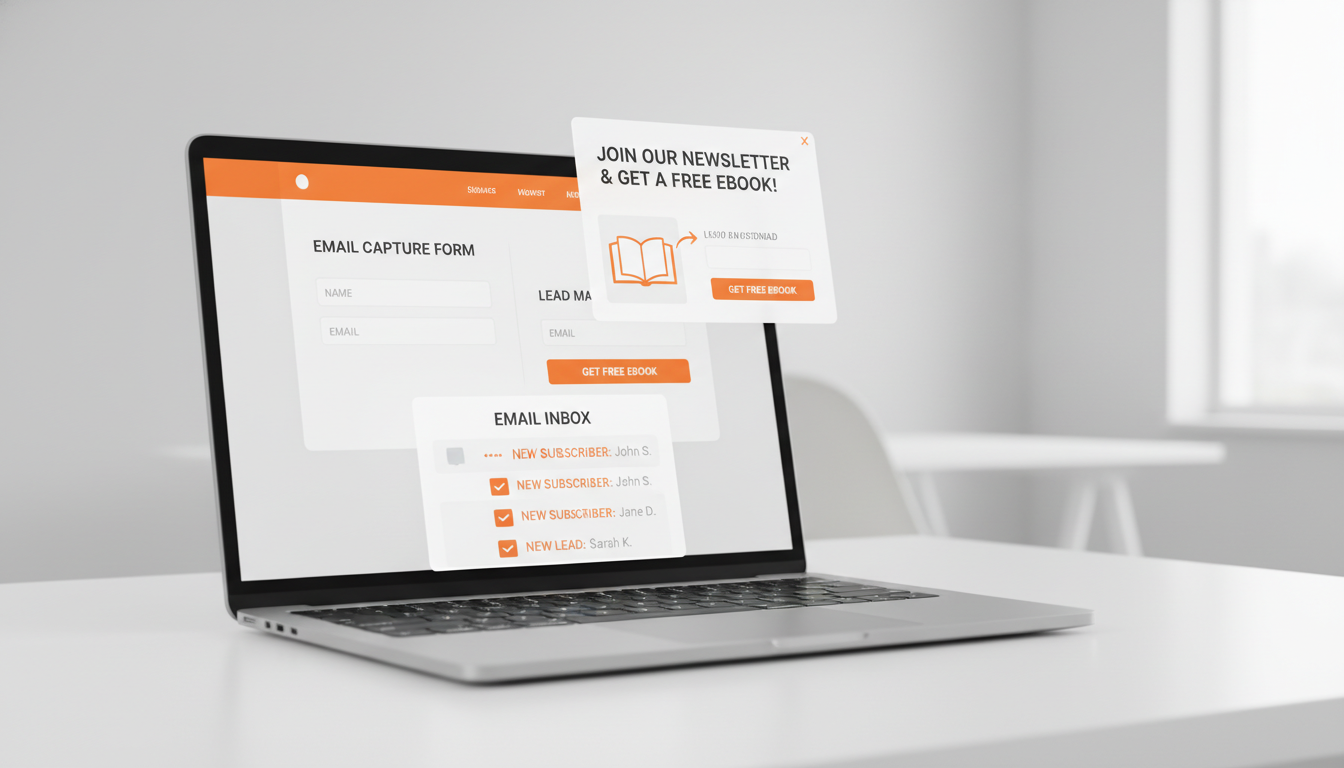
Your website receives visitors every day, but the overwhelming majority leave without making contact. For most UK business websites, the conversion rate from visitor to enquiry sits between 1% and 3%, meaning that 97 to 99 out of every 100 visitors leave without taking any action. These are people who were interested enough to find your website and spend time reading your content, yet you have no way of following up with them because you did not capture their contact details.
Email capture and lead magnets solve this problem by offering visitors something genuinely valuable - a guide, a checklist, a template, a tool, or exclusive content - in exchange for their email address. This transforms anonymous website traffic into a growing list of prospects who have demonstrated interest in your services and given you permission to stay in touch. For UK businesses operating in competitive markets, this approach can be the difference between a website that generates enquiries and one that simply exists.
This guide explains how to set up an effective email capture system with lead magnets, from choosing the right lead magnet format to configuring the technical infrastructure and ensuring compliance with UK marketing regulations.
Choosing the Right Lead Magnet
A lead magnet is only effective if it provides genuine value to your target audience. The most common mistake businesses make is creating lead magnets that are thinly disguised sales brochures - these convert poorly because visitors can smell a sales pitch from a distance. The best lead magnets solve a specific problem, answer a pressing question, or save the visitor significant time and effort.
The format of your lead magnet should match both your industry and your audience's preferences. For professional services firms, detailed guides and whitepapers tend to perform best because they demonstrate expertise. For technology businesses, checklists, templates, and calculators convert well because they offer immediate practical utility. For creative industries, case studies and portfolio pieces showcase capability effectively.
| Lead Magnet Type | Best For | Average Conversion Rate | Effort to Create |
|---|---|---|---|
| PDF Guide / Whitepaper | Professional services, B2B | 3-7% | High (5-15 pages of content) |
| Checklist / Cheat Sheet | Any industry | 5-10% | Low (1-2 pages) |
| Template / Spreadsheet | Finance, operations, project management | 4-8% | Medium (functional template) |
| Calculator / Interactive Tool | Financial services, SaaS, utilities | 6-12% | High (development required) |
| Free Consultation / Audit | Services businesses | 2-5% | Low (but high fulfilment cost) |
| Video Training / Webinar | Training, coaching, education | 3-6% | Medium (recording and editing) |
When selecting a lead magnet format, consider where your prospects sit within the buyer journey. A visitor reading a general introductory article is in the awareness stage and responds best to broad educational content such as introductory guides or industry reports. A visitor comparing specific solutions or reading detailed how-to content is in the consideration stage and prefers more practical resources such as templates, checklists, or calculators. A visitor on your pricing or services page is in the decision stage and is most likely to respond to consultation offers, audits, or free trials.
According to research by the DMA (Data and Marketing Association), UK businesses that align their lead magnets to the buyer journey see conversion rates 2.3 times higher than those offering a single generic download across their entire website. The most successful approach is to create at least two or three different lead magnets, each targeted to a different stage of the journey, and place them on the most relevant pages of your site.
Understanding Your Audience and Mapping the Buyer Journey
Before creating any lead magnet, invest time in understanding who your ideal subscribers are and what motivates them to share their email address. This requires building detailed buyer personas - semi-fictional representations of your ideal customers based on market research and real data about your existing client base. The more thoroughly you understand your audience, the more precisely you can craft lead magnets that address their specific needs and concerns.
For UK businesses, buyer personas should include demographic information such as job title, company size, industry sector, and geographic location within the United Kingdom. They should also cover behavioural patterns - how prospects search for solutions, which publications they read, and what social platforms they use. Pain points deserve careful documentation: the specific problems your product or service solves. Finally, record objections - the reasons a prospect might hesitate to make an enquiry. The more specific your personas, the more targeted and effective your lead magnets will be.
A useful exercise is to audit your existing enquiries and clients. What questions do they most frequently ask before purchasing? What concerns come up repeatedly during sales conversations? What information do they wish they had had earlier in the process? The answers to these questions point directly to lead magnet topics that will resonate with your target audience and deliver genuine value.
The buyer journey for most UK B2B services follows a predictable pattern. First, the prospect becomes aware of a problem or opportunity - perhaps through a search engine query, a recommendation from a colleague, or industry news coverage. Next, they research potential solutions, comparing approaches and providers. Finally, they evaluate specific options and make a decision. Your email capture strategy should address each stage with appropriate content, gradually building trust and demonstrating expertise until the prospect is ready to make contact.
Mapping your existing website content to the buyer journey helps identify gaps where a lead magnet could capture visitors who are not yet ready to enquire. If your website has strong awareness-stage content through blog posts and general guides but little consideration-stage content such as comparison tools, case studies, or detailed technical resources, adding a lead magnet at the consideration stage fills a critical gap in your conversion funnel. Research from HubSpot indicates that businesses addressing all three stages of the buyer journey generate 67% more leads than those focusing exclusively on top-of-funnel content.
Building Your Email Capture Forms
The design and placement of your email capture forms directly impacts conversion rates. A well-designed form is prominent without being intrusive, asks for minimal information, clearly communicates what the visitor will receive, and removes friction from the sign-up process.
Keep forms short. Every additional field you add to a form reduces conversion rates. For a lead magnet download, ask for a first name and email address only. You can gather additional information later through progressive profiling - collecting more details over time as the relationship develops. A form with two fields converts 25% to 40% better than a form with four or five fields.
Place forms strategically. The most effective positions for email capture forms on a website include inline within blog posts (after approximately 30% of the content), at the end of blog posts, in a sticky sidebar widget on content pages, as an exit-intent popup that appears when the visitor moves to close the tab, and in a dedicated landing page optimised specifically for the lead magnet.
Under GDPR and the Privacy and Electronic Communications Regulations (PECR), you must obtain explicit consent before sending marketing emails to individuals. Your email capture form must include a clear explanation of what emails the subscriber will receive, a genuine opt-in mechanism (pre-ticked boxes are not valid consent under GDPR), a link to your privacy policy explaining how their data will be processed, and the identity of your organisation as the data controller. You must also make it easy to unsubscribe from every email you send. The ICO can impose significant fines for non-compliant email marketing.
Segmentation and Personalisation Strategies
Collecting email addresses is only the first step. The real value of an email list comes from segmentation - dividing your subscribers into groups based on shared characteristics or behaviours, so you can send more relevant and targeted communications to each group. Segmented email campaigns generate 58% of all email revenue according to Campaign Monitor, and UK businesses that use segmentation see open rates 14% higher and click-through rates 101% higher than those sending the same emails to their entire list.
The simplest form of segmentation is based on the lead magnet that triggered the subscription. If a visitor downloaded your guide to cloud migration, they have different needs and interests than someone who downloaded your template for project cost estimation. By tagging subscribers according to their lead magnet at the point of capture, you can automatically route them into different nurture sequences that speak directly to their specific interests.
More advanced segmentation uses behavioural data collected over time. Which emails does the subscriber open? Which links do they click? Which pages do they visit on your website after subscribing? Do they open emails immediately or days later? This behavioural data allows you to build a progressively more detailed picture of each subscriber, enabling increasingly personalised communications that feel relevant rather than generic.
Personalisation beyond the first name. Most businesses understand the basics of email personalisation - inserting the subscriber's first name into the subject line and greeting. But effective personalisation goes much further. Reference the specific lead magnet they downloaded. Mention the industry they work in. Highlight case studies from similar organisations. Address the specific pain points associated with their segment. Every element of personalisation increases the likelihood that the subscriber will engage with your emails and eventually make an enquiry.
For UK businesses with smaller lists (under 2,000 subscribers), manual segmentation is manageable using tags and filters within most email marketing platforms. For larger lists, consider marketing automation platforms such as ActiveCampaign or HubSpot that can automatically segment subscribers based on behavioural triggers and lead scoring - assigning points based on actions such as opening emails, clicking links, visiting pricing pages, or downloading additional resources. When a subscriber reaches a certain score threshold, they can be automatically flagged as a high-priority lead for direct sales follow-up.
Technical Setup
The technical infrastructure for email capture consists of three components: the email marketing platform that stores your subscriber list and sends automated emails, the forms or pop-ups that capture email addresses on your website, and the delivery mechanism that sends the lead magnet to new subscribers.
For UK businesses, the most popular email marketing platforms include Mailchimp (free for up to 500 contacts, popular with small businesses), ConvertKit (designed for content creators and professional services), ActiveCampaign (powerful automation for growing businesses), and HubSpot (comprehensive marketing suite for larger organisations). All of these platforms offer GDPR compliance features including consent tracking, double opt-in, and automated unsubscribe handling.
When selecting an email marketing platform, UK businesses should pay particular attention to data residency. Under GDPR, transferring personal data outside the UK or EU requires appropriate safeguards. Whilst most major platforms have implemented Standard Contractual Clauses to address this requirement, some organisations - particularly those in regulated sectors such as healthcare, finance, or legal services - may prefer platforms that offer UK or EU data hosting options. Mailchimp and HubSpot store data primarily in the United States, whilst platforms such as Brevo (formerly Sendinblue) offer EU-based data storage.
Integration with your website platform is another critical consideration. If your website runs on WordPress, most email marketing platforms offer dedicated plugins that simplify form embedding and subscriber management. For custom-built websites, look for platforms with robust API documentation and webhook support to enable real-time subscriber synchronisation. The technical setup should also include double opt-in confirmation - whilst not strictly required under GDPR, it provides an additional layer of consent evidence and significantly improves list quality by filtering out mistyped email addresses and bot submissions.
Automated Email Sequences
Once a visitor downloads your lead magnet, the relationship is just beginning. An automated email sequence - sometimes called a nurture sequence or drip campaign - sends a series of follow-up emails over the following days and weeks, gradually building trust and moving the subscriber closer to making an enquiry.
Effective Nurture Sequence
- Email 1 (Immediate): Deliver the lead magnet
- Email 2 (Day 2): Add value related to the lead magnet topic
- Email 3 (Day 5): Share a relevant case study or success story
- Email 4 (Day 8): Address common objections or misconceptions
- Email 5 (Day 12): Soft call to action - offer a consultation
- Then: Move to regular newsletter (weekly or fortnightly)
Ineffective Approach
- Deliver lead magnet and then silence for weeks
- Immediate hard sales pitch in first follow-up
- Generic, impersonal emails unrelated to the lead magnet
- Inconsistent sending schedule (random intervals)
- No call to action or next step offered
- No segmentation - same emails to everyone
Lead Magnet Design and Professional Presentation
The visual quality and professional presentation of your lead magnet has a direct impact on how subscribers perceive your business. A well-designed PDF guide or template signals competence and attention to detail. A poorly formatted document with inconsistent fonts, low-resolution images, and amateur layout undermines the credibility you are trying to build, regardless of how valuable the content itself may be.
You do not need a professional graphic designer to create attractive lead magnets, though the investment is worthwhile for high-volume lead magnets that will be downloaded thousands of times. Tools such as Canva offer professional templates specifically designed for ebooks, guides, checklists, and worksheets. Adobe InDesign provides more sophisticated layout control for businesses with design experience. Google Docs and Microsoft Word can produce clean, professional documents when formatted carefully with consistent heading styles, appropriate white space, and a cohesive colour palette that matches your brand identity.
Brand consistency matters. Your lead magnet should use the same colours, fonts, logo placement, and visual style as your website and other marketing materials. When a subscriber downloads your lead magnet and then receives a follow-up email that links back to your website, the visual consistency reinforces brand recognition and builds trust. Inconsistent branding between touchpoints creates a disjointed experience that reduces confidence in your professionalism and attention to detail.
Consider the practical usability of your lead magnet. If it is a checklist, will the subscriber print it out? Ensure it formats well on A4 paper. If it is a spreadsheet template, include clear instructions and example data so the subscriber can start using it immediately without needing to figure out the structure. If it is a multi-page guide, include a table of contents, clear headings, and a logical structure that makes it easy to navigate. The easier your lead magnet is to use, the more value the subscriber derives from it, and the more positively they will view your business.
Landing page design is equally important. A dedicated landing page for each lead magnet converts significantly better than a simple pop-up form. The landing page should include a compelling headline that communicates the benefit of the lead magnet, a brief description of what the reader will find inside, a visual preview or mockup of the lead magnet, social proof such as download counts or testimonials, and a simple form with minimal fields. Remove navigation menus and other distractions to focus the visitor entirely on the conversion action. According to Unbounce research, landing pages with a single call to action convert 266% more than pages with multiple competing actions.
Email Marketing Effectiveness Scores
The following scores represent typical benchmarks for UK business email marketing programmes, based on industry data from the DMA and Litmus. Use these as a guide to evaluate where your own email capture and nurture system may need improvement.
Measuring and Optimising Performance
Email capture is not a set-and-forget system. Continuous measurement and optimisation are essential for maximising the return on your investment. The key metrics to track include form conversion rate (what percentage of visitors who see your form actually submit it), lead magnet download rate, email open rate across your nurture sequence, click-through rate on emails, and ultimately, the conversion rate from subscriber to enquiry or customer.
Use A/B testing to systematically improve each element of your email capture system. Test different lead magnet titles, form placements, form designs, button colours and text, popup timing, and email subject lines. Even small improvements compound over time - a 1% improvement in form conversion rate across a website with 5,000 monthly visitors means 50 additional leads per month, or 600 per year.
Beyond individual element testing, consider the overall subscriber lifecycle as an optimisation opportunity. Track how long subscribers remain engaged - regularly opening emails and clicking links - before becoming inactive. If engagement drops sharply after week four of your nurture sequence, that specific email or the transition point from nurture to newsletter needs attention. Map the complete journey from initial capture to enquiry, identifying the stages where the highest proportion of subscribers disengage, and focus your optimisation efforts on those critical drop-off points.
Email deliverability deserves particular attention because even the best email content is worthless if it lands in the spam folder. Maintain list hygiene by regularly removing hard bounces, unsubscribes, and long-term inactive subscribers. Authenticate your sending domain with SPF, DKIM, and DMARC records - this tells email providers that your emails are genuinely from your domain and dramatically improves inbox placement rates. Monitor your sender reputation using tools such as Google Postmaster Tools and avoid practices that damage deliverability, such as purchasing email lists, sending to very old addresses, or using deceptive subject lines.
UK Industry Benchmarks and Real-World Results
Understanding how your email marketing performance compares to UK industry averages provides essential context for setting realistic goals and identifying areas for improvement. The DMA's annual Email Benchmarking Report provides the most comprehensive data for the UK market, and the figures consistently show that well-executed email capture strategies outperform most other digital marketing channels in terms of return on investment.
Across all industries in the United Kingdom, the average email open rate sits at approximately 21.5%, with click-through rates of 2.3%. However, these figures vary enormously by sector. Professional services firms typically achieve open rates of 25% to 30%, whilst retail businesses see rates closer to 18% to 22%. The most significant factor in determining open rates is not the industry but the quality of the list - subscribers who opted in through a relevant lead magnet engage at rates 40% to 60% higher than those added through generic newsletter sign-ups or purchased lists.
A practical example illustrates the commercial impact. Consider a UK professional services firm with 10,000 monthly website visitors. Without an email capture strategy, they might convert 1.5% of those visitors directly into enquiries - approximately 150 per month. With a well-executed lead magnet and email nurture system, they capture an additional 5% of visitors as email subscribers (500 per month). Over a 12-month nurture cycle, approximately 8% of those subscribers convert into enquiries - an additional 40 enquiries per month on top of the direct conversions. If their average client value is £5,000, those additional enquiries represent significant revenue potential that would otherwise be lost entirely.
UK businesses that implement comprehensive email capture strategies consistently report several key outcomes. First, the cost per lead from email marketing is significantly lower than from paid advertising - typically £3 to £8 per lead compared to £15 to £40 for Google Ads in competitive sectors. Second, leads nurtured through email sequences convert at higher rates and have higher lifetime values than leads acquired through other channels, because the nurture process builds trust and qualifies interest before the sales conversation begins. Third, email provides an owned marketing channel that is not subject to the algorithm changes, rising costs, and platform risks associated with social media and paid advertising.
The Data and Marketing Association's most recent Marketer Email Tracker found that 73% of UK marketers rated email as their best-performing channel for return on investment, ahead of SEO (72%), content marketing (63%), and paid social media (44%). For small and medium-sized UK businesses in particular, email marketing represents one of the most accessible and cost-effective growth levers available, requiring relatively modest upfront investment for what can become a substantial and predictable source of new business enquiries over time.
Email capture and lead magnets are among the most cost-effective marketing strategies available to UK businesses. The combination of a valuable lead magnet, a well-designed capture form, a thoughtful nurture sequence, and ongoing optimisation creates a system that generates qualified leads around the clock - turning your website from a digital brochure into a genuine business development engine.
Want to Generate More Leads From Your Website?
Cloudswitched builds high-performance websites with integrated email capture and lead generation systems for UK businesses. From lead magnet creation to automated nurture sequences, we help you convert more visitors into enquiries.
Explore Our Web Development Services
CloudSwitched
London-based managed IT services provider offering support, cloud solutions and cybersecurity for SMEs.


