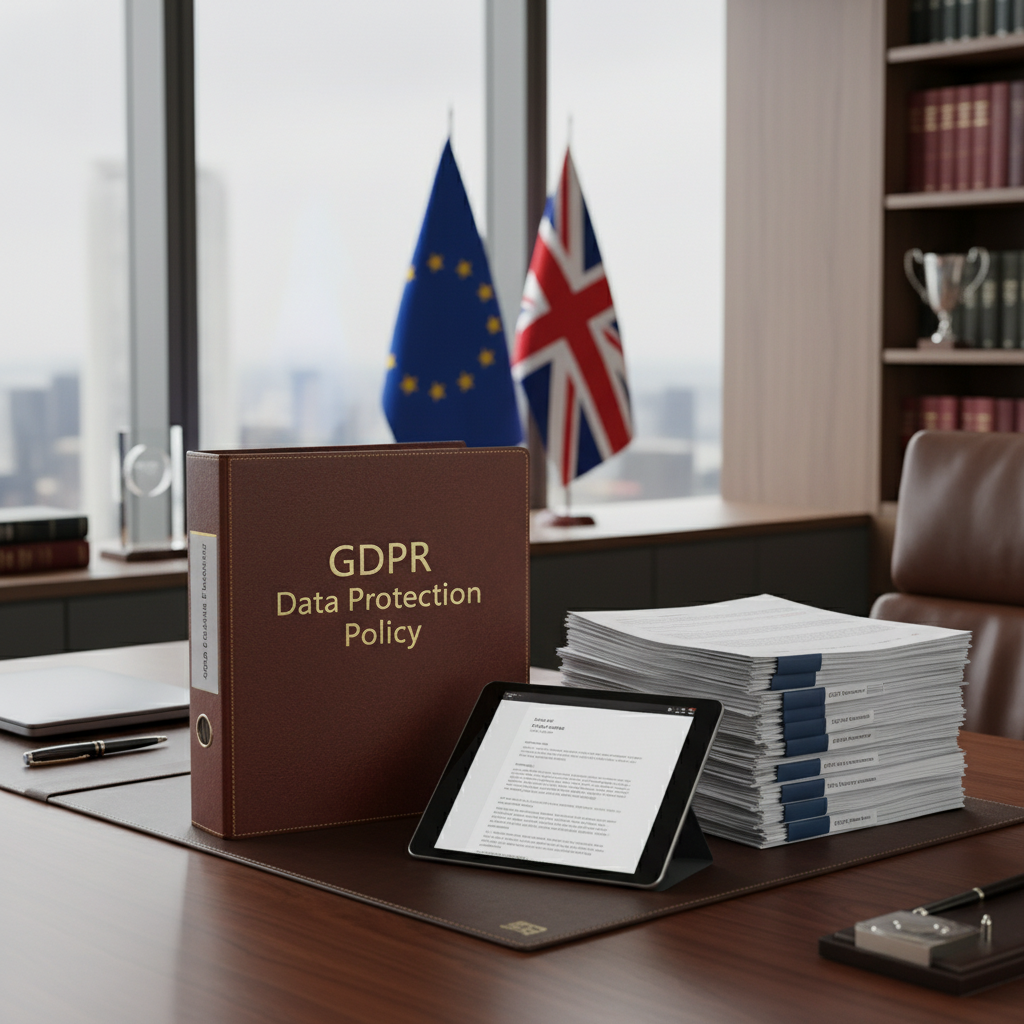
The United Kingdom's data protection landscape has matured significantly since the original GDPR came into force in 2018. UK GDPR - the domestic version retained after Brexit - continues to govern how businesses collect, process, store, and protect personal data. Yet despite eight years of enforcement, many UK small and medium-sized businesses remain uncertain about their obligations, underestimate the risks of non-compliance, and lack the practical measures needed to meet the law's requirements.
In 2026, with the Information Commissioner's Office (ICO) increasingly active in enforcement and public awareness of data rights at an all-time high, GDPR compliance is not something businesses can afford to treat casually. This guide provides a practical, jargon-free overview of what UK GDPR compliance means for SMEs in 2026, covering the key principles, your obligations, practical steps for compliance, and the consequences of getting it wrong.
UK GDPR in 2026: What Has Changed?
While the core principles of UK GDPR remain unchanged since 2018, enforcement and interpretation have evolved considerably. The ICO has refined its guidance on several areas, including the use of artificial intelligence in processing personal data, the requirements for international data transfers following adequacy decisions, cookie consent and online tracking practices, and children's data protection under the Age Appropriate Design Code.
The Data Protection and Digital Information Act, which received Royal Assent in 2024, introduced modifications to UK data protection law. These changes include reforms to the legitimate interest basis for processing, updates to the rules on automated decision-making, changes to the rules on subject access requests, and modifications to the cookie consent framework. UK businesses must ensure their data protection practices reflect these updates.
One of the most significant shifts in 2026 concerns how the ICO approaches enforcement against smaller organisations. Historically, many SME owners assumed that ICO fines and enforcement actions were aimed solely at large corporations and public bodies. That assumption is no longer safe. The ICO has made clear through multiple enforcement actions that businesses of all sizes are expected to comply, and that ignorance of the rules is not a defence. In 2025 alone, the ICO issued reprimands and monetary penalties to dozens of organisations with fewer than fifty employees, typically for failures in basic areas such as inadequate security measures, failure to respond to subject access requests, and sending marketing communications without valid consent.
The growing use of artificial intelligence in business operations has also brought new compliance considerations. UK businesses using AI-powered tools for customer service chatbots, recruitment screening, credit scoring, or marketing personalisation must understand that automated processing of personal data carries specific GDPR obligations. The ICO has published detailed guidance on AI and data protection, emphasising the need for transparency about automated decision-making, the right of individuals to obtain human review of automated decisions that significantly affect them, and the requirement to conduct Data Protection Impact Assessments (DPIAs) before deploying AI systems that process personal data at scale.
International data transfers remain another area requiring close attention. Following Brexit, the UK secured an adequacy decision from the European Commission in 2021, which was renewed with conditions in 2025. This means personal data can still flow freely from the EU and EEA to the UK. However, UK businesses transferring data outside the UK to countries without adequacy status must use approved transfer mechanisms such as Standard Contractual Clauses or Binding Corporate Rules. For SMEs using cloud services, it is essential to understand where your data is stored and processed, and to verify that your providers have appropriate transfer mechanisms in place.
The Seven Principles of UK GDPR
Everything in UK GDPR stems from seven core principles. Understanding these principles is more valuable than memorising specific rules, because they guide every decision about how your business handles personal data.
In practice, applying these principles requires embedding data protection thinking into everyday business decisions. When your marketing team proposes a new email campaign, the lawfulness and purpose limitation principles require you to check whether you have a valid legal basis for contacting each recipient. When a new software tool is being evaluated, the data minimisation principle demands that you ask what personal data it collects and whether all of it is genuinely necessary. When an employee leaves the company, the storage limitation principle means their personal data should be reviewed and, where no longer needed, securely deleted.
The accountability principle deserves particular attention because it shifts the burden of proof onto your organisation. It is not enough to simply comply with GDPR - you must be able to demonstrate that you comply. This means maintaining written records of your processing activities, documenting the legal basis for each type of processing, keeping logs of staff training, recording how data subject requests were handled, and retaining evidence of your security measures. If the ICO investigates your organisation, whether following a complaint or a data breach, these records will form the basis of their assessment. Organisations that cannot produce evidence of their compliance efforts face significantly harsher outcomes.
| Principle | What It Means | Practical Example |
|---|---|---|
| Lawfulness, Fairness, Transparency | Process data legally, fairly, and openly | Clear privacy notice explaining what data you collect and why |
| Purpose Limitation | Collect data for specific, stated purposes only | Customer email collected for order updates must not be used for unrelated marketing without consent |
| Data Minimisation | Collect only what you actually need | A contact form should not ask for date of birth if it is irrelevant to the enquiry |
| Accuracy | Keep data accurate and up to date | Regular data cleansing processes to remove outdated records |
| Storage Limitation | Do not keep data longer than necessary | Defined retention policies with automatic deletion schedules |
| Integrity and Confidentiality | Protect data with appropriate security | Encryption, access controls, regular security assessments |
| Accountability | Demonstrate compliance actively | Documented policies, records of processing, training logs |
What Counts as Personal Data?
Personal data is any information that can identify a living individual, either directly or in combination with other data. This is broader than many businesses realise. It includes obvious identifiers like names, email addresses, and phone numbers, but also IP addresses, location data, online identifiers, employee records, CCTV footage, and even pseudonymised data if it can be linked back to an individual.
Special category data - which requires additional protections - includes information about racial or ethnic origin, political opinions, religious beliefs, trade union membership, genetic data, biometric data, health data, and sexual orientation. If your business processes any of this data, you need explicit consent or another specific legal basis, and enhanced security measures.
Many UK businesses are surprised to discover just how much special category data they process. An employer that records sickness absence, for instance, is processing health data. A business that monitors employees' religious holidays for scheduling purposes is processing data about religious beliefs. A security firm that uses fingerprint scanners for access control is processing biometric data. Each of these activities requires a specific legal basis under Article 9 of UK GDPR, typically either explicit consent or a condition under employment law, and must be supported by appropriate safeguards.
Beyond special category data, businesses should also be aware of criminal conviction data, which receives similar enhanced protections. If your hiring process includes Disclosure and Barring Service (DBS) checks, or if your business records customer or employee criminal convictions for any purpose, you must have a lawful basis and an appropriate policy document in place. The ICO has been particularly robust in enforcing these requirements, and the penalties for mishandling criminal conviction data can be severe.
Under UK GDPR, you must appoint a Data Protection Officer (DPO) if you are a public authority, if your core activities require large-scale systematic monitoring of individuals, or if your core activities involve large-scale processing of special category data. Most UK SMEs do not meet these thresholds. However, designating someone within your organisation to take responsibility for data protection - even if they are not a formal DPO - is strongly recommended by the ICO and demonstrates accountability.
Practical Steps for GDPR Compliance in 2026
Compliance is not a one-off project - it is an ongoing commitment woven into how your business operates. Here are the practical steps every UK SME should take.
It is helpful to think of GDPR compliance as a framework rather than a checklist. Checklists give a false sense of completeness - once every box is ticked, they suggest the work is done. In reality, data protection compliance must evolve continuously as your business changes, as new technologies are adopted, as staff come and go, and as the regulatory landscape shifts. A framework approach means establishing principles, policies, and processes that adapt to new circumstances rather than becoming outdated the moment they are completed.
For many UK SMEs, the most pragmatic starting point is to focus on the areas of greatest risk. If your business handles sensitive customer data such as financial information or health records, securing that data and ensuring proper access controls should be the priority. If your business engages in direct marketing, ensuring you have valid consent and proper opt-out mechanisms is critical. If your business relies heavily on third-party processors, auditing those relationships and ensuring proper Data Processing Agreements are in place should be addressed first. By tackling the highest-risk areas first, you achieve the greatest reduction in exposure while building the foundations of a broader compliance programme.
1. Map Your Data
You cannot protect what you do not understand. Conduct a thorough data mapping exercise to identify what personal data your business collects, where it comes from, where it is stored, who has access to it, who it is shared with, and how long it is retained. This exercise often reveals data held in unexpected places - old spreadsheets, personal email accounts, legacy applications, and paper records in filing cabinets.
2. Review Your Legal Basis
Every processing activity needs a lawful basis. The six available bases are consent, contract performance, legal obligation, vital interests, public task, and legitimate interest. For most UK SMEs, the most commonly used bases are contract (processing needed to fulfil a contract with the customer), legitimate interest (processing justified by your business needs where it does not override the individual's rights), and consent (where the individual has actively opted in).
3. Update Your Privacy Notice
Your privacy notice must clearly explain what data you collect, why you collect it, the legal basis for each type of processing, who you share data with, how long you retain it, and the individual's rights. It must be written in plain language - not legal jargon - and be easily accessible on your website and in other contexts where you collect data.
4. Implement Appropriate Security
UK GDPR requires "appropriate technical and organisational measures" to protect personal data. What constitutes "appropriate" depends on the sensitivity of the data and the risks involved. For most UK SMEs, appropriate measures include encryption of data at rest and in transit, multi-factor authentication for system access, regular security patching and updates, access controls based on the principle of least privilege, regular backup with tested recovery procedures, staff training on data protection and security awareness, and Cyber Essentials certification as a baseline.
5. Prepare for Data Breaches
Data breaches happen to organisations of every size. Under UK GDPR, you must report qualifying breaches to the ICO within 72 hours of becoming aware of them. A qualifying breach is one that is likely to result in a risk to individuals' rights and freedoms. If the risk is high, you must also notify the affected individuals directly.
Having a documented breach response procedure means you can act quickly and decisively when an incident occurs, rather than scrambling to figure out what to do under pressure. Your procedure should define how breaches are detected and reported internally, who is responsible for assessing the breach and making the ICO notification decision, how affected individuals will be notified if required, and how the breach will be documented and lessons learned.
6. Handle Subject Access Requests
Individuals have the right to request a copy of all personal data you hold about them - this is a Subject Access Request (SAR). You must respond within one calendar month. In practice, fulfilling SARs can be complex and time-consuming, particularly if data is spread across multiple systems, email accounts, and paper records. Having a defined process and clear data mapping makes SAR fulfilment manageable.
Signs of Good GDPR Compliance
- Data processing activities are mapped and documented
- Privacy notices are up to date and easily accessible
- Staff receive regular data protection training
- Breach response procedures are documented and tested
- Retention policies are in place with scheduled deletion
- Third-party processors are vetted and have data processing agreements
Red Flags for Non-Compliance
- No idea what personal data the business holds or where
- Privacy notice has not been updated since 2018
- No staff training on data protection in the past year
- No documented procedure for handling data breaches
- Personal data retained indefinitely "just in case"
- No data processing agreements with third-party suppliers
The Cost of Non-Compliance
The ICO has the power to issue fines of up to £17.5 million or 4% of annual global turnover (whichever is higher) for the most serious GDPR breaches. While fines of this magnitude are reserved for the largest organisations, the ICO regularly takes enforcement action against SMEs, including monetary penalties, enforcement notices requiring specific changes, and reprimands that become public record.
Beyond regulatory penalties, the business impact of a data breach can be devastating. Customer trust is difficult to rebuild once lost. Negative publicity can damage your reputation for years. And the operational cost of responding to a breach - forensic investigation, legal advice, customer notification, system remediation - can easily run into tens of thousands of pounds for even a small business.
GDPR and Your IT Provider
Your IT support provider almost certainly processes personal data on your behalf - whether through managing your email systems, handling backups, monitoring your network, or supporting your users. Under UK GDPR, they are a data processor, and you must have a formal Data Processing Agreement (DPA) in place that defines their obligations.
The DPA should specify what data the processor handles, the purpose and duration of processing, the security measures they implement, their obligations regarding data breaches, the geographic location of data processing, and their obligations when the contract ends (returning or deleting data). A reputable IT provider will have a standard DPA ready and will be transparent about their data handling practices. If your IT provider cannot or will not provide a DPA, that is a serious red flag.
Third-party processor management extends beyond your IT provider. Most UK businesses share personal data with a range of processors including payroll providers, CRM platforms, email marketing services, accountancy software, cloud storage providers, and HR systems. Each of these relationships requires a Data Processing Agreement, and your organisation is ultimately responsible for ensuring that each processor handles personal data in accordance with UK GDPR. The ICO has made clear that you cannot outsource accountability - if a processor suffers a data breach or mishandles personal data, the controller (your business) shares responsibility.
Conducting regular due diligence on your processors is a practical necessity. At minimum, you should maintain a register of all third-party processors, review their security certifications and practices annually, ensure DPAs are in place and up to date, verify where data is stored and whether international transfers are involved, and confirm that processors have their own breach notification procedures. For critical processors - those handling large volumes of personal data or particularly sensitive data - more detailed audits may be appropriate. This might include reviewing their penetration testing results, examining their access control policies, or requesting evidence of staff training on data protection.
Supply Chain Data Protection
The concept of supply chain data protection has gained increasing prominence in 2026. It is no longer sufficient to ensure your direct processors are compliant - you must also consider sub-processors. When your CRM platform uses a third-party cloud hosting provider, or when your payroll provider outsources print services for payslips, personal data flows through multiple organisations. Your DPAs should require processors to inform you of any sub-processors and to ensure equivalent data protection standards throughout the processing chain. The ICO expects controllers to have visibility of the entire data processing chain, not just the first link.
Making Compliance Sustainable
GDPR compliance is not a project with a start and end date - it is a continuous practice that must be embedded into your business operations. Schedule annual reviews of your data processing activities, privacy notices, and security measures. Provide regular staff training - at least annually and as part of new employee induction. Stay informed about ICO guidance updates and enforcement actions. And treat data protection not as a burden but as a business advantage - customers increasingly prefer to do business with organisations they trust to handle their data responsibly.
Building a genuine data protection culture within your organisation is perhaps the most impactful step you can take. Policies and procedures are essential, but they only work when your staff understand and follow them. Data protection training should not be a once-a-year tick-box exercise - it should be relevant, practical, and reinforced through everyday business practices. Train staff to recognise phishing attempts, to question unusual requests for personal data, to report potential breaches promptly, and to apply the data minimisation principle in their daily work.
Consider appointing data protection champions within each department or team. These are not formal DPOs but enthusiastic staff members who take an interest in data protection and can act as a first point of contact for questions and concerns within their team. This distributed approach helps embed data protection thinking across the organisation rather than concentrating it in a single role. Data protection champions can also help identify potential issues early - a team member noticing that customer data is being stored in an insecure location, for example, or that a new process involves sharing personal data in ways that have not been properly assessed.
Finally, remember that GDPR compliance and Cyber Essentials certification are natural companions. Cyber Essentials addresses the technical security controls - firewalls, secure configuration, access controls, malware protection, and patch management - that form a critical part of your GDPR obligation to implement appropriate technical measures. Achieving Cyber Essentials certification demonstrates to the ICO, to your customers, and to your partners that your organisation takes technical security seriously. Many UK businesses find that pursuing Cyber Essentials and GDPR compliance together creates efficiencies, as the assessment processes overlap and the same improvements benefit both frameworks.
Need Help with GDPR Compliance?
Cloudswitched helps UK businesses implement the technical measures required for GDPR compliance, including data encryption, access controls, backup solutions, and security assessments. We also hold Cyber Essentials certification and can support your business in achieving the same.
GET IN TOUCH
CloudSwitched
London-based managed IT services provider offering support, cloud solutions and cybersecurity for SMEs.


