What Is Programmatic SEO?
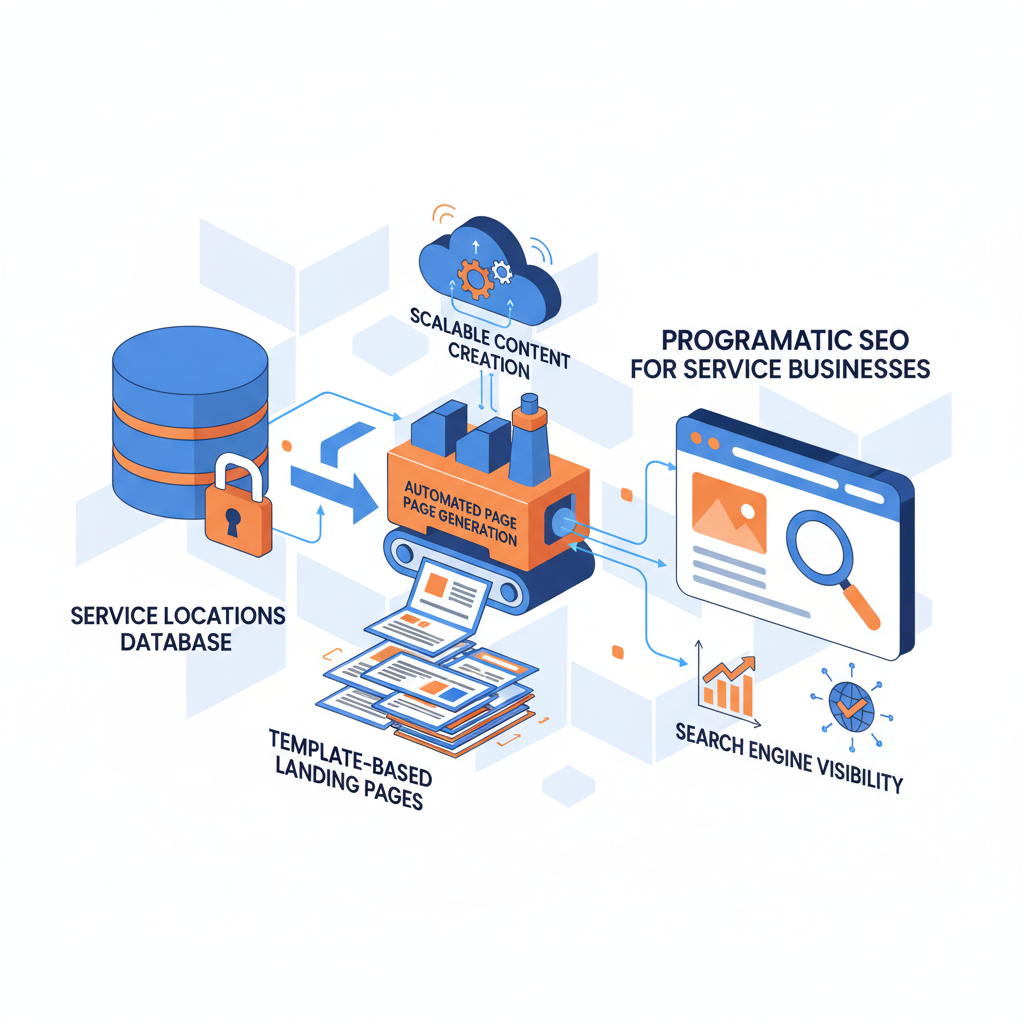
Programmatic SEO is the practice of generating large volumes of search-optimised web pages using structured data, templates, and automation. Rather than manually crafting every single page on your website, you build a system that creates hundreds - or even thousands - of unique, valuable pages based on repeatable patterns and dynamic data inputs.
For service businesses across the United Kingdom, this approach represents a transformative opportunity. Whether you operate a plumbing company serving dozens of towns, a legal firm covering multiple practice areas, or a cleaning service expanding into new postcodes, programmatic SEO allows you to capture search demand at a scale that manual content creation simply cannot match.
The concept is straightforward: identify a repeatable page pattern, populate it with unique and relevant data, and publish at scale. The execution, however, requires careful planning to ensure quality remains high and search engines reward your efforts rather than penalise them.
Why Service Businesses Should Embrace Programmatic SEO
Service businesses are uniquely positioned to benefit from programmatic SEO because their offerings naturally map to structured, repeatable search patterns. A potential customer searching for “emergency electrician in Bristol” has a fundamentally different intent from someone searching for “emergency electrician in Leeds,” yet the page structure required to serve both queries is remarkably similar.
Traditional SEO strategies often leave service businesses struggling to create enough content to capture the full breadth of relevant search queries. A locksmith serving 50 towns cannot realistically write 50 entirely unique, hand-crafted pages from scratch - at least not without significant time and financial investment. Programmatic SEO solves this by enabling you to build a template once and then populate it with location-specific, service-specific, or audience-specific data at scale.
The UK has over 1,500 towns and cities with populations above 10,000. If your service covers even a fraction of these locations, programmatic SEO lets you create targeted landing pages for each area - capturing local search traffic that your competitors are likely missing entirely. Research from BrightLocal shows that 78% of local mobile searches result in an offline purchase within 24 hours.
The benefits extend beyond just volume. Programmatic SEO helps service businesses achieve consistent brand messaging across all pages, maintain up-to-date information through database-driven content, and respond rapidly to new market opportunities by simply adding new data entries rather than commissioning entirely new pages.
Location-Based Page Generation: The Foundation
For most UK service businesses, location-based page generation forms the cornerstone of any programmatic SEO strategy. The logic is compelling: people search for services near them, and Google prioritises locally relevant results. By creating dedicated pages for each location you serve, you dramatically increase your visibility in local search results.
The most effective location-based programmatic SEO strategies work at multiple geographic levels. You might create pages targeting regions (South East England), counties (Surrey), cities (Guildford), and even specific neighbourhoods or postcodes. Each level captures different search intents and competition levels.
A successful location page is not simply a generic service description with the town name swapped in. Each page should incorporate genuinely local information: references to local landmarks, area-specific pricing where applicable, nearby transport links, testimonials from customers in that area, and any local regulations or considerations relevant to your service.
Structuring Your Location Data
The foundation of effective location-based programmatic SEO is a well-structured database. Your location data should include far more than just a place name. Consider building a database that includes:
| Data Field | Example | Purpose |
|---|---|---|
| Town/City Name | Manchester | Primary keyword targeting |
| County | Greater Manchester | Regional context and breadcrumbs |
| Population | 553,230 | Dynamic content variation |
| Notable Landmarks | Old Trafford, Arndale Centre | Local relevance signals |
| Average Property Price | £245,000 | Service pricing context |
| Postcode Areas | M1, M2, M3, M4 | Granular targeting |
| Local Competitors | 3 major, 12 small | Competitive positioning |
| Customer Reviews | 4.8/5 from 23 reviews | Social proof and uniqueness |
The richer your underlying data, the more unique and valuable each generated page becomes. This is the critical difference between programmatic SEO that thrives and programmatic SEO that gets flagged as thin content by Google’s algorithms.
Template-Driven Content at Scale
Templates are the engine that powers programmatic SEO. A well-designed template acts as a framework that produces unique, valuable pages when combined with your structured data. The key is building templates that are flexible enough to accommodate data variation while maintaining consistent quality and user experience.
- Fully unique copy for each page
- £85–£250 per page
- 5–10 pages per week output
- Inconsistent formatting
- Difficult to update at scale
- High quality but low volume
- Structured templates with dynamic data
- £0.50–£5 per page after setup
- Hundreds of pages per day
- Consistent formatting and branding
- Database update refreshes all pages
- Scalable quality with proper design
- AI-generated copy with minimal oversight
- £0.01–£0.10 per page
- Thousands of pages per day
- Variable quality and accuracy
- Risk of duplicate or thin content
- Requires heavy quality assurance
Effective templates for service businesses typically include several key sections: a location-aware headline and introduction, a service description that adapts based on local context, a pricing section with regional variations, customer testimonials filtered by location, a frequently asked questions block with location-specific answers, and a clear call to action with local contact details.
Template Design Best Practices
When designing your templates, think in terms of content blocks that can be conditionally included or excluded based on available data. If you have customer reviews for Birmingham but not for Solihull, your template should gracefully handle both scenarios - displaying reviews where available and substituting alternative trust signals where they are not.
Each template should have at least 40–60% variable content. If more than half your page is identical across all generated pages, search engines may view these as duplicate or near-duplicate content. The variable elements should go beyond simple text substitution; they should include different images, different data points, different customer stories, and different local insights.
Keyword Research for Programmatic Pages
Keyword research for programmatic SEO differs fundamentally from traditional keyword research. Rather than identifying individual keywords to target with individual pages, you are identifying keyword patterns - repeatable structures that apply across your entire data set.
The most common keyword patterns for UK service businesses follow predictable formats:
| Pattern | Example | Estimated Monthly Volume | Competition |
|---|---|---|---|
| [Service] in [City] | Plumber in Birmingham | 500–2,000 | High |
| [Service] [City] | Plumber Birmingham | 300–1,500 | High |
| [Service] near me | Plumber near me | 5,000–20,000 | Very High |
| [Adjective] [Service] in [City] | Emergency plumber in Birmingham | 100–500 | Medium |
| [Service] [Neighbourhood] | Plumber Edgbaston | 20–100 | Low |
| [Service] cost [City] | Plumber cost Birmingham | 50–200 | Low–Medium |
| [Service] for [Property Type] | Plumber for commercial properties | 50–300 | Medium |
Start by mapping out every service variation you offer, every location you serve, and every modifier that customers use when searching. Cross-reference these to create a matrix of potential pages. A business offering five services across 100 locations with three modifiers could theoretically generate 1,500 unique pages - each targeting a specific, intentful search query.
When generating pages at scale, there is a real risk that multiple pages will compete for the same keyword. For example, a page targeting “plumber in Manchester” might compete with a page targeting “emergency plumber in Manchester.” Plan your page hierarchy carefully, use canonical tags where appropriate, and ensure each page targets a distinct primary keyword with clearly differentiated content. Audit your pages quarterly to identify and resolve cannibalisation issues before they erode your rankings.
Avoiding Thin Content Penalties
Google’s algorithms have become increasingly sophisticated at identifying low-quality programmatic content. The March 2024 core update specifically targeted websites with large volumes of pages created primarily to manipulate search rankings rather than serve users. To stay on the right side of these guidelines, your programmatic pages must deliver genuine value.
The concept of “thin content” in the context of programmatic SEO typically manifests in several ways: pages with minimal unique text, pages that differ from each other only in a location name swap, pages lacking substantive information, and pages with no clear user intent beyond ranking for a keyword.
Strategies to Ensure Content Quality at Scale
First, invest in rich, diverse data sources. The more unique data you can incorporate into each page, the more distinct and valuable it becomes. For a cleaning service, this might mean including area-specific pricing, local water hardness data (which affects cleaning products), typical property sizes in the area, and local environmental regulations.
Second, incorporate user-generated content where possible. Customer reviews, ratings, and testimonials that are specific to each location add substantial unique content that search engines value highly. Even a handful of genuine reviews per location can dramatically improve page quality.
Third, build conditional content logic into your templates. Rather than showing identical FAQ sections across all pages, create a pool of 50+ questions and dynamically select the most relevant 8–10 based on the specific location and service combination. This ensures meaningful variation across pages while maintaining relevance.
Fourth, conduct regular quality audits. Sample 5–10% of your programmatic pages monthly and evaluate them against Google’s E-E-A-T criteria (Experience, Expertise, Authoritativeness, Trustworthiness). Pages that do not meet your quality threshold should be improved or removed.
Database-Driven Page Creation
At the technical heart of programmatic SEO lies the database. Your database is the single source of truth for all the dynamic content that populates your templates. Getting your database architecture right from the start is critical to long-term success.
For most UK service businesses, a relational database structure works best. You will typically need tables for locations (with all associated geographic and demographic data), services (with descriptions, pricing tiers, and specifications), testimonials (linked to both locations and services), FAQs (tagged by relevance to services and locations), and page metadata (titles, meta descriptions, canonical URLs).
Database Architecture Example
Consider a pest control company serving England and Wales. Their database might include a locations table with 500+ entries covering every major town and city, a services table covering 15 different pest types, a pricing table with regional variations (London rates typically being 20–30% higher than the national average), and a reviews table with hundreds of verified customer testimonials.
When a user visits the page for “rat control in Oxford,” the system queries the database to pull Oxford-specific information: local pricing (£95–£180 for a standard visit), Oxford-specific testimonials, information about common rat entry points in Oxford’s older Victorian and Edwardian housing stock, and relevant local authority contact details for reporting pest issues.
This database-driven approach also makes maintenance straightforward. When pricing changes, you update one database field and every affected page reflects the new information instantly. When you expand into a new area, you add a database entry and new pages are generated automatically.
Stale data is one of the quickest ways to undermine trust in programmatic pages. Set up quarterly data reviews to verify pricing, contact details, and local information. Consider automating data freshness checks - for example, flagging any location page where the pricing data has not been reviewed in 90+ days. Google’s algorithms reward regularly updated content, and users notice when information is outdated.
Internal Linking Strategies for Programmatic Pages
Internal linking is the connective tissue that makes programmatic SEO work. Without a thoughtful linking strategy, your programmatic pages risk becoming orphaned islands that search engines struggle to discover, crawl, and rank effectively.
The hub-and-spoke model is particularly effective for service businesses. Your main service pages act as hubs, linking down to location-specific spokes. Each spoke page links back to its hub and across to related spokes (nearby locations or complementary services). This creates a clear hierarchy that search engines can follow and understand.
Practical Internal Linking Tactics
Implement breadcrumb navigation on every programmatic page. A page for “Boiler Repair in Leeds” should display breadcrumbs like: Home › Heating Services › Boiler Repair › Leeds. This gives both users and search engines clear context about where the page sits within your site hierarchy.
Include a “nearby locations” section on each location page, linking to the 4–6 closest towns or cities where you also offer services. This encourages crawling across your location pages and provides genuine value to users who might be on a boundary between two service areas.
Add “related services” links that connect complementary offerings. A page about “gutter cleaning in Nottingham” should link to “roof repair in Nottingham” and “fascia and soffit installation in Nottingham.” These cross-links build topical authority and increase time on site.
Create an HTML sitemap that organises all your programmatic pages by service category and location. This serves as both a user navigation aid and a powerful crawling tool for search engines dealing with large-scale sites.
Schema Markup for Programmatic Pages
Structured data markup is essential for programmatic SEO, particularly for service businesses targeting local search. Schema markup helps search engines understand the content and context of your pages, potentially earning you rich results that dramatically improve click-through rates.
| Schema Type | Use Case | Key Properties | Rich Result Potential |
|---|---|---|---|
| LocalBusiness | Location-specific service pages | name, address, telephone, openingHours, geo | Knowledge panel, map pack |
| Service | Individual service descriptions | name, description, provider, areaServed, offers | Service carousel |
| AggregateRating | Review summary per location | ratingValue, reviewCount, bestRating | Star ratings in SERPs |
| FAQPage | FAQ sections on each page | mainEntity, acceptedAnswer | FAQ rich snippets |
| BreadcrumbList | Navigation hierarchy | itemListElement, position, name, item | Breadcrumb display in SERPs |
| Offer | Pricing information | price, priceCurrency (GBP), availability | Price display in results |
The beauty of programmatic SEO is that schema markup can be generated automatically from the same database that drives your page content. When your database contains pricing, ratings, addresses, and service descriptions, your template can automatically output the correct JSON-LD structured data for each page.
Implementation Considerations
Ensure your schema is dynamically generated and accurate for each page. Google penalises sites with incorrect or misleading structured data. If your Manchester page shows a Birmingham address in its LocalBusiness schema, that inconsistency can harm your entire site’s trust signals.
Test your schema implementation using Google’s Rich Results Test tool on a sample of pages from each template type. Validate that the data pulled from your database renders correctly in the structured data output. Set up automated monitoring to catch schema errors before they impact rankings.
Measuring Programmatic SEO Success
Measuring the effectiveness of a programmatic SEO campaign requires a different approach from traditional SEO measurement. With hundreds or thousands of pages, you need to think in terms of page groups and aggregate performance rather than individual page metrics.
Key Performance Indicators
Track indexation rate as your primary health metric. If Google is not indexing a significant percentage of your programmatic pages, it signals a quality or technical issue. Use Google Search Console’s Page Indexing report to monitor how many of your submitted pages are actually indexed versus excluded.
Monitor organic traffic at the template level. Group your pages by type (e.g., all city-level service pages) and track aggregate traffic trends. A declining trend across an entire template group suggests a systemic issue that needs addressing, while individual page fluctuations are normal.
Measure conversion rates by page group. Location pages in densely populated urban areas will naturally receive more traffic, but suburban and rural pages often convert at higher rates due to lower competition. Understanding these patterns helps you prioritise data enrichment efforts where they will have the greatest impact on revenue.
Track crawl budget efficiency using server logs. Large-scale programmatic sites can consume significant crawl budget. If Googlebot is spending most of its time on low-value pages while ignoring your highest-priority content, you may need to adjust your internal linking, robots.txt directives, or sitemap strategy.
Tools for Programmatic SEO
Choosing the right technology platform for your programmatic SEO implementation is a decision that will affect your project for years. The three main approaches - using an existing CMS like WordPress, a visual builder like Webflow, or a fully custom solution - each have distinct advantages and trade-offs.
- Lowest barrier to entry
- WP All Import for data-driven pages
- Thousands of SEO plugins available
- Setup cost: £500–£3,000
- Monthly maintenance: £50–£200
- Scalability ceiling: ~5,000 pages
- Risk of performance issues at scale
- Best for: small to medium service businesses
- Visual design flexibility
- CMS API for programmatic population
- Built-in hosting and CDN
- Setup cost: £2,000–£8,000
- Monthly cost: £30–£70 (CMS plan)
- Scalability ceiling: ~10,000 CMS items
- Limited server-side logic
- Best for: design-focused service brands
- Complete control over architecture
- No scalability ceiling
- Server-side rendering for speed
- Setup cost: £5,000–£25,000
- Monthly hosting: £20–£500
- Unlimited pages and data complexity
- Requires developer resources
- Best for: large or multi-brand operations
Emerging Tools and Platforms
Several newer tools have emerged specifically for programmatic SEO. Platforms like Whalesync allow you to sync data from Airtable or Notion directly into your CMS, making it easier to manage the data layer without touching code. Tools like PageFactory and byword.ai focus on generating content at scale with AI assistance, though quality control remains essential.
For UK service businesses, the choice often comes down to scale ambitions and technical resources. A local trades business targeting 50–100 locations will do perfectly well with WordPress and a good plugin setup costing under £2,000 to implement. A national franchise network with thousands of locations across multiple service categories will likely need a custom solution to handle the complexity and scale effectively.
Case Studies: UK Service Businesses Using Programmatic SEO
Examining real-world implementations provides valuable insight into how programmatic SEO works in practice for UK service businesses.
Case Study 1: National Drainage Company
A drainage and plumbing company based in the Midlands wanted to expand their online presence across England. They built a programmatic SEO system generating location pages for over 400 towns and cities, each incorporating local pricing data, customer reviews from that area, information about common drainage issues in the local housing stock, and details about local water authority contacts.
Within 8 months, organic traffic increased by 420%, with 73% of the new traffic landing on programmatic location pages. The cost per lead from organic search dropped from £18.50 to £3.20, and the company expanded from covering 3 counties to 12 without proportionally increasing their marketing spend. Their total investment in the programmatic system was approximately £12,000, which paid for itself within the first quarter of operation.
Case Study 2: Legal Services Firm
A mid-sized law firm in London created programmatic pages targeting every combination of their 12 practice areas with 60 London boroughs and surrounding areas. Each page included borough-specific legal considerations, local court information, relevant local authority contacts, and anonymised case studies from that area.
The firm saw a 290% increase in organic enquiries over 12 months. Crucially, the quality of leads improved because visitors arrived on pages that already addressed their specific legal need in their specific area, resulting in a 35% higher conversion rate from enquiry to paid instruction compared to their generic service pages. The project cost £8,500 to build and generated an estimated £340,000 in additional revenue in its first year.
Case Study 3: Commercial Cleaning Company
A commercial cleaning company in Manchester used programmatic SEO to target specific industry verticals across 80 cities. They created page templates for different business types (offices, restaurants, medical facilities, schools, warehouses) combined with location targeting. Each page included industry-specific cleaning protocols, relevant compliance requirements, and case studies from similar businesses in the area.
The approach generated over 3,200 unique pages. After 10 months, the company reported that 40% of all new business enquiries originated from these programmatic pages. Their organic traffic grew by 580%, and they attributed over £200,000 in new annual contract value directly to leads from programmatic landing pages.
Balancing Automation with Quality
The greatest challenge in programmatic SEO is maintaining quality at scale. It is tempting to prioritise volume over value, but this approach invariably leads to penalties, poor user experience, and wasted investment. The most successful programmatic SEO implementations treat automation as a tool for scaling quality, not a shortcut for avoiding the work of creating genuinely valuable content.
The Quality Framework
Adopt a three-tier quality assurance process for your programmatic pages. The first tier is automated validation: use scripts to check that every generated page meets minimum content length requirements, has all required sections populated, contains valid schema markup, and has no broken internal links.
The second tier is sample-based human review. Each month, randomly select 5–10% of your programmatic pages and evaluate them against a quality scorecard. Assess readability, accuracy of local information, relevance of testimonials, and overall user experience. Any systemic issues identified in the sample should trigger template-level improvements that cascade across all pages.
The third tier is performance-based evaluation. Pages that consistently underperform in terms of engagement metrics (high bounce rate, low time on page, zero conversions) should be flagged for investigation. Poor performance often indicates a content quality issue that automated checks might miss.
While AI tools like ChatGPT and Claude can assist with generating content variations for programmatic pages, relying entirely on AI without human oversight is risky. Google’s spam policies explicitly target content generated primarily to manipulate search rankings, regardless of whether it was written by humans or AI. Use AI as a drafting tool, but ensure every template and content block is reviewed and refined by a human editor who understands your service, your customers, and your local markets. The investment in human quality control will protect your site’s long-term search performance.
Content Enrichment Strategies
The best programmatic SEO implementations continuously enrich their content over time. Start with a solid foundation and then layer in additional data and content as it becomes available. Month one might see your pages launch with core service information and location data. By month three, you add customer reviews. By month six, you incorporate seasonal content variations. By month twelve, you have rich, deeply localised pages that no competitor can easily replicate.
Consider creating editorial content that links to and enriches your programmatic pages. A blog post about “How to Prepare Your Home for a Boiler Installation” can link to dozens of your location-specific boiler installation pages, passing authority and providing additional context that enhances the value of your programmatic content.
Monitor your competitors’ programmatic efforts. If they launch similar location pages, your response should not be to create more pages, but to make your existing pages better. Add more unique data, improve your templates, gather more reviews, and deepen the local relevance of each page. In programmatic SEO, sustained quality always beats sheer volume in the long run.
The Long-Term View
Programmatic SEO is not a one-time project; it is an ongoing system that requires maintenance, monitoring, and continuous improvement. Budget for ongoing data updates, template refinements, and quality assurance alongside your initial build costs. The businesses that achieve the greatest returns from programmatic SEO are those that treat it as a core marketing capability rather than a one-off technical project.
Set realistic expectations with stakeholders. Programmatic pages typically take 3–6 months to gain traction in search results, and the full impact may not be apparent for 12–18 months. However, the compounding nature of programmatic SEO means that once your pages gain authority, the traffic and lead generation benefits grow exponentially with minimal additional investment.
Need Help With Programmatic SEO?
Our SEO specialists can design and implement a programmatic content strategy that scales your organic traffic. Get in touch for a free consultation.
Contact Us Today
CloudSwitched
London-based managed IT services provider offering support, cloud solutions and cybersecurity for SMEs.


