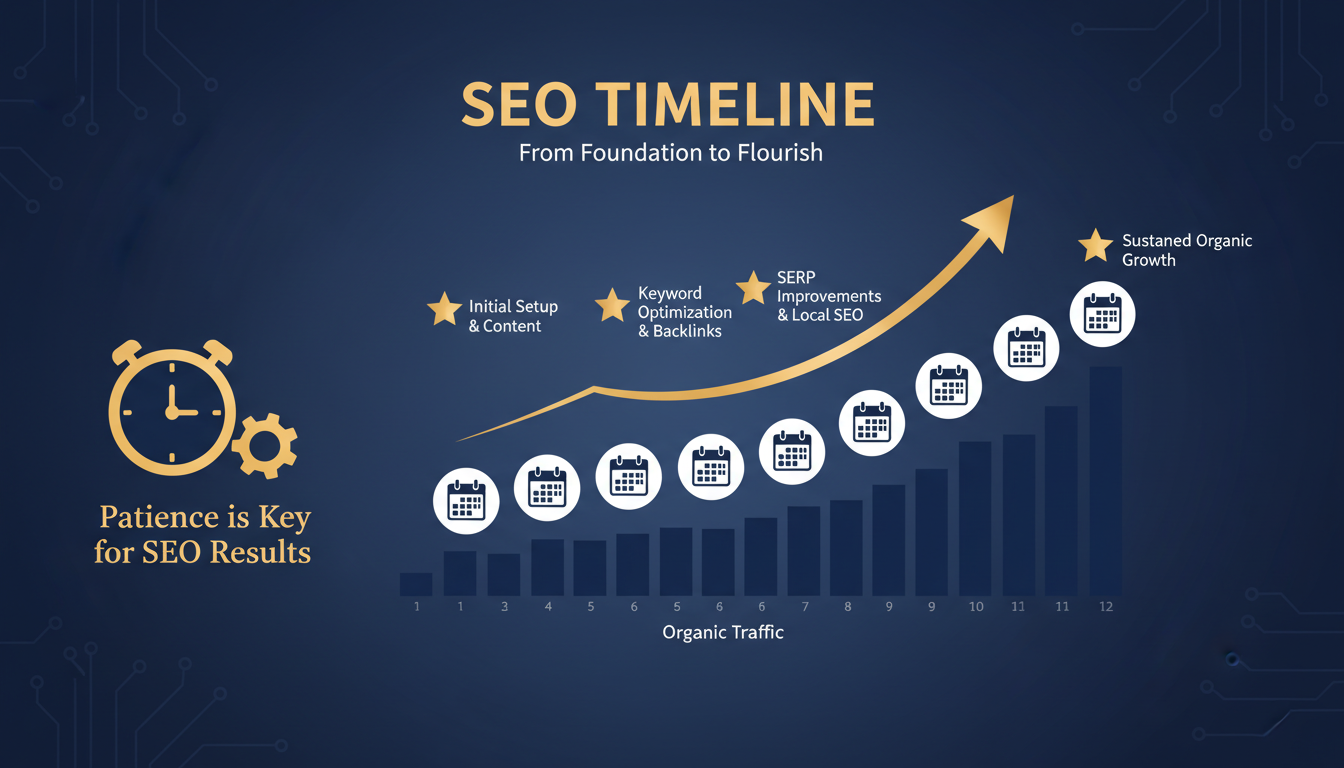
"How long until we see results?" It is the first question every business owner asks when considering an investment in search engine optimisation, and it is an entirely reasonable one. You are committing budget, time, and trust to a strategy, and you deserve a clear-eyed understanding of what the timeline looks like. The honest answer is nuanced, but that does not mean it is vague. With the right context, you can build realistic expectations and make informed decisions about your SEO investment.
The short answer is that most UK businesses begin to see measurable improvements from SEO within three to six months, with more significant results typically appearing between six and twelve months. But this headline figure obscures enormous variation depending on your starting point, your industry, your competition, and the resources you commit. Some businesses see early wins within weeks; others need a year or more to build momentum in highly competitive markets.
This guide unpacks the factors that determine your SEO timeline, explains what you should realistically expect at each stage, and provides practical guidance for measuring progress along the way.
The Factors That Determine Your Timeline
No two SEO campaigns follow exactly the same trajectory because no two websites start from the same position or face the same competitive landscape. Understanding the key variables that influence your timeline helps you set realistic expectations and identify where you can accelerate progress.
Your Starting Point
The current state of your website is the single biggest factor in determining how quickly SEO will produce results. A well-established website with a clean technical foundation, existing content, and some backlink authority is in a fundamentally different position from a brand new website with no history, no content, and no authority.
New websites face what is sometimes called the "Google sandbox" - a period during which Google appears to suppress rankings for new domains while it assesses their quality and trustworthiness. While Google has never officially confirmed the sandbox exists, the observable pattern is consistent: new domains typically struggle to rank for competitive terms during their first six to twelve months, regardless of content quality or technical optimisation.
Established websites, by contrast, already have a foundation of trust, indexed pages, and (usually) some backlink authority. For these sites, SEO improvements often produce faster results because they are building on existing equity rather than starting from nothing.
Competition and Industry
The competitiveness of your industry and your specific target keywords directly impacts how long it takes to achieve meaningful rankings. A local plumber in a medium-sized town faces fundamentally different competition from a national insurance broker or an international law firm.
Competitive analysis should be one of the first steps in any SEO campaign. If your target keywords are dominated by large, well-established websites with strong backlink profiles and extensive content, achieving first-page rankings will take longer and require more resources. If your competitors have weaker SEO, opportunities to rank quickly are more abundant.
In the UK market specifically, competition varies significantly by sector. Financial services, legal services, and insurance are among the most competitive sectors for SEO. Local trades, niche B2B services, and geographically specific businesses often face much less competition and can achieve results more quickly.
Resources and Investment Level
SEO is not a binary activity - you are either doing it or you are not. The level of resources you commit directly influences the speed and scale of results. A comprehensive campaign with dedicated content creation, technical optimisation, link building, and ongoing analysis will produce results faster than a minimal effort focused on basic on-page changes alone.
This does not mean you need an enormous budget. It means that your expectations should be calibrated to your investment. A business spending £500 per month on SEO should not expect the same speed of results as one spending £3,000 per month, all else being equal.
The SEO Timeline: What to Expect Month by Month
While every campaign is unique, there is a general pattern to how SEO results develop over time. Understanding this pattern helps you evaluate progress realistically and avoid making premature judgements about whether your strategy is working.
Months 1-2: Foundation and Discovery
The first two months of an SEO campaign are primarily about laying foundations. This phase includes a comprehensive technical audit, keyword research, competitor analysis, content strategy development, and initial technical fixes. It is a period of diagnosis and planning rather than visible results.
During this phase, you should expect to see improvements in technical health metrics - faster page speeds, resolved crawl errors, improved mobile usability, and cleaner site architecture. You might see small improvements in rankings for some keywords, particularly branded terms and low-competition phrases, but dramatic ranking improvements are unlikely at this stage.
The value of this phase should not be underestimated, even though it produces little visible traffic improvement. The technical foundation you build now determines how effectively all subsequent work performs. Skipping or rushing this phase to chase quick ranking gains is a common mistake that undermines long-term success.
Months 3-4: Early Momentum
By months three and four, the work invested in the foundation phase begins to show results. New and optimised content starts to get indexed and ranked. Technical improvements have had time to be processed by Google. Initial link-building efforts begin to generate referral authority.
You should start seeing increased impressions in Google Search Console, particularly for long-tail keywords and informational queries. Some pages will begin appearing on the first two pages of search results for their target keywords. Organic traffic should show modest growth, though it may still be small in absolute terms.
This is also the phase where "quick wins" materialise - pages that were already ranking on page two or three of search results and needed only minor optimisation to break onto page one. These quick wins provide early proof that the strategy is working and often deliver disproportionate traffic gains relative to the effort invested.
Many businesses become anxious during months two through four because they are investing money but not yet seeing significant traffic increases. This is entirely normal. SEO is an investment that compounds over time - the work done in months one and two pays dividends in months four through six, and the work done in months three and four pays dividends in months six through twelve. Patience during this phase is essential.
Months 5-8: Acceleration
This is typically when SEO campaigns begin to generate meaningful results. Content has been indexed and matured. Backlinks have accumulated. Technical foundations are solid. The compound effect of all these efforts starts to produce noticeable traffic growth.
You should see consistent month-on-month growth in organic traffic, expanding keyword rankings across your target terms, improved positions for competitive keywords, and increasing organic conversions. Pages that were created in the early months of the campaign should now be ranking well and driving traffic.
This acceleration phase is also when the return on investment begins to become apparent. While the first few months required investment with limited visible return, the accelerating traffic growth during months five through eight starts to deliver tangible business value in the form of leads, enquiries, and sales.
Months 9-12: Maturity and Compounding
By months nine through twelve, a well-executed SEO campaign should be delivering strong, consistent results. Your website should rank on page one for a significant portion of your target keywords, organic traffic should represent a substantial and growing share of your total website traffic, and the cost per acquisition from organic search should be declining as traffic grows without proportional increases in investment.
This is also the phase where you transition from building foundations to optimising and scaling. Efforts shift toward targeting more competitive keywords, expanding into new topic areas, refining conversion optimisation, and maximising the value of the traffic you are attracting.
Why Some Businesses See Results Faster
Some businesses achieve SEO results significantly faster than the typical timeline suggests. Understanding why can help you identify opportunities to accelerate your own progress.
Businesses targeting genuinely low-competition keywords can see results within weeks rather than months. If you offer a niche service in a specific geographic area and few competitors are optimising for those terms, even basic on-page SEO can produce rapid ranking improvements.
Websites with existing authority that have simply not been optimised often see dramatic improvements quickly. A well-established business website with strong backlinks and brand recognition that has never had proper SEO work done is like a powerful engine that has not been tuned - minor adjustments can unlock significant performance immediately.
Fixing critical technical issues can produce fast results when those issues were actively suppressing rankings. If your website has a robots.txt file blocking important pages, duplicate content issues confusing Google, or speed problems so severe that Google cannot effectively crawl your site, resolving these issues can produce rapid ranking improvements.
Why Some Businesses See Results Slower
Conversely, several factors can extend the timeline beyond typical expectations.
Operating in a highly competitive industry with well-funded competitors means you need to work harder and longer to build sufficient authority. Financial services, legal services, and healthcare in the UK are examples of sectors where achieving first-page rankings for commercial terms can take twelve months or more even with aggressive strategies.
A history of poor SEO practices - spammy link building, keyword stuffing, or previous Google penalties - can significantly slow progress. Recovery from a Google penalty or the negative effects of past spam requires cleaning up the problems before forward progress can begin, which adds months to the timeline.
Inconsistent effort is perhaps the most common reason businesses see slower-than-expected results. SEO requires sustained, consistent work. Publishing a burst of content in month one and then nothing for three months, or investing heavily for six months and then stopping, produces far worse results than the same total effort distributed consistently over time.
Be wary of any SEO provider who guarantees specific rankings within a specific timeframe. No legitimate SEO professional can guarantee rankings because Google's algorithm considers hundreds of factors, many of which are outside anyone's control. Guarantees of "page one in 30 days" are almost always a sign of unethical practices that will harm your website in the long run.
How to Measure Progress Before Traffic Arrives
One of the biggest challenges with SEO timelines is that the ultimate metric - organic traffic that converts into business - takes time to materialise. But this does not mean you are flying blind during the early months. Several leading indicators can confirm that your strategy is on track long before traffic numbers spike.
Track your indexed pages in Google Search Console. As you publish new content and resolve indexing issues, the number of indexed pages should grow steadily. This confirms that Google is finding and processing your content.
Monitor your keyword ranking positions. Even before a keyword generates significant traffic, you can track its movement through the rankings. A keyword that moves from position 50 to position 15 over three months is making strong progress even though it is not yet driving much traffic. That momentum typically continues, carrying it to page one where the traffic materialises.
Watch your impressions in Google Search Console. Impressions represent how often your pages appeared in search results, regardless of whether anyone clicked. Growing impressions indicate growing visibility, which is the precursor to growing traffic.
Track your backlink profile growth. As your link-building efforts progress, the number and quality of domains linking to your website should increase. This growing authority will translate into ranking improvements across your entire site, not just for the specific pages that received the links.
SEO vs. Other Marketing Channels: A Timeline Comparison
Understanding how SEO's timeline compares to other marketing channels provides useful context for setting expectations and allocating budget.
Pay-per-click advertising delivers immediate visibility and traffic. You can launch a Google Ads campaign today and have traffic tomorrow. However, the moment you stop paying, the traffic stops entirely. PPC provides no lasting equity - it is a tap you turn on and off.
Social media marketing can generate engagement relatively quickly but typically drives low-intent traffic that converts poorly compared to organic search. Building a substantial social media following takes months or years, similar to SEO, but the traffic tends to be less commercially valuable.
SEO is slower to start but compounds over time. Unlike PPC, the traffic does not disappear when you stop investing. A well-optimised page can continue to attract organic traffic for months or years after it was created, making SEO one of the most cost-effective marketing channels in the long run. The initial patience required is the price of building an asset rather than renting attention.
| Channel | Time to Results | Long-Term Value |
|---|---|---|
| Pay-Per-Click (PPC) | Immediate (hours to days) | No lasting equity; traffic stops when spend stops |
| Social Media Marketing | Weeks to months for engagement | Low-intent traffic; audience building takes years |
| SEO | 3–12 months for meaningful results | Compounds over time; traffic persists without ongoing spend |
| Email Marketing | Days to weeks per campaign | Requires existing audience; list building is gradual |
| Content Marketing | 3–6 months for traction | Strong long-term value when combined with SEO |
How to Accelerate Your SEO Results
While there are no genuine shortcuts in SEO, there are strategies that can help you see results faster without resorting to risky tactics.
Focus your initial efforts on low-competition, high-intent keywords. Rather than targeting the most competitive terms in your industry from day one, identify long-tail variations and niche terms where you can achieve rankings more quickly. These early wins build momentum, generate initial traffic, and provide evidence that your strategy is working.
Prioritise technical fixes that have the biggest impact. If your website has critical issues - slow speed, mobile usability problems, indexing errors - fixing these first can unlock immediate improvements. Technical SEO is often the fastest path to early results because it removes barriers that are actively suppressing your performance.
Invest in content quality over quantity. A single comprehensive, well-researched piece of content that genuinely serves your audience will outperform ten thin, hastily produced articles. Quality content earns links, generates engagement, and builds authority more effectively than a high volume of mediocre content.
Build relationships, not just links. Genuine relationships with industry publications, bloggers, journalists, and complementary businesses produce more sustainable and higher-quality backlinks than transactional link-building approaches. These relationships also create opportunities for brand mentions, guest contributions, and collaborative content that amplify your authority.
Effective SEO Acceleration
- Target low-competition, high-intent long-tail keywords first
- Prioritise critical technical fixes that remove ranking barriers
- Invest in fewer, comprehensive pieces of quality content
- Build genuine industry relationships for sustainable link acquisition
Common SEO Mistakes
- Chase high-volume head terms from day one against established competitors
- Skip the technical audit and jump straight to content creation
- Produce a high volume of thin, hastily written articles
- Purchase links from low-quality directories and link farms
Align your SEO with your broader marketing. SEO does not exist in isolation. A coordinated approach where your content marketing, social media, PR, and email marketing all reinforce your SEO efforts produces faster results than SEO pursued in a silo. Content promoted through multiple channels earns more links, generates more engagement, and sends stronger relevance signals to Google.
When to Reassess Your SEO Strategy
While patience is essential in SEO, there are legitimate reasons to reassess your strategy if progress is not materialising within expected timeframes.
If you see no improvement in any metrics - rankings, impressions, indexed pages, or technical health - after three months of active work, something may be fundamentally wrong. This could be a technical issue preventing Google from crawling your site effectively, a strategy targeting the wrong keywords, or a quality issue with the work being produced.
If rankings and impressions are growing but traffic is not, the issue may be with click-through rate optimisation. Your pages might be ranking for the right terms but not compelling users to click. Improving title tags, meta descriptions, and earning rich results can bridge this gap.
If traffic is growing but conversions are not, the issue lies in your website's conversion optimisation rather than your SEO strategy. Ensure that the traffic you are attracting lands on pages with clear calls to action, compelling value propositions, and minimal friction in the conversion process.
If you have been working with an SEO provider for six months and cannot see a clear correlation between their work and improvements in your metrics, it is reasonable to request a detailed accounting of what has been done, what results have been achieved, and what the plan is for the next six months. Good SEO providers welcome this kind of scrutiny because their work should speak for itself.
Ready to Start Your SEO Journey?
We believe in transparency about timelines and expectations. Our SEO team will assess your website, your competition, and your goals to provide a realistic roadmap for achieving meaningful results. No false promises - just honest strategy and consistent execution.
Explore Our SEO ServicesThe Long Game: Why SEO Rewards Patience
The businesses that achieve the greatest returns from SEO are those that commit to it as a long-term strategy rather than a short-term tactic. SEO compounds - the content you create, the links you earn, and the authority you build today continue to deliver value for months and years into the future.
Consider a blog post that takes eight hours to write, optimise, and promote. If it ranks well for a valuable keyword, it might attract 500 visitors per month for the next three years - that is 18,000 visitors from a single piece of content. Compare that cost per visitor to paid advertising, and the economics of SEO become extraordinarily compelling.
The key insight about SEO timelines is not just how long results take to appear, but how long they last once they do. A PPC campaign delivers results only while you are paying. A well-executed SEO campaign delivers results that persist and compound, creating an increasingly valuable asset over time. The question is not whether you can afford to wait for SEO results. The question is whether you can afford not to build this asset while your competitors are building theirs.

CloudSwitched
London-based managed IT services provider offering support, cloud solutions and cybersecurity for SMEs.


