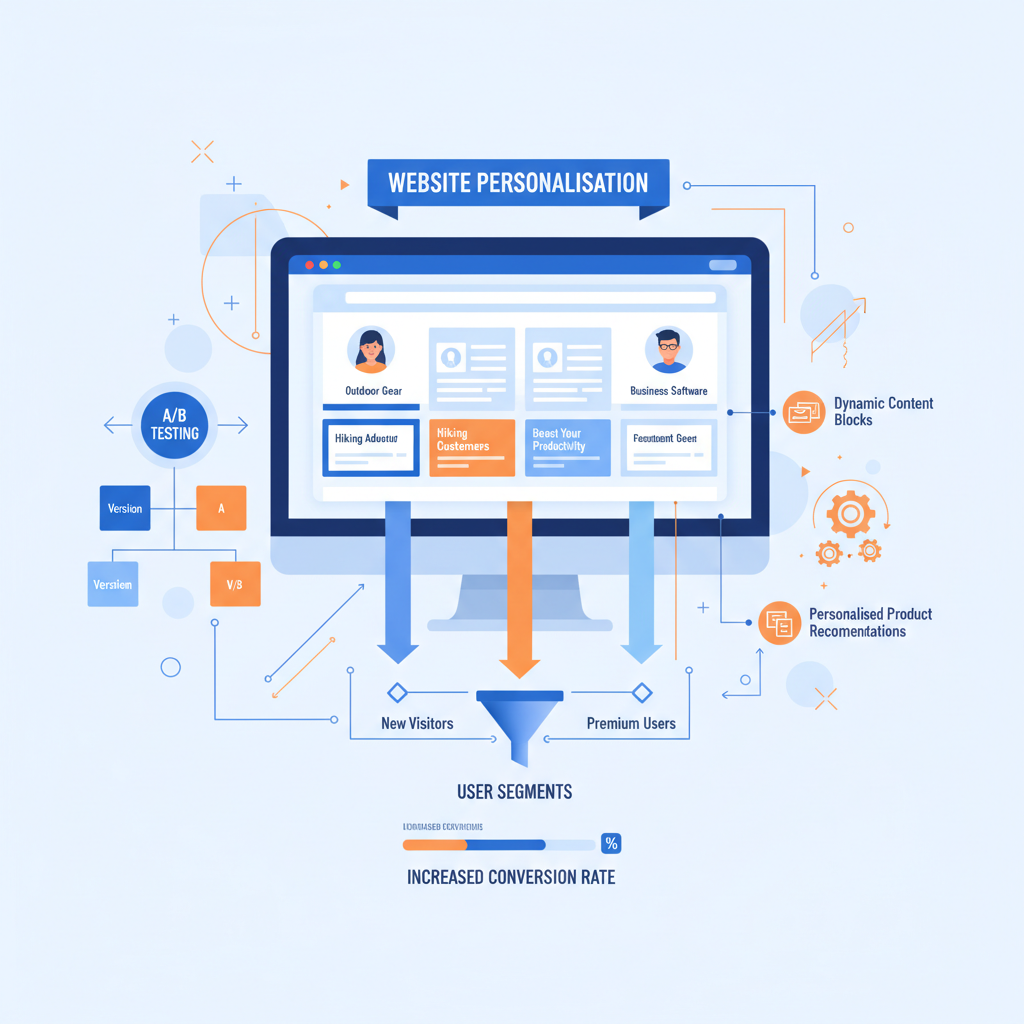
Every visitor who lands on your website arrives with a different set of needs, expectations, and intentions. A first-time visitor from Manchester searching for “best CRM for small business” is in a fundamentally different mindset from a returning customer in Edinburgh who has already purchased your software and is looking for upgrade options. Yet the vast majority of UK business websites serve the exact same content to both of these visitors - the same hero banner, the same calls to action, the same product descriptions, the same pricing page. It is the digital equivalent of a shop assistant delivering the same rehearsed pitch to every person who walks through the door, regardless of whether they are a curious browser or a loyal customer ready to buy.
Website personalisation changes this. It is the practice of dynamically adapting your website’s content, layout, messaging, and calls to action based on who the visitor is, where they have come from, what they have done before, and what they appear to be interested in right now. When done well, personalisation transforms a static, one-size-fits-all website into an intelligent, responsive experience that speaks directly to each visitor’s context - and the impact on conversion rates is substantial.
This guide covers everything a UK business needs to know about setting up website personalisation for conversion: from the strategic foundations of visitor segmentation and behavioural targeting through to the practical implementation of personalised CTAs, geo-targeted content, A/B testing, GDPR-compliant data collection, and the tools that make it all possible. Whether you are running an e-commerce store, a SaaS platform, a professional services firm, or a lead generation website, the principles and techniques outlined here will help you turn more of your existing traffic into customers - without spending a penny more on advertising.
What Is Dynamic Content Personalisation?
Dynamic content personalisation is the technical backbone of any website personalisation strategy. Rather than serving a single, static version of each page to every visitor, dynamic personalisation uses rules, algorithms, or machine learning to swap in different content elements based on visitor attributes and behaviour. These content elements can include headlines, hero images, product recommendations, calls to action, testimonials, pricing displays, navigation menus, pop-ups, banners, and even entire page layouts.
The key distinction between dynamic personalisation and basic A/B testing is that personalisation is targeted - different visitors see different content based on who they are - whereas A/B testing is random - visitors are split into groups regardless of their attributes. The two approaches are complementary, as we will explore later, but they serve different purposes. A/B testing tells you which version of a page performs better across your entire audience. Personalisation tells you which version performs better for specific segments of your audience.
Types of Dynamic Content
Dynamic content personalisation operates across several dimensions. Text personalisation involves changing headlines, body copy, or microcopy based on visitor context - for example, showing “Welcome back, ready to continue where you left off?” to returning visitors rather than the generic “Discover our products.” Visual personalisation swaps images, videos, or graphics to match visitor segments - showing a construction-related hero image to a visitor whose browsing history suggests they work in the building trade, for instance. Structural personalisation rearranges page layouts, reorders product categories, or changes navigation emphasis based on what a visitor is most likely to engage with. Offer personalisation presents different promotions, discounts, or pricing tiers based on visitor value, loyalty status, or purchase history.
The most effective personalisation strategies combine multiple dimensions. A returning high-value customer might see a different headline (text), a loyalty-specific banner image (visual), their most-purchased product category promoted to the top of the page (structural), and an exclusive repeat-customer discount code (offer) - all without any manual intervention.
Visitor Segmentation Strategies
Personalisation is only as good as your segmentation. If you cannot accurately identify and categorise your visitors, you cannot serve them relevant content. Visitor segmentation is the process of dividing your website audience into distinct groups based on shared characteristics, and it forms the foundation of every personalisation effort.
Demographic Segmentation
Demographic segmentation groups visitors by attributes such as age, gender, job title, company size, industry, or income level. For B2B websites, demographic segmentation is particularly powerful - a visitor identified as a “Marketing Director at a mid-sized financial services firm” should see very different content from a “IT Manager at a startup.” Demographic data can be inferred from IP-based firmographic databases (such as Clearbit or ZoomInfo), captured through progressive profiling on forms, or matched against CRM records for returning visitors.
Behavioural Segmentation
Behavioural segmentation groups visitors based on what they do on your website rather than who they are. Key behavioural signals include pages visited, time spent on specific pages, scroll depth, click patterns, search queries used on-site, downloads initiated, videos watched, forms started but not completed, products viewed, items added to basket, and previous purchase history. Behavioural data is typically the most actionable for personalisation because it reveals intent in real time - a visitor who has viewed your pricing page three times in the past week is clearly evaluating your product, even if you know nothing else about them.
Contextual Segmentation
Contextual segmentation groups visitors by the circumstances of their current visit: the device they are using (mobile, tablet, desktop), the traffic source that brought them to the site (organic search, paid advertising, social media, email campaign, direct), the specific search query or ad copy that triggered their visit, the time of day or day of the week, and the weather conditions at their location. Contextual segmentation is powerful for time-sensitive personalisation - a visitor arriving from a Google Ads campaign for “emergency IT support London” has very different needs from someone who typed your URL directly into their browser.
Lifecycle Segmentation
Lifecycle segmentation groups visitors by their relationship stage with your business: anonymous first-time visitor, returning visitor, known lead, active trial user, paying customer, at-risk customer, or churned customer. This is one of the most impactful segmentation approaches because the appropriate messaging for each stage is radically different. A first-time visitor needs education and trust signals. A trial user needs activation guidance and feature highlights. A paying customer needs upsell opportunities and loyalty recognition. An at-risk customer needs re-engagement incentives and satisfaction surveys.
Generic Website Experience
Personalised Website Experience
Behavioural Targeting in Practice
Behavioural targeting is the art of using real-time and historical visitor behaviour to trigger specific personalisation actions. While segmentation defines who your visitor groups are, behavioural targeting defines when and how you respond to their actions. It is the most immediately impactful form of personalisation because it responds to demonstrated intent rather than assumed characteristics.
Real-Time Behavioural Triggers
Real-time triggers fire personalisation actions based on what a visitor is doing right now. Common real-time triggers include: exit intent - detecting when a visitor’s mouse moves toward the browser close button and displaying a targeted offer or content piece to retain them; scroll depth - showing a contextual CTA when a visitor has scrolled through 70% or more of a long-form content page, indicating genuine engagement; time on page - triggering a chatbot prompt or assistance offer when a visitor has spent more than 90 seconds on a complex product page, suggesting they may need help; cart abandonment - displaying a persistent notification bar when a visitor navigates away from the checkout without completing their purchase; and repeated page visits - escalating the urgency or specificity of CTAs when a visitor views the same product or pricing page multiple times across sessions.
Historical Behavioural Patterns
Historical targeting uses accumulated data from previous sessions to personalise the current visit. A visitor who has previously downloaded a whitepaper on “Cloud Migration for Financial Services” should see content that reflects their industry (financial services) and their stage in the buyer journey (research/consideration) when they return. A customer who purchased a basic subscription six months ago and has been regularly using advanced features should see upgrade messaging highlighting the premium features they have been missing. A visitor who abandoned a form on the contact page during their last visit should see a simplified version of that form - or a different conversion mechanism entirely, such as a callback request button - on their return.
Predictive Behavioural Modelling
Advanced personalisation platforms use machine learning to predict visitor behaviour based on patterns observed across your entire audience. Predictive models can identify which visitors are most likely to convert (enabling you to allocate personalisation resources to the highest-value opportunities), which visitors are showing early signals of churn (enabling pre-emptive retention offers), and which content or product categories a visitor is most likely to be interested in based on the behaviour of similar visitors. Tools like Dynamic Yield, Monetate, and Optimizely’s experimentation platform offer built-in predictive capabilities, while more bespoke implementations can be built using Google Analytics 4’s predictive audiences or dedicated customer data platforms (CDPs).
Geo-Targeted Content for UK Regions
For UK businesses serving customers across multiple regions, geo-targeting is one of the simplest and most effective forms of personalisation. The United Kingdom is not a monolithic market - a customer in London has different concerns, references, and expectations from a customer in Glasgow, Cardiff, or Belfast. Geo-targeted personalisation acknowledges these differences and adapts content accordingly.
Regional Pricing and Offers
While most UK businesses operate uniform national pricing, there are meaningful opportunities for regional offer personalisation. Service businesses can display region-specific pricing that reflects local market conditions - for example, showing different rates for IT support in London (where operating costs are higher) versus the North of England. Delivery-based businesses can display accurate regional shipping costs and timelines upfront rather than forcing visitors through the checkout to discover them. Event-based businesses can highlight local events, workshops, or meetups relevant to the visitor’s region.
Regional Social Proof
Social proof is significantly more persuasive when it is locally relevant. A testimonial from “Sarah, Marketing Director, Manchester” resonates more strongly with a visitor from Greater Manchester than a generic testimonial from an unnamed “satisfied customer.” Geo-targeted personalisation can dynamically select and display testimonials, case studies, client logos, and review scores from customers in the visitor’s region. For national businesses with a broad client base, this is straightforward to implement and typically produces a measurable uplift in trust metrics and conversion rates.
Regional Content and References
Subtler forms of geo-targeted personalisation include adapting imagery (showing recognisable local landmarks or cityscapes in hero images), referencing regional business conditions (mentioning the Northern Powerhouse initiative for visitors in the North of England, or referencing Edinburgh’s financial district for Scottish visitors), and adapting language to regional preferences where appropriate. For businesses operating across England, Scotland, Wales, and Northern Ireland, acknowledging the distinct business environments and regulatory nuances of each nation can significantly improve engagement and trust.
Implementing Geo-Targeting
Geo-targeting relies on IP-based geolocation, which can identify a visitor’s location to the city level with approximately 80–90% accuracy in the UK. Most personalisation platforms include built-in geolocation, or you can use services such as MaxMind GeoIP2 or IP2Location for custom implementations. For more precise localisation, you can use the browser’s Geolocation API with the visitor’s explicit consent - though this requires a clear reason (such as “find your nearest branch”) to justify the permission request under GDPR principles of data minimisation.
You do not need a full personalisation platform to get started. These five quick wins can be implemented on most websites within a few days and deliver immediate conversion improvements: (1) Show different CTAs to new versus returning visitors using a simple cookie check. (2) Display geo-targeted phone numbers and office addresses based on visitor location. (3) Personalise email campaign landing pages to match the specific offer and messaging in the email. (4) Show recently viewed products or pages to returning visitors. (5) Adapt your homepage hero message based on UTM parameters from different advertising campaigns.
Personalised CTAs and Landing Pages
Your calls to action and landing pages are where personalisation has the most direct impact on conversion. A generic “Contact Us” button performs adequately, but a personalised CTA that reflects the visitor’s specific context - “Get Your Free IT Audit” for a new visitor from an organic search, “Upgrade to Premium” for an existing basic-tier customer, “Resume Your Application” for a visitor who started but did not finish a form - performs dramatically better.
Smart CTA Strategy
HubSpot’s research found that personalised CTAs convert 202% better than generic ones. The key to effective CTA personalisation is matching the CTA to the visitor’s position in the buying journey. Awareness stage visitors (first-time, arriving from informational searches) should see CTAs focused on education and value exchange: “Download the Free Guide,” “Watch the Explainer Video,” “Take the Free Assessment.” Consideration stage visitors (returning, viewing product/pricing pages) should see CTAs that reduce friction and build confidence: “Book a Free Demo,” “Start Your Free Trial,” “Compare Plans.” Decision stage visitors (high engagement, returning to pricing repeatedly) should see direct conversion CTAs with urgency: “Get Started Today,” “Claim Your 20% Launch Discount,” “Speak to a Specialist Now.”
Landing Page Personalisation
Landing page personalisation extends the same principles to entire pages. When a visitor clicks through from a specific advertising campaign, email, or referral source, the landing page should continue the conversation started by that source rather than dropping the visitor onto a generic page. This means matching the landing page headline to the ad copy or email subject line, displaying imagery and examples relevant to the visitor’s segment, showing social proof from similar businesses, pre-selecting relevant product options or pricing tiers, and reducing form fields to only what is essential for that particular conversion path.
For UK businesses running multiple advertising campaigns across Google Ads, Meta Ads, and LinkedIn Ads, dynamic landing pages that adapt to UTM parameters can dramatically improve quality scores (by increasing relevance) and conversion rates (by reducing cognitive disconnect between the ad and the landing page). A visitor who clicked an ad about “affordable CRM for UK retailers” should land on a page that talks about CRM for retailers with UK-specific pricing in pounds - not a generic product page that talks about CRM for all industries with pricing in dollars.
A/B Testing Your Personalisation
Personalisation without testing is guesswork with a technology layer on top. Every personalisation rule, segment definition, and content variation should be validated through rigorous A/B testing before being rolled out to your full audience. The goal of testing is not just to confirm that personalisation works (though that is important), but to quantify exactly how much impact each personalisation has on your key metrics and to continuously optimise your approach.
What to Test
Common personalisation elements to A/B test include: headline variations for different segments, CTA text and colour for different journey stages, hero images for different industries or regions, product recommendation algorithms (collaborative filtering versus content-based versus hybrid), the timing and trigger conditions for behavioural pop-ups, the level of personalisation intensity (subtle versus overt - some audiences respond positively to being recognised, others find it intrusive), form length and fields for different traffic sources, and social proof selection criteria (regional, industry-specific, recency-based).
Testing Methodology
For personalisation testing, you are typically running what is known as a “holdout test” or “champion/challenger test.” The holdout group sees the unpersonalised (generic) version of the page, while the treatment group sees the personalised version. This directly measures the incremental impact of personalisation on conversion. It is essential to run holdout tests continuously, not just during initial implementation, because personalisation effectiveness can decay over time as visitor behaviour changes, market conditions shift, or your content becomes stale.
Statistical significance is non-negotiable. A personalisation that appears to improve conversion by 15% based on 200 visitors may turn out to be statistical noise when measured across 2,000 visitors. Most testing platforms calculate significance automatically, but as a rule of thumb, you should aim for at least 95% confidence and a minimum of 1,000 conversions per variation before drawing conclusions. For businesses with lower traffic volumes, prioritise testing high-impact elements (headlines, CTAs, hero content) over subtle variations (button colour, microcopy).
Personalisation Tools and Platforms
The personalisation technology landscape has matured significantly in recent years, with options available for businesses of every size and budget. Choosing the right platform depends on your traffic volume, technical capability, integration requirements, and budget. Here is a comparative overview of the leading platforms relevant to UK businesses in 2025.
Enterprise Platforms
Optimizely (formerly Episerver) is one of the most established experimentation and personalisation platforms, widely used by enterprise organisations. Its strengths lie in sophisticated experimentation (A/B, multivariate, multi-armed bandit testing), content personalisation, and feature flagging for product teams. Optimizely’s platform includes a full CMS with built-in personalisation capabilities, making it particularly suitable for content-heavy websites. Pricing is enterprise-level, typically starting from £30,000–£50,000 per year depending on traffic volume and modules selected.
Dynamic Yield (acquired by Mastercard) offers an AI-powered personalisation engine with strong capabilities in product recommendations, content personalisation, and customer journey orchestration. It is particularly popular in e-commerce, where its recommendation algorithms and predictive targeting capabilities deliver measurable revenue uplift. Pricing is typically £25,000–£60,000+ per year.
Mid-Market Platforms
VWO (Visual Website Optimizer) has evolved from a straightforward A/B testing tool into a comprehensive experimentation and personalisation platform. VWO’s strength is its accessibility - the visual editor allows marketing teams to create and deploy personalisation experiences without developer involvement, while the platform’s server-side testing and API capabilities satisfy more technical requirements. Pricing starts from approximately £300 per month for the testing module, with personalisation capabilities available from £600 per month.
AB Tasty is a French-founded platform with strong EU and UK presence, offering experimentation, personalisation, and feature management. Its AI-powered EmotionsAI module uses visitor emotional profiling to enhance targeting. Pricing typically starts from £500 per month for mid-market businesses.
SME and Budget-Friendly Options
Google Analytics 4 Audiences + Google Ads serves as a de facto personalisation layer for businesses that rely heavily on paid advertising. While GA4 does not personalise your website directly, its audience building and predictive capabilities (predictive purchase probability, predicted revenue, churn probability) can be exported to Google Ads for highly targeted landing page campaigns. This is effectively free if you are already using GA4 and Google Ads. Google Optimize, the previous free A/B testing tool, was sunset in September 2023, and Google has not launched a direct successor. However, GA4’s integration with third-party testing platforms (including Optimizely and VWO) provides a pathway for businesses that relied on Google Optimize.
Mutiny is a B2B-focused personalisation platform that uses firmographic and intent data to personalise website experiences for target accounts. It is particularly popular with B2B SaaS companies running account-based marketing programmes. Pricing starts from approximately £800 per month.
ConvertFlow offers personalisation capabilities focused on CTAs, forms, pop-ups, and landing pages, with a generous free tier that supports up to 5,000 monthly visitors. For SMEs just beginning their personalisation journey, ConvertFlow provides an accessible entry point without the complexity or cost of enterprise platforms.
| Platform | Best For | Key Strength | Starting Price | GDPR Compliant |
|---|---|---|---|---|
| Optimizely | Enterprise content-heavy sites | Advanced experimentation + CMS integration | £30,000/yr | Yes - EU data centres available |
| Dynamic Yield | E-commerce personalisation | AI-powered product recommendations | £25,000/yr | Yes - full GDPR controls |
| VWO | Mid-market A/B testing + personalisation | Visual editor - no developer needed | £300/mo | Yes - EU hosting option |
| AB Tasty | EU/UK mid-market experimentation | EmotionsAI visitor profiling | £500/mo | Yes - EU-headquartered |
| Mutiny | B2B account-based personalisation | Firmographic + intent data targeting | £800/mo | Yes - GDPR-ready |
| ConvertFlow | SMEs starting personalisation | Free tier - CTAs, forms, pop-ups | Free (up to 5k visitors) | Yes - consent integration |
| GA4 + Google Ads | Paid advertising personalisation | Predictive audiences at no extra cost | Free | Configurable - requires consent mode |
The most common mistakes businesses make with website personalisation are: (1) Over-personalising too early - trying to create 20 different segment experiences before you have validated that even basic personalisation works for your audience. Start with 2–3 high-impact segments and expand from there. (2) Personalising without testing - assuming that personalised content will always outperform generic content. Sometimes a well-crafted generic message outperforms a poorly targeted personalised one. Always run holdout tests. (3) Ignoring the “creepy factor” - overtly demonstrating how much you know about a visitor (“We noticed you visited our pricing page 4 times this week”) can feel invasive rather than helpful. Personalisation should feel natural, not surveillance-like. (4) Neglecting mobile experiences - personalisation built for desktop often performs poorly on mobile due to screen size constraints. Test every personalisation across devices. (5) Forgetting to update personalised content - personalisation rules that reference specific dates, promotions, or events become embarrassing when they are left running months after the event has passed.
Cookie Consent and GDPR for Personalisation
Website personalisation in the UK operates within a strict regulatory framework governed by UK GDPR and the Privacy and Electronic Communications Regulations (PECR). Understanding and complying with these rules is not optional - it is a legal requirement that carries significant financial penalties for non-compliance. Fortunately, it is entirely possible to run sophisticated personalisation programmes within the bounds of the law, provided you approach it correctly from the outset.
The Legal Basis for Personalisation Data
Under UK GDPR, processing personal data for website personalisation requires a lawful basis. The two most commonly applicable bases are consent (Article 6(1)(a)) and legitimate interests (Article 6(1)(f)). Consent is the gold standard - it gives you the broadest latitude for personalisation activities, provided the consent is freely given, specific, informed, and unambiguous. In practice, this means your cookie consent banner must clearly explain that you use cookies and similar technologies for website personalisation, and the visitor must actively opt in (pre-ticked boxes are not valid consent under PECR).
Legitimate interests can be used as an alternative basis for certain personalisation activities, but it requires a documented Legitimate Interests Assessment (LIA) that demonstrates: (1) you have a genuine legitimate interest in personalising the visitor experience; (2) the personalisation is necessary to achieve that interest; and (3) the visitor’s rights and interests do not override yours. First-party personalisation based on anonymised behavioural data (e.g., showing “most popular products” based on aggregate browsing patterns) may be justifiable under legitimate interests. Individualised personalisation using personal data (e.g., personalising content based on a specific visitor’s CRM profile) almost always requires consent.
Cookie Consent Implementation
PECR requires prior consent before setting non-essential cookies on a visitor’s device. Since most personalisation relies on cookies - session cookies to track behaviour during a visit, persistent cookies to recognise returning visitors, and third-party cookies for cross-site tracking - your cookie consent mechanism must be robust and compliant. Best practice for UK websites includes: a clear, layered consent banner that explains cookie categories (strictly necessary, analytics, personalisation, advertising) with separate opt-in toggles for each; a prominent “Reject All” option that is equally easy to access as the “Accept All” option; a persistent cookie settings link in the footer that allows visitors to change their preferences at any time; and a server-side consent management system that genuinely blocks personalisation scripts until consent is granted (many implementations only block cookies client-side, which the ICO has flagged as insufficient).
First-Party Data Strategy
With third-party cookies being phased out across all major browsers (Chrome’s Privacy Sandbox, Safari’s Intelligent Tracking Prevention, Firefox’s Enhanced Tracking Protection), the future of website personalisation is firmly rooted in first-party data. First-party data is information you collect directly from your visitors through your own website - form submissions, purchase history, on-site behaviour, preferences explicitly stated by the visitor, and account data. This data is more reliable, more privacy-compliant, and more valuable for personalisation than third-party data ever was. UK businesses that invest in building a robust first-party data strategy now will have a significant competitive advantage as third-party tracking becomes increasingly restricted.
Practical steps for building a first-party data strategy include: implementing progressive profiling (asking for one or two data points at a time across multiple interactions rather than demanding everything upfront), offering value exchanges (free tools, calculators, assessments, content) in return for data, creating account or loyalty programmes that incentivise registration, using server-side analytics (such as server-side Google Tag Manager) that reduce reliance on client-side cookies, and investing in a Customer Data Platform (CDP) to unify first-party data from all touchpoints into a single, actionable customer view.
Measuring Personalisation Impact
Personalisation is an investment - in technology, in content creation, in ongoing management - and like any investment, it must be measured rigorously to justify continued expenditure and guide optimisation. The challenge with measuring personalisation is attribution: isolating the specific impact of personalisation from all the other factors that influence conversion rates (traffic quality, seasonal patterns, pricing changes, competitor activity).
Key Metrics to Track
The core metrics for evaluating personalisation impact are: conversion rate by segment - the primary measure, comparing conversion rates for each personalised segment against the unpersonalised holdout group; revenue per visitor (RPV) - a more nuanced metric than conversion rate alone, capturing both the likelihood of conversion and the value of each conversion; average order value (AOV) - particularly relevant for e-commerce personalisation, where recommendation algorithms and dynamic offers directly influence basket size; engagement metrics - time on site, pages per session, scroll depth, and bounce rate for personalised versus non-personalised experiences; customer lifetime value (CLV) - the long-term measure of whether personalisation attracts and retains higher-value customers over time; and personalisation coverage - the percentage of your total traffic that is actually seeing personalised experiences (if only 10% of visitors are being personalised, even a massive conversion lift on that 10% will have limited overall impact).
Reporting and Attribution
Most personalisation platforms include built-in reporting dashboards that show the impact of individual experiments and personalisation rules. However, relying solely on the platform’s own reporting creates a potential conflict of interest - the platform has an incentive to present its own impact favourably. Best practice is to validate personalisation impact independently using your analytics platform (Google Analytics 4, Adobe Analytics, or similar) by comparing segment performance between personalised and holdout groups. For businesses investing £10,000 or more per year in personalisation technology, consider implementing incrementality testing - a more rigorous measurement methodology that uses randomised controlled experiments to isolate the true incremental impact of personalisation from organic conversion trends.
Implementation Roadmap for SMEs
Implementing website personalisation does not require an enterprise budget or a team of data scientists. The following roadmap provides a practical, phased approach for UK SMEs to build personalisation capabilities over a 6–12 month period, starting with quick wins and progressively adding sophistication.
Phase 1: Foundation (Months 1–2)
The foundation phase focuses on getting the basics right before any personalisation technology is deployed. Audit your analytics - ensure Google Analytics 4 is properly configured with enhanced measurement, custom events for key conversion actions, and e-commerce tracking if applicable. You cannot personalise what you cannot measure. Define your segments - based on your existing customer data and business knowledge, identify 3–5 high-priority visitor segments that represent meaningfully different groups with different needs. Do not try to create 20 segments from day one. Implement cookie consent - if you do not already have a PECR-compliant cookie consent mechanism, implement one before doing anything else. Popular UK-compliant options include CookieYes (from £8 per month), Cookiebot (from £9 per month), and OneTrust (free tier available for small sites). Install a basic personalisation tool - ConvertFlow’s free tier or VWO’s starter plan provides sufficient capability for Phase 1 without major investment.
Phase 2: Quick Wins (Months 2–4)
With the foundation in place, implement your first personalisation experiences targeting the highest-impact, lowest-effort opportunities. New versus returning visitor personalisation - create different homepage hero messages and CTAs for first-time visitors (education-focused) versus returning visitors (conversion-focused). This single personalisation typically delivers 10–25% conversion uplift with minimal effort. Traffic source personalisation - create tailored landing pages for your top 3–5 advertising campaigns, matching the landing page messaging to the ad copy. Geo-targeted contact information - display local phone numbers, office addresses, and regional testimonials based on visitor location. Exit intent offers - implement exit-intent pop-ups with targeted offers for visitors who are about to leave high-value pages (pricing, product, checkout).
Phase 3: Expansion (Months 4–8)
Phase 3 builds on validated quick wins with more sophisticated personalisation. Behavioural targeting - implement personalisation rules based on on-site behaviour (pages viewed, content consumed, search queries) to dynamically adjust content and CTAs. Lifecycle personalisation - integrate your CRM or email marketing platform with your personalisation tool to deliver different experiences based on the visitor’s lifecycle stage (lead, trial user, customer, at-risk). Product recommendations - for e-commerce sites, implement personalised product recommendations based on browsing history and purchase patterns. A/B testing programme - establish a regular testing cadence, running at least 2–3 personalisation tests per month to continuously validate and optimise your approach.
Phase 4: Optimisation (Months 8–12)
Phase 4 focuses on maximising the return from your personalisation investment. Predictive targeting - leverage GA4’s predictive audiences or your personalisation platform’s machine learning capabilities to target visitors based on predicted behaviour rather than historical actions alone. Cross-channel personalisation - extend website personalisation to email, ensuring that email content and website experiences are consistent and mutually reinforcing. Advanced measurement - implement incrementality testing and customer lifetime value analysis to quantify the true long-term impact of your personalisation programme. Content scaling - develop a content production workflow that can sustain the volume of variant content required by your personalisation rules, potentially using AI-assisted content generation to accelerate production while maintaining quality.
Budget Guidance for SMEs
A realistic budget for an SME personalisation programme over the first 12 months looks approximately like this: personalisation platform costs of £3,600–£7,200 (VWO or similar mid-market platform at £300–£600 per month); cookie consent management of £96–£300 per year; content creation for personalised variants of £2,000–£5,000 (copywriting, design, landing page development); and implementation and configuration of £1,500–£4,000 (either internal team time or agency support). Total first-year investment of approximately £7,000–£16,500. For a business with £500,000 in annual online revenue, a personalisation programme delivering even a conservative 10% conversion uplift would generate £50,000 in additional revenue - a 3–7x return on investment in the first year alone.
Building a Long-Term Personalisation Culture
The businesses that extract the most value from website personalisation are those that treat it as an ongoing discipline rather than a one-off project. Personalisation is not something you “set and forget” - visitor behaviour evolves, market conditions change, new products and services are launched, and the competitive landscape shifts. A personalisation programme that was perfectly optimised six months ago may be underperforming today if it has not been updated and refined.
Building a personalisation culture means establishing regular review cycles (monthly performance reviews at minimum), maintaining a testing backlog of personalisation hypotheses to validate, investing in training for marketing and product teams to understand personalisation principles and tools, and creating feedback loops between customer-facing teams (sales, support) and the personalisation programme to incorporate qualitative insights alongside quantitative data.
It also means being honest about what personalisation can and cannot do. Personalisation cannot fix a fundamentally flawed value proposition, a poor product, or a broken checkout process. It can amplify the effectiveness of a strong website by ensuring the right visitors see the right content at the right time - but the content itself must be genuinely valuable and the underlying user experience must be solid. Focus on getting the basics right first, then layer personalisation on top as a conversion multiplier.
The UK market, with its sophisticated digital consumers, strong data protection framework, and competitive online landscape, is particularly well-suited to personalisation. Consumers expect relevant, timely experiences from the brands they interact with, and businesses that deliver those experiences will continue to outperform those that serve the same generic content to every visitor who arrives at their door.
Personalise Your Website for Growth
Ready to transform your website from a static brochure into an intelligent, conversion-focused experience? Our team can help you design and implement a personalisation strategy tailored to your business, your audience, and your goals - all fully GDPR-compliant and built for measurable results.

CloudSwitched
London-based managed IT services provider offering support, cloud solutions and cybersecurity for SMEs.


