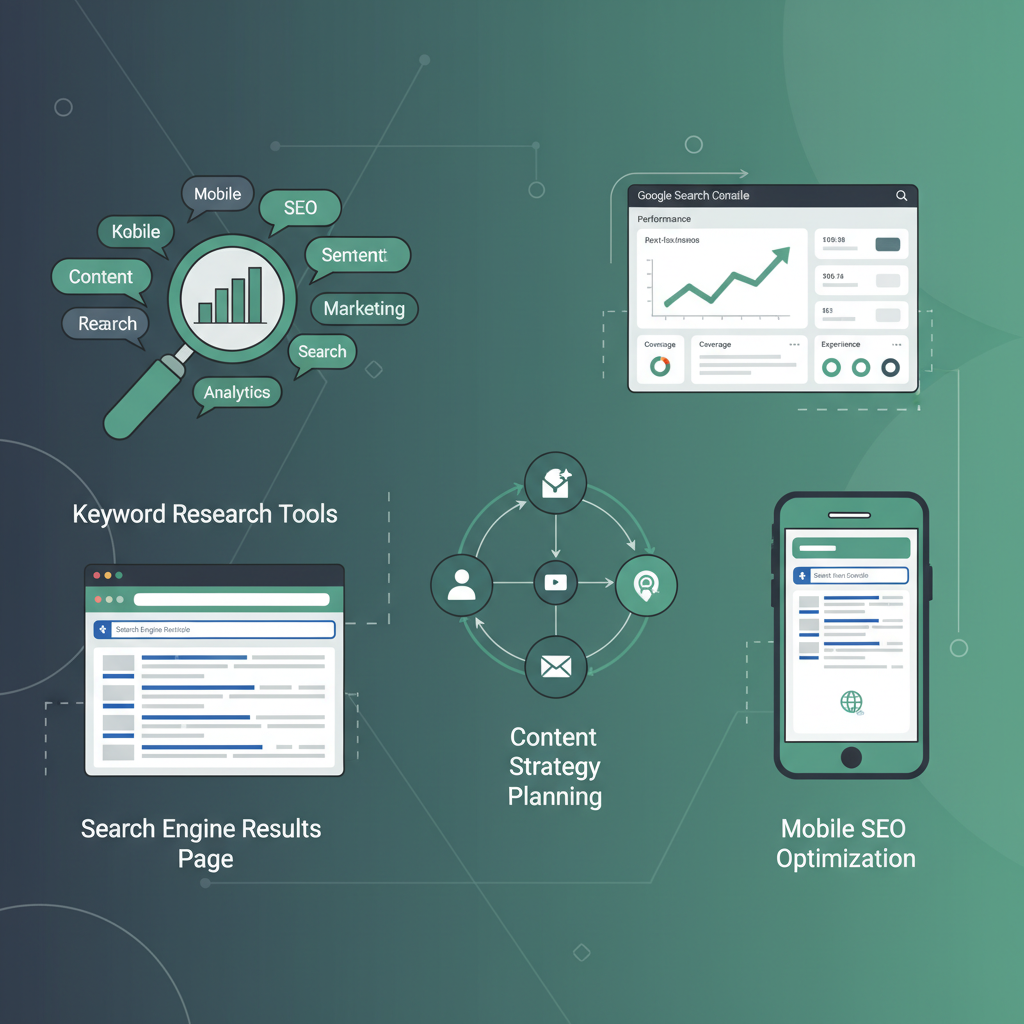
Keyword research is the foundation of every successful SEO campaign. Without understanding what your customers are actually typing into Google, you are essentially building a house on sand. For UK businesses looking to improve their organic visibility, mastering keyword research is not just a nice-to-have - it is the single most important step in your entire digital marketing strategy.
Whether you run a small business in Manchester, a professional services firm in London, or an e-commerce shop serving customers across the United Kingdom, the principles of effective keyword research remain the same. You need to find the terms that real people use when they are looking for what you offer, then create content that answers those searches better than anyone else.
Why Keyword Research Matters More Than Ever
Search engines have evolved dramatically over the past decade. Google now processes over 8.5 billion searches per day, and the competition for visibility has never been fiercer. In the UK market specifically, businesses face unique challenges - from regional search variations to industry-specific terminology that differs from American English.
The days of simply stuffing a page with keywords and hoping for the best are long gone. Modern keyword research requires a strategic approach that considers search intent, competition levels, and the commercial value of each term. Get this right, and you will attract visitors who are genuinely interested in what you offer. Get it wrong, and you will waste months creating content that nobody finds.
Understanding Search Intent
Before you even open a keyword research tool, you need to understand the concept of search intent. Every search query falls into one of four categories, and recognising which category a keyword belongs to will shape your entire content strategy.
Informational intent covers searches where the user wants to learn something. Queries like "what is cloud computing" or "how does cyber security work" fall into this category. These searchers are not ready to buy - they are gathering information. Content targeting these keywords should educate and build trust.
Navigational intent describes searches where the user is looking for a specific website or brand. Someone searching "Cloudswitched login" or "BBC News" already knows where they want to go. Unless these searches relate to your own brand, they are generally not worth targeting.
Commercial investigation intent sits between informational and transactional. Searches like "best IT support companies in London" or "managed services vs break-fix comparison" indicate someone who is researching options before making a decision. These keywords are extremely valuable because the searcher is actively considering a purchase.
Transactional intent represents searchers who are ready to act. Queries such as "buy office 365 licence UK" or "hire IT consultant near me" signal clear purchasing intent. These keywords typically have the highest conversion rates but also the most competition.
When building your keyword list, aim for a balanced mix of intent types. Informational keywords drive volume and build authority, whilst commercial and transactional keywords drive revenue. A healthy ratio for most UK businesses is roughly 60% informational, 25% commercial, and 15% transactional content.
How to Find Keywords Your Customers Actually Use
There are dozens of keyword research tools available, ranging from free options to enterprise-level platforms. The good news is that you do not need to spend a fortune to conduct effective research. Here is a practical, step-by-step approach that works for businesses of any size.
Step 1: Start With Seed Keywords
Seed keywords are the broad terms that describe your business, products, or services. If you run an IT support company, your seed keywords might include "IT support," "managed IT services," "cyber security," and "cloud computing." Write down every term you can think of that relates to what you do.
A useful exercise is to imagine you are a potential customer. What would you type into Google if you needed the services you offer? Ask your sales team what questions prospects commonly ask. Check your email inbox for the language clients use when describing their problems. These real-world phrases often make excellent seed keywords.
Step 2: Expand With Keyword Tools
Once you have your seed keywords, it is time to expand them using dedicated tools. Google's own Keyword Planner is free and provides solid data on search volumes and competition. For more detailed analysis, tools like Ahrefs, SEMrush, and Ubersuggest offer deeper insights into keyword difficulty, click-through rates, and related terms.
Enter each seed keyword into your chosen tool and examine the suggestions it returns. Pay particular attention to long-tail keywords - these are longer, more specific phrases that typically have lower competition and higher conversion rates. For example, "IT support" might be fiercely competitive, but "outsourced IT support for law firms in Birmingham" could be much easier to rank for and attract exactly the right audience.
Step 3: Analyse Google Autocomplete and Related Searches
One of the most underrated keyword research techniques is simply using Google itself. Start typing a search query and note the autocomplete suggestions that appear. These suggestions are based on real searches that people actually perform, making them invaluable for understanding customer language.
Similarly, scroll to the bottom of any Google search results page and look at the "Related searches" section. These terms give you additional keyword ideas that Google considers closely related to your original query. The "People also ask" boxes that appear in many search results are another goldmine of question-based keywords that you can target with your content.
Step 4: Study Your Competitors
Your competitors have likely already done significant keyword research of their own. By analysing which keywords they rank for, you can identify opportunities you might have missed and find gaps in their strategy that you can exploit.
Using a tool like Ahrefs or SEMrush, enter a competitor's domain and examine their organic keyword rankings. Look for keywords where they rank on page two or three - these represent terms where the competition has invested effort but not yet achieved dominant positions. You may be able to create superior content and overtake them.
Evaluating and Prioritising Keywords
Once you have built a substantial list of potential keywords, the next challenge is deciding which ones to target first. Not all keywords are created equal, and spreading your efforts too thinly across hundreds of terms will produce poor results. You need a framework for evaluation.
Search Volume
Search volume tells you how many times a keyword is searched per month. Higher volumes generally mean more potential traffic, but they also usually mean more competition. For most UK businesses, keywords with monthly search volumes between 100 and 5,000 offer the best balance of opportunity and achievability.
Be cautious about chasing high-volume head terms. A keyword with 50,000 monthly searches might seem attractive, but if your website is relatively new or lacks authority, you will struggle to rank for it. Focus on terms where you have a realistic chance of reaching page one within six to twelve months.
Keyword Difficulty
Most keyword research tools provide a difficulty score that estimates how hard it will be to rank for a given term. This score typically considers factors like the domain authority of currently ranking pages, the quality of their content, and the number of backlinks they have.
As a general rule, newer websites should target keywords with difficulty scores below 30 (out of 100). More established sites with stronger link profiles can aim for keywords in the 30-60 range. Only the most authoritative websites should regularly target keywords above 60.
Commercial Value
The commercial value of a keyword relates to how likely a searcher is to become a customer. You can gauge this by looking at the cost-per-click (CPC) in Google Ads - higher CPCs indicate that advertisers consider the keyword valuable, which usually correlates with conversion potential.
A keyword with modest search volume but high commercial intent is often more valuable than a high-volume informational keyword. For instance, "IT support pricing London" might only get 200 searches per month, but each visitor is likely much closer to making a purchasing decision than someone searching "what is IT support."
| Tool | Cost | Best For |
|---|---|---|
| Google Keyword Planner | Free (with Google Ads account) | Search volume data, CPC estimates, and basic keyword suggestions for UK-specific searches |
| Google Search Console | Free | Discovering which keywords your site already ranks for, identifying quick-win improvement opportunities |
| Ahrefs | From £79/month | Comprehensive keyword difficulty scores, competitor analysis, content gap identification |
| SEMrush | From £99/month | All-in-one keyword research, position tracking, site audit, and content planning for UK markets |
| Ubersuggest | Free tier / from £29/month | Budget-friendly keyword suggestions and SEO difficulty analysis for small UK businesses |
| AnswerThePublic | Free tier / from £9/month | Visualising question-based queries and preposition-based long-tail keyword opportunities |
| Google Trends | Free | Comparing keyword popularity over time, identifying seasonal trends across UK regions |
| AlsoAsked | Free tier / from £15/month | Mapping "People Also Ask" question clusters to build comprehensive topic coverage |
Strategic Keyword Research
Ad-Hoc Keyword Picking
Organising Your Keywords Into Content Clusters
Modern SEO favours a topic cluster approach over targeting individual keywords in isolation. This involves identifying broad topic areas (pillar topics) and then creating multiple pieces of content around related subtopics (cluster content) that all link back to a comprehensive pillar page.
For example, if "cyber security" is a pillar topic, your cluster content might cover subtopics like "phishing prevention," "ransomware protection," "password management," "employee security training," and "data breach response." Each piece of content targets different keywords but reinforces your authority on the broader topic.
This approach works exceptionally well because Google increasingly evaluates topical authority. A website that covers a subject comprehensively, with multiple interlinked pieces of quality content, will generally outrank a site that publishes a single article on the same topic.
Local Keyword Research for UK Businesses
If your business serves a specific geographic area, local keyword research deserves special attention. UK searchers frequently include location modifiers in their queries - "IT support Manchester," "accountant in Leeds," or "web design agency Bristol."
Research location-specific variations of your core keywords. Remember that people might search for your city, county, region, or even specific neighbourhoods. In London, for example, searchers might specify "IT support Canary Wharf" or "managed services City of London" rather than just "IT support London."
Google My Business data can be particularly helpful for local keyword research. If you have a Google Business Profile, check the search terms report to see exactly which queries are triggering your listing to appear. These real-world search terms should inform your local content strategy.
Regional language differences also play a role in local UK keyword research. Terminology varies across the country - what is called a "solicitor" in England and Wales may be referred to as an "advocate" in Scotland. Similarly, industry-specific terms can differ by region. Understanding these nuances ensures your keyword strategy reflects how local customers actually search, rather than how you assume they do.
Voice Search and Conversational Keywords
Voice search is no longer a futuristic concept - it is a present-day reality that UK businesses cannot afford to ignore. According to Ofcom's 2024 Communications Market Report, over 40% of UK adults use voice assistants regularly, and a growing proportion of those interactions involve search queries. Voice searches tend to be longer, more conversational, and more likely to be phrased as complete questions compared to typed searches.
Where a typed search might be "plumber Leeds emergency," a voice search is more likely to be "who is the best emergency plumber near me in Leeds?" This distinction has significant implications for keyword research. To capture voice search traffic, you need to identify and target natural language phrases and question-based queries that mirror how people actually speak.
Tools like AnswerThePublic and AlsoAsked are particularly useful for uncovering these conversational queries. Structure your content to directly answer questions - using the question as a subheading and providing a clear, concise answer in the first paragraph below it. This format is also ideal for earning featured snippets (position zero in Google results), which are the primary source for voice assistant responses.
For UK businesses, voice search also amplifies the importance of local SEO. A significant proportion of voice searches have local intent - "where is the nearest..." or "find a... near me." Ensure your Google Business Profile is complete, accurate, and optimised, and that your website content includes natural references to your location and service areas.
Seasonal Keyword Trends for UK Businesses
Keyword demand is not static - it fluctuates throughout the year based on seasons, events, and industry cycles. Understanding these patterns allows you to plan content in advance and capture traffic at precisely the right moment.
Google Trends is the essential tool for seasonal keyword analysis. It allows you to compare search interest over time, filtered by UK region, and identify recurring patterns. For example, searches for "accountant near me" spike every January as individuals and businesses prepare for the tax year end in April. Searches for "garden designer" peak in March and April as the spring season approaches. "Christmas gift ideas" begins climbing in September and peaks in late November.
Plan your content calendar around these seasonal patterns. The key is to publish content several weeks before the expected surge - Google needs time to crawl, index, and rank your pages. If you wait until the search volume peaks to publish, you will miss the opportunity entirely. A well-timed piece of content, published four to six weeks before seasonal demand peaks, can capture traffic that competitors who react too slowly will miss.
UK-specific events create additional keyword opportunities. The Budget announcement, bank holidays, school term dates, and industry-specific regulatory deadlines all generate predictable search spikes. Map these events to your keyword calendar and create targeted content that serves the needs of searchers at those specific moments.
Measuring the ROI of Your Keyword Research
Keyword research is an investment of time and often money (for paid tools), so it is important to measure whether that investment is delivering returns. The ultimate metric is revenue generated from organic search, but tracking this requires connecting your keyword strategy to business outcomes through a clear measurement framework.
Start with Google Search Console, which shows you exactly which keywords are driving impressions and clicks to your website. Track your target keywords over time to measure improvements in ranking position, click-through rate, and total traffic. Set up conversion tracking in Google Analytics 4 so that you can attribute enquiries, leads, and sales to specific organic landing pages - and by extension, to the keywords those pages target.
Calculate the value of your organic keyword traffic by comparing it to equivalent paid traffic costs. If a keyword you rank for organically would cost £3.50 per click in Google Ads, and that keyword drives 500 clicks per month, the organic ranking is saving you £1,750 per month - or £21,000 per year. This "equivalent paid value" metric is one of the most compelling ways to demonstrate SEO ROI to stakeholders and justify continued investment in keyword research and content creation.
For UK businesses specifically, the Centre for Economics and Business Research estimates that organic search contributes over £40 billion annually to the UK economy. The businesses capturing the largest share of this value are those that approach keyword research as a strategic, ongoing discipline rather than a one-off task.
Common Keyword Research Mistakes to Avoid
Even experienced marketers sometimes fall into keyword research traps. Here are the most common mistakes that UK businesses make, and how to avoid them.
Ignoring search intent: Targeting a keyword without understanding what the searcher actually wants is a recipe for high bounce rates and poor rankings. Always check the current search results for a keyword before deciding to target it. If the top results are all informational blog posts, do not try to rank a product page for that term.
Focusing only on volume: High search volume does not automatically equal high value. A keyword that brings thousands of visitors who never convert is less valuable than one that brings dozens of visitors who become paying customers.
Neglecting long-tail keywords: Many businesses obsess over short, competitive keywords whilst ignoring the long-tail variations that could drive targeted traffic much more quickly. Long-tail keywords are easier to rank for and often convert better because they are more specific.
Not updating your research: Search trends change constantly. Keywords that were popular two years ago might have declined, whilst new terms emerge as industries evolve. Review and refresh your keyword research at least quarterly to stay current.
Using American English: UK businesses targeting UK customers should use British spelling and terminology. "Optimise" rather than "optimize," "colour" rather than "color," and industry-specific terms that British searchers prefer. This seems minor but can make a meaningful difference for local relevance.
Ignoring keyword cannibalisation: This occurs when multiple pages on your website target the same keyword, causing them to compete against each other in search results. Before creating new content, check whether you already have a page targeting that keyword. If you do, consider updating and strengthening the existing page rather than creating a new one that will dilute your authority.
Putting Your Keyword Research Into Action
Keyword research is only valuable if you act on it. Once you have your prioritised list of target keywords, create a content calendar that maps each keyword to a specific piece of content. Assign target keywords to existing pages where appropriate, and plan new content for keywords that your website does not yet cover.
For each piece of content, ensure that the target keyword appears naturally in the page title, the first paragraph, at least one subheading, and throughout the body text. But never force keywords in where they do not fit naturally - Google's algorithms are sophisticated enough to understand synonyms and related terms, so readability should always come first.
Track your rankings for each target keyword using a tool like Google Search Console, Ahrefs, or SEMrush. Monitor your progress over time and adjust your strategy based on what is working. SEO is an iterative process, and the insights you gain from tracking your results will make each round of keyword research more effective than the last.
Effective keyword research is not a one-time task but an ongoing discipline that should inform every piece of content you create. By consistently identifying and targeting the right keywords, you will build a steady stream of organic traffic that grows month after month, delivering qualified leads and customers without the ongoing cost of paid advertising.
The businesses that dominate search results in the UK are not necessarily those with the biggest budgets - they are those that understand their customers' language, anticipate their questions, and provide genuinely useful answers. That understanding begins with thorough, strategic keyword research. Start with your seed keywords today, expand methodically, prioritise ruthlessly, and build content that serves real searcher needs. The organic traffic and leads will follow.
Need Help With Your Keyword Research Strategy?
Cloudswitched helps UK businesses identify the keywords that drive real results. From comprehensive keyword audits to full content strategies, our SEO specialists will help you attract the customers who are already searching for what you offer.

CloudSwitched
London-based managed IT services provider offering support, cloud solutions and cybersecurity for SMEs.


