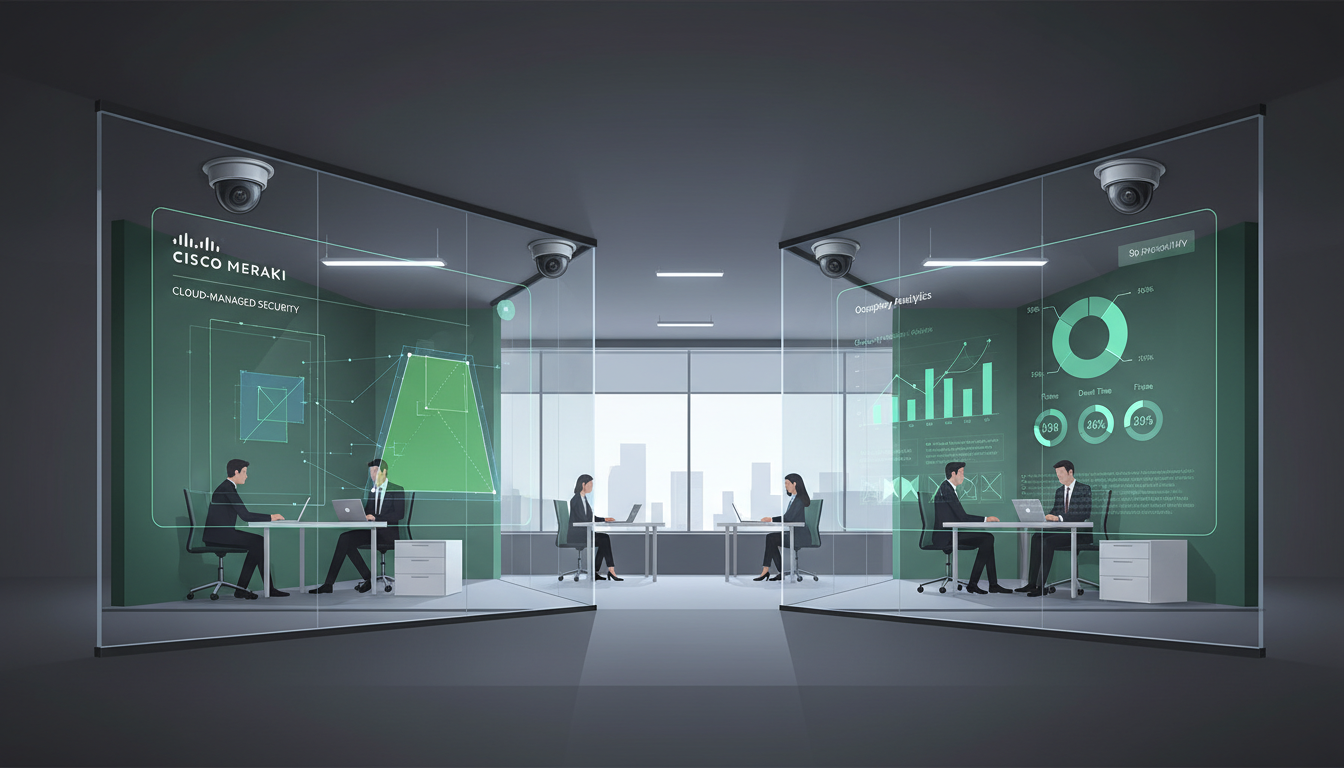
Physical security is a fundamental requirement for every UK business, yet traditional CCTV systems have long been a source of frustration. Clunky on-site recording equipment, grainy footage, complex wiring requirements, and the inability to check cameras remotely have made conventional surveillance systems a necessary evil rather than a genuinely useful business tool.
Cisco Meraki MV smart cameras represent a fundamentally different approach to office security. Built on Meraki's cloud-first architecture, these cameras combine enterprise-grade video surveillance with cloud management, on-camera analytics powered by artificial intelligence, and a management experience that is as intuitive as checking your email. For UK businesses looking to modernise their physical security, Meraki MV offers capabilities that were previously available only to large enterprises with dedicated security teams and six-figure budgets.
This guide explores how Meraki MV smart cameras work, what makes them different from traditional CCTV, how they integrate with your broader IT infrastructure, and what UK businesses need to consider when deploying them.
The commercial security landscape in the United Kingdom has shifted considerably over the past decade. With rising concerns about workplace safety, insurance requirements demanding verifiable surveillance coverage, and the increasing sophistication of threats facing businesses of all sizes, the need for reliable, intelligent security systems has never been greater. Traditional analogue CCTV systems, whilst still prevalent in many UK offices and retail premises, are increasingly unable to meet the demands of modern security operations. Their limitations in image quality, remote accessibility, and data management make them a poor fit for organisations that need to respond quickly to incidents and extract meaningful insights from their surveillance infrastructure.
Cloud-managed camera systems like Meraki MV address these limitations by leveraging modern computing architecture and artificial intelligence. Rather than treating cameras as simple recording devices, the Meraki approach transforms them into intelligent sensors that can detect, classify, and alert on events in real time. This shift from passive recording to active monitoring represents a fundamental change in how businesses can approach physical security, turning what was once a reactive tool into a proactive one.
How Meraki MV Cameras Work
Unlike traditional CCTV systems that record footage to a centralised Network Video Recorder (NVR) or Digital Video Recorder (DVR), Meraki MV cameras store video footage directly on the camera itself using built-in solid-state storage. Each camera is an independent, self-contained unit that records, stores, and processes video locally. The Meraki cloud dashboard provides remote management, live viewing, and analytics access from anywhere with an internet connection.
This architecture eliminates the need for expensive on-site recording hardware, reduces network bandwidth requirements (because video streams do not need to traverse the network to reach a central recorder), and provides resilience - each camera continues recording even if the network connection to the Meraki cloud is temporarily lost.
Management is handled entirely through the Meraki cloud dashboard, the same platform used to manage Meraki networking equipment (access points, switches, firewalls, and SD-WAN appliances). This unified management approach means your IT team or managed service provider can monitor and configure cameras alongside all other network infrastructure from a single pane of glass.
Firmware Updates and Lifecycle Management
One of the most underappreciated benefits of cloud-managed cameras is the simplification of firmware management. Traditional CCTV cameras require manual firmware updates, which are often neglected because the process is cumbersome and carries the risk of disrupting the system. As a result, many traditional CCTV installations run outdated firmware with known security vulnerabilities, making them potential entry points for cyber attackers who target IoT devices.
Meraki MV cameras receive firmware updates automatically through the cloud dashboard. These updates are scheduled during maintenance windows to minimise disruption, tested across Meraki's global install base before deployment, and can be rolled back if issues are detected. This ensures that every camera in your estate is always running the latest firmware with the most current security patches. For UK businesses that must comply with Cyber Essentials or other security frameworks, this automated approach to patch management is a significant advantage.
The cloud dashboard also provides comprehensive lifecycle management. You can monitor the health and status of every camera in real time, receive proactive alerts when a camera goes offline or experiences hardware issues, and plan replacements before failures occur. This predictive approach to maintenance reduces downtime and ensures continuous surveillance coverage across all your premises.
Traditional CCTV systems require a dedicated NVR - a specialised computer that receives and stores video streams from all cameras. NVRs are expensive (typically £1,000–£5,000 depending on capacity), require maintenance, consume power, take up rack space, and represent a single point of failure. If the NVR fails, all cameras stop recording. Meraki MV eliminates this entirely. Each camera is independent, so a failure in one camera has no impact on any other. There is no central recording device to purchase, power, cool, or maintain. This reduces both cost and complexity significantly.
Intelligent Analytics: More Than Just Recording
Where Meraki MV truly differentiates itself from traditional CCTV is in its built-in analytics capabilities. Each camera includes an onboard processor that runs computer vision algorithms directly on the device, without sending video to the cloud for processing. This edge computing approach means analytics run in real time with no latency, no cloud processing costs, and no privacy concerns about streaming video externally.
People Detection and Counting
Meraki MV cameras can detect and count people in the camera's field of view. This is useful for monitoring office occupancy levels, tracking footfall in retail environments or reception areas, understanding how meeting rooms and communal spaces are utilised, and ensuring compliance with maximum occupancy limits. The people counting data is aggregated and presented in the Meraki dashboard as historical trends, giving you insights into how your spaces are used over time.
Leveraging Analytics for Business Intelligence
Beyond their core security function, the analytics capabilities of Meraki MV cameras offer genuine business intelligence value. UK retailers, for example, can use people counting data to correlate footfall with sales figures, identifying peak trading periods and optimising staff rotas accordingly. Office-based businesses can use occupancy data to make informed decisions about real estate, potentially reducing their property footprint by identifying underutilised floors or buildings.
The analytics data is accessible through the Meraki dashboard API, which means it can be integrated with third-party business intelligence platforms, building management systems, and custom applications. A facilities management team could, for instance, use occupancy data to automate heating and lighting schedules, reducing energy costs whilst maintaining comfort for occupants. An HR department might use anonymised movement pattern data to assess whether open-plan office redesigns have achieved their intended goal of encouraging collaboration.
Motion Search and Heat Maps
Rather than scrubbing through hours of footage to find a specific event, Meraki MV's motion search allows you to draw a region of interest on the camera view and instantly find all moments when motion was detected in that area. Heat maps visualise movement patterns over time, showing you which areas of your office receive the most foot traffic and which are underutilised.
These visual analytics tools are particularly valuable for post-incident investigation. When a security event occurs, the motion search capability allows security personnel to rapidly identify the exact moment and location of the incident without trawling through hours of continuous footage. For UK businesses that need to provide evidence to police or insurers, this capability dramatically reduces the time required to produce relevant clips. The ability to export specific segments of footage directly from the dashboard, with metadata intact, creates an evidence chain that is far more robust than the manual processes required with traditional CCTV systems.
Heat mapping data also provides long-term strategic value for facilities planning. By analysing movement patterns over weeks and months, businesses can identify bottlenecks in office layouts, optimise the placement of shared resources such as printers and kitchen facilities, and make evidence-based decisions about office redesigns. Several UK businesses have reported significant improvements in employee satisfaction after using Meraki MV heat map data to reconfigure their office spaces based on actual usage patterns rather than assumptions.
Comparing operational efficiency between Meraki MV and traditional CCTV systems
The Meraki MV Camera Range
Meraki offers a range of camera models suited to different environments and use cases. Understanding the differences helps you select the right model for each location in your office.
Deployment Planning and Camera Placement
Selecting the right camera models is only part of the deployment process. Effective camera placement requires careful planning to ensure comprehensive coverage without excessive overlap or blind spots. For UK offices, key areas that typically require camera coverage include main entrances and exits, reception areas, server rooms and IT infrastructure areas, car parks, loading bays, and external perimeter areas. Internal corridors and stairwells may also warrant coverage depending on your security requirements and the outcomes of your risk assessment.
Meraki provides a camera placement tool within the dashboard that allows you to upload floor plans and position cameras virtually, visualising their field of view and identifying coverage gaps before installation begins. This planning capability reduces the risk of discovering blind spots after cameras are installed and minimises the need for costly repositioning. For multi-site UK businesses, the ability to plan and standardise camera deployments across all locations from a central dashboard ensures consistency and simplifies ongoing management.
It is also worth considering environmental factors during deployment planning. Indoor cameras such as the MV2 and MV12 are designed for controlled environments and should not be exposed to extreme temperatures or moisture. Outdoor models like the MV52 carry an IP67 rating, meaning they are fully protected against dust and can withstand temporary immersion in water, making them suitable for the often challenging British weather conditions. Lighting conditions should also be assessed, as camera performance varies depending on available light. Models with wide dynamic range capabilities handle mixed lighting conditions far more effectively than standard cameras.
| Model | Type | Resolution | Best For | Indoor/Outdoor |
|---|---|---|---|---|
| MV2 | Fixed Mini Dome | 1080p | Indoor spaces, corridors, reception | Indoor |
| MV12 | Mini Dome | 4K / 1080p | Offices, meeting rooms, retail | Indoor |
| MV22 | Fixed Dome | 1080p | Wide area indoor coverage | Indoor |
| MV32 | Fisheye | 8.4 MP | 360-degree coverage, open plan offices | Indoor |
| MV52 | Outdoor Dome | 4K | Car parks, building exteriors, loading bays | Outdoor (IP67) |
| MV72 | Outdoor Varifocal | 1080p | Perimeter security, long-range monitoring | Outdoor (IP67) |
GDPR and UK Data Protection Considerations
Any business deploying CCTV cameras in the UK must comply with GDPR and the Data Protection Act 2018. This applies equally to Meraki MV cameras and traditional CCTV systems. The key requirements include having a lawful basis for processing (typically legitimate interests for security), conducting a Data Protection Impact Assessment (DPIA) for systematic monitoring of public areas, displaying clear signage informing people that CCTV is in operation, having a documented CCTV policy, responding to Subject Access Requests (SARs) for footage, and limiting retention periods to what is necessary.
The ICO provides detailed guidance on CCTV use in commercial premises. For most UK offices, the legitimate interests basis is appropriate, but you must be able to demonstrate that the intrusion on privacy is proportionate to the security benefit. Cameras in private areas such as toilets or changing rooms are never appropriate, and cameras monitoring workstations raise significant employee privacy concerns that need careful consideration.
Implementing a GDPR-Compliant CCTV Policy
For UK businesses deploying Meraki MV cameras, developing a comprehensive CCTV policy is not merely a best practice but a legal requirement under the Data Protection Act 2018 and UK GDPR. This policy should clearly articulate the purpose of the surveillance, specify who has access to the footage and under what circumstances, define retention periods, and outline the process for handling Subject Access Requests.
A well-drafted CCTV policy should include the identity of the data controller, the lawful basis for processing (typically legitimate interests for security purposes), a description of the areas covered and the purpose of coverage in each area, details of who can access footage and the authorisation process, the retention period for footage and the process for secure deletion, how individuals can submit Subject Access Requests and the timeframe for response, and the complaints procedure for individuals who believe their rights have been infringed.
Meraki MV simplifies compliance with several of these requirements. The dashboard provides granular access controls, allowing you to restrict video access to authorised personnel only and maintain an audit trail of who accessed which camera footage and when. Automatic retention policies ensure footage is deleted after your specified period without manual intervention, reducing the risk of retaining data longer than necessary. When responding to a Subject Access Request, the motion search feature allows you to quickly locate all footage featuring a particular individual, significantly reducing the administrative burden of SAR compliance.
Meraki MV GDPR Advantages
- Video stored locally on camera (no cloud storage of footage)
- Automatic retention policy enforcement
- Easy SAR compliance with motion search
- Audit trail of dashboard access
- Granular user permissions for video access
- Encryption of stored footage
Traditional CCTV GDPR Challenges
- Manual deletion processes for retention compliance
- Difficult to search footage for SAR responses
- Limited or no access audit trail
- Physical access to NVR hard to control
- Footage often stored unencrypted
- No automated policy enforcement
Integration with the Meraki Ecosystem
One of the most compelling aspects of Meraki MV is its integration with the broader Meraki ecosystem. If your business already uses Meraki wireless access points (MR series), switches (MS series), or security appliances (MX series), adding MV cameras creates a unified, cloud-managed infrastructure where all components are visible and manageable from a single dashboard.
This integration enables powerful cross-platform capabilities. Meraki's wireless location analytics can be combined with camera data to build a comprehensive picture of how people move through your office. Network access policies can be correlated with camera footage for security investigations. Alerts from cameras can be integrated into your existing monitoring and notification workflows.
API Access and Third-Party Integrations
The Meraki dashboard exposes a comprehensive REST API that enables programmatic access to camera feeds, analytics data, and management functions. For UK businesses with in-house development capabilities or a managed service provider, this API opens up a range of integration possibilities. Camera alerts can be fed into a Security Information and Event Management platform for centralised security monitoring. Occupancy data can be integrated with access control systems to provide a complete picture of who is in the building at any given time. Analytics data can be pushed to business intelligence dashboards for management reporting.
Meraki MV also integrates with popular building management and physical security platforms through its ecosystem of technology partners. This means that rather than operating cameras as a standalone system, businesses can incorporate them into a unified physical security environment that includes access control, intrusion detection, and environmental monitoring. For larger UK organisations with dedicated security operations, this level of integration transforms Meraki MV from a simple camera system into a cornerstone of a comprehensive security infrastructure.
All Meraki MV cameras support Power over Ethernet (PoE), which means they receive both data connectivity and electrical power through a single Ethernet cable. When paired with Meraki PoE switches, this eliminates the need for separate power cables and electrical outlets at each camera location. A single network cable from the nearest switch provides everything the camera needs, dramatically simplifying installation and reducing cabling costs. This is particularly valuable in offices where running additional electrical circuits to camera locations would be disruptive and expensive.
Cost Considerations for UK Businesses
Meraki MV cameras represent a higher upfront cost per camera compared to budget CCTV options. However, when you factor in the elimination of the NVR, the reduction in cabling requirements (PoE means no separate power runs), the minimal ongoing management overhead, and the value of built-in analytics, the total cost of ownership is often comparable or lower than a traditional system of equivalent quality.
Meraki cameras require an ongoing licence subscription (typically bundled for 3, 5, or 7 years at purchase). This subscription covers access to the cloud dashboard, firmware updates, analytics features, and technical support. While the subscription model means you never stop paying for the system, it also means you always have access to the latest features and security updates without additional investment.
Calculating Total Cost of Ownership
When evaluating the financial case for Meraki MV, it is important to consider the total cost of ownership rather than focusing solely on the per-camera price. A comprehensive cost analysis should include hardware costs for cameras and any required mounting hardware, licensing fees over the expected deployment lifetime, installation and cabling costs, network infrastructure costs including PoE switches if not already in place, and ongoing management and maintenance costs.
For a typical UK office deployment of ten indoor cameras, the total five-year cost comparison is illustrative. A traditional CCTV system might cost less in hardware and have no licensing fees, but the addition of an NVR, professional installation with separate power and data cabling, periodic maintenance visits, and the cost of NVR replacement when storage fills or hardware fails typically brings the total to a comparable level. When you add the value of built-in analytics, automated firmware updates, and the ability for your IT team to manage the system remotely without site visits, the Meraki MV system often represents better overall value despite the higher initial per-camera cost.
UK businesses should also consider the insurance implications. Many commercial insurers offer reduced premiums for businesses with cloud-managed, remotely monitored surveillance systems. The ability to demonstrate that your cameras are always online, always recording, and always running current firmware can strengthen your insurance position and may result in savings that offset a portion of the licensing cost.
Modernise Your Office Security with Meraki MV
Cloudswitched is a Cisco Meraki partner, providing design, deployment, and management of Meraki MV smart camera systems for UK businesses. From single-office installations to multi-site deployments, we deliver cloud-managed security that integrates seamlessly with your existing Meraki infrastructure. Contact us for a site survey and quotation.
REQUEST A SITE SURVEY
CloudSwitched
London-based managed IT services provider offering support, cloud solutions and cybersecurity for SMEs.


