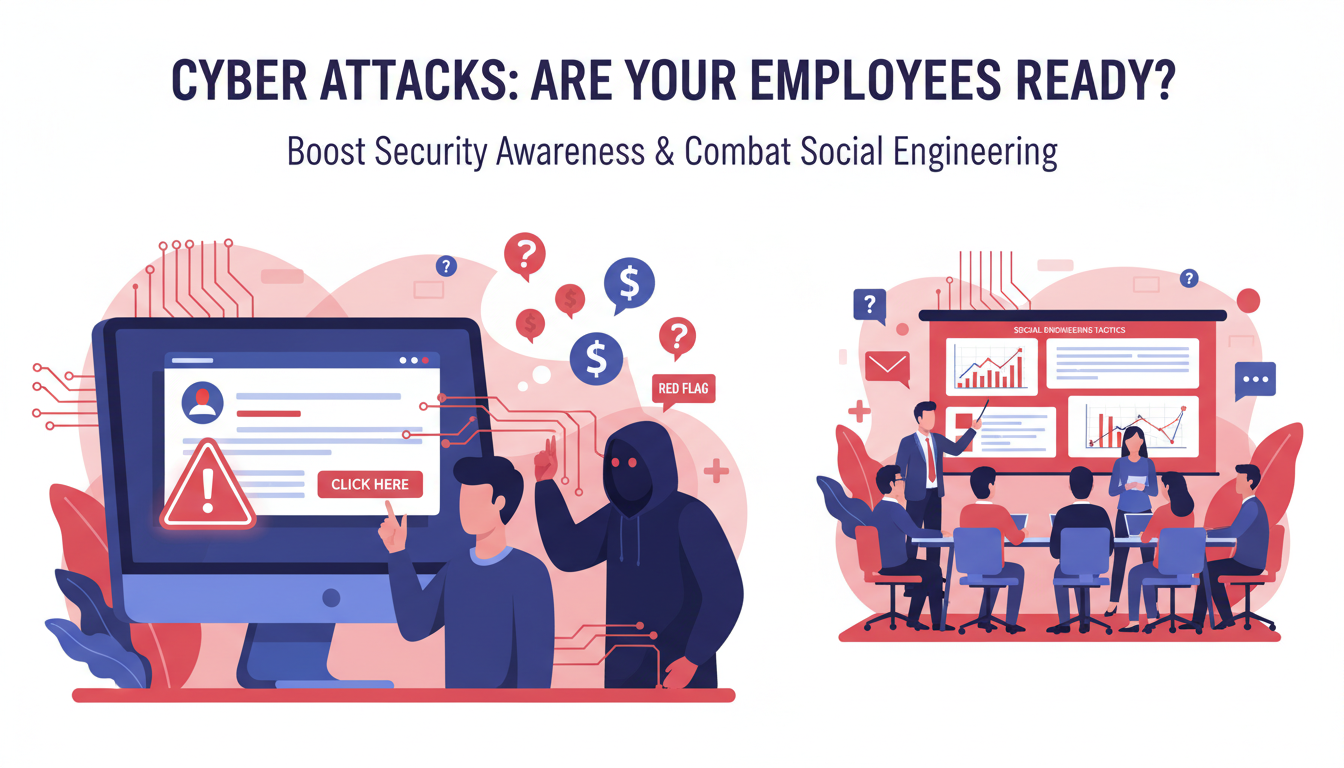
The most sophisticated firewall in the world cannot protect your business if an employee willingly hands over their login credentials to an attacker posing as the IT department. The most advanced email security cannot stop a finance team member from making a fraudulent bank transfer if they believe the instruction came from the managing director. The most robust network security is meaningless if someone holds the door open for a stranger who claims to be a delivery driver.
Social engineering - the art of manipulating people into divulging confidential information or performing actions that compromise security - remains the single most effective attack vector used by cybercriminals. According to the UK Government's Cyber Security Breaches Survey, phishing (the most common form of social engineering) was involved in 84% of businesses that reported a cyber security breach. The NCSC consistently identifies social engineering as one of the top threats to UK organisations of all sizes.
This guide explains the most common social engineering techniques targeting UK businesses, how to recognise them, and - most importantly - how to build a security culture that makes your team resilient against these attacks.
Understanding Social Engineering
Social engineering exploits human psychology rather than technical vulnerabilities. Attackers understand that people naturally want to be helpful, tend to trust authority figures, respond urgently under pressure, and are less vigilant when they believe they are communicating with someone they know. By exploiting these tendencies, skilled social engineers can bypass technical security controls entirely.
Unlike brute-force hacking attempts that leave clear technical traces, social engineering attacks often leave no log entries, no malware signatures, and no network anomalies. The attacker's weapon is persuasion, and their target is human judgement. This makes social engineering exceptionally difficult to detect with technology alone and is why employee awareness and training are the most effective countermeasures.
The Psychology Behind Social Engineering
To defend against social engineering effectively, it helps to understand why these attacks work so reliably. Social engineers exploit well-documented cognitive biases and psychological principles that govern how all human beings process information and make decisions under pressure. Understanding these principles equips your team to recognise when they are being manipulated.
The principle of authority causes people to comply with requests from perceived authority figures without questioning them. When an email appears to come from the chief executive or a senior partner, employees are naturally inclined to follow the instruction rather than challenge it. The principle of urgency narrows our focus and reduces our capacity for critical thinking - when we are told something must be done immediately, we are far less likely to pause and verify. Social proof leads us to assume that if others appear to be doing something, it must be legitimate. Reciprocity makes us feel obligated to help someone who has apparently helped us first. Scarcity convinces us that a valuable opportunity will be lost if we do not act quickly.
These are not signs of weakness or carelessness - they are fundamental aspects of human psychology that evolved to help us navigate complex social situations efficiently. The challenge for businesses is that these same instincts, which serve us well in everyday life, become dangerous vulnerabilities when deliberately exploited by a skilled attacker. Effective security awareness training does not attempt to eliminate these instincts but instead teaches employees to recognise the situations where they are most likely to be exploited, creating a conscious pause between stimulus and response that gives critical thinking an opportunity to intervene before damage is done.
Common Social Engineering Techniques
Phishing
Phishing is the most prevalent form of social engineering. Attackers send emails that appear to come from legitimate organisations - banks, cloud service providers, delivery companies, government agencies, or even your own IT department - to trick recipients into clicking malicious links, opening infected attachments, or entering their credentials on fake websites. Modern phishing emails are increasingly convincing, often replicating the exact branding, formatting, and tone of legitimate communications.
UK businesses face specific phishing campaigns impersonating HMRC (particularly around tax deadlines), Royal Mail and other delivery services, Companies House, the ICO, Microsoft 365 and other cloud services, and UK banks including Lloyds, Barclays, HSBC, and NatWest. These campaigns are tailored to British business culture and exploit UK-specific events like Self Assessment deadlines, Making Tax Digital requirements, and annual returns.
While mass phishing campaigns cast a wide net, spear phishing targets specific individuals within your organisation. Attackers research their targets using LinkedIn, company websites, and social media to craft highly personalised messages. A spear phishing email might reference a real project you are working on, mention colleagues by name, or reference a genuine upcoming event. Because the message appears so credible, even security-conscious employees can be deceived. Senior executives and finance team members are the most frequent targets because they have authority to approve payments and access sensitive systems.
Business Email Compromise (BEC)
BEC is one of the most financially devastating forms of social engineering. The attacker either compromises a genuine email account (through stolen credentials) or creates a near-identical spoofed email address, then uses it to send instructions that appear to come from a senior executive, supplier, or trusted partner. Common BEC scenarios include fake invoice fraud (an email from what appears to be a supplier requesting payment to a new bank account), CEO fraud (an urgent message apparently from the managing director requesting an immediate payment), and solicitor fraud (a message from what appears to be your legal adviser requesting urgent funds transfer for a property transaction).
BEC attacks targeting UK businesses have increased significantly, with Action Fraud reporting losses in the hundreds of millions of pounds annually. The average loss from a successful BEC attack on a UK SME is approximately £25,000–£50,000, though individual cases have resulted in losses exceeding £1 million.
Vishing (Voice Phishing)
Vishing uses telephone calls instead of emails. The attacker calls pretending to be from your bank, IT provider, Microsoft support, or HMRC, attempting to extract sensitive information or persuade the target to install remote access software. Common vishing scenarios include calls claiming there is a problem with your computer that requires remote access to fix, calls from "your bank" claiming to have detected fraudulent activity on your account, and calls from "HMRC" claiming you owe unpaid taxes and face arrest.
Pretexting
Pretexting involves creating a fabricated scenario (the pretext) to engage the target and extract information or access. For example, an attacker might call reception claiming to be from a maintenance company that needs access to the server room, or send an email posing as a new employee who needs login credentials set up urgently. The pretext provides a plausible reason for the unusual request, making the target more likely to comply.
Tailgating and Physical Social Engineering
Not all social engineering happens through digital channels. Physical social engineering - where an attacker gains unauthorised access to your premises through deception - remains a significant threat, particularly for businesses in shared office buildings or those with regular visitor traffic. Tailgating, where an unauthorised person follows an authorised employee through a secure door, is the most common technique. The attacker might be carrying boxes and ask someone to hold the door, or simply walk confidently behind a group of employees returning from lunch as though they belong there.
Once inside your premises, a physical intruder can plant malicious USB devices on desks, photograph sensitive documents left in plain view, install hardware keyloggers on unattended computers, access server rooms if they are not separately secured, or simply observe passwords being typed on nearby screens. Some sophisticated attacks combine physical and digital elements - for example, an attacker who gains physical access to plant a rogue wireless access point that then provides persistent remote access to your internal network from the car park outside.
Smishing and Quishing
Smishing - phishing via SMS text messages - has surged across the United Kingdom in recent years, with attackers impersonating Royal Mail, HMRC, banks, and delivery services. These messages typically contain links to convincing fake websites designed to harvest login credentials or payment card details. The limited screen space on mobile devices makes it harder to spot fraudulent URLs, and people tend to trust text messages more than emails because they feel more personal and immediate. Quishing, a newer variant, uses QR codes placed in emails, letters, or even physical posters to direct victims to malicious websites. As QR codes became commonplace during the pandemic for restaurant menus and NHS check-ins, people grew accustomed to scanning them without questioning their legitimacy - a behaviour that attackers now exploit with increasing frequency.
Percentage of UK businesses reporting each type of social engineering attack (Cyber Security Breaches Survey)
Building a Human Firewall: Training Your Team
Technical controls - email filtering, multi-factor authentication, web filtering, and endpoint protection - are essential but insufficient on their own. The most effective defence against social engineering is a well-trained workforce that understands the threats, knows how to recognise suspicious communications, and feels empowered to challenge unusual requests even when they appear to come from authority figures.
Regular Security Awareness Training
Every employee should receive security awareness training when they join the organisation and at regular intervals thereafter - quarterly is the recommended frequency. Training should be engaging, practical, and relevant to the specific threats your business faces. Avoid dry, compliance-focused training that employees click through without absorbing. Instead, use real-world examples, interactive scenarios, and brief (15–20 minute) focused sessions that maintain attention.
Simulated Phishing Campaigns
One of the most effective training tools is simulated phishing. Your IT provider or a specialist security company sends realistic phishing emails to your team and tracks who clicks, who reports the email, and who enters credentials on the fake landing page. This provides measurable data on your organisation's vulnerability and identifies individuals or departments that need additional training. Crucially, simulated phishing should be educational rather than punitive - the goal is to help people learn, not to catch them out and embarrass them.
Creating Clear Reporting Procedures
One of the most critical elements of an effective defence against social engineering is making it as easy as possible for staff to report suspicious communications. Many successful attacks could have been prevented if the targeted employee had simply asked a colleague or reported the communication before acting on it. However, in many organisations, employees either do not know how to report a suspicious email, feel uncertain about whether something is genuinely suspicious, or fear being criticised for raising a false alarm.
Your organisation should establish a clear, simple reporting process that every employee knows and understands. This might be a dedicated email address for forwarding suspicious messages, a button integrated into your email client that reports phishing with a single click, or a specific Teams or Slack channel monitored by your IT team. Whatever the mechanism, the key principles are simplicity (it should take seconds rather than minutes), visibility (the process should be prominently communicated and regularly reinforced), and positive reinforcement (every report should receive a prompt, appreciative response regardless of whether the communication turns out to be genuinely malicious).
Organisations with effective reporting cultures see dramatically higher reporting rates and correspondingly faster response times when genuine attacks occur. When an employee reports a phishing email within minutes of receiving it, your IT team can immediately block the sender, remove the same email from other employees' inboxes, and alert the wider organisation - potentially preventing dozens of compromises from a single campaign. This rapid response capability is only possible when reporting is actively encouraged and consistently rewarded.
| Warning Sign | What to Look For | Example |
|---|---|---|
| Urgency | Pressure to act immediately without time to think | "Your account will be suspended in 24 hours" |
| Authority | Claims to be from a senior figure or trusted organisation | "The CEO needs this payment processed today" |
| Unusual requests | Asking for something that deviates from normal processes | "Please pay this invoice to a new bank account" |
| Emotional manipulation | Using fear, curiosity, or greed to override caution | "You have been selected for a tax refund" |
| Mismatched details | Email address or URL does not match the claimed sender | Email from "support@micr0soft.com" instead of microsoft.com |
| Poor grammar | Unusual phrasing, spelling errors, or formatting issues | "Dear Valued Customer, Your account has been compromise" |
Role-Specific Training
While all employees need a baseline understanding of social engineering threats, different roles face different levels and types of risk. A one-size-fits-all training programme misses the opportunity to prepare specific teams for the attacks most likely to target them. Finance teams should receive dedicated training on invoice fraud, payment redirection schemes, and BEC attacks that request urgent transfers. They should practise verifying payment changes through independent channels and understand that no legitimate request should ever be so urgent that proper verification is impossible.
Reception and administrative staff are often the first point of contact for pretexting attacks, whether by telephone, email, or in person. They need specific training on what information should and should not be disclosed to callers, how to verify the identity of unexpected visitors, and the importance of following access control procedures even when it feels socially uncomfortable to challenge someone who appears confident and authoritative. Senior executives require awareness of whaling attacks - highly targeted phishing campaigns that leverage their public profiles, speaking engagements, and published business activities to craft extremely convincing personalised approaches.
IT staff and system administrators face their own category of social engineering attempts, including calls from attackers impersonating software vendors requesting remote access, emails claiming to be from cloud providers requiring urgent credential verification, and social engineering attacks that target the IT team specifically because of their elevated system privileges. Regular, role-specific training ensures that every team in your organisation is prepared for the particular threats most relevant to their daily responsibilities and level of access.
Technical Controls That Complement Training
While training builds awareness, technical controls provide additional layers of protection that catch attacks even when employees make mistakes.
Multi-Factor Authentication (MFA)
MFA is the single most impactful technical control against social engineering. Even if an attacker obtains an employee's password through phishing, they cannot access the account without the second factor (typically a code from an authenticator app or a hardware security key). Microsoft reports that MFA blocks 99.9% of automated account compromise attacks. Every UK business should have MFA enabled on all cloud services, email accounts, VPN connections, and any system containing sensitive data.
Email Security
Advanced email security solutions go beyond basic spam filtering to analyse email content, check sender reputation, scan attachments in sandboxed environments, and detect impersonation attempts. Microsoft Defender for Office 365, Mimecast, Proofpoint, and Barracuda are popular choices for UK businesses. Configure DMARC, DKIM, and SPF records for your email domain to prevent attackers from spoofing your organisation's email addresses when targeting your clients and partners.
Web Filtering and DNS Protection
Even with excellent email security, employees may encounter malicious links through other channels - text messages, social media, instant messaging platforms, or QR codes in physical locations. DNS-level filtering provides a network-wide safety net that blocks access to known malicious websites regardless of how the user encountered the link. Services such as Cisco Umbrella, Cloudflare Gateway, and Microsoft Defender for Endpoint can prevent connections to phishing sites, malware distribution points, and command-and-control servers before any malicious content reaches the user's device.
Web filtering can also be configured to block categories of websites that present elevated risk, such as newly registered domains (which are disproportionately used for phishing), file-sharing sites commonly used to distribute malware, and sites that closely mimic legitimate services. For UK businesses, DNS-level protection is particularly valuable because it works across all devices and all applications - protecting not just web browsing but also any application that connects to the internet, including email clients, messaging apps, and software update mechanisms.
Browser isolation technology represents an emerging layer of protection that is becoming increasingly accessible to mid-sized businesses. Rather than allowing web content to execute directly on the user's device, browser isolation renders web pages in a secure cloud environment and streams only the visual output to the user. This means that even if an employee clicks on a link to a malicious website, no malicious code ever reaches their actual device. While not yet mainstream for smaller businesses, browser isolation is worth discussing with your IT provider as part of a comprehensive defence-in-depth strategy against social engineering attacks that rely on malicious web pages to deliver their payloads.
Effective Security Culture
- Regular, engaging awareness training
- Simulated phishing with educational follow-up
- Clear reporting process for suspicious messages
- No blame culture - reporting is rewarded
- MFA on all business accounts
- Payment verification processes for any changes
- Regular security updates from leadership
Weak Security Culture
- Annual tick-box compliance training
- No simulated phishing or practical exercises
- No clear process for reporting suspicious activity
- Punitive approach that discourages reporting
- Passwords only, no MFA
- Payment changes processed without verification
- Security seen as IT's problem, not everyone's
Creating an Incident Response Plan for Social Engineering
Even with excellent training and technical controls, some social engineering attacks will succeed. Having a clear, practised incident response plan ensures your team knows exactly what to do when an attack is suspected or confirmed.
Your social engineering incident response plan should cover immediate actions (who to contact, how to contain the damage), escalation procedures (when to involve senior management, legal counsel, or law enforcement), communication protocols (what to tell affected parties, clients, and regulators), recovery steps (how to regain control of compromised accounts, reverse fraudulent transactions, and restore systems), and post-incident review (what went wrong, what can be improved, and what training updates are needed).
For UK businesses, remember that a successful social engineering attack may constitute a personal data breach under GDPR if personal data has been compromised. The ICO requires notification of qualifying breaches within 72 hours, so your incident response plan must include a process for assessing GDPR implications and making timely notifications if required.
Practising Your Response
An incident response plan that exists only as a document is of limited value if the people responsible for executing it have never practised doing so. Regular tabletop exercises - where key stakeholders walk through simulated incident scenarios and discuss their responses - reveal gaps in procedures, unclear responsibilities, and communication bottlenecks before a real incident forces you to discover them under extreme pressure.
Tabletop exercises for social engineering incidents should cover scenarios such as a finance team member discovering they have made a fraudulent payment after responding to a BEC email, an employee reporting that they entered their credentials on a phishing site, a receptionist realising they gave sensitive information to a caller who was not who they claimed to be, and the discovery that a senior executive's email account has been compromised and used to send fraudulent instructions to clients. For each scenario, participants should walk through the immediate containment steps, the internal and external communication requirements, the regulatory notification obligations, and the evidence preservation procedures.
These exercises need not be lengthy or disruptive. A focused 45-minute session covering one or two scenarios, conducted quarterly, is far more effective than an annual half-day exercise that participants dread and quickly forget. The key is consistency and follow-through - every exercise should produce a short list of action items that are actually implemented before the next exercise takes place. Over time, this regular practice builds the organisational muscle memory that enables a calm, effective, and well-coordinated response when a genuine incident occurs.
If your UK business is the victim of a social engineering attack, report it to Action Fraud (actionfraud.police.uk or 0300 123 2040), the UK's national fraud and cyber crime reporting centre. Reporting helps law enforcement track and disrupt criminal networks and may support your insurance claim. For active BEC attacks where a fraudulent payment has been made, also contact your bank immediately - it may be possible to recall the payment if action is taken quickly enough. The NCSC also encourages reporting of suspicious emails to report@phishing.gov.uk.
The statistics on UK business security preparedness paint a concerning picture. Despite the well-documented scale and sophistication of social engineering threats, a significant proportion of British businesses remain inadequately prepared. The gap between understanding the threat and taking meaningful action represents one of the most significant cyber security challenges facing UK organisations today. The following figures, drawn from government surveys and industry research, highlight both the scale of the problem and the substantial room for improvement that exists across businesses of all sizes throughout the United Kingdom.
Protect Your Team Against Social Engineering
Cloudswitched provides comprehensive security awareness training, simulated phishing campaigns, and technical security controls for UK businesses. From initial vulnerability assessment through to ongoing training programmes and incident response planning, we help you build a security culture that makes your organisation resilient against social engineering attacks. Contact us to discuss your security awareness needs.
EXPLORE CYBER ESSENTIALS CERTIFICATION
CloudSwitched
London-based managed IT services provider offering support, cloud solutions and cybersecurity for SMEs.


