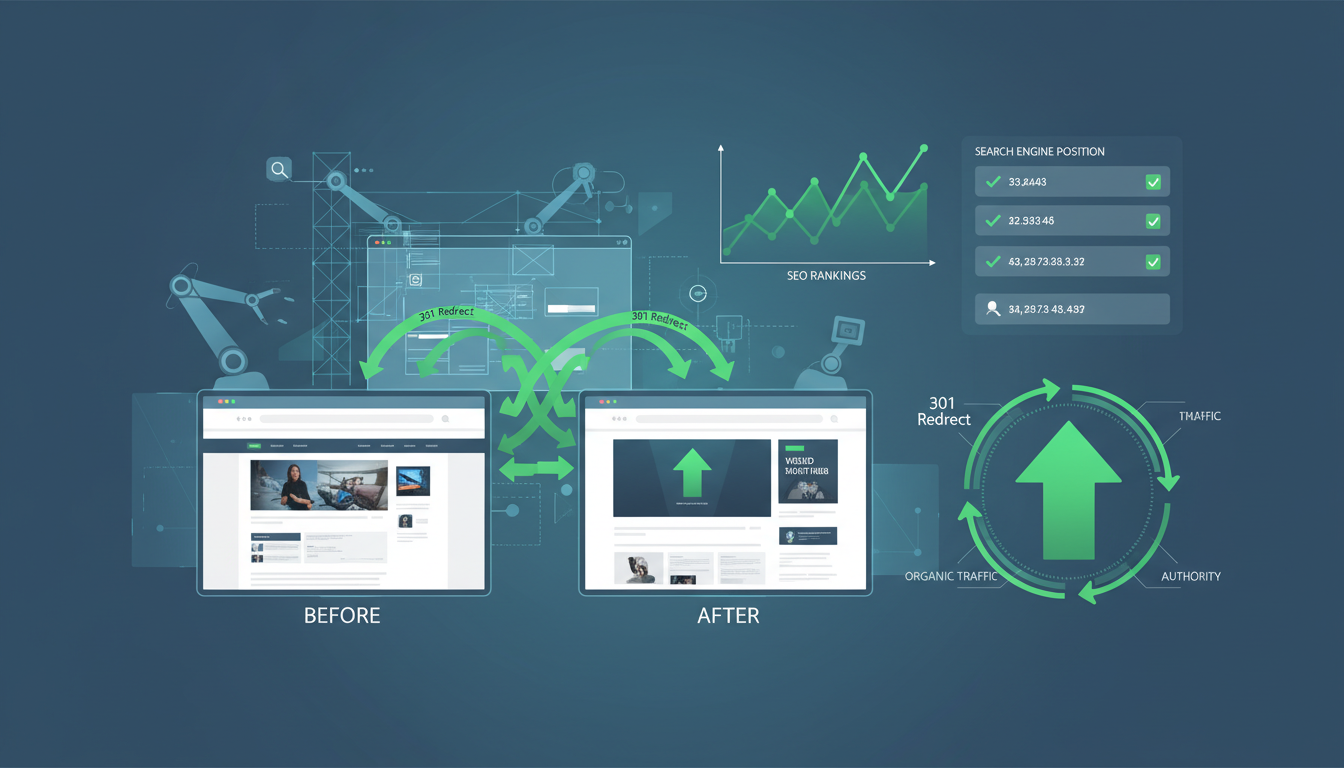
A website redesign is one of the most impactful projects a business can undertake. A fresh, modern, high-performing website can transform how customers perceive your brand, improve conversion rates, and position your business for growth. But for UK businesses that have invested years in building their search engine rankings, a website redesign carries a significant and often underestimated risk: the potential loss of organic search traffic that took years to build.
It happens with alarming frequency. A business launches a beautiful new website, celebrates for a few days, and then watches in horror as their Google rankings plummet, organic traffic drops by 30%, 50%, or even 80%, and phone enquiries dry up. The new website looks fantastic but is invisible to the search engines that were driving a significant proportion of their business.
This is not inevitable. With careful planning, the right technical approach, and close attention to SEO throughout the redesign process, you can launch a new website that is not only better looking and better performing but that maintains - and often improves - your search engine rankings. This guide explains exactly how to achieve this, with practical steps that apply whether you are a professional services firm in London, a manufacturing company in the Midlands, or an e-commerce business serving customers across the United Kingdom.
The financial impact of getting a redesign wrong cannot be overstated. For a business generating even a modest proportion of its revenue through organic search, a sustained drop in rankings translates directly into lost enquiries, lost customers, and lost revenue. Recovery is possible, but it is neither quick nor guaranteed. Some businesses never fully regain the positions they held before a botched redesign, particularly if competitors capitalise on the gap and strengthen their own presence in the search results during the period of disruption.
What makes this especially frustrating is that the damage is entirely preventable. The techniques for preserving SEO through a redesign are well established and straightforward to implement. They require planning, attention to detail, and a willingness to treat SEO as a first-class concern throughout the project - not an afterthought bolted on at the end. This guide provides a comprehensive, step-by-step framework for achieving exactly that, drawing on lessons learned from dozens of redesign projects carried out for UK businesses across a wide range of industries.
Why Redesigns Destroy Rankings
Understanding why website redesigns damage SEO is the first step to preventing it. The most common causes are well documented, and every one of them is avoidable with proper planning.
Changed URLs Without Redirects
This is the single most destructive mistake in any website redesign. Over the years, Google has built an index of your website’s pages based on their URLs. Each URL has accumulated authority through backlinks, user engagement signals, and indexing history. When a redesign changes URLs - for example, from /services/it-support to /what-we-do/managed-it - without implementing 301 redirects from the old URLs to the new ones, Google treats the new URLs as entirely new pages with no authority. The old pages return 404 errors, and the ranking authority they had accumulated simply evaporates.
Removed or Substantially Changed Content
Designers and copywriters often want to streamline content during a redesign, removing what they consider to be unnecessary text. But that “unnecessary text” may be exactly what Google is ranking the page for. If a service page that ranks well for “IT support in Manchester” has its content replaced with a few paragraphs and a stock photo, the rankings for that keyword will almost certainly disappear.
Technical SEO Regressions
A new website built on a different platform or framework may introduce technical SEO issues that did not exist on the old site. Slower page load times, missing meta tags, broken internal links, incorrect canonical tags, missing structured data, blocked crawling in robots.txt, or a missing XML sitemap can all contribute to ranking losses.
Internal Linking Structure Damage
Internal links are a critical but often overlooked component of SEO. Over time, your website builds an internal linking structure that distributes authority across your pages and signals to Google which pages are most important. During a redesign, this structure is frequently dismantled. Navigation menus change, sidebar links disappear, footer links are reorganised, and contextual links within body content are removed or broken. The cumulative effect can be substantial, particularly for deeper pages that relied on internal links from higher-authority pages to maintain their rankings.
Preserving your internal linking structure during a redesign means auditing existing internal links before the project begins, ensuring the new site maintains equivalent or better internal linking, and verifying after launch that no orphan pages exist - pages with no internal links pointing to them that Google may struggle to discover and index.
Mobile Experience Regression
Since Google moved to mobile-first indexing, the mobile version of your website is the primary version that Google evaluates for ranking purposes. A redesign that improves the desktop experience but degrades the mobile experience will almost certainly harm your rankings. Common mobile regressions include text that is too small to read without zooming, buttons and links that are too close together to tap accurately, content that is hidden behind tabs or accordions that Google may not fully index, horizontal scrolling caused by elements that exceed the viewport width, and interstitial pop-ups that obscure the main content. Every design decision during the redesign should be evaluated on mobile first, with desktop as the secondary consideration.
Some web designers advocate for “starting fresh” with a completely new site structure, arguing that the old structure was flawed. While there may be genuine structural improvements to make, abandoning an existing site structure wholesale means abandoning all the SEO equity that structure has accumulated. Every URL, every internal link, every piece of content that ranks in Google represents value. A skilled SEO-aware redesign preserves this value whilst improving the user experience and design. Starting fresh is rarely necessary and almost always harmful to rankings.
The Pre-Redesign SEO Audit
Before any design work begins, you need a comprehensive understanding of your current website’s SEO performance. This audit establishes the baseline against which you will measure the success of the redesign and identifies the assets you must protect.
Content and URL Inventory
Create a complete inventory of every page on your current website. For each page, record the URL, the page title, the meta description, the primary keyword it targets, its current Google ranking position for that keyword, its monthly organic traffic (from Google Analytics or Search Console), and the number of backlinks pointing to it (from a tool like Ahrefs, SEMrush, or Moz).
This inventory serves multiple purposes. It identifies your most valuable pages - the ones driving the most traffic and rankings - which must be preserved with the greatest care. It identifies pages that can be safely consolidated or removed because they attract no traffic and have no backlinks. And it provides the mapping you will need to create your 301 redirect plan.
Backlink Preservation Planning
Backlinks - links from external websites pointing to your pages - are one of the strongest ranking signals in Google’s algorithm. A single link from a high-authority website can be worth more than dozens of pages of optimised content. During a redesign, backlinks are at risk if the pages they point to change URLs, are removed, or have their content substantially altered. Your pre-redesign audit should include a comprehensive backlink analysis using tools such as Ahrefs, Moz, or SEMrush. Identify every page on your site that has external backlinks, and ensure these pages are either preserved at their existing URLs or have 301 redirects in place. Pay particular attention to pages with links from high-authority domains - these are your most valuable SEO assets and must be protected at all costs.
Technical Baseline Documentation
Before the redesign begins, document your current technical SEO configuration in detail. This includes your robots.txt file contents, your XML sitemap structure, your canonical tag implementation, your structured data markup, your page load speeds for key pages, your Core Web Vitals scores, your HTTPS configuration, and your hreflang tags if you serve multiple languages or regions. This documentation serves as a reference during the build to ensure the new site matches or exceeds the technical SEO standards of the old one. Without this baseline, it is impossible to identify regressions introduced during the redesign. Record everything, even if it seems obvious - the development team building the new site may not be the same team that built the original, and assumptions about what will be carried over are one of the most common sources of SEO regressions.
| Pre-Redesign Activity | Purpose | Tools | Priority |
|---|---|---|---|
| Full URL crawl | Identify all existing pages and their structure | Screaming Frog, Sitebulb | Critical |
| Keyword ranking audit | Identify which pages rank for which keywords | Google Search Console, Ahrefs | Critical |
| Backlink analysis | Identify pages with external links pointing to them | Ahrefs, Moz, SEMrush | Critical |
| Traffic analysis by page | Identify highest-traffic pages that must be preserved | Google Analytics | Critical |
| Technical SEO audit | Document current technical SEO configuration | Screaming Frog, PageSpeed Insights | High |
| Content audit | Evaluate content quality, identify gaps and redundancies | Manual review, Surfer SEO | High |
The 301 Redirect Map: Your Most Important Document
If there is one single thing that determines whether your redesign preserves or destroys your SEO, it is the 301 redirect map. This is a document - typically a spreadsheet - that maps every old URL to its corresponding new URL. When the new site launches, 301 (permanent) redirects are implemented so that any request for an old URL is automatically forwarded to the correct new URL.
The redirect map must cover every page on the old site, not just the main pages. Blog posts, service pages, case studies, team member profiles, resources, PDFs, and images all need to be mapped. Any URL that has ever been indexed by Google or that has external links pointing to it must be redirected. Missing even a single high-value redirect can cost you significant rankings.
The ideal approach is to keep URLs the same wherever possible. If your current URL structure is logical and working well, there is no reason to change it. Every URL change introduces risk. Only change URLs when there is a genuine improvement in clarity or structure, and always implement the corresponding redirect.
Implementation Best Practices
When implementing your redirect map, there are several technical considerations that can mean the difference between a smooth transition and a damaging one. First, use 301 (permanent) redirects, not 302 (temporary) redirects. A 301 redirect tells Google that the page has permanently moved and that all ranking authority should be transferred to the new URL. A 302 redirect signals a temporary move, and Google may continue to index the old URL rather than the new one, fragmenting your authority between two addresses.
Second, avoid redirect chains - situations where URL A redirects to URL B, which redirects to URL C. Each step in a chain dilutes some ranking authority and slows down the user experience. Every old URL should redirect directly to its final destination in a single hop. Third, implement redirects at the server level, not through JavaScript or meta refresh tags. Server-side redirects are processed instantly and pass the maximum amount of authority. Client-side redirects are slower, less reliable, and may not pass authority at all.
Finally, test every redirect before launch. Use a crawling tool like Screaming Frog to crawl all your old URLs and verify that each one returns a 301 status code pointing to the correct new URL. A redirect that points to the wrong page is almost as harmful as no redirect at all - it confuses Google about the relationship between your old and new content and can lead to ranking losses for both the old and new pages.
SEO-Safe Redesign Practices
- Complete URL inventory before starting design
- Keep existing URLs wherever possible
- 301 redirect every changed or removed URL
- Preserve all high-ranking content
- Maintain or improve page load speeds
- Submit new XML sitemap to Search Console
- Monitor rankings daily for four weeks post-launch
- Keep old site accessible for rollback
Common SEO-Destroying Mistakes
- No URL audit before the redesign begins
- Changing all URLs to match new structure
- No 301 redirects implemented
- High-ranking content removed or rewritten
- New site is significantly slower than the old one
- No sitemap submitted after launch
- No post-launch monitoring of rankings
- Old site deleted immediately after launch
Content Strategy During a Redesign
A redesign is an opportunity to improve your content, but it must be done carefully. The guiding principle is simple: protect what works and improve what does not.
For pages that currently rank well and drive significant organic traffic, the content should be preserved in full or enhanced - never reduced. You can improve the formatting, add images, update statistics, and enhance the user experience, but the core content that Google is ranking the page for must remain intact. If you want to rewrite a high-ranking page, do so gradually after the redesign - not as part of the launch.
For pages that are not performing well, the redesign is an opportunity to consolidate, improve, or redirect them. Multiple thin pages targeting similar keywords can be combined into a single, comprehensive resource. Outdated content can be refreshed with current information. And pages with no traffic, no rankings, and no backlinks can be removed (with redirects to the most relevant remaining page).
Handling Content Consolidation
Content consolidation is one of the most valuable opportunities a redesign presents, but it must be handled with care to avoid SEO losses. When combining multiple thin pages into a single comprehensive resource, the best practice is to identify the strongest-performing URL among the pages being consolidated and use that as the destination. All other URLs should 301 redirect to this page. The consolidated page should incorporate the best content from all the source pages, ensuring that every keyword and topic previously covered across the individual pages is addressed in the combined resource. This approach not only preserves ranking authority but often improves it, as Google tends to favour comprehensive, authoritative content over fragmented thin pages.
Timing Your Content Updates
One of the most important principles during a redesign is to avoid changing too many variables at once. If you launch a new design, a new URL structure, and substantially rewritten content simultaneously, it becomes impossible to diagnose the cause of any ranking changes that follow. The recommended approach is to launch the redesign with existing content preserved as closely as possible, allow Google two to four weeks to re-crawl and re-index the new site, confirm that rankings have stabilised, and only then begin making incremental content improvements. This staged approach lets you isolate the impact of each change and quickly identify and reverse any modifications that harm performance.
Technical SEO Checklist for Launch
Before the new website goes live, run through this technical SEO checklist to ensure nothing has been missed. Each item should be verified on the staging or development version of the new site before the production launch.
Each item on this checklist represents a potential ranking factor, and missing even one can undermine the entire redesign. The most effective approach is to assign a specific team member responsibility for each item, with a sign-off required before the site goes live. Many businesses find it helpful to conduct two rounds of testing: an initial check when the staging site is first built, and a final verification in the days immediately before launch. This catches issues introduced during late-stage development changes that can easily slip through if only a single round of testing is performed.
Pay particular attention to the interaction between different checklist items. For example, a perfectly configured XML sitemap is useless if the robots.txt file blocks Google from accessing it. Similarly, well-implemented 301 redirects provide no benefit if the canonical tags on the destination pages point to different URLs. Testing each item in isolation is necessary but insufficient - you must also verify that the entire technical SEO configuration works together as an integrated system.
Post-Launch Monitoring
The first four weeks after launch are critical. You should monitor your rankings, traffic, and technical health daily to catch and fix any issues before they cause lasting damage.
In Google Search Console, watch for crawl errors (404 pages that should have been redirected), indexing issues (pages that Google cannot access or index), and any manual actions or security issues. In Google Analytics, compare organic traffic week-over-week and year-over-year, watching for any significant drops. In your rank tracking tool, monitor your top 50 keywords daily, looking for any rankings that have dropped more than a few positions.
Some fluctuation in the first two weeks is normal and expected. Google needs time to re-crawl and re-index your site after a redesign. But significant drops (more than 10 positions for important keywords, or more than 20% drop in organic traffic) should be investigated immediately. The most common causes are missing redirects, pages that Google cannot crawl (blocked by robots.txt or noindex tags), and significant content changes on high-ranking pages.
A well-executed redesign should result in traffic returning to pre-redesign levels within two to four weeks, with improvements becoming visible within two to three months as the benefits of improved user experience, faster load times, and better content begin to take effect. If traffic has not recovered within six weeks, there is likely a technical or redirect issue that needs urgent investigation.
The key message is clear: a website redesign does not have to mean a loss of SEO rankings. With thorough pre-redesign auditing, careful URL mapping and redirects, content preservation, technical SEO diligence, and vigilant post-launch monitoring, you can achieve a redesign that delivers a better website and better search engine performance. The investment in doing this properly is small compared to the cost of rebuilding rankings from scratch.
Building an Ongoing SEO Relationship with Your Web Team
One of the most effective long-term strategies for preserving SEO through redesigns - and through all future website changes - is to establish an ongoing relationship between your SEO team and your web development team. Too often, SEO is treated as a separate discipline that is consulted only at the beginning and end of a project. In reality, decisions made throughout the design and development process have SEO implications, from the choice of content management system to the way images are compressed, from the structure of navigation menus to the implementation of JavaScript functionality.
When your SEO specialists are embedded in the redesign process from the first planning meeting to the final post-launch review, potential issues are identified and resolved before they reach production. The web development team learns to consider SEO implications as a natural part of their workflow, and the SEO team gains a deeper understanding of the technical constraints and opportunities that the new platform presents. This collaborative approach not only protects rankings during the redesign but positions your website for sustained organic growth in the months and years that follow.
For UK businesses operating in competitive markets, where organic search often represents the single largest source of new customer enquiries, this level of diligence is not a luxury but a necessity. The businesses that thrive in search are those that treat SEO not as a one-off project but as an integral, ongoing component of their digital strategy - and that starts with getting the redesign right.
Planning a Website Redesign?
Cloudswitched builds high-performance websites with SEO built in from the start. Our web development team works alongside our SEO specialists to ensure that every redesign preserves your existing rankings whilst creating a faster, more effective website that drives more enquiries. Contact us to discuss your redesign project.
Explore Our SEO Services
CloudSwitched
London-based managed IT services provider offering support, cloud solutions and cybersecurity for SMEs.


