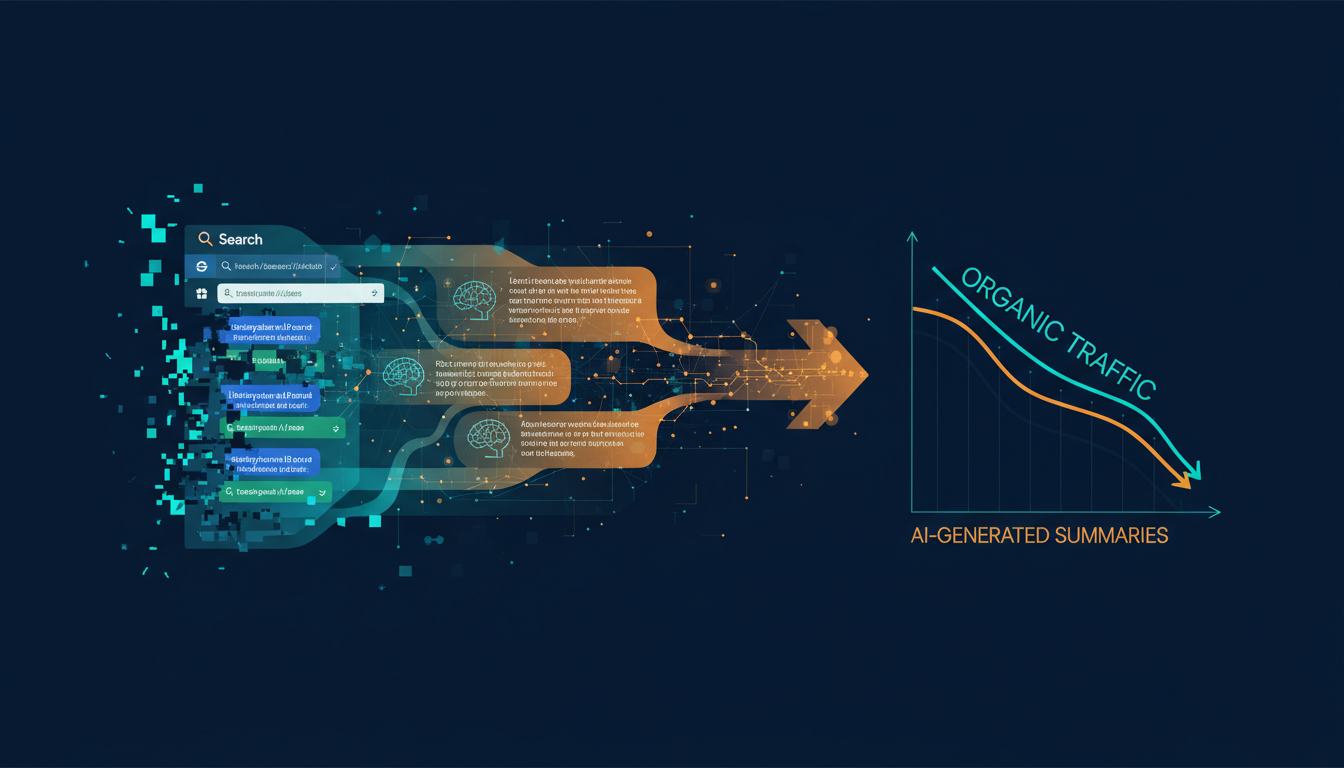
Google's March 2026 core update finished rolling out on 8 April, and the dust is still settling. For UK businesses that depend on organic search traffic, the picture is sobering: AI Overviews now appear on nearly half of all Google searches, organic click-through rates have plummeted by 61%, and six out of every ten searches end without a single click to any website. If your digital strategy still assumes that ranking on page one guarantees traffic, it is time for a serious rethink.
The convergence of Google's aggressive AI integration, back-to-back algorithm updates, and the quiet introduction of the "Google-Agent" user agent has created what many SEO professionals are calling the most significant shift in search since the mobile-first index. Here is what the data tells us - and what UK SMEs should do about it.
The March 2026 Core Update: What Actually Changed
March 2026 was extraordinary even by Google's standards. Within the space of a single week, webmasters faced not one but two significant algorithm updates - plus the stealth introduction of a new AI crawler that fundamentally changes how Google interacts with your website.
The sequence began on 24 March with the March 2026 Spam Update, which completed its rollout in under 20 hours - making it one of the fastest spam updates on record. Before most site owners had even noticed, Google launched the March 2026 Core Update on 27 March, just 72 hours later. This broader update took 12 days to complete, finishing on 8 April.
| Update | Start Date | Completion | Duration | Key Focus |
|---|---|---|---|---|
| February 2026 Discover Update | Late February | Early March | ~10 days | Google Discover feed quality |
| March 2026 Spam Update | 24 March | 25 March | <20 hours | AI-generated spam content |
| Google-Agent User Agent | 20 March | Ongoing | Permanent | AI-powered browsing, bypasses robots.txt |
| March 2026 Core Update | 27 March | 8 April | 12 days | Broad quality and relevance signals |
The core update has been described by industry analysts as "a weird one" - less overtly powerful than the seismic shifts of 2024, yet still producing significant surges and drops across a wide range of sites. The pattern emerging from the data suggests that Google is increasingly rewarding sites with clear topical focus, well-structured content, and demonstrable expertise, whilst continuing to penalise thin, AI-generated content farms.
This update is a weird one. It's less powerful than what we saw last year, but there are still big surges and big drops. The sites winning are those with clear, topic-focused, well-structured, fact-driven content. The AI-driven SEO farms have adapted to EEAT so well that search engines are losing the arms race against spam.
Perhaps the most consequential development, however, flew under most businesses' radar entirely. On 20 March - a full week before the core update - Google quietly introduced the "Google-Agent" user agent. Unlike Googlebot, which respects robots.txt directives, Google-Agent represents a new class of AI-powered systems that can browse and process web content without regard for traditional crawling restrictions. This has profound implications for any business that has relied on robots.txt to control how Google accesses and uses their content.
For UK businesses, this means that even if you have explicitly blocked AI crawlers from scraping your content, Google's new agent class may access it regardless. The distinction between indexing content for search results and ingesting content to train or power AI features is becoming increasingly blurred - and the technical controls webmasters have relied upon for decades are losing their effectiveness.
AI Overviews: The New Gatekeeper of Google Search
When Google launched AI Overviews in May 2024, they appeared on roughly 7% of search queries. The feature was tentative, often inaccurate, and widely mocked for suggesting users put glue on pizza. Eighteen months later, the picture could not be more different. AI Overviews have evolved into the dominant feature of Google Search, appearing on nearly half of all queries and fundamentally reshaping how users interact with search results.
BrightEdge data shows a 58% increase in AI Overview prevalence over the past 12 months, growing from 31% to 48% of all queries. At the current trajectory, AI Overviews could appear on more than 60% of Google searches by early 2027. For UK businesses, this is not a future problem - it is a present emergency.
The impact on click-through rates has been devastating. Research from Seer Interactive published in September 2025 found that for queries where AI Overviews appear, organic click-through rates fell from 1.76% to just 0.61% - a 61% decline. Paid search fared even worse, with ad CTR crashing by 68%. When Google provides a comprehensive answer directly in the search results, users simply have no reason to click through to your website.
This is reflected in the broader zero-click trend. Sixty per cent of all Google searches now end without the user clicking on any result - up from 50% in 2020. For purely informational queries, such as "what is cloud migration" or "how does GDPR affect small businesses", the zero-click rate exceeds 70%.
The message for UK SMEs is clear: if your content strategy is built around answering common questions and hoping those answers drive traffic, the ground has shifted beneath you. Google is now answering those questions itself, using your content as the raw material - and sending increasingly fewer visitors your way in return.
The Traffic Crisis: Winners and Losers
The headline statistics paint a grim picture. Google search traffic to publishers declined globally by a third in the year to November 2025, and Google Discover referrals - once a reliable source of supplementary traffic - fell by 21% year on year. Publishers surveyed across the industry expect traffic to decline by a further 43% on average over the next three years. For many UK businesses, organic search has been the backbone of their digital marketing strategy for over a decade. That backbone is fracturing.
Yet the picture is more nuanced than the doom-laden headlines suggest. A WordStream study found that 63% of businesses reported that AI Overviews had actually positively impacted their organic visibility. The crucial distinction is between businesses that are merely ranked in organic results and those that are actively cited within AI Overviews themselves. Being referenced as a source within an AI Overview provides a new form of visibility that can drive both brand awareness and traffic.
Perhaps the most encouraging finding for challenger businesses is that 60% of AI Overview citations come from sources outside the traditional top-three organic positions. This means that smaller, specialist businesses with genuinely authoritative content can leapfrog larger competitors who have historically dominated the first page through sheer domain authority and backlink volume.
Traditional SEO Approach
AI Overview Optimised Approach
The impact varies dramatically depending on the type of query your business targets. Informational queries - the "what is" and "how to" questions - have been hardest hit, with zero-click rates exceeding 70%. Commercial investigation queries, where users are comparing products or services, have seen moderate impact. Transactional queries with high purchase intent remain relatively protected, though AI Overviews are beginning to encroach here as well.
For UK SMEs in the IT services sector, this means that top-of-funnel educational content - the blog posts, guides, and explainers that have traditionally filled the pipeline - will deliver diminishing returns unless they are specifically crafted to earn AI Overview citations. The businesses that will thrive are those that pivot from chasing page-one rankings to building the kind of authoritative, well-structured content that Google's AI systems choose to reference.
The CMA Steps In: UK Regulatory Response
The UK's Competition and Markets Authority has taken notice of Google's expanding AI features and their impact on the competitive landscape. In a series of interventions that carry particular weight for UK businesses, the CMA has set out requirements designed to rebalance the relationship between Google and the publishers whose content powers AI Overviews.
The CMA's key demands centre on four pillars. First, publishers must be given meaningful choice over whether and how their content is used in AI responses. Second, Google must provide greater transparency about how content feeds into AI features and how results are ranked within AI Overviews. Third, there must be proper attribution of publisher content, ensuring that sources are clearly credited when their material is used. Fourth, Google must strengthen its complaints processes for businesses that experience significant negative impact.
Additionally, the CMA has required Google to provide more information about how it ranks results - including within AI Overviews. This is a significant development for UK businesses, as it may eventually provide clearer guidance on how to optimise content for citation within AI-generated answers.
The CMA's intervention, whilst welcome, will take time to produce tangible results. UK businesses that depend on Google for more than 50% of their website traffic face material risk. The regulatory timeline operates in months and years; Google's AI expansion operates in weeks. Do not wait for regulatory relief - begin diversifying your traffic sources immediately.
For UK SMEs, the CMA's actions provide a longer-term framework for fair treatment in AI-powered search, but they are not a short-term solution. The practical reality is that businesses need to adapt their digital strategies now, whilst regulatory protections catch up. The companies that wait for the CMA to level the playing field will find themselves significantly behind those that have already begun adapting.
What UK SMEs Should Do Now
The shift to AI-dominated search results does not mean that SEO is dead - but it does mean that the rules have changed fundamentally. UK businesses that adapt quickly have an opportunity to gain ground, particularly given that 60% of AI Overview citations come from outside the traditional top three positions. Here is a practical action plan built on what the March 2026 data is telling us.
Google's AI systems heavily favour content with clear structured data markup (Schema.org), strong EEAT signals (Experience, Expertise, Authoritativeness, Trustworthiness), and well-organised headings. Implement FAQ schema, HowTo schema, and organisation schema as a minimum. Ensure every piece of content has a named, credentialed author with a linked bio page. These signals directly influence whether your content gets cited in AI Overviews.
- Audit your AI Overview exposure. Use tools like BrightEdge, Semrush, or Ahrefs to identify which of your target keywords now trigger AI Overviews. Categorise them by query type (informational, commercial, transactional) and prioritise your response accordingly. Focus your immediate efforts on commercial and transactional queries where clicks still flow.
- Restructure content for citation. AI Overviews pull from content that provides clear, concise, factual answers. Structure your pages with direct answer paragraphs near the top, followed by supporting detail. Use descriptive subheadings, bullet points, and tables that AI systems can easily parse and reference. Every page should answer a specific question definitively within the first 200 words.
- Double down on topical authority. The March 2026 update rewarded sites with clear topical focus. Rather than publishing broadly across tangential subjects, build deep content clusters around your core expertise. A managed IT services company should own topics like "cloud migration for SMEs" or "cyber security compliance for UK businesses" with comprehensive, interlinked content hubs.
- Implement comprehensive structured data. Deploy Schema.org markup across your entire site - FAQPage, HowTo, Organisation, LocalBusiness, Service, and Article schemas at a minimum. This gives Google's AI systems the structured signals they need to understand, trust, and cite your content.
- Build genuine EEAT signals. Assign named authors with real credentials and detailed bio pages to every piece of content. Secure mentions and citations from recognised industry publications. Gather and display genuine client testimonials and case studies. Google's systems are increasingly sophisticated at evaluating whether expertise claims are backed by evidence.
- Optimise for featured snippets and "position zero". Content that already earns featured snippets is more likely to be cited in AI Overviews. Identify snippet opportunities for your target queries and create content specifically formatted to win them - concise definitions, numbered steps, comparison tables, and direct answer paragraphs.
- Prepare for Google-Agent. Review your robots.txt and understand that Google's new AI-powered user agent may not respect traditional crawling directives. Focus instead on ensuring that the content Google accesses accurately represents your expertise and brand. Remove or noindex thin, outdated, or low-quality pages that could dilute your site's perceived authority.
- Track citation metrics, not just rankings. Traditional rank tracking is no longer sufficient. Monitor whether your content appears as a cited source within AI Overviews for your target queries. Tools like BrightEdge and Authoritas now offer AI Overview tracking. Make citation rate a primary KPI alongside organic traffic and conversions.
The businesses that execute on these fundamentals will not only survive the AI Overview era - they will find new opportunities in it. Remember, 63% of businesses that have adapted their approach report a positive impact from AI Overviews. The key is being proactive rather than reactive.
Diversifying Beyond Google
Even the most effective AI Overview optimisation strategy should be part of a broader diversification effort. With 60% of searches now resulting in zero clicks, prudent UK businesses are building multiple pathways to reach their target audiences.
The rise of AI-powered search alternatives is creating new channels. Thirty per cent of UK consumers have now used an AI chatbot for product research - up from just 12% in early 2025. Fifty-five per cent have used AI tools to research legal questions, and 48% have consulted AI for financial queries. These users are not searching on Google at all, which means your content needs to be structured in ways that AI systems beyond Google can discover and reference.
- Email marketing and owned audiences: Build direct relationships through newsletters, email courses, and gated content. An email subscriber is worth far more than an anonymous organic visitor because you control the channel entirely.
- LinkedIn and professional networking: For B2B IT services, LinkedIn organic reach remains strong and is not subject to Google's zero-click problem. Publish thought leadership content directly on the platform.
- Community building: Create or participate in industry-specific communities, forums, and groups where your target audience gathers. Direct referral traffic from trusted communities converts at significantly higher rates than organic search.
- Partnerships and co-marketing: Collaborate with complementary (non-competing) businesses to cross-promote to each other's audiences. Joint webinars, co-authored research, and mutual referral programmes build traffic channels that no algorithm change can disrupt.
- Paid search refinement: With organic CTR declining, well-optimised paid campaigns targeting high-intent transactional queries become more valuable. Focus ad spend on bottom-of-funnel queries where purchase intent is clear and AI Overviews are less dominant.
- Direct and branded search: Invest in brand awareness so that customers search for you by name. Navigational queries (searches for your brand) have the lowest zero-click rate at around 20% and are virtually immune to AI Overview disruption.
Need Help Adapting Your SEO Strategy?
CloudSwitched helps UK businesses navigate the rapidly changing search landscape. From AI Overview optimisation and structured data implementation to full digital marketing diversification, our team can audit your current position and build a strategy that drives results in the new era of AI-powered search.
Get in TouchThe March 2026 core update and the continued expansion of AI Overviews represent a genuine inflection point for UK businesses. The era of straightforward organic search optimisation - publish good content, earn some links, rank on page one, and watch the traffic flow - is drawing to a close. What replaces it is more complex but also more rewarding for businesses willing to adapt. Those that build genuine topical authority, structure their content for AI citation, diversify their traffic sources, and treat their digital presence as a multi-channel ecosystem will not just survive the AI search revolution - they will be positioned to thrive within it. The window to adapt is narrowing. The time to act is now.

Cloudswitched
London-based managed IT services provider offering support, cloud solutions and cybersecurity for SMEs.