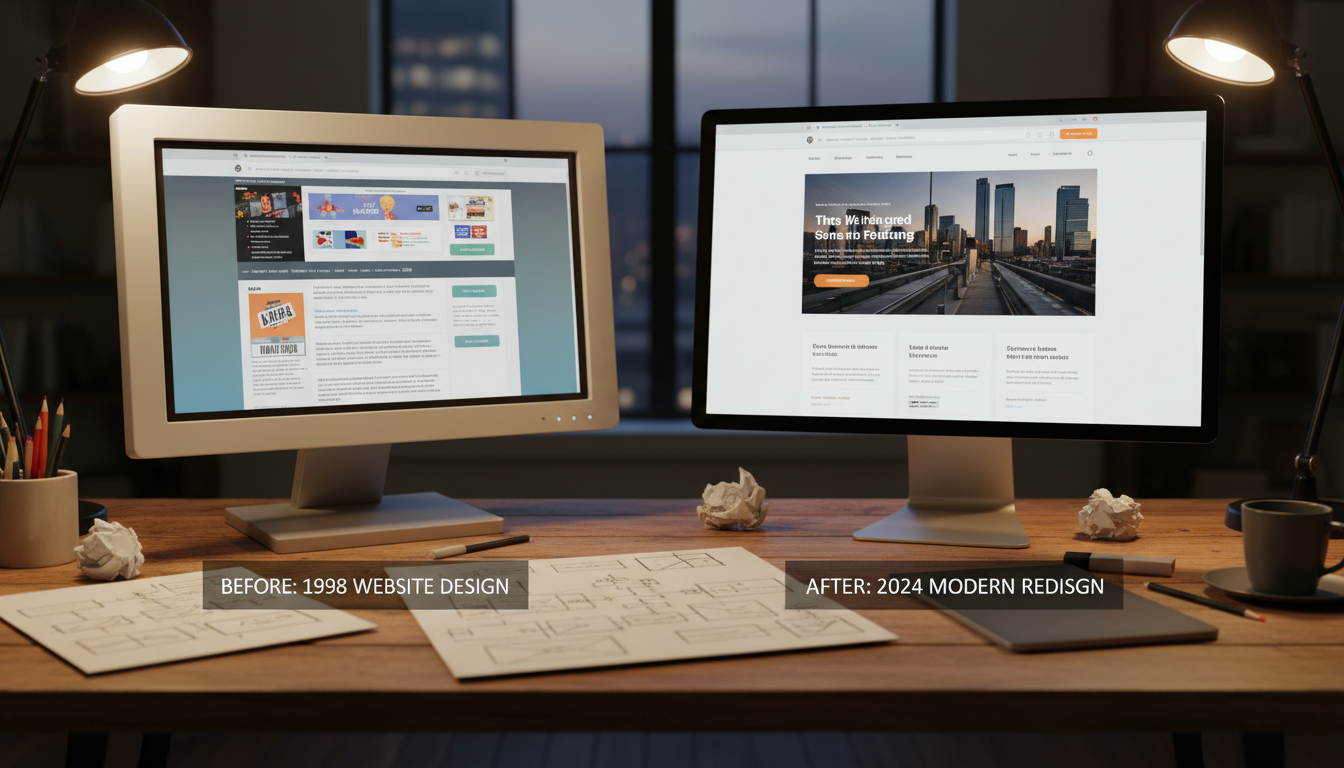
Your website is often the first interaction a potential customer has with your business. In today’s competitive UK market, a dated or underperforming website doesn’t just look bad - it actively costs you money. Research from Google shows that 53% of mobile visitors abandon a site that takes longer than 3 seconds to load, and Stanford University found that 75% of users judge a company’s credibility based on its website design.
If your website was built more than three years ago, there’s a strong chance it’s holding your business back. But how do you know for sure? Here are the five clearest signs that your business website is due for a professional redesign - and what you can do about each one.
Sign 1: Your Bounce Rate Is Alarmingly High
Bounce rate - the percentage of visitors who leave your site after viewing only one page - is one of the most revealing metrics in your analytics dashboard. A high bounce rate tells you that visitors are arriving at your website and immediately deciding it’s not worth their time. For most UK business websites, a bounce rate between 26% and 40% is considered excellent, 41% to 55% is average, and anything above 70% is a serious red flag.
What Causes a High Bounce Rate?
There are several interconnected factors that drive visitors away within seconds of landing on your site. Poor visual design is the most immediate culprit - if your site looks outdated or unprofessional, users make a snap judgement and leave. Confusing navigation is another major factor; if visitors can’t quickly find what they’re looking for, they’ll go to a competitor who makes it easier. Irrelevant or poorly structured content, intrusive pop-ups, auto-playing media, and a lack of clear calls to action all contribute to visitors bouncing before they engage.
How to Check Your Bounce Rate
Log into Google Analytics 4 and navigate to Reports > Engagement > Pages and screens. Look at the “Bounce rate” column for your key landing pages. If your homepage or main service pages have a bounce rate above 60%, your website design is likely the problem. Pay particular attention to bounce rates on mobile devices specifically, as these are typically 10-15% higher than desktop.
A professionally redesigned website addresses bounce rate at every level. At Cloudswitched, we structure layouts around user intent, ensuring that visitors immediately see relevant content, clear value propositions, and intuitive pathways to the information they need. Our clients typically see bounce rates drop by 25-40% within the first month after a redesign.
The Business Impact of High Bounce Rates
Every visitor who bounces is a lost opportunity. If your website receives 5,000 monthly visitors and your bounce rate is 75% instead of an achievable 45%, that’s 1,500 additional potential customers leaving every month without engaging. At a typical UK service business conversion rate of 2-3%, that translates to 30-45 lost leads per month. If your average customer value is £500, you could be losing £15,000 to £22,500 in potential revenue every single month simply because your website isn’t designed to retain visitors.
Sign 2: Your Website Is Not Mobile Responsive
In 2026, mobile responsiveness is not a luxury - it is an absolute baseline requirement. Ofcom’s latest UK Internet Use report shows that 92% of UK adults access the internet via smartphone, and for the 18-34 demographic, mobile is the primary device for browsing, researching, and purchasing. Google has used mobile-first indexing since 2019, meaning your site’s mobile version determines your search rankings, not the desktop version.
Diagnosing Mobile Responsiveness Issues
A truly mobile-responsive website isn’t just one that “sort of works” on a phone. It needs to provide a genuinely excellent experience across every screen size. Common problems with older websites include text that’s too small to read without zooming, buttons that are too close together to tap accurately, horizontal scrolling caused by oversized images or fixed-width layouts, menus that are difficult to navigate on touchscreens, and forms that are frustrating to fill in on mobile devices.
Quick Mobile Test
Open your website on your phone right now. Can you complete your most important user journey - whether that’s requesting a quote, making a booking, or finding your contact details - within 30 seconds using only your thumb? If not, your mobile experience needs work. You can also use Google’s free PageSpeed Insights tool, which provides a dedicated mobile performance and usability audit.
The gap between a desktop-designed site viewed on mobile and a genuinely mobile-optimised experience is enormous. At Cloudswitched, every website we build starts with the mobile experience. We design for thumb-friendly navigation, fast-loading mobile assets, and touch-optimised interactions before scaling up to tablet and desktop layouts. This mobile-first approach ensures your site performs brilliantly on the devices your customers actually use.
Non-Responsive Website
- Fixed-width layouts that require horizontal scrolling
- Tiny text requiring pinch-to-zoom on mobile
- Navigation menus that overlap or break on small screens
- Images that overflow the viewport or load at full desktop size
- Forms with input fields too small to tap accurately
- Click targets spaced too closely together
- Pop-ups that cannot be dismissed on touchscreens
- Google penalises rankings for poor mobile experience
Fully Responsive Website
- Fluid layouts that adapt seamlessly to any screen size
- Readable typography scaled for every device
- Collapsible, thumb-friendly mobile navigation
- Optimised images served at appropriate resolutions
- Large, accessible form fields with proper spacing
- Touch targets meeting the 48px minimum standard
- Mobile-optimised content hierarchy and CTAs
- Google rewards mobile-friendly sites with higher rankings
The Revenue Impact of Poor Mobile Experience
According to data from Statista, UK mobile commerce accounted for £76 billion in 2025, representing over 52% of all e-commerce transactions. Even for service-based businesses that don’t sell online, the figures are equally stark: 78% of local searches on mobile result in an offline purchase within 24 hours. If your website doesn’t function properly on mobile, you’re invisible to the majority of your potential customers during their highest-intent moments.
Sign 3: Your Website Loads Too Slowly
Page speed is one of the most measurable and impactful aspects of website performance. Google’s Core Web Vitals have made loading speed, interactivity, and visual stability direct ranking factors. But beyond SEO, speed directly impacts user behaviour and conversion rates. Research from Portent shows that a site that loads in 1 second has a conversion rate 3x higher than one that loads in 5 seconds.
Common Causes of Slow Loading
Older websites accumulate speed problems over time. The most common culprits include unoptimised images (uploading photos straight from a camera without compression), excessive use of JavaScript plugins and third-party scripts, poor hosting infrastructure, render-blocking CSS and JavaScript, lack of browser caching, no content delivery network (CDN), and bloated code from page builders like WordPress with heavy themes.
Many UK businesses don’t realise how slow their website actually is because they primarily test it on their office broadband connection. Your customers, however, might be browsing on mobile data in a rural area, on a train, or on a congested public WiFi network. What loads in 2 seconds on your office fibre connection might take 8-10 seconds on 4G.
Test Your Website Speed Now
Visit pagespeed.web.dev and enter your website URL. Google will test both mobile and desktop performance and give you a score out of 100. A score below 50 on mobile indicates serious performance problems. Pay close attention to the Core Web Vitals metrics: Largest Contentful Paint (should be under 2.5s), Interaction to Next Paint (should be under 200ms), and Cumulative Layout Shift (should be under 0.1).
How a Redesign Fixes Speed Issues
A website redesign gives you the opportunity to rebuild your site on a modern, performance-optimised foundation. At Cloudswitched, our websites are built on edge computing infrastructure that serves content from data centres closest to each visitor, ensuring sub-second load times across the UK. We implement next-generation image formats (WebP and AVIF), intelligent code splitting, aggressive caching strategies, and minimal JavaScript to achieve consistently high PageSpeed scores. Our typical client site scores 90+ on both mobile and desktop in Google PageSpeed Insights.
Sign 4: Your Design Looks Outdated
Web design trends evolve rapidly, and what looked modern and professional five years ago can now appear dated, untrustworthy, and amateurish. Users are exposed to hundreds of well-designed websites every day - from the apps on their phones to the sites of major brands they interact with. This constant exposure has raised the baseline of what people consider “professional” in web design. If your site doesn’t meet that standard, visitors will instinctively question the quality of your products or services too.
Telltale Signs of an Outdated Design
Several visual and functional cues immediately signal an old website to modern users. These include stock photography that looks generic or overly staged, image sliders or carousels on the homepage (a trend from the early 2010s now known to hurt engagement), small body text under 16px, cluttered layouts with too much content crammed onto each page, skeuomorphic design elements like glossy buttons, drop shadows, and faux 3D effects, Flash elements or other deprecated technologies, a colour palette that feels dated, and a lack of visual hierarchy that makes it hard to scan content.
Outdated Website Design Traits
- Busy, cluttered layouts with competing visual elements
- Generic stock photography that feels impersonal
- Small body text below 16px that’s hard to read
- Homepage image sliders and auto-rotating carousels
- Glossy buttons, heavy drop shadows, and faux-3D effects
- Inconsistent typography with too many font families
- Sidebar-heavy layouts with excessive widgets
- Footer with minimal information and no structure
- No clear visual hierarchy or content scanning patterns
Modern Website Design Traits
- Clean, spacious layouts with generous whitespace
- Authentic, brand-specific imagery and illustrations
- Large, readable body text at 18px or above
- Hero sections with clear value propositions and CTAs
- Flat design with subtle, purposeful micro-interactions
- Cohesive typography with a defined font pairing system
- Full-width content sections with intentional flow
- Information-rich footer with navigation, contact, and trust signals
- Clear visual hierarchy guiding the user’s eye through content
The Psychology of Design Trust
The connection between design quality and business credibility is well documented. A landmark study by the British Computer Society found that users take just 50 milliseconds (0.05 seconds) to form an opinion about a website. That opinion is almost entirely visual. If your design feels old, crowded, or unprofessional in that split second, no amount of excellent content or competitive pricing will overcome the negative first impression.
This is especially critical for UK service businesses competing in local markets. When a potential customer searches for a plumber, solicitor, or accountant and compares three websites side by side, the one with the most modern, professional design will almost always win the enquiry - even if the others offer better prices or more experience. Design is the proxy your customers use to judge quality before they’ve read a single word.
Quick Design Age Test
Open your website alongside three competitors and two aspirational brands in your industry. Be honest: does your site look like it belongs in the same era? Ask five people who aren’t employees to rank the six sites by “professionalism” and “trustworthiness” without telling them which is yours. If your site consistently ranks in the bottom half, a redesign is overdue.
At Cloudswitched, we don’t follow fleeting trends. Instead, we design around timeless principles - clear hierarchy, purposeful whitespace, strong typography, and authentic brand expression - while incorporating modern patterns that users expect in 2026. This approach means your redesigned website won’t feel dated in 18 months; it will remain fresh and professional for years.
Sign 5: Your SEO Rankings Are Declining
If your website used to appear on the first page of Google for your key search terms but has been steadily slipping, your site’s design and technical infrastructure could be the cause. Google’s algorithm updates in 2024 and 2025 placed even greater emphasis on user experience signals, page performance, and content quality. An older website that hasn’t been updated to meet these standards will inevitably lose ground to competitors who have invested in modern, SEO-optimised sites.
How Website Design Affects SEO
Many business owners think of SEO as something separate from web design, but the two are deeply intertwined. Google’s ranking algorithm considers dozens of design and technical factors, including page load speed (Core Web Vitals), mobile usability, site architecture and internal linking structure, structured data markup, HTTPS security, crawlability and indexing efficiency, content structure and heading hierarchy, and user engagement signals like time on site, pages per session, and bounce rate.
An outdated website often has fundamental structural problems that no amount of keyword optimisation can overcome. If your site is built on an old CMS version, has poor URL structures, lacks proper heading hierarchy, or has hundreds of broken links, these technical SEO issues will drag down your rankings regardless of how good your content is.
Diagnosing SEO-Related Design Problems
Check Google Search Console for your website. Look for declining impressions and click-through rates over the past 12 months. Review the Core Web Vitals report to see if Google has flagged performance issues. Check the Mobile Usability report for any errors. If you see a pattern of declining metrics, your website’s technical foundation is likely the problem, not your content strategy.
SEO Health Check
Run your website through Google Search Console’s URL Inspection tool for your top 10 pages. Check for indexing issues, mobile usability problems, and Core Web Vitals failures. Then use a tool like Screaming Frog or Ahrefs to audit for broken links, missing meta descriptions, duplicate content, thin pages, and orphaned content. If you find more than 20 issues across these checks, a redesign will be far more effective than trying to patch the existing site.
A website redesign is the single most effective SEO intervention you can make. At Cloudswitched, we build SEO into the foundation of every website, with clean semantic HTML, proper heading hierarchy, schema markup, optimised meta data, XML sitemaps, fast performance, and a logical site architecture that helps both users and search engines navigate your content. Our clients typically see a 40-80% increase in organic search traffic within six months of a redesign.
The Combined Impact: How These Issues Compound
These five signs don’t exist in isolation. A slow website increases bounce rate. A non-responsive site damages SEO. An outdated design erodes trust, which increases bounce rate further. Poor SEO means fewer visitors, and a bad experience means those who do arrive don’t convert. The compounding effect of multiple website problems creates a downward spiral that accelerates over time.
Consider a typical scenario. A small UK business has a website built in 2021. It gets 3,000 monthly visitors from organic search, with a bounce rate of 65% and a conversion rate of 1.2%. That’s roughly 36 enquiries per month. After a professional redesign that addresses all five signs, the same business might see 5,500 monthly visitors (improved SEO), a bounce rate of 38% (better design and speed), and a conversion rate of 3.1% (improved mobile experience and trust). That’s 106 enquiries per month - nearly triple the original figure.
Website Redesign Checklist
If you’ve recognised one or more of these signs in your own website, use this checklist to scope what a redesign should address. A thorough redesign isn’t just a visual refresh - it should tackle performance, usability, content strategy, and technical infrastructure.
| Area | Redesign Action | Priority | Typical Impact |
|---|---|---|---|
| Performance | Migrate to edge-deployed, performance-optimised hosting | Critical | 60-80% faster load times |
| Performance | Implement image optimisation with WebP/AVIF formats | Critical | 40-60% reduction in page weight |
| Mobile | Rebuild with mobile-first responsive framework | Critical | 50%+ improvement in mobile conversions |
| Mobile | Optimise touch targets, forms, and navigation for mobile | High | 25-35% lower mobile bounce rate |
| Design | Develop a modern visual identity with custom colour palette | High | Stronger brand perception and trust |
| Design | Implement clear visual hierarchy and content scanning patterns | High | 20-30% increase in time on page |
| UX | Restructure navigation and information architecture | High | 30-40% reduction in bounce rate |
| UX | Design clear conversion pathways with strategic CTAs | High | 2-3x improvement in conversion rate |
| SEO | Implement clean semantic HTML with proper heading structure | High | Improved crawlability and indexing |
| SEO | Add structured data markup (Schema.org) for rich snippets | Medium | 15-25% increase in click-through rate |
| SEO | Optimise meta titles, descriptions, and Open Graph tags | Medium | 10-20% increase in organic CTR |
| Content | Rewrite key page content with clear value propositions | High | Higher engagement and conversions |
| Content | Add social proof: testimonials, case studies, trust badges | Medium | 15-30% increase in conversion rate |
| Security | Implement HTTPS, security headers, and GDPR compliance | Critical | Required for rankings and legal compliance |
| Analytics | Set up GA4 with conversion tracking and goal measurement | Medium | Data-driven ongoing optimisation |
The ROI of a Professional Website Redesign
UK businesses often hesitate at the cost of a professional redesign, but the numbers consistently tell the same story: a well-executed redesign pays for itself within months. Let’s examine a realistic scenario for a mid-sized UK service business.
Suppose your current website generates 30 enquiries per month, with a 25% close rate and an average job value of £800. That’s £6,000 in monthly revenue from your website. After a redesign that triples your conversion rate and boosts traffic by 80%, you could be generating 160+ enquiries per month. Even with the same close rate and average value, that’s £32,000 in monthly revenue - an increase of £26,000 per month. Against a typical redesign investment of £5,000 to £15,000, the return is extraordinary.
When Is the Right Time to Redesign?
The honest answer: if you’re seeing any of the five signs above, the right time is now. Every month you wait with an underperforming website is a month of lost revenue, lost leads, and lost competitive ground. The UK market is increasingly digital, and your competitors who have already invested in modern websites are capturing the customers you’re missing.
However, there are particularly strategic moments to undertake a redesign. These include before a seasonal peak in your industry (to maximise revenue during your busiest period), when launching a new product or service line, after a rebrand or business pivot, when your business has outgrown its current website’s capabilities, and when migrating away from a platform that limits your growth.
A Word on “Quick Fix” Approaches
Some businesses try to address these issues incrementally - a speed plugin here, a mobile patch there, a fresh coat of paint on the homepage. While these band-aid solutions can provide marginal improvements, they rarely solve the underlying structural problems. If your website was built on an outdated foundation, patching individual symptoms is like repainting a house with crumbling foundations. A professional redesign addresses all five signs simultaneously because they share common root causes.
Why Cloudswitched for Your Website Redesign
At Cloudswitched, we specialise in building high-performance, conversion-optimised websites for UK businesses. Our approach addresses all five signs simultaneously because we build from the ground up on modern, performance-first infrastructure. Every site we deliver is mobile-first by default, loads in under one second on edge servers worldwide, is designed with a bespoke visual identity unique to your brand, and is built with SEO best practices embedded into the foundation.
We don’t use bloated WordPress themes or generic page builders. Our custom-built websites are lean, fast, and designed around your specific business goals. From initial strategy through to design, development, and ongoing optimisation, we handle the entire process so you can focus on running your business while your website works harder to bring in new customers.
Ready to Transform Your Online Presence?
If you’ve recognised any of these five signs in your current website, let’s talk. We offer a free, no-obligation website audit where we’ll assess your site against all five criteria and show you exactly what a redesign could do for your business. Get in touch today and start turning your website into your strongest sales asset.

CloudSwitched
London-based managed IT services provider offering support, cloud solutions and cybersecurity for SMEs.


