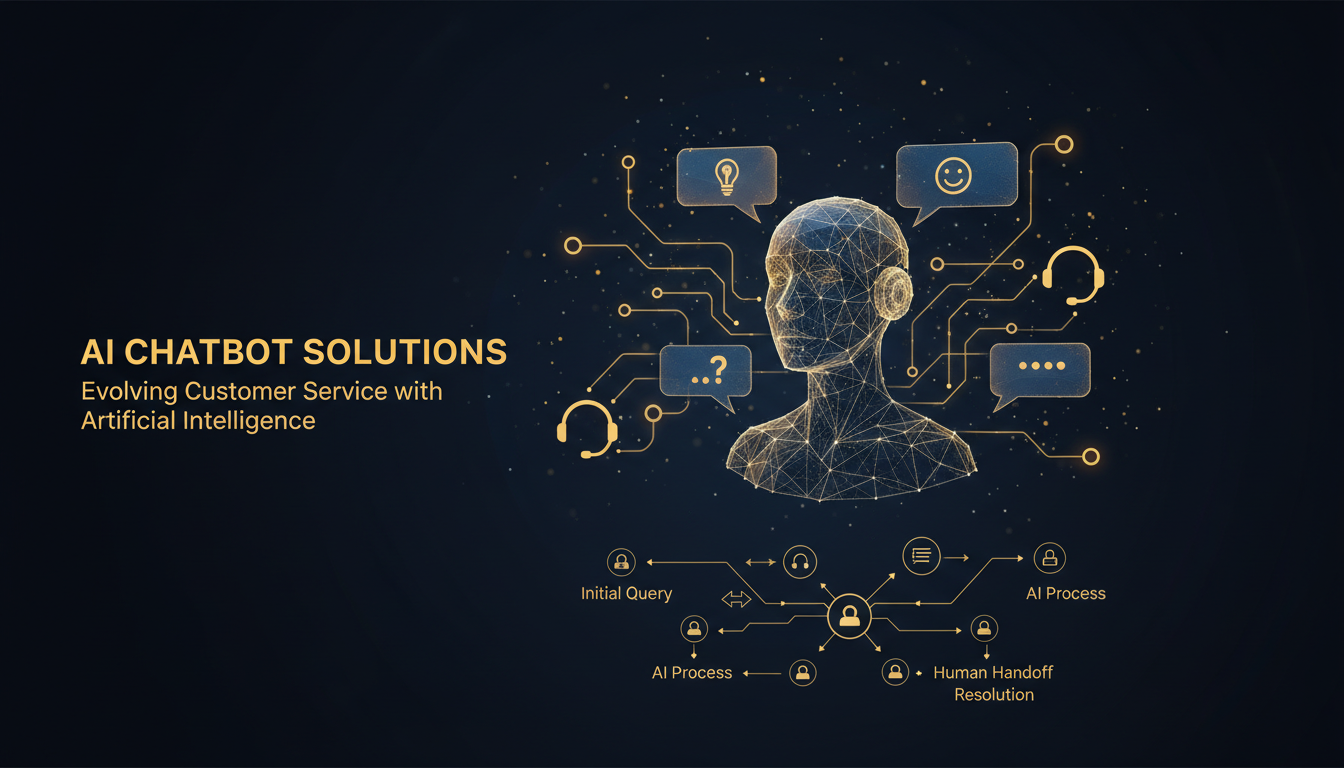
Customer expectations in the United Kingdom have shifted dramatically. Today's consumers demand instant, round-the-clock support - and they expect it to be intelligent, personalised, and seamless. For UK businesses navigating this landscape, AI chatbot development has emerged as one of the most impactful investments in modern customer service infrastructure.
Whether you operate a high-street retailer, a financial services firm, or a fast-growing SaaS company, the question is no longer if you should deploy an AI chatbot - it's how to do it properly. This comprehensive guide covers everything you need to know about building, deploying, and optimising AI-powered chatbots for customer service in the UK market, from foundational technology choices to GDPR compliance, conversation design, and measuring return on investment.
Understanding the Types of Customer Service Chatbots
Before diving into the development process, it's essential to understand the three primary categories of chatbot technology available to UK businesses. Each type serves different purposes, and the right choice depends on your customer service objectives, budget, and technical maturity.
Rule-Based Chatbots
Rule-based chatbots - sometimes called decision-tree or scripted chatbots - follow predetermined conversation paths. They work on an if/then logic framework: if the customer says X, the bot responds with Y. These bots are straightforward to build and maintain, making them suitable for businesses with well-defined, repetitive enquiries.
For example, a rule-based chatbot on a UK council website might guide residents through council tax enquiries by presenting a series of menu options. The bot doesn't truly "understand" language; it matches keywords or button selections to pre-written responses.
Whilst rule-based bots are limited in their conversational ability, they offer predictability and control - important qualities in regulated industries where every response must be vetted.
AI-Powered Chatbots (NLP/NLU)
AI-powered chatbots leverage natural language processing (NLP) and natural language understanding (NLU) to interpret the meaning behind customer messages, even when phrased in unexpected ways. These bots learn from training data and improve over time, handling a far broader range of enquiries than their rule-based counterparts.
An AI chatbot for business can understand intent, extract entities (such as order numbers, dates, or product names), manage context across a multi-turn conversation, and provide genuinely helpful responses. This is the technology behind the most effective customer service automation in the UK market today.
Hybrid Chatbots
Hybrid chatbots combine AI-powered understanding with structured decision trees and seamless human handover. They use AI for initial intent classification and open-ended questions, but fall back to guided flows for complex processes like booking modifications or complaint escalation.
Most successful UK deployments use a hybrid approach. The AI handles the conversational front end, whilst structured workflows ensure accuracy for high-stakes interactions. When the bot reaches its limits, it transfers the conversation - with full context - to a human agent.
Rule-Based Chatbot
AI-Powered Chatbot
Hybrid Chatbot
The GPT and LLM Revolution in Customer Service
The emergence of large language models (LLMs) - including GPT-4, Claude, and open-source alternatives - has fundamentally transformed what's possible with AI chatbot development. These models don't just match keywords; they genuinely understand language, context, and nuance in ways that were unimaginable just a few years ago.
A GPT chatbot for website UK deployments can now handle conversations that feel remarkably natural. Customers can ask questions in their own words, use colloquialisms, reference previous parts of the conversation, and receive responses that are contextually appropriate and genuinely helpful.
What Makes LLM-Powered Chatbots Different
Traditional NLP chatbots require extensive intent classification - you must anticipate every possible way a customer might phrase a question and map it to a predefined intent. LLM-powered chatbots eliminate much of this labour. They understand language natively and can generate appropriate responses based on your knowledge base, policies, and brand guidelines.
For UK businesses, this means faster time-to-deployment, lower training data requirements, and significantly better handling of edge cases. A GPT-powered chatbot can understand "I'm having a nightmare with my broadband, it keeps dropping out every evening" just as well as "My internet connection is intermittent" - without you having to train it on every possible phrasing.
When deploying LLM-powered chatbots for customer service, always implement retrieval-augmented generation (RAG). This grounds the chatbot's responses in your actual knowledge base and policies, dramatically reducing hallucination risk. Your chatbot should never invent information about your products, pricing, or policies.
Grounding LLMs With Your Business Knowledge
The key to successful LLM deployment lies in grounding. A raw GPT model knows nothing about your specific products, services, pricing, or policies. Retrieval-augmented generation (RAG) solves this by feeding relevant documents from your knowledge base into the model's context window alongside the customer's question.
This approach delivers the best of both worlds: the conversational fluency of a large language model combined with the accuracy and specificity of your own documentation. When a customer asks about your returns policy, the chatbot retrieves your actual policy document and uses it to generate a natural, accurate response.
Building vs Buying: Making the Right Decision for Your Business
One of the first strategic decisions in AI chatbot development is whether to build a custom solution, buy an off-the-shelf platform, or commission a bespoke build from a specialist development partner. Each path has distinct advantages, and the right choice depends on your specific requirements.
Off-the-Shelf Chatbot Platforms
Platforms like Intercom, Drift, Zendesk AI, and Tidio offer pre-built chatbot functionality that can be deployed quickly with minimal technical expertise. These solutions are ideal for businesses that need basic automation - handling FAQs, routing enquiries, and collecting lead information.
However, off-the-shelf platforms come with limitations. Customisation is often restricted, integration with bespoke internal systems can be challenging, and you're dependent on the vendor's roadmap for new features. Monthly subscription costs can also escalate significantly as conversation volumes grow.
Custom AI Chatbot Development
For businesses with complex requirements - deep integration with proprietary systems, industry-specific compliance needs, or unique conversational workflows - custom development delivers substantially better results. When you build AI chatbot UK solutions from scratch, you control every aspect of the experience.
Custom development allows you to design conversation flows that perfectly match your business processes, integrate directly with your CRM, ERP, and helpdesk systems, implement industry-specific compliance measures, and create a chatbot personality that authentically represents your brand.
| Factor | Off-the-Shelf Platform | Custom Development |
|---|---|---|
| Time to deploy | Days to weeks | 6–16 weeks |
| Upfront cost | Low (subscription) | Higher (project-based) |
| Long-term cost | Escalates with volume | Predictable, lower at scale |
| Customisation depth | Limited | Unlimited |
| System integration | Standard APIs only | Any system, any depth |
| Data ownership | Shared with vendor | Fully owned |
| GDPR compliance control | Vendor-dependent | Full control |
| Brand differentiation | Generic templates | Bespoke personality & UX |
| Scalability | Platform-limited | Architecture-driven |
| Vendor lock-in risk | High | None |
If you're spending more than £2,000/month on a chatbot platform subscription and finding it increasingly limiting, it's almost certainly time to explore custom development. The crossover point where custom becomes more cost-effective than subscription platforms typically arrives within 12–18 months for mid-sized UK businesses.
The AI Chatbot Development Process: Step by Step
Developing an effective AI customer service chatbot UK businesses can rely on requires a structured, methodical approach. Here's the development process that consistently delivers the best outcomes for UK organisations.
Phase 1: Discovery and Strategy (Weeks 1–2)
Analyse existing customer service data to identify the highest-volume enquiry types, peak contact times, and common pain points. Map current customer journeys and identify where chatbot intervention will deliver the greatest impact. Define success metrics: target containment rate, customer satisfaction score, cost per resolution, and average handling time.
Phase 2: Conversation Design (Weeks 2–4)
Design the conversational architecture: welcome messages, intent recognition categories, dialogue flows for each use case, escalation triggers, and fallback responses. Create a chatbot personality brief defining tone of voice, formality level, and brand-appropriate language. For UK deployments, this includes British English spelling and culturally appropriate phrasing.
Phase 3: Data Preparation and Knowledge Base (Weeks 3–5)
Compile and structure your training data: FAQ documents, product manuals, policy documents, previous customer service transcripts, and any other relevant knowledge. Clean, deduplicate, and format this data for ingestion. For RAG-based systems, create vector embeddings and configure retrieval pipelines.
Phase 4: Core Development and Integration (Weeks 4–10)
Build the chatbot engine, implement NLU/LLM integration, connect to your knowledge base, develop API integrations with CRM, helpdesk, and other business systems. Implement the conversation flows designed in Phase 2, including human handover logic, authentication workflows, and transactional capabilities.
Phase 5: Testing and Quality Assurance (Weeks 8–12)
Rigorous testing across hundreds of conversation scenarios, edge cases, and adversarial inputs. Load testing to ensure performance under peak traffic. User acceptance testing with real customer service staff. Compliance review for GDPR, accessibility (WCAG 2.1), and industry-specific regulations.
Phase 6: Soft Launch and Optimisation (Weeks 10–14)
Deploy to a subset of traffic (typically 10–20%) and monitor performance closely. Analyse conversation logs, identify failure points, refine responses, and expand coverage. Gradually increase traffic share as confidence builds. Most chatbots see a 15–25% improvement in containment rate during this phase.
Phase 7: Full Deployment and Continuous Improvement (Ongoing)
Roll out to 100% of eligible traffic. Establish ongoing monitoring dashboards, weekly performance reviews, and monthly optimisation cycles. Plan feature expansions - additional languages, new use cases, proactive messaging, and deeper system integrations.
Training Data: The Foundation of Chatbot Intelligence
The quality of your chatbot's responses is directly proportional to the quality of the data it's trained on. For UK customer service chatbots, training data comes from several sources, and preparing it properly is one of the most critical - and most underestimated - parts of the development process.
Essential Training Data Sources
The richest source of training data for most UK businesses is their existing customer service interactions. Email transcripts, live chat logs, call recordings (transcribed), and support ticket histories all contain invaluable examples of how customers actually phrase their questions - complete with regional variations, colloquialisms, and the specific terminology your customer base uses.
Beyond interaction data, your knowledge base is equally important. Product documentation, FAQs, policy documents, troubleshooting guides, and internal process documents form the factual foundation that your chatbot draws upon when generating responses.
Data Quality and Preparation
Raw data is rarely ready for direct use. Effective preparation involves removing personally identifiable information (critical for GDPR compliance), correcting errors in existing documentation, standardising formatting, resolving contradictions between documents, and structuring unstructured data into queryable formats.
For LLM-based chatbots using RAG, documents must be chunked into semantically meaningful segments, embedded using appropriate models, and indexed in a vector database. The chunking strategy - how you split documents - has a significant impact on retrieval quality and, consequently, response accuracy.
Integration With Existing Business Systems
A chatbot that can only answer questions is useful. A chatbot that can take action is transformative. The true power of an AI chatbot for business emerges when it's deeply integrated with your existing technology stack, enabling it to look up orders, update records, schedule appointments, process refunds, and perform dozens of other actions on behalf of your customers.
CRM Integration
Connecting your chatbot to your CRM (Salesforce, HubSpot, Microsoft Dynamics, or bespoke systems) enables personalised interactions from the first message. The chatbot can greet returning customers by name, reference their purchase history, and tailor recommendations based on their profile. When a conversation leads to a sales opportunity, lead data flows directly into your pipeline.
Helpdesk and Ticketing Systems
Integration with Zendesk, Freshdesk, ServiceNow, Jira Service Management, or similar platforms allows the chatbot to create, update, and track support tickets. When escalation to a human agent is necessary, the full conversation context is attached to the ticket - eliminating the frustrating need for customers to repeat themselves.
Website and E-Commerce Platforms
For online retailers, chatbot integration with platforms like Shopify, WooCommerce, or Magento enables real-time order tracking, stock availability checks, product recommendations, and even checkout assistance. A well-integrated e-commerce chatbot can increase conversion rates by 15–25% by engaging hesitant buyers at critical moments.
Payment and Booking Systems
Secure integration with payment gateways (Stripe, WorldPay, GoCardless) and booking systems allows the chatbot to process transactions and schedule appointments directly within the conversation. This is particularly valuable for UK service businesses - healthcare providers, salons, restaurants, and professional services firms.
| Integration Type | Common UK Platforms | Key Capabilities Unlocked |
|---|---|---|
| CRM | Salesforce, HubSpot, Dynamics 365 | Personalisation, lead capture, customer history |
| Helpdesk | Zendesk, Freshdesk, ServiceNow | Ticket creation, status updates, agent handover |
| E-Commerce | Shopify, WooCommerce, Magento | Order tracking, product lookup, cart recovery |
| Payment | Stripe, WorldPay, GoCardless | In-chat payments, refund processing |
| Booking | Calendly, SimplyBook, bespoke systems | Appointment scheduling, rescheduling, reminders |
| Communication | Microsoft Teams, Slack, WhatsApp Business | Multi-channel deployment, internal escalation |
| Analytics | Google Analytics, Mixpanel, Power BI | Conversation analytics, funnel tracking |
Conversation Design: The Art and Science of Chatbot UX
Technology is only half the equation. The difference between a chatbot customers love and one they abandon after two messages comes down to conversation design - the art of crafting natural, efficient, and satisfying dialogue flows.
First Impressions: The Welcome Message
Your chatbot's welcome message sets the tone for the entire interaction. It should be warm but concise, clearly state what the bot can help with, and set appropriate expectations. Avoid overpromising - if the bot can handle five types of enquiry, say so. Customers prefer honest scope to vague claims of omniscience.
For UK audiences, the tone should be professional yet approachable. Overly casual language ("Hey! What's up?") feels jarring for customer service, whilst overly formal language ("We cordially acknowledge your communication") feels robotic. The sweet spot is friendly professionalism: "Hello! I'm here to help with orders, deliveries, returns, and account queries. How can I assist you today?"
Handling Ambiguity and Misunderstanding
Even the best AI will sometimes misunderstand. How your chatbot handles these moments defines the user experience. Effective strategies include confidence scoring (if the bot isn't sure, it asks a clarifying question), graceful fallbacks ("I want to make sure I help you with the right thing - could you tell me a bit more?"), and proactive suggestion of related topics.
Escalation Design
Knowing when to hand over to a human is just as important as handling enquiries autonomously. Design clear escalation triggers: customer frustration signals (repeated questions, negative language), complex scenarios outside the bot's scope, high-value transactions requiring human judgement, and explicit requests to speak to a person.
The handover itself must be seamless. Transfer the full conversation history, any data collected, and a summary of the issue. Nothing frustrates customers more than repeating everything they've already told the chatbot.
Design your chatbot's error and escalation paths before the happy paths. In real-world customer service, edge cases and errors are far more common than textbook scenarios. A chatbot that handles confusion gracefully will earn customer trust - even when it can't answer the question itself.
UK-Specific Considerations for AI Chatbot Development
Deploying an AI customer service chatbot UK businesses can trust requires careful attention to regulations, cultural expectations, and market-specific nuances that are unique to the United Kingdom.
GDPR and UK Data Protection Act 2018
The UK's data protection framework - the UK GDPR and the Data Protection Act 2018 - imposes strict requirements on how chatbots collect, process, and store personal data. Key requirements include:
Lawful basis for processing: You must establish a lawful basis (typically consent or legitimate interests) for processing the personal data collected during chatbot conversations. This includes names, email addresses, order numbers, and any other identifying information.
Transparency: Customers must be informed that they're interacting with a bot, what data is being collected, how it will be used, and how long it will be retained. A clear privacy notice - accessible from within the chat interface - is essential.
Data minimisation: Collect only the data necessary for the specific interaction. If a customer is asking about opening hours, the bot shouldn't be requesting their email address.
Right to erasure: Customers can request deletion of their conversation data. Your chatbot infrastructure must support this capability, including deletion from any systems the data has been shared with.
Data residency: For many UK businesses, particularly in financial services and healthcare, data must remain within the UK or approved jurisdictions. If your LLM provider processes data overseas, you need appropriate safeguards (standard contractual clauses, adequacy decisions, or binding corporate rules).
Cultural Tone and Language Nuances
British consumers have distinct communication preferences that should be reflected in your chatbot's personality. UK customers generally prefer:
Politeness and understatement: British communication favours indirectness and politeness. "I'm afraid that's not quite right" lands better than "That's wrong." "Would you mind..." is preferred over "Please provide..."
British English spelling: Colour, not color. Organise, not organize. Favourite, not favorite. This seems minor but inconsistent spelling signals a generic, non-localised product.
Appropriate humour: A touch of warmth and wit can differentiate your chatbot, but it must be appropriate for the context. Self-deprecating humour works well; sarcasm less so. Never attempt humour when handling complaints or sensitive issues.
Regional sensitivity: Be mindful that the UK encompasses England, Scotland, Wales, and Northern Ireland - each with distinct identities. Avoid assumptions or London-centric language that might alienate customers in other regions.
Accessibility Requirements
Under the Equality Act 2010, UK businesses must ensure their digital services - including chatbots - are accessible to people with disabilities. This means WCAG 2.1 AA compliance for the chat interface: keyboard navigation, screen reader compatibility, sufficient colour contrast, resizable text, and alternative interaction methods for users who cannot type.
Industry-Specific Regulations
Depending on your sector, additional regulations may apply. Financial services firms must comply with FCA guidance on automated customer communication. Healthcare providers must meet NHS Digital standards and ensure clinical safety. Legal services must maintain client confidentiality in accordance with SRA regulations.
Common Use Cases for AI Customer Service Chatbots in the UK
Understanding where chatbots deliver the most value helps prioritise your development roadmap. Here are the highest-impact use cases for UK businesses, ordered by typical implementation priority.
FAQ Automation
The most immediate win for any business. Automating responses to frequently asked questions - opening hours, delivery timescales, pricing, returns policies, account setup - typically deflects 40–60% of all customer service contacts. For a UK business handling 10,000 enquiries per month, that's 4,000–6,000 conversations resolved instantly without human intervention.
Order Tracking and Delivery Updates
"Where is my order?" is consistently the highest-volume enquiry for UK e-commerce businesses. A chatbot integrated with your logistics provider can provide real-time tracking information, estimated delivery windows, and proactive delay notifications - resolving the enquiry in seconds rather than the minutes it takes a human agent.
Appointment and Booking Management
For service-based businesses - GP surgeries, dental practices, salons, restaurants, professional services - chatbot-powered booking management reduces no-shows, fills cancelled slots, and handles rescheduling without staff involvement. Particularly powerful for after-hours booking requests.
Complaints Triage and Resolution
AI chatbots can assess complaint severity, collect relevant details, offer immediate resolution for straightforward issues (refunds, replacements, credit), and ensure complex complaints are escalated to the right team with full context. This reduces resolution times and ensures nothing falls through the cracks.
Lead Generation and Qualification
For B2B and high-value B2C businesses, chatbots can engage website visitors, ask qualifying questions, score leads based on responses, and route qualified prospects to the sales team with a warm handover. UK businesses report 30–50% more qualified leads from chatbot-powered engagement compared to static contact forms.
Account Management
Password resets, address changes, subscription modifications, billing enquiries, and other account management tasks are ideal chatbot candidates. These interactions follow predictable patterns, can be fully automated with appropriate security measures, and are among the least satisfying tasks for human agents.
Industry-Specific Applications Across the UK
Whilst the core technology is the same, the application of AI chatbot development varies significantly across industries. Here's how different UK sectors are leveraging chatbot technology for customer service excellence.
Retail and E-Commerce
UK retailers are deploying chatbots for product discovery ("I need a waterproof jacket for hillwalking in the Lake District"), size recommendations, stock availability, order modifications, delivery tracking, and returns processing. The most advanced implementations use visual AI to let customers upload photos and find matching products.
Financial Services
Banks, insurance companies, and fintech firms use chatbots for balance enquiries, transaction disputes, policy questions, claims initiation, and regulated advice (within FCA guidelines). NatWest's Cora, HSBC's Amy, and numerous challenger bank bots demonstrate the sector's maturity. Security is paramount - multi-factor authentication within the chat flow is standard practice.
Healthcare
NHS trusts and private healthcare providers use chatbots for appointment booking, symptom triage (carefully designed with clinical safety frameworks), prescription management, and post-treatment follow-up. The Babylon Health chatbot, widely used across the UK, demonstrated both the potential and the compliance challenges of healthcare chatbots.
Travel and Hospitality
Airlines, hotels, and travel companies use chatbots for booking management, itinerary changes, loyalty programme queries, and travel disruption assistance. During periods of mass disruption (strikes, weather events), chatbots handle the surge in enquiries that would otherwise overwhelm human teams.
Utilities and Telecommunications
UK energy suppliers and telecoms providers deploy chatbots for meter reading submissions, tariff comparisons, fault reporting, billing queries, and switching processes. Given the high volume of routine enquiries in these sectors, chatbot ROI is typically among the highest of any industry.
Professional Services
Law firms, accountancy practices, and consultancies use chatbots for initial client enquiry handling, document request management, appointment scheduling, and basic guidance (with appropriate disclaimers). This allows fee-earning professionals to focus on billable work rather than administrative interactions.
| Industry | Top Use Case | Typical Containment Rate | Avg. ROI Timeline |
|---|---|---|---|
| Retail / E-Commerce | Order tracking & returns | 55–70% | 3–6 months |
| Financial Services | Balance & transaction queries | 60–75% | 6–9 months |
| Healthcare | Appointment booking | 50–65% | 6–12 months |
| Travel & Hospitality | Booking changes & disruptions | 45–60% | 4–8 months |
| Utilities & Telecoms | Billing & fault reporting | 60–75% | 3–6 months |
| Professional Services | Enquiry triage & scheduling | 40–55% | 6–9 months |
Measuring Chatbot ROI: Metrics That Matter
Justifying the investment in AI chatbot development requires a clear measurement framework. UK businesses should track a combination of operational efficiency, customer experience, and commercial impact metrics to build a comprehensive picture of chatbot performance.
Operational Efficiency Metrics
Containment rate: The percentage of conversations fully resolved by the chatbot without human intervention. This is your primary efficiency metric. Well-implemented chatbots achieve 50–70% containment within the first three months.
Average handling time (AHT): Compare the time taken for chatbot-resolved conversations versus human-resolved conversations. Chatbots typically resolve enquiries in 30–90 seconds versus 6–12 minutes for human agents.
Cost per resolution: Calculate the fully loaded cost per chatbot resolution (technology costs divided by conversations handled) versus the cost per human resolution (agent salary, benefits, training, infrastructure). Most UK businesses see 60–80% cost reduction per resolution.
Agent productivity: Measure how chatbot deployment affects human agent productivity. With routine enquiries handled by the bot, agents focus on complex, high-value interactions - typically handling each one more effectively.
Customer Experience Metrics
Customer satisfaction (CSAT): Post-interaction surveys specifically for chatbot conversations. Target: 80%+ satisfaction within six months. LLM-powered chatbots in the UK consistently outperform traditional bots on this metric.
First contact resolution (FCR): The percentage of chatbot conversations that resolve the customer's issue without requiring a follow-up contact. Target: 75%+ for enquiries within the chatbot's scope.
Escalation quality: When the chatbot does escalate, does the human agent have the context they need? Measure agent satisfaction with handover quality and the time agents spend re-gathering information.
Commercial Impact Metrics
Conversion rate impact: For sales-oriented chatbots, measure the conversion rate of chatbot-engaged visitors versus non-engaged visitors. UK e-commerce businesses typically see 15–25% higher conversion rates.
Lead generation volume and quality: Track the number and quality of leads generated through chatbot interactions. Measure lead-to-opportunity conversion rates to ensure volume isn't coming at the expense of quality.
Revenue attribution: Where possible, attribute revenue to chatbot interactions - both direct (sales assisted by the chatbot) and indirect (reduced churn, increased lifetime value from better service).
Development Costs: What to Budget for AI Chatbot Development in the UK
Understanding the investment required to build AI chatbot UK solutions helps businesses plan effectively and avoid unpleasant surprises. Costs vary significantly based on complexity, integration requirements, and the development approach chosen.
Cost Breakdown by Chatbot Complexity
Basic FAQ chatbot (£5,000–£15,000): Rule-based or simple NLP-powered bot handling 20–50 predefined topics. Limited integration (typically just website widget). Suitable for small businesses with straightforward enquiry patterns.
Mid-range AI chatbot (£20,000–£50,000): LLM-powered with RAG, handling 50–200+ topics. Integration with 2–3 business systems (CRM, helpdesk, e-commerce platform). Custom conversation design, British English localisation, and GDPR compliance built in. Suitable for most UK SMEs and mid-market businesses.
Enterprise AI chatbot (£50,000–£150,000+): Full LLM integration with advanced RAG, deep integration with 5+ business systems, multi-channel deployment (website, WhatsApp, Teams, app), custom analytics dashboard, advanced security, and ongoing optimisation programme. Suitable for large enterprises and regulated industries.
Ongoing Costs
Beyond initial development, budget for ongoing costs: LLM API usage (typically £500–£3,000/month depending on volume), hosting and infrastructure (£200–£1,000/month), knowledge base maintenance (internal time or agency retainer), and continuous optimisation (typically 10–15% of initial development cost annually).
Key Technical Decisions in AI Chatbot Architecture
Several architectural decisions made early in the development process have lasting implications for your chatbot's capabilities, costs, and scalability. Understanding these choices helps you have informed conversations with your development partner.
LLM Selection
The choice of underlying language model affects response quality, latency, cost, and data privacy. Options include commercial models (GPT-4, Claude, Gemini), open-source models (Llama, Mistral, Qwen), or a combination. For UK businesses concerned about data sovereignty, self-hosted open-source models keep all data within your infrastructure - though this requires more technical investment.
Vector Database for RAG
If using retrieval-augmented generation, you'll need a vector database to store and query document embeddings. Options include Pinecone, Weaviate, Qdrant, Milvus, and pgvector (PostgreSQL extension). For UK businesses, Qdrant and pgvector are popular choices as they can be self-hosted within UK data centres.
Conversation State Management
How the chatbot maintains context across a conversation significantly affects user experience. Options range from simple session-based context (conversation history passed with each request) to sophisticated memory systems that remember customer preferences across sessions and even across channels.
Multi-Channel Architecture
If you plan to deploy across multiple channels (website, WhatsApp, Facebook Messenger, Microsoft Teams, in-app), design the architecture for channel abstraction from the start. A well-designed system uses a single conversation engine with channel-specific adapters, ensuring consistent behaviour across all touchpoints.
Security and Safety Considerations
An AI customer service chatbot UK deployment must be built with security at every layer. Customer service chatbots handle sensitive information - personal details, financial data, account credentials - and a security breach could have catastrophic consequences for both your customers and your business.
Prompt Injection Protection
LLM-powered chatbots are susceptible to prompt injection attacks - attempts by malicious users to manipulate the bot into revealing system prompts, bypassing restrictions, or generating harmful content. Robust defences include input sanitisation, output filtering, system prompt isolation, and regular adversarial testing.
Data Encryption
All conversation data should be encrypted both in transit (TLS 1.3) and at rest (AES-256). API keys, database credentials, and other secrets must be managed through secure vault systems, never hardcoded. For regulated industries, consider end-to-end encryption of conversation content.
Authentication and Authorisation
When chatbots access customer accounts or perform actions, robust authentication is essential. Implement appropriate verification steps before allowing account-specific actions - verify identity through existing authentication mechanisms, not just by asking for information that might be socially engineered.
Content Safety
Implement guardrails to prevent the chatbot from generating inappropriate, harmful, or off-brand content. This includes toxicity filters, topic boundaries (the chatbot should only discuss topics within its scope), and regular auditing of conversation logs for concerning patterns.
Choosing the Right AI Chatbot Development Partner in the UK
Selecting the right development partner is perhaps the most consequential decision in your chatbot journey. The UK has a thriving ecosystem of AI development firms, but quality varies enormously. Here's what to look for when choosing a partner to build AI chatbot UK solutions for your organisation.
Essential Criteria
Proven AI/LLM expertise: Your partner should have demonstrable experience with the specific AI technologies your project requires. Ask for case studies, not just capability claims. Request to see working examples of chatbots they've built, ideally in your industry or a comparable one.
UK market understanding: A partner who understands UK consumer expectations, regulatory requirements, and business culture will deliver a more effective product. Look for a UK-based team with experience serving UK businesses - not an offshore team that claims UK expertise.
Integration capabilities: Chatbot development is fundamentally an integration challenge. Your partner must have experience integrating with the specific platforms in your technology stack. Ask about their experience with your CRM, helpdesk, and other critical systems.
Conversation design expertise: The best chatbot developers employ dedicated conversation designers - specialists who understand the psychology of human-bot interaction, not just the technology. Ask about their conversation design process and the team members involved.
Post-launch support and optimisation: A chatbot is never "finished." Your partner should offer ongoing optimisation services, performance monitoring, and a clear SLA for support and maintenance.
Red Flags to Watch For
Be wary of partners who promise unrealistic containment rates from day one, cannot explain their AI architecture in plain language, have no UK-based team members, offer no post-launch support plan, or pressure you towards proprietary technology that creates vendor lock-in.
Strong Development Partner
Weak Development Partner
Future Trends: What's Next for AI Chatbots in the UK
The pace of innovation in conversational AI shows no signs of slowing. UK businesses planning their chatbot strategy should be aware of emerging trends that will shape the next generation of customer service automation.
Multimodal Chatbots
Next-generation chatbots will process and generate not just text but also images, voice, and video. A customer could photograph a faulty product, send it to the chatbot, and receive a visual troubleshooting guide - all within a single conversation. Voice-first chatbots are already gaining traction, particularly for accessibility and hands-free use cases.
Proactive Customer Service
Rather than waiting for customers to initiate contact, AI systems will anticipate issues and reach out proactively. If a delivery is delayed, the chatbot contacts the customer before they notice. If usage patterns suggest a customer is struggling with a product, the chatbot offers help. This shift from reactive to proactive service represents the next frontier in customer experience.
Emotional Intelligence
Advances in sentiment analysis and emotional AI will enable chatbots to better detect and respond to customer emotions. A frustrated customer will receive a different conversational approach than a curious one - mirroring the emotional intelligence that the best human agents demonstrate naturally.
Autonomous Agents
The evolution from chatbots to autonomous agents - AI systems that can independently plan, execute multi-step tasks, use tools, and learn from outcomes - will dramatically expand what's possible. Rather than simply answering questions, these agents will proactively manage customer relationships, anticipate needs, and orchestrate complex workflows across multiple systems.
Getting Started: A Practical Roadmap for UK Businesses
If you're ready to explore AI chatbot development for your customer service operations, here's a practical roadmap to get started, regardless of your current technical maturity.
Step 1: Audit Your Current Customer Service
Before building anything, understand your starting point. Analyse your current customer service data: What are the most common enquiry types? What percentage could be automated? Where are the biggest pain points - for customers and for your team? What systems do you currently use, and what integrations would be needed?
Step 2: Define Clear Objectives
Set specific, measurable goals. Rather than "improve customer service," aim for "reduce average first-response time from 4 hours to under 30 seconds for the top 10 enquiry types" or "achieve 60% chatbot containment rate within 6 months, reducing cost per resolution by 50%."
Step 3: Start Focused, Then Expand
Don't try to automate everything at once. Start with your highest-volume, most straightforward enquiry types. Prove the value, learn from the data, and systematically expand the chatbot's capabilities based on real-world performance.
Step 4: Choose Your Development Approach
Based on your requirements, budget, and timeline, decide whether to use an off-the-shelf platform, commission custom development, or pursue a hybrid approach. For most UK businesses with meaningful customer service volumes, custom or semi-custom development delivers the best long-term value.
Step 5: Select Your Development Partner
If pursuing custom development, choose a partner with proven AI chatbot expertise, UK market understanding, strong integration capabilities, and a commitment to ongoing optimisation. Cloudswitched, as a London-based AI development specialist, combines deep technical expertise in LLM-powered chatbot development with practical understanding of UK business requirements, GDPR compliance, and the cultural nuances that make chatbots succeed in the British market.
Why Cloudswitched for AI Chatbot Development
As a London-based IT managed services provider and AI development specialist, Cloudswitched brings a unique combination of capabilities to AI chatbot development for UK businesses.
Our team has extensive experience building GPT chatbot for website UK deployments across multiple industries, from retail and financial services to healthcare and professional services. We understand the full technology stack - from LLM selection and RAG architecture to CRM integration and GDPR compliance - and we deliver chatbots that don't just work technically but genuinely improve customer satisfaction and operational efficiency.
What sets us apart is our end-to-end approach. We handle discovery and strategy, conversation design, technical development, system integration, testing, deployment, and ongoing optimisation. You get a single, accountable partner for every aspect of your chatbot journey - not a patchwork of vendors and freelancers.
Every chatbot we build is designed for the UK market from the ground up: British English, GDPR-compliant data handling, UK-appropriate conversational tone, and integration with the platforms British businesses actually use. We don't localise American products; we build for Britain.
Ready to Transform Your Customer Service With AI?
Whether you're exploring your first chatbot or looking to upgrade an existing solution, our team can help you design, build, and deploy an AI chatbot that delivers measurable results for your UK business. Book a free consultation to discuss your requirements and receive a tailored proposal.

CloudSwitched
London-based managed IT services provider offering support, cloud solutions and cybersecurity for SMEs.


