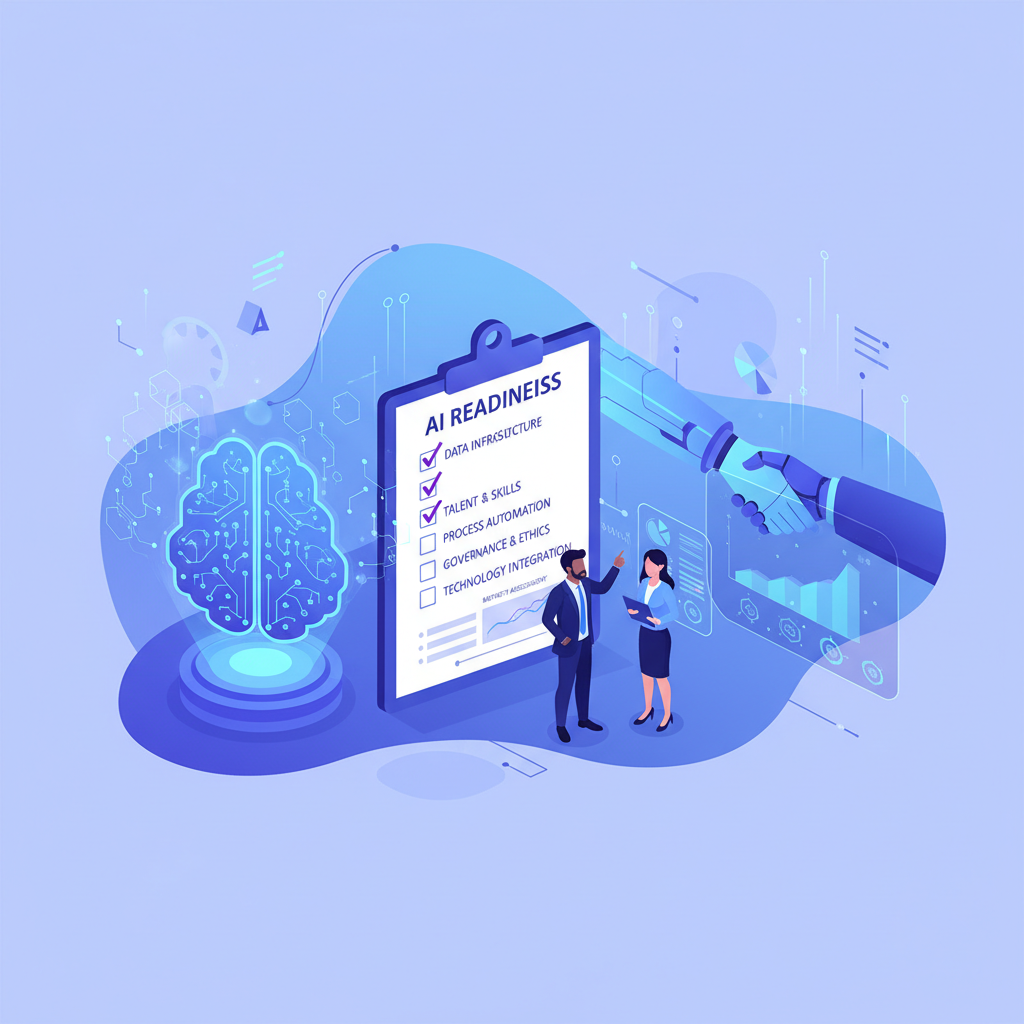
Artificial intelligence is no longer a futuristic concept reserved for Silicon Valley giants and multinational corporations. In 2026, AI is firmly embedded in the day-to-day operations of businesses across the United Kingdom - from automated customer service chatbots handling thousands of enquiries per hour, to intelligent document processing systems that extract and categorise data in seconds rather than hours. The question for UK small and medium-sized enterprises is no longer “should we adopt AI?” but rather “are we ready to adopt AI effectively, responsibly, and in a way that delivers genuine return on investment?”
That question - are we ready? - is precisely what an AI readiness assessment answers. It is a structured, honest evaluation of your organisation’s current capabilities across data, infrastructure, skills, culture, and governance, measured against the specific AI use cases that would deliver the most value for your business. Without this assessment, AI adoption becomes a gamble: you risk investing in tools you cannot properly implement, training models on data that is incomplete or unreliable, or deploying systems that create compliance risks under UK data protection law.
This guide walks you through every aspect of AI readiness for UK SMEs - from understanding what readiness truly means, through assessing your current position, to building an actionable roadmap that transforms AI from an abstract ambition into a practical business advantage. Whether you are a 10-person professional services firm or a 200-employee manufacturer, the principles are the same; only the scale differs.
What Does AI Readiness Actually Mean?
AI readiness is not about having the latest hardware or hiring a team of data scientists. For most UK SMEs, it is about having the right foundations in place - clean, accessible data; adequate infrastructure; digitally confident staff; clear use cases; and appropriate governance - so that when you invest in AI tools, they actually work as intended and deliver measurable business value.
Think of it like building a house. You would not start installing premium fixtures before ensuring the foundations are solid, the walls are straight, and the plumbing and electrics are properly routed. AI readiness is the surveyor’s report that tells you exactly where your foundations are strong, where they need reinforcing, and what must be addressed before you can build upward with confidence.
An AI readiness assessment typically evaluates five core dimensions: data maturity (the quality, accessibility, and governance of your business data), infrastructure readiness (whether your technology stack can support AI workloads), skills and culture (your team’s ability and willingness to work with AI), strategic alignment (whether proposed AI initiatives connect to genuine business objectives), and governance and ethics (your frameworks for responsible, compliant AI use). Each dimension contributes to an overall picture of how prepared your organisation is to adopt AI successfully.
Assessing Your Data Maturity
Data is the fuel that powers artificial intelligence. Without quality data, even the most sophisticated AI models produce unreliable, misleading, or outright wrong results. For UK SMEs, data maturity is frequently the single biggest gap between AI ambition and AI reality - and it is the area where honest assessment is most critical.
Data Quality and Completeness
Start by auditing the data your business currently holds. Customer records, financial transactions, sales histories, inventory data, employee records, communications, and operational logs all represent potential AI fuel - but only if they are accurate, complete, and consistently formatted. Common problems that undermine AI effectiveness include duplicate customer records, inconsistent date formats, missing fields in CRM entries, unstructured data trapped in email threads and spreadsheets, and outdated information that has never been cleaned.
A practical first step is to examine your three most business-critical datasets and score each on a simple scale: Is the data accurate (does it reflect reality)? Is it complete (are fields filled in consistently)? Is it current (is it regularly updated)? Is it accessible (can authorised people and systems retrieve it easily)? If any dataset scores poorly on two or more of these criteria, data quality improvement must come before AI deployment.
Data Accessibility and Integration
Many UK SMEs suffer from data silos - valuable information locked inside disconnected systems that cannot communicate with each other. Your CRM holds customer interaction data, your accounting software holds financial data, your email marketing platform holds engagement data, and your ERP or inventory system holds operational data. For AI to deliver meaningful insights, it needs access to data across these silos.
Assess whether your current systems offer APIs or export capabilities that would allow data integration. Cloud-based platforms generally excel here - Microsoft 365, Xero, HubSpot, Salesforce, and similar tools typically offer robust APIs and pre-built integrations. Legacy on-premise systems, bespoke databases, and manual spreadsheet workflows present significantly more challenge. Mapping your data landscape - what data exists, where it lives, who owns it, and how it can be accessed - is an essential early step in any AI readiness assessment.
Data scientists consistently report that 80% of any AI project’s time is spent on data preparation - cleaning, formatting, integrating, and validating data - rather than on building or training the AI model itself. For UK SMEs, this means that investing in data quality before purchasing AI tools delivers disproportionate value. A £5,000 investment in cleaning and structuring your CRM data will generate far better AI outcomes than spending £5,000 on a more expensive AI tool that processes the same messy data.
Infrastructure Requirements for AI
The good news for UK SMEs is that the infrastructure requirements for most practical AI applications have dropped dramatically. You do not need a server room full of GPUs or a dedicated high-performance computing cluster. The vast majority of SME-relevant AI runs in the cloud, accessed through APIs and SaaS platforms that handle the computational heavy lifting for you. However, your existing infrastructure still needs to meet certain baseline requirements.
Cloud Readiness
Most AI tools and platforms your business will use are cloud-based: Microsoft Copilot, ChatGPT for Business, Google Gemini, and countless industry-specific AI solutions all run in the cloud. This means your organisation needs reliable, fast internet connectivity; a mature cloud platform (Microsoft 365, Google Workspace, or equivalent); identity and access management that supports single sign-on and multi-factor authentication; and sufficient bandwidth to handle the additional data traffic that AI tools generate.
If your business is still running critical workloads on ageing on-premise servers, or relying on consumer-grade broadband that struggles with video calls, these infrastructure limitations will constrain your ability to use AI effectively. Cloud migration - or at minimum hybrid cloud adoption - is a prerequisite for most AI implementations.
Security Infrastructure
AI tools process sensitive business data - customer information, financial records, strategic documents, employee data. Your security infrastructure must be robust enough to protect this data as it flows between your systems and AI platforms. At a minimum, this means endpoint protection on all devices, encrypted connections (VPN or zero-trust network access), mobile device management for remote workers, regular security patching, and ideally Cyber Essentials certification as a baseline. AI adoption without adequate security is not just risky - it is potentially a breach of your obligations under UK GDPR.
Skills Gap Analysis: Is Your Team Ready?
Technology alone does not deliver AI value - people do. Your team’s ability to understand, use, and critically evaluate AI outputs is arguably the most important factor in successful adoption. A skills gap analysis identifies where your workforce stands today and what development is needed to realise AI’s potential.
Digital Literacy Baseline
Before introducing AI tools, assess your team’s general digital literacy. Can they confidently use your existing business software? Are they comfortable with cloud-based collaboration tools? Do they understand basic concepts like data privacy, phishing risks, and secure file sharing? If significant portions of your workforce struggle with current technology, adding AI on top will create frustration rather than productivity gains. Invest in foundational digital skills training first.
AI-Specific Skills
AI-specific skills for most SME employees are not about programming or data science. They are about understanding what AI can and cannot do, knowing how to write effective prompts for generative AI tools, being able to critically evaluate AI-generated outputs (recognising hallucinations, bias, and errors), and understanding when human judgement must override AI recommendations. These skills can be developed through targeted training programmes that typically require two to five days of structured learning, followed by ongoing practice and support.
Leadership Understanding
Senior leaders and decision-makers need a different skill set: the ability to evaluate AI investment proposals, understand the strategic implications of AI adoption, navigate ethical and regulatory considerations, and champion a culture of responsible experimentation. Without leadership buy-in and understanding, AI initiatives typically stall at the pilot stage, never progressing to the organisation-wide adoption that delivers transformative value.
Research from Microsoft and other sources indicates that a significant proportion of UK workers are already using AI tools - ChatGPT, image generators, writing assistants - without their employer’s knowledge or approval. This “shadow AI” creates serious risks: sensitive business data may be entered into consumer AI tools with weak data protection guarantees, AI-generated content may be published without proper review, and inconsistent AI use across teams creates quality and compliance problems. An AI readiness assessment should include an honest survey of existing AI use within your organisation - you may be further along than you think, but in an uncontrolled way that needs formalising.
Identifying AI Use Cases for UK SMEs
Not all AI applications are created equal. The key to successful AI adoption is identifying use cases that align with your specific business challenges, offer measurable benefits, and are achievable given your current level of readiness. For UK SMEs, the most impactful use cases typically fall into three categories: customer engagement, operational efficiency, and decision support.
Customer Engagement
AI-powered chatbots and virtual assistants can handle routine customer enquiries 24 hours a day, seven days a week - answering frequently asked questions, processing simple requests, booking appointments, and escalating complex issues to human agents. For businesses that receive high volumes of repetitive enquiries (IT support, professional services, e-commerce, hospitality), chatbots can reduce response times from hours to seconds whilst freeing staff to focus on complex, high-value interactions.
Operational Efficiency
Document processing - extracting data from invoices, contracts, receipts, and forms - is one of the highest-ROI AI applications for SMEs. Tools like Microsoft AI Builder, ABBYY, and Rossum can process documents with 95%+ accuracy, reducing manual data entry by 70–90%. Similarly, AI-powered scheduling, inventory forecasting, and workflow automation can eliminate hours of manual work per week across your organisation.
Decision Support and Analytics
AI-enhanced analytics tools can surface patterns in your business data that would take humans days or weeks to identify. Sales forecasting, customer churn prediction, pricing optimisation, and cash flow modelling are all areas where AI can provide decision-makers with better information, faster. Microsoft Power BI with Copilot, for example, allows users to ask natural-language questions of their data and receive instant visualisations and insights.
| Use Case | Typical SME Benefit | Implementation Complexity | Estimated Annual Saving | Time to Value |
|---|---|---|---|---|
| AI Chatbot (Customer Service) | 24/7 response, reduced ticket volume | Low–Medium | £15,000–£40,000 | 4–8 weeks |
| Document Processing (Invoices/Forms) | 70–90% reduction in manual data entry | Low | £10,000–£25,000 | 2–4 weeks |
| Sales Forecasting | Improved accuracy, better resource planning | Medium | £20,000–£60,000 | 6–12 weeks |
| Email & Content Drafting (Copilot) | 2–4 hours saved per employee per week | Low | £8,000–£20,000 | 1–2 weeks |
| Inventory Demand Forecasting | Reduced overstock and stockouts | Medium–High | £25,000–£80,000 | 8–16 weeks |
| Automated Meeting Summaries | Accurate records, action item tracking | Low | £5,000–£12,000 | 1–2 weeks |
| Customer Churn Prediction | Proactive retention, reduced churn rate | Medium | £15,000–£50,000 | 8–12 weeks |
| Cybersecurity Threat Detection | Faster incident response, reduced breach risk | Medium | £10,000–£30,000 | 4–8 weeks |
Quick Wins: Where to Start with AI Today
Whilst a comprehensive AI strategy is important, there is real value in starting with quick wins that deliver immediate, visible results. These early successes build confidence, generate internal momentum, and provide practical learning that informs larger initiatives. Here are the three quickest wins for most UK SMEs.
Microsoft Copilot
If your business runs on Microsoft 365, Copilot is the most natural and lowest-friction entry point to AI. It integrates directly into Word, Excel, PowerPoint, Outlook, and Teams - tools your team already uses daily. Copilot can draft emails and documents, summarise long email threads, generate presentation slides from documents, create Excel formulas from natural-language descriptions, summarise meetings and extract action items, and analyse data with conversational queries in Power BI.
At £25 per user per month (Microsoft 365 Copilot), it is a significant but manageable investment. The key to maximising ROI is not to roll it out to every employee simultaneously, but to identify the 10–20% of your workforce who handle the most document-heavy, communication-heavy, or data-analysis-heavy workloads and pilot with them first. Measure time savings rigorously, gather feedback, refine usage patterns, and then expand based on proven results.
Customer Service Chatbots
Modern chatbot platforms - Intercom, Zendesk AI, Tidio, and Freshdesk Freddy, among others - can be set up in days rather than months. They ingest your existing FAQs, help documentation, and product information, then use natural language processing to answer customer questions conversationally. The best platforms handle 40–60% of incoming enquiries without human intervention, and they get smarter over time as they learn from interactions.
Document Processing and Data Extraction
If your business processes significant volumes of invoices, receipts, contracts, or forms, AI document processing tools offer dramatic time savings. Microsoft AI Builder (included in Power Automate), Rossum, and Dext are popular choices for UK SMEs. These tools use optical character recognition (OCR) combined with machine learning to extract structured data from documents and feed it directly into your accounting, CRM, or ERP systems.
Microsoft Copilot Readiness: A Detailed Assessment
Given that Microsoft 365 is the dominant business productivity platform among UK SMEs, Copilot readiness deserves specific attention. Copilot is not simply a switch you turn on - it works best (and presents the fewest risks) when your Microsoft 365 environment is properly prepared.
Licensing and Technical Prerequisites
Microsoft 365 Copilot requires a qualifying base licence (Microsoft 365 Business Standard, Business Premium, E3, or E5) plus the Copilot add-on at £25 per user per month. Your tenant must be on a current update channel, and users need access to Microsoft Graph - the underlying data layer that Copilot queries. If your organisation uses on-premise Exchange or SharePoint rather than the cloud versions, Copilot functionality will be severely limited.
Data Governance and Permissions
This is the critical consideration that many organisations overlook. Copilot can access any data that the user has permission to access within Microsoft 365. If your SharePoint permissions are overly broad - if, for example, all employees can access all document libraries - then Copilot gives every employee the ability to search, summarise, and retrieve information from every document in your organisation. This is a significant data governance risk. Before deploying Copilot, audit and tighten your SharePoint and OneDrive permissions, implement proper sensitivity labels (Microsoft Purview), review shared mailbox access, and ensure that confidential documents (HR records, board papers, financial reports) are properly secured.
Copilot-Ready Organisation
- Microsoft 365 Business Premium or E3/E5 licences in place
- SharePoint permissions audited and tightened
- Sensitivity labels applied to confidential documents
- Data organised in logical SharePoint sites and libraries
- Staff trained on prompt writing and output evaluation
- Acceptable use policy covering AI-generated content
- Clear ownership of Copilot rollout and measurement
Not Yet Copilot-Ready
- Still running Microsoft 365 Basic or legacy Office licences
- SharePoint permissions never audited - broad access by default
- No sensitivity labels or document classification
- Data scattered across personal OneDrives, email, and local drives
- Staff unfamiliar with AI capabilities and limitations
- No AI usage policy or guidelines
- No designated project owner or success metrics
Ethical AI Considerations for UK Businesses
Responsible AI adoption is not optional - it is a legal, reputational, and moral imperative. The UK government’s approach to AI regulation, set out in the AI Regulation White Paper and subsequent guidance, emphasises five core principles: safety, security, and robustness; transparency and explainability; fairness; accountability and governance; and contestability and redress. Whilst these principles are not yet enshrined in prescriptive legislation (the UK has opted for a sector-specific, principles-based approach rather than the EU’s more prescriptive AI Act), they represent the standard against which your AI use will be judged by regulators, customers, and the public.
UK GDPR and Data Protection
The UK General Data Protection Regulation and Data Protection Act 2018 have direct implications for AI adoption. If your AI processes personal data (and most business applications do), you must ensure lawful basis for processing, conduct Data Protection Impact Assessments (DPIAs) for high-risk AI applications, provide transparency about automated decision-making, enable individuals to request human review of significant automated decisions, and ensure that AI vendors (as data processors) have appropriate data processing agreements in place. The Information Commissioner’s Office (ICO) has published specific guidance on AI and data protection that every UK business adopting AI should review.
Bias and Fairness
AI models can perpetuate and amplify biases present in their training data. For UK SMEs, this is most relevant in areas like recruitment (AI screening tools may disadvantage certain demographic groups), credit decisions (AI scoring may reflect historical lending biases), customer service (chatbots may provide different quality responses based on language patterns), and marketing (AI targeting may inadvertently exclude protected groups). Mitigating bias requires awareness, testing, and ongoing monitoring - not a one-time fix. Ensure that any AI system making decisions that affect individuals is regularly audited for fairness across protected characteristics defined in the Equality Act 2010.
UK copyright law regarding AI-generated content remains unsettled. The Copyright, Designs and Patents Act 1988 provides limited protection for computer-generated works, but the legal landscape is evolving rapidly. If your business uses generative AI to create marketing content, reports, or creative materials, understand that: you may not own copyright in AI-generated outputs in all circumstances; AI tools may generate content that inadvertently infringes third-party copyright; and content generated by AI should be reviewed by humans before publication. Include IP considerations in your AI governance framework and seek legal advice for high-stakes content creation.
Budget Planning for AI Adoption
One of the most common questions UK SME leaders ask is “how much does AI cost?” The honest answer is that it varies enormously depending on what you are doing, but for most SMEs, AI adoption is more affordable than they expect - provided they start with the right use cases and avoid over-engineering their initial implementations.
Typical Cost Categories
Software and licensing. Most SME-relevant AI tools are sold on a per-user or per-transaction subscription basis. Microsoft 365 Copilot costs £25 per user per month. Chatbot platforms range from £50 to £500 per month depending on features and volume. Document processing tools typically charge £0.01–£0.10 per page processed. AI-enhanced analytics platforms range from £200 to £2,000 per month.
Data preparation. Cleaning, structuring, and integrating your data is often the largest single cost in an AI project. For a typical UK SME, expect to invest £3,000–£15,000 in data preparation for your first significant AI initiative, depending on the current state of your data and the complexity of integration required.
Training and change management. Budget £500–£1,500 per employee for AI skills training, including both initial training and ongoing development. Change management activities - communication, piloting, feedback loops, and process redesign - typically add £5,000–£20,000 to a project budget.
Consultancy and implementation support. External expertise to guide your AI strategy, select tools, and support implementation typically costs £800–£1,500 per day for experienced AI consultants. A full readiness assessment and implementation roadmap for an SME usually requires 5–15 days of consultancy time, equating to £4,000–£22,500.
Vendor Evaluation: Choosing the Right AI Partners
The AI vendor landscape is crowded, noisy, and full of inflated claims. For UK SMEs without dedicated AI expertise in-house, selecting the right vendors and partners is a critical decision that can determine whether your AI investment succeeds or fails. A structured evaluation framework removes emotion and hype from the process.
Key Evaluation Criteria
Data residency and compliance. Where will your data be processed and stored? UK GDPR requires appropriate safeguards for international data transfers. Vendors that offer UK or EU data residency options significantly simplify your compliance obligations. Ask every vendor explicitly where data is processed, whether it is used to train their models, and what data processing agreement they provide.
Integration capability. The most valuable AI tools integrate seamlessly with your existing technology stack. A brilliant AI tool that requires manual data export and import is dramatically less useful than a good AI tool that connects directly to your CRM, accounting software, and email platform via APIs. Prioritise vendors that offer native integrations with the tools you already use.
Transparency and explainability. Can the vendor explain how their AI makes decisions? For customer-facing applications and any use case with regulatory implications, you need to understand and explain why the AI produced a particular output. Black-box systems that provide no explainability are increasingly unacceptable under UK regulatory expectations.
Track record with UK SMEs. Ask for case studies and references from UK businesses of a similar size and sector to yours. AI solutions that work brilliantly for a 10,000-employee enterprise may be over-engineered and overpriced for a 50-person SME. Conversely, tools designed for startups may lack the compliance features and support that established businesses require.
Total cost of ownership. Look beyond the headline subscription price. Factor in implementation costs, data preparation, training, ongoing maintenance, and potential price increases at renewal. A tool that costs £200 per month but requires £20,000 in implementation is more expensive in year one than a tool that costs £500 per month but can be deployed in a day.
Building Your AI Implementation Roadmap
An AI readiness assessment is only valuable if it leads to action. The output of your assessment should be a phased implementation roadmap that translates findings into a practical, time-bound plan with clear milestones, responsibilities, and success metrics.
Phase 1: Foundation (Months 1–3)
Focus on addressing the readiness gaps identified in your assessment. Clean and structure priority datasets, tighten access controls and permissions (especially in Microsoft 365), establish your AI governance framework and acceptable use policy, deliver baseline digital literacy and AI awareness training, and select and procure your first AI tool based on the highest-value, lowest-complexity use case identified. This phase is about removing blockers and preparing the ground for successful deployment.
Phase 2: Pilot (Months 3–6)
Deploy your first AI solution to a selected pilot group - typically 10–20% of affected users. Measure everything: time saved, error rates, user satisfaction, data quality impacts, and any unexpected issues. Gather structured feedback weekly, refine configurations and processes based on what you learn, and document lessons learned for the broader rollout. Resist the temptation to expand prematurely - the pilot phase exists to de-risk the investment before committing at scale.
Phase 3: Scale (Months 6–12)
Based on pilot results, expand the successful AI deployment across the organisation. Simultaneously, begin evaluating and piloting the second use case from your prioritised list. By this stage, you should have enough internal experience and confidence to move faster and with less external support. Continue measuring ROI rigorously and adjust your roadmap based on actual results rather than projections.
Phase 4: Optimise and Expand (Months 12–24)
With foundational AI capabilities established and delivering proven value, explore more advanced use cases that build on your data assets and organisational learning. Consider custom AI models trained on your proprietary data, more sophisticated automation workflows that chain multiple AI capabilities together, and predictive analytics that inform strategic decisions. This is also the phase where you review and update your governance framework based on practical experience.
Governance Framework for AI
An AI governance framework is not bureaucracy - it is the operating manual that ensures your AI use remains effective, compliant, and aligned with your values. For UK SMEs, governance does not need to be heavyweight, but it does need to exist and be followed. A practical AI governance framework for an SME should address the following areas.
Acceptable Use Policy
Define clearly which AI tools are approved for use, what data can and cannot be entered into AI systems (never enter personal data, financial credentials, or commercially sensitive information into unapproved tools), who is authorised to deploy new AI tools or use cases, quality assurance requirements for AI-generated outputs (all externally published AI content must be human-reviewed), and consequences for policy violations.
Risk Assessment Process
Establish a simple process for evaluating the risks of new AI applications before deployment. For each proposed use case, assess: what data does it process? What decisions does it influence? What is the impact if it gets something wrong? Who is affected? Are there regulatory implications? A straightforward risk matrix - likelihood versus impact - is sufficient for most SMEs.
Accountability and Oversight
Designate an AI lead or champion - this does not need to be a dedicated role; it can be added to an existing technology or operations leadership position. This person is responsible for maintaining the AI policy, reviewing new AI proposals, monitoring compliance, and serving as the escalation point for AI-related issues. For larger SMEs, consider establishing a small AI steering group that includes representation from IT, operations, compliance, and the business areas most affected by AI.
Your initial AI governance framework does not need to be a 50-page document. Start with a one-page acceptable use policy that covers: approved tools, prohibited data inputs, review requirements for AI outputs, and who to contact with questions. You can expand this as your AI maturity grows. The important thing is to have something in place from day one - not to wait until you have a perfect, comprehensive framework. Perfect is the enemy of good, and an imperfect policy is infinitely better than no policy at all.
Measuring AI Return on Investment
Measuring AI ROI is essential for justifying continued investment, expanding successful initiatives, and discontinuing those that are not delivering value. The challenge is that AI benefits are often a mixture of hard financial savings and softer productivity and quality improvements. A robust measurement approach captures both.
Hard Metrics
Time savings. Measure the hours saved per employee per week on specific tasks. If Copilot saves your accounts team an average of three hours per person per week, and you have five people on the team at an average cost of £22 per hour, that is £330 per week or £17,160 per year in recovered productivity.
Cost reduction. Direct cost savings from AI automation - reduced headcount requirements for specific tasks, lower error rates that reduce rework costs, reduced outsourcing spend for tasks now handled by AI, and lower customer service costs per enquiry.
Revenue impact. Increased conversion rates from faster response times, higher customer retention from proactive engagement, better sales forecasting accuracy leading to improved inventory management and reduced waste, and new revenue opportunities identified through AI-powered analytics.
Soft Metrics
Employee satisfaction. Track whether AI tools reduce frustration with repetitive tasks and improve job satisfaction. Staff who spend less time on data entry and more time on meaningful work are typically more engaged, more productive, and less likely to leave.
Decision quality. Assess whether AI-informed decisions lead to better outcomes over time - more accurate forecasts, faster problem identification, better customer targeting, and more informed strategic choices.
Competitive positioning. Evaluate whether AI adoption is helping you compete more effectively - responding faster to market changes, offering more personalised customer experiences, and operating more efficiently than competitors who have not yet adopted AI.
| Metric Category | What to Measure | How to Measure | Target Timeframe |
|---|---|---|---|
| Productivity | Hours saved per employee per week | Time-tracking before and after AI deployment | Monthly from pilot start |
| Quality | Error rate reduction in AI-assisted processes | Compare error rates pre- and post-AI | Quarterly |
| Financial | Cost per transaction/enquiry/document processed | Divide total process cost by volume | Monthly |
| Customer | Response time, satisfaction scores, resolution rate | CRM and support platform analytics | Monthly |
| Adoption | Active users, feature usage, prompt volume | Admin dashboards and usage reports | Weekly during pilot |
| ROI | Total benefit vs. total cost (including hidden costs) | Comprehensive cost-benefit analysis | Quarterly and annually |
Common Pitfalls and How to Avoid Them
Having guided numerous UK businesses through AI adoption, we have observed several recurring pitfalls that derail or diminish AI initiatives. Forewarned is forearmed.
Starting with technology rather than the problem. The most common mistake is choosing an AI tool first and then looking for problems to solve with it. Always start with a clear business problem, validate that AI is the appropriate solution, and then select the tool that best addresses that specific problem.
Underestimating data preparation. Businesses routinely underestimate the time, effort, and cost required to prepare their data for AI. Budget generously for data preparation - it is the foundation everything else rests on.
Skipping the governance framework. In the excitement of AI adoption, governance is often treated as an afterthought. This creates compliance risks, reputational risks, and operational risks that can be far more costly than the AI investment itself. Establish governance before deployment, not after an incident.
Expecting immediate transformation. AI delivers its greatest value through compound effects over time. Initial implementations often yield modest results that improve significantly as models learn, processes are refined, and users become more proficient. Set realistic expectations and measure progress over quarters, not days.
Neglecting change management. AI adoption is fundamentally a people challenge, not a technology challenge. If your staff feel threatened by AI, are not trained to use it effectively, or do not understand why it is being introduced, adoption will falter regardless of how good the technology is. Invest in communication, training, and ongoing support.
The Road Ahead: AI as a Strategic Advantage
Artificial intelligence is not a passing trend. It is a fundamental shift in how businesses operate, compete, and create value - and the gap between AI-adopting businesses and those that delay is widening. For UK SMEs, the opportunity is significant: AI tools that were once the exclusive domain of large enterprises are now accessible, affordable, and practical at SME scale. The businesses that invest in understanding their readiness, addressing their gaps, and implementing AI thoughtfully and responsibly will gain a competitive advantage that compounds over time.
An AI readiness assessment is the essential first step on this journey. It replaces guesswork with clarity, identifies the highest-value opportunities for your specific business, highlights the gaps that need addressing before you invest, and provides a roadmap that transforms AI from an abstract concept into a practical, measurable business tool. Whether you conduct this assessment internally or with expert support, the investment of time and resource will pay for itself many times over in avoided mistakes, better vendor decisions, and faster time to value.
The UK is well-positioned to lead in AI adoption among SMEs - with a strong digital infrastructure, a pragmatic regulatory approach, a skilled workforce, and a competitive business environment that rewards innovation. The question is not whether your business will use AI, but whether you will be among the leaders who adopt it strategically and reap the rewards, or among those who scramble to catch up later at greater cost and disadvantage.

CloudSwitched
London-based managed IT services provider offering support, cloud solutions and cybersecurity for SMEs.


