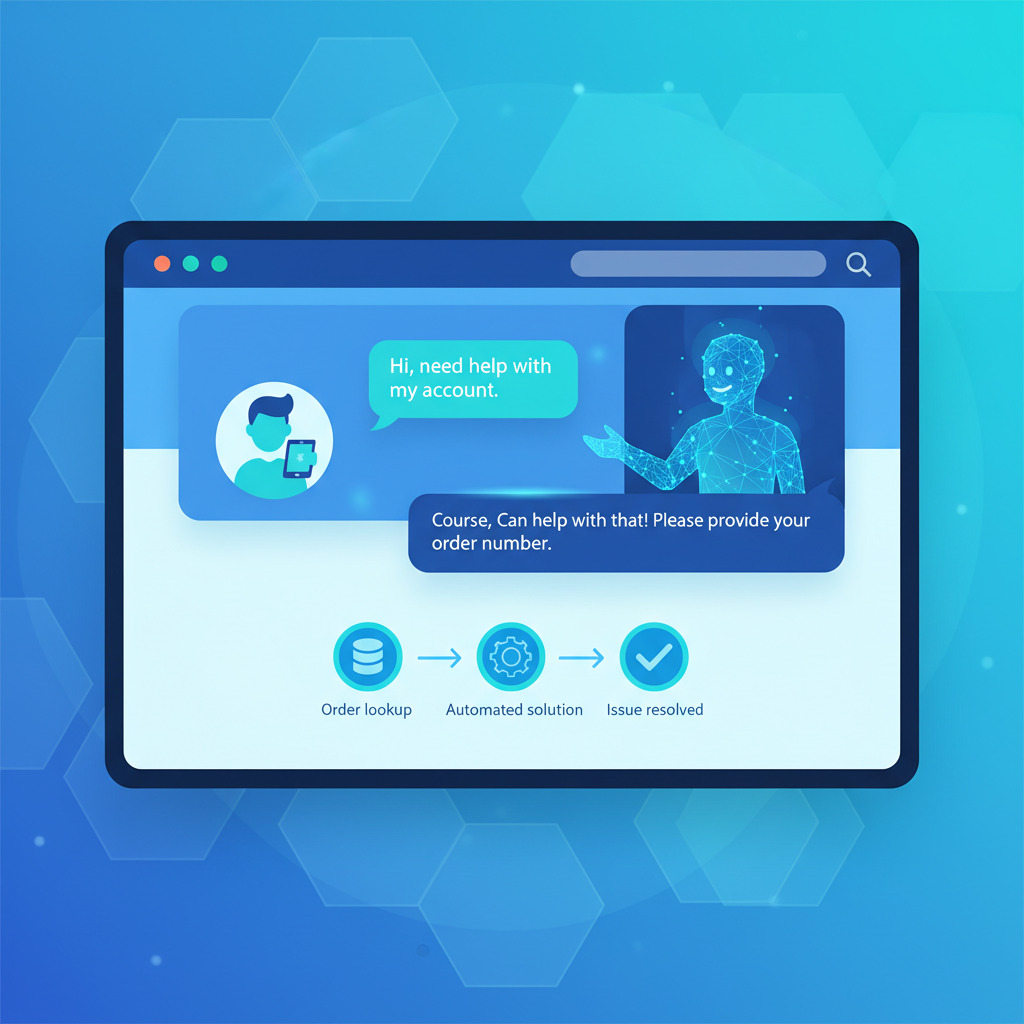
Website chatbots and AI assistants have moved from novelty to necessity for UK businesses. What began as simple automated FAQ responders has evolved into sophisticated conversational AI capable of qualifying leads, resolving support tickets, booking appointments, and guiding customers through complex purchasing decisions - all without human intervention. For businesses of every size, from high-street retailers to enterprise B2B organisations, the question is no longer whether to implement a chatbot, but which approach delivers the best return on investment.
The UK chatbot market is growing rapidly. Businesses across sectors - financial services, e-commerce, professional services, healthcare, and hospitality - are deploying conversational AI to handle the increasing volume of customer interactions that would otherwise require expanding headcount. With labour costs rising and customer expectations for instant responses becoming the norm, chatbots represent one of the most impactful digital investments a business can make in 2026.
This guide covers everything UK businesses need to know about website chatbots and AI assistants: the different types available, leading platforms, conversation design principles, CRM integration, lead qualification strategies, customer support automation, GDPR compliance, ROI measurement, and practical implementation advice drawn from real-world deployments.
Rule-Based vs AI Chatbots: Understanding the Difference
The chatbot landscape divides broadly into two categories: rule-based chatbots and AI-powered chatbots. Understanding the distinction is essential because the two approaches serve fundamentally different purposes, carry different costs, and suit different business scenarios.
Rule-Based Chatbots
Rule-based chatbots - sometimes called decision-tree or scripted chatbots - follow predefined conversation paths. They present users with a set of options (buttons, quick replies, or keyword triggers) and route the conversation based on the user’s selection. There is no natural language understanding involved; the chatbot matches inputs against a fixed set of rules and responds accordingly.
For many UK businesses, rule-based chatbots are perfectly adequate. If your customer queries are predictable and fall into well-defined categories - “What are your opening hours?”, “How do I track my order?”, “Can I book an appointment?” - a rule-based bot can handle them reliably, consistently, and at very low cost. They are easy to build, easy to maintain, and never produce unexpected or inappropriate responses.
The limitation is flexibility. Rule-based chatbots cannot handle queries they were not explicitly programmed for. If a customer phrases a question in an unexpected way, the bot either fails to understand or routes them to a generic fallback. For businesses with diverse or complex customer enquiries, this creates frustration rather than resolution.
AI-Powered Chatbots
AI chatbots use natural language processing (NLP) and, increasingly, large language models (LLMs) like GPT-4, Claude, and Gemini to understand the intent behind a user’s message and generate contextually appropriate responses. They don’t rely on fixed conversation trees; instead, they interpret free-text input, understand nuance and context, and can handle a virtually unlimited range of queries.
The most advanced AI chatbots can access your business’s knowledge base, product catalogue, help documentation, and CRM data to provide accurate, personalised responses. They learn from conversations over time, improving their accuracy and relevance. For UK businesses dealing with complex products, technical support queries, or consultative sales processes, AI chatbots represent a step change in capability.
However, AI chatbots are more expensive to implement, require more careful configuration and monitoring, and carry the risk of “hallucination” - generating plausible-sounding but incorrect information. They also require robust data governance, particularly around GDPR compliance, to ensure customer data is processed appropriately.
Rule-Based Chatbot
AI-Powered Chatbot
GPT-Powered Website Assistants: The New Standard
The release of GPT-4 and subsequent large language models has fundamentally changed what website chatbots can do. GPT-powered assistants - sometimes marketed as “AI copilots” or “intelligent website assistants” - go far beyond traditional chatbot capabilities. They can understand complex multi-turn conversations, maintain context across an entire interaction, access external data sources in real time, and generate responses that feel genuinely conversational rather than robotic.
For UK businesses, GPT-powered assistants are particularly valuable in scenarios where customers need guidance rather than simple answers. A visitor to a managed IT services website, for example, might describe their current infrastructure challenges in plain English and receive a tailored recommendation covering specific solutions, indicative pricing, and next steps - all without speaking to a salesperson. An e-commerce site might deploy a GPT assistant that helps customers find the right product by asking about their needs, budget, and preferences, then presenting curated options with explanations of why each is suitable.
The key technical consideration is grounding. An ungrounded GPT model will happily generate plausible but fictional information about your products, pricing, and policies. Effective GPT-powered assistants are grounded in your business’s actual data - product catalogues, pricing sheets, help documentation, FAQs, and policy documents - using techniques like Retrieval-Augmented Generation (RAG). This ensures the assistant’s responses are accurate and aligned with your business reality, not generic or fabricated.
When deploying a GPT-powered chatbot, always implement a confidence threshold. If the AI’s confidence in its answer falls below a set level (typically 70–80%), it should escalate to a human agent rather than guessing. This prevents hallucination from reaching your customers and maintains trust. At Cloudswitched, we configure every AI assistant with tiered escalation rules tailored to your business’s risk tolerance.
Chatbot Platforms: Choosing the Right Solution
The UK market offers dozens of chatbot platforms, ranging from simple plug-and-play widgets to enterprise-grade conversational AI suites. Choosing the right platform depends on your business size, technical capability, integration requirements, and budget. Below is a detailed comparison of the leading platforms used by UK businesses in 2026.
| Platform | Best For | AI Capability | Starting Price | CRM Integration | GDPR Compliant |
|---|---|---|---|---|---|
| Intercom | SaaS and tech companies | GPT-4 powered Fin AI | £65/month | Salesforce, HubSpot, Pipedrive | Yes (EU hosting available) |
| Drift | B2B lead generation | GPT-powered, intent detection | £2,000/month | Salesforce, Marketo, HubSpot | Yes |
| Tidio | SMEs and e-commerce | Lyro AI (GPT-based) | £25/month (AI from £52) | Shopify, WooCommerce, HubSpot | Yes (EU data centre) |
| ChatBot | Multi-channel support | AI Assist with knowledge base | £42/month | LiveChat, HubSpot, Zendesk | Yes |
| Zendesk AI | Enterprise support teams | Built-in AI agents | £45/agent/month | Native CRM + 1,500 integrations | Yes (EU data residency) |
| HubSpot ChatFlows | Inbound marketing | ChatSpot AI assistant | Free (basic) to £720/month | Native HubSpot CRM | Yes |
| Freshdesk Freddy | Cost-conscious support | Freddy AI with auto-triage | £12/agent/month | Native Freshsales + integrations | Yes |
Intercom: The SaaS Favourite
Intercom has positioned itself as the leading conversational platform for SaaS and technology businesses. Its Fin AI agent, powered by GPT-4, can resolve up to 50% of customer queries without human intervention by drawing on your help centre articles, product documentation, and custom data sources. For UK businesses, Intercom offers EU data hosting and full GDPR compliance tooling. The platform excels at combining AI responses with human handoff, ensuring complex queries reach the right team member with full conversation context.
Drift: B2B Revenue Acceleration
Drift (now part of Salesloft) focuses specifically on B2B revenue generation. Rather than just answering questions, Drift’s AI is designed to identify high-intent visitors, qualify them through conversational engagement, and route qualified leads directly to sales representatives in real time. For UK B2B companies with longer sales cycles and higher deal values, Drift’s ability to connect website conversations directly to CRM opportunities and revenue attribution is particularly valuable. The trade-off is price - Drift is significantly more expensive than alternatives, with plans starting at approximately £2,000 per month.
Tidio: SME-Friendly AI
Tidio has emerged as the go-to chatbot platform for UK small and medium enterprises, particularly e-commerce businesses. Its Lyro AI assistant can be trained on your website content, FAQs, and product information in minutes, providing accurate answers to customer queries without any technical configuration. At £25 per month for the base plan (with AI capabilities from £52), Tidio offers exceptional value for businesses that need conversational AI without enterprise budgets. The platform integrates natively with Shopify, WooCommerce, and major email marketing tools.
ChatBot: Visual Conversation Builder
ChatBot (by LiveChat) appeals to businesses that want granular control over conversation flows without writing code. Its visual drag-and-drop builder makes it straightforward to create complex conversation trees, while AI Assist adds natural language understanding for queries that fall outside predefined flows. For UK businesses that want the reliability of rule-based logic with AI as a fallback, ChatBot strikes an effective balance.
Lead Qualification with Chatbots
One of the highest-value applications of website chatbots for UK businesses is automated lead qualification. Rather than relying on static contact forms that sit unanswered for hours or days, a chatbot can engage visitors in real time, ask qualifying questions, score leads based on their responses, and route high-priority prospects to your sales team immediately.
How Chatbot Lead Qualification Works
Effective chatbot lead qualification follows a structured approach. When a visitor lands on a high-intent page - your pricing page, a product comparison page, or a “contact us” page - the chatbot initiates a conversation with a contextually relevant opening. Rather than a generic “How can I help?”, the bot might ask: “Are you looking at [product] for your business? I can help you find the right plan.”
The qualification conversation then gathers key information through natural dialogue: company size, industry, current solution, budget range, timeline, and decision-making authority. Each response is scored against your ideal customer profile (ICP). A visitor who matches your ICP closely - say, a 50-person professional services firm looking to upgrade their IT infrastructure within the next three months - is immediately flagged as a high-priority lead and either connected to a live agent or booked into a sales calendar.
Visitors who don’t match your ICP aren’t discarded. The chatbot can direct them to appropriate self-service resources, add them to nurture email sequences, or simply capture their contact details for future follow-up. This ensures no visitor leaves your website without receiving some value from the interaction.
Real-World Impact
UK businesses deploying chatbot lead qualification consistently report significant improvements across multiple metrics. Conversion rates from website visitor to qualified lead typically increase by 30–50%, because the chatbot engages visitors who would otherwise leave without taking action. Response time drops from hours (with traditional forms) to seconds. And sales teams spend their time on pre-qualified prospects rather than cold outreach, improving both efficiency and morale.
Customer Support Automation
Beyond lead generation, chatbots deliver enormous value in customer support. For UK businesses, the economics are compelling: the average cost of a human-handled support interaction in the UK is £4.50–£8.00, while a chatbot-handled interaction costs approximately £0.10–£0.50. When you multiply that saving across thousands of monthly interactions, the business case becomes overwhelming.
Tiered Support Architecture
The most effective approach to chatbot-powered support is a tiered architecture. Tier 0 is the chatbot itself, handling straightforward queries that can be resolved from your knowledge base: order tracking, account information, FAQs, password resets, booking confirmations, and similar routine requests. Research consistently shows that 60–70% of customer support queries fall into this category.
Tier 1 is a human agent who receives queries the chatbot cannot resolve, along with the full conversation history and any relevant customer data the bot has already gathered. This context means the agent doesn’t need to ask the customer to repeat themselves, significantly improving the experience. Tier 2 handles specialist or escalated issues, with the chatbot’s initial triage ensuring these queries reach the right specialist from the outset.
This architecture doesn’t replace your support team - it amplifies them. Your human agents spend their time on genuinely complex, high-value interactions where empathy, judgement, and expertise are required. The chatbot handles the repetitive, predictable queries that consume time but don’t require human intelligence.
24/7 Availability
For UK businesses serving customers across time zones - or simply outside standard office hours - chatbots provide round-the-clock support without the cost of night shifts or offshore teams. A customer visiting your website at 11pm on a Sunday can get immediate answers to their questions, place orders, book appointments, or submit detailed enquiries that are waiting for your team first thing Monday morning. Research from Drift shows that 64% of consumers say 24/7 availability is the most useful chatbot feature.
Never hide the human option. The fastest way to alienate customers is forcing them through a chatbot when they want to speak to a person. Always provide a clear, easily accessible route to a human agent. UK consumers are particularly sensitive to this - a 2025 survey by the Institute of Customer Service found that 72% of UK adults become frustrated when they cannot reach a human quickly. Additionally, never deploy a chatbot without testing it extensively with real customer queries. A chatbot that gives wrong answers is worse than no chatbot at all. And never use a chatbot to collect sensitive data (payment details, National Insurance numbers) without proper encryption and PCI DSS or GDPR compliance measures in place.
Chatbot Conversation Design
The difference between a chatbot that delights customers and one that frustrates them comes down to conversation design. This discipline - part UX design, part copywriting, part psychology - determines how your chatbot communicates, guides users through interactions, handles errors, and maintains a consistent brand voice.
Principles of Effective Conversation Design
Set expectations immediately. Your chatbot’s opening message should make clear what it can and cannot do. “I’m CloudBot, your virtual assistant. I can help with pricing, product information, and booking consultations. For billing or technical support, I can connect you to our team.” This prevents users from asking questions the bot cannot answer and reduces frustration.
Use progressive disclosure. Don’t overwhelm users with information upfront. Ask one question at a time, present 3–5 options maximum per interaction, and build the conversation progressively. Each response should move the user closer to their goal without cognitive overload.
Design for failure. Every conversation will eventually hit a point where the chatbot doesn’t understand the user’s intent. How it handles this moment is critical. Effective error handling includes acknowledging the misunderstanding (“I’m not sure I understood that correctly”), offering alternative paths (“Would you like me to connect you to a team member, or can I help with something else?”), and logging the failed interaction for future training.
Maintain brand voice. Your chatbot is a representative of your brand. Its tone, vocabulary, and personality should align with your overall brand identity. A legal firm’s chatbot should be professional and precise; a lifestyle brand’s chatbot can be warmer and more casual. Consistency between your chatbot’s voice and your other communications builds trust.
Minimise typing. Where possible, offer quick-reply buttons, carousels, and structured options rather than requiring free-text input. This speeds up interactions, reduces misunderstandings, and guides users along the most efficient path. Reserve free-text input for situations where structured options cannot capture the user’s needs.
Integration with CRM Systems
A chatbot that operates in isolation is a missed opportunity. The real power of conversational AI emerges when it connects to your Customer Relationship Management (CRM) system, creating a seamless flow of data between website conversations and your sales and support workflows.
What CRM Integration Enables
Personalised conversations. When your chatbot can access CRM data, it recognises returning visitors and tailors the conversation accordingly. “Welcome back, Sarah. Last time you were looking at our managed IT support plans. Would you like to continue from where you left off?” This level of personalisation dramatically improves engagement and conversion rates.
Automatic lead creation and scoring. Every qualifying conversation the chatbot conducts creates or updates a lead record in your CRM, complete with conversation transcript, qualification score, and recommended next action. Your sales team sees exactly what the prospect discussed, what their needs are, and how they scored against your ICP - all before making their first call.
Pipeline visibility. Chatbot-generated leads flow directly into your sales pipeline with appropriate stage assignments. Marketing leaders can track how many leads originated from chatbot conversations, their conversion rates through the pipeline, and ultimately the revenue attributable to the chatbot. This data is essential for calculating ROI and justifying continued investment.
Support ticket creation. For customer support scenarios, CRM integration means the chatbot can create support tickets with full context, assign them to the right team or individual, set priority levels based on the customer’s account value or issue severity, and update the customer record with the interaction history.
Popular CRM Integrations for UK Businesses
The most common CRM systems among UK businesses - Salesforce, HubSpot, Pipedrive, and Microsoft Dynamics 365 - all offer robust chatbot integration capabilities. HubSpot’s native ChatFlows tool provides the smoothest integration for businesses already on the HubSpot platform. Salesforce integrates deeply with Drift, Intercom, and its own Einstein Bot. Pipedrive’s chatbot integrations (via Tidio, ChatBot, and others) are particularly popular among UK SMEs due to Pipedrive’s strong presence in the small business market.
When connecting your chatbot to a CRM, map your qualification questions directly to CRM fields before building the conversation flow. This ensures every piece of information the chatbot collects has a structured home in your CRM, making reporting and segmentation far easier. At Cloudswitched, we create a data mapping document for every chatbot-CRM integration we deploy, ensuring no valuable conversation data gets lost between systems.
Measuring Chatbot ROI
Demonstrating return on investment is critical for securing ongoing budget and stakeholder support for your chatbot initiative. Unlike many digital marketing investments, chatbot ROI can be measured with remarkable precision because every interaction is logged and attributable.
Key Metrics to Track
Containment rate: The percentage of conversations the chatbot resolves without human escalation. A well-configured chatbot should achieve a containment rate of 50–70% within the first three months, rising to 70–85% as it’s refined based on conversation data. Each contained conversation represents a direct cost saving compared to human handling.
Conversation-to-lead rate: For lead generation chatbots, this measures what percentage of chatbot conversations result in a qualified lead. Benchmarks vary by industry, but 15–30% is typical for B2B and 5–15% for B2C.
Cost per interaction: Calculate the total monthly cost of your chatbot (platform subscription, AI API costs, maintenance time) divided by the number of conversations handled. Compare this to your cost per human-handled interaction to quantify savings.
Customer satisfaction (CSAT): Deploy a brief satisfaction survey at the end of chatbot conversations. Track CSAT for chatbot interactions separately from human interactions to ensure the bot isn’t damaging customer experience. Aim for chatbot CSAT within 10% of your human agent CSAT.
Revenue attribution: For sales-focused chatbots, track revenue from deals that originated or were influenced by chatbot conversations. Most CRM systems can attribute pipeline and revenue to chatbot touchpoints when properly integrated.
Calculating the Business Case
Consider a mid-sized UK business handling 2,000 customer support queries per month at an average cost of £6.00 per human interaction (£12,000 monthly). Deploying a chatbot that achieves 60% containment reduces human-handled queries to 800, saving £7,200 per month in agent time. If the chatbot platform costs £200 per month, the net monthly saving is £7,000 - an annual saving of £84,000. Factor in the additional revenue from chatbot-qualified leads and the ROI becomes even more compelling.
GDPR Compliance for Chatbots
Any chatbot deployed by a UK business must comply with the UK General Data Protection Regulation (UK GDPR) and the Data Protection Act 2018. This is non-negotiable and carries significant penalties for non-compliance - up to £17.5 million or 4% of global annual turnover, whichever is higher.
Key GDPR Requirements for Chatbots
Lawful basis for processing. You need a clear lawful basis for collecting and processing personal data through your chatbot. For lead generation, this is typically “legitimate interest” (you have a genuine business reason to contact prospects who have expressed interest). For support interactions, it may be “performance of a contract” (you need the data to deliver the service the customer has purchased). Whatever basis you rely on, document it clearly.
Transparency and consent. Users must know they are interacting with a chatbot, not a human. They must be informed about what data is being collected, how it will be used, and who will have access to it. This information should be accessible via a link within the chatbot interface, not buried in a privacy policy footer. If you’re using AI to process conversations, disclose this explicitly.
Data minimisation. Only collect the personal data you genuinely need. If your chatbot’s purpose is lead qualification, you might need a name, email, company, and role - but not a date of birth or home address. Every additional piece of data you collect increases your compliance burden.
Data subject rights. Customers have the right to access, rectify, and delete their chatbot conversation data. Your systems must be able to retrieve and delete specific conversation records on request. If your chatbot data is used to train AI models, consider whether this constitutes a separate processing activity requiring its own lawful basis.
International data transfers. If your chatbot platform stores or processes data outside the UK, ensure appropriate safeguards are in place. Many US-based chatbot providers now offer EU/UK data hosting options. If data is transferred to the US, ensure the provider is certified under the UK-US Data Bridge or that Standard Contractual Clauses (SCCs) are in place.
Practical Compliance Steps
Conduct a Data Protection Impact Assessment (DPIA) before deploying your chatbot, particularly if it processes sensitive data or uses AI. Update your privacy policy to cover chatbot data collection. Implement conversation data retention policies - don’t store chat transcripts indefinitely. Ensure your chatbot platform provider has signed a Data Processing Agreement (DPA). And train your team on handling data subject access requests that relate to chatbot interactions.
UK Business Use Cases
Chatbots and AI assistants are delivering measurable results across virtually every sector of the UK economy. Here are some of the most impactful use cases we see in practice.
Professional Services
Law firms, accountancy practices, and consultancies use chatbots to qualify potential clients before booking initial consultations. A chatbot on a law firm’s website might ask about the type of legal issue, the urgency, the approximate value of the matter, and whether the prospect has legal expenses insurance. This pre-qualification ensures partners and senior associates spend their limited time on prospects most likely to convert to paying clients.
E-Commerce
UK e-commerce businesses deploy chatbots for product recommendations, order tracking, returns processing, and size/fit guidance. Fashion retailers like ASOS and Boohoo use AI assistants to help customers find products based on natural language descriptions (“I need a dress for a summer wedding, budget around £80”). The result is higher average order values and lower return rates because customers find the right products more quickly.
Financial Services
Banks, insurance companies, and fintech businesses use chatbots to handle routine enquiries (balance checks, transaction queries, policy information), guide customers through application processes, and flag potentially fraudulent activity. Monzo, Starling, and other UK digital banks have set the standard, with AI assistants handling the majority of customer interactions without human involvement.
Healthcare
NHS trusts and private healthcare providers use chatbots for appointment scheduling, symptom triage, prescription reminders, and post-treatment follow-up. Babylon Health (now eMed) pioneered AI-powered symptom checking in the UK, and the model has been widely adopted. For private practices, chatbots reduce reception staff workload and ensure patients can book appointments outside surgery hours.
Hospitality
Hotels, restaurants, and event venues use chatbots to handle booking enquiries, manage reservations, answer questions about facilities and availability, and upsell additional services. A hotel chatbot might handle room availability queries, process direct bookings (avoiding OTA commission fees of 15–25%), and offer room upgrades or spa packages. For UK hospitality businesses operating on tight margins, the commission savings alone can justify the chatbot investment.
Managed Service Providers and IT Companies
IT companies and MSPs use chatbots as the first line of technical support, handling common issues like password resets, connectivity troubleshooting, and software installation guidance before escalating to Level 2 engineers. This reduces the volume of tickets reaching expensive technical staff while ensuring clients get immediate responses to routine issues. For an MSP managing hundreds of client endpoints, chatbot-powered Tier 0 support can reduce ticket volumes by 30–40%.
Implementation Roadmap
Deploying a chatbot successfully requires planning, not just technology. Based on our experience implementing chatbot solutions for UK businesses, here is a practical roadmap.
Phase 1: Discovery and Planning (Weeks 1–2)
Audit your current customer interaction data. Identify the top 20 queries by volume and categorise them by complexity. Define your chatbot’s primary purpose (lead qualification, support, or both). Select your platform based on the comparison criteria above. Map out the data flows between your chatbot, CRM, and support systems.
Phase 2: Design and Build (Weeks 3–5)
Design your conversation flows for the top 20 queries. Write your chatbot’s personality guidelines and tone of voice documentation. Build and configure the chatbot on your chosen platform. Set up CRM integration and test data flows end-to-end. Configure AI training with your knowledge base, FAQs, and product documentation.
Phase 3: Testing and Refinement (Weeks 6–7)
Conduct internal testing with team members who were not involved in building the bot. Run user acceptance testing with a small group of real customers. Review conversation transcripts for accuracy, tone, and completion rates. Refine conversation flows and AI training based on test results. Verify GDPR compliance, including privacy notices and data retention settings.
Phase 4: Launch and Optimise (Week 8 onwards)
Deploy the chatbot on your website, initially on high-traffic pages. Monitor conversations daily for the first two weeks, looking for unexpected queries, failed interactions, and escalation patterns. Use conversation analytics to continuously improve - update knowledge base content, refine conversation flows, and add new capabilities based on actual user behaviour. Review ROI metrics monthly and report to stakeholders quarterly.
Costs and Budgeting for UK Businesses
Chatbot costs vary enormously depending on the approach. A basic rule-based chatbot using a platform like Tidio can be operational for under £50 per month. A mid-range AI chatbot with CRM integration typically costs £200–£800 per month. Enterprise-grade conversational AI with custom GPT models, advanced analytics, and dedicated support runs from £1,500 to £5,000+ per month.
Beyond platform costs, budget for implementation (typically £2,000–£15,000 for a professional setup), conversation design (£1,000–£5,000 if you engage a specialist), CRM integration (£500–£3,000 depending on complexity), and ongoing optimisation (2–5 hours per week of internal resource, or £500–£2,000 per month for managed services).
The critical point is that chatbot costs should always be evaluated against the alternative: hiring additional staff. A single full-time customer service agent in the UK costs approximately £25,000–£35,000 per year including employer costs. A chatbot handling the equivalent workload costs a fraction of this, operates 24/7, and scales instantly to handle demand spikes.
The Future of Business Chatbots in the UK
The chatbot landscape is evolving rapidly. Several trends will shape how UK businesses use conversational AI over the next two to three years.
Multimodal AI. Next-generation chatbots will handle images, voice, and video alongside text. A customer might photograph a faulty product and send the image to a chatbot, which identifies the product, diagnoses the issue, and initiates a replacement - all without human involvement.
Voice-first interactions. As voice AI improves, website chatbots will increasingly support voice input and output, making them accessible to users who prefer speaking over typing. This is particularly relevant for accessibility compliance under the Equality Act 2010.
Proactive engagement. Rather than waiting for visitors to initiate conversations, AI-powered chatbots will analyse visitor behaviour in real time and intervene at the optimal moment - offering help when a user appears confused, suggesting products based on browsing patterns, or providing reassurance during checkout to reduce cart abandonment.
Agent-to-agent collaboration. In enterprise environments, multiple AI agents will collaborate on complex customer queries - one agent handling the conversational interface, another querying internal systems, and a third checking compliance requirements - all coordinated seamlessly behind a single chat interface.
For UK businesses, the message is clear: chatbots and AI assistants are no longer optional extras. They are fundamental tools for competing effectively, serving customers at the standard they expect, and operating efficiently in a market where talent is expensive and customer patience is limited. The businesses that invest thoughtfully in conversational AI today will be the ones setting the pace in their sectors tomorrow.
Add Intelligent Chat to Your Website
Whether you need a simple FAQ chatbot or a GPT-powered AI assistant integrated with your CRM, Cloudswitched designs and deploys chatbot solutions tailored to UK businesses. From conversation design and platform selection to CRM integration, GDPR compliance, and ongoing optimisation - we handle every aspect of your chatbot implementation so you can focus on what you do best.
Get Started
CloudSwitched
London-based managed IT services provider offering support, cloud solutions and cybersecurity for SMEs.


