Every organisation generates data at an extraordinary pace - from customer records and financial reports to casual internal memos and marketing collateral. Yet when it comes to backup and disaster recovery, a surprising number of UK businesses treat all of this data identically. They back up everything with the same frequency, the same retention periods, and the same encryption standards, regardless of how sensitive or critical the information actually is.
This one-size-fits-all approach creates two serious problems. First, it wastes significant budget by applying expensive, high-frequency backup to data that simply does not warrant it. Second - and far more dangerously - it often means that genuinely sensitive data receives the same protection as a folder of stock photographs. When a breach or data loss event occurs, the consequences can be catastrophic.
A data classification policy for backup solves both problems. By categorising your data into clearly defined tiers based on sensitivity, regulatory requirements, and business impact, you can tailor your backup strategy to deliver the right level of protection to the right data - efficiently, compliantly, and cost-effectively.
This guide walks you through everything you need to build a robust data classification policy specifically designed around backup and disaster recovery. We will cover classification tiers, retention periods, encryption requirements, UK GDPR considerations, automation tools, and a complete template framework you can adapt for your own organisation.
Why Data Classification Matters for Backup
Data classification is the process of organising information assets into categories based on their sensitivity, value, and regulatory requirements. While classification has long been a cornerstone of information security frameworks, its application to backup and disaster recovery is often overlooked - yet it is arguably where classification delivers the most tangible, measurable benefits.
Without classification, organisations face several compounding challenges. Backup windows grow unmanageable as every piece of data receives identical treatment. Storage costs escalate because trivial data consumes the same premium storage as mission-critical records. Compliance becomes a guessing game because there is no structured way to demonstrate that sensitive data receives appropriate protection. And when disaster strikes, recovery priorities are unclear because nobody has formally defined which data matters most.
A well-designed classification policy addresses all of these issues by establishing a clear hierarchy that maps directly to backup frequency, retention duration, encryption strength, storage location, and recovery priority. The result is a backup strategy that is both more protective and more economical - a rare combination in IT.
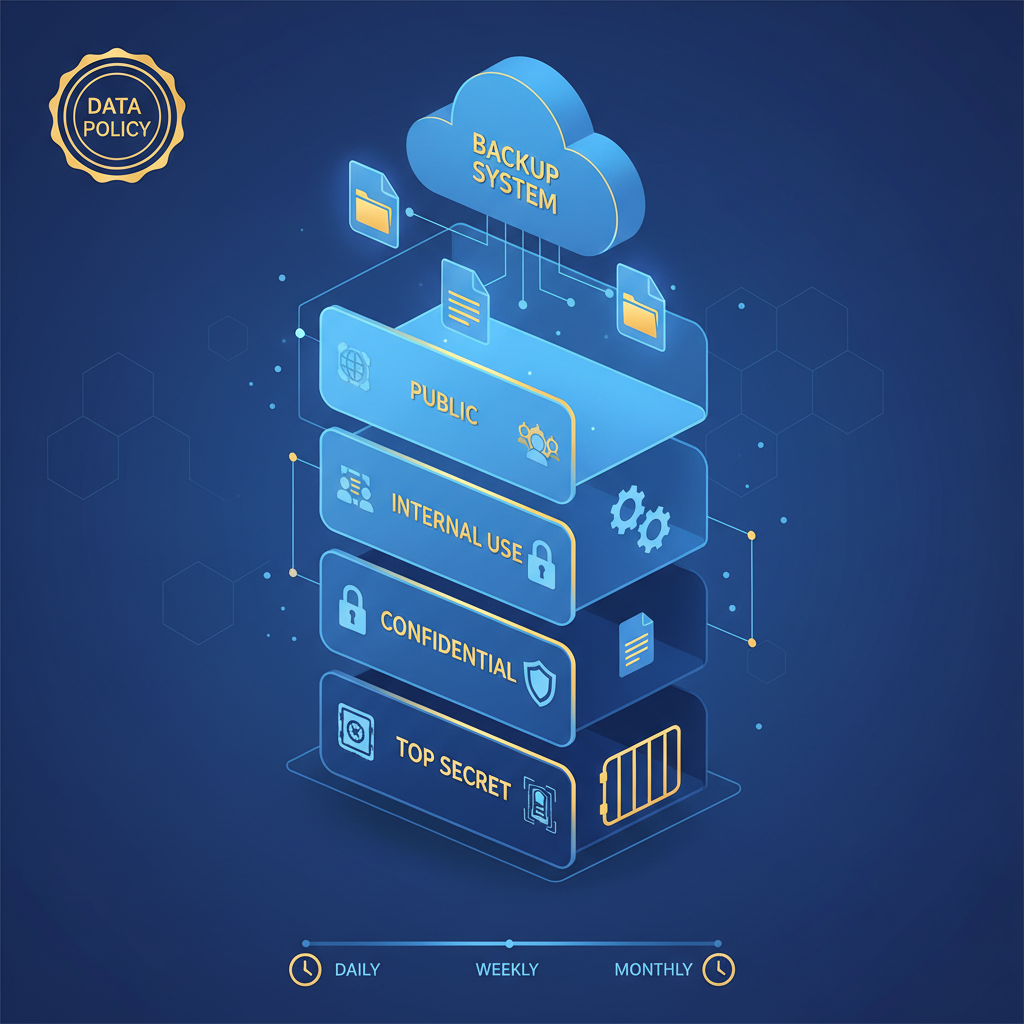
Understanding the Four Data Classification Tiers
Most data classification frameworks use between three and five tiers. For backup policy purposes, a four-tier model strikes the ideal balance between granularity and practicality. These tiers - Public, Internal, Confidential, and Restricted - are widely recognised across international standards including ISO 27001, the UK Government Security Classifications, and the NIST Cybersecurity Framework.
Tier 1: Public Data
Public data is information that has been explicitly approved for external disclosure and would cause no harm to the organisation if it were freely available. This includes published marketing materials, press releases, product brochures, public-facing website content, and published annual reports. Public data requires the lowest level of backup protection - it is typically easy to recreate and carries no regulatory sensitivity.
For backup purposes, public data can tolerate longer Recovery Point Objectives (RPOs) and Recovery Time Objectives (RTOs). Weekly or even fortnightly backups may be entirely sufficient, with shorter retention periods since the data can usually be regenerated from source materials or public records.
Tier 2: Internal Data
Internal data is information intended for use within the organisation that, while not highly sensitive, could cause minor inconvenience, embarrassment, or operational disruption if disclosed externally. Examples include internal meeting notes, project plans, non-sensitive internal communications, organisational charts, internal training materials, and procedural documentation.
This tier represents the bulk of most organisations’ data by volume. Backup frequency should be higher than public data - daily backups are typical - with retention periods aligned to operational needs rather than regulatory mandates. Standard encryption at rest is appropriate, but the most stringent controls are not required.
Tier 3: Confidential Data
Confidential data is information whose unauthorised disclosure could cause significant harm to the organisation, its customers, its employees, or its commercial interests. This category includes customer personal data subject to UK GDPR, employee HR records, financial data and management accounts, intellectual property, contracts and commercial agreements, business strategies, and supplier pricing information.
Confidential data demands rigorous backup protection. Backup frequency should be at minimum daily - and for transactional data, continuous or near-continuous protection is advisable. Retention periods must comply with relevant regulations (UK GDPR, Companies Act 2006, HMRC requirements). Strong encryption is mandatory both at rest and in transit, and access to backup media must be tightly controlled.
Tier 4: Restricted Data
Restricted data represents the most sensitive category - information whose compromise could result in severe legal, financial, or reputational damage. This includes special category personal data under UK GDPR (health records, biometric data, ethnic origin, political opinions), payment card data subject to PCI DSS, legal hold data, trade secrets, national security-related information, and authentication credentials or encryption keys.
Restricted data requires the most stringent backup controls. Real-time or near-real-time replication is strongly recommended. Encryption must meet the highest standards (AES-256 minimum). Access to backups must be limited to named, authorised individuals with multi-factor authentication. Storage locations must comply with data sovereignty requirements, and detailed audit trails must record every access event.
Mapping Classification Tiers to Backup Policies
The core value of data classification lies in its ability to drive differentiated backup treatment. Each tier should map to a distinct set of backup parameters covering frequency, retention, encryption, storage, and recovery priority. This mapping transforms classification from an abstract exercise into a practical, enforceable operational framework.
The following matrix provides a comprehensive reference for aligning classification tiers with specific backup policy parameters. These values represent best-practice guidelines for UK SMEs and mid-market organisations - your specific requirements may vary based on industry, regulatory obligations, and risk appetite.
| Policy Parameter | Public | Internal | Confidential | Restricted |
|---|---|---|---|---|
| Backup Frequency | Weekly | Daily | Every 4–6 hours | Real-time / continuous |
| Retention Period | 30 days | 90 days | 1–7 years (regulation-dependent) | 7+ years or indefinite (legal hold) |
| Encryption at Rest | AES-128 (optional) | AES-128 | AES-256 | AES-256 with key management |
| Encryption in Transit | TLS 1.2+ | TLS 1.2+ | TLS 1.3 | TLS 1.3 with mutual authentication |
| Storage Location | Any UK/EU region | UK/EU preferred | UK data centres only | UK sovereign cloud, air-gapped option |
| Access Control | IT team | IT team with logging | Named individuals, MFA required | Named individuals, MFA + approval workflow |
| Recovery Priority (RTO) | 48–72 hours | 8–24 hours | 1–4 hours | Under 1 hour |
| Recovery Point (RPO) | 7 days | 24 hours | 4–6 hours | Near-zero (minutes) |
| Backup Testing Frequency | Annually | Quarterly | Monthly | Monthly with documented evidence |
| Estimated Monthly Cost per TB | £5–£15 | £20–£45 | £60–£120 | £150–£300+ |
Start your classification project with a data discovery exercise. Many organisations are surprised to find that over 40% of their stored data is redundant, obsolete, or trivial (ROT data). Eliminating ROT data before classifying what remains dramatically reduces both backup costs and the complexity of your classification scheme. Tools such as Microsoft Purview, Varonis, or even basic file server auditing scripts can help identify data that has not been accessed in 12+ months.
Retention Periods by Data Class: UK Regulatory Requirements
Retention periods are one of the most critical - and frequently misunderstood - aspects of a classification-driven backup policy. Under UK GDPR, organisations must not retain personal data for longer than necessary for its original purpose. At the same time, various UK regulations mandate minimum retention periods for specific data types. Balancing these competing obligations requires careful, classification-aware planning.
Public Data Retention
Public data typically has no regulatory retention requirement. Retention periods should be driven by operational convenience - how long would it take to recreate the data if it were lost? For most public data, a 30-day backup retention window provides adequate protection against accidental deletion without accumulating unnecessary storage costs.
Internal Data Retention
Internal data retention should align with business operational cycles. Project documentation might be retained for 12 months after project closure. Internal communications are often subject to 90-day retention policies. Training materials should be retained for the duration of their relevance plus a buffer period. The key principle is that internal data retention should be driven by business need, not regulatory mandate.
Confidential Data Retention
Confidential data retention is heavily influenced by UK regulation. Employee records must be retained for 6 years after employment ends under the Limitation Act 1980. Financial records require 6–7 years of retention under Companies Act 2006 and HMRC requirements. Customer personal data must be retained only as long as the processing purpose requires under UK GDPR - which means you must define and document specific retention periods for each category of personal data you process.
Restricted Data Retention
Restricted data often carries the longest retention requirements. Health and safety records may need to be retained for 40 years (under the Control of Substances Hazardous to Health Regulations). Legal hold data must be retained indefinitely until the hold is released. PCI DSS requires that audit trail entries be retained for at least one year, with a minimum of three months immediately available for analysis. These extended retention periods directly impact backup storage costs and architecture.
Encryption Requirements Per Classification Tier
Encryption is the technical backbone of data protection within a classification policy. The level of encryption applied to backup data should be directly proportional to the data’s classification tier. Getting this mapping right ensures that your most sensitive data receives the strongest protection without over-engineering security for lower-risk information.
Public Tier Encryption
Public data does not strictly require encryption, since it is already approved for external disclosure. However, many organisations apply basic encryption (AES-128) to all backup data as a blanket policy, which simplifies administration and avoids the risk of misclassified data being stored unencrypted. The overhead is minimal and the practice is sound.
Internal Tier Encryption
Internal data should be encrypted at rest using AES-128 as a minimum standard. Encryption in transit should use TLS 1.2 or higher. Key management can follow standard organisational practices without requiring dedicated hardware security modules (HSMs). This level of protection is proportionate to the moderate sensitivity of internal data and aligns with the expectations of most cyber insurance policies.
Confidential Tier Encryption
Confidential data requires AES-256 encryption at rest and TLS 1.3 for data in transit. Encryption keys should be managed separately from the encrypted data, ideally using a dedicated key management service. For organisations handling significant volumes of UK GDPR-regulated personal data, this tier of encryption is effectively mandatory - the ICO has explicitly cited inadequate encryption as an aggravating factor in several enforcement actions.
Restricted Tier Encryption
Restricted data demands AES-256 encryption with formal key management through HSMs or cloud-based key management services such as Azure Key Vault or AWS KMS with UK-region key storage. Encryption keys must be rotated on a defined schedule (quarterly is common). Backup media must be encrypted end-to-end, and any physical media used for offline backup must be stored in physically secured locations with access logging. For PCI DSS-regulated data, specific encryption requirements under PCI DSS Requirement 3 must be met.
Failing to classify data before applying backup policies creates significant compliance exposure. Under UK GDPR, the ICO can impose fines of up to £17.5 million or 4% of annual global turnover for inadequate data protection measures. In 2024, the ICO issued enforcement notices to multiple UK organisations specifically citing the absence of data classification as a contributing factor in data breaches. Without classification, you cannot demonstrate to regulators that you have applied “appropriate technical and organisational measures” - the core requirement of Article 32 UK GDPR. Similarly, organisations subject to PCI DSS that fail to classify and appropriately protect cardholder data risk losing their ability to process card payments entirely.
UK GDPR and Data Protection Considerations
The UK General Data Protection Regulation (UK GDPR) is the most significant regulatory driver behind data classification for UK organisations. Understanding how classification intersects with data protection law is essential for building a compliant backup policy.
Lawful Basis and Purpose Limitation
Under UK GDPR, personal data must be processed (including backed up) under a valid lawful basis and only for specified purposes. Your classification policy should document which lawful basis applies to the backup of each data category. For most organisations, “legitimate interests” (Article 6(1)(f)) provides the lawful basis for backup of business data, while contractual necessity (Article 6(1)(b)) covers customer data required for service delivery.
Data Minimisation and Storage Limitation
The UK GDPR principles of data minimisation and storage limitation have direct implications for backup retention. You must not back up personal data you no longer need, and you must not retain backups beyond the period necessary for your stated purpose. This is where classification becomes invaluable - it provides the framework for defining and enforcing differentiated retention periods that satisfy these principles.
Rights of Data Subjects
Data subjects have the right to erasure (“right to be forgotten”) under Article 17 UK GDPR. This creates a challenge for backup systems, because deleting a specific individual’s data from backup archives can be technically complex. Your classification policy should address this by defining procedures for handling erasure requests against backup data - for example, maintaining a “suppression list” of erased records that are excluded from any restore operation.
International Data Transfers
If your backup data is stored or replicated outside the UK, the UK GDPR’s international transfer provisions apply. Following the UK’s adequacy decisions and the use of International Data Transfer Agreements (IDTAs), you must ensure that backup storage locations comply with UK transfer requirements. Classification helps here by identifying which data tiers require UK-only storage (typically Confidential and Restricted) versus those that may be stored in approved jurisdictions.
Data Protection Impact Assessments
For Restricted tier data, a Data Protection Impact Assessment (DPIA) is likely required before implementing or changing backup procedures. Your classification policy should specify that any backup arrangement involving Restricted data must undergo a DPIA, documenting the risks, safeguards, and residual risk level. This is particularly important for special category data (health, biometric, genetic) where the processing risks are inherently higher.
Classified vs. Unclassified Backup: A Direct Comparison
The difference between an organisation with a data classification-driven backup strategy and one without is stark. The following comparison illustrates the practical impact across every dimension that matters - from cost efficiency to regulatory compliance and disaster recovery speed.
Classified Backup Approach
Unclassified Backup Approach
Implementing Classification in Backup Tools
A classification policy is only as effective as its implementation. Modern backup platforms offer increasingly sophisticated integration with data classification systems, enabling automated policy enforcement based on classification labels. Understanding these capabilities is essential for translating your policy framework into operational reality.
Veeam Backup & Replication
Veeam supports classification-driven backup through its integration with Microsoft Information Protection labels and its own tagging system. Backup jobs can be configured to apply different schedules, retention periods, and encryption settings based on data classifications. Veeam’s Data Integration API also allows classification metadata to be preserved during backup and restore operations, ensuring that labels follow the data throughout its lifecycle. For UK organisations, Veeam’s UK-hosted cloud connect partners provide sovereign storage options for Confidential and Restricted tier data, with prices starting from around £80 per TB per month.
Acronis Cyber Protect
Acronis includes built-in data classification capabilities within its Cyber Protect platform. The Advanced Data Loss Prevention (DLP) module can automatically classify data based on content analysis and apply corresponding backup policies. This is particularly valuable for SMEs that lack the budget for standalone classification tools. Acronis pricing for UK businesses typically ranges from £45 to £85 per workload per month, depending on the protection level and storage capacity selected.
Microsoft Azure Backup
Azure Backup integrates natively with Microsoft Purview Information Protection, allowing backup policies to be automatically applied based on sensitivity labels. Azure’s UK South and UK West data centre regions provide domestic storage for organisations with data sovereignty requirements. Backup policies can be configured per vault with differentiated retention, encryption, and access controls. Azure Backup pricing for UK regions starts at approximately £4 per instance per month plus storage costs of £18–£45 per TB depending on redundancy level.
Datto / Kaseya BCDR
Datto’s Business Continuity and Disaster Recovery platform is widely used by UK managed service providers. While Datto does not include native classification capabilities, it supports policy differentiation through backup profiles that can be mapped to classification tiers. Different backup agents or jobs can be configured for different data classifications, with varying snapshot frequencies, retention policies, and cloud replication settings. Datto BCDR appliance pricing for UK SMEs typically starts from around £250 per month for entry-level devices.
Microsoft Information Protection Labels for Backup Classification
Microsoft Information Protection (MIP), now part of Microsoft Purview, provides one of the most mature and widely deployed classification label systems available. For organisations already using Microsoft 365, MIP labels offer a natural and cost-effective way to implement data classification that directly integrates with backup and data protection workflows.
Setting Up Classification Labels
MIP allows you to define custom sensitivity labels that align with your four classification tiers. Each label can include visual markings (headers, footers, watermarks), encryption policies, access restrictions, and metadata tags. Labels are configured in the Microsoft Purview compliance portal and can be deployed to all Microsoft 365 applications including Outlook, Word, Excel, PowerPoint, SharePoint, and Teams.
A typical label configuration for backup classification might include:
- Public: Green visual marking, no encryption, metadata tag “Classification: Public”
- Internal: Blue visual marking, optional encryption, metadata tag “Classification: Internal”
- Confidential: Orange visual marking, mandatory encryption, restricted sharing, metadata tag “Classification: Confidential”
- Restricted: Red visual marking, mandatory encryption, no external sharing, dynamic watermark, metadata tag “Classification: Restricted”
Label-Driven Backup Policies
Once labels are applied to documents and data, backup tools can read the classification metadata and apply the appropriate backup policy automatically. This creates a closed loop where the person closest to the data (the creator or owner) classifies it, and the backup system automatically applies the correct level of protection without any manual intervention from the IT team.
Microsoft 365 licensing for MIP varies by capability. Basic manual labelling is included in Microsoft 365 Business Premium (£19.70 per user per month). Automatic labelling based on content inspection requires Microsoft 365 E5 or the Information Protection & Governance add-on (approximately £10 per user per month on top of E3 licensing).
Automated Classification with AI
Manual classification relies on human judgement, which is inherently inconsistent and difficult to scale. As data volumes grow, automated classification powered by artificial intelligence and machine learning becomes not just desirable but essential for maintaining an effective backup classification policy.
How AI-Powered Classification Works
AI classification tools analyse the content, context, and metadata of data assets to automatically assign classification labels. They use a combination of pattern matching (for structured data like National Insurance numbers, credit card numbers, and NHS numbers), natural language processing (for unstructured documents), and machine learning models trained on your organisation’s specific data patterns.
The technology has matured significantly. Modern AI classifiers can achieve accuracy rates above 95% for well-defined data categories, particularly for regulated data types where the patterns are consistent and well-documented. For more nuanced classifications (such as distinguishing between “Internal” and “Confidential” business documents), accuracy typically ranges from 85% to 92%, which is why human review workflows remain important.
Key AI Classification Tools for UK Organisations
Microsoft Purview Trainable Classifiers use machine learning models that can be trained on your organisation’s specific data. Microsoft provides pre-built classifiers for common UK data types including HMRC references, National Insurance numbers, and NHS identifiers. Custom classifiers can be trained with as few as 50 example documents and typically reach production accuracy within 2–4 weeks of training.
Varonis Data Classification Engine scans file servers, SharePoint, Exchange, and cloud storage to automatically classify data at scale. Varonis is particularly strong at discovering sensitive data in unstructured repositories - a common blind spot for organisations that have grown rapidly without formal data management practices. UK licensing for Varonis typically starts from around £15,000 per year for mid-sized deployments.
BigID is a data intelligence platform that uses advanced machine learning to discover, classify, and catalogue data across hybrid environments. BigID excels at identifying UK GDPR-regulated personal data and mapping data flows, making it particularly valuable for organisations with complex data landscapes spanning on-premises and cloud environments.
Integrating AI Classification with Backup Workflows
The most effective approach combines AI classification with backup policy automation in a continuous loop. Data is classified as it is created or modified, classification labels trigger the appropriate backup policy, and regular rescanning catches any data that was missed or whose classification has changed. This approach ensures that backup protection evolves alongside the data it protects, rather than relying on a one-time classification exercise that quickly becomes stale.
Audit and Compliance Reporting
A data classification policy is only credible if it can be demonstrated to auditors, regulators, and stakeholders. Robust reporting capabilities transform your classification and backup policies from internal documents into verifiable compliance evidence.
Essential Audit Reports
Your classification-driven backup system should generate the following reports on a regular basis:
- Classification Coverage Report: What percentage of your data estate has been classified? Unclassified data is a compliance gap that auditors will flag immediately.
- Policy Compliance Report: Is each classification tier receiving the backup treatment specified in the policy? Are retention periods being enforced? Are encryption standards being met?
- Access Audit Trail: Who has accessed backup data for Confidential and Restricted tiers? Were proper authorisation procedures followed?
- Backup Success/Failure Report: Are all classified data sources being backed up successfully? Any failures in Confidential or Restricted tier backups should trigger immediate investigation.
- Retention Compliance Report: Is data being retained for the correct periods? Is expired data being properly purged? Over-retention of personal data is a UK GDPR violation.
- Recovery Test Report: When were backup restores last tested for each classification tier? Were RTO and RPO targets met during testing?
Reporting Frequency and Stakeholders
Reporting frequency should align with the sensitivity of each tier. Public and Internal tier reports can be generated quarterly. Confidential tier reports should be produced monthly. Restricted tier reports should be generated weekly or even daily for high-risk environments. Reports should be distributed to data owners, the IT security team, the Data Protection Officer (if appointed), and senior management as appropriate.
Preparing for ICO Audits
The ICO has increasingly focused on data protection by design and default in its audit and enforcement activities. Having a documented data classification policy with evidence of consistent enforcement through backup systems provides strong evidence of compliance with UK GDPR Article 25 (Data Protection by Design and by Default) and Article 32 (Security of Processing). Organisations that can demonstrate classification-driven backup policies are significantly better positioned in ICO investigations than those relying on undifferentiated backup approaches.
Template Policy Framework
The following framework provides a structured template for documenting your data classification policy for backup. Each section should be completed with your organisation’s specific details, approved by senior management, and reviewed at least annually.
Section 1: Policy Purpose and Scope
Define the purpose of the policy (to establish a classification framework that drives differentiated backup and data protection measures), the scope (all data assets stored, processed, or transmitted by the organisation), and the applicable regulations (UK GDPR, Companies Act 2006, PCI DSS if applicable, sector-specific regulations).
Section 2: Classification Tiers
Document each classification tier with clear definitions, examples of data types that fall within each tier, and the criteria for classification decisions. Include a decision tree or flowchart that data owners can use to classify new data assets. Specify that unclassified data should default to the Internal tier until formally classified.
Section 3: Backup Policy Matrix
Reproduce the backup policy matrix from this guide (or your customised version), specifying the backup frequency, retention period, encryption standard, storage location, access control, and RTO/RPO targets for each tier.
Section 4: Roles and Responsibilities
Define the roles involved in classification and backup governance. Typical roles include the Data Protection Officer (policy oversight), IT Manager (technical implementation), Data Owners (classification decisions for their data domains), and the Information Security Officer (encryption and access control standards).
Section 5: Classification Procedures
Document the process for classifying new data, reclassifying existing data, and handling disputes about classification decisions. Include escalation procedures for borderline cases and a process for periodic review of classifications (at least annually or when data usage changes).
Section 6: Compliance and Audit
Specify the reporting requirements, audit schedule, and the process for addressing compliance gaps. Include the escalation path for backup failures affecting Confidential and Restricted tier data, and the procedure for notifying the ICO in the event of a personal data breach involving classified backup data.
Section 7: Policy Review and Governance
Specify that the policy must be reviewed annually (at minimum), or whenever there is a significant change in the organisation’s data landscape, regulatory environment, or backup technology stack. Document the approval chain for policy changes and the communication plan for distributing updated policies to all relevant stakeholders.
Practical Steps to Get Started
Building a data classification policy for backup can seem daunting, but it does not need to be an all-or-nothing exercise. A phased approach allows you to deliver value quickly while building toward a comprehensive framework over time.
Phase 1: Discovery and Assessment (Weeks 1–4)
Begin with a thorough data discovery exercise. Map your data estate - every file server, cloud storage account, SaaS application, database, and email archive. Identify data owners for each repository. Run automated scanning tools to identify sensitive data types (personal data, financial data, health data). Eliminate ROT data to reduce the scope of your classification effort.
Phase 2: Policy Definition (Weeks 3–6)
Using the template framework above, draft your classification policy. Define your tiers, map them to backup parameters, and get approval from senior management. Engage with your Data Protection Officer and legal team to validate retention periods and regulatory alignments. This phase overlaps with Phase 1 because policy drafting can begin before discovery is fully complete.
Phase 3: Labelling and Implementation (Weeks 5–12)
Deploy classification labels through Microsoft Purview or your chosen classification platform. Begin classifying data, starting with Restricted and Confidential tiers (the highest-risk data). Configure your backup tools to apply differentiated policies based on classification labels. Implement access controls and encryption for higher-tier backup data.
Phase 4: Automation and Refinement (Weeks 10–16)
Deploy AI-powered classification to catch data that was missed during manual classification and to classify new data as it is created. Train custom classifiers on your organisation’s specific data patterns. Establish monitoring dashboards and automated compliance reporting. Conduct your first recovery tests against each classification tier to validate RTO and RPO targets.
Phase 5: Ongoing Governance (Continuous)
Establish the regular review cadence defined in your policy. Monitor classification coverage and policy compliance through automated reporting. Address gaps and refine classifiers based on real-world performance. Conduct annual policy reviews and update the framework as regulations, technology, and business needs evolve.
Common Pitfalls and How to Avoid Them
Implementing a data classification policy for backup is a significant undertaking, and several common mistakes can undermine even well-intentioned efforts.
Over-classification is perhaps the most frequent pitfall. When in doubt, people tend to classify data at a higher tier than necessary, which inflates backup costs and creates an unsustainable workload. Provide clear guidance, examples, and training to help data owners classify accurately. A peer review process for initial classifications can help calibrate decisions across the organisation.
Neglecting unstructured data is another common failure. Organisations often focus classification efforts on databases and structured repositories while ignoring the vast quantities of unstructured data in file shares, email archives, and collaboration platforms. Yet unstructured data frequently contains the most sensitive information - contracts saved to personal drives, sensitive emails forwarded outside controlled systems, and customer data in spreadsheets. Ensure your classification programme covers all data types and storage locations.
Static classification assumes that data is classified once and never revisited. In reality, data sensitivity changes over time. A confidential business strategy becomes public after announcement. A restricted legal hold is released. An internal project plan becomes irrelevant after project completion. Your policy must include procedures for reclassification and mechanisms (ideally automated) for detecting when classifications may need updating.
Ignoring backup media disposal is a risk that many organisations overlook. When backup tapes, disks, or cloud storage instances reach the end of their retention period, they must be disposed of securely - especially for Confidential and Restricted tier data. Your policy should specify disposal methods (cryptographic erasure for cloud storage, physical destruction for tapes and disks) and require certificates of destruction for Restricted tier media.
Conclusion
A data classification policy for backup is not a luxury reserved for large enterprises with dedicated compliance teams. It is a practical, achievable framework that delivers measurable benefits for organisations of every size. By categorising your data into clearly defined tiers and mapping those tiers to specific backup parameters, you gain tighter regulatory compliance, more efficient use of backup resources, clearer recovery priorities, and stronger evidence for auditors and insurers alike.
The investment required is modest relative to the returns. Most UK SMEs can design and implement a basic classification framework within 8–12 weeks, with AI-powered automation extending coverage over the following months. The cost savings from eliminating unnecessary backup of low-value data typically offset the implementation costs within the first year.
The regulatory landscape is only becoming more demanding. The ICO’s enforcement posture continues to tighten, cyber insurance requirements are growing more prescriptive, and the sheer volume of data that organisations generate shows no sign of slowing. Building a classification-driven backup strategy now positions your organisation to meet these challenges with confidence - and to recover from any data loss event with speed, precision, and full compliance.
Build Your Data Classification Strategy
Whether you are starting from scratch or looking to formalise an existing approach, our team can help you design and implement a data classification policy that integrates seamlessly with your backup and disaster recovery infrastructure. We work with UK organisations of all sizes to build compliant, cost-effective data protection frameworks that stand up to regulatory scrutiny.

CloudSwitched
London-based managed IT services provider offering support, cloud solutions and cybersecurity for SMEs.


