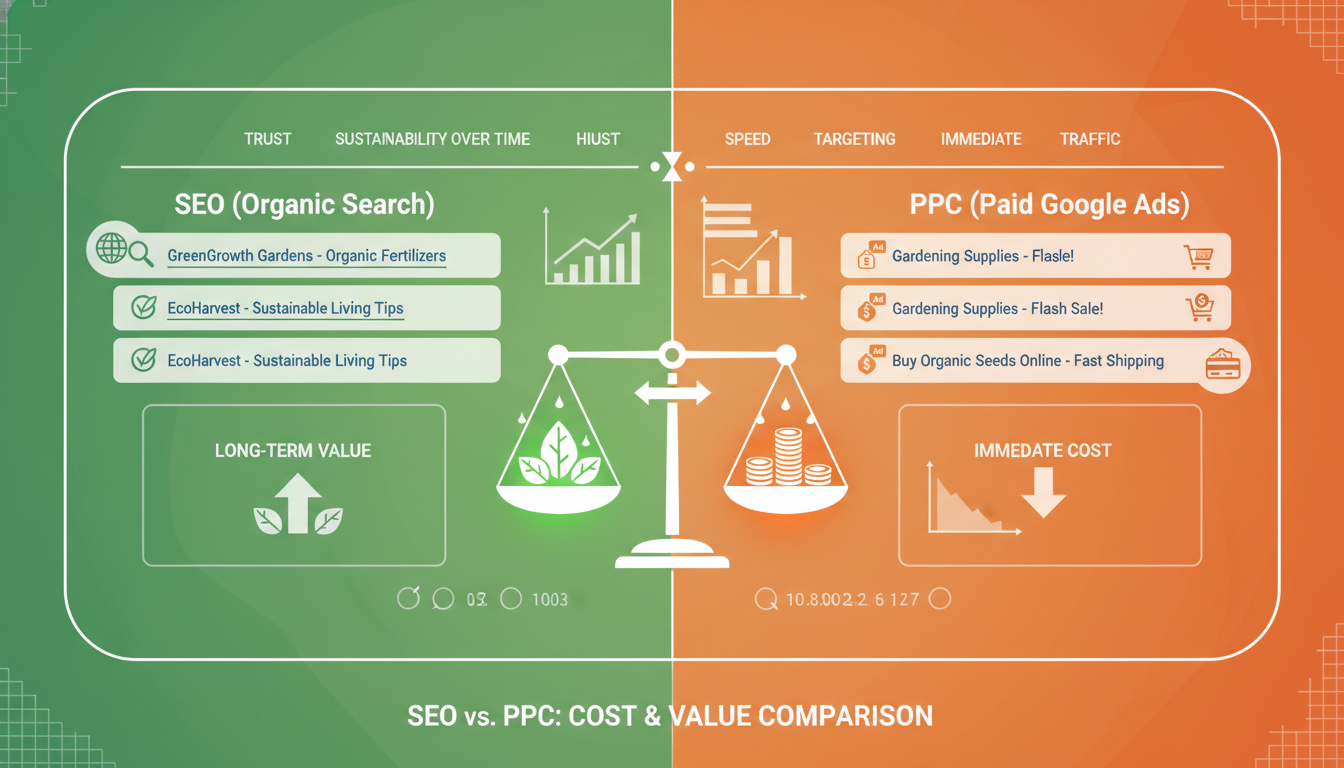
One of the most common questions UK businesses ask when investing in digital marketing is whether they should focus on SEO or PPC. The truth is that both organic and paid search have distinct strengths, and the right choice depends entirely on your business goals, budget, and timeline. Understanding the differences - and knowing when to use each - can save you thousands of pounds and months of wasted effort.
Search engine optimisation (SEO) and pay-per-click (PPC) advertising are the two primary ways to appear in Google search results. SEO earns you visibility through organic rankings, whilst PPC lets you buy your way to the top through paid ads. Both drive traffic, but they do so in fundamentally different ways with very different cost structures and timescales.
How SEO Works
SEO is the process of optimising your website so that it ranks higher in Google's organic (unpaid) search results. This involves improving your site's technical foundations, creating high-quality content that targets relevant keywords, and building authority through backlinks from other reputable websites.
The key characteristic of SEO is that results compound over time. A well-optimised page can continue to attract traffic for months or even years after it is published, without any ongoing cost per click. However, SEO is not a quick fix. It typically takes three to six months to see meaningful results, and highly competitive keywords can take twelve months or longer to crack.
For UK businesses, SEO offers particular advantages when it comes to local search. Google's local algorithm heavily rewards businesses that have optimised their Google Business Profile, built local citations, and created content relevant to their geographic area. A strong local SEO strategy can put your business in front of customers at the exact moment they are searching for services in your area.
It is also worth understanding that SEO is not a single discipline but rather a combination of three interconnected pillars. Technical SEO focuses on ensuring that your website loads quickly, is mobile-friendly, has a clean site architecture, and is free of crawl errors that prevent search engines from indexing your pages. On-page SEO involves optimising individual pages with targeted keywords, compelling meta descriptions, well-structured header tags, and strategic internal links that guide both users and search engines through your content. Off-page SEO, primarily centred on link building, remains one of the strongest ranking signals in the algorithm. A comprehensive SEO strategy must address all three pillars simultaneously to achieve and maintain strong rankings in the increasingly competitive UK search landscape.
How PPC Works
PPC advertising, most commonly through Google Ads, allows you to bid on keywords and display ads at the top of search results. You pay each time someone clicks on your ad, with costs varying dramatically depending on the competitiveness of the keyword and your industry.
The primary advantage of PPC is speed. You can launch a campaign in the morning and start receiving traffic by the afternoon. This makes it invaluable for time-sensitive promotions, product launches, or situations where you need leads immediately. PPC also gives you precise control over your budget, targeting, and messaging.
However, PPC traffic stops the moment you stop paying. There is no residual benefit - once your budget runs out or you pause your campaigns, your visibility disappears entirely. This makes PPC fundamentally different from SEO in terms of long-term value.
A critical factor that many businesses overlook is Google Ads Quality Score. Google assigns a score between 1 and 10 to each of your keywords based on the relevance of your ad copy, the expected click-through rate, and the quality of your landing page experience. A higher Quality Score means you pay less per click and achieve better ad positions relative to your competitors. This means that PPC is not purely about spending more money than the next advertiser - it actively rewards businesses that invest in creating relevant, high-quality ad experiences. Neglecting Quality Score optimisation can result in paying two or three times more per click than a well-optimised competitor bidding on the same keyword, significantly eroding your return on investment over time.
SEO - Organic Search
PPC - Paid Search
Cost Comparison: The Real Numbers
Understanding the true cost of each approach is essential for making an informed decision. Many businesses underestimate the cost of SEO because they focus only on the monthly retainer, ignoring the time investment required. Similarly, PPC costs can spiral quickly if campaigns are not managed properly.
In the UK market, the average cost per click across all industries on Google Ads is approximately £1.50 to £2.50. However, this varies enormously by sector. Legal services can see CPCs of £5 to £15 per click, whilst e-commerce keywords might cost as little as 30p to 80p. B2B technology and professional services typically fall in the £2 to £8 range.
SEO costs are structured differently. Most UK SEO agencies charge between £500 and £3,000 per month for ongoing optimisation, depending on the scope of work and competitiveness of your industry. The key difference is that this investment builds a lasting asset. The content and authority you build through SEO continue to generate traffic long after any individual month's work is complete.
Beyond the direct costs, there are hidden expenses that businesses frequently overlook when comparing the two channels. PPC campaigns require ongoing management - bid adjustments, ad copy testing, negative keyword refinement, and landing page optimisation - which either consumes internal staff time or necessitates agency management fees typically ranging from 10% to 20% of ad spend. SEO likewise demands investment in content creation, technical audits, and link building activities that extend beyond the base retainer. When calculating the true cost of each channel, businesses should factor in these ancillary expenses to arrive at an accurate cost-per-acquisition figure that reflects the full investment required.
Click-Through Rates and User Trust
One often-overlooked difference between SEO and PPC is how users perceive and interact with each type of result. Research consistently shows that organic results receive significantly more clicks than paid ads, particularly for informational queries.
Studies indicate that approximately 70-80% of users skip paid ads entirely and go straight to organic results. The first organic position on Google captures roughly 28-32% of all clicks, whilst the first paid ad position captures only about 2-3%. This disparity is even more pronounced on mobile devices, where screen space is limited and users tend to scroll past ads quickly.
There is also a trust factor at play. Many UK consumers are increasingly savvy about digital advertising and view organic results as more credible and trustworthy than paid placements. Earning a top organic ranking signals to potential customers that your business is a genuine authority in your field, not just someone willing to pay for visibility.
That said, PPC ads have improved considerably in recent years. Google's ad formats now include sitelinks, callout extensions, structured snippets, and other features that can make ads look comprehensive and professional. For certain high-intent commercial queries, users may actually prefer clicking an ad because it takes them directly to a product or service page rather than an informational article.
The evolution of search engine results pages has further complicated the SEO versus PPC landscape. Featured snippets, knowledge panels, People Also Ask boxes, and local map packs now occupy significant real estate above traditional organic results. Winning a featured snippet - sometimes called position zero - can dramatically increase your organic click-through rate, but it requires a specific content strategy built around question-based queries and structured data markup. Meanwhile, Google continues to expand the visual prominence of paid ads, particularly on mobile devices, with larger formats and more extension types that push organic results further down the page. Understanding how these SERP features affect your specific target keywords is essential when deciding where to allocate your search marketing budget.
When to Choose SEO
SEO is the better choice in several specific scenarios. If you are building a business for the long term and can afford to wait three to six months for results, SEO will almost certainly deliver a better return on investment over time. The compounding nature of organic traffic means that your cost per acquisition decreases month after month as your rankings improve.
SEO is also the right approach when you need to build brand authority and thought leadership. Publishing high-quality content that ranks well for relevant keywords positions your business as an expert in your field. This builds trust with potential customers long before they ever contact you.
For businesses with limited ongoing marketing budgets, SEO makes particular sense. Whilst the initial investment period requires patience, the ongoing cost of maintaining organic rankings is typically much lower than the ongoing cost of PPC campaigns. A piece of content that ranks on page one can continue to generate leads for years with only periodic updates.
Local businesses in the UK often benefit enormously from SEO. Local search results are less competitive than national terms, and a well-executed local SEO strategy can dominate your geographic area relatively quickly. If your business serves customers within a specific region, SEO should be a core component of your marketing strategy.
When to Choose PPC
PPC is the better option when speed is essential. If you are launching a new product, running a time-limited promotion, or entering a new market, PPC can deliver immediate visibility and traffic whilst your SEO efforts are still building momentum.
PPC is also valuable for testing. Before investing months of effort into SEO for a particular keyword, you can run a PPC campaign to test whether that keyword actually drives conversions. This data-driven approach helps you validate your SEO strategy and avoid investing in keywords that drive traffic but not revenue.
In highly competitive industries where organic rankings are dominated by large, authoritative websites, PPC can provide a level playing field. A small IT consultancy in Leeds cannot easily outrank Microsoft or Gartner for broad technology keywords, but it can bid on those same keywords and appear alongside them in the paid results.
PPC is also ideal for remarketing - showing ads to people who have previously visited your website but did not convert. This keeps your brand visible to potential customers as they continue researching their options, increasing the likelihood that they will return and complete a purchase.
Seasonal businesses and those with cyclical demand patterns find PPC particularly valuable for its ability to scale spend up and down in alignment with demand. A UK holiday lettings company, for example, can increase PPC investment dramatically in January and February when booking searches peak, then reduce spend during quieter months. This flexibility is difficult to replicate with SEO, where rankings take months to build and cannot be switched on and off to match seasonal fluctuations. PPC allows you to match your marketing investment precisely to your revenue opportunities throughout the calendar year, ensuring that you capture maximum value during peak periods without wasting budget during off-peak months.
Many UK businesses make the mistake of choosing between SEO and PPC as an either/or decision. In reality, the most successful digital marketing strategies use both channels in combination. PPC covers the gap whilst SEO builds momentum, and SEO reduces your dependence on paid advertising over time. Think of PPC as the accelerator and SEO as the engine.
The Combined Approach: Using SEO and PPC Together
The most effective search marketing strategies use SEO and PPC in tandem, leveraging the strengths of each to compensate for the other's weaknesses. Here is how a combined approach typically works in practice.
Phase one (months 1-3): Launch PPC campaigns to drive immediate traffic and leads whilst your SEO work begins. Use PPC data to identify which keywords convert best - this intelligence will inform your SEO content strategy. Simultaneously, address technical SEO issues, optimise existing pages, and begin creating new content.
Phase two (months 4-8): As your organic rankings begin to improve, you will start seeing traffic from SEO. Continue PPC campaigns but begin reducing bids on keywords where you are achieving strong organic positions. Shift PPC budget towards keywords where organic ranking is still difficult or towards remarketing campaigns.
Phase three (months 9+): With established organic rankings for your core keywords, you can significantly reduce or restructure your PPC spend. Focus PPC on high-value commercial keywords, new market tests, and remarketing. Your organic traffic should now be providing a steady baseline of leads, with PPC supplementing for specific objectives.
This phased approach is particularly effective for UK SMEs because it delivers results at every stage. You are never waiting months with no return - PPC provides immediate leads whilst SEO builds the foundation for sustainable, cost-effective growth.
One of the most powerful advantages of running SEO and PPC simultaneously is the data synergy between the two channels. PPC search term reports reveal exactly which queries users are typing and which ones convert into leads or sales. This intelligence is invaluable for informing your SEO keyword strategy - rather than guessing which topics to create content around, you can prioritise keywords that PPC data has already proven to drive revenue. Similarly, SEO performance data can highlight keywords where your site ranks on page two or three, indicating opportunities where a targeted PPC investment could capture traffic whilst organic rankings continue to improve. This bidirectional data loop makes both channels measurably more effective than either would be when operated in isolation from the other.
Measuring Success: Different Metrics for Different Channels
SEO and PPC require different measurement approaches, and confusing the two can lead to poor decisions. For SEO, the primary metrics to track include organic traffic growth, keyword ranking positions, organic conversion rate, and the number of pages ranking on page one. These metrics should be evaluated over months, not days, as SEO results fluctuate naturally.
For PPC, the key metrics are click-through rate (CTR), cost per click (CPC), conversion rate, cost per acquisition (CPA), and return on ad spend (ROAS). PPC metrics can and should be evaluated much more frequently - daily or weekly monitoring allows you to optimise campaigns in real time.
Regardless of which approach you choose, the ultimate measure of success is the same: are you generating profitable leads and customers? Both SEO and PPC should be judged on their contribution to revenue, not just traffic. A channel that drives 10,000 visitors but no sales is less valuable than one that drives 100 visitors who become paying customers.
Several tools are essential for measuring and comparing SEO and PPC performance effectively. Google Analytics 4 provides a unified view of traffic from both channels, allowing you to compare conversion rates, revenue attribution, and user behaviour patterns side by side. Google Search Console offers detailed data on organic keyword performance, impressions, click-through rates, and indexing issues. For PPC, the Google Ads interface delivers granular campaign-level data on spend, conversions, and quality metrics. Third-party platforms such as SEMrush, Ahrefs, and Moz can provide competitive intelligence for both organic and paid search, revealing where your competitors are investing and where gaps in the market exist. Setting up proper conversion tracking and multi-touch attribution modelling before drawing any conclusions about channel performance is absolutely essential - without accurate data, you risk making expensive strategic mistakes that could take months to correct.
Industry-Specific Considerations for UK Businesses
The optimal balance between SEO and PPC varies significantly by industry. Professional services firms (accountants, solicitors, consultants) typically benefit most from SEO because their customers conduct extensive research before choosing a provider. The trust and authority built through organic content is particularly valuable in these sectors.
E-commerce businesses often need a heavier PPC component, particularly for product-specific searches where Google Shopping ads dominate the results. However, SEO remains crucial for category pages, buying guides, and comparison content that captures customers earlier in the purchasing journey.
Technology companies and SaaS businesses in the UK market usually benefit from a strong content-driven SEO strategy supplemented by targeted PPC for high-intent keywords. The lengthy sales cycles common in B2B technology mean that SEO content can nurture prospects over weeks or months before they are ready to buy.
Regulated industries such as financial services, healthcare, and legal sectors face additional considerations that influence the SEO versus PPC balance. Google Ads enforces strict policies governing advertising in these sectors, and certain types of claims, targeting methods, and landing page content are restricted or prohibited entirely. SEO content in these industries must also meet higher quality standards - Google applies more rigorous evaluation criteria to content that falls into what it classifies as YMYL (Your Money, Your Life) categories. For UK financial advisors, medical practitioners, and solicitors, building genuine expertise, authority, and trustworthiness through in-depth, well-researched SEO content is not just good marketing practice - it is a fundamental ranking requirement that the algorithm actively enforces. PPC in these regulated sectors tends to carry significantly higher costs per click due to increased competition and compliance requirements, making a strong organic presence even more financially advantageous over the long term.
| Factor | SEO | PPC |
|---|---|---|
| Time to results | 3-12 months | Immediate |
| Cost structure | Fixed monthly investment | Pay per click |
| Long-term ROI | Increases over time | Stays constant |
| Traffic when paused | Continues (gradually declines) | Stops immediately |
| User trust | Higher (earned placement) | Lower (paid placement) |
| Targeting precision | Keyword and content based | Keyword, demographic, device, time |
| Best for | Brand building, thought leadership | Immediate leads, testing |
Making Your Decision
If you are a UK business trying to decide between SEO and PPC, start by honestly assessing your situation. Consider your budget, your timeline, your competitive landscape, and your business goals. If you need leads within the next 30 days, PPC is your answer. If you want to build a sustainable source of organic traffic that grows over time, invest in SEO.
For most businesses, the ideal approach is a combination of both, weighted according to your specific circumstances. Start with PPC for immediate results whilst investing in SEO for long-term growth. As your organic presence strengthens, gradually shift budget from paid to organic. The end goal is a marketing strategy where SEO provides your baseline traffic and PPC amplifies it for specific campaigns and objectives.
Whatever you decide, commit to measuring results rigorously and adjusting your approach based on data rather than assumptions. Digital marketing is not a set-and-forget exercise - it requires ongoing attention, testing, and refinement to deliver the best possible return on your investment.
Getting started does not need to be overwhelming. If you are new to search marketing entirely, begin with a professional SEO audit to understand where your website currently stands in terms of technical health, content quality, and backlink profile. Identify the quick wins - technical issues that can be resolved immediately, existing pages that can be optimised with minimal effort, and local SEO opportunities that your competitors may have overlooked. Simultaneously, consider launching a small, tightly focused PPC campaign targeting your highest-value keywords to generate leads whilst your organic foundation is being built. This measured, data-driven approach allows you to learn, adapt, and scale both channels intelligently as you gather real performance data about what works for your specific business, your market, and your customers.
Ready to Build Your Search Strategy?
Whether you need SEO, PPC, or a combined approach, our team helps UK businesses develop search strategies that deliver measurable results. Let us analyse your market and recommend the right mix for your goals and budget.
Explore Our SEO Services
CloudSwitched
London-based managed IT services provider offering support, cloud solutions and cybersecurity for SMEs.


