What Is Topical Authority - And Why Does It Matter for SEO?
Topical authority is the measure of how comprehensively and credibly your website covers a given subject area. Search engines like Google evaluate whether a site demonstrates genuine expertise across an entire topic - not just a handful of loosely related keywords. When your site is recognised as an authority on a subject, every page within that topic cluster benefits from improved rankings, higher crawl priority, and increased trust signals.
In the early days of SEO, ranking well was largely about targeting individual keywords, building backlinks, and ensuring basic on-page optimisation. That approach still has value, but it’s no longer sufficient on its own. Google’s algorithm updates - from Hummingbird and RankBrain to the Helpful Content Update and E-E-A-T guidelines - have progressively shifted the focus towards topical depth, semantic relevance, and demonstrable expertise.
For UK businesses competing in crowded markets, topical authority represents one of the most powerful - and most sustainable - SEO strategies available. Rather than chasing hundreds of disconnected keywords, you build a cohesive body of content that signals to Google: “We don’t just mention this topic. We own it.”
The concept is straightforward in principle: instead of writing one article about “cloud security” and hoping it ranks, you create a comprehensive content ecosystem that covers cloud security fundamentals, specific threat types, compliance frameworks, implementation guides, tool comparisons, case studies, and frequently asked questions. Each piece reinforces the others, and collectively they demonstrate an unassailable depth of knowledge.
This matters enormously for small and mid-sized businesses. You don’t need the domain authority of a multinational corporation to outrank competitors - you need to prove that your expertise on your chosen topics runs deeper than theirs. Topical authority levels the playing field in ways that traditional link-building alone never could.
The Topic Cluster Strategy - Your Foundation for Authority
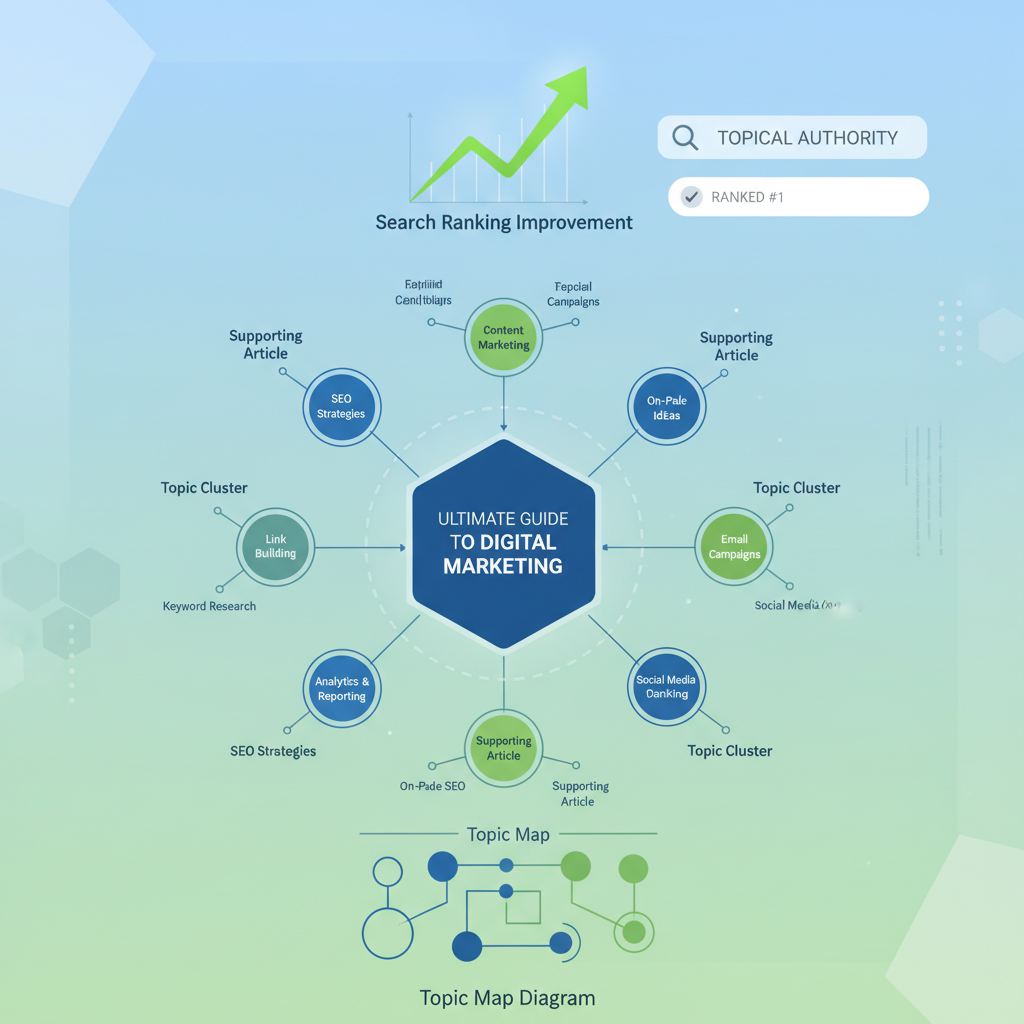
A topic cluster is an organised group of interlinked content pieces that collectively cover a broad subject from every meaningful angle. At the centre sits a pillar page - a comprehensive, long-form resource that addresses the topic at a high level. Surrounding it are cluster pages, each diving deep into a specific subtopic, question, or use case. Together, they form a content architecture that search engines can crawl, understand, and reward.
The strategic value of topic clusters lies in how they communicate relevance to search engines. When Google crawls a pillar page on “IT security for SMEs” and discovers it links to detailed cluster articles on firewalls, endpoint protection, phishing prevention, password policies, and incident response - each of which links back to the pillar - it builds a clear semantic map of your expertise. That interconnected structure is far more powerful than isolated articles scattered across your blog.
How to Identify Your Core Topics
Before building clusters, you need to determine which topics align with your business objectives and audience needs. Start with these steps:
1. Audit your existing content. Review every blog post, guide, and resource page on your site. Categorise them by subject area and identify where you already have depth - and where gaps exist.
2. Analyse your commercial services. Your topic clusters should map directly to the services or products you offer. If you provide managed IT support, cloud migration, and cyber security services, those are three natural cluster foundations.
3. Research your audience’s questions. Use tools like Google Search Console, AnswerThePublic, AlsoAsked, and People Also Ask data to discover what your target audience is actively searching for. Group these queries by theme.
4. Study your competitors’ content. Identify which topics your competitors cover well and where they fall short. Topical authority is relative - you don’t need to cover everything, but you need to cover your chosen topics more thoroughly than anyone else in your market.
Pillar and Cluster Content - The Architecture of Authority
The pillar-cluster model is the structural backbone of any topical authority strategy. Understanding the distinct roles of pillar pages and cluster pages - and how they interact - is essential for getting this right.
Pillar Pages - Your Comprehensive Hub
A pillar page is a substantial, authoritative resource that covers a broad topic in its entirety. Think of it as the definitive guide that someone new to the subject would want to read first. Pillar pages typically run to 3,000–5,000 words and address the topic at a high level whilst linking out to cluster pages for deeper exploration of each subtopic.
Key characteristics of an effective pillar page include:
• Broad but thorough coverage - touching on every major aspect of the topic without going into exhaustive detail on any single one.
• Clear structure - using headings, subheadings, and a table of contents to help readers navigate.
• Strategic internal links - pointing to every cluster page within the topic group.
• Evergreen value - designed to remain relevant with periodic updates rather than being time-sensitive.
• Conversion opportunities - including calls to action that guide readers toward your services.
Cluster Pages - Your Deep-Dive Expertise
Cluster pages are focused, detailed articles that address a specific subtopic, question, or angle within the broader theme. Where a pillar page on “cloud migration” might dedicate a paragraph to cost planning, the corresponding cluster page would provide a 2,000-word guide to budgeting for cloud migration, complete with UK-specific pricing examples, cost calculators, and real-world scenarios.
Each cluster page should:
• Target a specific long-tail keyword or question related to the pillar topic.
• Link back to the pillar page (and often to related cluster pages).
• Provide genuinely useful, actionable information that stands on its own.
• Demonstrate hands-on expertise through examples, data, and practical guidance.
- Publishes dozens of short, surface-level articles targeting individual keywords
- No logical structure connecting related content pieces together
- Each article covers a topic in 300–500 words with minimal depth
- Internal linking is random or absent entirely
- Content is often duplicated or paraphrased from competitor sites
- No clear hierarchy between overview content and detailed guides
- Relies heavily on keyword density rather than semantic relevance
- Leads to keyword cannibalisation where multiple pages compete for the same queries
- Publishes comprehensive pillar pages supported by detailed cluster articles
- Every piece of content has a defined role within a topic cluster
- Articles range from 1,500–5,000 words with genuine depth and expertise
- Internal linking follows a deliberate hub-and-spoke architecture
- Content offers original insights, data, examples, and practical frameworks
- Clear hierarchy with pillar pages linking to and from supporting content
- Covers topics semantically - addressing entities, questions, and related concepts
- Each page targets a distinct intent, eliminating cannibalisation
Semantic SEO and Entity Coverage - Speaking Google’s Language
Topical authority isn’t just about writing more content on a subject. It’s about covering the right entities, concepts, and semantic relationships that search engines expect to find when evaluating expertise on a topic. This is where semantic SEO becomes essential.
Google’s Knowledge Graph contains billions of entities - people, places, concepts, organisations, and things - along with the relationships between them. When Google evaluates your content, it doesn’t just look for keywords. It analyses whether your content covers the entities and concepts that a genuine expert would naturally discuss.
How to Implement Semantic SEO
Map the entity landscape. For any topic you want to own, identify the key entities that Google associates with it. If your topic is “managed IT services,” the expected entities might include SLAs, help desks, remote monitoring, patch management, endpoint security, Microsoft 365 administration, and disaster recovery. Your content should naturally reference and explain these entities.
Use natural language processing (NLP) tools. Platforms like Surfer SEO, Clearscope, and MarketMuse analyse top-ranking content and identify the terms, phrases, and concepts that correlate with higher rankings. These tools help you understand what Google considers semantically relevant to your target topics.
Answer related questions comprehensively. Google’s People Also Ask boxes reveal the questions that searchers associate with a topic. Addressing these questions - either within your pillar content or as standalone cluster articles - signals comprehensive coverage.
Build content around topic maps, not keyword lists. Instead of starting with a list of keywords, create a visual map of your topic showing all the subtopics, related concepts, questions, and entities. This ensures your content strategy covers the full semantic landscape rather than just the highest-volume search terms.
Publishing without a plan. Randomly adding blog posts without a cluster strategy dilutes your authority rather than building it. Every piece of content should have a defined role within a topic cluster.
Ignoring search intent. A page targeting “what is cloud computing” serves a completely different intent than “best cloud providers for UK SMEs.” Mixing intents on a single page confuses search engines and users alike.
Neglecting content updates. Topical authority erodes if your content becomes outdated. Schedule quarterly reviews of all pillar and cluster pages to ensure accuracy and freshness.
Skipping internal linking. Even the best content won’t build authority if it isn’t properly linked within your cluster structure. Every cluster page must link to its pillar, and the pillar must link to every cluster page.
Copying competitor structures exactly. Your topic clusters should reflect your unique expertise and perspective. Replicating what competitors have done leads to undifferentiated content that adds no new value to the search ecosystem.
Internal Linking Architecture - The Connective Tissue of Authority
Internal linking is arguably the most underrated element of a topical authority strategy. Without a deliberate, well-maintained internal linking structure, your content exists as isolated pages rather than a cohesive knowledge base. Google uses internal links to understand the relationships between your pages, distribute page authority, and determine which content is most important.
The Hub-and-Spoke Model
The most effective internal linking architecture for topical authority follows a hub-and-spoke pattern:
• The pillar page (hub) links to every cluster page within its topic group.
• Each cluster page (spoke) links back to the pillar page.
• Related cluster pages link to each other where contextually relevant.
• Cross-cluster links connect related topics where they naturally overlap.
This structure creates a clear hierarchy that search engines can follow. The pillar page accumulates link equity from all its cluster pages, strengthening its ability to rank for competitive head terms. Meanwhile, each cluster page benefits from the authority flowing down from the pillar.
Internal Linking Best Practices
Use descriptive anchor text. Instead of linking with “click here” or “read more,” use anchor text that describes the destination page’s topic. This helps search engines understand what the linked page is about.
Link contextually. Internal links should appear naturally within the body content where they add value for the reader. Don’t force links into unrelated paragraphs just to create connections.
Maintain link consistency. When you publish a new cluster page, go back to your pillar page and add a link to it. When you update a pillar page, verify that all cluster links still work and point to the right destinations.
Create a linking audit schedule. Every quarter, review your internal linking structure to identify orphaned pages (content with no internal links pointing to it), broken links, and missed linking opportunities.
Content Gap Analysis - Finding Your Authority Opportunities
Content gap analysis is the process of identifying topics, questions, and subtopics that your competitors cover but you don’t - or that no one in your market covers adequately. For topical authority, this analysis is indispensable because it reveals exactly where you need to build depth.
How to Conduct a Content Gap Analysis
Step 1: Identify your competitors. Choose three to five websites that rank well for your target topics. These might be direct business competitors or content publishers in your niche.
Step 2: Map their content. Use tools like Ahrefs, SEMrush, or Sistrix to export every page on each competitor’s site that ranks for keywords related to your topic clusters. Categorise these pages by subtopic.
Step 3: Compare coverage. Create a matrix showing which subtopics each competitor covers and which ones you cover. The gaps - subtopics covered by competitors but absent from your site - represent your highest-priority content opportunities.
Step 4: Assess quality gaps. Sometimes you already have a page on a subtopic, but your competitor’s version is more comprehensive, more current, or better structured. These quality gaps are just as important as missing-content gaps.
Step 5: Prioritise by impact. Not all gaps are equal. Prioritise based on search volume, commercial relevance, and how critical the subtopic is to your overall cluster authority. A missing cluster page on a core subtopic is more urgent than a missing page on a tangential question.
Competing With Larger Sites Through Depth
One of the most compelling aspects of topical authority is that it enables smaller businesses to outrank much larger competitors - provided they choose their battles wisely. A multinational corporation might have thousands of pages and an enormous backlink profile, but if their coverage of a specific topic is shallow or disorganised, a focused SME can surpass them.
The Niche Depth Advantage
Large websites often spread their content across hundreds of topics, giving each one only surface-level treatment. They might have a single blog post on “IT compliance for UK businesses” whilst you have a pillar page plus fifteen cluster articles covering GDPR, Cyber Essentials, ISO 27001, PCI DSS, data protection impact assessments, and sector-specific regulations. In Google’s eyes, you are the authority on that topic - regardless of your overall domain size.
This is particularly powerful for UK-based businesses targeting local or industry-specific audiences. A managed IT provider in Manchester focusing exclusively on content about IT support for legal firms can build topical authority that no generalist technology publication can match. The specificity of your expertise becomes your competitive advantage.
Strategies for Outranking Larger Competitors
Go deeper, not wider. Instead of trying to match a large competitor’s breadth of coverage, choose a narrower topic and cover it with unmatched depth. If they have one article on disaster recovery, create an entire cluster: planning guides, testing frameworks, cloud backup comparisons, RTO and RPO calculations, UK regulatory requirements, and real recovery case studies.
Add original value. Large sites often rely on generic, repurposed content. Differentiate yourself with original research, proprietary data, genuine case studies, expert interviews, and practical tools like templates and calculators. Google’s Helpful Content system explicitly rewards content that demonstrates first-hand experience.
Leverage local expertise. If you serve UK businesses, make your content unmistakably relevant to the UK market. Reference UK regulations, use £ pricing, cite UK statistics, mention British industry bodies, and address the specific challenges that UK organisations face. This geographic specificity strengthens your authority for UK-focused searches.
Update relentlessly. Large organisations are often slow to update their content. By keeping your cluster pages current - reflecting the latest regulations, technologies, and market conditions - you signal freshness and ongoing expertise that static content from larger competitors cannot match.
Measuring Topical Authority - Tracking Your Progress
Building topical authority is a long-term endeavour, and measuring progress requires looking beyond simple keyword rankings. Several metrics and indicators can help you gauge whether your authority-building efforts are paying off.
Key Metrics to Track
Organic traffic by topic cluster. Group your pages by cluster and track total organic sessions for each group over time. Rising traffic across an entire cluster - not just individual pages - indicates growing topical authority.
Keyword coverage and rankings. Monitor how many keywords each cluster ranks for and the average position across those keywords. As authority builds, you should see more keywords entering the top 20 and gradual position improvements.
Impressions in Google Search Console. Before ranking improvements materialise, you often see increased impressions - Google is showing your pages to more searchers, indicating growing trust in your content.
Crawl frequency. Sites with strong topical authority tend to be crawled more frequently. Monitor your server logs or Google Search Console’s crawl stats to spot changes in crawl behaviour.
Featured snippet acquisition. Earning featured snippets (position zero) for questions within your topic cluster is a strong signal of authority. Track how many featured snippets you hold for cluster-related queries.
Referral and backlink growth. Authoritative content naturally attracts backlinks and referrals. Monitor whether your cluster content is earning links from industry publications, forums, and other relevant sources.
Tools for Measurement
Google Search Console provides free, first-party data on impressions, clicks, and average positions. Pair it with Google Analytics 4 for traffic and engagement metrics. For deeper analysis, tools like Ahrefs (from approximately £79 per month), SEMrush (from approximately £108 per month), or Sistrix (from approximately £85 per month) offer topic-level tracking, competitor comparisons, and content gap features that are invaluable for authority measurement.
Topic Cluster Planning Template
Use this template to plan your topic clusters systematically. For each cluster, define the pillar page, identify all cluster pages, assign target keywords and search intents, and track publication status.
| Component | Content Title | Target Keyword | Search Intent | Word Count | Status |
|---|---|---|---|---|---|
| Pillar Page | The Complete Guide to Cloud Migration for UK Businesses | cloud migration guide UK | Informational | 4,000–5,000 | Planning |
| Cluster Article | Cloud Migration Costs: What UK SMEs Should Budget | cloud migration costs UK | Commercial | 2,000–2,500 | Planning |
| Cluster Article | AWS vs Azure vs Google Cloud - A UK Business Comparison | AWS vs Azure UK business | Commercial | 2,500–3,000 | Planning |
| Cluster Article | How to Create a Cloud Migration Checklist | cloud migration checklist | Informational | 1,800–2,200 | Planning |
| Cluster Article | Data Security During Cloud Migration - Best Practices | cloud migration security | Informational | 2,000–2,500 | Planning |
| Cluster Article | Cloud Migration Case Study: UK Accounting Firm | cloud migration case study | Informational | 1,500–2,000 | Planning |
| Cluster Article | Hybrid Cloud vs Full Cloud - Which Is Right for Your Business? | hybrid cloud vs full cloud | Informational | 2,000–2,500 | Planning |
| Cluster Article | Post-Migration Optimisation and Cost Management | cloud cost optimisation | Informational | 1,800–2,200 | Planning |
| Cluster FAQ | Cloud Migration FAQ - Answers to Common Questions | cloud migration FAQ | Informational | 1,500–2,000 | Planning |
Content Calendar for Authority Building
Topical authority is built over months, not weeks. A structured content calendar ensures consistent output and strategic coverage across your chosen topics. Here is a framework for planning your authority-building content programme.
Phase 1: Foundation (Months 1–2)
During the foundation phase, focus on creating your pillar pages and the first wave of cluster content. Aim to publish one pillar page and three to four cluster articles per topic cluster. This establishes your initial topical footprint and gives search engines enough content to begin mapping your expertise.
Key activities:
• Conduct thorough keyword and topic research for each cluster.
• Create detailed content briefs for every planned piece.
• Write and publish pillar pages first - they anchor the entire cluster.
• Publish initial cluster articles, ensuring each links back to the pillar.
• Set up internal linking between the pillar and all published cluster pages.
Phase 2: Expansion (Months 3–5)
With your foundation in place, expand each cluster by adding the remaining planned articles. Aim to publish two to three new cluster articles per month across your active topics. During this phase, you should also begin seeing early ranking signals as Google recognises your growing coverage.
Key activities:
• Publish remaining cluster articles according to your editorial plan.
• Update pillar pages to include links to all new cluster content.
• Add cross-links between related cluster pages.
• Monitor Google Search Console for impression and click growth.
• Conduct a first-pass content gap analysis against competitors.
Phase 3: Deepening (Months 6–9)
Now focus on filling gaps, adding advanced content, and strengthening weak spots. This is where you add case studies, original research, expert roundups, and highly specific guides that demonstrate genuine first-hand expertise.
Key activities:
• Publish gap-filling content identified through competitor analysis.
• Create original research or survey-based content that attracts backlinks.
• Update existing articles with new data, examples, and insights.
• Begin tracking featured snippet acquisition.
• Consider launching a second or third topic cluster.
Phase 4: Maintenance and Growth (Month 10 Onwards)
Topical authority requires ongoing maintenance. Content becomes outdated, competitors publish new material, and search engine algorithms continue to evolve. Establish a regular cadence of updates and new publications to protect and extend your authority.
Key activities:
• Quarterly reviews of all pillar and cluster pages for accuracy and freshness.
• Publish one to two new cluster articles per month to maintain momentum.
• Monitor competitor movements and respond to new content threats.
• Expand into adjacent topic clusters that build on your established authority.
• Repurpose high-performing content into new formats (videos, infographics, downloadable guides).
UK Business Examples - Topical Authority in Practice
To illustrate how topical authority works in practice, consider these examples from UK businesses that have successfully built authority in their respective niches.
Example 1: A Bristol-Based Accountancy Firm
A mid-sized accountancy firm in Bristol decided to build topical authority around “tax planning for UK limited companies.” Over twelve months, they created a pillar page on the subject and published 22 cluster articles covering corporation tax, dividend strategies, R&D tax credits, capital allowances, VAT considerations, IR35, and sector-specific tax planning for industries like construction, technology, and professional services.
The result: organic traffic to their tax planning content increased by 340%, they acquired 14 featured snippets, and enquiries from business owners seeking tax advice grew by 85%. Their investment - approximately £12,000 in content creation over the year - delivered an estimated £180,000 in new client revenue.
Example 2: A Manchester IT Support Company
An IT managed services provider in Manchester focused their authority-building efforts on “cyber security for UK SMEs.” They created comprehensive content covering Cyber Essentials certification, phishing prevention, ransomware protection, security awareness training, compliance frameworks, and incident response planning. Over nine months, they published a pillar page and 18 supporting articles.
Within six months of completing their initial cluster, they ranked on page one for 34 cyber security-related keywords, overtaking several nationally recognised IT publications. New business enquiries citing their blog content as the initial touchpoint increased by 120%, and their average deal value grew because prospects arrived with a higher level of trust and understanding of the firm’s expertise.
Example 3: A London E-Commerce Brand
An online retailer selling sustainable home products from London built topical authority around “sustainable living in the UK.” Their cluster included guides on reducing household waste, sustainable cleaning products, eco-friendly home renovations, ethical sourcing, carbon footprint reduction, and seasonal sustainability tips. They published 25 articles over eight months, each linking to relevant products within their catalogue.
Organic traffic to their blog grew by 280%, and crucially, the blog became their second-largest source of revenue after paid advertising. Product pages linked from authoritative blog content converted at 2.4 times the rate of product pages reached through direct search, demonstrating how topical authority can directly impact commercial outcomes.
Relative Impact of Authority-Building Activities
Not all authority-building activities contribute equally to search rankings. Based on observed outcomes across UK business content strategies, these are the relative impact levels of each core activity:
Bringing It All Together - Your Topical Authority Roadmap
Building topical authority is not a quick win - it’s a strategic investment that compounds over time. But for UK businesses willing to commit to the process, the rewards are substantial: sustainable organic traffic, higher-quality leads, reduced dependence on paid advertising, and a competitive position that becomes increasingly difficult for rivals to displace.
The roadmap is clear. Choose your topics strategically. Build comprehensive pillar pages. Create detailed cluster content that demonstrates genuine expertise. Link everything together with a deliberate internal architecture. Fill gaps that competitors have missed. Measure your progress with the right metrics. And maintain your authority through consistent updates and ongoing publication.
Every piece of content you publish is a brick in the wall of your topical authority. The businesses that start building now will be the ones that dominate their search landscape for years to come. The question isn’t whether topical authority works - the evidence is overwhelming. The question is whether you’ll invest in building it before your competitors do.

CloudSwitched
London-based managed IT services provider offering support, cloud solutions and cybersecurity for SMEs.


