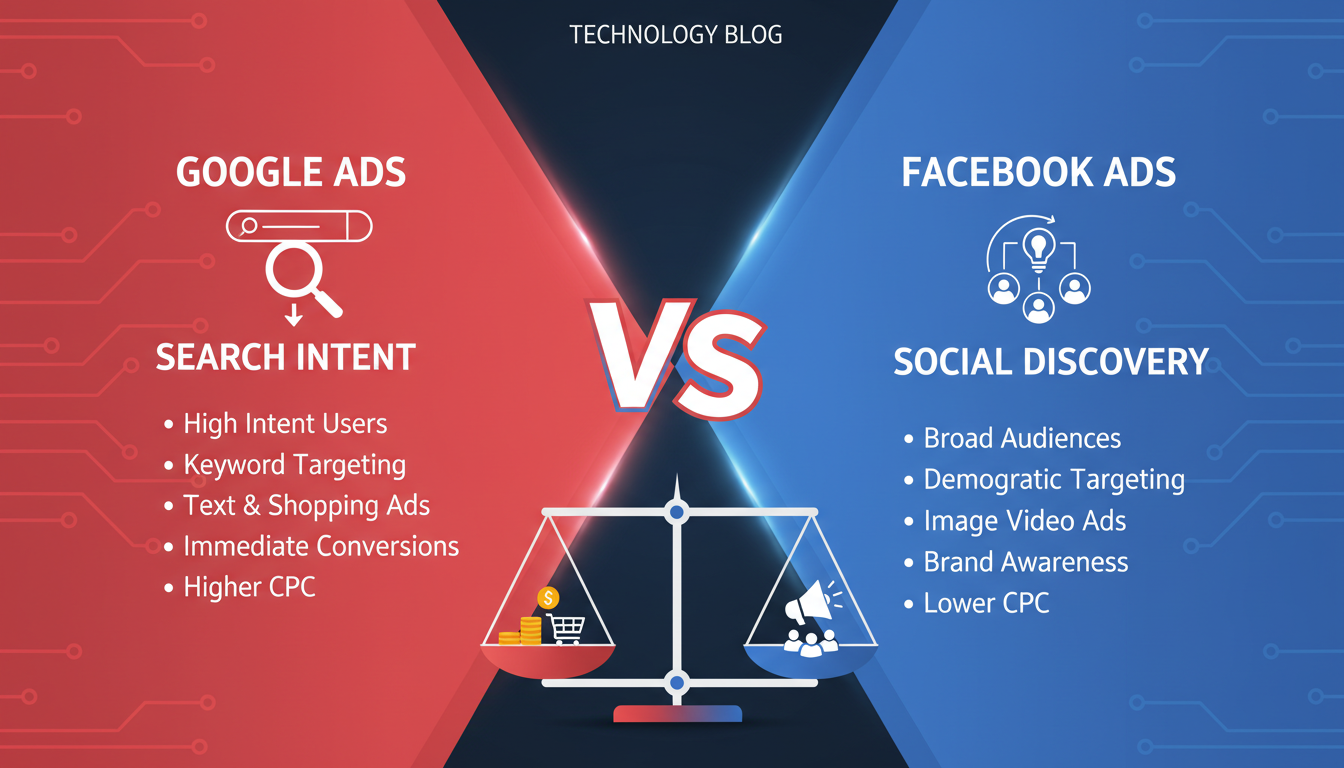
Google Ads or Facebook Ads - which platform should your business invest in? It's one of the most debated questions in digital marketing, and the answer isn't as straightforward as picking a winner. Both platforms are extraordinarily powerful, but they work in fundamentally different ways, reach audiences at different stages of the buying journey, and suit different types of businesses.
This comprehensive comparison breaks down the key differences between Google Ads and Facebook Ads across targeting, cost, intent, ad formats, and more. By the end, you'll have a clear framework for deciding which platform - or combination of both - is right for your business goals and budget.
The United Kingdom's digital advertising market is one of the most mature and competitive in the world, with businesses of all sizes vying for attention across search engines and social media. UK digital ad spend surpassed £29 billion in recent years, reflecting a clear shift away from traditional media towards performance-driven online channels. For UK businesses - whether you are a local tradesperson in Birmingham, a growing e-commerce brand in Manchester, or a professional services firm in London - understanding how to allocate your advertising budget between Google and Facebook is one of the most consequential marketing decisions you will make. Getting it right can transform your growth trajectory; getting it wrong means wasted spend and missed opportunities.
The Fundamental Difference: Intent vs. Interest
The most critical distinction between these two platforms comes down to a single concept: intent versus interest.
Google Ads captures demand. When someone types "emergency plumber near me" or "buy running shoes online," they have clear intent. They're actively looking for a solution. Google Ads puts your business in front of these high-intent searchers at the exact moment they need you. This is demand capture - you're not creating desire, you're fulfilling it.
Facebook Ads creates demand. On Facebook and Instagram, nobody is searching for products or services. They're scrolling through photos of friends, watching videos, and catching up on news. Facebook Ads interrupts this behaviour with visually compelling ads targeted based on demographics, interests, and behaviours. This is demand generation - you're planting seeds of interest that may convert later.
Understanding this distinction is vital because it fundamentally shapes every aspect of your campaign strategy. With Google Ads, your challenge is bidding on the right keywords and writing compelling ad copy that stands out among competitors. With Facebook Ads, your challenge is creating visual content that stops the scroll and resonates with audiences who were not actively looking for your product. The customer journey is inherently different: Google captures users at the bottom of the funnel when they are ready to act, whereas Facebook engages them at the top or middle of the funnel when they are still discovering options. This has profound implications for your landing page strategy, your attribution model, and the timeline you should expect before seeing returns on your investment.
Google Ads: Demand Capture
- User is actively searching
- High purchase intent
- Text-based ads (Search)
- Keyword targeting
- Higher CPC, higher conversion rate
- Bottom of funnel focus
Facebook Ads: Demand Generation
- User is passively browsing
- Lower immediate intent
- Visual/video ads
- Audience targeting
- Lower CPC, lower conversion rate
- Top/mid funnel focus
Targeting Capabilities Compared
Both platforms offer sophisticated targeting, but they approach it very differently.
Google Ads targeting begins with keywords - the words and phrases your potential customers are typing into Google. You can choose broad match keywords to cast a wide net, phrase match for more refined targeting, or exact match for precise control. Beyond keywords, Google also offers audience segments including in-market audiences (people actively researching a purchase category), affinity audiences (people with demonstrated long-term interests), and custom intent audiences built from your own data. For UK businesses, the ability to target by specific towns, cities, postcodes, and even radius around a physical location makes Google Ads exceptionally powerful for local services.
Facebook Ads targeting, by contrast, begins with people rather than keywords. You define your audience by demographics (age, gender, income, education, job title), interests (hobbies, favourite brands, media consumption), and behaviours (purchase history, device usage, travel patterns). Facebook's custom audiences let you upload customer lists or target website visitors, while lookalike audiences find new people who resemble your best existing customers. For UK advertisers, Facebook's detailed demographic data is particularly valuable for B2C brands targeting specific lifestyle segments.
| Targeting Feature | Google Ads | Facebook Ads |
|---|---|---|
| Keyword Intent | Excellent | Not available |
| Demographic Targeting | Basic | Excellent |
| Interest Targeting | Good (Display/YT) | Excellent |
| Lookalike Audiences | Good (Similar) | Excellent |
| Remarketing | Excellent | Excellent |
| Location Targeting | Excellent | Excellent |
Consider using Google's in-market audiences alongside keyword targeting for an extra layer of qualification. For example, a UK estate agent could target keywords like "houses for sale in Surrey" while also layering an in-market audience for "residential property" to ensure clicks come from serious buyers rather than casual browsers. Similarly, on Facebook, combine interest targeting with custom audience exclusions to avoid showing ads to people who have already converted.
Cost Comparison
Cost is often the deciding factor for businesses with limited budgets. Here's how the two platforms compare on key cost metrics:
While Facebook's CPC is significantly lower, Google's conversion rates are typically 2–3x higher because of the intent difference. When you calculate the cost per actual conversion, the gap narrows considerably. In many industries, Google Ads delivers leads at a similar or lower cost despite the higher CPC because those leads are further along the buying journey.
It is important to note that cost-per-click varies enormously by industry within the UK market. Legal services, financial advice, and insurance are among the most expensive sectors on Google Ads, with some keywords exceeding £10 per click. Meanwhile, industries such as e-commerce, hospitality, and retail tend to see much lower CPCs. On Facebook, costs are generally more uniform across industries, though competitive sectors like finance and technology will see higher CPMs (cost per thousand impressions) during peak periods. The chart below illustrates typical UK industry benchmarks for Google Ads CPC.
UK Industry Average CPC on Google Ads
For UK businesses with a monthly ad budget under £2,000, start by investing 70% in the platform that best matches your business type, and 30% in the other for testing. If your primary goal is lead generation and your customers actively search for your service, weight towards Google Ads. If you are building brand awareness or selling a visually appealing product, weight towards Facebook. After 60–90 days of data, reallocate based on actual cost-per-acquisition rather than assumptions.
When to Choose Google Ads
Google Ads is the stronger choice when:
People actively search for your product or service. If there's significant search volume for what you offer (plumbers, solicitors, accountants, software, etc.), Google Ads puts you in front of buyers at the moment of intent.
You offer an emergency or time-sensitive service. Nobody goes on Facebook when their boiler breaks down or they need a locksmith. They Google it. For urgent services, Google is the only viable option.
You have a higher-value product or service. The higher CPC of Google Ads is easily justified when each conversion is worth hundreds or thousands of pounds (legal, medical, B2B, etc.).
You want immediate, measurable ROI. Google Ads can generate leads from day one because you're reaching people who are ready to act. The path from click to conversion is shorter than on Facebook.
In the UK market specifically, Google Ads tends to perform exceptionally well for professional services such as solicitors, chartered accountants, and financial advisers, where potential clients actively search for qualified professionals. Local services such as plumbing, electrical work, and home renovations also see strong returns because these are inherently high-intent, location-based searches. B2B companies selling software, consulting, or specialist equipment also benefit enormously, as decision-makers in these sectors typically begin their research on Google. If your service area is geographically defined - for instance, a dental practice in Leeds or a conveyancing firm in Bristol - Google Ads' location targeting ensures your budget is spent exclusively on people within your service area.
When to Choose Facebook Ads
Facebook Ads is the stronger choice when:
Your product is visually appealing. Fashion, food, travel, home décor, fitness - products that look great in photos and videos thrive on Facebook and Instagram.
Nobody is searching for your product yet. If you're launching something new or innovative, there's no search demand to capture. Facebook lets you create awareness from scratch.
You need to build an audience. Facebook's interest and lookalike targeting excels at finding new potential customers who share characteristics with your existing buyers.
You have a lower price point and impulse-buy product. Products under £50 that people buy on impulse (fashion accessories, gadgets, books) work well with Facebook's scroll-and-click model.
Within the UK, Facebook Ads is particularly effective for direct-to-consumer brands, subscription boxes, fitness and wellness products, and event promotion. If you are a UK-based fashion brand selling through your own website, Facebook and Instagram's visual ad formats - including carousel ads, collection ads, and Reels - allow you to showcase products in context and drive traffic at a relatively low cost per click. Facebook is also the dominant platform for local event promotion in the UK, from restaurant openings and theatre shows to community events and charity fundraisers. The platform's ability to target users by life events (recently moved, newly engaged, upcoming birthday) is uniquely powerful for businesses whose products or services align with those milestones.
Google Ads
Facebook Ads
The Best Strategy: Use Both Together
The most successful digital advertisers don't choose one platform over the other - they use both in a complementary strategy. Here's a proven framework for combining Google Ads and Facebook Ads:
Facebook for awareness: Use Facebook Ads to introduce your brand to new audiences who match your ideal customer profile. Drive them to valuable content or an initial offer.
Google for conversion: When those same people later search for your product category, your Google Ads are there to capture them. They'll recognise your brand from Facebook, increasing trust and CTR.
Remarketing everywhere: Use both platforms to retarget website visitors who didn't convert. Show them relevant follow-up ads on Facebook, Instagram, YouTube, and Google's Display Network to stay top of mind.
A practical full-funnel framework for UK businesses looks like this: in the first week, launch Facebook awareness campaigns targeting cold audiences with educational or entertaining content that introduces your brand. In weeks two and three, run Facebook engagement campaigns to drive traffic to your website and build remarketing lists. From week three onwards, layer in Google Search campaigns targeting high-intent keywords - your audience will now include people who have already seen your brand on Facebook, which increases click-through rates and conversion rates on Google. Throughout, run remarketing campaigns on both platforms to recapture visitors who did not convert on their first visit. This integrated approach ensures you are reaching potential customers at every stage of their journey, from initial awareness through to final purchase.
UK Digital Advertising Effectiveness Scorecard
The following scorecard summarises how combined Google Ads and Facebook Ads campaigns typically perform across key effectiveness metrics for UK businesses. Scores are based on aggregated industry benchmarks and reflect what a well-managed, integrated paid media strategy can achieve.
Set up cross-platform conversion tracking from day one. Use UTM parameters on all ad links and configure both Google Analytics 4 and Facebook's Conversions API (CAPI) to capture the full picture. Many UK businesses undercount Facebook's contribution because they rely solely on last-click attribution, which naturally favours Google. A proper multi-touch attribution model reveals how Facebook's awareness campaigns feed Google's conversion campaigns - and justifies continued investment in both platforms.
Making Your Decision
If you can only invest in one platform, here's a simple decision framework: if people are already searching for what you offer, start with Google Ads. The intent-based targeting delivers faster, more predictable ROI. Once Google is profitable, add Facebook to expand your reach and build a full-funnel strategy.
If nobody is searching for your product (it's new, niche, or visually driven), start with Facebook to generate awareness and demand. Once you've built search demand, add Google Ads to capture it. Either way, the goal should be to eventually run both platforms in coordination.
Before committing your budget, take time to calculate your maximum allowable cost per acquisition. Start by working out the average lifetime value of a customer, then determine what percentage of that value you can afford to spend on acquisition while maintaining a healthy margin. For UK businesses, a common benchmark is spending no more than 20–30% of first-year customer value on acquisition. If your average customer is worth £1,000 over their lifetime, you can afford to spend £200–£300 to acquire them. Compare this figure against the estimated cost per lead on each platform (using the industry benchmarks above) and factor in your expected lead-to-customer conversion rate. This calculation will tell you exactly which platform - or combination - fits within your economics.
Another factor that UK businesses should consider is seasonality. Many industries see dramatic fluctuations in search volume and social media engagement throughout the year. Retail businesses will find Facebook Ads especially competitive (and expensive) during the November–December holiday season, while Google Ads costs for tax-related keywords spike in January and before the April self-assessment deadline. Planning your budget allocation month by month, rather than setting a flat monthly spend, allows you to capitalise on lower-cost periods and pull back during peak competition. The businesses that achieve the best ROI are those that continuously test, measure, and adapt their strategy based on real data rather than assumptions.
Need Help Choosing the Right Ad Platform?
Cloudswitched manages Google Ads campaigns for businesses across London and the UK. We help you invest your ad budget where it will generate the highest return, with transparent reporting and ongoing optimisation.
View Google Ads ServicesReady to Maximise Your Paid Advertising ROI?
Cloudswitched helps UK businesses build high-performing Google Ads campaigns that deliver measurable results. Whether you need help launching your first campaign or optimising an existing one, our certified specialists are ready to help you grow.

CloudSwitched
London-based managed IT services provider offering support, cloud solutions and cybersecurity for SMEs.


