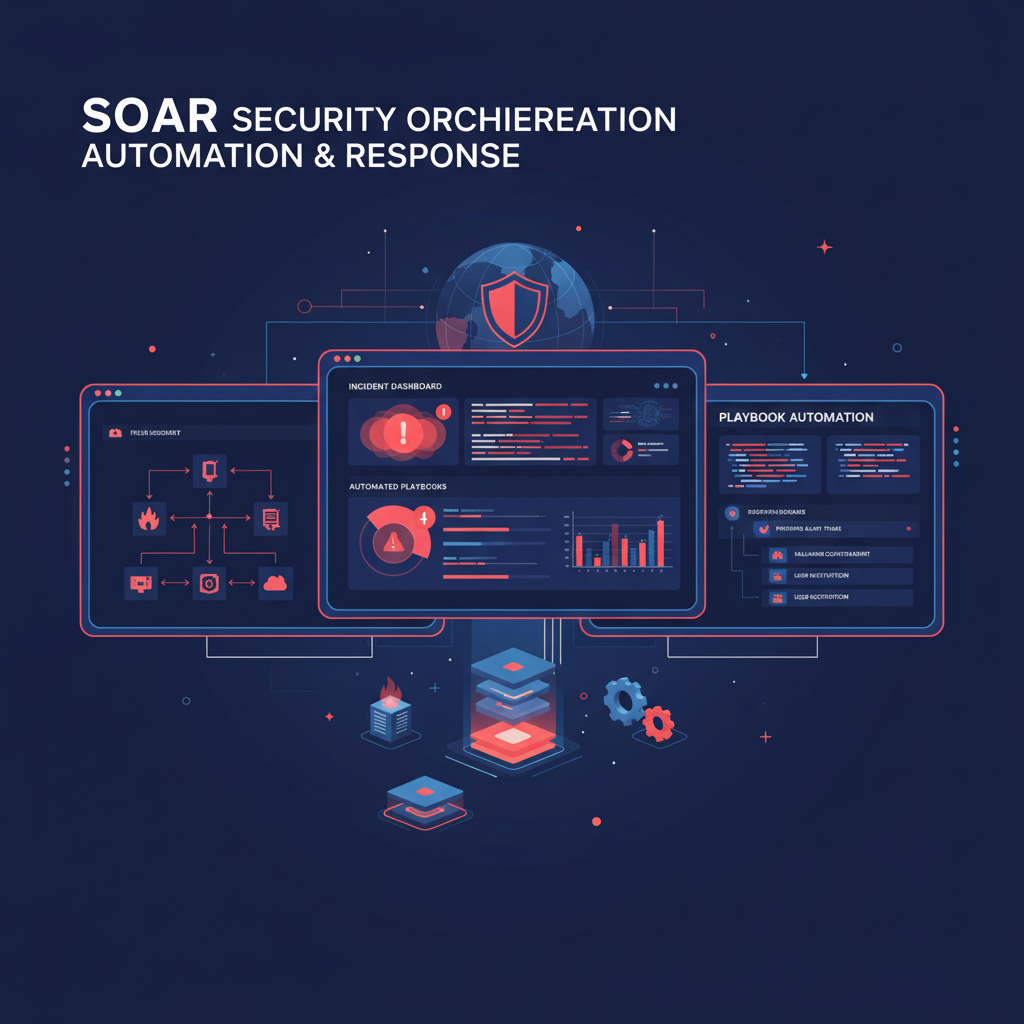
The modern cyber threat landscape does not wait for human analysts to finish their morning coffee. Attacks arrive around the clock - thousands of alerts, hundreds of potential incidents, and a relentless tide of telemetry data that would overwhelm even the most experienced security teams. For UK businesses, particularly small and medium-sized enterprises operating with lean IT departments, the challenge is acute: how do you defend against sophisticated, automated attacks when your security operations rely on manual processes, disconnected tools, and analysts who are already drowning in alert fatigue?
The answer, increasingly, is SOAR - Security Orchestration, Automation and Response. SOAR platforms represent a fundamental shift in how organisations manage security operations, moving from reactive, ticket-by-ticket investigation to automated, orchestrated workflows that detect, triage, and respond to threats in seconds rather than hours. For UK SMEs that cannot afford a 30-person security operations centre, SOAR is the force multiplier that makes enterprise-grade security response achievable on a realistic budget.
This guide covers everything you need to know about implementing SOAR - from understanding what it is and how it differs from SIEM, through designing playbooks and integrating threat intelligence, to selecting a platform, building an implementation roadmap, and measuring the return on investment. Whether you are a 20-person professional services firm or a 500-employee manufacturer, the principles apply; only the scale and complexity differ.
What Is SOAR and Why Does It Matter?
SOAR stands for Security Orchestration, Automation and Response. It is a category of security technology that combines three distinct capabilities into a single, integrated platform. Orchestration connects your disparate security tools - firewalls, endpoint detection, email gateways, SIEM, threat intelligence feeds - so they can share data and coordinate actions. Automation replaces repetitive manual tasks with predefined workflows (called playbooks) that execute instantly without human intervention. Response provides structured incident management, ensuring every security event follows a consistent, auditable process from detection through containment to resolution.
Think of SOAR as the conductor of your security orchestra. Each instrument - your firewall, your antivirus, your email filter, your SIEM - plays its own part, but without a conductor they produce noise rather than music. SOAR ensures every tool plays in harmony, responds to the same score, and delivers a coordinated performance that is far greater than the sum of its parts.
For UK businesses, SOAR matters because the threat landscape has evolved beyond what manual processes can handle. The National Cyber Security Centre (NCSC) reported a significant increase in cyber incidents affecting UK organisations throughout 2025, with ransomware, supply chain attacks, and credential theft leading the charge. At the same time, the UK’s cyber security skills gap continues to widen - there are simply not enough qualified analysts to fill every SOC seat. SOAR bridges that gap by enabling smaller teams to handle larger workloads with greater speed and consistency.
The Three Pillars of SOAR
Security Orchestration is about connecting tools. Most organisations use between 25 and 75 different security products, each generating its own alerts, logs, and telemetry. Without orchestration, analysts must manually pivot between consoles, copy-paste indicators of compromise, and mentally correlate data from multiple sources. Orchestration creates a unified fabric that lets tools talk to each other automatically - when your email gateway detects a suspicious attachment, the orchestration layer can automatically query your threat intelligence platform, check the file hash against known malware databases, and cross-reference the sender against your SIEM logs, all within milliseconds.
Security Automation is about eliminating repetitive work. The vast majority of security alerts - studies consistently show between 70% and 90% - are either false positives or low-severity events that follow predictable investigation patterns. Automation handles these routine cases end-to-end: enriching alerts with contextual data, checking indicators against threat feeds, applying decision logic, and either closing benign alerts automatically or escalating genuine threats with full context attached. This frees human analysts to focus on the complex, novel threats that genuinely require expert judgement.
Security Response is about structured incident management. When a genuine incident occurs, SOAR provides case management, evidence collection, communication workflows, and post-incident reporting - all within a single pane of glass. Every action is logged, every decision is documented, and every incident follows a repeatable process that satisfies both operational needs and regulatory requirements under frameworks like UK GDPR and Cyber Essentials Plus.
SOAR vs SIEM: Understanding the Difference
One of the most common points of confusion is the relationship between SOAR and SIEM (Security Information and Event Management). They are complementary technologies, not competitors, but they serve fundamentally different purposes. Understanding this distinction is critical before you invest in either.
- Collects and correlates log data from across your environment
- Generates alerts based on correlation rules and anomaly detection
- Provides search and investigation capabilities for historical data
- Requires manual triage - analysts must investigate each alert individually
- No automated response - humans must decide and execute every action
- Alert fatigue worsens as more data sources are connected
- Compliance reporting requires manual data extraction
- SIEM detects and correlates; SOAR enriches, triages, and responds automatically
- Alerts are enriched with threat intelligence before reaching an analyst
- Low-severity and false-positive alerts are closed automatically by playbooks
- Analysts receive pre-investigated, contextualised cases - not raw alerts
- Automated response actions (block IP, isolate endpoint, disable account) execute in seconds
- Alert fatigue drops dramatically as noise is filtered out
- Compliance reports are generated automatically from case data
In simple terms, SIEM is the eyes and ears of your security operation - it watches everything and raises the alarm. SOAR is the brain and the hands - it decides what the alarm means and takes action. Running SIEM without SOAR is like having a state-of-the-art burglar alarm with no security guards: you will know something is happening, but responding effectively depends entirely on someone being available, awake, and fast enough to act.
If you already have a SIEM solution in place, SOAR does not replace it - it supercharges it. Most SOAR platforms offer native integrations with popular SIEM tools including Microsoft Sentinel, Splunk Enterprise Security, and IBM QRadar. Start by automating the triage of your top five most frequent alert types; this alone can reduce analyst workload by 40–60% within the first month.
Playbook Automation: The Engine of SOAR
Playbooks are the heart of any SOAR implementation. A playbook is a predefined, automated workflow that specifies exactly how a particular type of security event should be handled - step by step, decision by decision, action by action. Well-designed playbooks transform security operations from ad-hoc, inconsistent responses into repeatable, measurable processes that execute at machine speed.
Anatomy of a SOAR Playbook
Every playbook follows a common structure, regardless of the platform you use. It begins with a trigger - the event that initiates the playbook, such as a phishing alert from your email gateway or a malware detection from your endpoint protection. Next come enrichment steps that gather additional context: querying threat intelligence feeds, looking up the affected user in Active Directory, checking recent login activity, and pulling related alerts from your SIEM. Then come decision nodes - automated logic that evaluates the enriched data against predefined criteria to determine severity and appropriate response. Finally, action steps execute the response: blocking a malicious URL, quarantining an endpoint, disabling a compromised account, creating an incident ticket, and notifying the relevant stakeholders.
Common Playbook Examples for UK SMEs
The beauty of SOAR is that you do not need hundreds of playbooks to see dramatic results. Most organisations start with five to ten playbooks covering their highest-volume alert types and expand from there. Here are the playbooks that deliver the most immediate value for UK businesses.
| Playbook | Trigger | Automated Actions | Time Saved per Incident |
|---|---|---|---|
| Phishing Email Triage | User-reported or gateway-detected suspicious email | Extract URLs/attachments, check against threat intel, analyse headers, quarantine if malicious, notify user | 25–40 minutes |
| Malware Alert Response | Endpoint detection alert | Isolate endpoint, collect forensic data, check hash against VirusTotal, create incident case, notify IT team | 30–60 minutes |
| Brute Force Detection | Multiple failed login attempts from single IP | Check IP reputation, correlate with other alerts, block IP at firewall, reset affected accounts, alert SOC | 15–30 minutes |
| Compromised Credential | Credential found on dark web or breach database | Force password reset, revoke active sessions, enable MFA, audit recent account activity, notify user and manager | 20–45 minutes |
| Suspicious Login | Impossible travel or anomalous location login | Check VPN/proxy usage, verify with user, block session if unverified, escalate to SOC if confirmed compromise | 10–25 minutes |
| Vulnerability Alert | Critical CVE published affecting deployed software | Identify affected assets, assess exposure, create patching ticket, notify asset owners, track remediation | 45–90 minutes |
The cumulative time savings are significant. If your team handles just 20 phishing alerts per week and each one takes 30 minutes to investigate manually, that is 10 hours of analyst time per week - or over 500 hours per year - spent on a single alert type. A well-tuned phishing playbook can handle 80–90% of those automatically, recovering hundreds of hours for more valuable work.
Incident Response Workflows
Beyond individual playbooks, SOAR platforms provide comprehensive incident response workflows that manage the full lifecycle of a security incident - from initial detection through investigation, containment, eradication, recovery, and post-incident review. For UK businesses subject to UK GDPR, having a documented, repeatable incident response process is not optional; it is a regulatory requirement.
A typical SOAR-driven incident response workflow operates in six phases. Detection and Alerting is handled by your SIEM, endpoint tools, and other security controls feeding alerts into the SOAR platform. Triage and Enrichment is where playbooks automatically assess severity, gather context, and determine whether the alert represents a genuine incident. Investigation provides analysts with a pre-enriched case file containing all relevant evidence, enabling faster and more accurate analysis. Containment executes automated or analyst-approved actions to stop the threat from spreading - isolating endpoints, blocking network traffic, disabling accounts. Eradication and Recovery removes the threat and restores normal operations, with SOAR tracking every step for audit purposes. Finally, Post-Incident Review generates automated reports documenting the timeline, actions taken, and lessons learned - essential for both internal improvement and regulatory compliance.
Under UK GDPR, organisations must report certain personal data breaches to the Information Commissioner’s Office (ICO) within 72 hours of becoming aware of the breach. Without automated incident response workflows, many SMEs struggle to meet this deadline because they spend the first 48 hours simply understanding what happened. SOAR platforms can automatically assess whether an incident involves personal data, calculate the likely severity, pre-populate the ICO notification form, and alert your Data Protection Officer - ensuring you never miss a reporting deadline.
Threat Intelligence Integration
Threat intelligence is the fuel that powers SOAR’s decision-making. Without up-to-date intelligence about current threats, indicators of compromise (IOCs), and attacker tactics, your playbooks are operating blind. Effective SOAR implementation requires integrating multiple threat intelligence sources that provide context for automated decision-making.
There are three primary categories of threat intelligence that feed into SOAR platforms. Strategic intelligence provides high-level insight into threat trends, attacker motivations, and emerging risks - useful for security strategy but not directly consumed by playbooks. Tactical intelligence describes attacker techniques, tactics, and procedures (TTPs) mapped to frameworks like MITRE ATT&CK - this helps playbooks understand how attacks unfold. Operational intelligence provides specific, actionable indicators - malicious IP addresses, file hashes, domain names, email addresses - that playbooks use to make real-time decisions about individual alerts.
For UK SMEs, the most practical approach is to combine free, open-source threat feeds (such as AlienVault OTX, Abuse.ch, and the NCSC’s own threat reports) with one or two commercial threat intelligence providers. Most SOAR platforms include built-in integrations with popular threat intelligence platforms including VirusTotal, Recorded Future, CrowdStrike Falcon Intelligence, and Microsoft Defender Threat Intelligence. The key is ensuring your playbooks automatically query these feeds during the enrichment phase of every alert, so analysts always have the fullest possible picture before making decisions.
Common SOAR Platforms for UK Businesses
The SOAR market has matured significantly, and UK businesses now have several strong options to choose from. The right choice depends on your existing technology stack, budget, team size, and security maturity. Here is a comparison of the leading platforms relevant to UK SMEs and mid-market organisations.
| Platform | Best For | Starting Price | Key Strengths |
|---|---|---|---|
| Microsoft Sentinel + Logic Apps | Microsoft 365 / Azure environments | £1.50–£2.50 per GB/day ingested | Native integration with Microsoft ecosystem; pay-as-you-go pricing; built-in playbook templates; UK data residency |
| Splunk SOAR (formerly Phantom) | Organisations with Splunk Enterprise Security | £15,000–£30,000/year | 350+ pre-built integrations; visual playbook editor; mature community; strong forensic capabilities |
| Palo Alto XSOAR | Organisations needing extensive automation | £20,000–£40,000/year | 700+ integrations; marketplace of community playbooks; war room collaboration; advanced case management |
| IBM QRadar SOAR | Regulated industries (finance, healthcare) | £18,000–£35,000/year | Strong compliance workflows; privacy module for GDPR; tight QRadar SIEM integration; UK support |
| Swimlane Turbine | SMEs wanting low-code automation | £10,000–£25,000/year | Low-code playbook builder; fast deployment; API-first architecture; good value for smaller teams |
| Tines | Teams with developer-oriented culture | Free community tier; paid from £8,000/year | No-code/low-code workflow builder; generous free tier; fast growing; Dublin-based (EU data compliance) |
For UK SMEs already running Microsoft 365 Business Premium or Microsoft 365 E5, Microsoft Sentinel with Logic Apps is often the most cost-effective entry point into SOAR. You are already paying for much of the underlying infrastructure, the integration with Defender, Entra ID, and Intune is seamless, and the consumption-based pricing means you only pay for what you use. For a 50-person company generating moderate log volumes, expect to pay £200–£500 per month - significantly less than standalone SOAR platforms.
Reducing Alert Fatigue with SOAR
Alert fatigue is one of the most dangerous problems in modern security operations. It occurs when analysts are bombarded with so many alerts - the vast majority of which are false positives or low-severity events - that they begin to ignore, skip, or superficially dismiss alerts, including genuine threats. Studies consistently show that SOC analysts typically investigate fewer than half the alerts they receive, and many critical alerts go completely uninvestigated simply because there are not enough hours in the day.
SOAR attacks alert fatigue on multiple fronts. First, automated enrichment and triage mean that false positives and known-benign events are identified and closed without ever reaching an analyst. Second, deduplication and correlation group related alerts into single incidents, so analysts see one consolidated case rather than fifty individual alerts about the same event. Third, prioritisation algorithms ensure that the alerts analysts do see are ranked by genuine risk, with full context attached, enabling faster and more confident decisions. Fourth, automated response handles routine containment actions immediately, so analysts are not spending time on mechanical tasks that do not require expert judgement.
The numbers tell the story. From 11,000 daily alerts to 110 critical incidents that genuinely need immediate human attention - a 99% reduction in analyst workload on routine triage. That is the transformative power of SOAR. Your analysts stop being overwhelmed alert processors and start being focused threat hunters who spend their time on the work that truly matters.
SOC Efficiency Metrics: Measuring SOAR’s Impact
Implementing SOAR without measuring its impact is a missed opportunity. The right metrics demonstrate value to leadership, justify ongoing investment, and identify areas where playbooks need tuning. Here are the key performance indicators that every SOAR implementation should track from day one.
Mean Time to Detect (MTTD) measures how long it takes from when a threat enters your environment to when it is identified. SOAR improves MTTD through automated correlation and continuous monitoring. Mean Time to Respond (MTTR) measures how long it takes from detection to containment. This is where SOAR delivers the most dramatic improvement - automated playbooks can contain threats in seconds rather than hours. Mean Time to Resolve (MTTRe) measures the full lifecycle from detection to complete resolution and recovery. Alert-to-Incident Ratio tracks the percentage of alerts that become confirmed incidents, helping you tune detection rules and reduce false positives. Playbook Execution Rate measures the percentage of alerts handled entirely by automation without human intervention - your target should be 70–85% within six months of deployment. Analyst Utilisation tracks how analysts spend their time, with the goal of shifting from routine triage toward proactive threat hunting and security improvement.
Implementation Roadmap for UK SMEs
Implementing SOAR is not a weekend project, but neither does it need to be a multi-year enterprise transformation. For UK SMEs, a phased approach over three to six months delivers the best balance of quick wins and sustainable capability building. Here is a practical roadmap that works for organisations with limited internal security resources.
Phase 1: Foundation (Weeks 1–4)
Begin by auditing your current security tool landscape. Document every security product you use - SIEM, endpoint protection, email gateway, firewall, identity provider, vulnerability scanner - and identify which ones offer APIs or pre-built SOAR integrations. Simultaneously, analyse your alert data from the past 90 days to identify the top ten alert types by volume, the average time to investigate each, and the typical resolution actions. This data directly informs which playbooks to build first.
Select your SOAR platform based on your existing stack, budget, and team capabilities. For Microsoft-centric environments, Sentinel plus Logic Apps is the natural choice. For organisations with diverse security tooling, Splunk SOAR or Palo Alto XSOAR offer broader integration libraries. For budget-conscious SMEs, Tines’ free community tier is an excellent starting point.
Phase 2: Core Playbooks (Weeks 5–10)
Build and deploy your first five playbooks, targeting the highest-volume, most repetitive alert types identified in Phase 1. For most UK SMEs, this means phishing triage, malware alert response, brute force detection, suspicious login investigation, and compromised credential response. Start each playbook in “observe mode” - the playbook executes and logs what it would do, but requires analyst approval before taking action. This lets you validate accuracy and tune decision logic before enabling full automation.
During this phase, integrate your primary threat intelligence feeds and configure enrichment steps within each playbook. Ensure that every playbook produces a standardised incident report, regardless of the alert type, to support consistent post-incident analysis.
Phase 3: Full Automation and Expansion (Weeks 11–16)
Promote validated playbooks from observe mode to full automation, starting with the lowest-risk playbooks (typically phishing triage and brute force detection). Monitor false positive rates closely during the first two weeks of full automation and adjust decision thresholds as needed. Begin building additional playbooks for secondary alert types and start integrating SOAR with your ticketing system (ServiceNow, Jira Service Management, or similar) for seamless handoff between automated and manual workflows.
Phase 4: Optimisation and Maturity (Ongoing)
Continuously measure SOC efficiency metrics, review playbook performance, and tune automation based on feedback from analysts. Expand threat intelligence sources, add new playbooks for emerging threat types, and begin exploring advanced SOAR capabilities such as machine learning–driven alert scoring, automated threat hunting, and cross-playbook orchestration for complex multi-stage incidents.
You do not need to wait until Phase 3 to see value. Most organisations report measurable improvements in analyst productivity and MTTR within the first four weeks of Phase 2, even while playbooks are still running in observe mode. The simple act of automatic alert enrichment - attaching threat intelligence, user context, and related alerts to every case - saves analysts 10–15 minutes per investigation from day one.
Cost-Benefit Analysis for UK SMEs
Security investment decisions ultimately come down to numbers. SOAR represents a meaningful financial commitment, but the return on investment is compelling when you quantify the costs of operating without it. Here is a realistic cost-benefit analysis for a UK SME with 50–200 employees.
| Cost Category | Without SOAR (Annual) | With SOAR (Annual) | Net Impact |
|---|---|---|---|
| SOAR platform licensing | £0 | £8,000–£25,000 | Additional cost |
| Implementation and configuration | £0 | £5,000–£15,000 (one-off) | Year-one cost |
| SOC analyst time on routine triage | £45,000–£65,000 | £12,000–£18,000 | Save £33,000–£47,000 |
| Average breach cost (risk-adjusted) | £85,000–£340,000 | £20,000–£85,000 | Reduce exposure by £65,000–£255,000 |
| Regulatory fine risk (UK GDPR) | Higher - slower response, less documentation | Lower - faster response, full audit trail | Significant risk reduction |
| Staff retention (reduced burnout) | Higher turnover cost (£15,000–£30,000 per replacement) | Lower turnover - analysts do meaningful work | Save £15,000–£30,000 per retained analyst |
For a typical UK SME, the first-year total cost of ownership for SOAR (platform licensing plus implementation) ranges from £13,000 to £40,000. The annual savings in analyst productivity alone typically range from £33,000 to £47,000, meaning most organisations achieve payback within the first year - before even accounting for the far larger financial impact of reduced breach risk and regulatory fine avoidance.
From year two onward, with implementation costs behind you and playbooks maturing, the economics become even more favourable. Annual SOAR costs of £8,000–£25,000 deliver £33,000–£47,000 in analyst productivity gains, £65,000–£255,000 in reduced breach exposure, and immeasurable benefits in staff retention, regulatory compliance, and customer trust. The question is not whether you can afford SOAR - it is whether you can afford not to have it.
Building Your Business Case
Presenting a SOAR investment to leadership requires translating technical benefits into business language. Focus on three themes that resonate with decision-makers: risk reduction (quantified in pounds, not percentages), operational efficiency (hours saved, headcount avoided), and compliance assurance (demonstrable process for UK GDPR, Cyber Essentials, and sector-specific regulations).
Gather your current alert volumes, average investigation times, and recent incident data. Calculate the fully loaded cost of analyst time spent on routine triage versus proactive security work. Estimate your organisation’s breach exposure based on industry data and your specific risk profile. Present SOAR as an investment that pays for itself through efficiency gains while simultaneously reducing your most significant financial risk - the cost of a successful breach.
For UK businesses pursuing Cyber Essentials Plus certification, SOAR provides documented evidence of your incident response capability, automated patching verification, and continuous monitoring - all of which strengthen your certification application and demonstrate security maturity to clients and partners.
Getting Started: Practical Next Steps
If you have read this far, you understand the value SOAR can deliver. The question now is how to take the first step. Here is a practical checklist for UK SMEs ready to begin their SOAR journey.
Start by auditing your current security stack. List every security tool, its purpose, and whether it offers an API. Identify the gaps where manual processes fill in for missing automation. Next, analyse your alert data. Pull 90 days of alert history from your SIEM or security tools and identify the top ten alert types by volume. Calculate the average time your team spends investigating each type. This data is the foundation of your playbook strategy.
Evaluate platform options based on your existing stack. If you are a Microsoft house, start with Sentinel and Logic Apps. If you have a mixed environment, explore Splunk SOAR, Tines, or Swimlane. Request a proof-of-concept or trial - most vendors offer 30-day evaluations. Design your first five playbooks targeting the highest-volume alert types. Map out the investigation steps your analysts currently follow manually, then translate those steps into automated workflows. Finally, engage a security partner who can accelerate your implementation. SOAR deployment benefits enormously from experienced guidance - a partner who has deployed SOAR across multiple UK organisations can help you avoid common pitfalls and reach full automation faster.
Security orchestration, automation and response is not a luxury reserved for enterprises with unlimited budgets. It is a practical, accessible technology that transforms how UK businesses of all sizes defend against cyber threats. The organisations that implement SOAR in 2026 will be the ones that detect threats faster, respond more effectively, retain their best analysts, and sleep better at night knowing that their security operations are running at machine speed, around the clock, every single day.
Ready to Implement SOAR?
CloudSwitched deploys security automation for UK businesses. Whether you are starting from scratch or looking to enhance an existing security operations setup, our team can design, implement, and manage a SOAR solution tailored to your organisation’s needs, budget, and risk profile. From platform selection through playbook development to ongoing optimisation, we handle every step so you can focus on running your business.

CloudSwitched
London-based managed IT services provider offering support, cloud solutions and cybersecurity for SMEs.


