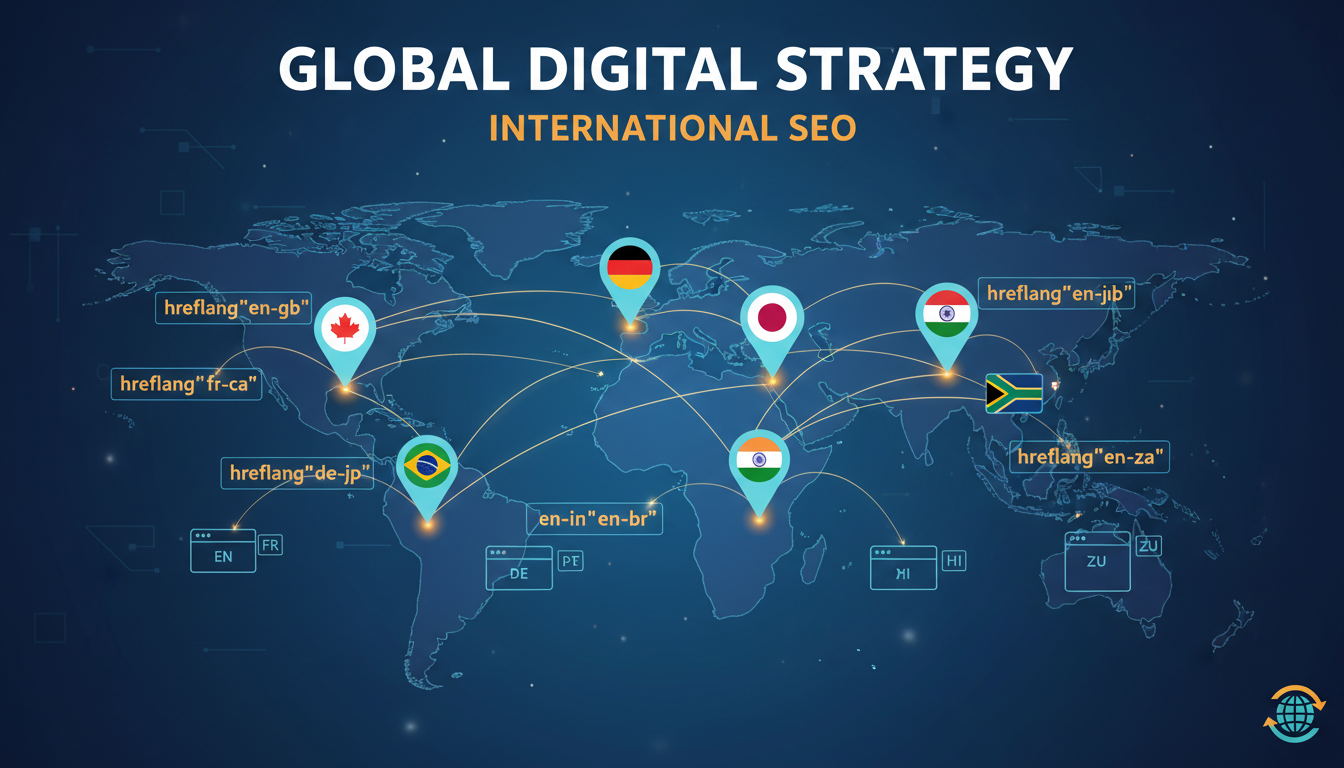
Expanding your business beyond UK borders is one of the most ambitious - and rewarding - digital strategies you can pursue. But if your website only ranks well in British search results, you're leaving enormous revenue on the table. International SEO is the discipline of optimising your online presence so that search engines serve the right version of your content to the right audience in each target country. Whether you're eyeing France, Germany, the United States, or the Gulf States, getting this right can transform a single-market operation into a genuinely global enterprise.
For UK businesses in particular, international expansion through organic search has never been more accessible. The infrastructure exists - from hreflang tags to country-code top-level domains - but the execution is where most companies stumble. This guide breaks down exactly how to target multiple countries with your SEO strategy, avoid the pitfalls that waste budget, and build a framework that scales.
Why International SEO Matters for UK Businesses
The United Kingdom has always been an outward-looking trading nation. Post-Brexit trade agreements, the strength of the English language globally, and the maturity of UK digital agencies mean that British companies are uniquely positioned to compete internationally. Yet the vast majority of UK SMEs still focus their SEO efforts exclusively on domestic rankings.
Consider the numbers: the global e-commerce market is projected to exceed £5.5 trillion by 2027. The UK accounts for roughly 4.8% of that figure. If your products or services have international appeal, ignoring the other 95% of the market is a strategic mistake. International SEO allows you to capture demand where it already exists, rather than fighting for increasingly competitive UK keywords alone.
Beyond the raw revenue opportunity, international SEO builds resilience. Businesses that depend on a single market are vulnerable to local economic downturns, regulatory changes, and seasonal fluctuations. A diversified organic traffic portfolio - pulling visitors from Germany, the Netherlands, the UAE, and Australia - creates a buffer that purely domestic operations lack.
Understanding Hreflang Tags: The Foundation of International SEO
At the heart of any multi-country SEO strategy sits the hreflang attribute. This small piece of HTML tells Google which language and regional version of a page should be served to which audience. Without hreflang tags, search engines are left guessing - and they frequently guess wrong, serving your British English page to American users or your French translation to Belgian visitors who speak Dutch.
The syntax is straightforward but unforgiving. A single misconfigured hreflang annotation can cascade errors across your entire international site structure. The tag uses ISO 639-1 language codes (such as en for English or de for German) combined with optional ISO 3166-1 Alpha-2 country codes (such as GB for the United Kingdom or US for the United States).
Here's how common configurations look:
- en-GB - English content targeted at the United Kingdom
- en-US - English content targeted at the United States
- fr-FR - French content targeted at France
- de-DE - German content targeted at Germany
- ar-AE - Arabic content targeted at the UAE
- x-default - The fallback page for users not matching any specified locale
Every page in your hreflang cluster must reference every other page in the cluster, including itself. If Page A points to Page B, Page B must point back to Page A. Missing return tags are the single most common hreflang error and can cause Google to ignore your annotations entirely.
Implementation options include placing hreflang in the HTML <head>, using HTTP headers (useful for PDFs and non-HTML resources), or declaring them in your XML sitemap. For large sites with thousands of pages, the sitemap method is typically the most maintainable.
Choosing Your International Site Structure
Before writing a single line of translated content, you need to decide on your URL architecture. This decision has long-term implications for crawl efficiency, link equity distribution, and operational complexity. There are three primary approaches, each with distinct trade-offs.
Country-Code Top-Level Domains (ccTLDs)
Using separate domains like example.co.uk, example.de, and example.fr sends the strongest geo-targeting signal to search engines. Each domain is treated as an independent entity, which means you benefit from clear country association but lose the consolidated domain authority of a single site. This approach is expensive to maintain and best suited for large enterprises with dedicated teams per market.
Subdirectories
Structuring your site as example.com/en-gb/, example.com/de/, and example.com/fr/ keeps all link equity under one domain. This is the most popular choice for mid-market UK businesses because it balances geo-targeting clarity with operational simplicity. All your content benefits from the root domain's authority, and you only need to manage one hosting environment.
Subdomains
Using de.example.com or fr.example.com sits between the two approaches. Subdomains are treated as semi-separate entities by Google, which means you get some geo-targeting benefit without the cost of multiple domain registrations. However, link equity does not flow as freely between subdomains as it does between subdirectories.
To help you evaluate which structure suits your organisation, here is a side-by-side comparison of the key factors that influence the decision. Each approach has distinct implications for authority consolidation, setup complexity, and geo-targeting precision - and the right choice depends on your resources, timeline, and the number of markets you plan to enter.
| Factor | ccTLDs | Subdirectories | Subdomains |
|---|---|---|---|
| Geo-targeting signal | Very strong | Strong (with hreflang) | Moderate |
| Domain authority | Separate per domain | Consolidated | Partially shared |
| Setup complexity | High | Low | Medium |
| Ongoing cost | £500–£2,000/yr per domain | Minimal additional | Minimal additional |
| Best suited for | Enterprises with local teams | Mid-market UK businesses | Businesses needing separation |
| Link equity flow | No cross-domain flow | Full flow across directories | Limited flow between subdomains |
For most UK businesses entering their first international markets, subdirectories offer the strongest balance of simplicity and effectiveness. You retain the domain authority you have already built, your development team manages a single codebase, and hreflang tags handle the geo-targeting signals. The exception is when you need to host content on country-specific servers for legal or compliance reasons - in which case, ccTLDs or subdomains may be necessary despite their higher operational overhead.
Without International SEO
With International SEO
Search Engine Market Share by Country
Not every country is a Google-dominated market. While Google holds roughly 92% of UK search traffic, other countries have significant alternative search engine usage. Understanding where your target audience actually searches is critical to allocating your international SEO budget wisely.
For most UK businesses expanding into Western Europe, North America, or Australasia, Google optimisation covers the vast majority of search activity. But if you're targeting East Asian or CIS markets, you'll need platform-specific strategies for Baidu, Naver, or Yandex alongside your Google efforts.
Content Localisation: More Than Just Translation
One of the costliest mistakes in international SEO is treating localisation as a simple translation exercise. Running your existing English content through a translation service - even a high-quality one - produces pages that technically say the right words but miss the cultural context, search intent, and local terminology that drive rankings.
True localisation involves several layers:
- Keyword research per market: The terms people use to search for your products differ dramatically between countries. A "solicitor" in the UK is a "lawyer" or "attorney" in the US. "Mobile phone" becomes "Handy" in German. Your keyword strategy must be rebuilt from scratch for each locale.
- Cultural adaptation: References to UK institutions, legislation, currency, and cultural norms must be replaced with locally relevant equivalents. A case study featuring a Manchester-based retailer means little to a German audience unless you contextualise it.
- Currency and measurements: Display prices in local currency. Use kilometres where appropriate. Adjust date formats. These details signal to both users and search engines that the page was created for their market.
- Legal compliance: GDPR applies across the EU, but individual countries layer additional requirements. The US has state-level privacy laws. The UAE has its own data protection framework. Your localised pages must reflect the regulatory environment of each target market.
- Visual localisation: Stock photography featuring exclusively British scenes or people may feel foreign to other audiences. Consider whether your imagery resonates across cultures or needs adaptation.
Research from CSA shows that 72% of consumers spend most or all of their time on websites in their own language, and 56% say the ability to obtain information in their own language is more important than price. For UK businesses, this means even markets where English proficiency is high - like the Netherlands or Scandinavia - still benefit enormously from native-language content.
Technical Implementation Checklist
Getting the technical foundations right prevents months of troubleshooting later. Here is a comprehensive checklist for launching an international SEO programme:
- Audit your current site structure - Determine whether subdirectories, subdomains, or ccTLDs best suit your resources and ambitions.
- Implement hreflang tags - Ensure bidirectional references across all language/country variants, including an x-default fallback.
- Set up Google Search Console properties - Create separate properties for each country or language variant and configure geographic targeting where applicable.
- Configure server-side settings - Serve each locale from geographically appropriate servers or CDN nodes. Page speed impacts rankings, and latency increases with distance.
- Create locale-specific XML sitemaps - Each language/country variant should have its own sitemap, cross-referenced in a sitemap index file.
- Build local backlink profiles - Domain authority in one country does not automatically transfer to another. You need backlinks from German sites to rank well in Germany, from French sites to rank in France, and so on.
- Implement proper canonical tags - Avoid duplicate content penalties by clearly indicating the preferred version of each page within its locale cluster.
- Test thoroughly - Use VPNs or Google's geolocation testing tools to verify that the correct versions appear for users in each target country.
Link Building Across Borders
International link building requires a fundamentally different approach from domestic campaigns. Your UK backlink profile - however strong - provides limited authority for ranking in foreign markets. Google assesses the relevance and authority of linking domains relative to the target country, meaning a link from a highly authoritative German publication carries far more weight for your /de/ pages than a link from a UK newspaper.
Effective international link building strategies include:
- Local digital PR: Pitching stories to journalists and publications in each target market, ideally in their native language.
- Industry partnerships: Collaborating with complementary businesses in target countries for guest content, co-branded research, or joint webinars.
- Local directory listings: Submitting to country-specific business directories and industry associations.
- Sponsorship and events: Supporting local conferences, meetups, or charitable initiatives that generate press coverage and natural links.
- Translated assets: Creating high-value resources - whitepapers, tools, calculators - in local languages that naturally attract citations.
Measuring International SEO Performance
Tracking the success of a multi-country SEO strategy requires more granular analytics than a domestic-only setup. You need visibility into performance by country, language, and locale - not just aggregate numbers that mask underperformance in specific markets.
Key metrics to monitor include:
- Organic traffic by country: Use Google Analytics segments or separate properties to track visits from each target market independently.
- Keyword rankings by locale: Tools like Ahrefs, SEMrush, and Sistrix allow you to track rankings in specific country versions of Google.
- Conversion rates by market: A market generating high traffic but low conversions may indicate a localisation problem rather than an SEO problem.
- Hreflang coverage and errors: Regularly audit your hreflang implementation using Screaming Frog or Sitebulb to catch misconfigurations before they impact rankings.
- Local backlink acquisition rate: Track the growth of your backlink profile in each target country separately.
International SEO Readiness Benchmarks
When assessing how well your international SEO programme is performing, it helps to benchmark against industry standards. The following metrics represent typical scores for UK businesses that have been running multi-country SEO campaigns for at least twelve months. Use these as a guide to identify areas where your programme may need additional investment or strategic adjustment.
The area where most UK businesses score lowest is local backlink acquisition. Building a strong backlink profile in a foreign market takes sustained effort and genuine engagement with local publishers, industry bodies, and media outlets. Many organisations underestimate the time required, expecting their existing UK authority to carry over into new markets. In reality, each target country requires its own dedicated link-building campaign with content and outreach adapted to local expectations and editorial standards.
Common Mistakes to Avoid
Even experienced SEO professionals make errors when venturing into international optimisation. Here are the most frequent - and most damaging - mistakes we see UK businesses make:
- Auto-redirecting based on IP address: Redirecting users to a locale version based on their IP prevents Googlebot from crawling all versions of your site. Use hreflang annotations and let users choose their preferred locale instead.
- Neglecting the x-default tag: Without an x-default, users from countries you haven't specifically targeted have no fallback - potentially seeing the wrong version or none at all.
- Using flags for language selectors: Flags represent countries, not languages. The Swiss flag doesn't represent German, French, or Italian - all of which are spoken in Switzerland. Use language names written in their native script instead.
- Thin translated content: Publishing machine-translated pages with no human review damages your credibility and can incur quality penalties from Google.
- Ignoring local search features: Featured snippets, knowledge panels, and "People Also Ask" boxes vary by country. Optimise your content for the SERP features that dominate in each target market.
- Expanding into too many markets at once: It's far more effective to dominate two or three markets thoroughly than to spread thin across ten. Prioritise based on market size, competition level, and your existing brand awareness.
Never use automatic IP-based redirects for international content. Googlebot primarily crawls from US-based IP addresses, meaning IP redirects can prevent your UK, European, and other locale pages from being indexed entirely. Always serve content based on hreflang annotations and give users an explicit language/region selector.
Building Your International SEO Roadmap
A successful international SEO strategy is a 12-to-24-month undertaking for most UK businesses. The first three months should focus on research: identifying target markets, analysing competitor landscapes in each country, and conducting thorough keyword research per locale. Months four through six are dedicated to technical setup - choosing your URL structure, implementing hreflang, and building your localised site architecture.
Content creation and localisation occupy months six through twelve, with initial focus on your highest-value pages - typically product or service pages and the top-performing blog content from your UK site. Link building should begin in parallel, with dedicated outreach campaigns for each target market.
From month twelve onwards, you're in optimisation mode: refining content based on performance data, expanding into secondary keyword targets, and potentially adding new markets based on the success of your initial rollout.
The investment is significant, but the returns are transformative. UK businesses that commit to international SEO properly - with genuine localisation, robust technical implementation, and sustained effort - consistently report that their international organic channels become their highest-ROI acquisition source within 18 to 24 months.
Ready to Take Your Business Global?
Our international SEO specialists have helped UK businesses expand into over 30 markets worldwide. From hreflang implementation to full content localisation strategies, we build organic growth programmes that deliver measurable results across borders. Let's discuss your international ambitions.
TALK TO AN EXPERT
CloudSwitched
London-based managed IT services provider offering support, cloud solutions and cybersecurity for SMEs.


