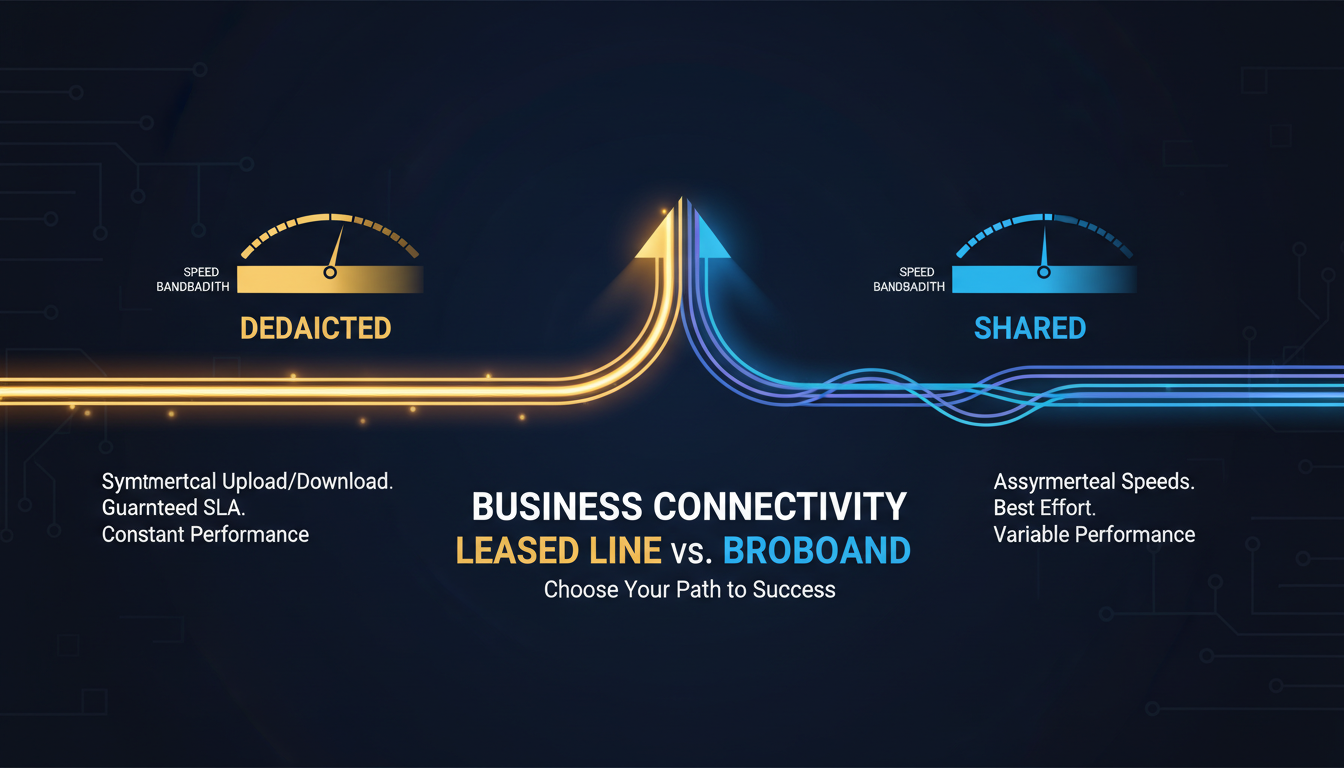
Choosing the right internet connection is one of the most consequential infrastructure decisions a UK business can make. Whether you're a five-person startup in Shoreditch or a 200-seat enterprise in Manchester, the debate between leased line vs broadband shapes everything from daily productivity to long-term scalability. Get it wrong and you're battling buffering video calls, sluggish cloud applications, and costly downtime. Get it right and your connectivity becomes an invisible enabler of growth.
This comprehensive guide cuts through the jargon to give you a clear, evidence-based framework for deciding between a leased line, fibre broadband business packages, and hybrid options such as Ethernet over FTTC. We'll examine real-world performance data, cost structures, SLA guarantees, and the scenarios where each technology genuinely excels - so you can invest with confidence.
Understanding the Fundamentals: What Is a Leased Line?
A leased line - sometimes called a dedicated internet access circuit - is a private, symmetric data connection between your business premises and the carrier's network. Unlike shared broadband services, a leased line is exclusively yours. No other user, business, or residential customer shares the capacity you've contracted for. Think of it as a private motorway lane reserved solely for your traffic, regardless of how congested the surrounding roads become.
Leased lines in the UK are typically delivered over fibre-optic cable using technologies such as Ethernet in the First Mile (EFM), Ethernet over Fibre to the Premises (EoFTTP), or traditional Ethernet Access Direct (EAD) circuits. The headline characteristic is symmetric broadband UK delivery: your upload speed matches your download speed exactly. If you purchase a 100 Mbps leased line, you get 100 Mbps in both directions, guaranteed, every second of every day.
This symmetry is not a marketing flourish. For businesses that rely on cloud-hosted applications, VoIP telephony, video conferencing, large file uploads, off-site backups, or SaaS platforms, symmetric speeds fundamentally change what's possible. A 100 Mbps symmetric connection delivers roughly five to ten times the upload capacity of a typical 100 Mbps asymmetric broadband line - and that upload headroom is precisely where most business bottlenecks occur.
When comparing leased line quotes, always check whether the speed is "up to" or "guaranteed minimum." A genuine leased line should guarantee the full contracted bandwidth at all times - anything less suggests a shared service being marketed as dedicated.
What Is Business Broadband?
Business broadband uses the same underlying infrastructure as residential broadband - typically FTTC (Fibre to the Cabinet), FTTP (Fibre to the Premises), or in legacy cases, ADSL2+. The key difference from residential packages is the inclusion of business-grade features: static IP addresses, faster fault-response times, and marginally better contention ratios. However, the fundamental architecture remains shared.
Fibre broadband business packages in the UK now commonly deliver download speeds of 36 Mbps to 900 Mbps depending on technology. FTTC typically caps at around 80 Mbps downstream and 20 Mbps upstream. Full-fibre FTTP connections can reach gigabit download speeds, though upload speeds are often asymmetric - a 900 Mbps download package might offer only 110 Mbps upload.
This asymmetry is built into the technology's design. Consumer broadband was engineered in an era when users primarily consumed content (web pages, streaming, downloads). The architecture allocates far more capacity to downloads than uploads. For businesses that primarily browse the web and receive emails, this may be perfectly adequate. For businesses running cloud-first operations, it's a structural limitation.
Symmetric vs Asymmetric: Why It Matters More Than You Think
The distinction between symmetric and asymmetric connectivity is the single most important technical factor in the leased line vs broadband debate, yet it's the one most frequently overlooked. Many businesses fixate on headline download speeds without understanding that their real-world experience is throttled by upload capacity.
Consider a typical modern office scenario. Your team uses Microsoft 365 with OneDrive sync. They conduct Teams video calls throughout the day. Your CRM is cloud-hosted. Backups run to an off-site data centre every evening. Every one of these activities requires substantial upload bandwidth. A single HD video call consumes approximately 1.5 Mbps upload. Ten simultaneous calls consume 15 Mbps - already 75% of a typical FTTC connection's upload capacity. Add OneDrive syncing, CRM data, and email attachments, and you've saturated the line before anyone has even tried to upload a large file.
With symmetric broadband UK delivery via a leased line, this bottleneck vanishes. A 100 Mbps symmetric circuit provides 100 Mbps of upload capacity - five times more than FTTC - creating headroom for concurrent usage patterns that would cripple an asymmetric connection.
Contention Ratios: The Hidden Performance Variable
Contention ratio refers to the number of users sharing a given amount of bandwidth at the exchange or cabinet level. It's one of the most critical - and least discussed - differences between leased lines and broadband connections. With dedicated internet access, the contention ratio is 1:1. Your bandwidth is yours alone.
Residential broadband in the UK typically operates at contention ratios of 50:1 - meaning up to 50 households share the same backhaul capacity. Business broadband improves this to approximately 20:1, but that still means your connection speed can degrade significantly during peak usage hours. Between 7pm and 10pm, when residential usage peaks, even business broadband connections on shared infrastructure can see throughput drop by 30-50%.
For businesses operating conventional 9-to-5 hours, this peak-hour degradation may be less impactful. But for organisations running evening shifts, supporting global teams across time zones, or providing customer-facing services that must perform consistently 24/7, contention-driven slowdowns are operationally unacceptable.
| Connection Type | Typical Contention Ratio | Peak-Hour Speed Drop | Guaranteed Bandwidth |
|---|---|---|---|
| Leased Line (EAD/EoFTTP) | 1:1 (uncontended) | 0% | 100% of contracted speed |
| Ethernet over FTTC (EoFTTC) | Typically 1:1 to backhaul | 0-5% | Varies by provider |
| Business FTTP | 10:1 to 20:1 | 10-30% | Usually none |
| Business FTTC | 20:1 | 20-40% | Usually none |
| Residential Broadband | 50:1 | 30-50% | None |
SLAs and Uptime Guarantees: Quantifying Reliability
Service Level Agreements are where the financial case for dedicated internet access often becomes clearest. A leased line SLA typically guarantees 99.95% uptime - equivalent to no more than 4.38 hours of downtime per year. Many premium carriers offer 99.99% SLAs (52.6 minutes of annual downtime) with financial penalties if targets are missed. Fault-response times are typically 4-5 hours, meaning if your connection fails at 9am, an engineer is working on it by lunchtime.
Business broadband SLAs, where they exist at all, are considerably weaker. Typical commitments hover around 99.5% uptime (43.8 hours of annual downtime - ten times more than a leased line). Fault-response times stretch to 24-48 hours, with some providers offering next-business-day repair only. For residential broadband, meaningful SLAs are essentially non-existent.
The cost of downtime varies dramatically by business type, but research consistently shows that even small businesses lose between £800 and £2,000 per hour of internet outage when accounting for lost productivity, missed sales, and customer impact. For a business experiencing 40 additional hours of downtime per year on broadband versus a leased line, the downtime cost alone - £32,000 to £80,000 - dwarfs the annual price difference between the two connection types.
When evaluating SLAs, look beyond the headline uptime percentage. Check the Mean Time to Repair (MTTR), whether the SLA covers the full circuit or just the provider's network, and what financial credits are offered when targets are missed. A 99.95% SLA with a 24-hour MTTR is far less valuable than one with a 5-hour MTTR.
Dedicated Internet Access: The Full Picture
Dedicated internet access (DIA) is the formal term for what a leased line delivers at the internet layer. While a leased line refers to the physical circuit, DIA describes the service: uncontended, guaranteed-bandwidth internet connectivity with full SLA backing. When you purchase a DIA service, you receive several capabilities that fundamentally differ from broadband.
First, you receive a block of public IPv4 addresses - typically a /29 (5 usable) or /28 (13 usable) subnet. This enables you to host services, run mail servers, operate VPN endpoints, and configure advanced network architectures without NAT complications. Business broadband typically provides a single static IP at most.
Second, DIA circuits support Quality of Service (QoS) tagging. You can prioritise voice traffic over bulk data transfers, ensuring crystal-clear VoIP calls even when the connection is under heavy load. Broadband connections offer no QoS guarantees - all traffic competes equally for available bandwidth.
Third, DIA services include proactive monitoring. Your provider watches the circuit 24/7, often detecting and responding to faults before you even notice them. Broadband faults are reactive - you notice the problem and raise a ticket, then wait.
Fibre Broadband Business Options in the UK
The UK fibre broadband business landscape has evolved dramatically over the past five years. The rollout of full-fibre FTTP networks by Openreach, CityFibre, Hyperoptic, Community Fibre, and numerous alt-nets means that genuine fibre-to-the-premises business broadband is now available to a growing proportion of UK businesses. As of 2026, approximately 65% of UK premises can access FTTP, with the government targeting 85% by 2027.
For businesses in areas with FTTP availability, business-grade fibre broadband packages offer a compelling middle ground. Download speeds of 500 Mbps to 1 Gbps are common, with upload speeds of 50-115 Mbps. Prices typically range from £40-£90 per month - a fraction of leased line costs. Some FTTP providers now offer symmetric packages at higher price points, narrowing the performance gap with leased lines still further.
However, important caveats apply. FTTP business broadband remains a shared service. Contention ratios, while better than FTTC, still mean your bandwidth is not guaranteed. SLAs remain weaker than leased lines. And availability is geographically uneven - many business parks, industrial estates, and rural commercial areas still lack FTTP coverage.
For businesses in serviced offices, co-working spaces, or multi-tenant buildings, the situation is further complicated by shared building infrastructure. Your FTTP connection may deliver 900 Mbps to the building, but if the internal network is poorly configured, you may see a fraction of that capacity at your desk.
Ethernet over FTTC: The Middle Ground
Ethernet over FTTC (EoFTTC) occupies a genuinely useful position between standard broadband and full leased lines. It uses the existing FTTC infrastructure - fibre to the street cabinet, copper to the premises - but layers an Ethernet service on top with enhanced SLAs, traffic prioritisation, and improved contention management.
The result is a service that delivers near-symmetric speeds (typically up to 20 Mbps symmetric on standard FTTC infrastructure), an SLA with 6-7 hour fix times, and proactive monitoring - at roughly one-third the cost of a full fibre leased line. Monthly prices typically fall between £150 and £300, compared to £200-£600+ for entry-level leased lines.
Ethernet over FTTC is particularly compelling for businesses that need better-than-broadband reliability and symmetry but cannot justify - or don't yet need - the full capacity and cost of a leased line. It's also valuable as a secondary failover connection alongside a primary leased line, providing resilience at a manageable price point.
The principal limitation of EoFTTC is speed. Because it relies on copper for the final connection to the premises, speeds are constrained by distance from the cabinet. Businesses more than 500 metres from their cabinet may see significantly lower speeds. And unlike a full leased line, EoFTTC cannot scale beyond approximately 20 Mbps symmetric - a ceiling that growing businesses may hit within a few years.
Leased Line
Ethernet over FTTC
Business Broadband
Cost Comparison: The Real Numbers
Cost is invariably the dominant factor in the leased line vs broadband decision. The price gap is real and significant - but it's often overstated when businesses fail to account for the total cost of ownership.
A typical UK business broadband FTTC connection costs between £25 and £50 per month. Business FTTP packages range from £40 to £90 per month. Ethernet over FTTC services sit between £150 and £300 per month. Entry-level leased lines (100 Mbps symmetric) typically cost £200 to £500 per month, with 1 Gbps circuits ranging from £400 to £1,200 per month depending on location and contract length.
Installation costs add another dimension. Broadband installation is typically free or under £100. EoFTTC installation is usually free with a contract. Leased line installation can range from free (in well-served business areas) to £2,000-£5,000+ where new fibre needs to be laid. Some providers amortise installation costs across the contract, increasing monthly charges but eliminating upfront capital expenditure.
| Connection Type | Monthly Cost | Installation | Contract Length | Speed (Down/Up) |
|---|---|---|---|---|
| Business FTTC | £25-£50 | Free-£100 | 12-24 months | 80/20 Mbps |
| Business FTTP | £40-£90 | Free-£150 | 12-24 months | Up to 900/115 Mbps |
| Ethernet over FTTC | £150-£300 | Free-£250 | 12-36 months | Up to 20/20 Mbps |
| Leased Line 100 Mbps | £200-£500 | Free-£3,000 | 12-36 months | 100/100 Mbps |
| Leased Line 1 Gbps | £400-£1,200 | Free-£5,000 | 12-36 months | 1000/1000 Mbps |
However, the headline monthly cost tells only part of the story. When you factor in the cost of downtime (£800-£2,000/hour for SMEs), lost productivity from slow connections, the IT support hours spent troubleshooting broadband issues, and the business opportunities missed due to unreliable connectivity, the total cost of ownership calculation often favours leased lines for any business where internet connectivity is genuinely critical to operations.
Leased line prices have fallen dramatically over the past five years. A 100 Mbps circuit that cost £800/month in 2020 can often be sourced for £250-£350/month in 2026. Always get at least three quotes and consider 36-month contracts for the best per-month pricing. Cloudswitched can broker multiple carrier quotes on your behalf to ensure you get the most competitive rates.
Performance Comparison: Real-World Metrics
Beyond raw speed, several performance metrics distinguish leased lines from broadband in daily business use. Latency, jitter, and packet loss collectively determine how "fast" a connection feels - and they vary significantly between connection types.
Latency (the time for a data packet to travel from source to destination) on a leased line typically measures 1-5 milliseconds to the provider's first hop. Business broadband latency ranges from 8-20 milliseconds. This difference may seem trivial, but for real-time applications - VoIP, video conferencing, remote desktop sessions, interactive cloud applications - it's the difference between seamless and frustrating.
Jitter (variation in latency) is often more impactful than latency itself. A connection with 10ms average latency but 2ms jitter will deliver better voice and video quality than one with 5ms average latency but 15ms jitter. Leased lines deliver near-zero jitter due to their uncontended nature. Broadband jitter spikes during peak hours, causing audio dropouts, video pixelation, and application timeouts.
Packet loss - the percentage of data packets that fail to reach their destination - should be zero on a properly functioning leased line. Business broadband connections typically experience 0.1-1% packet loss, rising during congestion. Even 0.5% packet loss can render a VoIP call unintelligible and cause significant TCP performance degradation for file transfers.
Scalability: Planning for Growth
Scalability is where leased lines demonstrate their longest-term value proposition. A well-architected leased line circuit can be upgraded in bandwidth without changing the physical connection. If you install a 100 Mbps leased line over a bearer capable of 1 Gbps, upgrading from 100 Mbps to 200 Mbps, 500 Mbps, or 1 Gbps is typically a remote configuration change - completed in days, not weeks, with no site visit required.
This "upgrade without disruption" capability is enormously valuable for growing businesses. You pay for the capacity you need today, knowing you can scale tomorrow without construction work, new contracts, or service interruption. Some providers offer "burstable" leased lines that allow temporary speed increases during peak demand - essentially paying for a base capacity with the option to burst higher when needed.
Business broadband scalability is more constrained. Upgrading from FTTC to FTTP requires a new physical connection. Moving from FTTP 300 Mbps to 900 Mbps may involve a plan change, but you remain capped at the technology's maximum speed. And the asymmetric nature of broadband means that even a 1 Gbps FTTP connection may offer less upload capacity than a 100 Mbps symmetric leased line.
Ethernet over FTTC scalability is the most constrained of all. The copper last-mile limits speeds to approximately 20 Mbps symmetric, with no upgrade path beyond switching to a different technology entirely. For businesses expecting significant growth, EoFTTC may serve well as a stepping stone but should not be viewed as a long-term solution.
When to Choose a Leased Line
A leased line is the right choice when internet connectivity is genuinely business-critical - when downtime directly costs money, when performance inconsistency impairs operations, or when your usage patterns demand symmetric, uncontended bandwidth. Specific indicators include:
You rely heavily on cloud applications. If your ERP, CRM, accounting software, document management, or core line-of-business applications are cloud-hosted, your internet connection is effectively your IT infrastructure. An unreliable or slow connection means unreliable or slow business operations. A leased line ensures these critical applications perform consistently.
You conduct significant voice and video communication. Organisations running 10+ simultaneous VoIP calls or regular video conferences need the low latency, low jitter, and symmetric bandwidth that only a leased line reliably delivers. QoS tagging on a DIA circuit allows you to prioritise voice traffic, ensuring call quality even under heavy data load.
You handle large file transfers. Architecture practices, design agencies, video production companies, engineering firms, and legal practices regularly transfer files of hundreds of megabytes or several gigabytes. On a 20 Mbps upload FTTC connection, a 2 GB file takes approximately 14 minutes to upload. On a 100 Mbps leased line, the same transfer completes in under 3 minutes.
You host on-premises services. Businesses running their own mail servers, web servers, VPN endpoints, or client-facing applications need the static IP block, symmetric bandwidth, and guaranteed uptime that only dedicated internet access provides.
You have regulatory or compliance requirements. Organisations in financial services, healthcare, or legal sectors may have regulatory obligations around data security and service availability that mandate guaranteed SLAs - something broadband simply cannot provide.
When Business Broadband Is Sufficient
Business broadband - including fibre broadband business FTTP packages - remains the right choice for many organisations. The key is honest assessment of your actual requirements rather than aspirational ones.
Your usage is primarily download-oriented. If your team primarily browses the web, reads email, downloads documents, and streams training content, the asymmetric nature of broadband is well-matched to your workload. The download speeds offered by modern FTTP packages (500 Mbps to 1 Gbps) are more than adequate for these use cases.
You have fewer than 10-15 employees. Smaller teams generate less concurrent bandwidth demand. A business FTTP connection with 500 Mbps download and 50 Mbps upload can comfortably support 10-15 users doing a mix of web browsing, email, cloud application use, and occasional video calls.
Occasional downtime is tolerable. If your business can function - even in reduced capacity - during internet outages (perhaps by using mobile data as a temporary backup), the weaker SLAs of business broadband may be acceptable. This is more likely for businesses where internet is a tool rather than the platform on which the entire operation runs.
Budget is the primary constraint. For startups and early-stage businesses where every pound of operating expenditure matters, the £300-£500 monthly saving between broadband and a leased line may be better invested elsewhere. As the business grows and connectivity becomes more critical, upgrading to a leased line is always possible.
Hybrid Approaches: The Best of Both Worlds
Increasingly, the smartest connectivity strategy is not a binary leased line vs broadband choice but a hybrid approach that combines both technologies for resilience and cost-efficiency.
Primary leased line + broadband failover. The most common hybrid configuration uses a leased line as the primary connection for all business traffic, with a broadband connection (FTTC or FTTP) as an automatic failover. If the leased line fails, traffic seamlessly switches to the broadband connection, maintaining basic operations until the primary circuit is restored. This approach typically costs only £40-£90 per month more than a leased line alone but provides a second layer of resilience.
SD-WAN with mixed connections. Software-Defined Wide Area Networking (SD-WAN) technology enables intelligent traffic routing across multiple connection types. A business might route VoIP and video over a leased line for guaranteed quality while directing web browsing and email over a cheaper broadband connection. SD-WAN can also aggregate bandwidth across connections, bond them for failover, and apply application-aware QoS policies - all managed through a single interface.
EoFTTC + broadband dual-WAN. For businesses not yet ready for a full leased line, pairing an Ethernet over FTTC connection with a standard broadband line provides meaningful resilience at a fraction of full leased line costs. The EoFTTC handles business-critical traffic with its enhanced SLA, while the broadband line handles bulk data and serves as backup.
Stage 1: Startup (1-10 employees)
Begin with business FTTP broadband. Low cost, fast installation, adequate for initial cloud and email needs. Add a 4G/5G backup for basic resilience.
Stage 2: Growth (10-30 employees)
Add Ethernet over FTTC as a primary connection with the broadband line retained as failover. Enhanced SLAs protect against growing operational risk.
Stage 3: Established (30-100 employees)
Deploy a 100-500 Mbps leased line as primary. Retain the broadband line as failover. Implement SD-WAN for intelligent traffic management across both connections.
Stage 4: Enterprise (100+ employees)
Upgrade to 1 Gbps+ leased line with a secondary leased line from a different carrier for diverse-path resilience. Full SD-WAN with application-aware routing.
Decision Framework: Matching Connectivity to Business Type
Different business types have fundamentally different connectivity requirements. The following framework maps common UK business profiles to recommended connectivity strategies, helping you identify where your organisation falls on the leased line vs broadband spectrum.
| Business Type | Recommended Primary | Recommended Backup | Key Requirement |
|---|---|---|---|
| Professional services (5-15 staff) | Business FTTP or EoFTTC | 4G/5G mobile backup | Reliable cloud access, occasional video calls |
| Professional services (15-50 staff) | 100 Mbps leased line | Business broadband | Heavy cloud use, constant VoIP, client SLAs |
| Creative/media agency | 500 Mbps+ leased line | Business FTTP | Large file uploads, video content, collaboration |
| E-commerce operation | 100-500 Mbps leased line | Diverse-path leased line | 24/7 uptime, payment processing, customer experience |
| Software/SaaS company | 500 Mbps-1 Gbps leased line | Diverse-path leased line | Code deployment, CI/CD, cloud hosting, symmetric speeds |
| Retail shop (single site) | Business FTTC/FTTP | 4G mobile backup | Card payments, basic cloud POS |
| Healthcare practice | EoFTTC or 100 Mbps leased line | Business broadband | NHS N3/HSCN compliance, patient record systems |
| Manufacturing/warehouse | EoFTTC or 100 Mbps leased line | 4G/5G backup | IoT, inventory systems, supply chain connectivity |
| Multi-site organisation | Leased line per site + SD-WAN | Broadband per site | Inter-site connectivity, centralised applications |
Installation and Lead Times
One of the most frequently underestimated factors in the leased line vs broadband decision is installation time. Business broadband (FTTC or FTTP) can typically be installed within 5-15 working days. If FTTP infrastructure already reaches your premises, installation may be completed in as little as 3-5 days.
Leased line installation is a fundamentally different undertaking. The typical timeline from order to activation is 45-90 working days - though this varies significantly based on whether existing fibre infrastructure reaches your building. In best-case scenarios (fibre already in the building or at the boundary), installation can be completed in 30-45 days. In worst-case scenarios (requiring new duct work or wayleave agreements with third-party landowners), lead times can stretch to 120+ days.
This extended lead time underscores the importance of planning connectivity decisions well in advance. If you're moving to new premises, the leased line order should be one of the first things you arrange - ideally 3-4 months before your move date. Many businesses install broadband as a temporary solution, operating on it for the first few weeks or months while the leased line installation completes.
Ethernet over FTTC offers the best of both worlds on lead time. Because it uses existing FTTC infrastructure, installation typically takes just 10-20 working days - significantly faster than a full leased line but with better service characteristics than standard broadband.
Migration Strategies: Moving from Broadband to Leased Line
For businesses that have outgrown their broadband connection - suffering from increasingly frequent slowdowns, struggling with video call quality, or hitting upload bottlenecks - migrating to a leased line is a well-trodden path. The key is planning the transition to avoid disruption.
Step 1: Audit your current usage. Before ordering a leased line, understand your actual bandwidth consumption. Most business-grade routers and firewalls can provide traffic reports showing peak usage, average consumption, and the split between upload and download traffic. This data helps you size the leased line correctly - there's no point paying for 500 Mbps if your peak consumption is 80 Mbps.
Step 2: Survey and quote. Leased line pricing depends heavily on your location and the availability of existing fibre infrastructure. A proper survey will determine the installation route, identify any wayleave requirements, and produce an accurate quote. Get at least three quotes from different carriers - pricing can vary by 40-60% for identical specifications.
Step 3: Order early, overlap deliberately. Order the leased line while keeping your existing broadband active. Plan for at least a month of overlap where both connections are live. This gives you time to test the leased line thoroughly, configure routing, and verify that all applications work correctly before cutting over.
Step 4: Configure and test. Once the leased line is installed, configure it as the primary connection on your router/firewall while keeping broadband as a failover. Test all critical applications, measure latency and throughput, and verify QoS policies are working correctly. Run in this dual-connection configuration for at least two weeks before making any changes to the broadband contract.
Step 5: Optimise and decommission (or retain). Once you're confident the leased line is performing correctly, decide whether to decommission the broadband connection or retain it as a failover. In most cases, retaining it at £30-£50/month provides worthwhile resilience for minimal cost.
Week 1-2: Usage Audit
Enable traffic monitoring on your router. Collect at least two weeks of data covering peak periods to understand actual bandwidth requirements and traffic patterns.
Week 3-4: Survey and Procurement
Request site surveys and quotes from multiple carriers. Compare not just price but SLA terms, installation timelines, and scalability options. Engage a connectivity broker for best results.
Week 5-16: Installation Period
Leased line installation proceeds. Use this time to plan router/firewall configuration, QoS policies, and failover settings. No disruption to existing broadband service during this phase.
Week 17-18: Testing and Cutover
Leased line goes live alongside broadband. Rigorous testing of all applications. Configure leased line as primary with broadband failover. Monitor for two weeks minimum.
Week 19+: Steady State
Confirm stable operation. Optionally retain broadband as failover or decommission. Ongoing monitoring via provider's NOC and your own network management tools.
The Role of 5G and Emerging Technologies
No discussion of business connectivity in 2026 would be complete without addressing 5G and its impact on the leased line vs broadband debate. 5G business services now offer download speeds of 100-500 Mbps with latency of 10-30 milliseconds in urban areas with strong coverage. Some providers offer 5G as a primary business connection with SLAs.
However, 5G should be viewed as a complement to, rather than a replacement for, wired connectivity. Radio-based connections are inherently more variable than wired ones - affected by weather, building materials, network congestion, and physical obstacles. For businesses requiring consistent, guaranteed performance, 5G cannot yet match the reliability of a wired leased line or even a wired broadband connection.
Where 5G excels is as a rapid-deployment backup connection. A 5G router can be installed in hours, providing immediate resilience without the lead times associated with wired installations. For temporary offices, pop-up locations, or as a stopgap while awaiting leased line installation, 5G is genuinely transformative.
Looking further ahead, technologies such as XGS-PON (10 Gbps symmetric passive optical networking) are beginning to enter the UK market, promising to blur the lines between broadband and leased line performance. Full-fibre symmetric services at broadband-like prices may eventually render the traditional leased line vs broadband distinction less stark - but that reality is still several years away for most UK businesses.
Security Considerations
Security is an often-overlooked dimension of the connectivity decision. A dedicated internet access leased line is inherently more secure than a shared broadband connection. Because the circuit is private to your organisation, there is no shared infrastructure where other users' traffic could theoretically be intercepted alongside yours.
Leased lines also support advanced security configurations more readily. The block of public IP addresses included with DIA enables you to deploy enterprise firewalls, intrusion prevention systems, and VPN gateways with proper address management. Single-IP broadband connections limit these options.
For organisations subject to data protection regulations - GDPR, PCI DSS, NHS DSPT, ISO 27001 - the enhanced security posture and documented SLAs of a leased line often form part of the compliance evidence required by auditors. While broadband is not inherently non-compliant, demonstrating adequate security controls and business continuity provisions is easier with dedicated internet access.
How to Evaluate Providers
Whether you choose a leased line, Ethernet over FTTC, or fibre broadband business package, the provider you select matters as much as the technology. Key evaluation criteria include:
Network ownership vs resale. Some providers own and operate their own fibre network infrastructure. Others are resellers, purchasing capacity from Openreach, BT Wholesale, or other carriers and rebranding it. Network-owning providers typically offer faster fault resolution because they control the entire circuit end-to-end. Resellers must raise tickets with the underlying carrier, adding a layer of delay.
Support quality and accessibility. Ask about the support model. Is it UK-based? Is there 24/7 telephone support or only business hours? What's the escalation process? Can you reach a network engineer directly, or must you work through tiered support? For a critical leased line, being able to speak to someone who understands BGP routing at 2am is worth a significant premium.
Proactive monitoring. The best providers monitor your circuit continuously and alert you to degradation before it becomes an outage. Ask whether monitoring is included, what metrics are tracked, and how alerts are communicated.
Contract flexibility. Leased line contracts typically run 12-36 months. Longer contracts generally offer lower monthly costs but reduce flexibility. Some providers offer break clauses or upgrade-without-penalty terms that provide valuable insurance against changing requirements.
Financial stability. A 36-month connectivity contract is only as good as the provider's ability to honour it. Check the provider's financial health, client portfolio, and market reputation. The UK telecoms market has seen numerous small provider failures in recent years, leaving customers scrambling for alternatives.
Total Cost of Ownership: A Worked Example
To illustrate the true cost comparison between leased line vs broadband, let's walk through a realistic scenario for a 30-person professional services firm in London.
Scenario: Business FTTC broadband
- Monthly cost: £45/month = £540/year
- Annual downtime: approximately 40 hours (99.5% uptime)
- Downtime cost at £1,200/hour: £48,000/year
- Productivity loss from slow uploads: estimated 15 minutes/employee/week = £23,400/year (at £40/hour average cost)
- IT support for connectivity issues: 4 hours/month at £75/hour = £3,600/year
- Total annual cost: £75,540
Scenario: 100 Mbps leased line
- Monthly cost: £350/month = £4,200/year
- Annual downtime: approximately 4.4 hours (99.95% uptime)
- Downtime cost at £1,200/hour: £5,280/year
- Productivity loss from slow uploads: near zero
- IT support for connectivity issues: 0.5 hours/month at £75/hour = £450/year
- Total annual cost: £9,930
In this analysis, the leased line costs £3,660 more per year in direct connectivity charges but saves over £65,000 per year in indirect costs. The total cost of ownership is dramatically lower with the leased line - a finding that surprises businesses focused solely on the monthly bill.
Your numbers will differ, but the methodology applies universally. Quantify downtime costs, productivity impacts, and support overhead alongside the direct connectivity charge, and the picture often shifts decisively in favour of dedicated internet access.
Common Myths and Misconceptions
Several persistent myths cloud the leased line vs broadband discussion. Let's address the most common ones.
Myth: "Leased lines are only for large enterprises." False. Leased line prices have fallen by 50-70% over the past decade. A 100 Mbps symmetric circuit can now be sourced for under £300/month in well-connected areas - comparable to the cost of two or three business broadband lines. Businesses with as few as 10 employees regularly justify leased lines when connectivity is operationally critical.
Myth: "Fibre broadband is just as fast as a leased line." Partially true for downloads, entirely false for uploads and guarantees. A 900 Mbps FTTP download speed exceeds most leased line speeds on paper. But the 110 Mbps upload limit, shared contention, lack of guaranteed bandwidth, and weaker SLA make it a fundamentally different product for business use.
Myth: "We don't need symmetric speeds." This was arguably true a decade ago. In 2026, with cloud-first operations standard across UK businesses, upload bandwidth is as critical as download. If your business uses any cloud-hosted application that synchronises data, you need symmetric speeds - or you need to accept that your cloud applications will always feel slower than they should.
Myth: "EoFTTC is just rebranded broadband." False. Ethernet over FTTC uses the same physical infrastructure but applies an entirely different service wrapper. The enhanced SLA, symmetric delivery, uncontended backhaul, and proactive monitoring make it a materially different product from standard FTTC broadband - one that occupies a legitimate and valuable middle ground.
Myth: "5G will replace all wired connections." Premature. 5G is excellent for mobility and backup but cannot yet match the consistency, latency, and guaranteed capacity of wired leased lines. For primary business connectivity in fixed premises, wired remains superior.
Making Your Decision: A Practical Checklist
After evaluating all the technical, financial, and operational factors, here's a structured approach to making your final decision on leased line vs broadband for your business.
Answer these five questions honestly:
- What is the hourly cost of a complete internet outage to your business? If it exceeds £500/hour, a leased line SLA pays for itself in prevented downtime.
- How many employees need simultaneous internet access? If more than 15 are using cloud applications and communication tools concurrently, broadband upload limits will constrain productivity.
- Do you regularly upload files larger than 100 MB? If yes, symmetric upload speeds deliver measurable time savings.
- Do you run VoIP telephony or video conferencing? If these are core to operations, the QoS and low jitter of a leased line prevents quality issues that degrade professional interactions.
- Are you subject to compliance requirements that mandate documented uptime guarantees? If yes, a leased line SLA provides the documentation auditors require.
If you answered "yes" to three or more of these questions, a leased line (or at minimum, Ethernet over FTTC) should be your primary connection. If you answered "yes" to one or two, a hybrid approach combining fibre broadband business packages with enhanced resilience may be optimal. If none apply, business broadband will serve you well.
Why Cloudswitched for Your Business Connectivity
At Cloudswitched, we're London-based IT specialists who understand that connectivity is the foundation everything else sits on. We don't sell one-size-fits-all solutions or push the most expensive option. We assess your actual requirements, model the total cost of ownership across different options, and recommend the solution that genuinely fits your business.
As a managed service provider, we handle the entire connectivity lifecycle: requirements analysis, multi-carrier procurement, installation coordination, router and firewall configuration, ongoing monitoring, and fault management. We work with all major UK carriers - Openreach, CityFibre, Virgin Media Business, Colt, Zayo, and others - ensuring you get the best circuit for your location at the most competitive price.
Whether you need a straightforward fibre broadband business connection, an Ethernet over FTTC circuit as a stepping stone, a full dedicated internet access leased line, or a hybrid SD-WAN solution combining multiple technologies, we design, deploy, and manage it - so you can focus on running your business.
Find the Right Connectivity for Your Business
Not sure whether your business needs a leased line, business broadband, or a hybrid approach? Our connectivity specialists will assess your requirements, compare options across multiple carriers, and recommend the most cost-effective solution for your specific needs - with no obligation.
Frequently Asked Questions
How much faster is a leased line than broadband?
Speed comparisons depend on the specific products being compared. A 100 Mbps leased line delivers 100 Mbps symmetrically (upload and download) with zero contention. A typical FTTC broadband connection delivers up to 80 Mbps download but only 20 Mbps upload, with speeds varying during peak hours. For upload-intensive work - which describes most modern cloud-based businesses - a leased line can deliver five to ten times the effective upload performance of FTTC broadband.
Can I get a leased line for a home office?
Technically yes, but it's rarely cost-effective for a single remote worker. Ethernet over FTTC or business-grade FTTP are more appropriate for home offices. If a home-based business has specific requirements for symmetric speeds and guaranteed SLAs - for example, running client-facing servers - a leased line is available but expect residential area installation to take longer and potentially cost more due to infrastructure limitations.
What is the minimum contract length for a leased line?
Most carriers offer leased line contracts from 12 to 36 months. Shorter contracts (12 months) carry higher monthly charges, while 36-month commitments typically offer the lowest per-month pricing. Some providers offer 1-month rolling contracts at a premium. Cloudswitched can help negotiate contract terms that balance cost savings with business flexibility.
Is Ethernet over FTTC available everywhere?
Ethernet over FTTC is available wherever standard FTTC broadband is available - approximately 96% of UK premises. However, actual speeds depend on the distance between your premises and the street cabinet. Businesses within 500 metres of the cabinet will see the best performance. Those further away may find speeds insufficient for their needs.
Can I upgrade from broadband to a leased line without downtime?
Yes. The standard migration approach involves installing the leased line alongside your existing broadband, running both in parallel for a testing period, then switching primary traffic to the leased line. There is no need to disconnect broadband before the leased line is active - and we recommend retaining broadband as a failover connection even after migration is complete.
What happens if my leased line provider goes bust?
If you've contracted with a reseller rather than the underlying carrier, the physical circuit usually survives the reseller's failure - you may be able to contract directly with the carrier or through a new reseller. Working with an established managed service provider like Cloudswitched mitigates this risk, as we maintain relationships with multiple carriers and can rapidly transition circuits if needed.
Conclusion: Invest in the Connection That Matches Your Ambition
The leased line vs broadband decision ultimately comes down to how central internet connectivity is to your business operations. If the internet is simply a tool your team uses occasionally, business broadband delivers excellent value. If the internet is the platform on which your entire business operates - as it is for an increasing majority of UK organisations - then dedicated internet access through a leased line provides the reliability, performance, and scalability that a business-critical dependency demands.
The UK connectivity landscape offers more options than ever before. Fibre broadband business packages deliver impressive headline speeds at consumer-adjacent prices. Ethernet over FTTC provides a genuine middle ground with enhanced SLAs and symmetric delivery. Full leased lines guarantee performance with financial-backed SLAs. And hybrid approaches, powered by SD-WAN technology, enable businesses to combine these technologies intelligently.
Whatever your starting point, the path to better connectivity is clear. Assess your requirements honestly, quantify the full cost of your current connection (including hidden costs of downtime and lost productivity), compare options across multiple carriers, and invest in the solution that supports not just where your business is today - but where you're taking it.
Cloudswitched is here to guide you through every step of that journey. From initial assessment to installation, migration, and ongoing management, we ensure your connectivity investment delivers maximum business value. Get in touch today to start the conversation.

CloudSwitched
London-based managed IT services provider offering support, cloud solutions and cybersecurity for SMEs.


