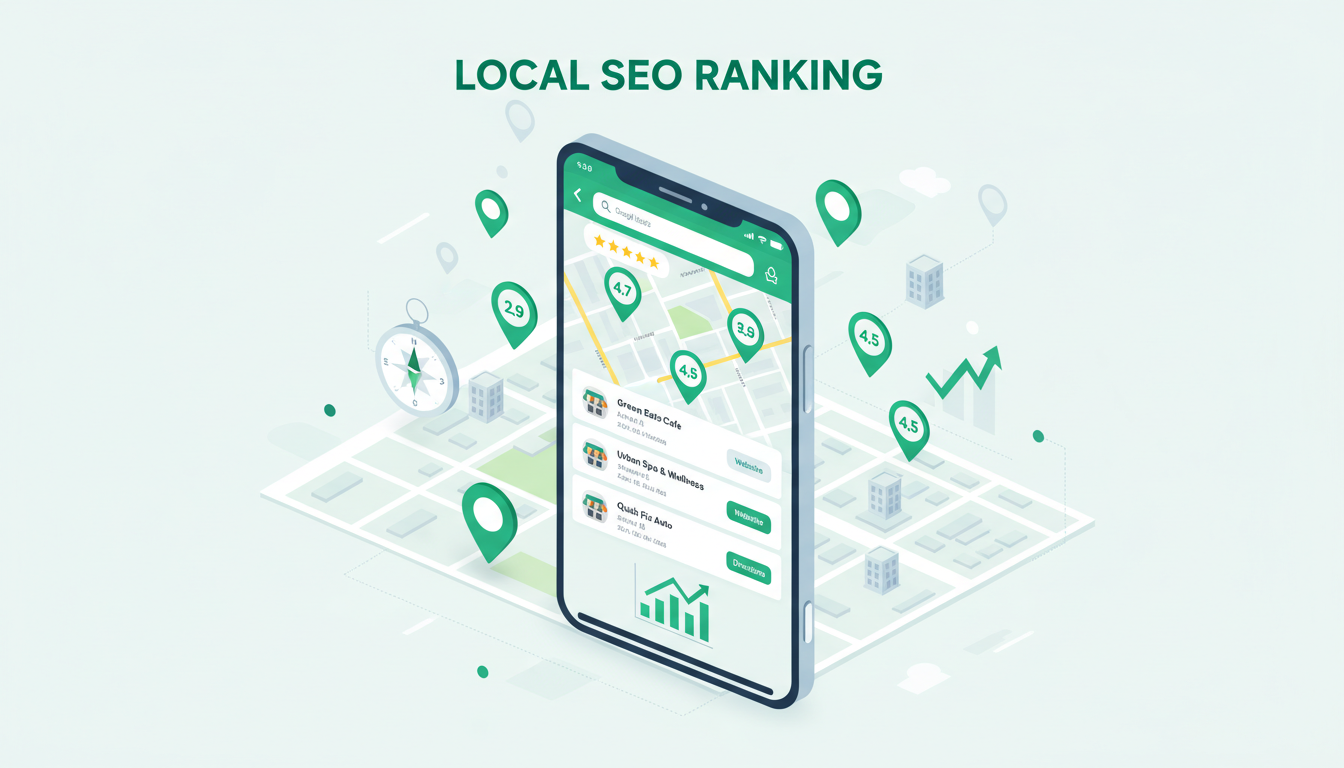
For businesses that serve customers in a specific geographic area - whether you are a restaurant in Edinburgh, a plumber in Birmingham, or a dental practice in Cardiff - local SEO is the single most important digital marketing investment you can make. When someone searches "electrician near me" or "best Italian restaurant in Leeds," Google displays a map with three business listings prominently at the top of the results. This is the local pack, and appearing in it can transform your business.
This guide covers everything UK businesses need to know about local SEO, from setting up and optimising your Google Business Profile to building the citations and reviews that push you into those coveted top three positions.
Understanding the Local Pack and Google Maps
The local pack (sometimes called the map pack or 3-pack) is the section of Google search results that displays a map alongside three local business listings. It appears for queries with local intent - searches where Google determines the user is looking for a nearby business or service.
These results are pulled from Google Business Profile listings, not from traditional organic rankings. A business can rank on page one of organic results but still be absent from the local pack, and vice versa. The two systems use different ranking algorithms, which means optimising for the local pack requires specific strategies beyond standard SEO.
The commercial value of local pack visibility is extraordinary. Users searching with local intent are typically ready to act - they are looking for a business to contact, visit, or buy from right now. The conversion rates from local search far exceed those from broader organic traffic.
How Google Ranks Local Results
Google has publicly stated that three primary factors determine local search rankings:
Relevance refers to how well your business profile matches the searcher's query. If someone searches for "emergency plumber in Bristol," Google needs to determine whether your business offers emergency plumbing services in Bristol. The more precisely your profile describes your services and service areas, the better Google can match you to relevant queries.
Distance is the physical proximity of your business to the searcher or the location specified in their query. This is a factor you cannot manipulate - your business is where it is. However, you can optimise other factors to compensate for distance, particularly for service-area businesses that travel to customers rather than operating from a fixed location.
Prominence is Google's assessment of how well-known and trusted your business is. This is influenced by your online reviews, the number and quality of citations (mentions of your business across the web), your backlink profile, your organic search ranking, and overall brand visibility.
Of these three factors, prominence is the one where you have the most room for improvement and strategic influence. It is also where most UK businesses underinvest.
Setting Up and Optimising Your Google Business Profile
Your Google Business Profile (GBP) - formerly Google My Business - is the foundation of your local SEO strategy. If you have not claimed your listing, do so immediately at business.google.com. If you already have a listing, the following optimisation steps will significantly improve your local visibility.
Complete Every Section
Google rewards comprehensive profiles. Fill in every available field:
- Business name: Use your exact legal business name. Do not stuff keywords into your business name - this violates Google's guidelines and can result in suspension.
- Categories: Select the most specific primary category available. For a fish and chip shop, "Fish & Chips Restaurant" is better than just "Restaurant." Add relevant secondary categories to capture additional query types.
- Address: Ensure it matches your address exactly as it appears on your website, Royal Mail records, and all other online listings.
- Phone number: Use a local phone number rather than a mobile or 0800 number where possible. The area code reinforces your geographic relevance.
- Opening hours: Keep these accurate and update them for bank holidays, seasonal changes, and special events. Nothing frustrates customers more than arriving at a closed business that Google said was open.
- Website URL: Link to your homepage or, ideally, a location-specific landing page if you have multiple branches.
- Business description: Write a compelling 750-character description that naturally incorporates your key services and location. Focus on what makes your business distinctive.
- Services/Products: Add every service or product you offer with descriptions. This helps Google match your profile to specific queries.
- Attributes: Select all applicable attributes - wheelchair accessibility, free Wi-Fi, outdoor seating, payment methods accepted, and so on.
Add High-Quality Photos and Videos
Businesses with photos receive 42% more requests for directions and 35% more website clicks than those without. Upload professional-quality images of your premises (interior and exterior), your team, your products or work, and any other visual content that helps potential customers understand what you offer.
Aim for at least 10-15 photos to start, and add new images regularly. Google notices when profiles are actively maintained with fresh content. Video content - short clips of your team at work, customer testimonials, or virtual tours - provides additional engagement signals.
Building and Managing Citations
Citations are online mentions of your business that include your name, address, and phone number (NAP). They appear on business directories, social media profiles, industry websites, and local community pages. Citations serve as trust signals - the more consistently your business information appears across the web, the more confidence Google has in its accuracy.
Essential UK Directories
Start by building citations on the most authoritative UK business directories:
- Yell.com - the digital successor to the Yellow Pages, still highly authoritative for UK local search
- Thomson Local - another established UK directory with strong authority
- FreeIndex - popular UK business directory with review functionality
- Yelp UK - particularly important for hospitality and consumer-facing businesses
- Facebook Business - essentially a citation with social features
- Bing Places - often overlooked but serves approximately 10% of UK search traffic
- Apple Maps - claim your listing through Apple Business Connect
- Foursquare - feeds data to many other platforms and apps
Industry-Specific Directories
Beyond general directories, list your business on platforms specific to your industry:
- Tradespeople: Checkatrade, MyBuilder, TrustATrader, Rated People, Bark
- Hospitality: TripAdvisor, OpenTable, DesignMyNight
- Healthcare: NHS Choices, Doctify, WhatClinic
- Legal: The Law Society, Solicitors.guru, ReviewSolicitors
- Financial: VouchedFor, Unbiased, Money.co.uk
NAP Consistency Is Critical
The golden rule of citations is consistency. Your business name, address, and phone number must be identical across every listing. Even small variations - "St" vs "Street," "Ltd" vs "Limited," or different phone formats - can confuse search engines and dilute the trust signal.
Conduct a citation audit using tools like BrightLocal, Moz Local, or Semrush's listing management tool. Identify and correct any inconsistencies, and establish a standard format that you use for all future listings.
Create a master document with your exact business name, address (including postcode), phone number, website URL, and business description. Use this as a reference whenever creating or updating any online listing. Consistency across even 20-30 quality directories can significantly boost your local rankings.
Reviews: Your Most Powerful Local SEO Weapon
Online reviews are the second most influential factor in local search rankings, and they are arguably the most influential factor in whether a potential customer chooses your business over a competitor. A strong review profile serves double duty - improving your search visibility whilst simultaneously persuading searchers to choose you.
How to Generate More Reviews
Most satisfied customers are willing to leave a review - they simply need to be asked. Effective review generation strategies include:
Direct asking: Train your team to ask happy customers for reviews at the point of service. A simple "We'd really appreciate it if you could leave us a Google review" is surprisingly effective.
Follow-up communications: Send post-purchase or post-service emails with a direct link to your Google review page. Make the process as frictionless as possible - one click should take them directly to the review form.
QR codes: Create QR codes that link to your Google review page and display them at your premises, on receipts, business cards, or service completion documents.
SMS requests: For service businesses, a text message sent shortly after a job is completed can be highly effective. Keep it personal and include a direct link.
Responding to Reviews
Responding to reviews - both positive and negative - is essential. Google has confirmed that businesses that respond to reviews are viewed more favourably in local rankings.
For positive reviews, thank the customer specifically, reference something about their experience, and reinforce your brand values.
For negative reviews, respond promptly, professionally, and empathetically. Acknowledge the issue, apologise where appropriate, and offer to resolve it offline. Never argue with a reviewer publicly - other potential customers are watching how you handle criticism.
Optimising Your Website for Local Search
While your Google Business Profile is the primary driver of local pack rankings, your website plays a supporting role that should not be neglected.
Location-Specific Pages
If you serve multiple areas, create dedicated pages for each location or service area. A plumbing company serving Greater Manchester might create individual pages for Manchester city centre, Salford, Stockport, Bolton, and Rochdale. Each page should include:
- Unique content specific to that area (not just the same text with the location name swapped)
- Your services available in that area
- Local landmarks, areas, or postcodes you cover
- Customer testimonials from clients in that area
- Embedded Google Map showing your service coverage
Schema Markup for Local Businesses
Implement LocalBusiness schema on your website to explicitly communicate your business details to search engines. This structured data should include your business name, address, phone number, opening hours, geographic coordinates, service area, and accepted payment methods.
If you have multiple locations, use separate LocalBusiness schema for each, linked to their individual location pages.
| Local SEO Action | Impact Level | Difficulty | Time to Results |
|---|---|---|---|
| Claim & optimise Google Business Profile | Very High | Easy | 1-4 weeks |
| Build core UK directory citations | High | Easy | 4-8 weeks |
| Generate customer reviews | Very High | Moderate | Ongoing |
| Create location-specific pages | High | Moderate | 4-12 weeks |
| Implement LocalBusiness schema | Moderate | Moderate | 2-6 weeks |
| Earn local backlinks | High | Difficult | 3-6 months |
| Post regularly on GBP | Moderate | Easy | Ongoing |
Google Business Profile Posts and Updates
Google Business Profile includes a posting feature that allows you to share updates, offers, events, and news directly on your profile. While posts are not a major ranking factor, they demonstrate that your business is active and engaged, and they provide additional content for Google to understand your services.
Effective GBP posting strategies include:
Weekly updates: Share news about your business, new services, seasonal offerings, or industry insights. Aim for at least one post per week to maintain an active profile.
Special offers: Use the "Offer" post type to promote discounts, seasonal deals, or limited-time promotions. These display prominently on your profile with a call-to-action button.
Events: If you host or participate in events, use the "Event" post type to promote them with dates, times, and descriptions.
Product highlights: Showcase specific products or services with images and descriptions. This helps Google understand the breadth of what you offer.
Building Local Backlinks
Backlinks from local sources carry extra weight in local search rankings because they reinforce your geographic relevance. Focus on earning links from:
Local news websites: Your regional newspaper, local BBC news site, and community news blogs. Pitch newsworthy stories, offer expert commentary on local issues, or sponsor community events that get covered in the local press.
Local business organisations: Your local Chamber of Commerce, Business Improvement District (BID), Federation of Small Businesses regional chapter, and other business networks typically offer member directories with links.
Community organisations: Sponsor local sports teams, charities, or community events. These organisations often link to their sponsors' websites.
Local bloggers and influencers: Identify bloggers and social media influencers in your area who cover topics related to your industry. Offer them a genuine experience of your business in exchange for honest coverage.
Partner businesses: If you regularly refer customers to other local businesses (or they refer to you), establish reciprocal links on your respective websites. A wedding venue might link to recommended local caterers, florists, and photographers.
Tracking Your Local SEO Performance
Measuring local SEO performance requires a different set of metrics and tools compared to traditional SEO:
Google Business Profile Insights: GBP provides data on how customers find your listing (direct searches vs discovery searches), what actions they take (calls, direction requests, website visits), and how your photos perform compared to competitors.
Local rank tracking: Standard rank tracking tools may not reflect your local pack position accurately because rankings vary by location. Use tools like BrightLocal, Local Falcon, or Local Viking that can check rankings from specific geographic coordinates to see exactly where you rank in different parts of your service area.
Phone call tracking: If phone calls are a key conversion, implement call tracking to attribute calls to your local SEO efforts. Many call tracking solutions can assign a unique number to your Google Business Profile while maintaining NAP consistency.
Direction requests: Track the number of "get directions" clicks from your GBP listing as a proxy for foot traffic driven by local search.
Review velocity and sentiment: Monitor not just your total review count but the rate at which you are gaining new reviews and the overall sentiment trend. A sudden drop in review velocity or average rating warrants investigation.
Common Local SEO Mistakes
Many UK businesses sabotage their local search performance through avoidable errors:
Keyword stuffing the business name. Adding keywords to your GBP business name (e.g., "Smith Plumbing - Best Emergency Plumber Manchester") violates Google's guidelines and risks profile suspension. Use your real business name only.
Ignoring negative reviews. Unanswered negative reviews damage both your reputation and your local rankings. Always respond professionally and work to resolve issues.
Inconsistent NAP information. Having different addresses, phone numbers, or business name variations across directories confuses Google and weakens your local authority.
Neglecting GBP maintenance. An incomplete or outdated profile signals to Google (and customers) that your business may not be active or reliable. Keep all information current and add new content regularly.
Using a virtual office address. Google's guidelines require a physical address where you conduct business or meet customers. Virtual office addresses can result in profile suspension if detected.
Not building citations beyond the basics. Many businesses claim their GBP listing and stop there. Without supporting citations across relevant directories, you are leaving ranking potential on the table.
Effective Local SEO Practices
- Complete every field in your Google Business Profile with accurate, consistent information
- Actively request and respond to customer reviews on a regular basis
- Build citations on authoritative UK directories with identical NAP details
- Create unique, locally-relevant content for each service area you cover
Common Local SEO Pitfalls
- Stuffing keywords into your Google Business Profile name to game rankings
- Ignoring negative reviews or responding defensively to customer complaints
- Using inconsistent business name, address, or phone number across listings
- Duplicating the same page content and swapping only the location name
Local SEO for Service-Area Businesses
Service-area businesses (SABs) - companies that travel to customers rather than serving them at a fixed location - face unique local SEO challenges. Plumbers, electricians, mobile hairdressers, and cleaning companies fall into this category.
Google allows SABs to hide their physical address on their GBP listing while specifying the areas they serve. This is important because you probably do not want customers showing up at your home address.
Key considerations for SABs:
- Set your service areas accurately - Google allows up to 20 service areas
- Do not set your service area too broadly; focus on the areas where you genuinely want to attract customers
- Create service-area-specific pages on your website for your key locations
- Build citations that reflect your service areas rather than just your office location
- Encourage reviews from customers across your service area to demonstrate geographic coverage
The competitive landscape for local SEO in the UK is intensifying. More businesses recognise the value of local pack visibility, which means the bar for entry continues to rise. However, the fundamental strategies remain consistent: maintain an exceptional Google Business Profile, build consistent citations, generate and manage reviews actively, create locally-relevant content, and earn local backlinks. Businesses that execute these strategies consistently and thoroughly will continue to dominate local search results in their markets.
Dominate Local Search in Your Area
Our local SEO specialists help UK businesses achieve top positions in Google Maps and the local pack. From GBP optimisation to citation building and review management, we deliver measurable local visibility.
Improve Your Local Rankings
CloudSwitched
London-based managed IT services provider offering support, cloud solutions and cybersecurity for SMEs.


