On-Page SEO: The Complete Guide for UK Businesses
On-page SEO remains one of the most powerful levers you can pull to improve your website's visibility in search engines. Unlike off-page strategies that rely on external factors, on-page optimisation puts you firmly in control of how search engines interpret and rank your content. For UK businesses competing in an increasingly crowded digital marketplace, mastering on-page SEO isn't optional - it's essential.
According to recent data, over 68% of all online experiences begin with a search engine, and the first five organic results account for roughly 67.6% of all clicks. If your website's pages aren't optimised correctly, you're leaving significant revenue on the table. This guide breaks down every critical element of on-page SEO, with practical advice tailored specifically for businesses operating in the United Kingdom.
What Exactly Is On-Page SEO?
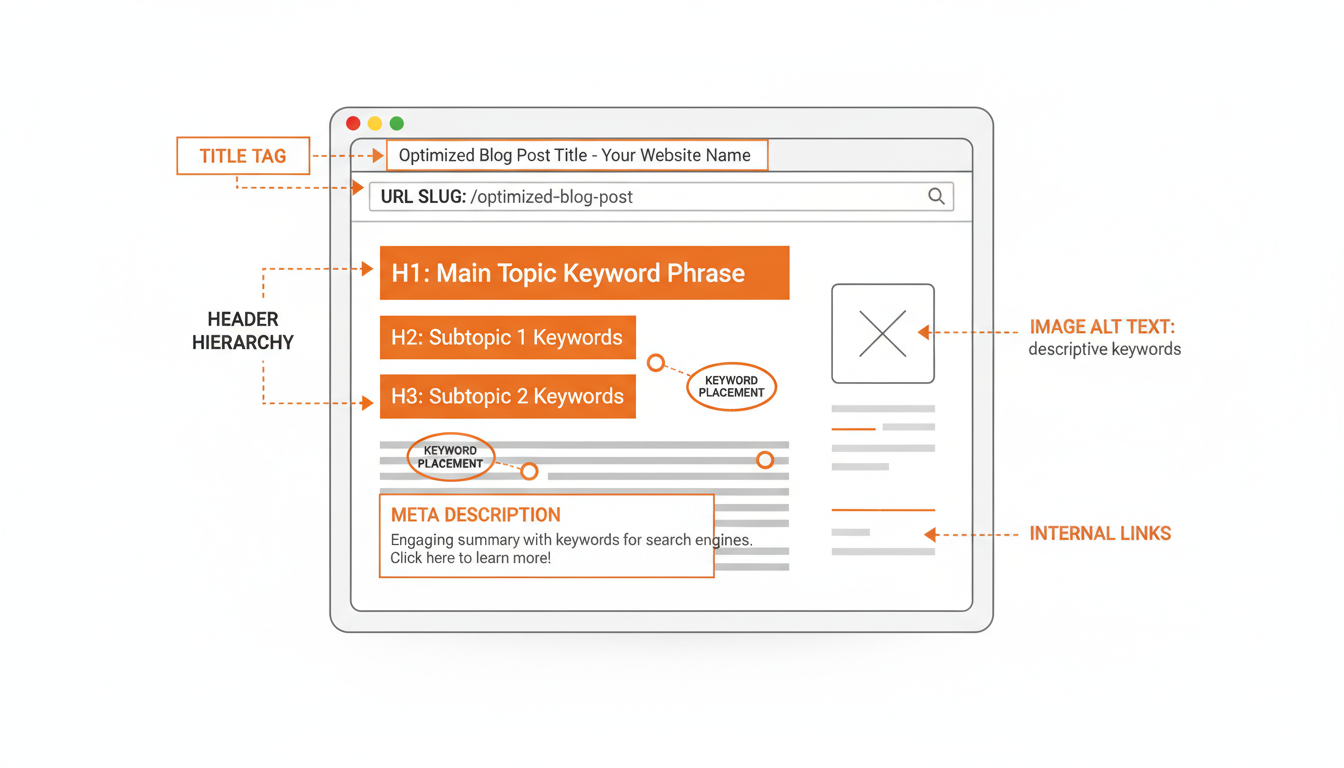
On-page SEO refers to the practice of optimising individual web pages to rank higher and earn more relevant traffic from search engines. It encompasses both the content visible to users and the HTML source code that search engines crawl. This includes elements such as title tags, meta descriptions, header tags, internal links, URL structure, image optimisation, and content quality.
The distinction between on-page and off-page SEO is straightforward. On-page factors are those you control directly on your website. Off-page factors - such as backlinks, social signals, and brand mentions - happen elsewhere on the internet. Technical SEO, which covers site speed, crawlability, and indexation, often overlaps with on-page SEO but is generally treated as its own discipline.
For UK businesses, on-page SEO carries additional considerations. You need to account for British spelling conventions, local search intent, UK-specific regulations around data privacy (such as GDPR compliance statements), and regional terminology that your target audience actually uses. A page optimised for an American audience won't necessarily resonate with someone searching from Birmingham or Edinburgh.
Title Tags: Your First Impression in Search Results
The title tag is arguably the single most important on-page SEO element. It appears as the clickable headline in search engine results pages (SERPs) and directly influences both rankings and click-through rates. Google has confirmed that title tags remain a ranking factor, and studies consistently show that well-crafted titles can increase organic click-through rates by 20% or more.
Best practices for title tags include:
- Keep them between 50 and 60 characters to avoid truncation in SERPs
- Place your primary keyword near the beginning of the title for maximum impact
- Ensure each page has a unique title tag - duplicate titles confuse search engines
- Include your location for local searches - "Professional Accounting Services in Manchester" outperforms generic alternatives
- Write for humans first - compelling titles earn clicks, which reinforce rankings
Avoid stuffing multiple keywords into your title tag. Google's algorithms have become sophisticated enough to penalise this practice, and it creates a poor user experience. Instead, focus on one primary keyword and craft a title that genuinely entices users to click.
How Much Do On-Page Factors Really Matter?
Search engine ranking algorithms consider hundreds of factors, but not all carry equal weight. On-page elements remain among the most influential signals, particularly for determining topical relevance. Here's how the key on-page factors stack up according to industry research and correlation studies:
Meta Descriptions That Drive Clicks
While meta descriptions are not a direct ranking factor, they play a crucial role in determining whether users click on your listing. Think of the meta description as your elevator pitch - you have approximately 155 to 160 characters to convince someone that your page has exactly what they're looking for.
Effective meta descriptions include a clear value proposition, a call to action, and naturally incorporate the target keyword. When the search query matches words in your meta description, Google bolds those terms, making your listing more visually prominent. For UK audiences, incorporating trust signals such as "Trusted by over 500 UK businesses" or "FCA regulated" can significantly improve click-through rates.
If you don't write a meta description, Google will automatically generate one by pulling text from your page. This auto-generated snippet is often less compelling and may not accurately represent your page's content, which is why crafting custom meta descriptions for every important page is well worth the effort.
Write your meta description as a mini advertisement. Include a specific benefit, a number or statistic if possible, and end with a subtle call to action. For example: "Discover how 350+ UK businesses increased organic traffic by an average of 147%. Get your free SEO audit today." This format consistently outperforms generic descriptions.
Header Tags and Content Structure
Header tags (H1 through H6) serve two critical purposes. First, they help search engines understand the hierarchical structure of your content and the relative importance of different topics on the page. Second, they make your content scannable for users, which is particularly important given that most people scan web pages rather than reading them word for word.
Every page should have exactly one H1 tag, which typically matches or closely relates to the title tag. Subheadings should use H2 tags for main sections and H3 tags for subsections within those. Avoid skipping heading levels - jumping from H2 to H4, for instance - as this can confuse both search engines and screen readers used by visitors with accessibility needs.
Incorporating keywords naturally into your header tags helps reinforce topical relevance. However, as with title tags, keyword stuffing in headers is counterproductive. Write headings that genuinely describe the content that follows, and the SEO benefits will follow naturally.
Content Quality and Optimisation
Content is the foundation of on-page SEO. Without high-quality, relevant content, no amount of technical optimisation will deliver sustainable results. Google's helpful content system, updated multiple times since its initial launch, explicitly rewards content created for people rather than search engines.
For UK businesses, content quality means addressing the specific needs, questions, and pain points of your British audience. This goes beyond simply using "colour" instead of "color." It means referencing UK regulations, using pounds sterling for pricing examples, citing statistics from UK sources such as the Office for National Statistics or Ofcom, and understanding the cultural nuances that resonate with British consumers.
Word count alone does not determine content quality, but comprehensive coverage of a topic tends to correlate with higher rankings. Research from multiple SEO studies indicates that the average first-page result on Google contains approximately 1,400 to 1,500 words. The key is to be thorough without padding - every sentence should add genuine value for the reader.
Keyword density, once a primary focus of SEO practitioners, has largely been replaced by the concept of topical relevance. Rather than obsessing over exact keyword percentages, focus on naturally covering the semantic field around your target topic. Use related terms, synonyms, and long-tail variations throughout your content. Tools like Google's "People Also Ask" feature and related searches at the bottom of SERPs provide excellent insight into the semantic landscape of any given topic.
The On-Page SEO Difference
The gap between a properly optimised website and one that neglects on-page SEO is often staggering. Here's what the difference looks like in practical terms for a typical UK business:
Without On-Page SEO
With Proper On-Page SEO
URL Structure and Internal Linking
Clean, descriptive URLs contribute to both user experience and search engine understanding of your pages. A well-structured URL gives users and search engines immediate context about the page's content before they even visit it.
Best practices for URL structure include using lowercase letters, separating words with hyphens rather than underscores, keeping URLs concise yet descriptive, and including your primary keyword. Avoid unnecessary parameters, session IDs, or overly complex directory structures. For example, yoursite.co.uk/services/seo-audit is far superior to yoursite.co.uk/services?id=47&cat=seo.
Internal links are the connective tissue of your website. They help search engines discover and index your pages, distribute link equity throughout your site, and guide users to related content. An effective internal linking strategy ensures important pages are accessible within three clicks from the homepage. Use descriptive anchor text that gives context about the linked page - "our comprehensive SEO audit service" is far more valuable than "click here."
Regularly audit your internal links to identify orphan pages (pages with no internal links pointing to them), broken links, and opportunities to link from high-authority pages to those you want to rank higher. Most UK businesses have dozens of internal linking opportunities they're not capitalising on, particularly between blog content and service pages.
Common On-Page SEO Issues on UK Websites
After auditing hundreds of UK business websites, certain on-page SEO issues appear with alarming frequency. Understanding these common pitfalls helps you prioritise your optimisation efforts and avoid the mistakes your competitors are making:
Image Optimisation and Accessibility
Images enhance user experience and can drive significant traffic through Google Image Search, yet image optimisation remains one of the most neglected areas of on-page SEO. Properly optimised images improve page load times, provide additional ranking signals, and enhance accessibility for all users.
Every image on your website should have a descriptive, keyword-relevant alt attribute. Alt text serves multiple purposes: it provides context to search engines about the image content, it appears when an image fails to load, and it's read aloud by screen readers for visually impaired users. Under UK accessibility regulations and the Equality Act 2010, providing meaningful alt text isn't just good SEO practice - it's a legal consideration for public sector organisations and an ethical obligation for all businesses.
File size has a direct impact on page speed. Compress images using modern formats like WebP, which typically reduces file sizes by 25% to 35% compared to JPEG without noticeable quality loss. Use responsive image techniques to serve appropriately sized images based on the user's device, and implement lazy loading so images below the fold don't slow down the initial page load.
Mobile Optimisation and Core Web Vitals
With over 60% of UK internet traffic now coming from mobile devices, and Google operating a mobile-first index, mobile optimisation is fundamental to on-page SEO success. Your website must deliver an excellent experience on smartphones and tablets, not just desktop computers.
Mobile optimisation encompasses responsive design, touch-friendly navigation, readable font sizes without zooming, properly spaced tap targets, and fast loading times on mobile networks. Google's Core Web Vitals - Largest Contentful Paint (LCP), Interaction to Next Paint (INP), and Cumulative Layout Shift (CLS) - are measured primarily from the mobile version of your site.
Key thresholds to aim for include:
- LCP under 2.5 seconds - measures how quickly the largest visible element loads
- INP under 200 milliseconds - measures responsiveness to user interactions
- CLS under 0.1 - measures visual stability as the page loads
Test your pages regularly using Google's PageSpeed Insights and address any mobile-specific issues. Common problems include text that's too small to read, clickable elements placed too close together, and content wider than the screen. Each of these issues can negatively impact both your rankings and your conversion rates.
Schema Markup and Structured Data
Schema markup is a form of structured data that helps search engines understand the context and meaning of your content. While not a direct ranking factor in the traditional sense, schema markup can earn you rich snippets in search results - enhanced listings that display additional information such as star ratings, prices, FAQs, and event details.
For UK businesses, particularly useful schema types include LocalBusiness (with your UK address and opening hours), Product (for e-commerce sites), FAQ (to capture featured snippets), and Review (to display star ratings). Implementing schema correctly can increase your click-through rate by up to 30%, according to industry research.
You can add schema markup using JSON-LD, which is Google's preferred format. Google's Structured Data Markup Helper and Rich Results Test tool make it straightforward to generate and validate your schema implementation. Many UK businesses overlook schema entirely, which means implementing it gives you a genuine competitive advantage in the SERPs.
Want Expert Help With Your On-Page SEO?
Our team has helped hundreds of UK businesses transform their on-page SEO and achieve page-one rankings. From comprehensive audits to full implementation, we handle every detail so you can focus on running your business.
TALK TO AN EXPERTThe Complete On-Page SEO Checklist
With so many elements to manage, it is helpful to have a structured checklist you can work through systematically for each page on your website. The following table consolidates the key on-page SEO factors discussed throughout this guide, along with their priority level and the tools you can use to audit each one. Print this out or save it as a reference document to use during your regular optimisation reviews.
| Element | Priority | Key Actions | Audit Tool |
|---|---|---|---|
| Title Tag | Critical | Unique, 50-60 chars, primary keyword near start | Screaming Frog / Search Console |
| Meta Description | High | Compelling copy, under 155 chars, includes CTA | Screaming Frog / Ahrefs |
| H1 Tag | Critical | Exactly one per page, matches page topic | Screaming Frog |
| Header Hierarchy | Medium | Logical H2-H3 structure, no skipped levels | Manual review / Screaming Frog |
| Content Quality | Critical | Comprehensive, original, user-focused | Surfer SEO / manual review |
| Internal Links | High | Descriptive anchors, no orphan pages | Screaming Frog / Ahrefs |
| Image Alt Text | Medium | Descriptive, keyword-relevant, accessible | Screaming Frog / Lighthouse |
| Image File Size | High | Compressed WebP format, lazy loaded | PageSpeed Insights |
| URL Structure | Medium | Short, descriptive, lowercase with hyphens | Manual review |
| Core Web Vitals | Critical | LCP < 2.5s, INP < 200ms, CLS < 0.1 | PageSpeed Insights / Search Console |
| Schema Markup | Medium | LocalBusiness, FAQ, Product as relevant | Rich Results Test |
| Mobile Usability | Critical | Responsive, readable, touch-friendly targets | Mobile-Friendly Test / manual |
Working through this checklist on a quarterly basis ensures that your on-page SEO remains sharp and competitive. As search engine algorithms evolve and your competitors refine their own strategies, regular reviews prevent the gradual erosion of your rankings. Many UK businesses find it useful to assign ownership of specific checklist items to different team members, turning SEO maintenance into a shared responsibility rather than a burden that falls solely on one individual.
Bringing It All Together
On-page SEO is not a one-time task but an ongoing process of refinement and improvement. The most successful UK businesses treat on-page optimisation as a continuous cycle: audit existing pages, implement improvements, monitor the results, and iterate based on performance data.
Start by auditing your most important pages - typically your homepage, key service pages, and highest-traffic blog content. Prioritise changes that will have the greatest impact: title tags, content quality, and page speed improvements typically deliver the fastest results. Then systematically work through the remaining elements outlined in this guide.
Remember that on-page SEO does not exist in isolation. It works in concert with technical SEO, content marketing, and off-page strategies to build your website's authority and visibility. But without a solid on-page foundation, those other efforts will never reach their full potential. Get the fundamentals right, and you'll be well-positioned to compete - and win - in the UK's digital marketplace.

CloudSwitched
London-based managed IT services provider offering support, cloud solutions and cybersecurity for SMEs.


