For years, UK businesses looking to provide a mobile experience to their customers or employees have faced an uncomfortable choice: invest tens of thousands of pounds in native mobile app development (separate codebases for iOS and Android, ongoing maintenance, app store approval processes), settle for a basic mobile website that lacks the features and performance of a native app, or use a cross-platform framework that promises the best of both worlds but often delivers the worst.
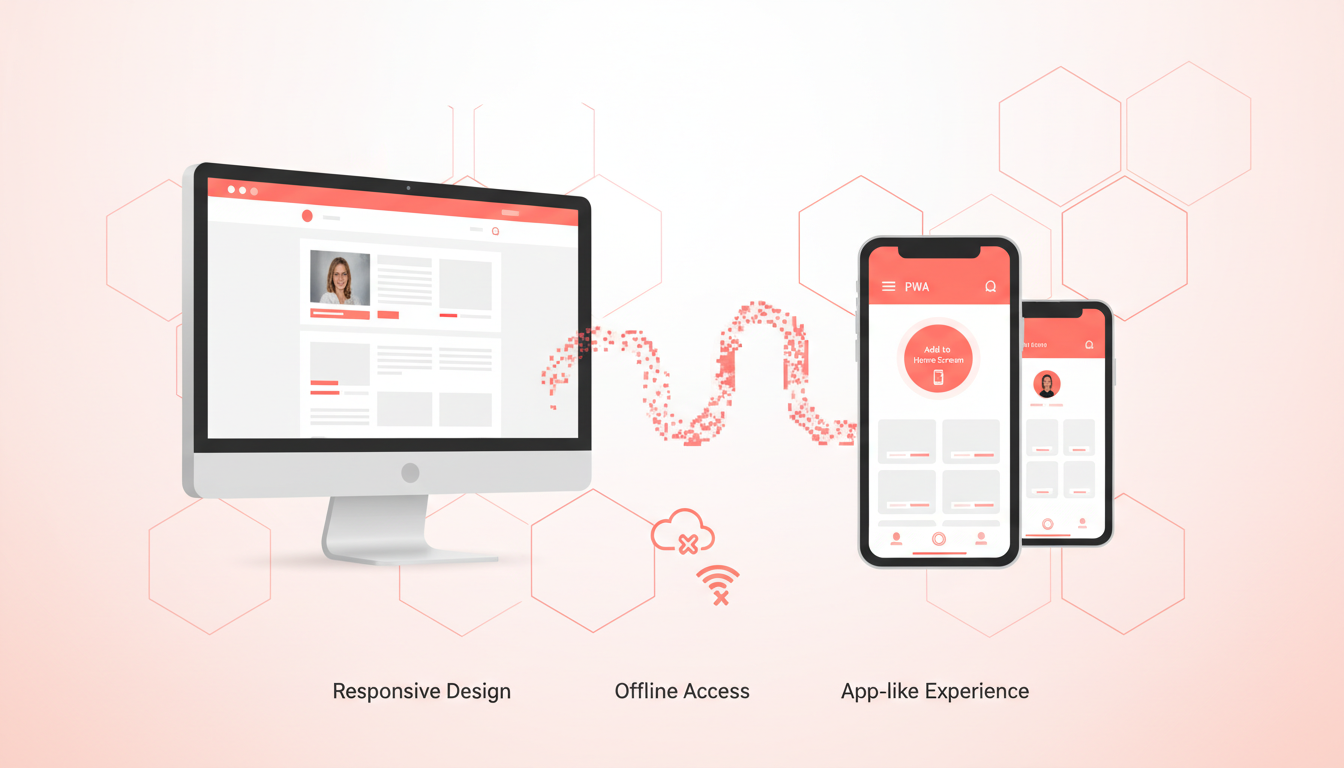
Progressive Web Apps (PWAs) represent a genuinely different approach - one that eliminates many of the trade-offs that have frustrated UK business owners and developers alike. A PWA is a web application built with modern web technologies that provides an app-like experience directly through the browser. It can be installed on a user's home screen, work offline, send push notifications, and access device features - all without going through an app store and without maintaining separate codebases for different platforms.
For small and medium-sized UK businesses in particular, PWAs offer a compelling combination of lower development costs, faster time-to-market, easier maintenance, and broader reach compared to traditional native app development. This guide explains what PWAs are, how they work, and how to determine whether a PWA is the right choice for your business.
The mobile landscape in the United Kingdom has matured considerably over the past decade. According to Ofcom, over 92 per cent of UK adults now own a smartphone, and mobile internet usage has overtaken desktop browsing for many categories of online activity. Yet the average smartphone user downloads fewer than two new apps per month, and the vast majority of time spent in apps is concentrated in just a handful of applications - typically social media, messaging, and banking. This presents a significant challenge for businesses hoping to reach customers through a native app: the barrier to downloading and installing yet another application is substantial, and many users simply will not do it for a business they interact with only occasionally.
PWAs address this challenge directly. Because they are accessed through the browser and can be installed with a single tap - no app store visit, no download progress bar, no storage warnings - they dramatically reduce the friction between a user discovering your business and engaging with your mobile experience. For UK high street retailers, hospitality businesses, professional service firms, and tradespeople alike, this lower barrier to entry can translate into meaningfully higher engagement rates compared to a native app that most potential users would never bother to install.
What Makes a Web App "Progressive"?
The term "progressive" refers to the idea that these apps work for every user regardless of browser choice or device capability, progressively enhancing the experience for users with more capable browsers and devices. A PWA is fundamentally a website - built with HTML, CSS, and JavaScript - but enhanced with specific technologies that give it app-like capabilities.
Three core technologies distinguish a PWA from a standard website. First, a Service Worker - a JavaScript file that runs in the background, separate from the web page, enabling features like offline functionality, background sync, and push notifications. The service worker intercepts network requests and can serve cached content when the network is unavailable, ensuring the app remains functional even without an internet connection. Second, a Web App Manifest - a JSON file that tells the browser how the app should behave when installed on the user's device, including its name, icons, theme colours, and display mode. Third, HTTPS - PWAs must be served over secure connections, ensuring data integrity and user trust.
When these three elements are properly implemented, browsers recognise the site as installable and offer users the option to add it to their home screen. Once installed, the PWA launches in its own window (without browser chrome), appears in the device's app switcher, and behaves indistinguishably from a native app in everyday use.
Service Workers: The Engine Behind PWA Capabilities
The service worker is arguably the most important component of a PWA, and understanding what it does helps explain why PWAs can deliver such a compelling user experience. A service worker is a script that the browser runs in the background, completely separate from the web page itself. It acts as a programmable network proxy - sitting between your application and the network, intercepting every outgoing request and deciding how to handle it. This gives developers extraordinary control over the application's behaviour in different network conditions.
The most common caching strategy for UK business PWAs is known as stale-while-revalidate. When a user requests a page or resource, the service worker immediately returns a cached version (ensuring instant perceived performance) whilst simultaneously fetching a fresh copy from the network in the background. The next time the user requests that resource, they receive the updated version. This approach is particularly effective for UK businesses with content that changes regularly but where a few seconds of staleness is acceptable - product catalogues, news feeds, menu listings, and similar content.
For scenarios requiring absolute data freshness - such as stock levels, booking availability, or pricing - the service worker can be configured to always fetch from the network first, falling back to cached content only when the network is unavailable. This network-first strategy ensures users see current data when connected whilst still providing a useful offline experience. The flexibility of service worker caching strategies means that different parts of your PWA can use different approaches, optimised for the specific requirements of each feature.
Some of the world's largest companies have adopted PWAs with remarkable results. Twitter Lite (a PWA) reduced data consumption by 70% and increased tweets sent by 75%. Starbucks' PWA is 99.84% smaller than its iOS app while delivering near-identical functionality. Lancôme saw a 17% increase in conversions after launching a PWA. Closer to home, several UK retailers and service businesses have adopted PWAs to reach customers who are reluctant to install native apps, particularly for services they use infrequently.
PWAs vs Native Apps: An Honest Comparison
The decision between a PWA and a native app should be based on your specific business requirements, not on technological fashion. Both approaches have genuine strengths and limitations, and the right choice depends on what you are trying to achieve.
For many UK businesses, the decision is not purely technical - it is fundamentally a business question about where to allocate limited resources. A native app requires specialist developers (often separate iOS and Android teams), ongoing app store management, compliance with platform-specific guidelines that change frequently, and a marketing effort to drive downloads. A PWA requires skilled web developers, standard web hosting, and benefits from your existing web marketing efforts since it is discoverable through search engines. The total cost of reaching and retaining each active user is typically far lower with a PWA, particularly for businesses whose app would be used intermittently rather than daily.
It is also worth noting that PWAs and native apps are not mutually exclusive. Some businesses adopt a hybrid strategy - launching a PWA first to validate demand and establish user journeys, then investing in a native app for the features that genuinely require native platform access. This approach reduces risk and ensures that any native app investment is informed by real user behaviour data rather than assumptions. Several UK retailers have followed this path, launching a PWA to serve the majority of their mobile users whilst maintaining a native app for power users who benefit from features like barcode scanning or augmented reality product visualisation.
PWA Advantages
- Single codebase for all platforms
- No app store approval or fees
- Instant updates without user action
- Discoverable through search engines (SEO)
- Shareable via URL - no download required
- Lower development and maintenance costs
- Works offline with cached content
- Smaller storage footprint on devices
Native App Advantages
- Full access to all device hardware features
- Better performance for graphics-intensive apps
- App store presence and discoverability
- More mature push notification support on iOS
- Background processing capabilities
- Bluetooth and NFC access
- More polished platform-specific UI patterns
- Established user expectation of app store download
When a PWA Is the Right Choice
PWAs are an excellent fit when your primary goal is content delivery and user engagement - e-commerce catalogues, news and media sites, booking and reservation systems, loyalty programmes, internal business tools, and service portals. They are also ideal when you need to reach the widest possible audience with minimal friction - a PWA requires no download, no app store account, and no device storage commitment, making it far more likely that users will engage with it.
For UK businesses specifically, PWAs are often the pragmatic choice when the budget does not stretch to separate iOS and Android development (which can easily exceed £40,000 to £80,000 for even a moderately complex app), when time-to-market is critical, when the app needs to be discoverable through Google search, or when the target audience is unlikely to install a dedicated native app for the service being offered.
Internal Business Tools
One of the most overlooked use cases for PWAs is internal business tools. Many UK businesses need mobile access to systems like inventory management, job tracking, time sheets, CRM data, or field service reports. Building a native app for an internal tool is rarely cost-effective, but a PWA can provide offline-capable mobile access to these systems at a fraction of the cost. Staff can install the PWA on their work phones, access it offline when in areas with poor connectivity (warehouses, construction sites, rural locations), and sync data when they reconnect.
E-Commerce and Retail Applications
UK e-commerce businesses stand to benefit enormously from PWA technology. Online retail in the United Kingdom generates over £100 billion annually, and mobile commerce accounts for a growing share of that total. A PWA allows retailers to offer an app-like shopping experience - complete with smooth animations, offline product browsing, and push notification alerts for sales and restocked items - without the friction of requiring customers to install a native app. For smaller retailers competing against major platforms, a well-built PWA can level the playing field by providing a premium mobile experience at a fraction of the cost.
Consider a typical independent fashion retailer based in Manchester. Building separate iOS and Android apps would cost upwards of £60,000 and require months of development time. A PWA delivering the same core functionality - product browsing, wish lists, size guides, checkout, and order tracking - can be built for a third of that cost, launched in weeks rather than months, and updated instantly without waiting for app store approval. The retailer's existing SEO efforts drive traffic directly to the PWA, and customers can install it on their home screens during their first visit.
Customer Portals and Loyalty Programmes
Loyalty programmes and customer portals are another natural fit for PWAs. UK consumers are increasingly accustomed to digital loyalty cards and reward programmes, but many are reluctant to install a dedicated app for every shop or restaurant they visit. A PWA-based loyalty programme can be accessed instantly through the browser, added to the home screen with one tap, and used offline to display loyalty cards and accumulated points. For hospitality businesses, this means customers can check their rewards balance, browse menus, and make reservations without the commitment of a full app installation.
Field service and logistics companies across the United Kingdom are also adopting PWAs for their mobile workforce. Engineers, delivery drivers, and maintenance teams need access to job schedules, customer information, and reporting tools whilst on the move - often in areas with unreliable connectivity. A PWA with robust offline support allows field workers to view their schedule, complete job reports, capture photographs, and collect customer signatures even without a network connection. All data synchronises automatically when connectivity is restored, ensuring nothing is lost and back-office systems stay up to date.
Technical Considerations for UK Businesses
Building a PWA requires competent web development skills, but the barrier to entry is significantly lower than native app development. The technology stack is standard web technology - HTML, CSS, JavaScript - enhanced with service worker APIs, the Cache API, and the Web App Manifest specification. Modern JavaScript frameworks like React, Vue, Angular, and Svelte all provide excellent PWA support through plugins and built-in tooling.
Performance is critical for PWA success. Google's Core Web Vitals - Largest Contentful Paint (LCP), First Input Delay (FID), and Cumulative Layout Shift (CLS) - apply directly to PWAs and influence both user experience and search engine ranking. For UK businesses, this means that your PWA must load quickly even on mid-range mobile devices and 4G connections, which are still common outside major urban areas. Aggressive asset optimisation, intelligent caching strategies, and lazy loading of non-critical resources are essential.
Hosting a PWA in the UK on infrastructure like Cloudflare Workers, Azure Static Web Apps, or AWS CloudFront with edge locations in London provides the best possible performance for UK users. The deployment and update process is dramatically simpler than native apps - you deploy to your web server, and all users receive the update automatically the next time they visit, with the service worker handling the transition seamlessly.
Offline-First Architecture
For many UK businesses, offline capability is not merely a nice-to-have feature - it is essential for practical operations. The United Kingdom's mobile network coverage, whilst generally good in urban areas, remains inconsistent in rural locations, underground environments, large buildings with poor signal penetration, and during peak usage periods. A PWA built with an offline-first architecture ensures that your application remains functional regardless of network conditions, which is particularly valuable for businesses with field operations, events-based activities, or customers in areas with variable connectivity.
Implementing offline-first architecture requires careful planning of your data synchronisation strategy. The IndexedDB API, available in all modern browsers, provides a robust client-side database capable of storing significant amounts of structured data on the user's device. Combined with the Background Sync API (which queues failed network requests and retries them when connectivity is restored), a PWA can provide a seamless experience where users are barely aware of network interruptions. For UK businesses operating in sectors like construction, agriculture, healthcare, and field services, this capability alone can justify the investment in a PWA.
Testing and Quality Assurance
Testing a PWA requires a slightly different approach compared to a standard website. In addition to the usual functional testing, cross-browser testing, and responsive design verification, you need to test offline behaviour, service worker caching, installation flows, and push notification delivery across different devices and operating systems. Google's Lighthouse tool provides an automated PWA audit that checks for compliance with PWA best practices and scores your application against key performance and accessibility metrics.
For UK businesses, it is particularly important to test on the devices and network conditions that your actual users will encounter. This means testing on mid-range Android handsets (which represent a significant portion of the UK smartphone market), on slower 3G and 4G connections, and in genuine offline scenarios. Testing only on high-end devices with fast Wi-Fi connections will give a misleadingly positive impression of your PWA's real-world performance. Invest in a small range of representative test devices and use browser developer tools with network throttling to simulate slower connections during development.
| Feature | PWA Support | Notes for UK Businesses |
|---|---|---|
| Offline Access | Full support | Essential for field workers in rural UK areas |
| Push Notifications | Android: full; iOS: since iOS 16.4 | Customer engagement for retail and hospitality |
| Home Screen Installation | Full support | App-like presence without app store listing |
| Camera Access | Full support | Useful for document scanning, photo capture |
| Geolocation | Full support | Field service routing and location tracking |
| Background Sync | Chrome/Edge; limited on iOS | Data submission when connectivity is restored |
| Bluetooth / NFC | Limited / experimental | Still a native app advantage for IoT and payments |
Cost Comparison for UK Businesses
The cost advantage of PWAs over native apps is substantial and worth quantifying for UK business planning purposes. A moderately complex native app - an e-commerce storefront, booking system, or customer portal - typically costs £30,000 to £80,000 to develop for a single platform (iOS or Android) through a UK development agency. Supporting both platforms doubles the initial development cost, and ongoing maintenance, updates, and app store compliance add £10,000 to £20,000 per year per platform.
An equivalent PWA typically costs £15,000 to £40,000 for initial development, supports all platforms from a single codebase, and requires £5,000 to £10,000 per year for maintenance and updates. Over a three-year period, the total cost of ownership for a PWA is typically 50 to 70 per cent lower than a dual-platform native app strategy.
Hidden Costs of Native App Development
When comparing costs, it is important to account for expenses that are often overlooked in initial native app estimates. Apple charges an annual developer programme fee of £79, and Google charges a one-time registration fee of £20 - modest amounts, but the real costs lie elsewhere. App store compliance requirements change regularly, and adapting your app to meet new guidelines can require unexpected development work. Apple's review process can delay critical updates by days or even weeks, which is particularly problematic when you need to deploy urgent bug fixes or respond to time-sensitive business requirements.
There is also the cost of app store optimisation (ASO) - the process of optimising your app's listing to improve its visibility in search results within the App Store and Google Play. ASO requires ongoing effort and sometimes paid promotion to achieve meaningful visibility, especially in competitive categories. A PWA, by contrast, benefits from standard search engine optimisation (SEO) techniques that most UK businesses are already investing in. Your PWA appears in Google search results alongside your regular website content, meaning you do not need to build a separate discovery channel from scratch.
Return on Investment Timeline
For a typical UK small or medium-sized business, a PWA begins delivering return on investment significantly faster than a native app. The shorter development timeline means you start acquiring users sooner, the lower maintenance burden means your ongoing costs remain manageable, and the absence of app store friction means a higher percentage of visitors convert into active users. Based on our experience working with UK businesses, a well-executed PWA typically achieves positive ROI within three to six months, compared to twelve to eighteen months for a comparable native app strategy.
It is also worth considering the opportunity cost of the longer native app development cycle. The months spent building, testing, and gaining app store approval for a native app are months during which your business has no mobile application at all. A PWA can be launched incrementally - starting with core functionality and adding features over time - meaning your business benefits from a mobile presence much sooner. In competitive UK markets where customer expectations for mobile experiences are continually rising, this time advantage can be commercially significant.
Getting Started With a PWA
If a PWA seems like the right approach for your business, the implementation path is straightforward. Start by defining the core functionality and user journeys that your PWA needs to support. Prioritise features that deliver the most business value and can be implemented within your budget. A PWA can always be enhanced incrementally - start with a focused minimum viable product and expand based on user feedback and business results.
Choose a development partner with genuine PWA experience - not just web development experience, but specific expertise in service workers, caching strategies, offline-first architecture, and progressive enhancement. Ask to see examples of PWAs they have built and test them on your own devices. A well-built PWA should be fast, smooth, and virtually indistinguishable from a native app in everyday use.
Key Questions to Ask Before Committing
Before committing to a PWA project, there are several important questions that UK businesses should consider. First, what are the core user journeys that your application needs to support? A PWA excels at content-driven experiences, transactional workflows, and information retrieval - if your primary use cases fall into these categories, a PWA is likely an excellent fit. If your application requires heavy use of device hardware features like Bluetooth, NFC, or advanced camera capabilities, a native app may still be necessary for those specific functions.
Second, who are your users and what devices do they use? If your target audience primarily uses Android devices - which represent approximately 50 per cent of the UK smartphone market - PWA support is comprehensive and mature. iOS support for PWAs has improved dramatically since Apple added support for push notifications and home screen installation in iOS 16.4, but some advanced features like Background Sync remain limited on Safari. Understanding your audience's device mix helps you make informed decisions about which PWA features to prioritise.
Phased Implementation Approach
We strongly recommend a phased approach to PWA implementation. Phase one focuses on establishing a solid foundation: a fast, responsive web application with a valid Web App Manifest, a service worker providing basic caching, and HTTPS throughout. This phase delivers immediate performance improvements and enables home screen installation. Phase two adds progressive enhancements: offline support for key user journeys, push notifications for re-engagement, and background sync for form submissions and data uploads. Phase three optimises and expands: advanced caching strategies, performance tuning based on real-world usage data, and additional features informed by user feedback.
This phased approach allows UK businesses to spread development costs over time, validate assumptions at each stage, and adjust priorities based on real user behaviour. It also means that your PWA is live and delivering value from the end of phase one, rather than waiting until every feature is complete before launching. For businesses operating in fast-moving UK markets - retail, hospitality, professional services - this iterative approach reduces risk and accelerates time to value.
Considering a Progressive Web App?
Cloudswitched builds high-performance Progressive Web Apps for UK businesses. From customer-facing e-commerce and booking platforms to internal business tools and field service applications, we deliver app-like experiences at a fraction of native app costs. Contact us to discuss your requirements and explore whether a PWA is the right approach for your project.
GET IN TOUCH
CloudSwitched
London-based managed IT services provider offering support, cloud solutions and cybersecurity for SMEs.


