Ransomware has evolved from an occasional nuisance into the single most devastating cyber threat facing British businesses. In 2025 alone, the National Cyber Security Centre (NCSC) recorded a 52 per cent year-on-year increase in ransomware incidents affecting UK organisations, with the average ransom demand exceeding £1.2 million and average total recovery costs - including downtime, lost revenue, regulatory penalties, and reputational damage - reaching £3.8 million per incident. For small and medium-sized enterprises, the impact is often existential: research from the UK Cyber Security Breaches Survey shows that 60 per cent of small businesses that suffer a ransomware attack without adequate ransomware recovery services in place cease trading within six months.
Yet the most alarming development in the ransomware landscape is not the attacks themselves - it is the systematic targeting of backup infrastructure. Modern ransomware operators conduct extensive reconnaissance before deploying their payload, specifically seeking out backup repositories, shadow copies, cloud-connected backup agents, and disaster recovery configurations. They delete or encrypt these resources first, then encrypt production systems, leaving their victims with no recovery option other than paying the ransom. This evolution has fundamentally changed what effective business continuity protection looks like. Traditional backup strategies - even those following the well-established 3-2-1 rule - are no longer sufficient against sophisticated, backup-aware ransomware campaigns.
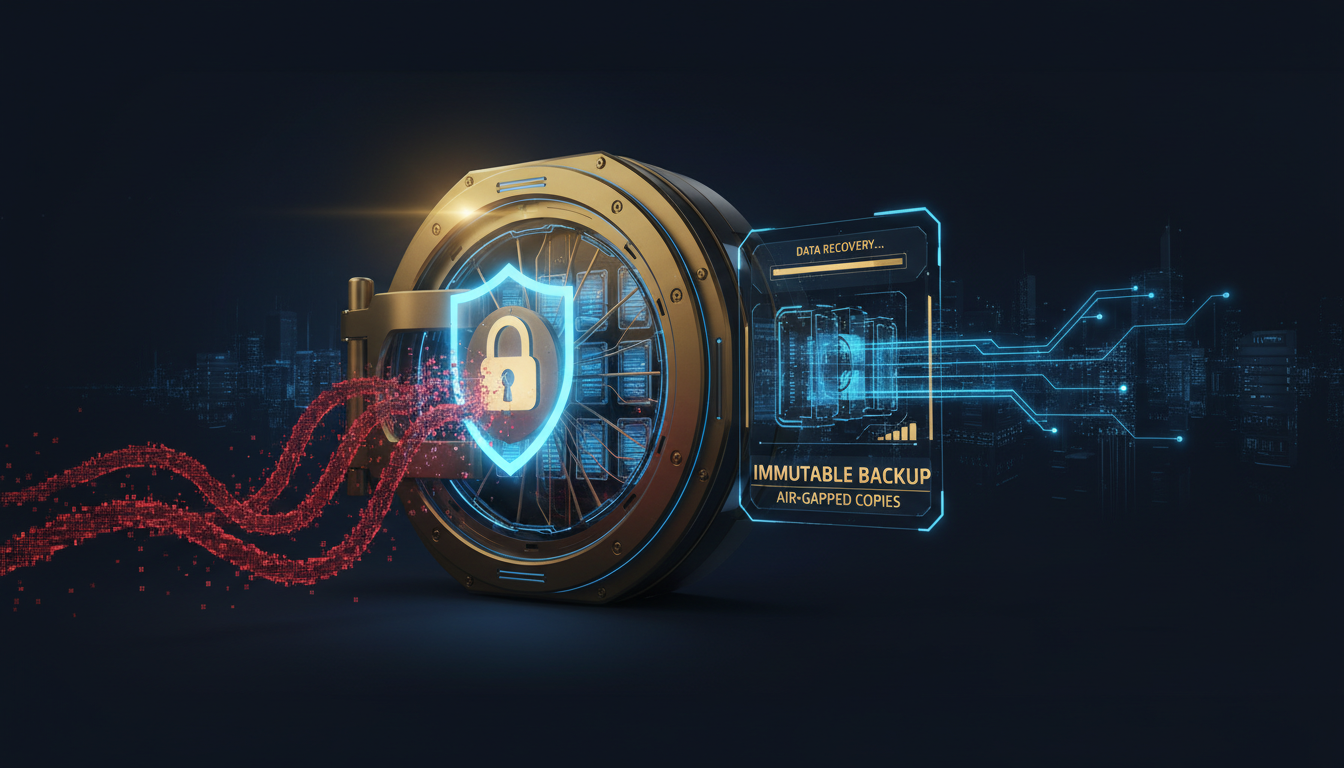
The answer lies in immutable backup solutions and air gapped backup solutions - technologies and architectures specifically designed to ensure that at least one copy of your data cannot be modified, encrypted, or deleted by any actor, including ransomware that has compromised your entire network with administrative privileges. Combined with robust incident response planning, tested ransomware recovery services, and comprehensive business continuity strategies, these technologies provide the foundation for genuine ransomware resilience - the ability not just to survive an attack, but to recover quickly, completely, and with minimal business impact.
This guide covers everything a UK business needs to know about ransomware recovery and immutable backups - from understanding the modern threat landscape and attack vectors, through the technical architecture of immutable and air-gapped storage, WORM compliance, incident response procedures, data recovery services UK options, and end-to-end business continuity planning. Whether you are a twenty-person professional services firm in Birmingham, a multi-site logistics company across the North West, or a regulated financial services business in the City of London, the strategies and technologies described here will help you build a defence posture that protects your organisation against the most destructive cyber threat of our era.
The Modern Ransomware Threat Landscape
To defend against ransomware effectively, UK businesses must first understand how modern attacks operate. The ransomware threat has evolved dramatically from the early days of mass-distributed malware that encrypted files and demanded a few hundred pounds in Bitcoin. Today's ransomware operations are sophisticated, well-funded criminal enterprises that employ tactics, techniques, and procedures (TTPs) rivalling those of state-sponsored threat actors.
How Modern Ransomware Attacks Unfold
A typical ransomware attack against a UK business follows a multi-stage process that can span days, weeks, or even months from initial compromise to payload deployment. Understanding each stage is critical for building effective defences and ransomware recovery services capabilities.
Initial access is most commonly gained through phishing emails targeting employees, exploitation of unpatched vulnerabilities in internet-facing systems (VPN appliances, remote desktop gateways, web applications), or compromise of valid credentials obtained from previous data breaches or purchased on dark web marketplaces. The NCSC has identified that exploitation of known vulnerabilities - particularly in VPN and remote access solutions - accounted for 38 per cent of initial access in UK ransomware incidents during 2025, whilst phishing and social engineering accounted for 31 per cent.
Lateral movement and privilege escalation follow initial access. Attackers use tools like Cobalt Strike, Mimikatz, BloodHound, and legitimate system administration utilities (PowerShell, PsExec, WMI) to move through the network, harvest credentials, and escalate their privileges to domain administrator level. During this phase, which can last from days to weeks, the attackers are mapping the network architecture, identifying critical systems, and - crucially - locating and assessing backup infrastructure.
Backup neutralisation is the stage that makes modern ransomware so devastating. Attackers specifically target Volume Shadow Copies (vssadmin delete shadows), backup agent services, backup repositories on network-attached storage, cloud-connected backup credentials, and backup management consoles. They may quietly disable backup jobs days before deploying ransomware, so that by the time the payload executes, even the most recent backups are stale and incomplete. Some advanced ransomware groups have been observed modifying backup retention policies to expire existing backups faster, or injecting corrupted data into backup streams to render them unrestorable.
Data exfiltration has become standard practice in what is now termed "double extortion" ransomware. Before encrypting data, attackers copy sensitive files, customer data, intellectual property, and confidential business information to external servers. This gives them additional leverage: even if you can restore from backups, they threaten to publish or sell the stolen data unless the ransom is paid. Some groups have escalated to "triple extortion," adding DDoS attacks against the victim's infrastructure or directly contacting the victim's customers and partners to increase pressure.
Payload deployment is the final stage. Ransomware is deployed across all accessible systems simultaneously - typically during evenings, weekends, or bank holidays when IT staff are least likely to be monitoring. The encryption process can complete within minutes on modern hardware, rendering entire environments unusable before anyone can respond.
Phase 1: Initial Access (Day 0)
Attackers gain entry through phishing, unpatched vulnerabilities, or compromised credentials. A single user clicking a malicious link or a single unpatched VPN appliance is sufficient for a full network compromise to begin.
Phase 2: Reconnaissance and Lateral Movement (Days 1-14)
Using living-off-the-land tools and stolen credentials, attackers map the network, escalate privileges to domain admin, and identify all critical systems including backup infrastructure, domain controllers, and file servers.
Phase 3: Backup Neutralisation (Days 7-21)
Shadow copies are deleted, backup agent services disabled, retention policies modified, and cloud backup credentials compromised. This is the stage that immutable and air-gapped backups are specifically designed to survive.
Phase 4: Data Exfiltration (Days 14-28)
Sensitive data is copied to attacker-controlled infrastructure for double-extortion leverage. Customer records, financial data, intellectual property, and confidential correspondence are common targets.
Phase 5: Encryption and Ransom Demand (Day 28+)
Ransomware payload deploys across all accessible systems simultaneously, typically outside business hours. Ransom notes appear on every encrypted machine demanding payment in cryptocurrency.
Common Attack Vectors Targeting UK Businesses
Understanding the specific attack vectors that ransomware groups use against British organisations helps prioritise defensive measures. The following represent the most prevalent entry points observed in UK ransomware incidents during 2024 and 2025.
Primary initial access vectors in UK ransomware incidents, 2024-2025 (NCSC and industry survey data)
The Financial Impact on UK Businesses
The true cost of a ransomware attack extends far beyond the ransom demand itself. For UK businesses, the financial impact includes direct costs (ransom payment, if made; incident response and forensics; system rebuilding and data restoration), indirect costs (business downtime, lost revenue, overtime for staff, temporary infrastructure), and long-term costs (regulatory penalties under GDPR and sector-specific regulations, litigation from affected data subjects, increased cyber insurance premiums, and reputational damage that reduces future revenue). The average total cost of a ransomware incident for a UK mid-market business in 2025 is estimated at £3.8 million - a figure that has doubled since 2022. For businesses in regulated sectors (financial services, healthcare, legal), regulatory penalties can add hundreds of thousands of pounds to the total, particularly where inadequate backup and recovery provisions are identified as a contributing factor.
The NCSC strongly advises against paying ransoms. Payment provides no guarantee of data recovery - analysis shows that only 65 per cent of organisations that paid a ransom recovered all their data, with many receiving corrupted or incomplete decryption tools. Payment also funds further criminal activity, marks your organisation as a willing payer (increasing the likelihood of repeat attacks), and may breach financial sanctions regulations if the ransomware group is linked to sanctioned entities. Investing in immutable backup solutions and tested ransomware recovery services is both cheaper and more reliable than paying ransoms.
Understanding Immutable Backups
Immutable backups are the single most important technology for ransomware resilience. The concept is straightforward: once backup data is written, it cannot be modified, encrypted, overwritten, or deleted by anyone - including administrators with the highest level of access - until a predefined retention period expires. This means that even if an attacker gains full domain administrator access and compromises your entire backup infrastructure, the immutable backup data remains intact and available for recovery.
What Makes a Backup Truly Immutable
True immutability is not simply a matter of setting files to read-only or applying restrictive permissions. These measures can be bypassed by an attacker with administrative access. Genuine immutable backup solutions enforce immutability at the storage layer using one or more of the following mechanisms.
Object Lock (WORM - Write Once Read Many) is the gold standard for cloud-based immutable storage. Services like AWS S3 Object Lock, Azure Immutable Blob Storage, and equivalent offerings from UK cloud providers allow backup data to be written with a retention period that is enforced by the cloud platform itself. Once an Object Lock retention period is set, the data cannot be deleted or overwritten - not by the account owner, not by the cloud provider's support staff, and not by an attacker who has compromised the account credentials. The retention period is mathematically enforced at the storage infrastructure level, making it impervious to application-level or account-level compromise.
Compliance mode vs. Governance mode represents an important distinction in Object Lock implementations. Governance mode prevents most users from modifying or deleting locked objects, but allows users with specific elevated permissions (typically requiring a separate, highly protected set of credentials) to override the lock if absolutely necessary. Compliance mode is stricter: once set, the retention period cannot be shortened or the object deleted by anyone, including the root account owner. For ransomware protection, Compliance mode is strongly recommended - Governance mode introduces a potential bypass path that a sophisticated attacker could exploit if they compromise the governance override credentials.
Immutable storage appliances are purpose-built hardware or hardened virtual appliances that enforce immutability at the appliance level. These systems accept backup data over standard protocols (NFS, SMB, S3-compatible API) but store it internally in an immutable format that cannot be modified from outside the appliance. Leading vendors in this space include ExaGrid (with their tiered backup architecture and retention time-lock), Cohesity (with DataLock), and various Linux-based hardened repository solutions used by Veeam and similar backup platforms. These appliances can be deployed on-premises, providing immutable storage without dependence on cloud infrastructure.
Blockchain-verified integrity is an emerging approach where cryptographic hashes of backup data are recorded on a distributed ledger, providing tamper-evident verification that backup data has not been modified since it was written. Whilst not a replacement for Object Lock or appliance-based immutability, blockchain verification provides an additional layer of assurance that is particularly valuable in regulated environments where demonstrable data integrity is a compliance requirement.
Immutable Backup (Object Lock / WORM)
Traditional Backup (Read-Only / Permissions)
Implementing Immutable Backups for UK Businesses
Implementing immutable backup solutions requires careful planning to balance security, cost, and operational flexibility. The following considerations are particularly relevant for UK organisations.
Retention period selection is a critical decision. Too short and your immutable backups may have expired before you discover and respond to a ransomware attack (remember, attackers often lurk in networks for weeks before deploying their payload). Too long and storage costs escalate significantly, particularly for organisations with large data estates. Most UK businesses find that 30-90 day immutable retention provides an effective balance - long enough to ensure that clean backups are available even after extended attacker dwell times, short enough to manage storage costs. Regulated businesses may need longer retention periods to satisfy sector-specific compliance requirements (for example, FCA-regulated firms typically require 7-year retention for certain record types).
Separate credential management is essential. The credentials used to access and manage your immutable backup infrastructure must be completely separate from your production Active Directory or identity provider. If an attacker compromises your domain admin credentials, they should not automatically gain access to your backup management console. Use dedicated, non-domain-joined service accounts with long, complex passwords stored in an offline or hardware-secured vault. Enable multi-factor authentication on all backup management interfaces, using a separate MFA provider if possible (so that compromise of your primary MFA system does not grant access to backups).
Tiered immutability allows organisations to apply different retention periods and immutability levels based on data criticality. Your most critical systems (domain controllers, financial databases, customer data repositories) might warrant 90-day immutable retention with Compliance mode Object Lock. Standard file servers and email might use 30-day immutable retention. Development and test environments might use 14-day retention. This tiered approach optimises cost without leaving any system without ransomware-resilient backup protection.
Air-Gapped Backup Solutions: The Physical Isolation Advantage
Whilst immutable storage protects backup data from modification or deletion through logical controls (software-enforced retention locks), air gapped backup solutions take a fundamentally different approach: physical isolation. An air-gapped backup is one that is completely disconnected from any network - wired, wireless, or internet - when not actively receiving backup data. Because the backup repository has no network connection, there is no pathway for ransomware (or any other network-borne threat) to reach it, regardless of how thoroughly the attacker has compromised the production network.
Types of Air-Gapped Backup Architecture
There are several approaches to implementing air gapped backup solutions, each with different trade-offs between security, automation, and operational complexity.
Physical tape rotation is the original air-gapped backup methodology and remains relevant today. Backup data is written to tape media (typically LTO-9 cartridges, each holding up to 18 TB of native capacity or 45 TB compressed), and the tapes are physically removed from the tape library and stored in a secure off-site location - a fire-rated media safe, a dedicated tape vaulting facility, or a bank safe deposit box. Once removed from the library, the tape is completely air-gapped: no network attack can reach data on a tape sitting in a vault fifty miles away. The trade-off is operational complexity (tapes must be physically transported and managed) and recovery time (tapes must be retrieved, loaded, and restored before data is available, which can add hours or days to your RTO).
Rotating disk arrays provide a more modern approach to air-gapping. Two or more disk-based backup repositories are used in rotation: one is connected to the network and receiving backup data, whilst the other(s) are physically disconnected (powered off or network cables removed). At defined intervals (daily, weekly), the repositories are swapped - the currently connected one is disconnected, and a previously disconnected one is brought online to receive the next batch of backups. This provides the ransomware resilience of air-gapping with faster recovery than tape, but requires manual or semi-automated swap procedures and careful scheduling to ensure that the disconnected repository always contains a recent, complete backup.
Virtual air-gapping (network isolation) is a compromise approach that provides many of the benefits of true air-gapping without the operational complexity of physical disconnection. In this model, the backup repository exists on an isolated network segment with no route to the production network. Backup data is pushed to the repository through a tightly controlled, one-way data path (often implemented via firewall rules that allow outbound backup traffic from the production network to the repository but block all inbound traffic from the repository to production, and block all internet access from the repository segment). Whilst not truly air-gapped (the repository has a network connection during backup windows), this approach makes it significantly harder for ransomware to reach the backup data, especially when combined with immutable storage on the repository itself.
Cloud-based air-gapping uses cloud storage tiers that are inherently disconnected from real-time network access. For example, AWS S3 Glacier Deep Archive or Azure Archive Storage can serve as air-gapped targets: data is uploaded during scheduled backup windows and then effectively becomes inaccessible for real-time modification (retrieval requires an explicit restore request that takes hours to fulfil). Combined with Object Lock immutability, cloud-based archive storage provides a practical form of air-gapping that scales automatically and requires no physical infrastructure management.
| Air-Gap Method | Isolation Level | Recovery Speed | Automation | Cost | Best For |
|---|---|---|---|---|---|
| Physical tape rotation | Complete (true air gap) | Slow (hours to days) | Low (manual handling) | Low (media cost) | Long-term archival, compliance |
| Rotating disk arrays | Complete (when disconnected) | Fast (disk-speed restore) | Medium (manual swap) | Medium (disk hardware) | Balanced protection and speed |
| Virtual air-gap (network isolation) | High (no production route) | Fast (network restore) | High (automated backups) | Medium (infrastructure) | Operational convenience |
| Cloud archive with Object Lock | High (retrieval delay + immutable) | Moderate (retrieval wait) | Very high (fully automated) | Low (archive tier pricing) | Scalable, hands-off protection |
Combining Air-Gapping with Immutability
The strongest ransomware protection combines both immutable backup solutions and air gapped backup solutions in a layered architecture. This is sometimes referred to as the "belt and braces" approach: immutability ensures that backup data cannot be modified even if the storage is network-accessible, whilst air-gapping ensures that the storage cannot be reached even if the network is fully compromised. Together, they address both logical and physical attack vectors, providing defence in depth that no single technology can achieve alone.
A practical implementation for a UK mid-market business might look like this: production systems back up to an on-premises immutable repository (Veeam Hardened Linux Repository or similar) providing fast local recovery. This repository replicates to a cloud-based immutable store (AWS S3 with Object Lock in Compliance mode) providing off-site protection. Additionally, weekly full backups are written to LTO-9 tape and rotated to a secure off-site vault, providing true air-gapped protection for long-term retention and ultimate last-resort recovery. This three-tier architecture ensures that recovery is possible from any combination of scenarios - from a simple file deletion (restore from local immutable repository in seconds) through to a catastrophic site-level ransomware event combined with cloud account compromise (restore from air-gapped tape in hours).
When implementing air gapped backup solutions, do not overlook the physical security of your air-gapped media. Tapes in an unlocked cupboard in the server room are not truly air-gapped in any meaningful security sense - they are vulnerable to theft, fire, and deliberate destruction. Use commercial tape vaulting services, fire-rated media safes (rated for magnetic media, not just paper documents), or bank-grade secure storage facilities. The entire point of air-gapping is to place recovery media beyond the reach of any threat - digital or physical.
WORM Compliance and Regulatory Requirements
For many UK businesses, immutable backup is not merely a best practice for ransomware resilience - it is a regulatory requirement. WORM (Write Once Read Many) compliance mandates that certain categories of data must be stored in a format that prevents modification or deletion for a specified retention period. Several UK and EU regulatory frameworks impose WORM or WORM-equivalent requirements that directly influence backup architecture decisions.
Financial Conduct Authority (FCA)
FCA-regulated firms are subject to extensive record-keeping requirements under SYSC 9 (Record-Keeping), MiFID II transaction reporting requirements, and the Senior Managers and Certification Regime (SM&CR). These regulations require that certain records - including transaction data, communications, decision-making documentation, and compliance records - be retained in an unalterable format for periods of five to seven years (or longer for specific record types). Immutable storage with WORM compliance is the accepted technical implementation for meeting these requirements. The FCA has explicitly referenced the importance of resilient, tamper-proof data storage in its operational resilience framework (PS21/3), and firms that cannot demonstrate adequate data protection and recovery capabilities risk regulatory censure.
General Data Protection Regulation (UK GDPR)
Whilst UK GDPR does not explicitly mandate WORM storage, Article 32 requires "appropriate technical and organisational measures" to ensure the security of personal data, including the "ability to restore the availability and access to personal data in a timely manner in the event of a physical or technical incident." The ICO has made clear in enforcement actions that organisations holding significant volumes of personal data are expected to maintain resilient backup and recovery capabilities. Immutable backups directly support GDPR compliance by ensuring that personal data can be recovered even following a ransomware attack, demonstrating the "resilience of processing systems" that Article 32 requires. The intersection of immutability and the right to erasure (Article 17) requires careful management - organisations must design their retention policies to ensure that immutable retention periods do not prevent compliance with legitimate erasure requests once the retention period expires.
NHS Data Security and Protection Toolkit (DSPT)
NHS organisations and suppliers handling NHS patient data must comply with the Data Security and Protection Toolkit, which includes specific requirements around data backup, business continuity, and disaster recovery. The DSPT requires that organisations can "restore the availability of and access to personal data in a timely manner" following a cyber incident, and that backup and recovery procedures are regularly tested. Immutable backup is increasingly referenced in NHS Digital guidance as a recommended control for ransomware resilience, particularly following high-profile NHS ransomware incidents including the 2017 WannaCry attack and subsequent incidents affecting NHS trusts and suppliers.
Legal Sector Regulation (SRA)
Solicitors and law firms regulated by the Solicitors Regulation Authority (SRA) have professional obligations around client data protection, confidentiality, and record retention. The SRA's guidance on information security explicitly references the need for resilient backup and recovery capabilities, and law firms holding sensitive client data (financial records, litigation documents, personal injury claims) face particular obligations to protect this data against loss or unauthorised access. Immutable backup provides the assurance that client data can be recovered intact following any type of incident, supporting compliance with the SRA's principles of professional conduct.
| Regulatory Framework | WORM Requirement | Retention Period | Testing Mandate | Penalty for Non-Compliance |
|---|---|---|---|---|
| FCA (SYSC 9 / MiFID II) | Explicit (unalterable records) | 5-7 years (record-type dependent) | Annual (minimum) | Unlimited fines, licence revocation |
| UK GDPR (Article 32) | Implicit (resilience measures) | As defined by data processing purpose | Regular (not specified) | Up to £17.5M or 4% of global turnover |
| NHS DSPT | Recommended (NCSC guidance) | As per NHS retention schedule | Annual (mandatory) | Loss of NHS contracts, regulatory action |
| SRA (Solicitors) | Implicit (client data protection) | 6-15 years (matter-type dependent) | Regular (best practice) | Regulatory sanctions, professional liability |
| PCI DSS v4.0 | Implied (integrity controls) | 1 year minimum for audit logs | Quarterly | Fines from card brands, loss of processing |
Ransomware Recovery Procedures: A Step-by-Step Framework
When ransomware strikes, the quality and speed of your response determine the difference between a managed incident and a business-ending catastrophe. Effective ransomware recovery services follow a structured, rehearsed framework that minimises downtime, prevents reinfection, preserves forensic evidence, and restores operations systematically. The following framework represents industry best practice for UK businesses, aligned with NCSC guidance and the NIST Cybersecurity Framework.
Phase 1: Detection and Containment (First 60 Minutes)
The first priority upon detecting a ransomware attack is containment - stopping the encryption from spreading to additional systems. Every minute of delay in containment means more systems encrypted and a longer recovery ahead. Effective containment actions include immediately isolating affected systems from the network (disconnect network cables, disable Wi-Fi adapters, isolate VLANs at the switch level), shutting down file sharing services across the network to prevent lateral encryption, disabling compromised user accounts identified in the attack, blocking known malicious IP addresses and domains at the firewall and DNS level, and preserving volatile forensic evidence (memory dumps, network connection states) before systems are powered off.
Critically, do not power off systems that are actively being encrypted unless absolutely necessary - forensic investigators can extract valuable intelligence from running systems (encryption keys in memory, active network connections to command-and-control servers) that is lost when systems are shut down. Instead, isolate them from the network to stop the spread whilst preserving the forensic state.
Phase 2: Assessment and Triage (Hours 1-4)
Once the immediate spread is contained, a systematic assessment determines the scope of the attack and informs the recovery strategy. This phase involves identifying which systems are encrypted and which remain clean, determining the ransomware variant (which informs whether free decryption tools exist), assessing the integrity of backup infrastructure (are immutable backups intact? are air-gapped tapes available?), evaluating whether data exfiltration occurred (double extortion assessment), and categorising affected systems by business criticality to prioritise recovery order.
This is where immutable backup solutions prove their value. If your immutable backups are intact - and they should be, because immutability by definition prevents the attacker from modifying or deleting them - you have a confirmed recovery path that does not depend on paying the ransom. The assessment phase should confirm immutable backup integrity before any recovery actions begin.
Phase 3: Eradication (Hours 4-24)
Before restoring any data, you must ensure that the attacker no longer has access to your environment. Restoring from backup into an environment that is still compromised simply gives the attacker the opportunity to encrypt everything again. Eradication involves resetting all credentials (every password, service account, API key, and certificate in the environment), rebuilding domain controllers from known-good backups or clean installation media, patching the vulnerability that provided initial access, removing all attacker tools, backdoors, and persistence mechanisms identified during forensic analysis, and verifying that the attacker's command-and-control communications are blocked.
Many UK businesses engage specialist ransomware recovery services and data recovery services UK providers for this phase, as eradication requires deep forensic expertise to ensure that all attacker footholds are identified and removed. Incomplete eradication is the most common cause of repeat ransomware attacks - organisations that rebuild without thoroughly removing the attacker's access frequently suffer a second attack within weeks.
Phase 4: Recovery and Restoration (Hours 24-96+)
With the environment secured, systematic recovery begins. The priority order for restoration should follow the Business Impact Analysis - domain controllers and authentication infrastructure first, then critical business applications, then standard systems, then non-critical systems. Each restored system should be verified before being reconnected to the production network: confirm that the restored data is intact and not encrypted, verify that the system is patched and hardened, ensure that new, clean credentials are in place, and monitor the restored system for any signs of residual compromise.
Recovery from immutable backups is typically faster than recovery from traditional backups because there is no need to verify backup integrity - immutability guarantees that the backup data has not been tampered with. Recovery from air-gapped tape may be slower but provides the ultimate assurance for situations where even the immutable cloud storage is suspect (for example, if the attacker is believed to have compromised cloud account credentials before immutable retention began).
Phase 5: Post-Incident Review (Week 2+)
After operations are restored, a thorough post-incident review identifies lessons learned and drives improvements to prevent recurrence. This review should produce an updated risk assessment incorporating the specific vulnerabilities and attack vectors exploited, improvements to backup architecture (adding immutability or air-gapping if not already in place), updates to incident response procedures based on what worked and what did not, additional staff training focused on the specific attack vector used, and an updated business continuity plan that incorporates the lessons from the incident.
Document everything during a ransomware incident - every action taken, every system affected, every decision made and why. This documentation is essential for regulatory reporting (GDPR requires notification to the ICO within 72 hours if personal data is compromised), insurance claims (cyber insurance providers require detailed incident documentation), law enforcement reporting (Action Fraud and the NCSC benefit from detailed incident intelligence), and your own post-incident review. Designate a dedicated scribe during the incident response to ensure nothing is missed.
Building a Ransomware-Resilient Backup Architecture
A truly ransomware-resilient backup architecture is not a single product or technology - it is an integrated system designed with the assumption that your production network will be fully compromised, and that your backup infrastructure must survive independently. The following architecture framework, based on the 3-2-1-1-0 principle enhanced for ransomware resilience, provides a template that UK businesses of all sizes can adapt to their specific requirements and budgets.
Tier 1: Local Immutable Repository (Fast Recovery)
The first tier is an on-premises immutable backup repository optimised for fast recovery. This is typically a hardened Linux server running a backup repository service (such as Veeam's Hardened Linux Repository) with immutability enforced at the file system level using XFS with reflink and immutable attributes. The repository accepts backup data over the network but enforces a configurable retention lock that prevents any modification or deletion of backup data - even by the backup administrator - until the retention period expires. Recovery from this tier is fast (LAN speed, typically restoring 1 TB in under 30 minutes) and straightforward, making it the primary recovery target for the majority of incidents. The repository should be on its own network segment, with firewall rules restricting traffic to only the backup data flow (inbound from production to repository, no outbound from repository to production).
Tier 2: Cloud Immutable Storage (Off-Site Resilience)
The second tier replicates backup data to cloud object storage with immutability enabled. For UK businesses, this typically means AWS S3 with Object Lock in a London or Ireland region, Azure Blob Storage with Immutable Storage policies, or a UK-based cloud provider offering equivalent WORM functionality. The cloud tier provides geographic separation (your backup data survives the complete destruction of your office) and an additional layer of immutability enforced by the cloud provider's infrastructure. Recovery from this tier is slower than local (dependent on internet bandwidth) but provides off-site protection that local infrastructure alone cannot deliver.
Tier 3: Air-Gapped Archive (Last Resort Recovery)
The third tier is the ultimate fallback - physically air-gapped backup media stored in a secure off-site location. For most UK businesses, this means LTO tape stored in a commercial vaulting facility, although offline disk arrays in a secure location serve the same purpose. This tier is not intended for routine recovery (the recovery time is measured in hours to days rather than minutes), but it provides the absolute assurance that no digital attack - no matter how sophisticated - can destroy your ability to recover. It is the insurance policy that ensures business continuity even in the worst conceivable scenario.
Backup Testing: The 0 in 3-2-1-1-0
The most critical element of any backup architecture is not the technology - it is testing. A backup that has never been tested is not a backup; it is a hope. The "0 errors" component of the 3-2-1-1-0 rule requires regular, automated verification that backup data can actually be restored to a working state. This goes beyond simply checking that backup jobs completed without errors (which only confirms that data was written, not that it can be read back and restored). Genuine backup testing involves regularly performing full test restores to an isolated recovery environment, verifying that restored systems boot, applications start, databases are consistent, and data is intact. Leading backup platforms support automated restore testing - scheduling regular test restores, performing automated health checks on the restored systems, and generating compliance reports - removing the manual effort that causes many organisations to skip testing entirely.
For UK businesses providing data recovery services UK to their own clients, or relying on managed ransomware recovery services, regular testing is doubly important: it validates both the backup data and the recovery procedures, ensuring that when a real incident occurs, the recovery team knows exactly what to do and can confirm that the process works as expected.
Backup testing frequency among UK mid-market businesses, 2025 industry survey
Incident Response Planning for Ransomware
A well-designed backup architecture is only half the equation. Without a documented, rehearsed incident response plan, even organisations with excellent immutable backup solutions can stumble during the chaos of a live ransomware event. Incident response planning transforms your technical capabilities into operational readiness - ensuring that the right people do the right things in the right order when an attack occurs.
Building Your Incident Response Team
An effective ransomware incident response team is cross-functional, not purely technical. Whilst IT and security personnel handle the technical response, the broader business impact of a ransomware attack requires input and decision-making from across the organisation. A well-structured team typically includes an Incident Commander (senior management with authority to make spending decisions and authorise business impact), Technical Lead (senior IT/security engineer directing containment, eradication, and recovery), Communications Lead (managing internal staff communications, customer notifications, and media enquiries), Legal Counsel (advising on regulatory notification obligations, law enforcement engagement, and contractual implications), and External Specialists (pre-contracted ransomware recovery services providers, forensic investigators, and crisis communications firms).
Pre-contracting with external ransomware recovery services and forensic investigation firms is essential. Attempting to engage these specialists during an active incident - when demand is high and response times are long - costs more and delays recovery. Establish retainer agreements with at least one specialist data recovery services UK provider before you need them, ensuring that they can mobilise within hours of a call.
The Incident Response Playbook
Your incident response playbook should be a practical, step-by-step guide that can be followed under pressure by people who may be stressed, tired, and operating outside their normal comfort zone. It should include clear triggers that define when the ransomware response playbook is activated (what constitutes a confirmed ransomware incident versus a false alarm), contact trees with current phone numbers for all team members and external providers (not email - your email system may be encrypted), pre-authorised containment actions that technical staff can take immediately without waiting for management approval, decision trees for common scenarios (pay or do not pay, engage law enforcement, notify the ICO, communicate to customers), and recovery priority lists aligned with the Business Impact Analysis.
Critically, the playbook must be accessible offline. A beautifully documented incident response plan stored on the SharePoint server that has just been encrypted is useless. Maintain printed copies in secure locations (the IT manager's home, the CEO's safe, the DR site), and ensure that key contact information is available without relying on any system that could be compromised.
Tabletop Exercises and Simulation
Regular tabletop exercises test your incident response plan in a low-pressure environment, identifying gaps, ambiguities, and assumptions before they become problems during a real incident. A tabletop exercise presents a realistic ransomware scenario and walks the incident response team through their response, decision by decision. Effective exercises test communication chains (can you actually reach everyone at 2 AM on a Sunday?), decision-making under uncertainty (the scope of the attack is unclear - how do you triage?), coordination with external parties (your forensic provider asks for specific log data - can you provide it?), and recovery procedures (you have confirmed clean immutable backups - walk through the actual restoration process step by step).
UK businesses should conduct tabletop exercises at least twice per year, and ideally quarterly. Each exercise should include a post-exercise review that identifies action items for improving the plan, and those action items should be tracked to completion before the next exercise.
Business Continuity Planning: Beyond Backup and Recovery
Business continuity planning extends beyond IT backup and recovery to encompass the entire organisation's ability to continue delivering critical services during and after a disruptive event. Whilst ransomware recovery focuses on restoring IT systems and data, business continuity planning addresses the broader question: how does the business continue to operate - serve customers, process transactions, meet contractual obligations, and maintain regulatory compliance - during the period between the incident and full recovery?
Business Impact Analysis (BIA)
The Business Impact Analysis is the foundation of all business continuity planning. It systematically identifies critical business functions, the IT systems and data that support them, the impact of their unavailability over time, and the maximum tolerable downtime before the impact becomes unacceptable. A thorough BIA produces the RPO and RTO targets that drive your backup and recovery architecture, the priority order for system recovery, the identification of manual workarounds that can sustain critical functions during downtime, and the resource requirements (people, facilities, equipment) for operating in degraded mode.
For UK businesses, the BIA should consider sector-specific impacts: a solicitors' practice missing court filing deadlines, a financial services firm unable to process trades, a logistics company unable to track shipments, or a healthcare provider unable to access patient records. Each of these scenarios has specific regulatory, contractual, and reputational consequences that must be quantified and planned for.
Continuity Strategies During Recovery
Whilst your IT team executes the technical recovery from immutable backups, the rest of the organisation needs strategies for continuing critical operations. Effective business continuity strategies for the recovery period include pre-configured alternative communication channels (a backup email system, a messaging platform hosted entirely outside your primary infrastructure, pre-registered mobile phones with key contacts), manual processing procedures for critical business functions (paper-based order processing, manual invoicing, offline customer service scripts), pre-arranged access to alternative facilities (if your primary site is unusable, where do critical staff work?), customer and supplier communication templates (pre-drafted notifications explaining the situation and expected recovery timeline, reviewed by legal counsel before they are needed), and financial reserves or credit facilities to cover the costs of extended recovery operations.
Supply Chain and Third-Party Considerations
Modern UK businesses do not operate in isolation. Your business continuity depends on the continuity of your critical suppliers, technology partners, and service providers. A ransomware attack on a key supplier can disrupt your operations as effectively as an attack on your own systems. Your business continuity plan should identify critical third-party dependencies and assess their resilience, include contractual requirements for suppliers to maintain adequate backup, recovery, and continuity capabilities, establish alternative supplier arrangements for critical services (can you switch to a backup payroll provider if your primary one is attacked?), and define communication protocols with key suppliers for mutual incident notification.
This is particularly relevant for UK businesses that rely on managed IT service providers (MSPs). If your MSP is attacked - as happened in several high-profile UK incidents in 2024 and 2025 - your systems may be compromised through the trust relationship. Ensure that your MSP maintains immutable backup solutions that are architecturally separate from their management infrastructure, and that you retain independent access to your backup data.
Data Recovery Services in the UK: What to Look For
When ransomware strikes and internal recovery capabilities are overwhelmed, specialist data recovery services UK providers become a critical lifeline. The UK has a mature market of ransomware recovery services providers, ranging from large multinational consultancies to specialist boutique firms. Selecting the right provider before you need them - and establishing retainer agreements in advance - is a fundamental part of ransomware preparedness.
Key Capabilities to Evaluate
When selecting a data recovery services UK provider for ransomware recovery, evaluate the following capabilities thoroughly.
24/7/365 availability is non-negotiable. Ransomware does not respect business hours, and every hour of delay in engaging recovery support increases the business impact. Ensure that your chosen provider offers genuine round-the-clock availability with guaranteed response times (typically 2-4 hours for critical incidents), not just a phone number that goes to voicemail at weekends.
Forensic investigation capability is essential alongside recovery. Understanding how the attackers got in, what they accessed, and whether data was exfiltrated is necessary for regulatory compliance (ICO notification requires understanding the scope of personal data compromise), insurance claims, law enforcement engagement, and preventing recurrence. Your recovery provider should either offer forensic investigation services directly or work seamlessly with a specialist forensic firm.
Multi-platform recovery expertise matters because most UK businesses run heterogeneous environments - Windows servers, Linux systems, VMware or Hyper-V virtualisation, Microsoft 365, various database platforms, and industry-specific applications. Your recovery provider must have demonstrated experience with the specific platforms and applications in your environment, not just generic data recovery skills.
Compliance and regulatory support is particularly important for regulated UK businesses. A good data recovery services UK provider will support you through the regulatory notification process (ICO breach notification, FCA incident reporting, NHS DSPT incident reporting), helping ensure that notifications are accurate, timely, and legally sound.
Clean room and secure facilities are important for situations where physical media recovery is required (damaged servers, encrypted storage devices). The provider should operate ISO 27001-certified facilities with appropriate physical security, environmental controls, and data handling procedures.
The Managed Service Advantage
For many UK businesses, the most effective approach to ransomware recovery services is to work with a managed service provider (MSP) that combines ongoing backup management with incident response capability. A managed approach provides continuous monitoring and management of your backup infrastructure, proactive maintenance and testing of recovery procedures, immediate incident response capability from a team that already understands your environment, and regular reporting on backup health, test results, and compliance status. This is the model that Cloudswitched provides for UK businesses - proactive, managed ransomware resilience that combines immutable backup solutions, air gapped backup solutions, and expert ransomware recovery services in a unified, continuously monitored service.
Managed Ransomware Recovery Service
Break-Fix / Ad-Hoc Recovery
Technical Deep Dive: Implementing Immutable Storage
For IT teams and managed service providers implementing immutable backup solutions, the following technical guidance covers the most common implementation patterns used in UK business environments.
AWS S3 Object Lock Implementation
Amazon S3 Object Lock is one of the most widely used immutable storage platforms for cloud-based backups. To implement it effectively for ransomware resilience, create a dedicated S3 bucket with Object Lock enabled at bucket creation (Object Lock cannot be added to existing buckets - this is a common implementation pitfall). Configure the default retention mode as Compliance (not Governance) for maximum protection. Set the default retention period based on your recovery requirements - typically 30-90 days for ransomware protection. Enable versioning (required for Object Lock) to maintain multiple versions of backup objects. Apply a bucket policy that denies all delete operations except those originating from your backup service role. Enable S3 Access Logging and CloudTrail integration for audit purposes. Use a dedicated IAM role for backup operations with the minimum permissions required, and store the role credentials in a separate, independently secured account.
The critical security consideration is credential separation: the IAM credentials used to write immutable backups must be stored and managed separately from your production AWS account. If an attacker compromises your production AWS credentials, they should not be able to access the backup account. AWS Organisations with Service Control Policies (SCPs) can enforce this separation at the account level.
Veeam Hardened Linux Repository
For organisations using Veeam Backup and Replication (one of the most popular backup platforms in UK mid-market businesses), the Hardened Linux Repository provides on-premises immutable storage. The implementation involves deploying a fresh Linux server (Ubuntu LTS recommended) with no domain membership or dependency on Active Directory, configuring XFS file system with immutable attributes, deploying the Veeam transport service via single-use credentials (the Veeam server does not store persistent credentials for the repository), and setting immutability retention periods per backup job.
Once configured, backup data written to the repository cannot be modified or deleted - even by the root user on the Linux server - until the immutability period expires. The server should be hardened according to CIS benchmarks, with SSH access disabled after initial configuration and all management performed via the Veeam console.
Azure Immutable Blob Storage
For organisations with Microsoft Azure infrastructure, Azure Blob Storage with Immutable Storage policies provides WORM-compliant immutable backup storage. Azure supports both time-based retention policies (data cannot be modified or deleted for a specified period) and legal hold policies (data cannot be modified or deleted until the legal hold is explicitly removed). Time-based retention in locked mode is equivalent to S3 Object Lock Compliance mode - once locked, the retention period cannot be shortened. Azure's Immutable Storage is SEC 17a-4(f), CFTC 1.31(d), and FINRA 4511(c) compliant, making it suitable for FCA-regulated UK financial services firms.
| Feature | AWS S3 Object Lock | Azure Immutable Blob | Veeam Hardened Linux Repo |
|---|---|---|---|
| Deployment | Cloud-native | Cloud-native | On-premises |
| Compliance mode (unbreakable) | Yes | Yes (locked policy) | Yes (XFS immutable) |
| Governance mode (admin override) | Yes | Yes (unlocked policy) | No |
| UK data residency | London region | UK South / UK West | On-premises (inherent) |
| Regulatory compliance certifications | SEC, CFTC, FINRA | SEC, CFTC, FINRA | Vendor-certified |
| Recovery speed | Cloud bandwidth limited | Cloud bandwidth limited | LAN speed (fastest) |
| Scalability | Virtually unlimited | Virtually unlimited | Hardware limited |
| Cost model | Per-GB storage + requests | Per-GB storage + operations | Capital expenditure |
Cyber Insurance and Ransomware: The UK Landscape
Cyber insurance has become a critical component of ransomware risk management for UK businesses. However, the cyber insurance market has undergone significant hardening since 2022, with UK insurers dramatically increasing premiums, tightening coverage terms, and imposing stringent security requirements that must be met before coverage is granted. Understanding the current landscape helps UK businesses align their ransomware defence investments with insurance requirements, ensuring that protection spending delivers both security and insurability benefits.
Minimum Security Requirements for Coverage
UK cyber insurers now routinely require evidence of specific security controls before they will issue or renew policies. The most commonly required controls include multi-factor authentication on all remote access and privileged accounts, endpoint detection and response (EDR) deployed across all endpoints and servers, regular patching with evidence of vulnerability management processes, email security including anti-phishing controls, and - increasingly - immutable backup solutions or air gapped backup solutions with documented testing evidence.
The backup requirements have become particularly strict. Insurers have seen too many claims where organisations had backups that were destroyed alongside production data because they were not immutable or air-gapped. Many UK cyber insurance policies now explicitly require evidence that backup data is protected by immutability or air-gapping, that recovery procedures are tested at least quarterly, that backup infrastructure is segmented from production networks, and that backup credentials are managed independently from production credentials. Failure to maintain these controls can result in claim denial, even if a policy is in force - insurers treat them as material representations that must be continuously maintained.
Aligning Investment with Insurance Requirements
The overlap between good ransomware defence and insurance requirements creates a virtuous circle: investing in immutable backup solutions, air gapped backup solutions, and ransomware recovery services simultaneously improves your security posture, reduces the likelihood and impact of an attack, and meets the prerequisites for obtaining and maintaining cyber insurance coverage at competitive premiums. UK businesses that can demonstrate robust, tested, immutable backup and recovery capabilities typically secure significantly lower cyber insurance premiums than those with basic or untested backup infrastructure - savings that can offset a meaningful portion of the investment in better protection.
Employee Training and Human Factors
Technology alone cannot prevent ransomware. With phishing and social engineering accounting for 31 per cent of initial access in UK ransomware incidents, your employees are both a critical vulnerability and a potential first line of defence. Effective security awareness training, combined with technical controls, reduces the probability of successful initial access and increases the speed of incident detection.
Building a Security-Aware Culture
Effective ransomware prevention training goes beyond annual compliance box-ticking. It builds a genuine security culture where employees understand the threat, recognise attack patterns, and feel empowered to report suspicious activity without fear of blame. Key elements of effective training include regular phishing simulation exercises (monthly, with varied scenarios covering email, SMS, and voice phishing), immediate, constructive feedback when employees click simulated phishing links (educational rather than punitive), role-specific training for high-risk groups (finance teams who process payment instructions, IT administrators with privileged access, executives who are prime spear-phishing targets), clear and simple reporting procedures (a single button in the email client to report suspicious messages), and positive reinforcement for good security behaviour (recognising and rewarding employees who report genuine threats).
The goal is not to make employees paranoid - it is to make security awareness an instinctive, habitual part of how they work. Organisations with mature security cultures detect ransomware attacks earlier (often at the phishing or initial access stage), contain them faster, and recover more effectively because employees cooperate with incident response procedures rather than panicking or attempting to hide the problem.
Insider Threat Considerations
Whilst the majority of ransomware attacks originate from external threat actors, insider threats - both malicious and accidental - represent a genuine risk that immutable backup solutions help mitigate. A disgruntled employee with administrative access could deliberately delete or corrupt backup data. An administrator who falls victim to a social engineering attack could unknowingly provide attackers with backup credentials. Immutability removes the ability for any single individual - regardless of their access level - to destroy backup data, providing protection against insider threats as well as external attacks.
Month 1: Baseline Assessment
Conduct an unannounced phishing simulation to establish the current click rate. Survey staff on security awareness and confidence in reporting procedures. Identify high-risk groups.
Month 2-3: Foundation Training
Deliver interactive security awareness training covering ransomware threats, phishing recognition, password hygiene, and reporting procedures. Tailor content by role and risk level.
Month 4-6: Reinforcement and Simulation
Monthly phishing simulations with increasing sophistication. Immediate educational feedback for those who click. Recognition for those who report. Track click rate reduction.
Month 7-12: Culture Building
Integrate security awareness into onboarding and regular team communications. Conduct tabletop exercises involving non-IT staff. Measure and report on cultural indicators (reporting rates, simulation performance).
Ransomware Recovery: Sector-Specific Considerations for UK Businesses
Different sectors face different ransomware risks, regulatory requirements, and recovery challenges. The following guidance addresses sector-specific considerations for the industries most commonly affected by ransomware in the UK.
Financial Services
FCA-regulated firms face the strictest requirements for business continuity and operational resilience. The FCA's operational resilience framework (PS21/3) requires firms to identify their "important business services," set impact tolerances for their disruption, and demonstrate the ability to remain within those tolerances during severe but plausible scenarios - including ransomware. Immutable backups with WORM compliance are effectively mandatory for FCA-regulated firms, and the ability to demonstrate tested recovery within defined impact tolerances is a regulatory expectation that will be assessed during supervisory reviews. Financial services firms should implement Compliance mode Object Lock with minimum 7-year retention for regulatory records, and maintain separate recovery environments that can be activated within impact tolerance timescales.
Healthcare and NHS
Healthcare organisations hold some of the most sensitive personal data - patient records, treatment histories, genetic data - and are among the most frequently targeted by ransomware operators (because the urgency of restoring access to clinical systems increases the likelihood of ransom payment). NHS trusts and NHS-contracted suppliers must comply with the Data Security and Protection Toolkit, maintain business continuity plans that ensure patient safety during IT outages, and report cyber incidents to NHS England and the ICO within specified timescales. Immutable backups must be designed to support rapid restoration of clinical systems (electronic patient records, pharmacy, imaging, pathology) within clinically safe timescales - minutes to hours, not days.
Legal Services
Law firms hold vast quantities of privileged, confidential client data that makes them attractive targets for double-extortion ransomware. The threat of publishing stolen legal documents - litigation strategies, merger plans, personal injury details, criminal defence files - provides particularly powerful leverage. SRA-regulated firms must maintain client data confidentiality as a fundamental professional obligation, and a data breach resulting from inadequate security can result in professional misconduct proceedings alongside regulatory penalties. Legal firms should implement immutable backup solutions with encryption using client-matter-level key management where possible, ensuring that even in a breach scenario, individual client matters are separately protected.
Manufacturing and Logistics
Manufacturing and logistics businesses face particular ransomware risks because operational technology (OT) systems - production lines, warehouse management systems, fleet tracking, SCADA controllers - are increasingly network-connected and vulnerable to ransomware that spreads from IT networks. The business continuity impact of production line downtime is immediate and severe: every hour of standstill costs revenue and potentially breaches customer delivery commitments. These businesses need backup and recovery architectures that address both IT systems (email, ERP, file servers) and OT systems (PLC configurations, SCADA databases, production recipes), with recovery priorities that reflect the operational reality that production line restoration may be more urgent than email restoration.
Average total ransomware incident cost by UK sector, 2025 (includes downtime, recovery, regulatory penalties, and reputational impact)
Building Your Ransomware Defence Roadmap
Implementing comprehensive ransomware resilience is not a single project - it is an ongoing programme that evolves as threats, technologies, and regulatory requirements change. The following roadmap provides a structured approach for UK businesses to build their ransomware defence capabilities over a twelve-month period, progressing from foundational controls to advanced resilience.
Quarter 1: Foundation (Weeks 1-12)
The first quarter focuses on establishing the baseline controls that provide immediate risk reduction. Conduct a comprehensive backup audit - document every backup job, verify completion rates, test restores for critical systems, and identify gaps in coverage. Implement immutable backup solutions for your most critical systems (start with domain controllers, financial databases, and customer data repositories). Enable multi-factor authentication on all backup management interfaces and separate backup credentials from production Active Directory. Engage a specialist data recovery services UK provider and establish a retainer agreement for incident response. Document your initial incident response playbook, even if it is basic - a simple, incomplete plan is better than no plan at all.
Quarter 2: Expansion (Weeks 13-24)
The second quarter extends immutable backup coverage and begins building operational resilience. Expand immutable backup to all business systems (not just the most critical). Implement air gapped backup solutions - either tape rotation or rotating disk arrays - for your Tier 1 critical data. Begin automated backup testing (weekly automated restore verification for critical systems). Conduct your first tabletop exercise with the full incident response team. Review and update your business continuity plan to incorporate ransomware-specific scenarios and recovery procedures.
Quarter 3: Hardening (Weeks 25-36)
The third quarter focuses on hardening the backup infrastructure and improving detection capabilities. Implement network segmentation to isolate backup infrastructure from production. Deploy monitoring and alerting on backup infrastructure (detect unauthorised access attempts, failed backup jobs, unusual data patterns). Conduct a penetration test specifically targeting your backup infrastructure - can a simulated attacker compromise your immutable backups? Address any findings. Begin employee security awareness training with monthly phishing simulations.
Quarter 4: Maturity (Weeks 37-52)
The fourth quarter brings the programme to operational maturity and establishes ongoing improvement mechanisms. Conduct a full-scale ransomware simulation (not just tabletop - actually test recovery from immutable and air-gapped backups in a simulated attack scenario). Review and refine all procedures based on simulation findings. Establish quarterly review cycles for backup testing, incident response plans, and business continuity documentation. Align your backup and recovery capabilities with cyber insurance requirements and submit evidence to your insurer for premium review. Document your programme maturity for regulatory purposes (FCA, ICO, NHS DSPT).
Quarter 1: Foundation
Backup audit, immutable backup for critical systems, MFA on backup management, incident response retainer, initial playbook documentation. Immediate risk reduction focus.
Quarter 2: Expansion
Full immutable backup coverage, air-gapped backup implementation, automated testing, first tabletop exercise, business continuity plan update. Broadening protection.
Quarter 3: Hardening
Network segmentation, monitoring and alerting, backup-focused penetration testing, employee training programme launch. Closing gaps and improving detection.
Quarter 4: Maturity
Full-scale simulation, procedure refinement, quarterly review cycles, insurance alignment, regulatory documentation. Operational maturity and continuous improvement.
Do not try to implement everything at once. The roadmap above is designed as a progressive journey that delivers meaningful risk reduction at every stage. Even completing just Quarter 1 - implementing immutable backups for critical systems and establishing an incident response retainer - dramatically reduces your ransomware exposure. Perfect is the enemy of good: start with the highest-impact controls and build from there.
Cost Analysis: The Economics of Ransomware Resilience
UK business leaders often ask whether the investment in immutable backup solutions, air gapped backup solutions, and ransomware recovery services is justified. The answer becomes clear when you compare the cost of prevention and prepared recovery against the cost of an unprepared ransomware incident.
Prevention vs. Recovery Cost Comparison
For a typical UK mid-market business (50-500 employees, 5-50 TB of data), the annual cost of a comprehensive ransomware-resilient backup programme - including immutable cloud storage, on-premises immutable repository, air-gapped tape rotation, automated testing, managed monitoring, and incident response retainer - typically ranges from £20,000 to £60,000 per year depending on data volume and complexity. This represents a fraction of the £3.8 million average total cost of a ransomware incident. Even accounting for the probability of an attack (which industry data suggests is approximately 20-30 per cent per year for UK mid-market businesses across a three-year period), the expected annual loss from ransomware significantly exceeds the cost of prevention.
Moreover, the investment in ransomware resilience delivers benefits beyond ransomware protection alone. Immutable backups protect against accidental deletion, hardware failure, insider threats, and natural disasters. Tested recovery procedures reduce downtime from any type of IT incident. Business continuity planning improves organisational resilience against all disruptive events, not just cyber attacks. And documented, tested backup and recovery capabilities support regulatory compliance, reduce cyber insurance premiums, and demonstrate due diligence to customers, partners, and stakeholders.
Why UK Businesses Choose Cloudswitched for Ransomware Resilience
As a London-based managed IT service provider, Cloudswitched understands the ransomware threat landscape facing UK businesses - and we have built our ransomware recovery services and backup solutions specifically to address it. Our approach combines the technical depth of immutable backup solutions and air gapped backup solutions with the operational expertise of a dedicated team that manages, monitors, and tests your backup infrastructure continuously.
We provide end-to-end ransomware resilience for UK businesses: tiered immutable backup architecture (on-premises, cloud, and air-gapped), automated daily backup verification and quarterly full-restore testing, 24/7 backup infrastructure monitoring with real-time alerting, incident response capability from a team that already knows your environment, regulatory compliance support (GDPR, FCA, NHS DSPT, SRA), and business continuity planning that goes beyond IT recovery to address the full organisational impact of a ransomware event. Whether you are a growing professional services firm, a regulated financial business, a healthcare organisation, or a multi-site enterprise, our data recovery services UK team can design and implement a ransomware resilience programme that matches your risk profile, compliance requirements, and budget.
The question is not whether your business will face a ransomware attack - the question is whether you will be ready when it happens. With immutable backup solutions, air gapped backup solutions, tested ransomware recovery services, and a robust business continuity plan, the answer can be yes.
Protect Your Business from Ransomware
Cloudswitched provides comprehensive ransomware resilience for UK businesses - immutable backups, air-gapped protection, tested recovery procedures, and 24/7 expert support. Book a free consultation to assess your current ransomware exposure and build a recovery strategy that keeps your business safe.

CloudSwitched
London-based managed IT services provider offering support, cloud solutions and cybersecurity for SMEs.


