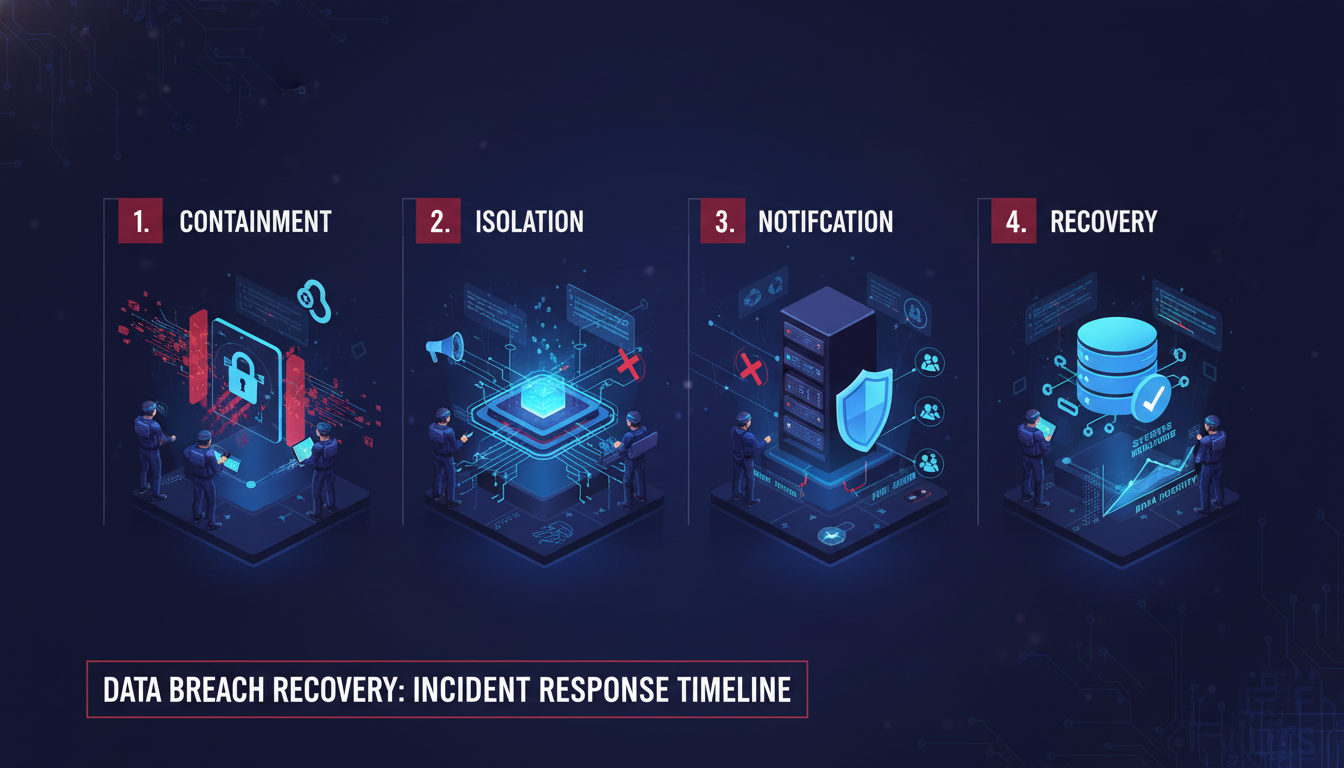
Discovering that your business has suffered a data breach is one of the most stressful experiences any UK business owner or manager can face. In those first moments of realisation, panic is natural - but panic leads to poor decisions, and poor decisions during a data breach can magnify the damage enormously. What you need is a clear, structured recovery process that addresses every aspect of the breach methodically and thoroughly.
Data breaches are not rare events. The UK Government's Cyber Security Breaches Survey consistently shows that approximately 39% of UK businesses identify at least one cyber attack or breach each year, with the figure rising to 69% for medium businesses and 72% for large businesses. The question is not whether your business will face a breach, but when - and how well-prepared you are to respond.
This step-by-step guide walks you through the entire data breach recovery process, from the initial discovery through containment, investigation, notification, remediation, and the long-term measures that prevent recurrence. Whether you are dealing with a breach right now or preparing for one that has not yet happened, this guide provides the practical framework you need.
Step 1: Contain the Breach Immediately
The first priority upon discovering a breach is containment. Every minute that a breach remains active, more data may be compromised, more systems may be affected, and the eventual cost of recovery increases. Containment does not mean fixing everything - it means stopping the bleeding.
If the breach involves compromised user accounts, immediately disable those accounts and force password resets for all potentially affected users. If the breach is through a network vulnerability, isolate the affected systems from the rest of your network. If malware is involved, disconnect affected machines from the network but do not turn them off - forensic investigators may need to examine live system memory.
Do not attempt to "clean up" evidence. In the urgency of the moment, it is tempting to delete suspicious files, wipe affected machines, or restore from backup immediately. Resist this impulse. Evidence preservation is crucial for the investigation that follows, and destroying evidence can actually increase your liability. The ICO expects organisations to be able to demonstrate what happened, and deleting evidence undermines that ability.
Assembling Your Incident Response Team
Effective containment requires clear leadership and defined roles from the very first moment. Your incident response team should include a senior decision-maker with authority to approve expenditure and operational changes, your IT lead or managed service provider, a communications lead responsible for internal and external messaging, and a legal adviser familiar with data protection law. If your business does not have an in-house IT team, your managed IT provider should be your first call - they can begin technical containment whilst you assemble the rest of the team. Having these roles documented in a formal incident response plan before a breach occurs is invaluable, because the middle of a crisis is the worst possible time to be working out who is responsible for what.
Establish a single, secure communication channel for the response team. If your email system may be compromised, do not use it for incident response communications - attackers who have access to your email can monitor your response efforts and adapt accordingly. A separate messaging platform, a dedicated phone bridge, or even in-person meetings may be necessary depending on the nature of the breach. Every member of the response team should understand their role before a breach occurs, which is why rehearsing your incident response plan through regular tabletop exercises is so valuable. These simulation exercises, typically lasting two to three hours, walk the team through a realistic breach scenario and expose gaps in your plan before a real incident puts it to the test.
Communication with the wider business during containment must be carefully managed. Staff need to know enough to cooperate with containment measures - for example, if they are being asked to change passwords, stop using certain systems, or avoid discussing the incident externally - but sharing excessive detail before the investigation is complete can lead to rumour, speculation, and premature disclosure. Designate a single point of contact for internal queries and prepare a brief holding statement that acknowledges the situation without speculating about details that have not yet been confirmed.
The actions you take in the first hour after discovering a breach set the trajectory for the entire recovery. Assemble your incident response team (or contact your IT provider if you do not have one), document what you know so far, isolate affected systems, preserve evidence, and begin a written log of every action taken with timestamps. This log becomes a critical document for the ICO, your insurer, and potentially legal proceedings. Do not rely on memory - write everything down as it happens.
Step 2: Assess the Scope and Impact
Once the immediate breach is contained, you need to understand what happened, what data was affected, and how extensive the damage is. This assessment directly determines your notification obligations, remediation steps, and the resources you need to allocate.
Determine what type of data was compromised. Personal data (names, email addresses, phone numbers) triggers GDPR obligations. Special category data (health information, ethnic origin, political opinions, biometric data) triggers the most stringent requirements. Financial data (bank details, credit card numbers) creates additional regulatory and practical concerns. Each type of data carries different risks for the affected individuals and different obligations for your business.
Establish how many individuals are affected. A breach affecting 10 people requires a different scale of response than one affecting 10,000. Count not just customers but also employees, contractors, suppliers, and any other individuals whose data may have been compromised. When exact numbers are not yet known, work with reasonable estimates and update them as the investigation progresses.
Determine the likely cause. Was this a sophisticated external attack, a phishing email that tricked an employee, a misconfigured cloud service that exposed data publicly, an insider threat, or a lost or stolen device? The cause affects both your remediation approach and the narrative you present to affected individuals and regulators.
Engaging External Forensic Expertise
For anything beyond the most straightforward breaches, engaging a specialist digital forensics firm is strongly advisable. Forensic investigators bring tools and expertise that most in-house IT teams simply do not possess - they can analyse system logs, trace attacker movements through your network, identify the initial point of compromise, and determine exactly what data was accessed or exfiltrated. Their findings carry weight with the ICO and in legal proceedings in a way that internal investigations often do not. The distinction between a professional forensic report and an informal internal assessment can be the difference between regulatory confidence and regulatory scepticism.
When selecting a forensics firm, look for NCSC-assured providers or firms that hold relevant certifications such as CREST accreditation. Ideally, you should identify and engage a forensics provider before a breach occurs - having a retainer agreement in place means they can begin work immediately rather than going through a procurement process whilst the clock is ticking. Your cyber insurance provider may also have a panel of approved forensics firms, and using a panel firm can streamline the claims process considerably.
The scope assessment should also consider the timeline of the breach. Many breaches are not discovered immediately - attackers may have had access to your systems for days, weeks, or even months before detection. Understanding the dwell time is critical because it determines how far back you need to look when assessing what data may have been compromised. System logs, access records, and network traffic data from the entire period of suspected compromise must be analysed, which is another reason why professional forensic expertise is so important for anything beyond a trivial incident.
| Data Type Compromised | Risk Level | ICO Notification | Individual Notification |
|---|---|---|---|
| Names and email addresses | Medium | Likely required | Depends on context |
| Financial data (bank, card details) | High | Required | Required |
| Login credentials | High | Required | Required (urgent) |
| Health or medical data | Very High | Required | Required |
| National Insurance numbers | Very High | Required | Required |
| Children's data | Very High | Required | Required (parents/guardians) |
Step 3: Notify the ICO (If Required)
Under GDPR, you must notify the Information Commissioner's Office within 72 hours of becoming aware of a personal data breach that is likely to result in a risk to individuals' rights and freedoms. This is not 72 business hours - it is 72 hours from the moment you become aware, including weekends and bank holidays.
Not every breach requires ICO notification. If the breach is unlikely to result in a risk to individuals - for example, if the compromised data was encrypted and the encryption key was not compromised - notification may not be required. However, you must still document the breach internally and your reasoning for not notifying. When in doubt, notify - the ICO is generally more sympathetic to organisations that over-report than those that fail to report when they should have.
The ICO provides an online breach reporting tool at ico.org.uk. You do not need to have all the details when you submit your initial report - the ICO understands that investigations take time. Provide what you know, state what is still under investigation, and commit to providing updates as more information becomes available. The ICO will assess your report and may contact you for further information or to provide guidance on next steps.
Documenting Your ICO Submission
The quality of your ICO notification matters enormously. A well-prepared submission demonstrates competence and good faith, whilst a poorly prepared one can attract additional scrutiny. Before submitting, ensure you have documented the date and time the breach was discovered, who discovered it and how, the nature of the personal data involved, the approximate number of individuals affected, and the containment measures already implemented. The ICO's breach reporting form guides you through these elements, but having the information prepared in advance makes the process far smoother and reduces the risk of omitting critical details under pressure.
Keep meticulous records of every communication with the ICO throughout the process. If the ICO requests additional information or asks you to take specific actions, respond promptly and thoroughly. The ICO has the power to issue fines of up to four per cent of annual global turnover for serious GDPR violations, but in practice they take a proportionate approach - organisations that respond transparently, cooperatively, and competently are treated far more favourably than those that are evasive or disorganised. Your goal is to demonstrate that you are taking the breach seriously and handling it responsibly.
It is also worth noting that the 72-hour clock starts from the moment you become aware of the breach, not from the moment you complete your investigation. If you cannot provide all the required information within 72 hours, you should still submit your initial notification on time and provide the remaining details in a follow-up submission. The ICO explicitly allows for phased reporting and will not penalise organisations for providing incomplete initial notifications, provided the initial report is timely and the follow-up is prompt. Failing to notify within the deadline, however, is itself a regulatory breach that can attract enforcement action independent of the underlying data breach.
Step 4: Notify Affected Individuals
If the breach is likely to result in a high risk to the rights and freedoms of individuals, you must notify those individuals directly and without undue delay. This is a higher threshold than ICO notification - not every breach that requires ICO reporting also requires individual notification.
Your notification to individuals must be clear, concise, and written in plain language. It should describe the nature of the breach, the types of data involved, the likely consequences, the measures you have taken to address the breach, and what steps individuals can take to protect themselves. Avoid corporate jargon, minimisation language, or anything that sounds like you are downplaying the situation - affected individuals deserve honesty and respect.
Provide practical guidance appropriate to the type of data compromised. If email addresses were exposed, advise recipients to be vigilant about phishing emails. If passwords were compromised, instruct them to change their passwords on your service and any other service where they used the same password. If financial data was exposed, recommend that they contact their bank and consider credit monitoring services.
Communication Channels and Timing
Choosing the right communication channel for breach notification is crucial. Direct email to affected individuals is the most common approach, but consider whether the breach itself may have compromised email addresses or accounts - in which case, alternative channels such as postal letters, SMS messages, or phone calls may be more appropriate. For large-scale breaches affecting thousands of individuals, a dedicated breach notification page on your website, supplemented by direct communications, can provide a central source of information and reduce the burden on your customer support team.
Timing requires careful judgement. You must notify without undue delay, but a premature notification based on incomplete information can cause unnecessary panic and require multiple corrections. Aim to notify once you have enough information to provide meaningful guidance - what happened, what data was affected, and what individuals should do - even if the full investigation is ongoing. Make clear that the investigation continues and commit to providing updates as more information emerges. A single, well-crafted communication followed by structured updates is far more effective than a drip-feed of alarming but incomplete messages that erode confidence with each revision.
Consider the needs of vulnerable individuals in your notification approach. If the breach affects elderly customers, ensure your communication is accessible and avoid overly technical language. If children's data is involved, direct your communication to parents or guardians with age-appropriate guidance. Businesses that demonstrate genuine care for the individuals affected by a breach - not merely compliance with legal obligations - tend to retain more trust and suffer less reputational damage in the long term. Establishing a dedicated helpline or email address for breach-related queries shows affected individuals that you take their concerns seriously and are committed to supporting them through the process.
Good Breach Notification Practices
- Clear, honest language explaining what happened
- Specific details about what data was affected
- Practical steps individuals can take to protect themselves
- Contact details for questions and support
- Sent promptly once the breach is confirmed
- Follow-up communications as investigation progresses
- Genuine apology and commitment to improvement
Poor Breach Notification Practices
- Vague language that obscures what happened
- Buried in marketing emails or small print
- Delayed for weeks or months after discovery
- No practical advice for affected individuals
- Blaming external parties without taking responsibility
- No way for individuals to ask questions
- Minimising the severity of the breach
Step 5: Remediate and Recover
With containment and notification addressed, focus shifts to fixing the vulnerabilities that allowed the breach and recovering normal operations. This phase often takes weeks or months, depending on the severity of the breach and the complexity of your IT environment.
Address the root cause first. If the breach was caused by a phishing attack, implement email filtering, conduct staff awareness training, and deploy multi-factor authentication. If a software vulnerability was exploited, apply the relevant patches and audit your entire environment for similar vulnerabilities. If access controls were inadequate, review and strengthen permissions across all systems.
Restore affected systems from clean backups. Verify the integrity of your backups before restoring - if the breach was present for an extended period, even your recent backups may contain compromised data. Work back through your backup history to find the most recent clean copy, and rebuild from there.
Conduct a thorough security review of your entire IT environment, not just the systems directly involved in the breach. Attackers often establish multiple footholds, and addressing only the obvious entry point may leave other backdoors in place. Consider engaging a specialist cyber security firm to conduct a penetration test and vulnerability assessment once you believe the remediation is complete.
Managing Business Continuity During Recovery
Breach recovery inevitably disrupts normal business operations, and managing that disruption is as important as the technical remediation itself. Communicate clearly with your staff about what has happened, what is being done, and how it affects their daily work. Employees who understand the situation are better able to support the recovery effort and less likely to spread inaccurate information externally. Depending on the severity of the breach, you may need to implement temporary manual processes for functions that relied on compromised systems, redirect customer enquiries to alternative channels, or adjust delivery timelines for ongoing projects and commitments.
Work closely with your cyber insurance provider throughout the recovery process. Most cyber insurance policies cover not only the direct costs of breach response - forensic investigation, legal advice, notification costs, and credit monitoring for affected individuals - but also business interruption losses and the costs of restoring systems and data. Document every cost associated with the breach meticulously, as your insurer will require detailed evidence to process the claim. If you do not currently have cyber insurance, the experience of a breach often provides compelling evidence for securing coverage going forward, and many insurers offer post-incident policies for businesses that can demonstrate they have addressed the vulnerabilities that led to the breach.
Client and supplier communication during recovery requires particular care. If you handle data on behalf of clients, you may have contractual obligations to notify them of the breach within specific timeframes. Review your contracts and data processing agreements to understand these obligations. Proactive, transparent communication with key clients - informing them of the breach, explaining what you are doing about it, and providing regular updates - is almost always better received than allowing clients to discover the breach through other channels. Businesses that communicate openly during a crisis frequently strengthen their client relationships rather than damaging them, because transparency under pressure demonstrates integrity.
Step 6: Learn and Strengthen
Every data breach, however painful, is a learning opportunity. Once the immediate crisis is resolved, conduct a formal post-incident review to understand what happened, why your existing defences failed, and what changes are needed to prevent recurrence.
Document everything. Create a comprehensive incident report covering the timeline of events, the root cause analysis, the actions taken during response, the costs incurred, and the lessons learned. This report serves multiple purposes - it demonstrates to the ICO that you have taken the breach seriously, it provides a basis for insurance claims, and it informs your future security strategy.
Update your incident response plan based on what you learned. If the breach revealed gaps in your detection capabilities, invest in better monitoring. If response times were slower than they should have been, streamline your escalation procedures. If staff awareness was a contributing factor, enhance your training programme. The businesses that suffer most from data breaches are not those that experience them - they are those that experience them and fail to learn from the experience.
Consider pursuing Cyber Essentials or Cyber Essentials Plus certification if you do not already hold it. This NCSC-backed scheme provides a structured framework for baseline cyber security and demonstrates to customers, partners, and regulators that you take security seriously. Many UK businesses pursue certification in the aftermath of a breach as a concrete step towards rebuilding trust and strengthening their defences.
Building a Culture of Security Awareness
Technical controls alone are insufficient if the human element remains weak. Staff awareness training should become a regular, ongoing activity rather than a one-off exercise conducted in the aftermath of a breach. Effective training programmes combine formal education - covering topics such as phishing recognition, password hygiene, and safe browsing practices - with simulated phishing exercises that test whether staff can apply what they have learned in realistic scenarios. The most effective training is brief, frequent, and relevant to the specific threats your business faces, rather than generic annual sessions that staff endure and immediately forget.
Foster an environment where staff feel comfortable reporting potential security incidents without fear of blame. Many breaches are detected by observant employees who notice something unusual - a strange email, an unexpected login prompt, a file that should not be there. If staff fear being punished for making a mistake, they will hide incidents rather than report them, and small incidents that could have been contained quickly can escalate into major breaches. A blame-free reporting culture, combined with clear procedures for escalating concerns, is one of the most valuable security assets any organisation can possess.
Finally, use the breach as a catalyst for board-level engagement with cyber security. In too many organisations, cyber security is treated as a purely technical matter delegated entirely to the IT department. A breach that reaches the board agenda creates an opportunity to establish ongoing governance arrangements - regular security reporting to the board, a designated board member with responsibility for cyber risk, and a security budget that reflects the actual level of risk the business faces. Organisations where the board is actively engaged in cyber security consistently achieve better security outcomes than those where it remains a back-office concern.
Need Help Responding to a Data Breach?
If your business has experienced a data breach, Cloudswitched provides emergency incident response support for UK businesses. Our security team helps contain the breach, investigate the cause, manage regulatory notifications, and implement the remediation measures needed to restore security and confidence. Contact us immediately for urgent assistance, or get in touch to discuss proactive breach preparedness planning.
Explore Cyber Essentials Certification
CloudSwitched
London-based managed IT services provider offering support, cloud solutions and cybersecurity for SMEs.


