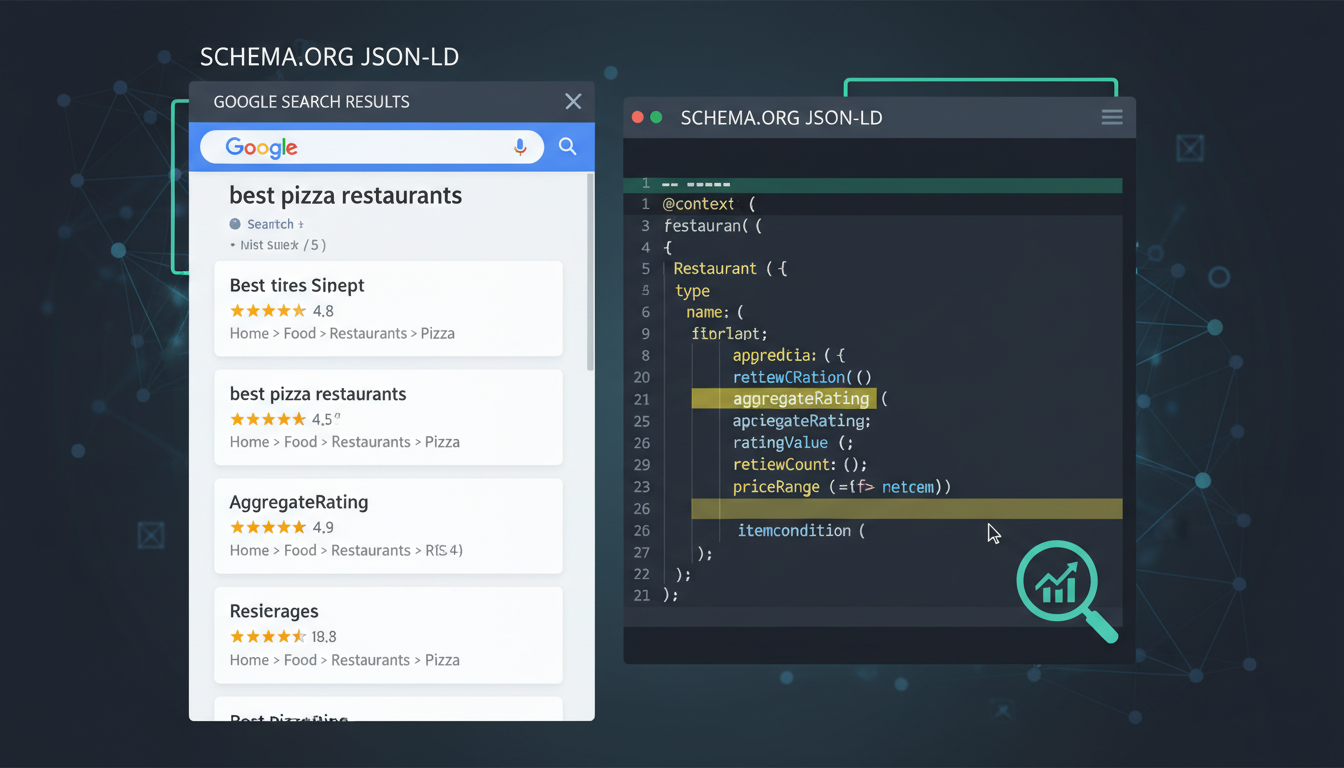
When you search for something on Google, you have probably noticed that some results look different from others. Some display star ratings, prices, and availability. Others show recipe cooking times, event dates, or FAQ accordions directly in the search results. These enhanced listings are called rich results (formerly known as rich snippets), and they are generated using a technology called schema markup - structured data embedded in your website's HTML that helps search engines understand the content and context of your pages.
For UK businesses, schema markup represents one of the most underutilised opportunities in search engine optimisation. While most SEO efforts focus on content quality, keyword targeting, and link building, schema markup provides a way to stand out visually in search results, improve click-through rates, and help search engines understand your business more accurately - all without changing a single word of your visible content.
This guide explains what schema markup is, why it matters for UK businesses, the most valuable schema types for different industries, and how to implement it on your website.
What Is Schema Markup?
Schema markup is a standardised vocabulary of tags - defined by Schema.org, a collaborative project between Google, Microsoft, Yahoo, and Yandex - that you add to your website's HTML to provide search engines with explicit information about the content on your pages. Think of it as a translation layer between your human-readable content and the structured data that search engines need to generate rich results.
Without schema markup, search engines rely on natural language processing to understand what your page is about. They can usually figure out the basics - this page is about a product, this page contains a recipe - but they may miss specific details or misinterpret ambiguous content. Schema markup removes this ambiguity by explicitly declaring: "This is a product. Its name is X. Its price is Y. It has Z reviews with an average rating of 4.5 stars." Search engines can then use this structured information to generate rich results that display these details directly in the search results page.
Schema markup is typically implemented using JSON-LD (JavaScript Object Notation for Linked Data), which is Google's recommended format. JSON-LD is added as a script block in the head or body of your HTML page, separate from the visible content. This means you can implement schema markup without modifying the visible design or content of your website - it is purely metadata for search engines.
There are three formats for implementing schema markup: JSON-LD, Microdata, and RDFa. JSON-LD is strongly recommended by Google and is the easiest to implement and maintain. It is added as a standalone script block, completely separate from your HTML content. Microdata and RDFa, by contrast, require you to embed schema attributes directly within your HTML tags, making them more complex to implement and harder to maintain. Unless you have a specific technical reason to use Microdata or RDFa, always use JSON-LD for new implementations.
How Search Engines Use Structured Data
To understand why schema markup is so valuable, it helps to understand how search engines process web content. When Google crawls a web page, its algorithms must interpret the meaning of text, images, and other elements using natural language processing. While these algorithms are remarkably sophisticated, they can still struggle with ambiguity. The word "jaguar," for example, could refer to an animal, a car brand, or a professional sports team. Schema markup resolves this ambiguity by providing explicit context that tells search engines exactly what each piece of content represents.
Schema.org was launched in 2011 as a joint initiative between Google, Microsoft, Yahoo, and Yandex. The vocabulary has grown from a few dozen types to over 800, covering everything from local businesses and products to medical conditions and educational courses. This shared vocabulary ensures that structured data works consistently across all major search engines, making it a sound investment for any business with an online presence.
Beyond generating rich results in traditional search, structured data feeds directly into the Knowledge Graph, the vast database of entities and relationships that powers knowledge panels, answer boxes, and many other search features. When you implement Organisation schema with your company details, you are effectively registering your business as an entity in the Knowledge Graph. This can lead to a prominent knowledge panel appearing when someone searches for your brand name, displaying your logo, address, phone number, social media profiles, and other key information in a highly visible panel on the right side of search results.
Structured data also plays a growing role in how AI-powered search experiences present information. As search engines increasingly use large language models to generate AI overviews and conversational answers, schema markup helps these systems accurately attribute information to its source. Businesses with comprehensive structured data are more likely to be cited in AI-generated search responses, making schema implementation increasingly relevant for future search visibility.
Why Schema Markup Matters for UK Businesses
The benefits of schema markup extend beyond aesthetics. Rich results generated by schema markup consistently demonstrate higher click-through rates than standard search results. Studies show that rich results can increase organic click-through rates by 20 to 40 per cent, depending on the schema type and the competitiveness of the search query. For a UK business generating significant organic traffic, a 30 per cent increase in click-through rate translates directly into more visitors, more enquiries, and more revenue - with no additional content creation or link building required.
Schema markup also plays an increasingly important role in voice search. When users ask their smart speaker or phone assistant a question, the answer is often drawn from search results that include structured data. Businesses with comprehensive schema markup are more likely to be selected as the voice search answer - a growing channel that represents an estimated 20 per cent of mobile searches in the UK.
Furthermore, schema markup helps with local SEO, which is critical for UK businesses with physical locations. LocalBusiness schema provides search engines with your business name, address, phone number, opening hours, and service area in a structured format, improving your visibility in local search results and Google Maps.
Industry-Specific Benefits for UK Sectors
The impact of schema markup varies by industry, and certain UK business sectors stand to gain more than others. Professional services firms, including solicitors, accountants, and IT support companies, benefit enormously from LocalBusiness and FAQPage schema. These businesses typically compete in local search results where a rich listing with star ratings, opening hours, and FAQ accordions can be the deciding factor in whether a potential client clicks through or chooses a competitor. For a law firm in Birmingham, for instance, displaying a 4.8-star rating and answers to common legal questions directly in search results creates an immediate trust advantage over firms with plain text listings.
UK e-commerce businesses gain significant value from Product and Offer schema, which displays price, availability, and review ratings directly in search results. In a competitive retail landscape where British consumers are increasingly price-conscious and comparison-driven, these rich snippets provide the information shoppers need to make a purchasing decision before they even visit your website. Product schema also enables your products to appear in Google Shopping results, opening an additional traffic channel that many UK retailers overlook.
The hospitality and events sector, including restaurants, hotels, and entertainment venues, benefits from Event schema and Restaurant schema. Displaying event dates, ticket prices, menu items, and booking options directly in search results reduces friction and drives more direct bookings. For UK restaurants, Recipe schema on blog content and Menu schema on your main site can generate visually rich listings that stand out in a crowded local dining market.
Healthcare providers, including NHS-affiliated services and private clinics, can use MedicalOrganization schema and FAQPage schema to improve their visibility for health-related searches. With patients increasingly turning to search engines for health information, having structured data that clearly identifies your practice, specialisms, and answers to common health questions helps both your search visibility and the quality of information available to the public.
Essential Schema Types for UK Businesses
| Schema Type | Best For | Rich Result Generated |
|---|---|---|
| LocalBusiness | Any business with a physical location | Knowledge panel, Maps listing enhancement |
| FAQPage | Service pages, support pages | Expandable FAQ accordion in search results |
| HowTo | Tutorial and guide content | Step-by-step instructions with images |
| Product | E-commerce product pages | Price, availability, ratings in results |
| Review / AggregateRating | Any business with customer reviews | Star ratings displayed in search results |
| Article / BlogPosting | Blog content, news articles | Enhanced article listing with image, date, author |
| Service | Professional service businesses | Service details in knowledge panel |
| Event | Businesses hosting events | Event dates, times, and ticket info in results |
| BreadcrumbList | Any website with navigation hierarchy | Breadcrumb trail in search results |
| Organization | Company websites | Knowledge panel with logo, social links |
Choosing the Right Schema Types for Your Business
With over 800 schema types available, deciding where to start can feel overwhelming. The most effective approach is to prioritise schema types based on two factors: the potential for rich results that Google currently supports, and the relevance to your most important pages. Google only generates rich results for a subset of schema types, so implementing schema that does not produce visible search enhancements delivers less immediate value. The types listed in the table above represent the schemas most likely to generate rich results for UK business websites.
FAQPage schema deserves particular attention because it is both easy to implement and highly effective. By marking up genuine frequently asked questions on your service pages, you can earn expandable FAQ accordions that appear directly beneath your search listing. These accordions significantly increase the visual space your listing occupies in search results, pushing competitors further down the page. For a UK IT support company, adding FAQPage schema to a managed services page with questions about what managed IT support includes and how much IT support costs for a small business can double or triple the visual footprint of that listing in search results.
For businesses with multiple locations, each branch or office should have its own LocalBusiness schema with location-specific details. A company with offices in London, Manchester, and Edinburgh should implement separate LocalBusiness schema for each location, with the correct address, phone number, opening hours, and geographic coordinates. This approach helps each location appear in relevant local searches, rather than relying on a single company-wide listing that may not surface for location-specific queries.
Article and BlogPosting schema should be implemented across all blog and news content. While the rich result enhancements for articles are subtler than those for products or FAQs, they improve how search engines understand your content, attribute it to the correct author, and categorise it within topic areas. For content marketing strategies that rely on organic search traffic, Article schema is a baseline requirement rather than an optional enhancement.
Implementing Schema Markup: A Practical Approach
Implementation follows a structured process. First, identify which pages on your website would benefit most from schema markup. Priority pages typically include your homepage (Organization or LocalBusiness schema), service pages (Service and FAQPage schema), blog posts (Article or BlogPosting schema), product pages if applicable (Product schema), and contact pages (LocalBusiness with ContactPoint schema).
For each page, create the appropriate JSON-LD script block. Here is a simplified example of LocalBusiness schema for a UK IT support company - the kind of structured data that helps Google understand your business details and display them prominently in local search results. The JSON-LD block includes your business name, address with UK postal code, telephone number, opening hours, service area, and the type of services you provide.
The key fields for a UK LocalBusiness schema include the business type (choose the most specific applicable type from schema.org), your registered business name, full UK postal address, telephone number in international format (+44), opening hours specification, geographic service area, and any applicable accreditations or certifications. For UK businesses, including your Companies House registration number via the taxID property can further enhance your knowledge panel.
Validation and Testing Workflow
Before deploying schema markup to your live website, thorough validation is essential. Google provides two key testing tools for this purpose. The Rich Results Test shows whether your markup is eligible to generate rich results and highlights any errors or warnings in your implementation. The Schema Markup Validator performs a more comprehensive structural check, verifying that your markup conforms to the schema.org specification regardless of whether Google currently supports a rich result for that schema type. Both tools are free and should be used before any schema markup goes live.
A practical testing workflow for UK businesses involves several steps. First, create your JSON-LD markup for a single page and validate it using both tools. Address any errors, which indicate problems that will prevent rich results, before addressing warnings, which identify opportunities for improvement but will not block your markup from functioning. Second, deploy the validated markup to a staging environment if available, or a single page on your live site. Third, request reindexing of that page through Google Search Console and monitor the Enhancements report over the following two to four weeks. Once you have confirmed that the markup is generating valid rich results, roll out the same pattern across similar pages.
Schema for Multi-Location UK Businesses
Businesses with multiple UK locations face additional complexity when implementing schema markup. Each location requires its own LocalBusiness schema with a unique name, address, telephone number, and set of opening hours. These individual location schemas should be linked to a parent Organisation schema that represents the business as a whole. This hierarchical structure helps search engines understand the relationship between your locations and present the most relevant one in response to location-specific queries.
For multi-location businesses, consistency is critical. Ensure that the business name, address format, and telephone number in your schema markup exactly match those in your Google Business Profile for each location. Even minor discrepancies, such as abbreviating "Road" to "Rd" in one place but not another, or using a local number format in schema but an 0800 number in your Google Business Profile, can undermine the consistency signals that strengthen your local search presence. Establish a central reference document with the canonical details for each location and use it as the single source of truth for both your schema markup and your business directory listings.
Schema Implementation Best Practices
- Use JSON-LD format (Google's recommended approach)
- Start with LocalBusiness and Organization schemas
- Add FAQPage schema to service and support pages
- Validate all markup with Google's Rich Results Test
- Keep schema data consistent with visible page content
- Monitor rich result performance in Search Console
- Update schema when business details change
Common Schema Mistakes
- Using schema for content not visible on the page
- Marking up fake or misleading reviews
- Implementing incorrect schema types for the content
- Forgetting to update schema when details change
- Using Microdata when JSON-LD would be simpler
- Not validating markup before deployment
- Adding schema but never monitoring rich result status
Measuring the Impact
After implementing schema markup, monitor its impact using Google Search Console. The Enhancements section shows which schema types Google has detected on your site, any errors or warnings in your markup, and the number of pages with valid rich results. The Performance report allows you to filter by search appearance to see how rich results are affecting your click-through rates compared to standard results.
Give Google at least two to four weeks to recrawl your pages and process the new structured data. Rich results are not guaranteed - Google decides whether to display them based on the quality and relevance of your markup, the search query, and other factors. However, correct implementation significantly increases your chances of earning rich results for relevant queries.
Long-Term Monitoring and Maintenance
Schema markup is not a set-and-forget implementation. Your business details change over time, Google regularly updates its requirements and supported schema types, and new opportunities emerge as the structured data ecosystem evolves. Establish a quarterly review process to audit your schema markup across all pages, verify that business details remain accurate, and check for new schema types that could benefit your website. Google Search Console sends email notifications when it detects new schema errors on your site, but proactive monitoring catches issues before they affect your search performance.
Track the impact of your schema markup over time by creating a dedicated report in Google Search Console that compares click-through rates for pages with rich results against those without. Segment this data by schema type to understand which types of rich results are delivering the most value for your business. For many UK businesses, FAQPage schema delivers the most immediate and measurable improvement, as the expanded accordion format in search results occupies significantly more visual space and drives higher click-through rates than standard listings.
The Future of Structured Data
The importance of schema markup is set to increase as search engines continue to evolve. AI-powered search experiences, including the Search Generative Experience from Google, rely heavily on structured data to generate accurate, contextualised answers. Businesses with comprehensive schema markup are better positioned to be cited and referenced in these AI-generated responses, which are becoming an increasingly prominent feature of the search results page. As traditional organic links are supplemented by AI-generated summaries, having machine-readable structured data on your website becomes not just beneficial but essential for maintaining search visibility.
The schema.org vocabulary continues to expand, with new types and properties added regularly to reflect emerging business models and content formats. Recent additions relevant to UK businesses include schema types for virtual events, online courses, and sustainability certifications. Staying current with these developments and implementing new schema types as they become available gives early adopters a competitive advantage, as rich results for newer schema types face less competition than established ones like FAQPage or Product. For forward-thinking UK businesses, investing in schema markup today is an investment in long-term search visibility that will continue to pay dividends as the search landscape evolves.
Schema markup is one of the most cost-effective SEO investments a UK business can make. It requires no ongoing content creation, no link building campaigns, and no advertising spend - just a one-time technical implementation that continues to deliver results for as long as the markup remains on your pages. For businesses competing in crowded UK search results, it provides a genuine competitive advantage that most competitors have not yet exploited.
Boost Your Search Visibility with Schema Markup
Cloudswitched implements comprehensive schema markup strategies for UK business websites. From local business schema to FAQ rich results and product markup, we help your search listings stand out and attract more clicks.
Improve Your Search Results
CloudSwitched
London-based managed IT services provider offering support, cloud solutions and cybersecurity for SMEs.


