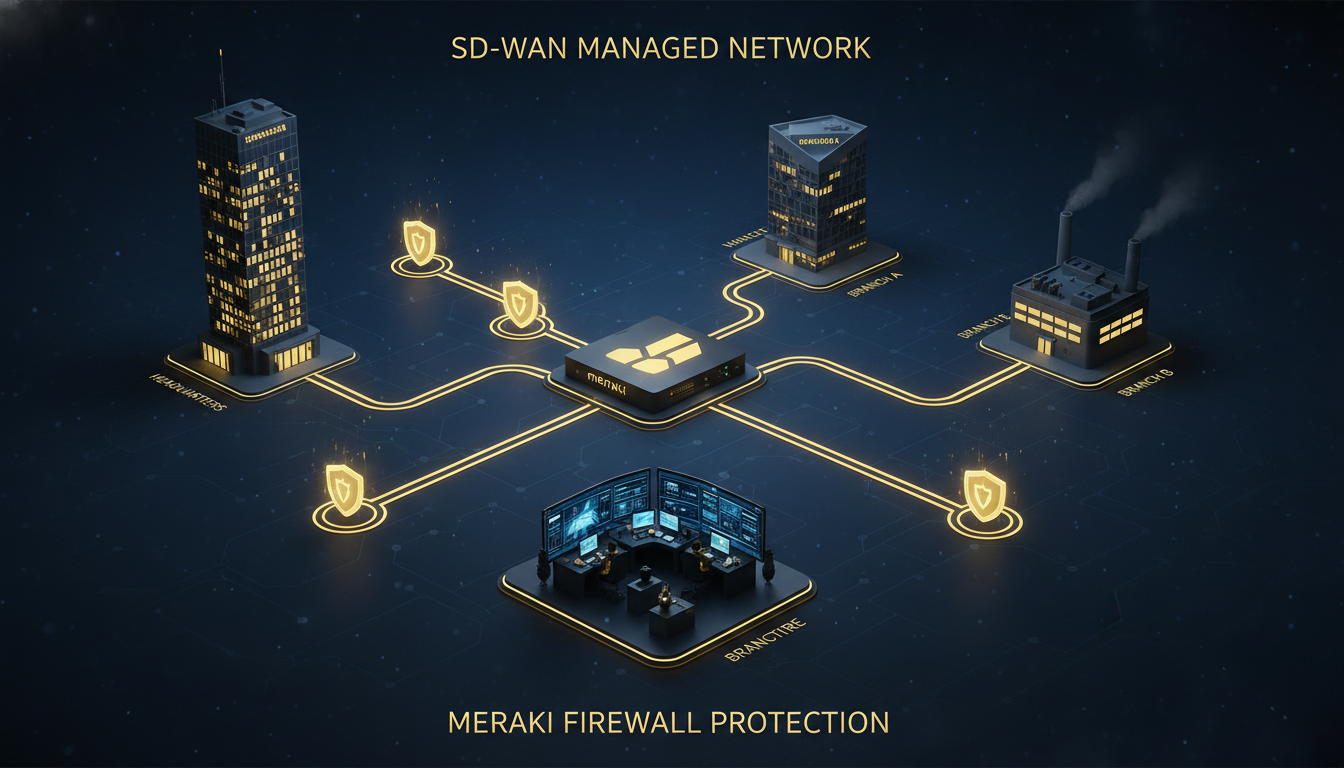
British businesses today operate across more locations, more cloud platforms, and more bandwidth-hungry applications than at any point in history. A retail chain with forty shops scattered across England and Wales, a professional services firm with offices in London, Manchester, and Edinburgh, a logistics company with warehouses from the South Coast to the Scottish Borders - all face the same fundamental challenge: how do you connect every site, every user, and every application into a network that is fast, reliable, secure, and manageable without drowning your IT team in complexity? The answer, increasingly, lies at the intersection of SD-WAN managed services, comprehensive managed network services, and intelligent security platforms like the Meraki firewall UK organisations have come to depend upon.
The traditional model of wide-area networking - expensive MPLS circuits backhauling all traffic through a central data centre - has been crumbling for years. Cloud adoption made it obsolete for many workloads. The pandemic-driven shift to hybrid working hammered in the final nails. Yet replacing MPLS with raw internet connections and hoping for the best is not a strategy; it is a liability. SD-WAN (Software-Defined Wide Area Networking) emerged to bridge that gap, offering intelligent traffic routing, application-aware path selection, built-in encryption, and centralised management. When delivered as a fully managed service by a specialist provider, SD-WAN transforms multi-site networking from a constant headache into a strategic advantage.
This guide explores everything UK businesses need to know about SD-WAN managed services, managed network services, Cisco Meraki MX firewalls, Meraki MV smart cameras, enterprise wireless solutions UK, and the practical realities of building, securing, and managing modern multi-site networks in Britain. Whether you are running five sites or five hundred, the principles, technologies, and considerations covered here will help you make informed decisions that deliver measurable business outcomes.
Understanding SD-WAN: Why UK Businesses Are Making the Switch
To appreciate why SD-WAN managed services have become the dominant approach to multi-site networking in the UK, it helps to understand the limitations of what came before. For two decades, MPLS (Multiprotocol Label Switching) was the gold standard for connecting branch offices to a central data centre. MPLS circuits offered guaranteed bandwidth, low latency, and predictable performance. They also came with eye-watering costs - a typical 100 Mbps MPLS circuit between London and Birmingham might cost £800 to £1,200 per month, whereas a 500 Mbps business broadband connection over the same route costs a fraction of that. When most applications lived in the on-premises data centre, the premium was justifiable. When those applications migrated to Microsoft 365, Salesforce, AWS, and Azure, the logic collapsed.
Consider the classic MPLS architecture: a user in a branch office in Leeds needs to access Microsoft Teams. Their traffic travels from Leeds to the central data centre in London over the MPLS circuit, exits to the internet through the London firewall, reaches the Microsoft data centre (which might actually be physically closer to Leeds than to London), and the response traverses the same path in reverse. This traffic tromboning adds latency, wastes expensive MPLS bandwidth, and creates a single point of failure at the central internet breakout. Multiply this across forty branches and hundreds of users, and the inefficiency becomes staggering.
SD-WAN fundamentally changes this model. At its core, SD-WAN decouples the network control plane from the underlying transport. Instead of relying on a single, expensive circuit per site, SD-WAN creates an intelligent overlay network across whatever transport is available - business broadband, dedicated internet access (DIA), 4G/5G cellular, or even retained MPLS circuits. The SD-WAN controller makes real-time decisions about which path each application's traffic should take, based on application requirements (latency sensitivity, bandwidth needs, loss tolerance) and current path conditions (packet loss, jitter, throughput).
How SD-WAN Path Selection Works in Practice
Imagine a branch office in Manchester with two internet connections - a 500 Mbps leased line and a 200 Mbps business broadband service with a 4G backup. The SD-WAN appliance at that site continuously monitors both paths, measuring latency, packet loss, and jitter in real time. When a user launches a Microsoft Teams video call, the SD-WAN controller recognises this as a real-time voice and video application with strict latency and jitter requirements. It routes the Teams traffic over the leased line, which currently shows 8ms latency and 0% packet loss. Simultaneously, a large file upload to SharePoint - a bulk data transfer that is latency-tolerant but bandwidth-hungry - is routed over the broadband connection. If the leased line degrades (perhaps a carrier issue causes latency to spike to 50ms), the SD-WAN controller detects the change within seconds and seamlessly moves the Teams session to the broadband path, provided it meets the application's quality thresholds. The user experiences no interruption.
This application-aware routing is what distinguishes SD-WAN from simple load balancing or failover configurations. Traditional failover requires a complete link failure before traffic moves; SD-WAN acts on quality degradation before users notice a problem. Traditional load balancing distributes traffic without understanding application requirements; SD-WAN matches each application to the path that best meets its needs.
When evaluating SD-WAN solutions for UK multi-site deployments, always test application-aware routing with your actual critical applications - Microsoft Teams, your ERP system, VoIP - rather than relying on synthetic benchmarks. The real-world difference between SD-WAN platforms often shows up in how gracefully they handle path degradation during peak hours, not in laboratory conditions.
Direct Cloud Access and Local Internet Breakout
One of the most impactful capabilities of SD-WAN for UK businesses is local internet breakout. Instead of backhauling all internet-bound traffic to a central data centre, SD-WAN enables each branch to access cloud applications directly from the local internet connection. For organisations heavily invested in Microsoft 365, this single change can transform the user experience. Microsoft's own network architecture is designed to serve users from the nearest point of presence - forcing traffic through a central breakout defeats this design and degrades performance.
However, local internet breakout introduces a security consideration: if branch traffic no longer passes through the central firewall, how do you maintain consistent security policy across all sites? This is where the integration between SD-WAN and next-generation firewalls becomes critical, and it is one of the strongest arguments for platforms like Cisco Meraki that combine SD-WAN and firewall functionality in a single appliance.
Comparison of legacy MPLS and SD-WAN across key performance and cost metrics for a typical UK multi-site deployment
SD-WAN Managed Services: Why DIY Rarely Makes Sense
SD-WAN technology is powerful, but deploying and managing it effectively requires specialised expertise that most UK businesses do not have in-house. The technology itself is only part of the challenge - successful SD-WAN deployment involves circuit procurement and management across multiple ISPs, careful traffic policy design, ongoing performance monitoring, security policy maintenance, firmware management, and capacity planning. This is why SD-WAN managed services have become the preferred delivery model for the majority of UK organisations.
A quality SD-WAN managed service provider handles the entire lifecycle: they design the network architecture based on your application requirements and site locations, procure the most appropriate circuits for each site (considering factors like openreach fibre availability, leased line lead times, and 4G/5G coverage), provision and ship pre-configured SD-WAN appliances, coordinate installation engineers, manage the migration from existing connectivity (often running both old and new in parallel during a transition period), and then provide ongoing monitoring, management, and support.
What to Expect from a UK SD-WAN Managed Service
The scope of a well-structured SD-WAN managed service typically includes several key elements. Network design and architecture involves assessing your application landscape, user distribution, bandwidth requirements, and resilience needs at each site. A good provider will map your critical applications, understand their network requirements (a video conferencing platform has very different needs from a batch data replication job), and design traffic policies accordingly. Circuit procurement and management is often the most time-consuming aspect - the provider manages the relationships with ISPs, handles circuit ordering, tracks provisioning, and manages fault resolution across multiple carriers. For a twenty-site deployment across the UK, this alone can involve coordinating with half a dozen different carriers, each with their own provisioning timescales and fault management processes.
Zero-touch provisioning is a hallmark of modern SD-WAN platforms, particularly Cisco Meraki. The managed service provider pre-configures the SD-WAN appliance in the cloud management platform, ships it to the site, and the on-site engineer (or even a non-technical staff member) simply plugs it in. The appliance connects to the cloud controller, downloads its configuration, establishes VPN tunnels to other sites, and applies the correct traffic policies - all automatically. This dramatically reduces deployment time and eliminates the need to send expensive network engineers to every site.
24/7 monitoring and support means the managed service provider's network operations centre (NOC) continuously monitors the health of every SD-WAN appliance, every circuit, and every VPN tunnel across your estate. When an issue is detected - a circuit failure, a VPN tunnel dropping, unusual traffic patterns that might indicate a security incident - the NOC can respond proactively, often resolving issues before users are aware of them. This is a paradigm shift from the traditional break-fix support model where the IT team only learns about a problem when users start complaining.
| Service Element | DIY SD-WAN | Managed SD-WAN Service |
|---|---|---|
| Network design | Internal team - requires SD-WAN expertise | Provider architects with multi-vendor experience |
| Circuit procurement | Your team manages each ISP relationship | Provider manages all carriers as single point of contact |
| Appliance provisioning | Manual config, engineer site visits | Zero-touch provisioning, ship-to-site |
| Ongoing monitoring | Internal NOC or reactive break-fix | 24/7 NOC with proactive fault resolution |
| Firmware management | Manual scheduling, testing, rollout | Provider handles staged rollouts, rollback plans |
| Security policy | Internal security team or ad-hoc | Managed security policies, threat feed updates |
| Typical internal FTE required | 1.5–3 FTE for 20+ sites | 0.25 FTE for liaison and escalation |
| Mean time to resolve faults | 4–8 hours average | Under 2 hours with carrier coordination |
When selecting an SD-WAN managed service provider in the UK, ask specifically about their carrier relationships and circuit fault management process. The biggest operational pain point in multi-site networking is not the SD-WAN technology itself - it is dealing with ISP faults across different carriers. A provider with direct escalation paths to the major UK carriers (BT/Openreach, Virgin Media Business, CityFibre, TalkTalk Business) will resolve connectivity issues dramatically faster than one that relies on standard support channels.
Cisco Meraki MX: The Firewall That Defines Cloud-Managed Networking
When UK organisations evaluate SD-WAN and next-generation firewall platforms, Cisco Meraki's MX series consistently ranks among the most widely deployed. The Meraki firewall UK market has grown substantially because the platform addresses the core challenges that British businesses face: complex multi-site environments that need to be managed simply, integrated security that does not require a dedicated security operations team, and a cloud-first management model that eliminates the need for on-premises management servers.
The Meraki MX is not just a firewall - it is a unified threat management (UTM) appliance that combines stateful firewall, SD-WAN, intrusion detection and prevention (IDS/IPS), content filtering, advanced malware protection (AMP), site-to-site VPN (Auto VPN), and client VPN in a single device managed entirely through the Meraki cloud dashboard. This convergence is what makes the platform so compelling for organisations that lack large, specialised security teams.
Meraki Auto VPN: Multi-Site Connectivity in Minutes
One of the most celebrated features of the Meraki firewall UK deployments rely upon is Auto VPN. Traditional site-to-site VPN configuration is a tedious, error-prone process - each tunnel requires matching IPsec parameters, pre-shared keys or certificates, routing configurations, and access control lists on both ends. For a twenty-site network in a full mesh topology, that is 190 individual tunnel configurations (n*(n-1)/2). With Meraki Auto VPN, you simply designate which MX appliances should form tunnels, select hub or spoke roles, and the Meraki cloud controller handles everything else - key exchange, tunnel establishment, route propagation, and failover. Adding a new site takes minutes, not hours.
For UK businesses with branch offices spread across the country, Auto VPN is transformative. A retailer opening a new shop can have it securely connected to the corporate network within minutes of the Meraki firewall being plugged in. The VPN tunnels are established over whatever internet connections are available at the site, with automatic failover if one connection drops. Traffic routing between sites follows hub-and-spoke or full-mesh topologies as configured, with the option for direct spoke-to-spoke communication when the Meraki dashboard determines it is more efficient.
Threat Protection: IDS/IPS, AMP, and Content Filtering
The integrated security stack on the Meraki MX provides multiple layers of protection that work together. The intrusion detection and prevention system (IDS/IPS) uses the Cisco SNORT engine - one of the most widely deployed intrusion detection engines in the world - to inspect traffic for known attack signatures, protocol anomalies, and suspicious behaviour patterns. The signature database is updated automatically through the Meraki cloud, ensuring protection against newly discovered threats without manual intervention.
Advanced Malware Protection (AMP) integrates with Cisco's threat intelligence network to identify and block known malicious files. AMP uses a cloud-based reputation lookup - when a file crosses the MX, its hash is checked against Cisco's global threat database. Known malicious files are blocked immediately, known safe files are allowed, and unknown files are sandboxed for analysis. If a file later identified as malicious was previously allowed, AMP provides retrospective alerting, enabling the security team to identify potentially compromised endpoints.
Content filtering allows organisations to enforce acceptable use policies by controlling access to web content categories. This is particularly important for UK organisations that need to comply with regulatory requirements - financial services firms that must prevent access to categories that could facilitate insider trading, healthcare organisations that need to protect patient data from exfiltration via web-based file sharing services, or educational institutions with duty of care obligations.
Meraki MX (Cloud-Managed UTM)
Traditional On-Premises Firewall
Meraki MX Model Selection for UK Deployments
Choosing the right Meraki firewall UK model for each site is critical - an undersised appliance creates a bottleneck, whilst an oversized one wastes budget. Cisco Meraki offers a range of MX models designed for different deployment scales, from small branch offices to large data centre hubs. Understanding the throughput ratings, VPN capacity, and feature set of each model helps UK businesses right-size their investment.
The MX68 is the entry point for small branch offices with up to 50 users. It provides 450 Mbps of stateful firewall throughput and 200 Mbps of VPN throughput, making it suitable for sites with business broadband connections up to around 200 Mbps. The built-in PoE port and wireless capability on the MX68W variant make it an all-in-one solution for very small sites - a single device providing firewall, SD-WAN, WiFi, and switching for a small retail unit or satellite office.
The MX85 steps up to 1 Gbps firewall throughput and 500 Mbps VPN throughput, suited for medium branch offices with 50–200 users. This model handles the typical UK business broadband and leased line speeds comfortably and includes dedicated WAN ports for dual-internet configurations. The MX105 pushes to 3 Gbps firewall throughput with 1 Gbps VPN, serving as a larger branch or small hub concentrator for organisations with higher bandwidth requirements.
For hub sites and data centres, the MX250 delivers 4 Gbps firewall throughput and 2 Gbps VPN, suitable for concentrating VPN tunnels from up to 1,000 branch sites. The MX450, the flagship model, provides 6 Gbps firewall throughput and 3 Gbps VPN, with the capacity to serve as the hub for the largest enterprise deployments. UK organisations with centralised data centres or major hub offices where all branch traffic concentrates typically deploy MX250 or MX450 appliances in high-availability pairs.
Managed Network Services: The Full Picture Beyond SD-WAN
Managed network services encompass far more than just WAN connectivity. A comprehensive managed network service covers every layer of the network - from the circuits that connect your sites, through the SD-WAN and firewall appliances that route and secure traffic, to the switches that form the wired backbone within each building, the enterprise wireless solutions UK businesses depend on for day-to-day operations, and increasingly, the physical security cameras that protect premises. The goal is a single provider taking end-to-end responsibility for network performance, security, and availability, freeing the internal IT team to focus on business-enabling projects rather than keeping the lights on.
LAN Switching and Network Infrastructure
Within each site, managed network services typically include the provisioning and management of network switches. For organisations on the Cisco Meraki platform, the MS series switches extend the same cloud-managed philosophy to the LAN. Every switch port, VLAN, access control list, and quality-of-service policy is configured and monitored through the Meraki dashboard, providing the same single-pane-of-glass visibility that the MX firewalls and MR access points offer.
The managed service provider handles switch stacking configurations for resilience, PoE budget planning (ensuring sufficient power for access points, IP phones, and cameras), VLAN segmentation design (separating corporate, guest, IoT, and voice traffic), and 802.1X port-based authentication integration with your identity provider. For UK businesses subject to PCI DSS (any organisation processing card payments), proper network segmentation is a compliance requirement - the managed service provider ensures this is correctly implemented and documented.
Enterprise Wireless Solutions for UK Businesses
Enterprise wireless solutions UK organisations require have evolved dramatically. Modern enterprise WiFi is no longer simply about providing internet access - it is critical infrastructure that supports voice and video communications, point-of-sale systems, warehouse scanning operations, building management systems, and an ever-growing ecosystem of IoT devices. A managed wireless service includes site surveys (using professional tools to map RF coverage, interference sources, and client density), access point placement design, channel planning, power level optimisation, and ongoing performance management.
Cisco Meraki MR access points are the natural companion to the MX firewall and MS switching platforms, providing a unified management experience. The Meraki dashboard shows real-time client connectivity, signal strength, bandwidth utilisation, and application usage across every access point in every site. The managed service provider uses this visibility to proactively identify coverage gaps, capacity constraints, and interference issues - often resolving problems before users notice them.
For UK organisations with specific wireless requirements - high-density environments like conference centres or trading floors, outdoor coverage for car parks and loading bays, or warehouse environments with challenging RF propagation through racking - the managed service provider brings specialist wireless design expertise that generic IT support providers typically lack. A professional wireless site survey, using spectrum analysis tools and predictive modelling software, is the foundation of any reliable enterprise WiFi deployment.
Meraki MV Smart Cameras: Physical Security Through the Network Lens
An increasingly important component of managed network services is physical security, and the Meraki camera UK market has expanded rapidly as organisations recognise the advantages of converging physical security with network infrastructure. Cisco Meraki MV smart cameras are fundamentally different from traditional CCTV systems - they are network-native devices that process video on-device using built-in solid-state storage, eliminate the need for network video recorders (NVRs), and are managed through the same Meraki dashboard that controls your firewalls, switches, and access points.
For UK businesses, the Meraki camera UK proposition addresses several pain points with traditional CCTV. First, eliminating the NVR removes a significant single point of failure and ongoing maintenance burden. Traditional CCTV systems rely on dedicated recording servers with mechanical hard drives that fail, require regular replacement, and need UPS protection. Meraki MV cameras store footage on-device (up to 256 GB of solid-state storage depending on model), with optional cloud archiving for longer retention. Second, the cloud management model means footage from every camera across every site is accessible through a single web-based dashboard - no VPN connections to individual site NVRs, no juggling multiple CCTV software platforms.
Intelligent Video Analytics
What truly distinguishes the Meraki camera UK deployment from traditional CCTV is the built-in video analytics powered by on-device machine learning. The MV cameras can detect and classify objects (people, vehicles), generate heat maps showing foot traffic patterns over time, provide occupancy counts for rooms or areas, and create motion-based alerts. For UK retail businesses, this means understanding customer flow patterns, identifying peak trading times, and optimising store layouts - all from the same camera system that provides security footage. For office environments, occupancy analytics help facilities managers understand space utilisation, supporting decisions about hot-desking ratios, meeting room provisioning, and floor space requirements.
The privacy implications of video analytics are a legitimate concern for UK organisations, particularly under the UK GDPR and the Data Protection Act 2018. Meraki MV addresses this by processing all analytics on-device - the analytics data (heat maps, occupancy counts, motion events) is extracted from the video stream locally, and only the aggregated analytics data is sent to the Meraki cloud. The raw video footage remains on the camera's local storage unless specifically requested through the dashboard. Additionally, the Meraki dashboard provides configurable privacy zones that mask specified areas of the camera's field of view, preventing recording of areas where privacy expectations are higher (such as bathroom entrances or neighbouring properties visible from the camera's position).
Meraki MV Model Range
The MV camera range includes indoor fixed-lens models (MV2), indoor varifocal models (MV12) for adjustable fields of view, outdoor ruggedised models (MV72) with IP67 ratings suitable for British weather, and fisheye models (MV32) providing 360-degree coverage for large open areas like warehouses and retail floors. For UK deployments, the outdoor MV72 series is particularly popular for loading bays, car parks, building perimeters, and entry points, where the combination of weather resistance, night vision, and intelligent analytics provides comprehensive coverage.
Traffic Shaping, QoS, and Application Performance
One of the most technically impactful aspects of SD-WAN managed services is traffic shaping - the ability to prioritise, limit, and control how bandwidth is allocated across different applications and user groups. In a multi-site environment where branch offices share internet connections across voice, video, business applications, and general web browsing, traffic shaping ensures that business-critical applications always get the bandwidth they need, even during peak usage periods.
The Meraki MX SD-WAN platform provides granular traffic shaping controls through its cloud dashboard. Applications are identified using deep packet inspection (DPI) and categorised into groups - voice and video conferencing, business-critical SaaS (Microsoft 365, Salesforce, SAP), standard web browsing, social media, streaming video, software updates, and so on. Each category can be assigned a bandwidth limit, a priority level, and specific per-client rate limits. For example, a typical configuration might guarantee 30% of available bandwidth for voice and video (ensuring call quality is never degraded), allocate 40% for business applications, and allow the remaining 30% for general browsing - with streaming video and software updates deprioritised during business hours but allowed to use full bandwidth outside working hours.
Layer 7 Application Visibility
The Meraki dashboard provides deep visibility into application-level traffic across the entire network. Administrators can see, in real time, which applications are consuming bandwidth at each site, which users are the heaviest consumers, and how traffic patterns change throughout the day. This visibility is invaluable for capacity planning - when you can see that Microsoft Teams traffic has grown 40% quarter-on-quarter at a particular site, you can proactively upgrade the circuit before users start experiencing quality issues.
For managed network services providers, this application visibility feeds into regular service reviews with clients. Monthly or quarterly reports showing bandwidth utilisation trends, application usage patterns, and quality metrics provide the data needed to make informed decisions about circuit upgrades, traffic policy adjustments, and technology investments. This data-driven approach to network management is a significant step up from the reactive, ticket-driven model that many UK businesses are accustomed to.
Configure your SD-WAN traffic shaping policies to treat Windows Update and macOS Software Update traffic as low priority during business hours (08:00–18:00) but unrestricted outside those hours. A single Windows feature update across fifty devices can consume a significant portion of a branch office's bandwidth if left unmanaged. Most SD-WAN platforms, including Meraki, can schedule bandwidth policies by time of day.
VPN Architectures for UK Multi-Site Businesses
Virtual Private Networks remain the backbone of secure multi-site connectivity, and the VPN architecture choices made during the SD-WAN design phase have long-lasting implications for performance, resilience, and manageability. UK businesses typically face a choice between three primary VPN topologies: hub-and-spoke, full mesh, and hybrid architectures.
Hub-and-Spoke
In a hub-and-spoke topology, all branch sites (spokes) connect to one or more central hub sites. Inter-branch traffic must traverse the hub, which provides a natural point for centralised security inspection and policy enforcement. This topology is simple to manage and scales well - adding a new spoke requires only one new tunnel to the hub. The downside is that the hub becomes a potential bottleneck and single point of failure (mitigated by deploying hub MX appliances in high-availability pairs), and inter-branch traffic incurs additional latency from the double hop through the hub.
Full Mesh
Full mesh creates direct VPN tunnels between every pair of sites. This provides optimal inter-site latency (traffic flows directly between any two sites) and maximum resilience (no single point of failure). However, full mesh becomes complex at scale - the number of tunnels grows quadratically with the number of sites (190 tunnels for 20 sites, 1,225 for 50 sites). With Meraki Auto VPN, the operational complexity is largely abstracted by the cloud controller, but the bandwidth and processing overhead of maintaining hundreds of tunnels is still a consideration.
Hybrid Hub-Spoke with Dynamic Spoke-to-Spoke
The most common architecture for UK multi-site deployments is a hybrid model: a hub-and-spoke foundation with dynamic spoke-to-spoke tunnels established on demand. In this model, traffic between two branch sites initially traverses the hub, but the SD-WAN controller detects the inter-branch traffic flow and dynamically establishes a direct tunnel between the two branches. Once the direct tunnel is active, traffic flows between the branches without touching the hub, providing the latency benefits of full mesh without the overhead of maintaining permanent tunnels between every pair of sites. This is the default behaviour of Meraki Auto VPN when configured in hub-and-spoke mode with the "Any-to-any" option enabled.
| VPN Topology | Tunnels (20 sites) | Inter-Site Latency | Hub Dependency | Complexity | Best For |
|---|---|---|---|---|---|
| Hub-and-Spoke | 19 | Higher (via hub) | High | Low | Centralised applications, strict security policy |
| Full Mesh | 190 | Optimal (direct) | None | High | Latency-sensitive inter-branch apps |
| Hybrid (Meraki Auto VPN) | 19 + dynamic | Optimal (after warmup) | Initial only | Low | Most UK multi-site deployments |
Threat Protection and Security Posture in a Managed SD-WAN Environment
Security is not an add-on to SD-WAN managed services - it is a fundamental requirement that must be woven into every layer of the architecture. The shift from centralised MPLS with a single internet breakout to distributed SD-WAN with local internet breakout at every branch site dramatically expands the attack surface. Every branch office is now directly exposed to the internet, and every branch needs consistent, enterprise-grade security. This is precisely why the Meraki firewall UK platform's integration of SD-WAN and security in a single appliance is so valuable.
The Multi-Layer Security Model
A properly configured Meraki MX provides multiple security layers at each site. The stateful firewall enforces network-level access control - controlling which traffic is permitted between network segments (VLANs), between the site and the internet, and between the site and other sites via VPN. The IDS/IPS engine inspects permitted traffic for attack signatures and anomalous behaviour, blocking threats that would otherwise pass through standard firewall rules. AMP provides file-level protection against malware, using Cisco's global threat intelligence. Content filtering prevents access to malicious or policy-violating websites. And Geo-IP filtering can restrict traffic to or from specific countries, reducing the attack surface by blocking connections from regions where the organisation has no business relationships.
For UK businesses subject to regulatory requirements - financial services firms regulated by the FCA, healthcare organisations bound by NHS Data Security and Protection Toolkit standards, legal practices handling confidential client data - this multi-layer approach provides the defence-in-depth that auditors and regulators expect. The Meraki dashboard's logging and reporting capabilities support compliance evidence gathering, showing that security policies are consistently enforced across all sites.
Zero Trust Network Access (ZTNA) Integration
The security landscape for UK businesses is evolving beyond traditional perimeter-based protection toward Zero Trust models. In a Zero Trust architecture, no user or device is implicitly trusted - every access request is verified, regardless of whether the user is on the corporate network or connecting remotely. Meraki's integration with Cisco's broader security ecosystem, including Cisco Umbrella (cloud-delivered DNS-layer security and secure web gateway) and Cisco Duo (multi-factor authentication and device trust), enables UK organisations to layer Zero Trust principles onto their managed SD-WAN infrastructure.
Cisco Umbrella integrates natively with the Meraki MX, providing DNS-layer filtering that blocks connections to malicious domains before they are established - stopping phishing attacks, command-and-control communications, and malware downloads at the earliest possible stage. Duo provides the identity verification layer, ensuring that only authenticated users on trusted devices can access corporate resources. Together with the MX's network-level security, these integrations create a security posture that addresses the modern threat landscape far more effectively than any single technology alone.
Phase 1 - Foundation (Weeks 1–4)
Deploy Meraki MX at all sites with stateful firewall, Auto VPN, and SD-WAN traffic policies. Establish baseline security with IDS/IPS in detection mode and content filtering for known malicious categories. This provides immediate improvement over legacy firewalls.
Phase 2 - Active Protection (Weeks 5–8)
Enable IDS/IPS in prevention mode after baseline tuning to reduce false positives. Activate AMP for file reputation checking on all internet traffic. Implement Geo-IP filtering to block traffic from high-risk countries with no business relevance.
Phase 3 - Cloud Security Layer (Weeks 9–12)
Integrate Cisco Umbrella for DNS-layer security across all sites. Deploy Umbrella roaming client on laptops for protection outside the corporate network. Configure category-based and custom block/allow policies aligned with corporate acceptable use policy.
Phase 4 - Zero Trust (Weeks 13–16)
Deploy Cisco Duo for multi-factor authentication on all corporate applications. Implement device trust policies requiring managed, patched, and encrypted endpoints. Enable adaptive access policies that adjust security requirements based on user location and device posture.
Phase 5 - Continuous Improvement (Ongoing)
Regular security posture reviews, threat landscape assessments, policy refinements, and penetration testing. The managed service provider monitors for new threats and adjusts security policies proactively. Quarterly compliance reporting for regulatory requirements.
Multi-Site Network Deployment: Planning and Execution
Deploying SD-WAN managed services across multiple UK sites is a significant project that requires careful planning, realistic timescales, and close coordination between the managed service provider, internal IT, facilities management, and the business. The most common deployment failures come not from technology issues but from poor planning - circuits not ordered early enough, site access not arranged, power and cabling not prepared, or insufficient testing time before go-live.
Site Assessment and Readiness
Every site in a multi-site deployment needs a readiness assessment before equipment arrives. This assessment covers physical infrastructure (comms room or cabinet space, power availability, cooling adequacy, structured cabling condition), connectivity (existing circuits, new circuit availability and lead times, 4G/5G signal strength for cellular backup), and operational factors (site access procedures, key holder information, change window availability). For UK deployments, circuit lead times are often the critical path - a new leased line in a well-connected city centre building might take 30–45 working days, whilst a leased line to a rural site served by a single exchange could take 90+ working days. The managed service provider should survey circuit availability across all sites at the very start of the project and order circuits immediately, before detailed technical design is complete.
Staged Rollout Strategy
Attempting to deploy all sites simultaneously is a recipe for chaos. Best practice for UK multi-site deployments is a staged rollout: begin with a pilot phase deploying two or three representative sites (ideally including the main hub, one well-connected branch, and one more challenging site), validate that SD-WAN policies, VPN tunnels, traffic shaping, and security features are working correctly, refine configurations based on pilot learnings, and then proceed with the wider rollout in batches of five to ten sites per week. This approach allows the project team to develop deployment playbooks, identify and resolve issues at small scale, and build confidence before committing to the full estate.
For the migration itself, the best practice is to run the new SD-WAN infrastructure in parallel with the existing network for a transition period (typically one to two weeks per site). During this period, the managed service provider migrates applications and users from the old network to the new one in stages, monitors performance closely, and only decommissions the legacy equipment once the new infrastructure is proven stable. This parallel-running approach eliminates the risk of a "big bang" cutover - if any issue arises on the new infrastructure, traffic can be quickly reverted to the legacy network whilst the problem is resolved.
Project criticality score - higher scores indicate phases most likely to cause deployment delays if not managed proactively
The UK Connectivity Landscape: Circuits, Carriers, and Considerations
The choice of underlying connectivity is fundamental to any SD-WAN managed services deployment, and the UK market presents a unique landscape of carriers, technologies, and regional variations. Understanding what is available, and at what cost, across your site portfolio is essential for designing a cost-effective, high-performance SD-WAN overlay.
Broadband and Leased Lines
The UK's broadband infrastructure has improved significantly in recent years, driven by the rollout of FTTP (Fibre to the Premises) by Openreach, Virgin Media's cable network expansion, and the growing footprint of alternative network operators (altnets) like CityFibre, Hyperoptic, and Community Fibre. For many branch office locations, especially in urban and suburban areas, business-grade FTTP with speeds of 300 Mbps to 1 Gbps symmetric is now available at costs ranging from £40 to £120 per month - a fraction of the cost of a traditional leased line.
However, for sites requiring guaranteed bandwidth, strict SLA-backed performance, and deterministic latency, dedicated leased lines (Ethernet over Fibre) remain the gold standard. A typical 100 Mbps Ethernet leased line in the UK costs £200–£400 per month depending on location and contract term, with 1 Gbps circuits costing £400–£800 per month. Lead times are typically 30–90 working days, which is why circuit ordering should be the very first activity in any multi-site deployment project.
The optimal circuit strategy for most UK SD-WAN deployments is dual connectivity at each site - a primary leased line or business-grade FTTP for guaranteed performance, combined with a secondary broadband or 4G/5G connection for resilience. The SD-WAN appliance uses both connections simultaneously during normal operation (leveraging the additional bandwidth) and seamlessly shifts all traffic to the surviving connection if either path fails. This dual-circuit approach typically costs less than a single premium leased line of equivalent total bandwidth whilst providing significantly better resilience.
4G/5G Cellular as WAN Backup
Cellular connectivity plays an important role in UK SD-WAN deployments as a tertiary or emergency backup. Many Meraki MX models include built-in or add-on USB cellular modems, and dedicated cellular routers from providers like Cradlepoint (now part of Ericsson) can provide managed 4G/5G connectivity with enterprise-grade features. For UK deployments, cellular is particularly valuable for rapid site provisioning (providing connectivity whilst leased line orders are being fulfilled), temporary sites (events, construction sites, pop-up retail), and as a last-resort backup when both primary and secondary wired connections fail simultaneously.
The availability of 5G in UK business districts is expanding rapidly, with EE, Three, Vodafone, and O2 all offering 5G business services in major cities. Where available, 5G can provide speeds comparable to or exceeding business broadband, making it a viable primary or secondary WAN connection for some use cases. However, signal strength and consistency vary significantly by location - a proper site survey with signal testing should precede any commitment to cellular as a primary connection.
Cost Analysis: MPLS vs SD-WAN Managed Services in the UK
The financial case for migrating from MPLS to SD-WAN managed services is compelling for most UK multi-site organisations, but the savings depend heavily on the specific circumstances - the number and distribution of sites, current MPLS bandwidth and pricing, and the SD-WAN architecture chosen. A rigorous cost comparison should consider all elements: circuit costs, hardware (purchased or leased), licensing, and management fees.
For a representative UK deployment of twenty sites, the following analysis illustrates the typical cost structure. With MPLS, each site requires a dedicated MPLS circuit (average £900/month for 100 Mbps) plus the central internet breakout (average £1,500/month for 1 Gbps). The total MPLS circuit cost across twenty sites is approximately £19,500 per month. The MPLS provider typically includes basic CPE (router) and circuit monitoring in the monthly charge, but advanced firewall and security features require separate appliances and management.
With SD-WAN, each site has a primary leased line or FTTP connection (average £350/month for 200–500 Mbps) and a secondary broadband or cellular backup (average £80/month). The total circuit cost across twenty sites is approximately £8,600 per month - a 56% reduction. The Meraki MX appliance licence (which includes SD-WAN, firewall, IDS/IPS, AMP, and content filtering) adds approximately £100–£250 per month per site depending on model, and the managed service provider's management fee adds approximately £75–£150 per site per month. Even including hardware amortisation, the total managed SD-WAN cost typically comes in at 40–60% of the equivalent MPLS deployment, whilst delivering higher bandwidth, better application performance, and stronger security.
Cost and performance comparison for a typical 20-site UK deployment - MPLS vs managed SD-WAN
Choosing a Managed Network Services Provider in the UK
The quality of your managed network services provider will ultimately determine whether your SD-WAN investment delivers its full potential. The UK market has dozens of providers offering managed SD-WAN and network services, ranging from the major carriers (BT, Virgin Media Business, Vodafone) through to specialist MSPs and boutique consultancies. Selecting the right partner requires evaluating several critical factors.
Technical Expertise and Certifications
For Meraki-based deployments, look for providers with Cisco Meraki specialisation certifications. A provider with deep Meraki expertise will design and optimise your deployment more effectively than one that treats Meraki as one of many platforms they support. Ask about the team's hands-on experience: how many Meraki MX deployments have they completed? What is the largest multi-site SD-WAN project they have delivered? Can they provide UK-based reference clients?
Carrier Management Capability
As discussed earlier, carrier management - ordering circuits, tracking provisioning, managing faults across multiple ISPs - is often the most operationally challenging aspect of multi-site networking. The best managed service providers have dedicated carrier management teams with direct relationships and escalation paths to the major UK carriers. They maintain real-time visibility of circuit status across your estate and take ownership of fault resolution from detection through to restoration, keeping your IT team informed but not burdened with the back-and-forth with ISPs.
Service Level Agreements
Scrutinise the SLAs carefully. A meaningful SLA for managed network services should cover not just circuit availability (which is largely the carrier's responsibility) but also management platform availability, fault response and resolution times, change request turnaround times, and performance metrics. Beware of providers offering impressive headline SLA percentages (99.99% availability!) without clearly defining what constitutes a breach, how it is measured, and what the commercial remedy is.
Proactive vs Reactive Management
There is a world of difference between a managed service that simply responds to faults when they occur and one that proactively monitors, analyses, and optimises your network. A proactive managed service provider monitors performance baselines, identifies trends that indicate developing problems, and takes corrective action before users are affected. They provide regular service reviews with data-driven insights - not just a list of tickets closed, but analysis of network performance trends, capacity utilisation, application quality metrics, and recommendations for optimisation.
Enterprise Wireless Solutions: Completing the Managed Network Picture
Enterprise wireless solutions UK businesses need extend far beyond simply mounting access points on the ceiling. A properly designed and managed enterprise wireless network is a complex system that requires expert design, careful deployment, and ongoing optimisation to deliver the reliable, high-performance connectivity that modern business operations demand.
Professional Wireless Site Survey
The foundation of any successful enterprise WiFi deployment is a professional site survey. There are two types of survey: a predictive survey uses floor plans, building materials data, and RF modelling software to simulate coverage patterns and recommend access point placement. This is useful for new-build or major refurbishment projects where the building is not yet occupied. An active (AP-on-a-stick) survey involves temporarily deploying access points at proposed locations and measuring actual coverage, signal strength, and interference in the real environment. For existing buildings, the active survey is always preferred - it accounts for real-world factors like unexpected interference sources, building materials that attenuate signals differently than predicted, and existing WiFi networks in neighbouring buildings.
For UK deployments, specific building types present particular challenges. Listed buildings and heritage properties (common for professional services firms in city centres) may have restrictions on where equipment can be mounted and cables can be run. Warehouses with metal racking create severe multipath interference and require specialised access point placement (often on the racking itself, rather than on the ceiling). Multi-tenancy buildings suffer from interference from neighbouring organisations' WiFi networks, requiring careful channel planning and possibly the use of 6 GHz (WiFi 6E) spectrum where co-channel interference from legacy networks is eliminated.
Meraki MR Access Points for UK Enterprises
The Cisco Meraki MR access point range offers models for every enterprise wireless scenario. The MR36 is the standard indoor WiFi 6 access point for office environments, supporting 2x2 MIMO on both 2.4 GHz and 5 GHz bands with up to 1.7 Gbps aggregate throughput. The MR46 adds a third radio for dedicated security scanning and wireless intrusion prevention, making it suitable for environments with heightened security requirements. The MR56 brings WiFi 6E capability with tri-band operation including the 6 GHz band, ideal for high-density environments and future-proofing new deployments.
For outdoor coverage, the MR86 provides IP67-rated WiFi 6 in a ruggedised housing suitable for UK outdoor conditions. For high-density venues - conference rooms, lecture theatres, and event spaces - the MR46E with external antenna connectors allows directional antenna configurations that focus RF energy where it is needed rather than wasting it on empty space. The managed service provider's wireless design expertise is crucial for selecting the right model and antenna configuration for each location.
Compliance, Data Sovereignty, and UK Regulations
UK businesses deploying managed network services must navigate a regulatory landscape that includes the UK GDPR, the Data Protection Act 2018, sector-specific regulations (FCA for financial services, CQC for healthcare, SRA for legal), and standards like Cyber Essentials and ISO 27001. The network infrastructure underpins all of these - if the network is insecure, every system and dataset that traverses it is at risk.
Data Sovereignty Considerations
For cloud-managed platforms like Cisco Meraki, a common question from UK organisations is: where does my data reside? The Meraki cloud management platform processes configuration and telemetry data (not actual network traffic - user data flows directly between sites and the internet, never through Meraki's cloud). Cisco operates Meraki cloud infrastructure in multiple regions, and UK organisations should confirm with their managed service provider that their Meraki organisation is hosted in the European region. Post-Brexit, the UK has an adequacy agreement with the EU for data transfers, but organisations in regulated sectors may have stricter requirements that need to be addressed in the managed service agreement.
Cyber Essentials and Beyond
Cyber Essentials, the UK government-backed certification scheme, sets baseline security requirements that are directly relevant to network infrastructure. The five technical controls - boundary firewalls and internet gateways, secure configuration, user access control, malware protection, and security update management - map directly to capabilities provided by a properly configured Meraki MX with managed service oversight. A competent managed network services provider will ensure that the network configuration supports Cyber Essentials compliance and can provide the documentation and evidence needed for certification.
For organisations pursuing ISO 27001 (the international standard for information security management), the managed service provider's operational processes become important. ISO 27001 requires documented processes for change management, incident management, capacity management, and supplier management - all of which should be part of the managed service agreement. A provider with their own ISO 27001 certification provides additional assurance that their operational processes meet the required standard.
Real-World Deployment Scenarios for UK Businesses
Understanding how SD-WAN managed services and managed network services apply in practice is best illustrated through common UK deployment scenarios.
Multi-Site Retail
A UK retail chain with 30–100 shops faces specific challenges: each shop needs reliable connectivity for point-of-sale systems (which must work even if the internet connection fails), secure payment card processing (PCI DSS compliance requires network segmentation between cardholder data environments and general-purpose networks), customer WiFi (a regulatory and marketing requirement in modern retail), IP CCTV, and increasingly, digital signage and IoT sensors. A managed SD-WAN solution deploys a Meraki MX at each shop (typically an MX68 for smaller shops or MX85 for flagships), with dual internet connections and 4G backup. VLAN segmentation isolates PCI, corporate, guest, and IoT traffic. Traffic shaping prioritises point-of-sale traffic above all else. Meraki MV cameras provide both security and customer analytics. The managed service provider monitors all sites centrally, deploying new shops rapidly with zero-touch provisioning.
Professional Services Firm (Multi-Office)
A law firm, accountancy practice, or consultancy with offices in London, Manchester, Birmingham, and Edinburgh needs secure inter-office connectivity for shared file servers and practice management systems, reliable Microsoft Teams for video conferencing between offices, secure client data handling compliant with SRA or ICAEW standards, and guest WiFi for visiting clients. A hub-and-spoke SD-WAN with the primary hub in London and dynamic spoke-to-spoke tunnels provides the connectivity foundation. Meraki MX with IDS/IPS and AMP at each office enforces consistent security policy. MR access points with WPA3 Enterprise and 802.1X authentication provide secure wireless access. The managed service provider handles day-to-day operations, freeing the firm's internal IT resource (often a single person or small team) to focus on the firm's practice management systems and client-facing technology.
Logistics and Warehousing
A distribution company with a head office, three warehouses, and a dozen depot locations needs reliable connectivity for warehouse management systems (WMS), barcode scanning over WiFi in warehouse environments, CCTV for security and operational monitoring, and real-time vehicle tracking integration. The warehouse WiFi design is particularly challenging - metal racking, forklifts, and constantly moving inventory create a hostile RF environment. The managed service provider deploys ruggedised access points at specific heights and positions determined by a professional site survey, with the wireless network designed for consistent coverage in every aisle. SD-WAN connects all sites with traffic shaping that prioritises WMS and scanning traffic. Meraki MV cameras monitor loading bays, yard areas, and internal warehouse operations.
Future-Proofing Your Network: Emerging Trends
Technology never stands still, and UK businesses investing in managed network services today should consider the trends that will shape networking over the next three to five years.
SASE - Secure Access Service Edge
SASE (pronounced "sassy") converges SD-WAN with cloud-delivered security services - secure web gateway, cloud access security broker (CASB), zero trust network access, and firewall-as-a-service - into a single, globally distributed platform. For UK organisations with remote and hybrid workers, SASE extends the same security policies to users wherever they work, not just when they are on a branch office network. Cisco's approach to SASE combines Meraki SD-WAN with Cisco Umbrella and Duo, providing a migration path for organisations already invested in the Meraki platform.
AIOps and Predictive Networking
Artificial intelligence and machine learning are increasingly being applied to network operations. Cisco's Meraki platform already incorporates AI-driven wireless optimisation (automatically adjusting channel assignments and power levels across the access point estate) and anomaly detection (flagging unusual traffic patterns that might indicate a security incident or misconfiguration). Over the next few years, expect AI to play a growing role in predictive capacity planning, automated fault diagnosis, and even self-healing network configurations that detect and resolve issues without human intervention.
WiFi 7 and Multi-Gigabit Wireless
WiFi 7 access points are beginning to ship from major vendors, and over the next two to three years, the client device ecosystem will catch up. For UK businesses deploying enterprise wireless solutions today, selecting a vendor with a clear WiFi 7 roadmap (Cisco Meraki has announced WiFi 7 MR models) and ensuring that the wired infrastructure supports multi-gigabit speeds (2.5 GbE or 5 GbE uplinks to access points) will protect the investment as wireless throughput requirements continue to grow.
Private 5G and Convergence
Private 5G networks are emerging as an alternative to WiFi for specific use cases - large outdoor areas, manufacturing environments, and logistics operations where the coverage range and mobility handling of cellular technology offers advantages over WiFi. Ofcom has made shared spectrum available for private 5G deployments in the UK, and forward-looking managed network services providers are beginning to offer converged WiFi and private 5G solutions. For most UK businesses, WiFi will remain the primary indoor wireless technology, but private 5G is worth monitoring for specific high-demand scenarios.
Why Cloudswitched for SD-WAN and Managed Network Services in the UK
Cloudswitched is a London-based IT managed service provider specialising in SD-WAN managed services, managed network services, and the full Cisco Meraki platform - including Meraki firewall UK deployments, Meraki camera UK installations, and enterprise wireless solutions UK businesses trust for their most demanding environments. As a Cisco Meraki specialist, Cloudswitched brings deep technical expertise, proven UK deployment experience, and a service-first approach that prioritises your business outcomes over technology for its own sake.
What sets Cloudswitched apart is the combination of technical depth and operational maturity. The team includes certified Cisco engineers with hands-on experience across hundreds of Meraki MX, MS, MR, and MV deployments in UK multi-site environments. From initial network design and site surveys through to circuit procurement, zero-touch deployment, and ongoing 24/7 managed services, Cloudswitched handles the entire lifecycle - giving your internal IT team the freedom to focus on the projects that drive your business forward.
Whether you are migrating from MPLS to SD-WAN, consolidating your multi-site network onto the Meraki platform, deploying enterprise WiFi across a new facility, or adding smart camera analytics to your security infrastructure, Cloudswitched has the UK-specific expertise and carrier relationships to deliver on time, on budget, and with the performance and security your business demands.
Ready to Transform Your Multi-Site Network?
Speak with Cloudswitched's SD-WAN and Meraki specialists about your multi-site connectivity, security, and managed network service requirements. Whether you need a full SD-WAN migration, a wireless network overhaul, or comprehensive managed services across your UK estate, our London-based team is ready to help.

CloudSwitched
London-based managed IT services provider offering support, cloud solutions and cybersecurity for SMEs.


