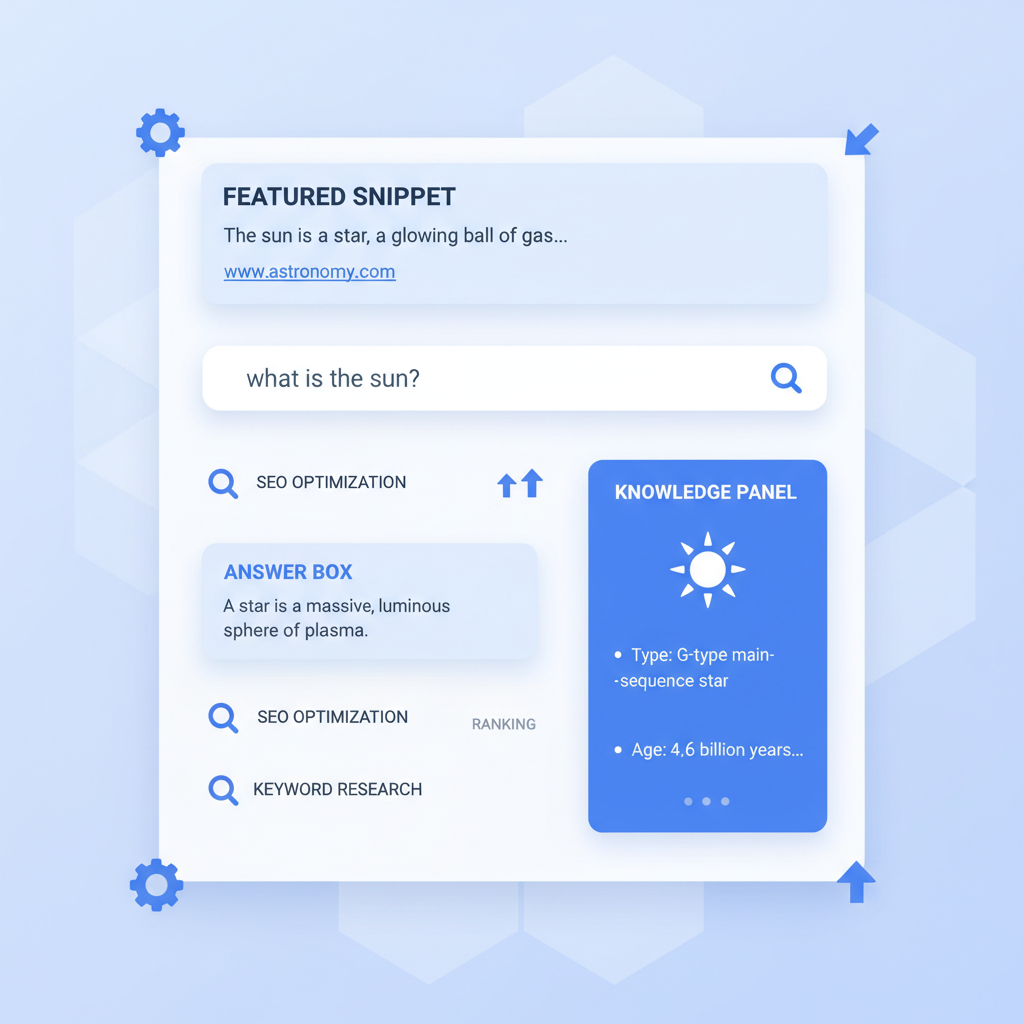
If you have ever searched for something on Google and seen a large, prominently displayed answer sitting above the traditional blue links, you have encountered a featured snippet. Known informally as “position zero,” featured snippets represent some of the most valuable real estate in search engine results - and for UK businesses investing in SEO, understanding how to win and maintain these positions can transform organic visibility, click-through rates, and ultimately revenue.
Featured snippets are not a novelty or a passing trend. They have become a core part of how Google presents information to users, particularly on informational and semi-commercial queries. For businesses operating in competitive UK markets - whether you are a managed IT provider in Manchester, an e-commerce brand in London, or a professional services firm in Edinburgh - the ability to consistently capture featured snippets means appearing above competitors who may outrank you in traditional organic results. A page ranking in position four or five can leapfrog to position zero with the right content structure, bypassing competitors who have spent thousands of pounds on link building and domain authority.
This guide covers everything you need to know about optimising for featured snippets in the UK market: the different types of snippets, how to identify opportunities, how to structure content for snippet selection, how to use schema markup, how to analyse competitor snippets, and how to track and maintain your snippet positions over time. Whether you are handling SEO in-house or working with an agency, this is the practical, no-fluff playbook for winning position zero.
What Are Featured Snippets and Why Do They Matter?
A featured snippet is a special search result that Google extracts from a web page and displays prominently at the top of the organic results, typically inside a bordered box. The snippet provides a direct answer to the searcher’s query, pulled from the content of the ranking page, along with the page title, URL, and sometimes an image. Featured snippets appear above the standard organic listings - hence the term “position zero” - and are designed to give users an immediate, concise answer without requiring them to click through to a website.
For UK businesses, featured snippets matter for three fundamental reasons. First, visibility: a featured snippet occupies significantly more screen real estate than a standard organic listing, making your brand more prominent even when competing against larger organisations with stronger domain authority. Second, credibility: Google selecting your content as the definitive answer to a query acts as an implicit endorsement, positioning your business as an authority in your space. Third, traffic: while some snippets satisfy the user’s query without a click (so-called “zero-click searches”), research consistently shows that pages holding featured snippet positions receive substantially more traffic than the same page would receive from a standard organic listing - particularly for complex queries where the snippet provides a partial answer that encourages the user to click for more detail.
Types of Featured Snippets
Not all featured snippets are created equal. Google displays different snippet formats depending on the nature of the query and the structure of the content it finds. Understanding these types is essential because the format of your content must match the snippet type Google is likely to display for your target query. There are four primary types of featured snippets that appear in UK search results.
Paragraph Snippets
Paragraph snippets are the most common type, accounting for roughly 70% of all featured snippets. They display a block of text - typically 40 to 60 words - extracted directly from a web page. Google uses paragraph snippets to answer “what is,” “why does,” and “how does” style queries where a concise textual explanation is the most appropriate response format. For example, searching “what is a managed IT service” in the UK will typically return a paragraph snippet defining the concept.
To optimise for paragraph snippets, you need to provide a clear, concise definition or explanation immediately after a heading that matches or closely mirrors the target query. The ideal paragraph snippet answer is 40–60 words, written in plain language, and directly addresses the question without preamble or filler.
List Snippets (Ordered and Unordered)
List snippets appear when the query implies a series of items, steps, or ranked entries. Google displays these as either numbered (ordered) lists for step-by-step processes, or bulleted (unordered) lists for non-sequential collections. Queries such as “how to set up a business VPN” or “best cybersecurity practices for small businesses” commonly trigger list snippets in UK SERPs.
List snippets are particularly valuable because Google often truncates them after five to eight items, displaying a “More items...” prompt that strongly encourages clicks. This makes list snippets one of the highest-CTR featured snippet formats - the user sees enough to recognise the content is useful but needs to click through to see the complete list.
Table Snippets
Table snippets display structured data in a tabular format directly within the SERP. Google extracts data from HTML tables on your page and reformats it for display. These are common for comparison queries, pricing information, technical specifications, and data-driven content. Queries such as “business broadband speeds comparison UK” or “GDPR fines by year” frequently trigger table snippets.
To win table snippets, your content must include properly structured HTML tables with clear header rows. Google can extract and reformat table data, but it will only do so if the underlying HTML is clean and semantically correct.
Video Snippets
Video snippets display a video thumbnail - almost always from YouTube - with a suggested clip timestamp that answers the query. These are increasingly common for “how to” queries where a visual demonstration is more useful than text. Google can identify specific segments within a video that answer the query, displaying a “suggested clip” with start and end timestamps.
For UK businesses, video snippets represent an under-exploited opportunity. Many competitors focus exclusively on text-based snippet optimisation, leaving video snippets relatively uncontested. Creating concise, well-structured tutorial or explainer videos with clear timestamps and transcripts can capture video snippet positions that text-only competitors cannot reach.
Identifying Featured Snippet Opportunities
Before you can win featured snippets, you need to identify which queries in your niche trigger them and where the realistic opportunities lie. A systematic approach to snippet opportunity research involves three stages: discovering snippet-triggering queries, assessing your current ranking positions, and evaluating the quality of existing snippets you could potentially displace.
Discovering Snippet-Triggering Queries
The starting point is keyword research filtered specifically for featured snippet presence. Tools such as Semrush, Ahrefs, and Moz allow you to filter keyword results by SERP features, showing only queries where a featured snippet currently appears. For UK-specific research, always set your target location to the United Kingdom and use google.co.uk as your search engine - featured snippet results can differ significantly between US and UK SERPs for the same query.
Focus on queries where you already rank in positions one through ten. Google overwhelmingly pulls featured snippet content from pages already ranking on page one - roughly 99.6% of featured snippets come from pages with a top-ten organic position. If you are not yet on page one for a query, your priority should be improving your organic ranking first before attempting to optimise for the snippet.
Assessing Current Snippet Holders
For each snippet opportunity, examine the current snippet holder’s content critically. Is the snippet answer comprehensive and accurate, or is it outdated, vague, or poorly formatted? Is the source a high-authority domain with deeply relevant content, or a generic page that happened to have the right structure? Many featured snippets in UK SERPs are held by pages with mediocre content that simply formatted one section correctly - these represent your best opportunities for displacement.
Look for featured snippets where the current answer is more than 18 months old, factually incomplete, or sourced from a page with lower domain authority than yours. These are the lowest-hanging fruit for snippet capture. Use Ahrefs or Semrush to check when the snippet-holding page was last updated - stale content is the most common vulnerability you can exploit. Also target queries where the current snippet is a paragraph but the query would be better served by a list or table - Google may prefer your better-formatted alternative.
Content Formatting for Featured Snippets
Winning a featured snippet is fundamentally about content structure. Google’s algorithms extract snippet content from pages that provide clear, well-organised answers in the format that best matches the query intent. This means your content formatting must be deliberate and strategic, not an afterthought.
The Inverted Pyramid for Paragraph Snippets
For paragraph snippets, use what journalists call the inverted pyramid: put the most important information first. Immediately after your H2 or H3 heading (which should closely match the target query), provide a concise 40–60 word answer. Then expand with supporting detail, examples, and context in the following paragraphs. Google extracts the concise answer for the snippet, while the expanded content provides the depth that supports your overall page ranking.
A common mistake is burying the answer deep in a long paragraph or prefacing it with unnecessary context. If your target query is “what is endpoint detection and response,” your content should have an H2 reading “What Is Endpoint Detection and Response?” followed immediately by a clean, direct definition - not three paragraphs of history before getting to the point.
Structured Lists for List Snippets
For list snippets, use proper HTML list elements (<ol> for steps, <ul> for collections) rather than manually numbered paragraphs. Each list item should be concise - ideally one sentence or a short phrase - with optional supporting text in a separate paragraph beneath each item. Google can extract lists from both HTML list elements and from a series of H3 headings under an H2, so both approaches work.
Include more items than Google typically displays (which is five to eight). This creates the “More items...” truncation that drives clicks. If your list naturally has only four items, consider whether you can legitimately expand it - but never pad with low-quality filler items, as this undermines the content quality that earned the snippet in the first place.
Clean HTML Tables for Table Snippets
For table snippets, the HTML structure is critical. Use proper <table>, <thead>, <tbody>, <th>, and <td> elements. Header cells must use <th> tags, not styled <td> elements. Keep tables focused - three to five columns maximum - and ensure data is current. Google will not extract a snippet from a poorly structured or excessively complex table.
Standard Content
Snippet-Optimised Content
Question-Based Content Structure
Featured snippets are overwhelmingly triggered by question-based queries. Users searching “what is,” “how to,” “why does,” “when should,” and “which is best” are the primary audience for snippet results. Structuring your content around these question patterns is one of the most effective strategies for capturing multiple snippet positions from a single page.
Using Questions as Headings
The simplest and most effective approach is to use the target question - or a close variant - as your H2 or H3 heading, followed immediately by a direct answer. Google’s snippet extraction algorithm heavily weights the relationship between the heading and the content immediately following it. A heading that precisely matches a common search query, followed by a concise answer, creates a strong signal that your content is the best snippet candidate.
For UK businesses, pay attention to how British users phrase questions. UK searchers are more likely to use “how do I” rather than “how to,” “what is the best” rather than “top,” and to include qualifiers such as “in the UK” or “for small businesses.” Incorporating these natural language patterns into your headings improves your relevance signal for UK-specific featured snippets.
The FAQ Section Strategy
Adding a dedicated FAQ section to your content pages is a proven strategy for capturing multiple featured snippets from a single URL. Each FAQ entry should use the question as an H3 heading with a concise answer immediately below. This structure serves double duty: it targets featured snippets for specific queries and it provides content that Google can use for People Also Ask (PAA) boxes, which function similarly to featured snippets and appear on many of the same SERPs.
However, avoid creating thin FAQ sections with one-sentence answers that add no value. Each answer should be substantive enough to be genuinely useful while remaining concise enough for snippet extraction - the 40–60 word range remains the target. If an answer requires more depth, provide the concise snippet-optimised answer first, then expand in a following paragraph.
Schema Markup for Featured Snippets
While schema markup (structured data) does not directly cause Google to award a featured snippet, it provides additional signals that help Google understand your content’s structure, relevance, and intent. For snippet optimisation, three schema types are particularly relevant.
FAQPage Schema
FAQPage schema marks up question-and-answer content so that Google can clearly identify the questions your page answers and the corresponding responses. Implementing FAQPage schema for your FAQ sections signals to Google that your content is specifically designed to answer these questions, which can improve your chances of snippet selection and also enables rich results in standard organic listings.
HowTo Schema
HowTo schema marks up step-by-step instructional content, identifying each step, any required tools or materials, and the estimated time to completion. For list-type featured snippets triggered by “how to” queries, HowTo schema provides Google with a structured representation of your steps that complements the HTML list structure on the page.
Article and WebPage Schema
Article schema (or its more specific variants, such as TechArticle or BlogPosting) helps Google understand the nature of your content, including the headline, author, publication date, and last modified date. The “dateModified” field is particularly important for snippet retention - Google prefers fresh content, and a recent modification date signals that your content is current and maintained.
Do not add schema markup that does not accurately reflect your page content. Google’s guidelines explicitly prohibit misleading structured data, and violations can result in manual actions that strip your rich results and potentially impact your organic rankings. If your page has three FAQ entries, mark up three FAQ entries - not ten. If your how-to guide has six steps, mark up six steps - not a fabricated twelve. Google’s algorithms are increasingly sophisticated at detecting mismatches between schema markup and actual page content, and the penalties for abuse are severe.
Competitor Snippet Analysis
Understanding why a competitor currently holds a featured snippet is the key to displacing them. Competitor snippet analysis involves examining the current snippet holder’s content structure, identifying weaknesses, and creating content that is demonstrably better in the specific ways that matter for snippet selection.
Analysing the Current Snippet
For each target snippet, document the following: the exact text Google is displaying in the snippet, the heading structure on the source page, the word count of the snippet answer, the overall content length and depth of the source page, the page’s domain authority and page authority, the page’s publication and last-modified dates, and any schema markup present. This gives you a complete picture of what Google currently considers the best answer.
Identifying Displacement Opportunities
The most common reasons a snippet can be displaced are: the current answer is outdated or contains stale statistics, the current answer is too vague or generic, the current answer’s formatting does not match the ideal snippet type for the query, the source page lacks schema markup, the source page has not been updated recently, or the source page has lower topical authority than your site on the subject.
When you identify a vulnerability, craft your competing content to specifically address it. If the current snippet answer is 80 words and rambling, write a tight 50-word alternative. If the current snippet is a paragraph but the query is clearly a “steps” question, format your answer as a numbered list. If the current snippet contains 2022 statistics, provide 2025 data. Every improvement you make over the current snippet holder increases your probability of displacement.
Tracking Featured Snippet Performance
Winning a featured snippet is only valuable if you can track the impact and maintain the position over time. Snippet tracking requires dedicated tools and processes because standard rank tracking often does not distinguish between a position-one organic ranking and a position-zero featured snippet.
Tools for Snippet Tracking
Several SEO platforms offer featured snippet tracking as part of their rank tracking modules. Semrush’s Position Tracking tool identifies which of your tracked keywords trigger featured snippets and whether your site holds them, has lost them, or has opportunities to win them. Ahrefs’ Rank Tracker provides similar functionality with historical snippet data. For budget-conscious UK businesses, SE Ranking offers snippet tracking from around £39 per month, while enterprise-grade solutions from Sistrix or Searchmetrics start from approximately £100 per month and provide more granular SERP feature analysis.
Google Search Console provides free but limited snippet data. While it does not explicitly label featured snippet impressions, you can identify potential snippet positions by looking for queries where your page shows high impressions but an average position better than 1.0 (which indicates a position-zero placement) or where click-through rates spike for specific queries.
Key Metrics to Monitor
Beyond simple win/loss tracking, monitor these metrics for your snippet positions: click-through rate (a snippet with low CTR may indicate the query is being fully answered in the SERP, reducing click incentive), impression volume (to quantify the visibility value of the snippet), organic traffic to the snippet-holding page (to measure actual business impact), and snippet stability (how frequently the snippet changes hands between you and competitors).
Snippet Volatility and Maintaining Position Zero
Featured snippets are not permanent. Google continuously re-evaluates which page provides the best snippet answer, and positions can change daily. Snippet volatility - the frequency with which snippet holders change - varies by query type, competition level, and content freshness requirements. Understanding and managing this volatility is crucial for long-term snippet strategy.
Why Snippets Change Hands
The most common causes of snippet loss are: a competitor publishes better-structured or more current content, your page content becomes outdated (particularly for queries involving statistics, pricing, or regulations), Google changes its algorithm for snippet selection, the query intent shifts (perhaps due to a news event or seasonal change), or your page experiences technical issues that affect crawlability or load speed.
Strategies for Snippet Retention
Maintaining a featured snippet position requires ongoing attention, not a one-time optimisation. Content freshness is the single most important factor - update your snippet-holding pages at least quarterly, refreshing statistics, adding new information, and updating the “dateModified” in your schema markup. Content expansion keeps your page comprehensively ahead of competitors - if your page covers eight aspects of a topic and a competitor publishes content covering twelve, Google may decide their page is more authoritative. Technical performance matters too - Core Web Vitals scores, mobile usability, and page load speed all influence snippet selection when content quality between competing pages is similar.
Set up automated alerts for your most valuable snippet positions. Both Semrush and Ahrefs offer position change alerts that notify you when you lose a featured snippet, giving you time to investigate and respond before the traffic impact becomes significant. A snippet lost on Monday and recovered by Wednesday has minimal business impact; a snippet lost and ignored for three months means thousands of lost visits and potentially hundreds of lost leads.
People Also Ask Optimisation
People Also Ask (PAA) boxes are closely related to featured snippets and appear on roughly 65% of UK Google SERPs. Each PAA result is effectively a mini featured snippet - an expandable question that, when clicked, reveals an answer extracted from a web page along with a link to the source. Optimising for PAA is a natural extension of featured snippet optimisation and can provide significant additional visibility.
How PAA Works
Google generates PAA questions dynamically based on the search query, displaying questions that users commonly ask in relation to the original search. When a user expands a PAA question, Google loads the answer and simultaneously generates additional related questions, creating an infinite-scroll effect. This means PAA boxes can expose your content to users who did not search for your specific target query but are exploring a related topic.
Optimising for PAA Inclusion
The optimisation principles are similar to featured snippets but with some important distinctions. PAA answers tend to be shorter than featured snippets - typically 30–50 words rather than 40–60. Google pulls PAA answers from a wider range of ranking positions, including pages outside the top ten, making PAA a viable target even for pages that have not yet reached page one. The question-and-answer format is even more important for PAA than for featured snippets - using the exact PAA question as an H2 or H3 heading with an immediate concise answer is the most reliable strategy.
To discover PAA questions for your niche, search for your target queries on google.co.uk and record every PAA question that appears. Also use tools like AlsoAsked.com, which maps PAA question relationships to show you the complete network of related questions Google associates with a topic. This reveals long-tail opportunities that keyword research tools alone would miss.
UK Search Behaviour Patterns
Optimising for featured snippets in the UK requires an understanding of how British searchers behave differently from their US or global counterparts. These differences affect which queries trigger snippets, how snippets should be formatted, and what content resonates with UK audiences.
Language and Spelling Differences
UK searchers use British English spellings: “optimise” not “optimize,” “organisation” not “organization,” “colour” not “color.” While Google understands these are equivalent, featured snippet content that uses British spellings performs better in UK SERPs because it more closely matches user expectations and query patterns. If your content uses American English, it may rank well organically but lose snippet positions to British English alternatives that feel more native to UK searchers.
Pricing and Currency
For queries involving costs, pricing, or financial information, UK users expect to see pounds sterling (£), not dollars. Content that provides pricing in GBP with UK-specific context - referencing HMRC, UK tax bands, or UK market rates - is significantly more likely to win featured snippets in UK SERPs than content with US dollar pricing, even if the US content is otherwise superior. This is a consistent pattern and one that many international or US-headquartered businesses overlook when targeting UK search visibility.
Regulatory and Cultural Context
UK searchers expect answers that reference UK-specific regulations (GDPR as implemented by the ICO, Companies House requirements, FCA regulations), UK institutions (NHS, HMRC, Ofcom), and UK market conditions. A featured snippet answer about data protection that references the FTC or CCPA will feel irrelevant to a UK searcher, even if the underlying principles are similar. Localising your content to reference UK-specific frameworks, case studies, and regulatory bodies is essential for snippet success in the UK market.
| Optimisation Area | Action | Priority | Estimated Impact |
|---|---|---|---|
| Heading Structure | Match H2/H3 headings to exact target queries | Critical | High - directly influences snippet extraction |
| Answer Length | Provide 40–60 word concise answers after headings | Critical | High - determines snippet text quality |
| Content Freshness | Update snippet pages quarterly with current data | High | High - stale content is the top cause of snippet loss |
| HTML Structure | Use proper <ol>, <ul>, <table> elements | High | Medium - enables list and table snippet extraction |
| Schema Markup | Implement FAQPage, HowTo, and Article schema | Medium | Medium - provides supporting signals |
| UK Localisation | Use British English, GBP, UK regulatory references | High | High - essential for UK SERP snippet selection |
| PAA Targeting | Map and answer related PAA questions on each page | Medium | Medium - additional SERP visibility channel |
| Competitor Monitoring | Track snippet holders monthly, respond to losses within days | Medium | High - prevents prolonged snippet loss |
| Page Speed | Ensure Core Web Vitals pass on all snippet-target pages | Medium | Low–Medium - tiebreaker when content is equal |
| Video Content | Create timestamped YouTube videos for how-to queries | Low | High for uncontested queries - low competition format |
Putting It All Together: A Practical Snippet Strategy
Winning featured snippets is not about a single tactic or a one-time optimisation. It is a systematic, ongoing process that combines keyword research, content structure, technical SEO, competitor analysis, and performance monitoring into a coherent strategy. For UK businesses, the approach should follow this sequence.
Phase one: research and prioritisation. Identify all queries in your niche that trigger featured snippets using Semrush or Ahrefs filtered to UK SERPs. Cross-reference with your existing rankings to find queries where you already rank in positions one through ten. Prioritise opportunities based on search volume, commercial value, and the quality of the current snippet holder.
Phase two: content optimisation. For each priority query, optimise your existing content (or create new content if needed) following the formatting principles covered in this guide. Match your content format to the expected snippet type. Use question-matching headings, concise answers, proper HTML structure, and relevant schema markup. Ensure all content uses British English, GBP pricing, and UK-specific references.
Phase three: monitoring and iteration. Set up snippet tracking for all target queries. Monitor weekly for wins and losses. When you win a snippet, document what worked. When you lose one, investigate why and respond within days. Update snippet-holding content quarterly to maintain freshness. Expand successful pages to target additional related queries and PAA questions.
The businesses that win at featured snippets in the UK are not necessarily those with the highest domain authority or the biggest content budgets. They are the businesses that treat snippet optimisation as a discipline - systematic, data-driven, and consistently executed over time. A medium-sized UK business that methodically targets 50 snippet opportunities and captures 15 of them will generate more visibility and traffic than a larger competitor that ignores snippet optimisation entirely.
Featured snippet optimisation is one of the highest-ROI activities in modern SEO. The investment is primarily in content structure and formatting - you are often optimising content you have already created, not building from scratch. The returns are immediate and measurable: higher visibility, increased click-through rates, enhanced credibility, and more qualified traffic. For UK businesses serious about organic search performance, position zero is not optional - it is essential.
Win Featured Snippets
Our SEO specialists help UK businesses capture featured snippet positions through data-driven content optimisation, technical SEO, and ongoing snippet monitoring. Whether you are looking to win your first position zero or scale an existing snippet strategy, we can help you dominate the SERPs.

CloudSwitched
London-based managed IT services provider offering support, cloud solutions and cybersecurity for SMEs.


