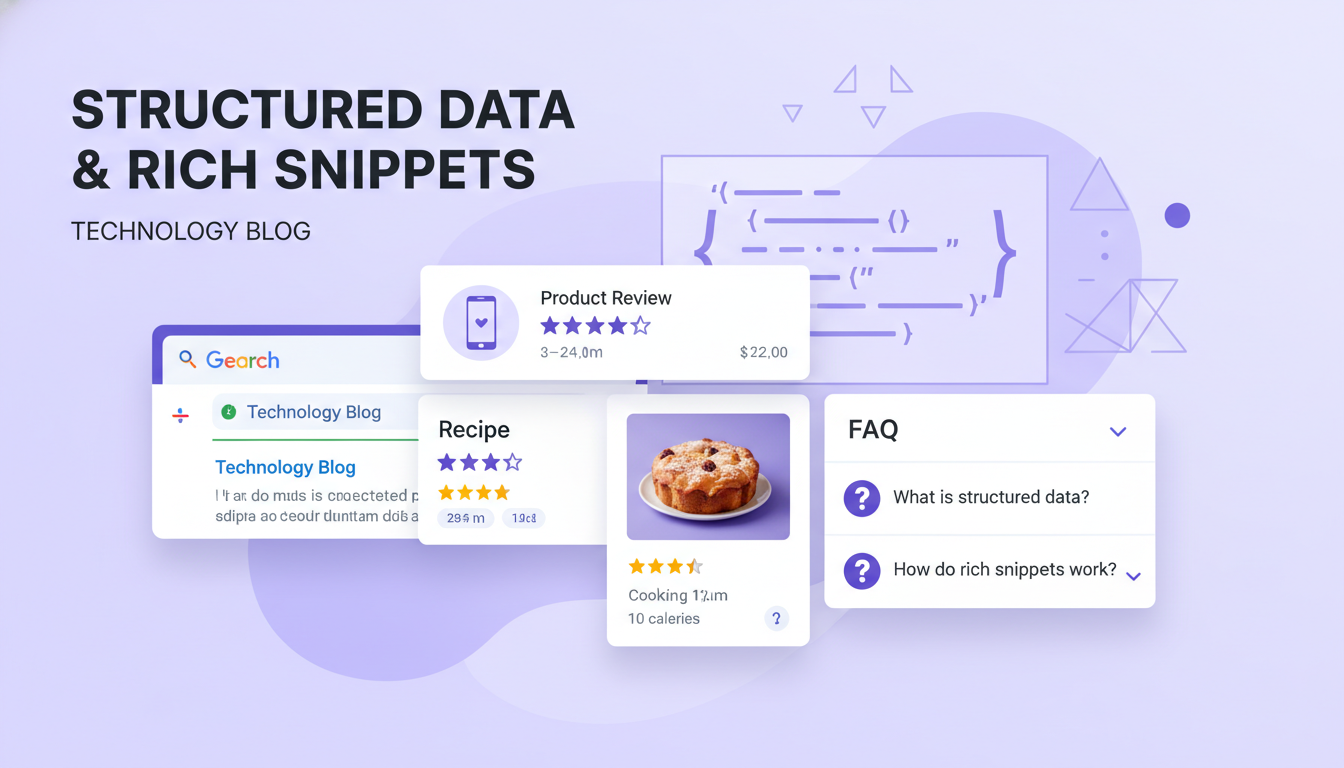
When you search for a recipe on Google and see star ratings, cooking times, and calorie counts displayed directly in the search results, you are looking at rich snippets powered by structured data. When a local business listing shows opening hours, price ranges, and review scores without you clicking through to the website, that too is structured data at work. For UK businesses serious about search engine optimisation, structured data represents one of the most powerful yet underutilised tools for increasing visibility, click-through rates, and organic traffic.
Structured data is a standardised format for providing information about a page and classifying its content. Using a vocabulary called Schema.org - maintained jointly by Google, Microsoft, Yahoo, and Yandex - you can add machine-readable annotations to your HTML that help search engines understand not just what your page says, but what it means. This deeper understanding enables search engines to present your content in enhanced, more informative ways in the search results.
This guide covers everything you need to know about structured data and rich snippets: what they are, why they matter, how to implement them, and how to measure their impact on your SEO performance.
What Are Rich Snippets and Why Do They Matter?
Rich snippets are the enhanced search result listings that display additional information beyond the standard blue link, URL, and meta description. They can include star ratings, product prices, event dates, recipe details, FAQ accordions, how-to steps, and much more. These enhanced listings occupy more visual space in the search results and provide users with valuable information before they click.
The impact of rich snippets on click-through rates is substantial. Research consistently shows that rich results generate significantly higher click-through rates than standard listings, with some studies reporting increases of 20-30% or more. In competitive search results, the visual distinction of a rich snippet can be the difference between a user clicking on your listing or a competitor's.
Beyond click-through rates, rich snippets also influence user behaviour in subtler ways. They set expectations before the click, which means users who do click through are more likely to be genuinely interested in what your page offers. This pre-qualification effect can lead to lower bounce rates, longer time on page, and higher conversion rates - all of which are positive signals for your overall SEO performance.
Understanding Schema.org and Structured Data Formats
Schema.org provides the vocabulary - the types and properties - that structured data uses. There are hundreds of schema types covering everything from articles and products to medical conditions and educational courses. Each type has specific properties that describe different aspects of the thing being described.
For example, the LocalBusiness schema type has properties for name, address, telephone number, opening hours, price range, and geographic coordinates. The Product schema type includes properties for name, description, price, availability, brand, and reviews. By populating these properties with accurate information from your page, you give search engines a structured, unambiguous understanding of your content.
JSON-LD: The Recommended Format
Structured data can be implemented in three formats: JSON-LD, Microdata, and RDFa. Google explicitly recommends JSON-LD (JavaScript Object Notation for Linked Data) as its preferred format, and for good reason. JSON-LD is added as a script block in your HTML, separate from your visible content. This separation means you can add or modify structured data without changing your page's HTML structure, making it easier to implement and maintain.
JSON-LD is also easier to read and debug than Microdata or RDFa, which require inline annotations throughout your HTML. When troubleshooting structured data issues, a clean JSON-LD block is far simpler to audit than scattered inline attributes across your page's markup.
Place your JSON-LD structured data in the <head> section of your HTML rather than the <body>. While Google can process JSON-LD anywhere on the page, placing it in the head ensures it is parsed early and avoids any potential issues with JavaScript-rendered content or late-loading elements.
Essential Schema Types for UK Businesses
While Schema.org offers hundreds of types, only a subset are commonly used and supported by Google for generating rich results. Focusing on the most impactful types for your specific business will give you the best return on your implementation effort.
Organisation and LocalBusiness
Every business website should implement Organisation schema on its homepage, and local businesses should use LocalBusiness or a more specific subtype (such as Dentist, Restaurant, or AccountingService). This schema establishes your business identity and can generate a knowledge panel - that information box that appears on the right side of search results when someone searches for your brand name.
Key properties to include are your business name, logo, address, phone number, opening hours, social media profiles, founding date, and a description. For businesses with multiple locations, implement LocalBusiness schema separately for each location, each with its own address, phone number, and opening hours.
Product and Offer
For e-commerce sites, Product schema is essential. It enables rich results that show price, availability, review ratings, and images directly in the search results. These enhanced listings are particularly powerful for product searches, where users are comparing options and the additional information helps them make faster decisions.
Ensure your Product schema includes price, currency (GBP for UK businesses), availability status, brand, product images, and aggregate rating if you have reviews. The Offer schema, nested within Product, specifies the purchasing details including price, seller, and availability.
Article and BlogPosting
Content-focused websites should implement Article or BlogPosting schema on their editorial content. This helps Google understand the article's headline, author, publication date, and featured image, and can enable enhanced presentation in Google News and Discover. Include the author's name, a link to their author page, the publication and modification dates, and the article's main image.
FAQ Page
FAQPage schema is one of the most impactful schema types for generating rich results. When properly implemented, it creates expandable question-and-answer sections directly in the search results, dramatically increasing the visual footprint of your listing. This is particularly effective for service pages and informational content where common questions are naturally addressed.
BreadcrumbList
Breadcrumb schema tells Google about your site's hierarchy and generates breadcrumb trails in search results instead of the raw URL. These breadcrumbs are more informative and more clickable than plain URLs, improving both user experience and click-through rates. They also help Google understand your site's structure, which can benefit your overall crawling and indexing.
Review and AggregateRating
Review schema enables star ratings in search results, which are among the most powerful visual cues for attracting clicks. Implement AggregateRating to show an overall rating based on multiple reviews, and individual Review schema for specific testimonials. Be careful to follow Google's guidelines - self-serving reviews (marking up testimonials about your own business on your own website) are not eligible for review rich results as of Google's 2024 policy updates.
| Schema Type | Rich Result | Best For |
|---|---|---|
| LocalBusiness | Knowledge panel, map results | Any local business |
| Product + Offer | Price, availability, ratings | E-commerce, retail |
| FAQPage | Expandable Q&A in SERP | Service pages, guides |
| Article / BlogPosting | Enhanced news/discover display | Blogs, news, content sites |
| BreadcrumbList | Breadcrumb navigation in SERP | All websites |
| HowTo | Step-by-step display | Tutorials, guides, DIY |
| Event | Date, location, ticket info | Events, conferences |
| VideoObject | Video thumbnails, duration | Video content |
Implementing Structured Data: A Step-by-Step Guide
Implementing structured data does not require advanced technical skills, but it does require attention to detail and a methodical approach. Errors in your structured data - incorrect nesting, missing required properties, or data that does not match your visible page content - can prevent rich results from appearing or even trigger manual actions from Google.
Step 1: Identify Opportunities
Start by auditing your website to identify pages where structured data could generate rich results. Product pages, service pages with FAQ sections, blog posts, location pages, and event listings are all strong candidates. Prioritise pages that already rank well or target high-value keywords, as rich results will amplify existing visibility.
Step 2: Choose the Right Schema Types
Match your page content to the most appropriate schema types. A product page should use Product and Offer schema. A blog post should use BlogPosting schema. A service page with frequently asked questions should use both Service and FAQPage schema. You can use multiple schema types on a single page when they are all relevant to the content.
Step 3: Create the JSON-LD Markup
Write your JSON-LD based on Schema.org's documentation and Google's structured data guidelines. Ensure that all required properties are included and that the data accurately reflects what is visible on the page. Google explicitly requires that structured data represents content that is visible to users - do not include information in your structured data that is not present on the page.
Never add structured data that does not match your visible page content. Google considers this a form of spam and can issue manual actions that remove your pages from search results entirely. If your Product schema says the price is £49.99, that price must be clearly displayed on the page. If your FAQPage schema includes a question, that question and its answer must be visible on the page.
Step 4: Validate Your Markup
Before deploying your structured data, validate it using Google's Rich Results Test and the Schema Markup Validator. The Rich Results Test shows you exactly how Google interprets your markup and whether it is eligible for rich results. The Schema Markup Validator checks for syntax errors and compliance with Schema.org specifications.
Test every page individually, as errors often occur in page-specific dynamic data (prices, dates, URLs) rather than in the template markup itself. Pay particular attention to required properties, correct data types (numbers should be numbers, not strings), and proper nesting of child objects.
Step 5: Deploy and Monitor
Once validated, deploy your structured data and monitor its performance in Google Search Console. The Enhancements section of Search Console provides detailed reports on your structured data, including any errors, warnings, or valid items for each schema type. Google may take days or weeks to process your structured data and begin showing rich results, so be patient.
Choosing the right structured data format is a critical decision that affects both implementation complexity and long-term maintenance. Whilst Google supports multiple formats, the practical differences between JSON-LD and Microdata are significant enough to warrant careful consideration before committing to either approach.
JSON-LD
Microdata
Common Structured Data Mistakes
Even experienced developers make mistakes with structured data implementation. Understanding the most common errors helps you avoid them and ensures your markup works as intended.
The first and most serious mistake is marking up content that does not exist on the page. This includes invisible content, content behind tabs or accordions that is not initially visible (though Google generally accepts this), and content that only appears in the structured data but not in the visible HTML. Google treats this as spammy markup and may penalise your site.
The second common mistake is using incorrect schema types. Marking up a service page with Product schema, or using Review schema for self-serving testimonials, will at best result in ineligible markup and at worst trigger a manual action. Always use the most specific and accurate schema type for your content.
The third mistake is incomplete implementation. Missing required properties prevent rich results from being generated. For example, Product schema without a price or review rating will not generate a product rich result. Check Google's documentation for each schema type's required and recommended properties.
The fourth mistake is outdated markup. Google regularly updates its structured data requirements and deprecated features. FAQ rich results, for instance, are now only shown for well-known authoritative government and health websites in some contexts - a significant change from their previous widespread availability. Stay current with Google's structured data documentation to avoid investing effort in deprecated features.
The fifth mistake is implementing structured data once and never reviewing it. As your website content changes - prices update, products go out of stock, events pass, business hours change - your structured data must be updated to match. Stale or inaccurate structured data undermines trust and can trigger errors in Google Search Console.
Structured Data and AI Search
The rise of AI-powered search experiences - Google's AI Overviews, Bing's Copilot, and various AI chatbots - is making structured data more important than ever. These AI systems rely heavily on structured, machine-readable information to generate accurate answers and cite relevant sources.
Websites with well-implemented structured data are better positioned to be cited in AI-generated responses because the AI can extract and verify specific facts from structured markup more reliably than from unstructured text alone. Product prices, business hours, event dates, and FAQ answers are all the types of discrete facts that AI systems frequently reference.
As AI search continues to evolve, structured data is likely to become the primary interface between your website and the AI systems that mediate between you and your potential customers. Investing in comprehensive, accurate structured data today positions your website for this AI-driven future.
Measuring the Impact of Structured Data
To understand whether your structured data implementation is delivering value, you need to track several metrics across multiple tools.
Google Search Console's Performance report allows you to filter by search appearance, showing you clicks, impressions, CTR, and average position specifically for pages that generated rich results versus those that did not. Compare these metrics to identify the uplift that rich results are providing.
The Enhancements reports in Google Search Console show the current status of your structured data - how many items are valid, how many have warnings, and how many have errors. Monitor these reports regularly to catch and fix issues before they impact your rich result eligibility.
Track your click-through rate at the page level before and after implementing structured data. While many factors influence CTR, significant improvements following structured data implementation are a strong indicator of positive impact. Also monitor whether your organic traffic to pages with structured data increases relative to similar pages without it.
Before advancing to more sophisticated strategies, it is worth assessing your current structured data implementation against industry benchmarks. The following metrics reflect what leading SEO practitioners consider essential thresholds for a well-optimised structured data setup across a typical UK business website.
Advanced Structured Data Strategies
Once you have the fundamentals in place, several advanced strategies can further maximise the value of your structured data implementation.
Nesting and Connecting Schema Types
Schema types can be nested within each other to create rich, interconnected descriptions. A LocalBusiness can contain an Address, GeoCoordinates, OpeningHoursSpecification, and multiple Review objects. A Product can contain Offers, AggregateRating, and Brand objects. This nesting provides search engines with a comprehensive, structured understanding of your content that flat, disconnected markup cannot match.
Using the Same Entity Across Pages
When the same entity - your business, a product, a person - appears on multiple pages, use consistent identifiers (typically URLs) to tell search engines that these are the same thing. Your Organisation schema on your homepage should reference the same entity as the author attribution on your blog posts, creating a connected web of structured information about your business.
Structured Data for Internal Linking
SiteNavigationElement schema and WebSite schema with SearchAction can help Google understand your site's navigation structure and enable a site-specific search box in your search results. These schema types improve both the user experience and Google's understanding of your site's architecture.
Automating Structured Data
For large websites with hundreds or thousands of pages, manually adding structured data is impractical. Most modern CMS platforms - WordPress, Shopify, Magento - either include structured data functionality or support plugins that automate it. For custom websites, develop templates that dynamically generate JSON-LD from your database or content management system, ensuring every page receives appropriate structured data automatically.
Unlock Rich Results for Your Website
Structured data implementation requires precision and ongoing maintenance. Our SEO team can audit your current markup, implement comprehensive schema across your website, and monitor your rich result performance to ensure maximum visibility in search results.
Explore Our SEO ServicesThe Future of Structured Data
Structured data is not a static technology - it continues to evolve as search engines develop new ways to use machine-readable information. Google regularly introduces new rich result types, retires others, and updates requirements for existing ones. Staying current with these changes is essential for maintaining and maximising the benefits of your structured data implementation.
The trend is clear: search engines are moving toward a more structured, semantic web where machines can understand content as well as humans do. Structured data is the bridge between human-readable web pages and machine-readable information. The businesses that build this bridge thoughtfully and maintain it diligently will continue to enjoy a significant competitive advantage in organic search.
For UK businesses competing in increasingly crowded search results, structured data offers a tangible, measurable way to stand out. It does not replace the need for great content, strong technical SEO, and authoritative backlinks. But layered on top of those fundamentals, it amplifies their impact and ensures that your website gets the visibility and attention it deserves.

CloudSwitched
London-based managed IT services provider offering support, cloud solutions and cybersecurity for SMEs.


