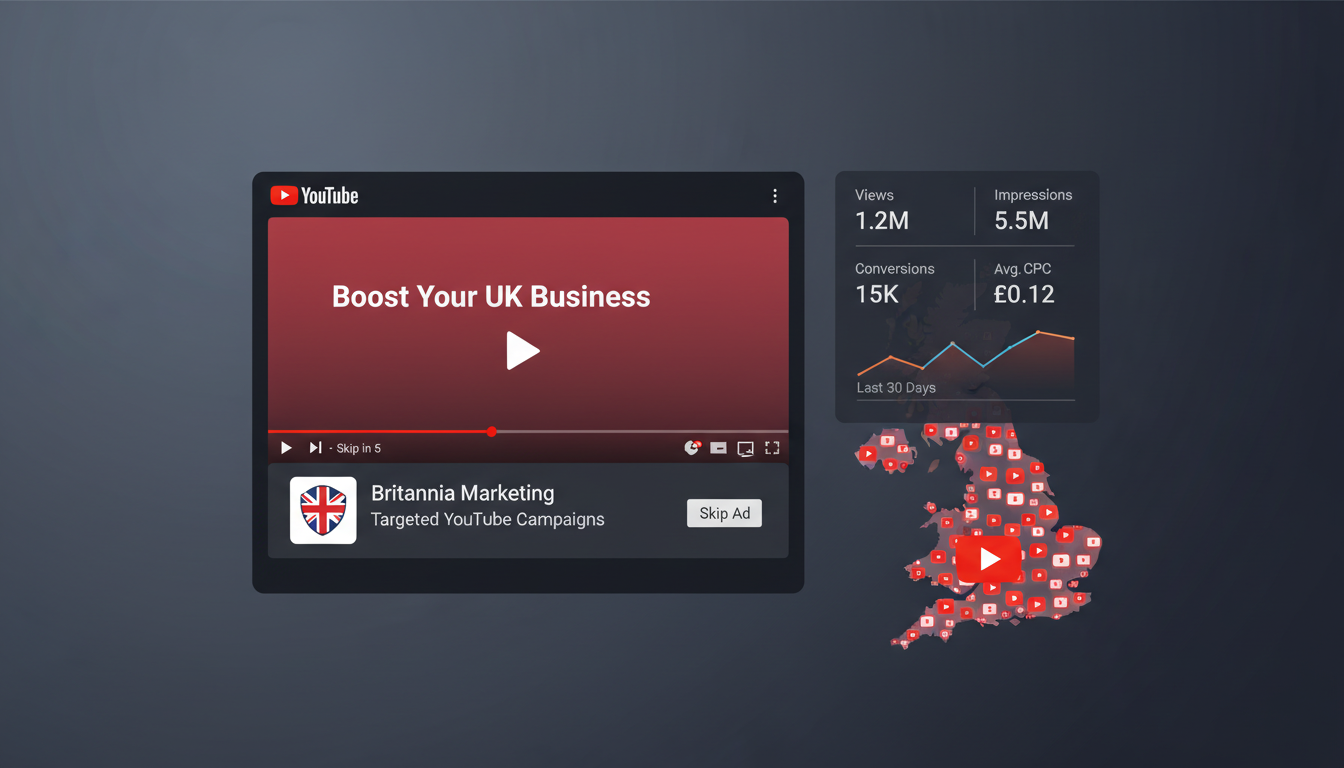
YouTube is the second largest search engine in the world and the UK's most popular video platform, with over 57 million monthly active users. For businesses, it represents a massive advertising opportunity that most UK companies are barely tapping into. While your competitors fight over expensive search keywords, YouTube advertising offers a way to reach highly engaged audiences at a fraction of the cost.
YouTube advertising operates through Google Ads, which means you get the same powerful targeting, measurement, and optimisation tools you'd use for search campaigns - applied to video. You can target by demographics, interests, search history, and even remarket to people who've visited your website. The combination of visual storytelling and precise targeting makes YouTube one of the most effective advertising platforms available to UK businesses today.
This guide covers everything you need to know to launch successful YouTube advertising campaigns, from choosing the right ad format to measuring your return on investment.
These figures underscore the sheer scale of YouTube's advertising opportunity in the United Kingdom. With over 57 million monthly active users, the platform reaches more than 80% of the UK's adult population. The average cost per view of just four pence makes it one of the most affordable video advertising channels available, and Google's own research confirms that users exposed to YouTube ads are twice as likely to convert on a subsequent search query. For UK businesses looking to stretch their marketing budgets further, these numbers represent an opportunity that is increasingly difficult to ignore.
YouTube Ad Formats Explained
YouTube offers several ad formats, each suited to different objectives. Understanding the differences is essential for choosing the right approach.
Skippable In-Stream Ads
These play before, during, or after other YouTube videos. Viewers can skip the ad after 5 seconds. You only pay when someone watches at least 30 seconds (or the full ad if it's shorter than 30 seconds) or interacts with the ad - whichever comes first.
This is the most popular format for UK advertisers because the pay-per-view model means you're only charged for genuine engagement. If someone skips at second 6, you pay nothing. This makes it exceptionally cost-effective for brand awareness campaigns.
Non-Skippable In-Stream Ads
These 15-second ads play before, during, or after a video and cannot be skipped. You pay per thousand impressions (CPM). They're ideal when your message needs to be delivered in full - product launches, special offers, or brand campaigns with a concise, punchy message.
Bumper Ads
Six-second non-skippable ads charged on a CPM basis. Think of these as digital billboards - they're perfect for reinforcing a message or maintaining brand awareness at scale. Their brevity forces creative discipline, and the best bumper ads deliver a single, memorable message.
In-Feed Video Ads
Previously called Discovery ads, these appear in YouTube search results, alongside related videos, and on the YouTube homepage. They consist of a thumbnail and text, and viewers choose to watch by clicking. You pay when someone clicks to watch your video.
These are particularly effective for how-to content, product demonstrations, and educational videos. Since the viewer actively chose to watch, engagement rates tend to be higher than in-stream formats.
YouTube Shorts Ads
Short-form vertical video ads that appear between Shorts content. With YouTube Shorts growing rapidly in the UK market, this format reaches a younger, mobile-first audience. These ads can be up to 60 seconds and are charged on a CPM basis.
| Ad Format | Length | Skippable | Pricing | Best For |
|---|---|---|---|---|
| Skippable In-Stream | 12 sec - 3 min recommended | After 5 seconds | CPV (cost per view) | Brand awareness, consideration |
| Non-Skippable In-Stream | 15 seconds | No | CPM | Full message delivery |
| Bumper | 6 seconds | No | CPM | Reach, brand reinforcement |
| In-Feed | Any length | User-initiated | CPC | Consideration, how-to content |
| YouTube Shorts | Up to 60 seconds | Varies | CPM | Mobile-first audiences |
What YouTube Advertising Costs in the UK
One of YouTube's biggest advantages is its cost efficiency compared to search advertising. Here's what UK businesses can typically expect to pay.
Compare a typical cost per view of £0.04 on YouTube with a £3 cost per click on Google Search. For the same £3,000 monthly budget, you could reach approximately 75,000 engaged viewers on YouTube versus 1,000 clicks on Search. The scale of YouTube's reach is in a completely different league.
Of course, the two channels serve different purposes - search captures active intent while YouTube builds awareness and consideration. But for many UK businesses, YouTube advertising offers remarkably good value that they're currently missing.
Targeting Options for UK Audiences
YouTube's targeting capabilities are extensive, leveraging Google's vast data ecosystem. Here's how to reach the right UK audiences.
Demographic Targeting
Target by age, gender, household income, and parental status. For UK businesses, income targeting can be particularly useful - premium service providers can focus on higher-income brackets, while budget-conscious offers can target accordingly.
Interest-Based Targeting
Affinity audiences: Reach people based on their long-term interests and lifestyle. Categories include "Technology Enthusiasts," "Business Professionals," "Home and Garden Enthusiasts," and hundreds more. These are ideal for brand awareness campaigns.
In-market audiences: Target people who are actively researching or considering purchasing specific products or services. "Business Technology," "Financial Services," "Commercial Property" - these audiences have demonstrated purchase intent through their recent search and browsing behaviour.
Custom Audiences
Create custom audience segments based on specific keywords people have searched for on Google, websites they've visited, or apps they've used. This is exceptionally powerful - you can target people who have searched for your competitors, specific industry terms, or problem-related queries on Google, and then serve them your YouTube ads.
Create a custom audience of people who have searched for your top-performing Google Search keywords but haven't clicked your ad. This captures the intent audience that Search campaigns miss, often at a much lower cost. A user who searched "managed IT support London" but didn't click your search ad might see your YouTube ad later that day - and that video touchpoint can be the difference between being shortlisted or forgotten.
Remarketing
Show ads to people who have previously interacted with your brand - website visitors, YouTube channel viewers, customer email lists, and app users. YouTube remarketing is incredibly effective for staying top-of-mind during long consideration periods, particularly for B2B and high-value B2C purchases.
Placement Targeting
Choose specific YouTube channels, videos, or even individual content topics where your ads will appear. If you know your audience watches specific industry channels or content creators, you can place your ads directly alongside that content.
Geographic Targeting
For local UK businesses, target specific cities, regions, or postcodes. A restaurant in Leeds can target viewers within a 20-mile radius. A national business can adjust bids by region based on where their customers are concentrated.
Creating Effective YouTube Ads
The creative quality of your video ad is the single biggest determinant of campaign success. A brilliantly targeted campaign with a poor video will underperform, while a compelling video with basic targeting can deliver excellent results.
The First Five Seconds
For skippable ads, those first five seconds are everything. Before the skip button appears, you need to accomplish at least one of these objectives:
Hook with a problem: "Tired of IT systems that crash every week?" immediately resonates with anyone experiencing that frustration. Problem-led openings tap into existing pain points and compel viewers to keep watching.
Hook with a benefit: "What if you could cut your IT costs by 40%?" A bold benefit statement creates curiosity about how the promise will be delivered.
Hook with surprise: An unexpected visual, statement, or scenario that breaks the pattern of what viewers expect to see. Pattern interrupts are the most effective way to prevent skipping.
Show your brand immediately. Even if someone skips at second 6, they've seen your brand. Display your logo, brand name, or product within the first three seconds so every impression has value, regardless of whether the viewer stays.
Video Structure That Converts
Effective YouTube ads follow a clear narrative structure:
Problem (seconds 1-5): Identify the viewer's pain point immediately. Make them feel understood.
Solution (seconds 5-15): Introduce your product or service as the answer. Be specific about what you offer and how it addresses their problem.
Proof (seconds 15-25): Provide evidence - customer testimonials, statistics, demonstrations, or case studies. UK audiences respond well to specific, credible proof points.
Call to action (final 5 seconds): Tell the viewer exactly what to do next. "Visit our website," "Call us today," "Get your free quote at..." Make the next step clear and simple.
Production Quality
You don't need a Hollywood budget, but you do need professional quality. Viewers associate production quality with business quality. At minimum, ensure good lighting, clear audio, and steady footage. Smartphone cameras are perfectly capable of producing professional-looking content when used correctly.
For UK businesses on a budget, consider these approaches: interview-style videos with the business owner or key team members, screen recordings for software demonstrations, animated explainer videos, or customer testimonial compilations. All of these can be produced for under £1,000 and deliver excellent results.
Campaign Setup Best Practices
How you structure your YouTube campaigns within Google Ads significantly impacts performance.
Separate Campaigns by Objective
Create distinct campaigns for brand awareness, consideration, and conversion objectives. Each uses different bidding strategies, ad formats, and targeting approaches. Combining them in a single campaign forces compromises that reduce effectiveness.
Budget Allocation
For businesses new to YouTube advertising, start with a test budget of £500-£1,000 per month. This provides enough data to evaluate performance without committing significant resources. Focus your initial spend on remarketing (highest ROI) and one prospecting audience (to test reach).
Once you've identified what works, scale gradually. A common allocation for an established YouTube strategy:
Allocate 40% to remarketing audiences (highest conversion rates), 35% to custom intent audiences (warm prospecting), and 25% to broader awareness targeting (audience building). Adjust based on your specific results - if remarketing consistently outperforms, shift more budget there.
Frequency Capping
Set frequency caps to control how often the same person sees your ads. Without caps, YouTube will repeatedly show your ads to the most engaged viewers, which can lead to ad fatigue and negative brand perception. A cap of 3-5 impressions per week per viewer is a reasonable starting point for most UK campaigns.
Bidding Strategy
For awareness campaigns, use Target CPM or Maximum CPV bidding to maximise reach. For consideration campaigns, use Maximum CPV with a focus on view rate. For conversion campaigns, use Target CPA or Maximise Conversions once you have sufficient conversion data (at least 30 conversions in 30 days).
Measuring YouTube Advertising Performance
YouTube metrics require different interpretation than search advertising metrics. Understanding what to measure - and what constitutes good performance - prevents misguided optimisation.
Key Metrics
View rate: The percentage of people who watched your ad to completion (or 30 seconds) rather than skipping. A view rate above 15% for skippable in-stream ads is considered good. Above 25% is excellent.
Cost per view (CPV): What you pay for each completed view. UK averages range from £0.02-£0.08. Lower is better, but not at the expense of audience quality.
Click-through rate (CTR): The percentage of viewers who clicked through to your website. YouTube CTRs are naturally lower than search - 0.5-2% is typical. Focus on CTR alongside view rate for a complete picture.
View-through conversions: People who saw your ad (without clicking) and then converted on your website later. This metric captures YouTube's influence on purchase decisions even when the viewer didn't click the ad directly. It's often YouTube's most valuable metric.
Brand lift: For larger campaigns, Google offers Brand Lift studies that measure the impact of your ads on brand awareness, consideration, and purchase intent through surveys. This provides definitive evidence of YouTube's branding impact.
UK YouTube Advertising Benchmarks
When evaluating your campaign performance, it helps to measure your results against established UK industry benchmarks. The following metrics represent typical performance levels across well-optimised YouTube advertising campaigns in the United Kingdom. These benchmarks are drawn from aggregate data across hundreds of UK advertiser accounts, providing a realistic reference point for assessing whether your campaigns are performing above or below the norm.
A view rate above 25% generally indicates that your creative is resonating well with the target audience. If your view rate falls below 15%, consider revisiting the first five seconds of your video or refining your audience targeting. Click-through rates on YouTube are naturally lower than search advertising, so figures below 1% should not cause alarm - the platform's strength lies in brand building and view-through conversions rather than direct clicks. The brand recall lift metric is particularly important for awareness campaigns, as it demonstrates how effectively your ads are embedding your brand in the minds of potential customers.
YouTube Advertising for Different UK Business Types
The approach varies significantly depending on your business model and audience.
Local businesses: Focus on geographic targeting and remarketing. Create videos that showcase your premises, team, and local community involvement. Local businesses often see the highest ROI from YouTube remarketing - reaching people who've already visited their website with a compelling video can dramatically boost conversion rates.
E-commerce: Use product demonstration videos and customer testimonial compilations. In-feed ads work particularly well for product-focused content. Dynamic remarketing on YouTube, showing viewers the specific products they viewed on your website, can recover abandoned browsing sessions.
B2B services: Educational content, thought leadership videos, and case study presentations. Target in-market audiences and custom intent segments. B2B YouTube ads often support longer sales cycles - they're about building trust and brand recognition rather than immediate conversions.
Professional services: Expert commentary, FAQ videos, and client success stories. Position your team as knowledgeable authorities. Solicitors, accountants, and consultants can use YouTube to build the trust that drives enquiries.
YouTube Advertising vs Traditional Television
Many UK business owners still associate video advertising with traditional television, assuming it requires substantial budgets and offers limited accountability. YouTube has fundamentally changed this equation, bringing video advertising within reach of businesses that could never have justified a television spend. The following comparison highlights the key advantages that make YouTube the superior choice for performance-driven UK advertisers who want measurable returns from their video investment.
YouTube Advertising
Traditional TV Advertising
The shift from broadcast to digital video advertising represents one of the most significant opportunities for UK businesses in recent years. With YouTube, you gain the emotional impact of video storytelling combined with the precision and measurability of digital marketing - a combination that traditional television simply cannot match. Even businesses with modest budgets can now create compelling video campaigns that reach precisely the right audience at precisely the right moment in their buying journey.
Common YouTube Advertising Mistakes
Avoid these errors that UK advertisers commonly make when starting with YouTube.
Repurposing TV ads without modification: Television ads are designed for passive viewing. YouTube viewers are engaged and one click from skipping. Adapt your creative for the platform - front-load the value, address the viewer directly, and include interactive elements.
Ignoring mobile formatting: Over 70% of UK YouTube viewing happens on mobile. Ensure your videos work well on small screens - use larger text, avoid fine details, and consider vertical or square formats for Shorts and in-feed placements.
Measuring only last-click conversions: YouTube typically influences the buyer journey rather than being the final conversion point. Judging it purely on last-click attribution drastically undervalues its contribution. Use view-through conversions and data-driven attribution models for a more accurate picture.
Starting too broad: Targeting "everyone in the UK aged 25-54" will burn through budget quickly with minimal results. Start with remarketing and narrow custom audiences, then expand as you learn what works.
Neglecting the landing page: A viewer who clicks your YouTube ad has a different mindset than someone who clicked a search ad. They've just watched a video - continue that visual experience on your landing page. Video-first landing pages that expand on the ad's narrative typically convert better than text-heavy alternatives.
Integrating YouTube With Your Search Campaigns
YouTube advertising is most powerful when it works alongside your search campaigns, not in isolation.
Use YouTube for top-of-funnel awareness, building audiences that you then remarket to on Search. Someone who watched your 30-second explainer video is far more likely to click your search ad a week later than someone encountering your brand for the first time. This "surround sound" approach - reaching the same prospects across multiple touchpoints - dramatically improves overall campaign performance.
Google's data shows that people exposed to YouTube ads are 2x more likely to convert on search. The two channels create a multiplier effect that neither achieves alone.
Track the full cross-channel journey using Google Ads attribution reports. You'll often find that campaigns which look unprofitable in isolation are actually driving significant value when you account for their influence on other channels.
Launch Your YouTube Advertising Campaign
Cloudswitched helps UK businesses harness the power of YouTube advertising - from creative strategy to campaign management. Whether you're new to video advertising or looking to improve existing campaigns, our team builds YouTube strategies that drive measurable business results.
Start Advertising on YouTube
CloudSwitched
London-based managed IT services provider offering support, cloud solutions and cybersecurity for SMEs.


