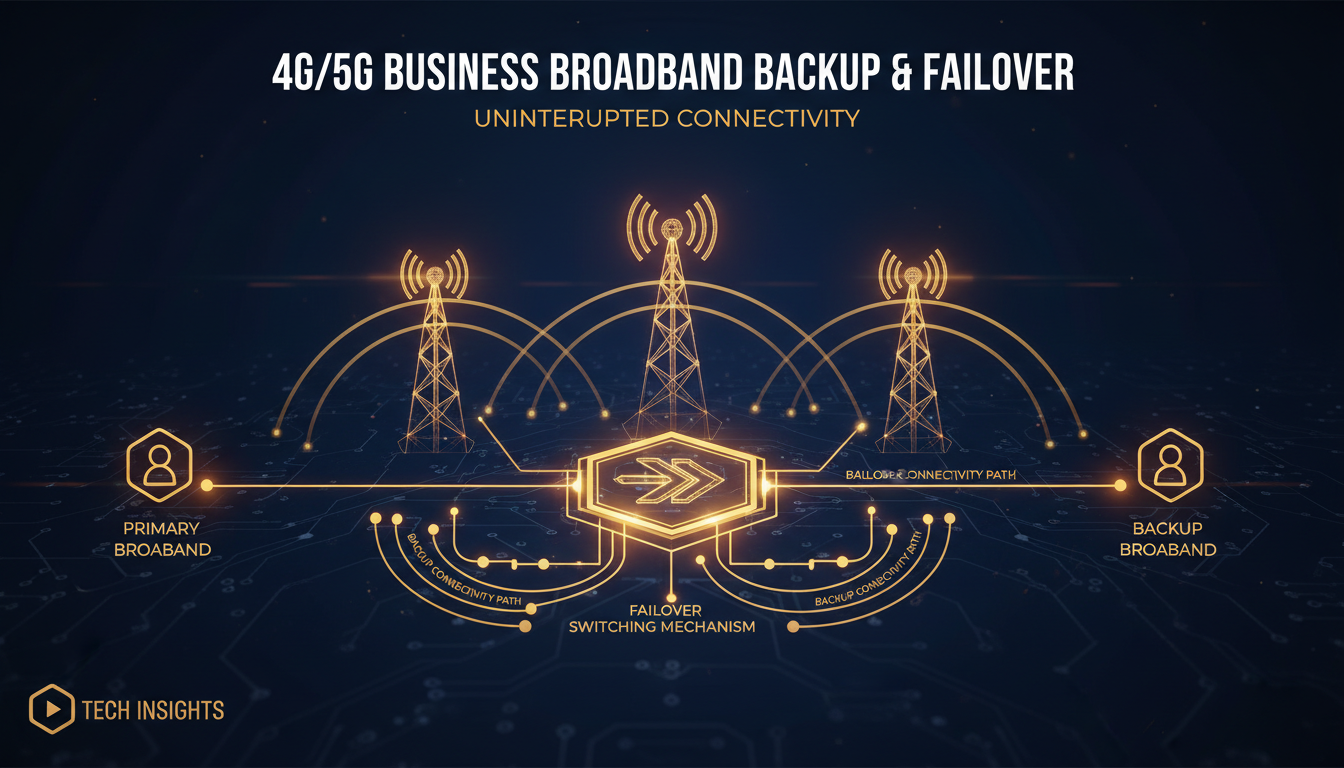
In a world where even a few minutes of downtime can cost thousands, 4G business broadband and 5G business broadband UK solutions have moved from "nice-to-have" extras to mission-critical infrastructure components. Whether you are running a logistics operation in Sheffield, managing a financial services firm in Nottingham, or coordinating a multi-site retail chain across the Midlands, the question is no longer whether you need cellular connectivity - it is how you deploy it most effectively.
Traditional fixed-line broadband, leased lines, and even MPLS network UK deployments can all suffer from the same fundamental vulnerability: a single point of failure. A digger severs a fibre cable, a local exchange fails, or a provider experiences a routing issue - and suddenly your entire operation grinds to a halt. This is precisely where 4G and 5G business broadband steps in, providing rapid-deployment backup, intelligent failover, and in many cases, a viable primary connection that rivals or exceeds what fixed-line infrastructure can deliver.
In this comprehensive guide, Cloudswitched - a London-based IT managed service provider serving businesses across the United Kingdom - breaks down everything you need to know about deploying 4G and 5G for business connectivity. From backup and failover configurations to primary connectivity use cases, from business broadband Nottingham coverage to business broadband Sheffield availability, we cover the full spectrum of what modern cellular business broadband can achieve for your organisation.
Understanding 4G Business Broadband: The Foundation of Cellular Connectivity
Before diving into specific deployment scenarios, it is worth understanding exactly what 4G business broadband entails and why it has become such a powerful tool in the modern connectivity landscape. Unlike consumer 4G services that share contended spectrum with millions of mobile phone users, business-grade 4G broadband solutions are engineered from the ground up for reliability, performance, and manageability.
A 4G business broadband connection typically utilises dedicated business SIM cards with enhanced data allowances, priority traffic routing on carrier networks, and enterprise-grade router hardware that supports features such as bonding multiple SIM connections, automatic failover, VLAN segmentation, and VPN tunnelling. The result is a connection that can deliver consistent speeds of 30–80 Mbps downstream and 10–30 Mbps upstream, with latency typically ranging from 20–50 milliseconds.
For many businesses - particularly those in areas where fibre connectivity is limited or where rapid deployment is essential - 4G business broadband provides a level of performance that more than adequately supports day-to-day operations including VoIP telephony, cloud application access, video conferencing, and point-of-sale systems.
How 4G Business Broadband Differs From Consumer Mobile Data
One of the most common misconceptions we encounter at Cloudswitched is the assumption that business 4G broadband is simply a consumer mobile hotspot dressed up in corporate packaging. The reality could not be more different, and understanding these distinctions is critical when evaluating 4G business broadband for your organisation.
| Feature | Consumer 4G | 4G Business Broadband |
|---|---|---|
| Data Allowance | Typically 10–100 GB/month | Unlimited or 500 GB–2 TB/month |
| Network Priority | Standard (deprioritised during congestion) | Enhanced priority on business tariffs |
| Static IP | Not available | Available (essential for VPN, remote access) |
| Router Hardware | Basic MiFi or phone tethering | Enterprise routers with external antennas, failover, VLAN support |
| SLA Guarantees | None | 99.9%+ uptime SLAs with defined fix times |
| Multi-SIM Bonding | Not supported | Bond 2–4 SIMs across carriers for aggregated bandwidth |
| Monitoring | Basic data usage tracking | 24/7 proactive monitoring with alerting |
| Support | Consumer helplines | Dedicated account management, 4-hour response SLAs |
When evaluating 4G business broadband providers, always ask about their backhaul arrangements with mobile network operators. The best providers have direct peering agreements with multiple UK carriers (EE, Three, Vodafone, O2), allowing them to route your traffic optimally and switch carriers dynamically if one network experiences issues in your area.
5G Business Broadband UK: The Next Generation Arrives
While 4G continues to serve as a robust and reliable connectivity solution, the rollout of 5G business broadband UK networks is fundamentally changing what is possible with cellular connectivity. With theoretical peak speeds exceeding 10 Gbps and real-world business deployments regularly achieving 500 Mbps–1.5 Gbps, 5G is positioning itself not merely as a backup technology but as a genuine primary connectivity solution that can compete with - and in many cases surpass - traditional fixed-line infrastructure.
The advantages of 5G business broadband UK extend well beyond raw speed. Ultra-low latency (often under 10 milliseconds) makes 5G suitable for real-time applications that were previously impossible over cellular networks, including industrial IoT, remote desktop sessions that feel genuinely local, and high-definition video conferencing without perceptible delay. Network slicing technology allows carriers to dedicate virtual segments of their 5G infrastructure to business customers, providing guaranteed bandwidth and quality of service that approaches what you would expect from a dedicated leased line.
For organisations looking at 5G business broadband UK as either a primary or failover solution, the technology represents a step-change in what cellular connectivity can deliver. The combination of speed, latency, and capacity means that many businesses can now consider 5G as a complete replacement for their existing fixed-line infrastructure, not merely a supplement to it.
5G Coverage Across the UK: Where We Stand in 2026
The practical value of 5G business broadband UK depends entirely on coverage availability at your specific location. While the UK's major carriers have made significant progress in their 5G rollouts, coverage remains concentrated in urban centres and along major transport corridors. Understanding the current state of 5G deployment is essential for making informed connectivity decisions.
As the chart illustrates, 5G business broadband UK coverage varies significantly by region. Businesses in business broadband Sheffield areas benefit from South Yorkshire's strong 5G buildout, with coverage now extending well beyond the city centre into commercial parks and industrial estates. Similarly, business broadband Nottingham users are seeing rapidly improving 5G availability, particularly along the city's key business corridors and in areas like the Nottingham Science Park and the Creative Quarter.
Where 5G coverage is not yet available, 4G business broadband remains an excellent alternative, with near-universal outdoor coverage across the UK. Many of the enterprise routers used in Cloudswitched deployments support both 4G and 5G, meaning your hardware investment is future-proofed - as 5G coverage reaches your location, your connection will automatically upgrade without any equipment changes.
Backup and Failover: Protecting Your Business from Downtime
The most common deployment scenario for 4G business broadband and 5G business broadband UK is as a backup or failover connection that activates automatically when your primary link fails. This configuration provides business continuity insurance at a fraction of the cost of a second fixed-line connection, and with significantly faster activation times than any wired alternative.
Failover connectivity is not a luxury - it is a fundamental requirement for any business that depends on internet access for its core operations. Whether you rely on cloud-hosted applications, process card payments, run VoIP phone systems, or simply need email and web access to function, the cost of an unplanned outage almost always exceeds the cost of implementing a proper failover solution.
How Automatic Failover Works
Modern 4G business broadband failover solutions operate transparently, switching between your primary and backup connections without any manual intervention and - in the best implementations - without users even noticing the transition. Here is how the process typically works:
Continuous Health Monitoring
The enterprise router continuously monitors the health of your primary connection using ICMP pings, HTTP probes, and DNS resolution tests to multiple targets. This multi-vector approach ensures that partial failures (e.g., DNS issues or packet loss above acceptable thresholds) are detected, not just complete link failures.
Failure Detection (0–30 seconds)
When the monitoring probes detect that your primary connection has failed or degraded below acceptable thresholds, the router triggers its failover protocol. Enterprise-grade routers can detect failures in as little as 3–5 seconds using aggressive probe intervals.
4G/5G Activation (5–15 seconds)
The router activates the 4G business broadband or 5G business broadband UK connection. If the cellular modem is kept in a warm-standby state (which we recommend), this happens almost instantly. The router establishes the cellular data session and verifies connectivity.
Traffic Rerouting (Immediate)
All network traffic is seamlessly redirected through the 4G/5G connection. VPN tunnels are re-established, DNS is updated if required, and existing sessions are maintained where possible. For most users, this manifests as a brief pause of 10–30 seconds - barely noticeable during normal working patterns.
Primary Link Recovery Monitoring
The router continues monitoring the primary connection and, once it detects stable recovery (typically requiring several consecutive successful probes over 2–5 minutes to prevent flapping), it gracefully transitions traffic back to the primary link.
Alerting and Reporting
Throughout the process, your IT team (or Cloudswitched's managed services team) receives real-time notifications about the failover event, including the cause of the primary failure, the duration of the outage, and performance metrics for the backup connection.
Configure your failover router to keep the 4G/5G modem in warm-standby mode rather than cold-standby. While this consumes a small amount of data for periodic keepalive signals, it reduces failover activation time from 30–60 seconds to under 10 seconds. For businesses running VoIP or real-time applications, this difference is critical. Cloudswitched configures all managed failover deployments with warm-standby as standard.
Failover Architecture Patterns
There are several ways to architect a 4G business broadband failover solution, each with distinct advantages depending on your existing infrastructure, budget, and resilience requirements. Understanding these patterns helps you select the right approach for your specific situation.
Active-Passive Failover
Active-Active (SD-WAN)
For most businesses deploying their first 4G business broadband failover solution, the active-passive pattern provides the best balance of protection and cost-efficiency. The backup connection only consumes data when it is actually needed, keeping monthly costs low whilst still providing robust protection against primary link failures. Organisations with more demanding resilience requirements - or those looking to maximise the value of their cellular investment - may prefer an active-active SD-WAN configuration, where both connections share the load and failover is essentially instantaneous.
MPLS Network UK: Why Businesses Are Seeking Alternatives
For decades, MPLS network UK deployments were the gold standard for multi-site business connectivity. Multiprotocol Label Switching provided guaranteed bandwidth, predictable latency, built-in quality of service, and traffic isolation that made it ideal for organisations running mission-critical applications across multiple locations. However, the landscape has shifted dramatically, and many businesses are now questioning whether the cost and complexity of an MPLS network UK deployment is still justified.
The fundamental challenge with MPLS network UK is cost. A typical MPLS circuit delivering 100 Mbps of guaranteed bandwidth between two sites in the UK can cost £800–£2,000 per month per site, with installation lead times of 60–90 days and contract terms of 3–5 years. For organisations with ten or more sites, the annual cost of maintaining an MPLS network UK infrastructure can easily exceed £200,000 - a significant expense that many businesses are finding difficult to justify when alternatives exist.
Moreover, the rigidity of MPLS network UK contracts means that businesses cannot easily scale their connectivity up or down in response to changing requirements. Opening a new branch office requires ordering a new MPLS circuit with all the associated lead times and costs. Closing a site may mean paying out the remainder of a multi-year contract. In a business environment that increasingly demands agility and flexibility, the fixed nature of MPLS is becoming a liability rather than an asset.
MPLS vs SD-WAN with 4G/5G: A Detailed Comparison
The emergence of SD-WAN technology, combined with the maturation of 4G business broadband and 5G business broadband UK services, has created a compelling alternative to traditional MPLS network UK deployments. Here is how they compare across the dimensions that matter most to UK businesses:
| Dimension | MPLS Network UK | SD-WAN + 4G/5G |
|---|---|---|
| Monthly Cost (per site, 100 Mbps) | £800–£2,000 | £150–£500 |
| Installation Lead Time | 60–90 days | 1–5 days |
| Contract Term | 3–5 years | 1–12 months (flexible) |
| Bandwidth Scalability | Requires circuit upgrade (weeks) | Add SIMs or upgrade plan (hours) |
| Quality of Service | Guaranteed (built into protocol) | Application-aware (software-defined) |
| Latency | 10–25 ms (predictable) | 15–50 ms 4G / 5–15 ms 5G |
| Redundancy | Requires dual MPLS (2x cost) | Built-in (multiple SIMs, carriers, paths) |
| Site Deployment Speed | 2–3 months | Same day possible |
| Geographic Flexibility | Fixed to building/address | Portable (can relocate with site) |
| Cloud Application Performance | Backhauled through hub (suboptimal) | Direct internet breakout per site |
| Management Complexity | High (requires specialist knowledge) | Centralised cloud management |
The cost savings alone are often sufficient to justify a migration from MPLS network UK to an SD-WAN architecture with 4G business broadband or 5G business broadband UK connectivity. But the benefits extend far beyond cost. The agility to deploy new sites in days rather than months, the ability to scale bandwidth on demand, and the inherent redundancy of multi-carrier cellular connectivity make this approach increasingly attractive to forward-thinking UK businesses.
That said, it is important to acknowledge that MPLS network UK still has valid use cases. Organisations in highly regulated industries (financial services, healthcare) that require absolute traffic isolation and contractually guaranteed performance may find that MPLS remains the appropriate choice - at least for their most critical traffic. Many Cloudswitched clients adopt a hybrid approach, maintaining MPLS for their most sensitive applications whilst migrating general internet access and less critical traffic to SD-WAN with cellular backup.
Primary Connectivity: When 4G/5G Becomes Your Main Link
While backup and failover represent the most common use cases, an increasing number of UK businesses are deploying 4G business broadband and 5G business broadband UK as their primary - and sometimes only - internet connection. This approach is particularly compelling in several specific scenarios:
Rapid deployment sites: Pop-up shops, construction sites, event venues, and temporary offices all need connectivity fast. A 4G business broadband solution can be operational within hours of a site opening, compared to weeks or months for a fixed-line installation. For businesses in the events, construction, or retail sectors, this speed of deployment can be a genuine competitive advantage.
Underserved locations: Despite ongoing investment in the UK's fibre network, there remain significant pockets - particularly in semi-rural areas around cities like Nottingham and Sheffield - where fixed-line broadband options are limited to slow ADSL connections. In these locations, 4G business broadband can deliver speeds that are five to ten times faster than the available fixed-line alternatives.
Multi-site flexibility: Businesses that frequently open, close, or relocate sites benefit enormously from the portability of cellular connectivity. There are no physical infrastructure dependencies, no long-term contracts tied to specific addresses, and no installation fees for each new location.
Performance Benchmarks: 4G vs 5G as Primary Business Connectivity
When considering 4G business broadband or 5G business broadband UK as a primary connection, understanding realistic performance expectations is critical. The following benchmarks are based on Cloudswitched's real-world deployment data across UK business sites:
These figures demonstrate that 5G business broadband UK is now more than capable of serving as a primary connection for the vast majority of business applications. Even 4G business broadband, particularly when using carrier bonding to aggregate multiple SIM connections, delivers performance that exceeds many fixed-line broadband products available to UK businesses.
Carrier Bonding: Maximising Cellular Performance
One of the most powerful techniques available for enhancing 4G business broadband performance is carrier bonding - the practice of combining multiple SIM cards from different mobile network operators into a single, aggregated connection. This technology addresses two critical challenges simultaneously: increasing available bandwidth and improving resilience through carrier diversity.
With a bonded 4G business broadband setup, your enterprise router maintains active connections across two, three, or even four different mobile networks. Traffic is distributed intelligently across these connections based on real-time performance metrics, and if any single carrier experiences issues, the remaining connections continue to carry traffic without interruption. The result is both faster and more reliable than any single-carrier solution could deliver.
How Carrier Bonding Enhances Your Connectivity
Consider a practical example. A manufacturing business in Sheffield deploys a bonded 4G business broadband solution with SIMs from EE, Three, and Vodafone. Each individual connection delivers approximately 40 Mbps downstream. With bonding, the aggregated throughput reaches 100–120 Mbps - comfortably supporting the company's ERP system, VoIP phones, and 15 concurrent users. If EE's network experiences congestion during peak hours, the router automatically rebalances traffic across Three and Vodafone, maintaining consistent performance throughout the day.
For businesses in areas with business broadband Sheffield or business broadband Nottingham requirements, carrier bonding is particularly valuable because it allows you to capitalise on the varying strengths of different mobile networks in your specific location. One carrier might have stronger coverage at your exact address due to a nearby mast, while another might perform better during peak hours due to lower local contention. Bonding lets you benefit from the best of each carrier simultaneously.
Business Broadband Nottingham: Regional Connectivity Landscape
Nottingham and the wider East Midlands region present a fascinating microcosm of the UK's connectivity challenges and opportunities. As a major regional city with a thriving business community, business broadband Nottingham demands are sophisticated and diverse - from the creative agencies in the Lace Market to the logistics firms along the A52 corridor, from the tech startups at Nottingham Science Park to the financial services companies in the city centre.
The fixed-line business broadband Nottingham landscape is a mixed picture. Central Nottingham benefits from excellent fibre coverage, with Openreach FTTP available at many business premises and alternative providers like CityFibre and Virgin Media O2 providing competitive alternatives. However, move even a few miles outside the city centre - to business parks in areas like Colwick, Beeston, or the Sherwood Business Park - and fibre availability becomes patchy. Many businesses in these locations are still reliant on FTTC connections delivering 40–80 Mbps, which may be insufficient for growing organisations with heavy cloud application usage.
This is where 4G business broadband and 5G business broadband UK solutions become particularly compelling for business broadband Nottingham users. EE's 5G network now covers much of central Nottingham and is expanding into the surrounding commercial areas. Three's 5G rollout, while slightly behind, is progressing well along the key business corridors. For businesses in areas not yet reached by 5G, bonded 4G business broadband from Cloudswitched provides a reliable, high-performance alternative that can be deployed within days.
Nottingham Business Connectivity Options Compared
For businesses evaluating their business broadband Nottingham options, here is how the available technologies compare in practice for a typical Nottingham business location:
| Technology | Typical Speed (Down/Up) | Monthly Cost | Install Time | Availability |
|---|---|---|---|---|
| ADSL2+ | 10–17 Mbps / 1 Mbps | £25–£40 | 10–14 days | Near-universal |
| FTTC (VDSL) | 40–80 Mbps / 10–20 Mbps | £35–£60 | 10–14 days | Good (city/suburbs) |
| FTTP (Full Fibre) | 100–1,000 Mbps / 100–1,000 Mbps | £45–£150 | 14–30 days | Expanding (city centre strong) |
| Leased Line | 100–10,000 Mbps (symmetric) | £200–£1,500+ | 45–90 days | Most business areas |
| 4G Business Broadband (Bonded) | 60–150 Mbps / 15–40 Mbps | £80–£200 | 1–3 days | Near-universal |
| 5G Business Broadband | 300–1,200 Mbps / 50–150 Mbps | £100–£250 | 1–3 days | City centre, expanding |
Cloudswitched's recommended approach for business broadband Nottingham clients is typically a hybrid configuration: a cost-effective fixed-line connection (FTTP where available, FTTC otherwise) as the primary link, with a bonded 4G business broadband or 5G business broadband UK solution providing automatic failover. This combination delivers both the bandwidth and the resilience that modern Nottingham businesses require, without the cost and complexity of a traditional leased line or MPLS network UK deployment.
Business Broadband Sheffield: Steel City Connectivity Solutions
Sheffield's unique geography and business landscape create distinct connectivity requirements that make 4G business broadband and 5G business broadband UK solutions particularly relevant. Built across seven hills and bisected by multiple river valleys, Sheffield presents challenges for traditional fixed-line infrastructure that do not exist in flatter cities. Cable ducting is more expensive to install, fibre routes are more circuitous, and some business locations - particularly those in the city's industrial areas along the Don Valley - have historically been underserved by fixed broadband providers.
At the same time, Sheffield's business community has undergone a remarkable transformation. The Advanced Manufacturing Research Centre (AMRC), the Sheffield Digital cluster, and the city's growing professional services sector all demand high-performance, reliable business broadband Sheffield solutions. The ongoing regeneration of areas like Kelham Island, the Heart of the City development, and the expansion of Sheffield Business Park are creating new demand for connectivity that needs to be delivered quickly and flexibly - exactly the characteristics that cellular broadband excels at providing.
The business broadband Sheffield picture is further complicated by the city's industrial heritage. Many business premises in Sheffield are located in converted industrial buildings where installing new fixed-line infrastructure can be prohibitively expensive or structurally challenging. A 4G business broadband solution, requiring only a router and an external antenna, can be installed in these environments in a matter of hours - delivering reliable connectivity without the need for any structural modifications to the building.
Sheffield 5G Coverage and Deployment
5G business broadband UK coverage in Sheffield has progressed rapidly, with all four major UK carriers now offering 5G services in the city centre and expanding into surrounding commercial areas. For business broadband Sheffield users, this means that 5G is increasingly viable as both a primary and failover connectivity option.
EE leads the business broadband Sheffield 5G rollout with coverage spanning the city centre, Meadowhall, and extending along the main arterial routes. Three has deployed 5G across much of the city centre with particularly strong coverage along the A61 corridor. Vodafone's 5G network covers key business areas including the Digital Campus and Sheffield Hallam University business precinct. O2's 5G rollout, while the most recent, is expanding steadily into commercial zones across the city.
For Sheffield businesses in areas not yet covered by 5G - and there remain many, particularly in the outlying industrial estates - bonded 4G business broadband continues to provide an excellent solution. The topography that makes fixed-line installations challenging in Sheffield actually works in favour of cellular connectivity in many cases, as elevated business locations often enjoy strong line-of-sight to multiple mobile masts, resulting in excellent 4G performance.
If your Sheffield business premises is in a converted industrial building with thick walls that attenuate cellular signals, an external antenna installation can dramatically improve performance. Cloudswitched's site survey service for business broadband Sheffield clients includes a comprehensive signal analysis that identifies the optimal antenna placement and carrier selection for your specific location, ensuring maximum performance from your 4G business broadband or 5G solution.
SIM-Based Failover: The Simplest Path to Resilience
For businesses that need a straightforward, cost-effective failover solution without the complexity of a full SD-WAN deployment, SIM-based failover represents the simplest entry point into 4G business broadband resilience. This approach involves adding a 4G/5G-capable router alongside your existing networking equipment, configured to activate automatically when your primary broadband connection fails.
SIM-based failover is particularly popular among smaller businesses and branch offices where the primary connectivity requirement is modest (under 100 Mbps) and where the cost of a more sophisticated solution cannot be justified. It is also an excellent starting point for organisations that want to test the viability of 4G business broadband before committing to a larger cellular deployment.
Single-SIM vs Multi-SIM Failover
When configuring a SIM-based failover solution, one of the first decisions is whether to deploy a single SIM or multiple SIMs. This choice has significant implications for both cost and resilience:
Single-SIM failover is the most cost-effective option, requiring only one business SIM card and a compatible router. It provides protection against your primary fixed-line connection failing, but introduces a single point of failure at the mobile network level - if the carrier you have selected experiences an outage, your failover will not function. For businesses in areas with strong, reliable coverage from a single carrier, this trade-off is often acceptable.
Multi-SIM failover uses a router with two or more SIM slots, each connected to a different mobile network operator. This provides protection against both fixed-line failures and carrier-specific mobile network outages. In the event that your primary broadband and one mobile carrier both fail simultaneously, the remaining carrier(s) provide continued connectivity. For businesses where downtime is simply not an option, multi-SIM failover is the recommended approach.
Cost Analysis: Building the Business Case for Cellular Connectivity
One of the most compelling aspects of 4G business broadband and 5G business broadband UK solutions is their cost-effectiveness relative to the alternatives. Whether you are evaluating cellular connectivity as a backup, failover, or primary solution, the numbers consistently demonstrate strong return on investment.
Cost of Downtime vs Cost of Protection
The starting point for any connectivity investment analysis should be the cost of downtime to your organisation. While this varies significantly by industry and business size, research consistently shows that even small businesses incur substantial costs when their internet connection fails:
Now compare these costs against the monthly investment required for a 4G business broadband failover solution. A managed, enterprise-grade failover deployment from Cloudswitched - including hardware, multi-carrier SIM, monitoring, and support - typically costs between £80 and £250 per month depending on data requirements and configuration complexity. That means a single hour of downtime prevented pays for between four months and two and a half years of failover protection. For most businesses, the payback period is measured in days or weeks of uptime gained.
Total Cost of Ownership: Cellular vs Traditional Alternatives
When comparing the total cost of ownership over a three-year period, the advantages of cellular connectivity become even more pronounced:
| Solution | Year 1 (Inc. Setup) | Year 2 | Year 3 | 3-Year Total |
|---|---|---|---|---|
| Second Leased Line (Backup) | £15,600 | £12,000 | £12,000 | £39,600 |
| MPLS Secondary Circuit | £14,400 | £10,800 | £10,800 | £36,000 |
| 4G Business Broadband (Bonded Failover) | £3,000 | £2,400 | £2,400 | £7,800 |
| 5G Business Broadband (Primary) | £3,600 | £3,000 | £3,000 | £9,600 |
The three-year savings of choosing a 4G business broadband failover solution over a second leased line amount to over £30,000 per site. For multi-site organisations migrating from an MPLS network UK deployment, the cumulative savings can be transformative - freeing up budget for investment in other areas of the business whilst actually improving connectivity resilience.
Use Cases: Real-World Deployments Across Industries
To illustrate the practical value of 4G business broadband and 5G business broadband UK solutions, here are examples of how Cloudswitched has deployed cellular connectivity for businesses across various industries and regions - including business broadband Nottingham and business broadband Sheffield deployments.
Retail Chain: Multi-Site 4G Failover
A national retail chain with 45 UK locations, including stores in Nottingham and Sheffield, needed to ensure that their point-of-sale systems and stock management application remained operational even during broadband outages. Each store relied on a single FTTC broadband connection, and the company was experiencing an average of two to three outages per store per year, each lasting between one and four hours. With revenue losses of approximately £800 per hour per store during outages, the annual impact was significant.
Cloudswitched deployed 4G business broadband failover routers at all 45 locations, configured with dual-SIM (EE and Three) for carrier resilience. The solution included centralised monitoring, automatic failover with sub-30-second activation, and monthly performance reporting. Within the first year, the system successfully handled 127 primary connection failures across the estate, with an average failover time of 12 seconds and zero lost transactions. The total annual cost of the failover infrastructure was less than the revenue lost from two hours of downtime at a single store.
Professional Services Firm: MPLS to SD-WAN Migration
A professional services firm with offices in London, Birmingham, Nottingham, and Sheffield was spending over £180,000 annually on an MPLS network UK deployment connecting their four offices. The MPLS contract was approaching renewal, and the firm was seeking a more cost-effective and flexible alternative that could support their growing reliance on cloud-hosted applications including Microsoft 365, their practice management system, and a cloud-based telephony platform.
Cloudswitched designed and implemented an SD-WAN solution using a combination of FTTP primary connections and bonded 4G business broadband at each site. The business broadband Nottingham and business broadband Sheffield offices both utilised dual-carrier bonded 4G as both a secondary WAN link for SD-WAN load balancing and an automatic failover path. Site-to-site connectivity was secured using encrypted SD-WAN tunnels with application-aware routing that prioritised voice and video traffic.
The result: a 68% reduction in annual connectivity costs (from £180,000 to £57,600), improved application performance due to direct cloud breakout at each site (no longer backhauling cloud traffic through the London hub), and superior resilience with each site having two diverse connectivity paths. The migration was completed in under three weeks, with zero downtime during the transition.
Construction Company: Portable Primary Connectivity
A Sheffield-based construction company needed reliable internet access at each of their project sites - temporary locations that could be anywhere in the UK, lasting from three months to two years, with no notice of exactly where the next site would be. Traditional broadband was impractical due to long installation lead times and the temporary nature of the sites, while consumer mobile broadband lacked the reliability and management features the company required.
Cloudswitched provided a fleet of pre-configured 4G business broadband routers with ruggedised enclosures, external antennas, and triple-carrier SIM bonding. Each router was configured with the company's VPN credentials and network policies, meaning a site manager could deploy full connectivity by simply powering on the router and mounting the antenna - a process taking approximately 30 minutes. The routers provided 80–120 Mbps of aggregated bandwidth, supporting site offices with 10–20 users running project management software, email, and video conferencing.
Choosing a Provider: What to Look For
The 4G business broadband and 5G business broadband UK market has matured significantly, with a wide range of providers offering varying levels of service, from basic SIM-only packages to fully managed enterprise solutions. Choosing the right provider is critical to ensuring you get the performance, reliability, and support your business requires.
Essential Evaluation Criteria
When evaluating providers for 4G business broadband, 5G business broadband UK, or any cellular connectivity solution, consider the following criteria:
Multi-carrier capability: The best providers are carrier-agnostic, maintaining direct relationships with all four major UK mobile network operators (EE, Three, Vodafone, O2). This allows them to select the optimal carrier - or combination of carriers - for your specific location, and to switch carriers without hardware changes if network conditions change.
Enterprise-grade hardware: Look for providers that deploy commercial-grade router hardware (Peplink, Cradlepoint, Draytek, or similar) rather than consumer-grade equipment. Enterprise routers support critical features including external antenna connections, multi-SIM bonding, advanced failover logic, VLAN segmentation, and centralised cloud management.
Proactive monitoring: Your provider should be monitoring your connections 24/7, not waiting for you to report a problem. Proactive monitoring means your provider knows about issues before you do, and can often resolve them before they impact your business - or at least have a fix in progress by the time you call.
Site survey and optimisation: Reputable providers will conduct a thorough site survey before deployment, including signal strength testing across all carriers, antenna placement planning, and an assessment of any environmental factors that might affect performance. This is particularly important for business broadband Sheffield and business broadband Nottingham deployments where building construction, terrain, and local network conditions vary significantly between locations.
SLA-backed service: Ensure your provider offers service level agreements that define guaranteed uptime, response times, and resolution targets. A provider that does not offer SLAs for their 4G business broadband or 5G business broadband UK service is, in effect, making no promises about the quality of service you will receive.
Scalability: Your connectivity needs will evolve over time. Choose a provider that can scale with you - whether that means adding more sites, upgrading from 4G to 5G as coverage improves, increasing data allowances, or transitioning from a simple failover deployment to a full SD-WAN architecture.
SD-WAN Integration: The Intelligent Overlay
Software-Defined Wide Area Networking (SD-WAN) represents the most sophisticated way to integrate 4G business broadband and 5G business broadband UK into your connectivity infrastructure. Rather than treating cellular as a simple backup that sits idle until needed, SD-WAN allows you to use all available connections - fixed-line, 4G, 5G, MPLS - as a unified, intelligently managed network fabric.
SD-WAN's application-aware routing engine continuously monitors the performance of each available connection (latency, jitter, packet loss, throughput) and steers individual application flows to the best-performing path in real time. Voice traffic might be routed over the connection with the lowest latency, bulk file transfers over the link with the highest throughput, and critical business applications over whichever path currently offers the best combination of speed and reliability.
For businesses currently operating an MPLS network UK environment, SD-WAN with cellular connectivity offers a phased migration path. You can overlay SD-WAN on top of your existing MPLS infrastructure, add 4G business broadband or 5G business broadband UK as additional transport links at each site, and then gradually reduce your MPLS dependency as you gain confidence in the new architecture. Many Cloudswitched clients have completed full MPLS network UK decommissions within 12–18 months of beginning their SD-WAN migration, with connectivity costs falling by 50–75% in the process.
SD-WAN Configuration Best Practices with 4G/5G
When integrating 4G business broadband or 5G business broadband UK connections into an SD-WAN architecture, several configuration best practices can significantly improve performance and reliability:
Traffic classification and prioritisation: Define clear traffic policies that align with your business priorities. Voice and video should always receive priority routing with dedicated bandwidth guarantees. Cloud application traffic should be steered to the best-performing path. Non-critical traffic (software updates, backups) should use whatever capacity is available without competing with business-critical applications.
Data management: If your 4G business broadband SIMs have data caps, configure your SD-WAN to be intelligent about cellular data consumption. Route large, non-urgent data transfers (backups, software updates) exclusively over fixed-line connections. Use cellular primarily for real-time, interactive traffic where the latency and availability benefits justify the data consumption.
Path quality thresholds: Configure appropriate thresholds for when the SD-WAN should shift traffic between paths. Too-sensitive thresholds will cause excessive path flapping; too-lenient thresholds will mean traffic continues flowing over degraded paths. Start with conservative thresholds and tune based on real-world performance data.
Security Considerations for Cellular Business Connectivity
Security is a legitimate consideration when deploying 4G business broadband and 5G business broadband UK solutions, and one that deserves careful attention rather than dismissal or excessive alarm. Modern cellular business broadband, when properly configured, is at least as secure as - and in some respects more secure than - fixed-line alternatives.
At the network level, 4G LTE and 5G NR both incorporate strong encryption (128-bit AES for 4G, 256-bit for 5G) between the device and the base station. SIM-based authentication ensures that only authorised devices can connect to the network, and mutual authentication in 5G prevents rogue base station attacks that were theoretically possible in earlier cellular generations.
At the application level, the same security best practices that apply to any internet connection apply equally to cellular broadband. All traffic should be encrypted using VPN tunnels or TLS/SSL. Access control policies should be enforced at the router level. Firewalling should be comprehensive and actively managed. And remote management interfaces should be secured with strong authentication and, ideally, restricted to specific source IP addresses.
Where cellular connectivity actually offers security advantages is in its physical resilience. A 4G business broadband connection cannot be compromised by cutting a cable in the street - a surprisingly common cause of connectivity loss that can also potentially expose traffic on physically compromised fixed-line connections. Cellular's over-the-air transmission also makes it inherently more difficult to tap or intercept than copper or fibre cables that run through accessible ducting and manholes.
Future-Proofing Your Connectivity Strategy
The connectivity landscape is evolving rapidly, and any investment you make today should be evaluated not just on current performance but on its ability to adapt to future requirements. Fortunately, 4G business broadband and 5G business broadband UK solutions are inherently well-suited to future-proofing, for several reasons.
Technology evolution: The progression from 4G to 5G, and eventually to 5G Advanced and 6G, is a software and spectrum evolution - not a wholesale infrastructure replacement. Enterprise routers designed for 5G business broadband UK today will benefit from ongoing network improvements through software updates and network-side enhancements, without requiring hardware replacement. Multi-mode routers that support both 4G and 5G ensure that your investment remains relevant regardless of which generation provides the best coverage at your location.
Flexibility and portability: Unlike fixed-line infrastructure that is permanently tied to a specific address, 4G business broadband equipment can be redeployed, relocated, or reconfigured as your business needs change. Open a new office? Move your existing router. Close a site? Return the equipment to your pool for redeployment elsewhere. This flexibility is invaluable in a business environment where agility and adaptability are competitive necessities.
Scalable architecture: Whether you start with a simple single-SIM failover solution or deploy a full multi-site SD-WAN with bonded cellular connectivity, the architecture is inherently scalable. Adding capacity is as simple as adding SIMs. Adding sites requires only shipping a pre-configured router. Upgrading from 4G to 5G happens automatically as coverage becomes available. There are no long-term contracts, no infrastructure dependencies, and no vendor lock-in to limit your future options.
Deployment Planning: A Step-by-Step Approach
Whether you are deploying 4G business broadband as a failover solution for a single site or rolling out 5G business broadband UK across a multi-site estate, a structured deployment approach ensures optimal results. Here is the methodology that Cloudswitched follows for all cellular connectivity deployments:
Phase 1: Assessment and Design
Every successful deployment begins with a thorough understanding of your current connectivity landscape, business requirements, and site-specific conditions. This phase typically takes one to two weeks and includes:
Current state audit: Documenting all existing connectivity - primary broadband, backup links, MPLS network UK circuits, VPN configurations, and any existing cellular solutions. Understanding what you have today is essential for designing what you need tomorrow.
Requirements gathering: Defining bandwidth requirements by application, acceptable latency and jitter thresholds, uptime requirements, and any compliance or regulatory constraints that might influence the solution design.
Site survey: For each location, conducting signal strength testing across all carriers, identifying optimal antenna placement, assessing power and rack space availability, and documenting any site-specific challenges (building construction materials, nearby interference sources, elevation, and line-of-sight to mobile masts).
Solution design: Based on the assessment findings, designing the optimal configuration - single SIM or bonded, active-passive or active-active, standalone failover or SD-WAN integrated, and specifying the exact hardware, SIM cards, and carrier combinations for each site.
Phase 2: Procurement and Configuration
Once the design is approved, Cloudswitched procures and pre-configures all equipment in our lab environment before any site visits occur. This approach minimises on-site installation time and ensures that routers arrive at each location fully configured with:
Network settings (VPN credentials, VLAN configurations, firewall rules), failover parameters (probe targets, threshold settings, activation timings), monitoring agent configuration, SIM cards activated and tested, and remote management access verified.
Phase 3: Installation and Testing
On-site installation of a 4G business broadband solution typically takes two to four hours, including antenna mounting, cable routing, router installation, integration with existing network infrastructure, and comprehensive testing. For business broadband Nottingham and business broadband Sheffield deployments, we schedule installations to minimise disruption to your business operations - typically outside core working hours if required.
Testing includes verifying cellular performance across all deployed carriers, confirming failover activation and recovery, testing VPN connectivity over the cellular path, running application-specific tests (VoIP call quality, cloud application responsiveness), and documenting baseline performance metrics for ongoing comparison.
Phase 4: Monitoring and Optimisation
Deployment is not the end of the process - it is the beginning of ongoing management and optimisation. Cloudswitched's managed service includes 24/7 proactive monitoring of all cellular connections, automatic alerting on performance degradation, monthly performance reporting, and periodic optimisation based on real-world usage patterns and evolving network conditions.
Regulatory and Compliance Considerations
For businesses in regulated industries, the use of 4G business broadband and 5G business broadband UK for business connectivity raises legitimate questions about data sovereignty, encryption standards, and regulatory compliance. Here is what you need to know:
Data routing: All UK mobile network operators route domestic traffic within the UK. Your 4G business broadband data does not leave the country unless it is specifically destined for an international endpoint. This is important for businesses subject to data residency requirements under UK GDPR and similar regulations.
Encryption: As noted earlier, both 4G and 5G incorporate strong encryption at the air interface. For businesses requiring additional encryption (PCI DSS compliance, legal privilege, healthcare data), VPN tunnels over the cellular connection provide an additional layer of protection that satisfies even the most stringent regulatory requirements.
Audit and logging: Enterprise-grade 4G business broadband routers support comprehensive logging of all connection events, failover activations, and traffic flows. This audit trail can be essential for demonstrating compliance with industry regulations and for forensic analysis in the event of a security incident.
Business continuity compliance: Many regulatory frameworks (FCA for financial services, CQC for healthcare, ISO 27001 for information security) require organisations to demonstrate business continuity provisions including connectivity resilience. A properly documented 4G business broadband failover solution directly supports compliance with these requirements.
Common Misconceptions About Cellular Business Broadband
Despite the maturity and proven track record of 4G business broadband and 5G business broadband UK solutions, several misconceptions persist that can prevent businesses from realising the benefits of cellular connectivity. Let us address the most common ones:
"4G/5G is unreliable." This perception often stems from experience with consumer mobile data on congested networks. Business-grade cellular broadband with enterprise hardware, external antennas, and multi-carrier bonding delivers reliability levels of 99.9%+ - comparable to or exceeding many fixed-line business broadband services. Network-level reliability is further enhanced by the inherent redundancy of multi-carrier configurations, where the failure of any single carrier is automatically compensated by the remaining connections.
"Cellular data is too expensive for business use." While per-gigabyte costs for cellular data are higher than fixed-line broadband, business 4G business broadband tariffs offer unlimited or very high data allowances at fixed monthly costs that compare favourably with alternative resilience solutions. A bonded 4G failover solution at £150–£250 per month is dramatically less expensive than a second leased line or MPLS circuit.
"5G requires new hardware every few years." Modern 5G business broadband UK routers are designed to support the full 5G roadmap through software updates. The hardware you deploy today will benefit from ongoing 5G network improvements - including carrier aggregation enhancements, network slicing, and coverage expansion - without requiring replacement.
"Cellular broadband cannot support VoIP." This was arguably true in the early days of 3G, but modern 4G business broadband with properly configured quality of service delivers excellent VoIP performance. Latency of 20–50 ms on 4G (under 15 ms on 5G) is well within the acceptable range for voice communications, and enterprise routers can prioritise voice traffic to ensure consistent call quality even under load.
"We need MPLS for multi-site connectivity." While MPLS network UK was historically the only option for reliable multi-site connectivity, SD-WAN with cellular transport now provides equivalent or superior performance at a fraction of the cost. Application-aware routing, encrypted tunnels, and dynamic path selection give SD-WAN capabilities that MPLS cannot match - including the ability to optimise traffic for cloud applications that were not even a consideration when most MPLS deployments were designed.
Environmental and Sustainability Benefits
An often-overlooked advantage of 4G business broadband and 5G business broadband UK solutions is their environmental impact - or rather, their relative lack of it compared to fixed-line alternatives. Deploying cellular connectivity avoids the environmental cost of trenching, ducting, and cable-laying required for new fixed-line installations. It also reduces the overall amount of physical infrastructure required to deliver connectivity, as mobile networks serve many users from shared base stations rather than requiring individual physical connections to each premises.
For businesses with sustainability commitments, the ability to deploy and redeploy 4G business broadband equipment across multiple sites over its lifetime - rather than abandoning fixed-line infrastructure when a site closes - represents a more circular approach to connectivity infrastructure. Enterprise routers have typical operational lifespans of 7–10 years, during which they can serve multiple locations and purposes, maximising the return on both financial and environmental investment.
Getting Started with Cloudswitched
Whether you are looking for a simple 4G business broadband failover solution for a single site, evaluating 5G business broadband UK as a primary connectivity option, planning an MPLS network UK migration, or need reliable business broadband Nottingham or business broadband Sheffield connectivity, Cloudswitched provides the expertise, technology, and managed service capabilities to deliver the right solution for your business.
As a London-based IT managed service provider with extensive experience across the UK, we understand that every business has unique connectivity requirements. Our approach always begins with understanding your specific needs - your applications, your locations, your budget, and your resilience requirements - and then designing a solution that addresses those needs precisely. We do not sell one-size-fits-all packages; we engineer solutions that work for your business.
Our managed 4G business broadband and 5G business broadband UK services include enterprise-grade hardware from leading manufacturers, multi-carrier SIM cards with business-grade data allowances, professional installation with site survey and antenna optimisation, 24/7 proactive monitoring and alerting, dedicated account management, and monthly performance reporting. Whether you need connectivity for one site or one hundred, we have the scale and expertise to deliver.
Ready to Eliminate Downtime and Modernise Your Business Connectivity?
Cloudswitched designs and manages 4G/5G business broadband solutions for organisations across the UK - from simple failover deployments to full MPLS replacement architectures. Book a free connectivity consultation to discuss your requirements and discover how cellular broadband can transform your business resilience.

CloudSwitched
London-based managed IT services provider offering support, cloud solutions and cybersecurity for SMEs.


