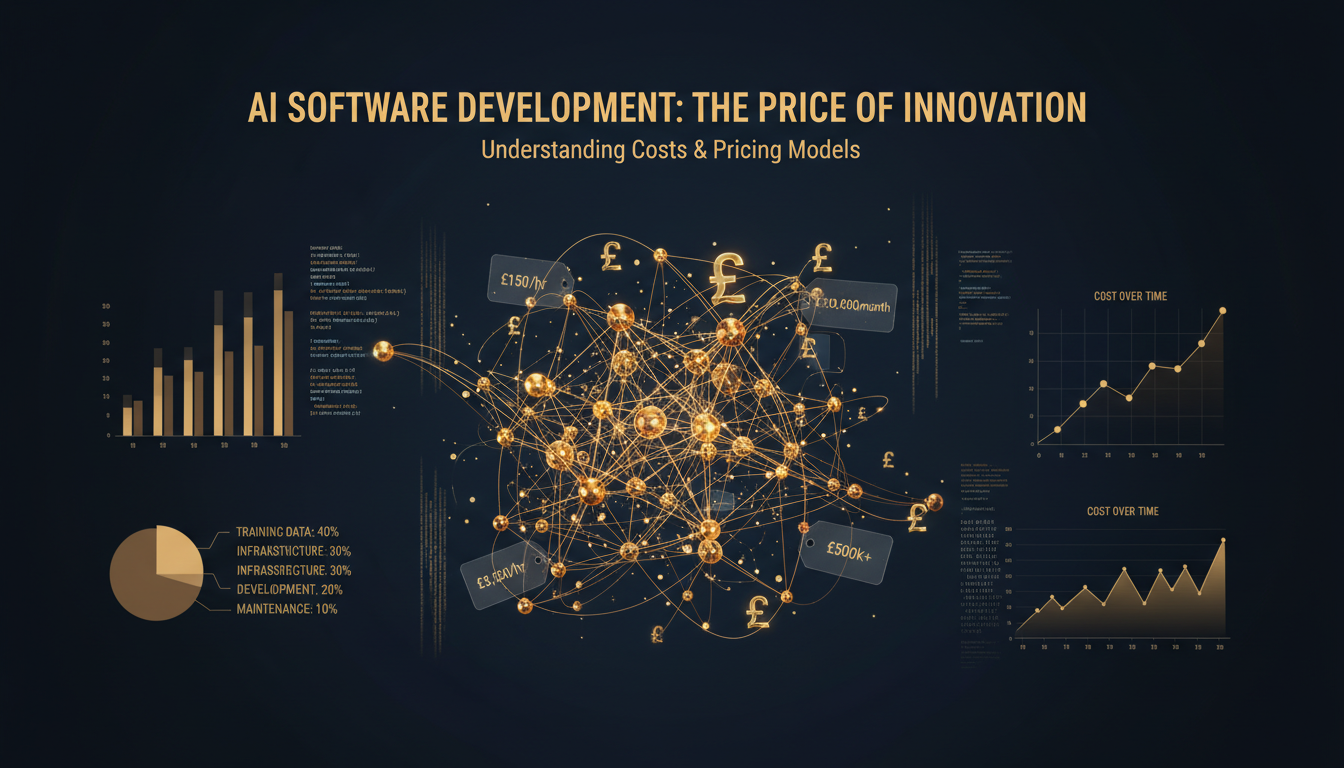
Artificial intelligence is no longer a futuristic novelty reserved for Silicon Valley giants. In 2026, UK businesses of every size - from ambitious startups in Manchester to established enterprises in the City of London - are actively investing in AI software development to streamline operations, enhance customer experiences, and gain competitive advantages. Yet one question consistently tops every boardroom discussion: how much does AI software development actually cost in the UK?
The answer, as with most technology investments, is nuanced. AI app development UK projects can range from a few thousand pounds for a straightforward chatbot to well over half a million for a fully custom, enterprise-grade predictive analytics platform. This comprehensive 2026 pricing guide breaks down every factor that influences cost, explores pricing models, reveals hidden expenses, and provides practical frameworks to help you budget accurately and maximise your return on investment.
Understanding the UK AI Development Landscape in 2026
The UK’s AI sector has matured significantly. Government-backed initiatives, the AI Safety Institute’s evolving regulatory frameworks, and a thriving ecosystem of development agencies, consultancies, and freelancers have created a competitive market for AI software development services. Whether you require custom AI agent development for customer service automation or bespoke workflow automation UK solutions for back-office processes, there is no shortage of providers.
However, this abundance of choice can make it harder to compare quotes and understand what constitutes fair pricing. Costs are influenced by the provider’s location, the complexity of the AI models involved, the volume and quality of training data required, and the depth of integration with your existing systems. London-based agencies typically command a premium, whilst regional providers in cities like Birmingham, Leeds, and Edinburgh often offer competitive rates without sacrificing quality.
Before requesting quotes, document your business problem thoroughly. Agencies can provide far more accurate estimates when they understand the specific workflow you want to automate, the data sources available, and the success metrics you intend to measure. A well-written brief can reduce initial estimate variance by up to 40%.
AI Software Development Costs by Project Type
The single biggest determinant of cost is the type of AI solution you need. Below, we break down the four most common categories of AI app development UK businesses invest in, with realistic 2026 price ranges.
1. Conversational AI & Chatbots
Chatbots remain one of the most accessible entry points into AI. However, there is an enormous gap between a simple FAQ bot and a sophisticated conversational AI agent capable of handling nuanced customer interactions, escalating to human agents, and learning from each conversation.
| Chatbot Complexity | Features | Estimated Cost | Timeline |
|---|---|---|---|
| Basic FAQ Bot | Rule-based, limited responses, single channel | £5,000 – £15,000 | 2–4 weeks |
| AI-Powered Chatbot | NLP understanding, multi-channel, CRM integration | £15,000 – £50,000 | 6–12 weeks |
| Custom AI Agent | Multi-turn reasoning, tool use, knowledge base, learning | £40,000 – £120,000 | 3–6 months |
| Enterprise Conversational Platform | Multi-agent orchestration, omnichannel, analytics, compliance | £100,000 – £300,000+ | 6–12 months |
Custom AI agent development has become particularly popular in 2026, as businesses seek agents that can autonomously handle complex workflows - booking appointments, processing returns, conducting research, or managing internal IT support tickets. Unlike simpler chatbots, these agents require sophisticated prompt engineering, tool integration, and extensive testing to ensure reliable performance.
2. Process Automation & Workflow AI
Bespoke workflow automation UK projects focus on eliminating manual, repetitive tasks across your organisation. From invoice processing and employee onboarding to supply chain optimisation and compliance monitoring, AI-driven automation can deliver transformative efficiency gains.
| Automation Scope | Examples | Estimated Cost | Timeline |
|---|---|---|---|
| Single Process | Invoice extraction, email classification | £8,000 – £30,000 | 3–6 weeks |
| Multi-Process Workflow | End-to-end order processing, HR onboarding pipeline | £30,000 – £80,000 | 2–4 months |
| Department-Wide Automation | Finance operations suite, customer service automation | £80,000 – £200,000 | 4–8 months |
| Enterprise Orchestration | Cross-departmental AI workflows, decision intelligence | £200,000 – £500,000+ | 8–18 months |
Bespoke workflow automation UK solutions typically deliver the fastest ROI of any AI project type, as they directly reduce labour costs and processing times. Many Cloudswitched clients see payback within 6 to 12 months of deployment.
3. Predictive Analytics & Machine Learning
Predictive analytics projects involve training custom machine learning models on your historical data to forecast future trends, identify risks, or optimise decision-making. These projects tend to be more expensive due to the data engineering, model training, and validation work required.
| Analytics Complexity | Examples | Estimated Cost | Timeline |
|---|---|---|---|
| Basic Predictive Model | Churn prediction, demand forecasting (single variable) | £15,000 – £40,000 | 4–8 weeks |
| Advanced ML Pipeline | Multi-variable forecasting, anomaly detection, recommendation | £40,000 – £120,000 | 3–6 months |
| Real-Time Analytics Platform | Live fraud detection, dynamic pricing, real-time personalisation | £120,000 – £350,000 | 6–12 months |
| Enterprise AI/ML Platform | MLOps infrastructure, model registry, automated retraining | £250,000 – £500,000+ | 9–18 months |
4. Document Processing & Intelligent Data Extraction
AI-powered document processing uses optical character recognition (OCR), natural language processing (NLP), and large language models to extract, classify, and act upon information within unstructured documents - contracts, invoices, medical records, legal filings, and more.
| Document AI Scope | Features | Estimated Cost | Timeline |
|---|---|---|---|
| Template-Based Extraction | Fixed-format documents, structured fields | £10,000 – £25,000 | 3–5 weeks |
| Intelligent Document Processing | Variable formats, entity extraction, classification | £25,000 – £75,000 | 2–4 months |
| End-to-End Document Workflow | Ingestion, extraction, validation, routing, archiving | £75,000 – £180,000 | 4–8 months |
| Enterprise Content Intelligence | Multi-document reasoning, compliance checks, audit trails | £150,000 – £400,000+ | 6–14 months |
AI Internal Tools Development: Building Smarter Operations
One of the fastest-growing segments of AI internal tools development UK is the creation of bespoke internal applications that leverage AI to enhance productivity within your organisation. Unlike customer-facing AI products, internal tools prioritise integration with existing systems, ease of adoption by your team, and measurable operational improvements.
Common AI internal tools include:
- Intelligent search and knowledge bases - allowing employees to query company documentation, policies, and historical data using natural language
- Automated reporting dashboards - AI-generated insights from disparate data sources, updated in real time
- Internal AI assistants - custom AI agent development for IT helpdesk, HR queries, or compliance checks
- Data quality and enrichment tools - automated cleansing, deduplication, and enrichment of CRM or ERP data
- Meeting intelligence - automated transcription, summarisation, and action item extraction from meetings
| Internal Tool Type | Complexity | Estimated Cost | Typical ROI Timeline |
|---|---|---|---|
| AI-Powered Knowledge Base | Medium | £20,000 – £60,000 | 3–6 months |
| Internal AI Assistant / Agent | Medium–High | £30,000 – £90,000 | 4–8 months |
| Automated Reporting Platform | Medium | £25,000 – £70,000 | 2–5 months |
| Data Quality & Enrichment Suite | High | £40,000 – £120,000 | 6–12 months |
| Meeting Intelligence System | Medium | £15,000 – £45,000 | 1–3 months |
AI internal tools development UK projects are particularly attractive because they offer clear, quantifiable benefits: reduced time-to-information, fewer manual errors, and measurable productivity improvements. They also tend to be lower risk than customer-facing AI, as any teething issues affect internal workflows rather than customer experience.
Start your AI internal tools development with a single high-impact use case - such as automating a manual process that consumes significant staff time. A successful pilot builds internal confidence and makes it far easier to secure budget for broader AI adoption across the organisation.
Pricing Models: Fixed Price, Time & Materials, or Retainer?
How your AI development project is priced can significantly affect both total cost and project outcomes. The three dominant pricing models in the UK market each have distinct advantages and risks.
Time & Materials
Fixed Price
Monthly Retainer
Typical UK Day Rates for AI Development (2026)
| Role | London Day Rate | Regional UK Day Rate | Nearshore/Offshore |
|---|---|---|---|
| AI/ML Engineer | £650 – £1,200 | £500 – £900 | £250 – £500 |
| Data Scientist | £600 – £1,100 | £450 – £850 | £200 – £450 |
| Data Engineer | £550 – £950 | £400 – £750 | £200 – £400 |
| AI Solutions Architect | £800 – £1,500 | £600 – £1,100 | £350 – £600 |
| Full-Stack Developer (AI integration) | £500 – £900 | £400 – £700 | £200 – £400 |
| UX/UI Designer (AI interfaces) | £450 – £800 | £350 – £650 | £150 – £350 |
| Project Manager / Scrum Master | £500 – £850 | £400 – £650 | £200 – £400 |
For AI projects, Time & Materials generally outperforms Fixed Price. AI development is inherently iterative - model performance depends on data quality, which is often only fully understood once development begins. T&M allows the team to pivot training approaches, experiment with different model architectures, and optimise without the constraints of a rigid scope document.
Factors That Influence AI Development Cost
Beyond project type and pricing model, numerous technical and commercial factors affect the total cost of AI app development UK projects. Understanding these enables more accurate budgeting and helps you avoid costly surprises.
1. Project Complexity & Model Requirements
The sophistication of the AI model or models required is often the primary cost driver. A rule-based system with simple decision trees costs a fraction of a solution requiring custom-trained large language models, computer vision models, or multi-modal AI systems.
2. Data Requirements & Preparation
Data is the fuel for any AI system, and preparing it is frequently the most time-consuming (and therefore costly) phase of development. Key data-related cost factors include:
- Data availability: Do you already have the data needed, or must it be collected, purchased, or generated?
- Data quality: How clean, consistent, and well-structured is your existing data?
- Data volume: More data generally means better models, but also higher processing and storage costs
- Data labelling: Supervised learning models require labelled training data, which can be expensive to produce
- Data privacy & compliance: GDPR and UK data protection requirements may necessitate anonymisation, consent management, and data governance processes
Data preparation typically accounts for 30% to 50% of total project effort in AI development. Businesses with clean, well-organised data can save tens of thousands of pounds compared to those requiring extensive data engineering.
3. Integration Complexity
Every AI system must connect to your existing technology ecosystem. The number, type, and quality of integrations significantly affect cost. Connecting to modern APIs with good documentation is far less expensive than integrating with legacy systems, proprietary databases, or platforms with limited API support.
| Integration Scenario | Typical Additional Cost | Complexity |
|---|---|---|
| Single modern API (e.g., Slack, Salesforce) | £2,000 – £5,000 per integration | Low |
| Multiple SaaS platforms | £8,000 – £25,000 | Medium |
| Legacy system or on-premises database | £15,000 – £40,000 per system | High |
| Real-time data streaming integration | £20,000 – £60,000 | High |
| Custom middleware / ETL pipeline | £25,000 – £80,000 | Very High |
4. Model Selection: Build, Fine-Tune, or Use APIs?
A critical architectural decision that profoundly impacts cost is whether to build custom models from scratch, fine-tune existing open-source models, or leverage commercial AI APIs (such as those from OpenAI, Anthropic, Google, or Mistral).
For most UK businesses, a hybrid approach works best: use commercial APIs for general-purpose capabilities (text generation, summarisation, translation) and fine-tune or train custom models only where proprietary data creates a genuine competitive advantage.
5. Security, Compliance & Governance
UK businesses must comply with the UK GDPR, the Data Protection Act 2018, and emerging AI-specific regulations. Depending on your industry, additional requirements from the FCA, NHS, ICO, or sector-specific bodies may apply. Building compliant AI systems adds cost but is non-negotiable.
Typical compliance-related costs include:
- Data Protection Impact Assessments (DPIAs): £3,000 – £10,000
- AI ethics review and bias testing: £5,000 – £25,000
- Audit trail and explainability features: £10,000 – £40,000
- Ongoing compliance monitoring: £2,000 – £8,000 per month
Custom AI Development London vs Regional UK Pricing
Location has a meaningful impact on custom AI development London costs versus those in other UK regions. The London premium reflects higher operating costs, greater competition for talent, and the concentration of enterprise clients willing to pay top rates.
However, choosing a London agency is not simply about paying more. Custom AI development London providers often bring advantages in terms of access to a larger talent pool, proximity to major enterprises and financial institutions, and experience with complex, high-stakes projects. For regulated industries such as financial services, healthcare, and legal, the depth of London-based compliance expertise can justify the premium.
Regional UK agencies, meanwhile, have significantly closed the quality gap. Cities like Manchester, Bristol, Edinburgh, and Cambridge now host thriving AI ecosystems with highly skilled teams offering competitive rates. Remote and hybrid working arrangements, accelerated by the pandemic, have further levelled the playing field.
| Factor | London Agency | Regional UK Agency | Offshore / Nearshore |
|---|---|---|---|
| Day Rates | £650 – £1,500 | £400 – £1,100 | £150 – £600 |
| Enterprise Experience | Extensive | Growing | Variable |
| Regulatory Knowledge (UK) | Deep | Good | Limited |
| Talent Pool Depth | Very Large | Moderate | Large but variable quality |
| Communication & Timezone | Seamless | Seamless | Challenging |
| On-Site Availability | Easy | Possible | Rarely |
Consider a blended approach: engage a London-based firm like Cloudswitched for architecture, strategy, and compliance-sensitive components, whilst leveraging regional or specialist teams for implementation work. This optimises both quality and cost-effectiveness.
Hidden Costs of AI Software Development
Many UK businesses underestimate the total cost of ownership for AI solutions by focusing solely on initial development. The following hidden costs frequently catch organisations off guard and should be factored into every AI budget.
Training Data Acquisition & Preparation
If your existing data is insufficient, you may need to acquire additional training data through purchase, manual labelling, or synthetic data generation. Professional data labelling services in the UK typically cost £0.05 to £2.00 per labelled item, depending on complexity. A dataset of 50,000 labelled examples could therefore cost £2,500 to £100,000.
Ongoing Model Tuning & Monitoring
AI models are not “set and forget.” They degrade over time as the data they encounter in production drifts from the data they were trained on. Budget for ongoing model monitoring, periodic retraining, and performance optimisation. This typically costs £2,000 to £10,000 per month depending on the number and complexity of models in production.
Infrastructure & Compute Costs
Running AI models requires computing infrastructure, whether cloud-based (AWS, Azure, GCP) or on-premises. Training costs can be particularly significant for custom models, whilst inference costs accumulate with usage volume.
Full Cost Breakdown Over 3 Years
| Cost Category | Year 1 | Year 2 | Year 3 | 3-Year Total |
|---|---|---|---|---|
| Initial Development | 60–75% of total | 0% | 0% | 30–40% |
| Infrastructure / Compute | 10–15% | 25–30% | 25–30% | 20–25% |
| Model Monitoring & Retraining | 5–10% | 20–25% | 20–25% | 15–20% |
| Feature Enhancements | 5% | 15–20% | 15–20% | 12–15% |
| Support & Maintenance | 5% | 10–15% | 10–15% | 8–12% |
| Compliance & Governance | 5% | 5–10% | 5–10% | 5–8% |
When evaluating AI development quotes, always ask for a 3-year total cost of ownership estimate, not just the initial build cost. A cheaper initial build that requires expensive ongoing maintenance or lacks proper monitoring can cost significantly more over the medium term.
Bespoke Workflow Automation UK: Cost Deep Dive
Bespoke workflow automation UK projects represent one of the most accessible and impactful ways to introduce AI into your organisation. Unlike flashy customer-facing AI, workflow automation quietly transforms how your team operates day to day, eliminating bottlenecks, reducing errors, and freeing valuable staff time for higher-value work.
The cost of bespoke workflow automation UK depends heavily on the number of steps in the workflow, the systems involved, exception handling requirements, and the level of AI intelligence required at each decision point.
Workflow Automation Cost by Complexity
Example: AI-Powered Invoice Processing Automation
Consider a mid-sized UK professional services firm processing 5,000 invoices per month. A bespoke workflow automation UK solution might include:
- AI-powered document ingestion and OCR extraction
- Automated matching against purchase orders
- Anomaly detection for duplicate or unusual invoices
- Approval routing based on value thresholds and department
- Integration with accounting software (Xero, Sage, or SAP)
- Dashboard for finance team oversight
| Component | Estimated Cost |
|---|---|
| Discovery & Design | £5,000 – £8,000 |
| Document AI / OCR Development | £15,000 – £25,000 |
| Workflow Engine & Business Logic | £12,000 – £20,000 |
| Accounting System Integration | £5,000 – £12,000 |
| Dashboard & Reporting | £6,000 – £10,000 |
| Testing & Deployment | £4,000 – £8,000 |
| Total | £47,000 – £83,000 |
At 5,000 invoices per month, with an average manual processing cost of £4.50 per invoice reduced to £0.80 with AI automation, the annual saving would be approximately £222,000 - delivering ROI within 3 to 5 months.
Custom AI Agent Development: What to Expect
Custom AI agent development has emerged as one of the most transformative and sought-after categories of AI software development in 2026. Unlike traditional chatbots or simple automation scripts, AI agents are autonomous systems capable of reasoning, planning, using tools, and executing multi-step workflows with minimal human oversight.
The cost of custom AI agent development varies dramatically based on the agent’s autonomy level, the tools it needs to access, the complexity of its decision-making, and the safety guardrails required.
AI Agent Complexity Tiers
| Tier | Capabilities | Example Use Cases | Estimated Cost |
|---|---|---|---|
| Tier 1: Reactive Agent | Responds to queries, accesses knowledge base, follows scripts | FAQ agent, internal helpdesk | £15,000 – £40,000 |
| Tier 2: Task Agent | Executes defined tasks, uses tools, handles exceptions | Appointment booking, order processing, data entry | £35,000 – £80,000 |
| Tier 3: Reasoning Agent | Multi-step planning, context awareness, adaptive behaviour | Research assistant, sales qualification, compliance review | £70,000 – £150,000 |
| Tier 4: Orchestrator Agent | Manages sub-agents, makes strategic decisions, self-improves | Operations management, multi-channel marketing, supply chain | £120,000 – £300,000+ |
What Drives Custom AI Agent Development Costs
Several factors are unique to agent development compared to traditional software:
- Tool integration complexity: Each tool the agent can use (email, CRM, databases, APIs) must be carefully integrated, tested, and safeguarded
- Safety and guardrails: Autonomous agents require robust guardrails to prevent unintended actions, especially when they can modify data or communicate with customers
- Prompt engineering and testing: Significant effort goes into crafting system prompts, testing edge cases, and optimising the agent’s reasoning
- Evaluation and monitoring: Custom evaluation frameworks are needed to measure agent performance and detect degradation
- Human-in-the-loop design: Defining when and how the agent should escalate to a human requires careful UX design
AI App Development UK: Building Customer-Facing Products
AI app development UK covers the creation of customer-facing applications and products powered by artificial intelligence. Whether you are building a SaaS product with AI at its core, adding AI features to an existing mobile app, or creating an entirely new AI-powered platform, costs are driven by user experience requirements, scalability needs, and the depth of AI integration.
AI App Development Cost Ranges
| App Type | Description | Estimated Cost | Timeline |
|---|---|---|---|
| AI Feature Addition | Adding AI capabilities (search, recommendations) to existing app | £15,000 – £50,000 | 4–10 weeks |
| AI-Powered MVP | Minimum viable product with core AI functionality | £40,000 – £100,000 | 2–4 months |
| Full AI Application | Complete product with multiple AI features, polished UX | £100,000 – £250,000 | 4–9 months |
| Enterprise AI Platform | Multi-tenant, highly scalable, advanced AI capabilities | £250,000 – £600,000+ | 9–18 months |
AI app development UK projects require careful attention to user experience, as AI interactions (such as waiting for model responses, handling uncertainty, and presenting AI-generated content) introduce unique UX challenges. Budget for thorough user testing and iterative design refinement.
For AI-powered products, start with an MVP that tests your core AI hypothesis before investing in a full build. An AI MVP costing £40,000–£60,000 can validate whether your target users value the AI functionality before you commit £200,000+ to a comprehensive platform.
ROI Calculation: Making the Business Case for AI
Every pound spent on AI software development should be justified by measurable business returns. Whilst the upfront costs may seem significant, well-executed AI projects consistently deliver strong returns over the medium term.
AI ROI Framework
Use this framework to calculate the potential ROI of your AI investment:
Step 1: Quantify Current Costs
Measure the full cost of the process or function you intend to augment with AI. Include labour costs (salaries, overtime), error costs (rework, corrections, penalties), opportunity costs (delays, missed revenue), and tool/software costs currently in use.
Step 2: Estimate AI-Driven Savings
Based on similar implementations and your development partner’s experience, estimate the percentage reduction in each cost category. Conservative estimates typically project 40–70% labour reduction, 60–90% error reduction, and 30–50% processing time improvement.
Step 3: Calculate Total Investment
Include all costs: initial development, data preparation, infrastructure, training, change management, and ongoing maintenance for the projection period (typically 3 years).
Step 4: Project Net Benefits
Subtract total investment from total savings over the projection period. Factor in revenue growth if AI enables new capabilities or improved customer experience. Apply a discount rate for time value of money.
Step 5: Calculate Payback Period
Determine when cumulative benefits exceed cumulative costs. Well-executed AI projects typically achieve payback within 8–18 months. Workflow automation projects often achieve payback even faster, within 3–8 months.
ROI Benchmarks by AI Project Type
| Project Type | Typical Annual Savings | Average Payback Period | 3-Year ROI |
|---|---|---|---|
| Workflow Automation | £50,000 – £500,000 | 3–8 months | 250–400% |
| Customer Service AI | £30,000 – £300,000 | 6–14 months | 200–350% |
| Document Processing | £40,000 – £250,000 | 4–10 months | 250–400% |
| Predictive Analytics | £100,000 – £1,000,000+ | 8–18 months | 200–500% |
| Internal AI Tools | £20,000 – £200,000 | 4–12 months | 200–350% |
Budget Planning: A Practical Framework
Effective budget planning for AI software development requires a structured approach that accounts for all phases of the project lifecycle. The following framework, refined through hundreds of UK AI projects, provides a reliable foundation for your planning.
Phase-Based Budget Allocation
Budget Planning Checklist
Use this checklist to ensure your AI development budget is comprehensive:
- Discovery phase costs: Workshops, requirements gathering, data audit, feasibility assessment
- Data costs: Acquisition, cleaning, labelling, storage, ongoing data pipeline maintenance
- Development costs: Model development, application development, integration work
- Infrastructure costs: Cloud compute for training, inference hosting, storage, monitoring
- Testing costs: Functional testing, model evaluation, user acceptance testing, security testing
- Deployment costs: Migration, training materials, user onboarding, change management
- Ongoing costs: Model monitoring, retraining, infrastructure, support, enhancements
- Compliance costs: DPIAs, audits, regulatory reporting, bias testing
- Contingency: Always allocate 10–15% for unexpected complexity or scope adjustments
Break your AI investment into phases rather than committing your entire budget upfront. Start with a discovery and proof-of-concept phase (typically 8–12% of total budget) to validate the approach before committing to full development. This reduces financial risk and ensures you are investing in a solution that genuinely works with your data and processes.
How to Get Accurate AI Development Quotes
The quality of the quotes you receive is directly proportional to the quality of the brief you provide. Follow these steps to ensure you get accurate, comparable proposals from potential AI development partners.
1. Define the Business Problem, Not the Technical Solution
The best AI development partners will help you determine the right technical approach. Focus your brief on the business outcome you need: what process is inefficient, what decisions could be better, what customer experience needs improving. Let the technical experts propose how AI can address it.
2. Prepare Your Data Inventory
Catalogue the data you have available, including its format, volume, quality, location, and any access restrictions. Data readiness is one of the biggest variables in AI project costing, and providing this information upfront enables far more accurate estimates.
3. Document Integration Requirements
List every system your AI solution must connect to, including the version, API availability, and any authentication or compliance requirements. Integration work is frequently underestimated in initial quotes.
4. Define Success Metrics
Establish clear, measurable criteria for success before development begins. Examples include: processing time reduced by 60%, accuracy above 95%, customer satisfaction score improvement of 15 points. These metrics shape development priorities and testing requirements.
5. Request Phased Proposals
Ask providers to break their quote into clear phases with defined deliverables and go/no-go decision points. This gives you visibility into how the budget will be spent and the opportunity to course-correct if needed.
6. Compare Like for Like
When comparing quotes from multiple providers, ensure you are comparing equivalent scopes. Check whether each quote includes data preparation, testing, documentation, deployment, training, and post-launch support. A lower headline figure that excludes these elements will likely cost more in total.
Week 1–2: Internal Preparation
Document business requirements, audit available data, catalogue integration needs, define success metrics, and establish budget range and timeline expectations.
Week 3: Issue RFP / Contact Providers
Share your brief with 3–5 shortlisted AI development agencies. Include your data inventory and integration requirements to enable accurate estimates.
Week 4–5: Evaluate Proposals
Compare proposals on scope coverage, team composition, methodology, risk mitigation, and total cost of ownership (not just build cost). Conduct reference checks.
Week 6: Discovery Workshop
Engage your chosen partner in a paid discovery workshop (typically £3,000–£8,000) to refine requirements, validate feasibility, and produce a detailed project plan with accurate cost estimates.
AI Development Cost Optimisation Strategies
Whilst AI software development represents a significant investment, several strategies can help UK businesses optimise costs without sacrificing quality or outcomes.
Start with APIs, Graduate to Custom Models
Commercial AI APIs (GPT-4, Claude, Gemini) provide powerful capabilities at a fraction of the cost of building custom models. For many use cases, an API-based approach with careful prompt engineering and retrieval-augmented generation (RAG) delivers excellent results at 20–40% of the cost of custom model training. You can always migrate to custom models later as your needs evolve and your data grows.
Prioritise Data Quality Over Quantity
A smaller dataset of high-quality, well-labelled data often produces better model performance than a massive dataset of poor quality. Invest in data quality early to avoid expensive retraining cycles later.
Use Pre-Built Components Where Possible
Modern AI development leverages a rich ecosystem of pre-built components: vector databases, embedding services, orchestration frameworks, and evaluation tools. A skilled development partner will know which components to build custom and which to source from the ecosystem, optimising both cost and time to market.
Plan for Iteration
AI projects improve through iteration. Budget for 2–3 rounds of model optimisation rather than expecting perfection on the first attempt. This iterative approach typically costs 10–15% more than a single-pass development but delivers significantly better results.
Industry-Specific AI Development Costs in the UK
Different industries have unique requirements that affect AI development costs. Regulatory complexity, data sensitivity, and domain-specific expertise all contribute to industry-specific pricing variations.
Financial Services
AI development for UK financial institutions carries a premium of 20–35% above standard rates due to FCA compliance requirements, stringent data security standards, model explainability mandates, and rigorous testing and audit trail requirements. Typical projects include fraud detection, credit scoring, regulatory reporting automation, and customer onboarding AI.
Healthcare & Life Sciences
NHS and private healthcare AI projects require compliance with medical device regulations (where applicable), clinical data governance standards, and patient safety requirements. Expect a premium of 25–40% above standard development costs, particularly for clinical decision support or diagnostic AI applications.
Legal Services
AI for legal firms - contract analysis, due diligence automation, legal research assistants - requires deep domain expertise and high accuracy thresholds. The specialist knowledge required typically adds 15–25% to standard development costs.
Retail & E-Commerce
Retail AI projects (personalisation engines, demand forecasting, inventory optimisation) tend to be cost-effective due to readily available data, well-established patterns, and less stringent regulatory requirements. These projects typically fall within or slightly below standard cost ranges.
Choosing the Right AI Development Partner
The choice of development partner will significantly impact both the cost and success of your AI project. Here are the key criteria to evaluate when selecting an AI development agency in the UK.
Essential Evaluation Criteria
| Criterion | What to Look For | Red Flags |
|---|---|---|
| AI Expertise | Dedicated AI/ML team, not generalists dabbling in AI | No AI-specific case studies, vague technical descriptions |
| Relevant Experience | Projects in your industry or similar complexity level | Impressive but irrelevant portfolio, no referenceable clients |
| Technical Depth | Clear methodology, thoughtful architecture proposals | One-size-fits-all approach, inability to explain trade-offs |
| Data Capability | Strong data engineering alongside AI/ML | Focus only on models, dismissive of data challenges |
| Post-Launch Support | Clear model monitoring and maintenance plans | Hands off after deployment, no ongoing support options |
| Communication | Regular updates, clear documentation, responsive | Slow responses, opaque processes, jargon-heavy communication |
| Pricing Transparency | Detailed cost breakdowns, honest about risks and unknowns | Suspiciously low estimates, vague “it depends” answers |
During the evaluation process, ask potential partners to walk through a similar project they have delivered. Their ability to articulate challenges they encountered, how they solved them, and what they would do differently provides far more insight than polished case studies or sales presentations.
2026 AI Development Trends Affecting Cost
Several emerging trends are reshaping the cost landscape for AI development in the UK as we progress through 2026.
AI Agents Are Becoming Mainstream
The shift from simple AI integrations to autonomous AI agents is accelerating. Custom AI agent development now accounts for a growing share of UK AI spending, driven by advances in reasoning capabilities and tool use. Whilst agents are more expensive to develop than traditional integrations, they deliver significantly higher value by automating entire workflows rather than individual tasks.
Foundation Model Costs Are Falling
The cost of accessing frontier AI models via APIs has dropped dramatically, making AI more accessible to small and medium-sized businesses. This trend is expected to continue throughout 2026, reducing the compute component of AI development budgets by 20–40% compared to 2024 pricing.
Regulation Is Adding Cost - But Also Trust
The UK’s evolving AI regulatory landscape, whilst adding compliance costs, is also building business confidence in AI adoption. Organisations that invest in compliant, trustworthy AI systems now will be better positioned as regulatory requirements tighten.
Low-Code AI Tools Are Filling the Gap
A growing ecosystem of low-code AI tools enables simpler AI integrations at reduced cost. However, for complex, bespoke solutions - custom AI agent development, sophisticated workflow automation, or domain-specific predictive models - custom development remains essential and delivers superior results.
Cloudswitched: Your UK AI Development Partner
At Cloudswitched, we specialise in delivering practical, results-driven AI software development for UK businesses. Based in London, our team combines deep AI expertise with a pragmatic understanding of UK business requirements, regulatory standards, and commercial realities.
Our AI development services include:
- AI app development UK: Customer-facing and internal applications powered by cutting-edge AI
- Custom AI agent development: Autonomous agents that handle complex workflows, from customer service to operations management
- AI internal tools development UK: Bespoke internal tools that transform how your team works
- Bespoke workflow automation UK: End-to-end process automation using AI-powered decision-making
- Custom AI development London: Enterprise-grade AI solutions with the expertise and support that complex projects demand
- Predictive analytics: Data-driven forecasting and optimisation models tailored to your business
- AI strategy and consulting: Expert guidance to help you identify the highest-impact AI opportunities
We pride ourselves on transparent pricing, honest advice about what AI can and cannot achieve for your specific situation, and a relentless focus on delivering measurable business value. Every project begins with a thorough discovery phase, ensuring our estimates are accurate and our solutions are precisely tailored to your needs.
Frequently Asked Questions
How much does a basic AI chatbot cost in the UK?
A basic AI-powered chatbot with natural language understanding, CRM integration, and multi-channel deployment typically costs between £15,000 and £50,000 in the UK. Simple rule-based chatbots can be built for £5,000–£15,000, whilst sophisticated conversational AI agents with reasoning capabilities range from £40,000 to £120,000 or more.
What is the average cost of custom AI agent development?
Custom AI agent development in the UK ranges from £15,000 for simple reactive agents to £300,000+ for enterprise-grade orchestrator agents. The average mid-complexity agent project (task execution with tool use and exception handling) costs between £35,000 and £80,000.
How much does AI internal tools development cost in the UK?
AI internal tools development UK projects typically range from £15,000 for a focused tool (such as a meeting summariser) to £120,000 for comprehensive data quality and enrichment suites. Most internal AI tools fall in the £25,000–£70,000 range.
Is it cheaper to develop AI software outside London?
Yes, custom AI development London agencies typically charge 20–40% more than regional UK providers. However, the premium may be justified for complex projects requiring deep regulatory expertise, enterprise experience, or on-site collaboration. Many businesses use a blended approach, combining London-based strategy with regional implementation.
How long does AI software development take?
Timelines vary significantly by project complexity. Simple automations can be delivered in 3–6 weeks, whilst enterprise AI platforms may take 12–18 months. A typical mid-complexity AI project (such as an intelligent document processing system or custom AI agent) takes 3–6 months from discovery to deployment.
What ongoing costs should I expect after deployment?
Post-deployment costs typically include model monitoring and retraining (£2,000–£10,000/month), infrastructure and compute (£500–£5,000/month), support and maintenance (£1,000–£5,000/month), and periodic feature enhancements. Plan for ongoing costs of approximately 15–25% of the initial development cost per year.
How do I know if my business is ready for AI?
Your business is likely ready for AI if you have a clear business problem that AI can address, access to relevant data (even if it needs cleaning), budget for both development and ongoing operation, organisational willingness to adopt new processes, and a champion within leadership who understands the value proposition.
Conclusion: Investing Wisely in AI Software Development
AI software development in the UK in 2026 represents a significant but increasingly accessible investment. From £8,000 for a simple automation to £500,000+ for an enterprise AI platform, the cost range is vast - but so is the range of business impact.
The key to a successful AI investment is not finding the cheapest provider, but rather finding the right partner who understands your business objectives, provides transparent pricing, and delivers solutions that generate measurable returns. Whether you need AI app development UK for a customer-facing product, custom AI agent development for autonomous operations, AI internal tools development UK to boost team productivity, or bespoke workflow automation UK to eliminate manual bottlenecks, the investment should always be justified by clear, quantifiable business outcomes.
At Cloudswitched, we help UK businesses navigate the complexities of AI development with clear-eyed pragmatism and deep technical expertise. Our approach prioritises your business outcomes above all else, ensuring every pound invested in AI delivers tangible value.
Ready to explore what AI can do for your business? Start with a conversation. We will help you understand the costs, timelines, and expected returns for your specific use case - with no obligation and complete transparency.
Get Your Free AI Development Cost Estimate
Every AI project is unique. Book a free consultation with our team to discuss your specific requirements and receive a tailored cost estimate with clear ROI projections. No jargon, no pressure - just honest expert advice on how AI can deliver real value for your business.

CloudSwitched
London-based managed IT services provider offering support, cloud solutions and cybersecurity for SMEs.


