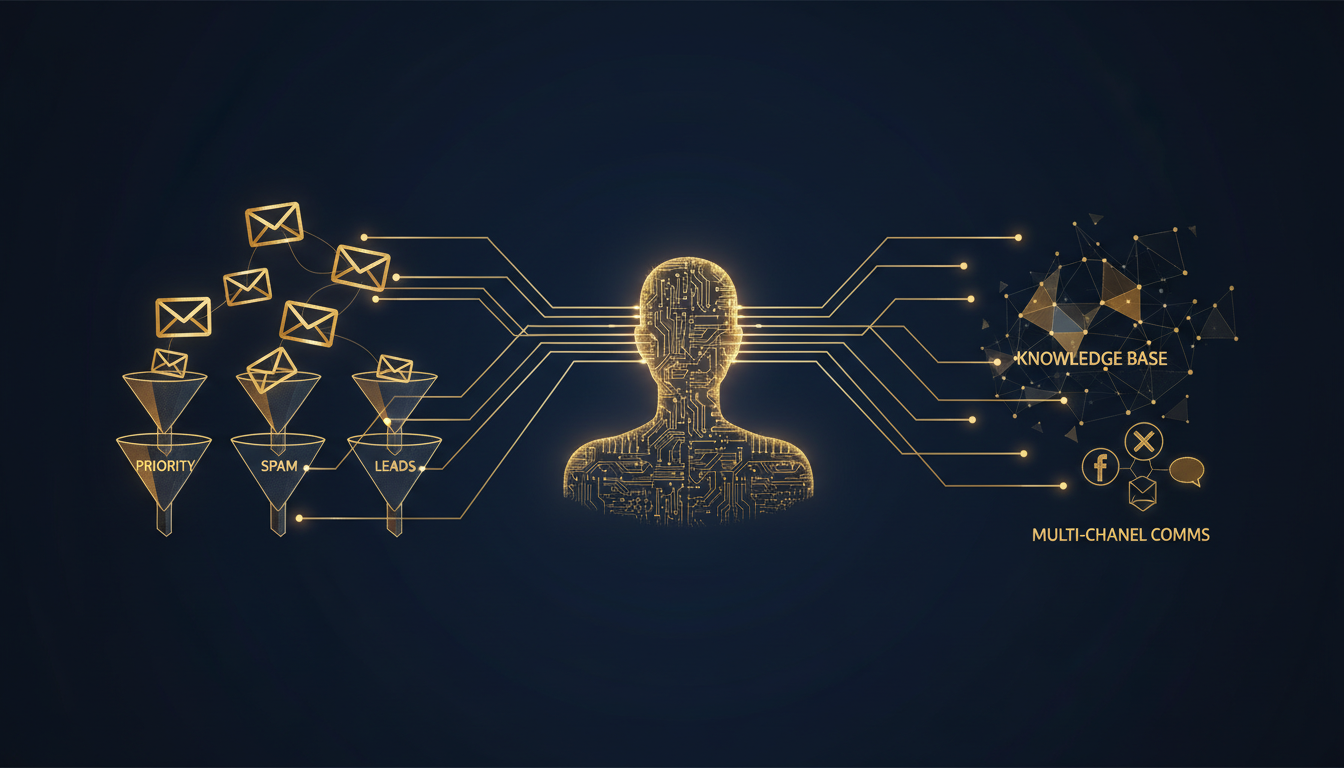
Artificial intelligence is reshaping the way UK businesses communicate with customers, manage inbound enquiries, and convert prospects into paying clients. From sophisticated AI virtual assistant development to intelligent AI email triage automation and purpose-built AI lead qualification bots, the technology has matured beyond experimental curiosity into a core operational tool. For organisations seeking to scale customer engagement without proportionally scaling headcount, these AI-driven systems represent a genuine competitive advantage.
This comprehensive guide explores every dimension of AI virtual assistants, email triage systems, and lead qualification bots - from foundational concepts and architecture decisions through to deployment, measurement, and selecting the right custom chatbot development UK partner. Whether you are a growing SME or an enterprise-scale operation, this resource will equip you with the knowledge to make informed investment decisions.
The State of AI Virtual Assistants in 2026
The AI assistant landscape has undergone a radical transformation. What began as simple rule-based chatbots has evolved into context-aware, multi-modal virtual assistants capable of understanding nuance, maintaining conversation history, and executing complex workflows across multiple business systems. For UK businesses, this evolution coincides with rising customer expectations - 73% of British consumers now expect immediate responses to enquiries, and 62% prefer self-service options that work around the clock.
AI virtual assistant development today encompasses a broad spectrum of capabilities. Modern assistants can interpret natural language queries, access knowledge bases in real time, perform actions within connected systems (booking appointments, updating records, processing transactions), and escalate gracefully to human agents when the situation demands it. The distinction between a basic chatbot and a genuine virtual assistant lies in this depth of capability - and in the quality of the conversation design that underpins it.
The UK market for AI assistants is particularly robust. British businesses operate under strict regulatory frameworks (GDPR, FCA compliance for financial services, NHS data governance for healthcare), which means off-the-shelf solutions from American vendors frequently fall short. This creates strong demand for custom chatbot development UK specialists who understand both the technical requirements and the regulatory landscape.
Types of AI Virtual Assistants
Not all AI assistants serve the same purpose. Understanding the different categories helps you identify which type - or combination of types - your organisation needs. The right architecture depends on your use case, your existing technology stack, and the complexity of the conversations you need to support.
Customer-Facing Conversational Assistants
These are the front-line AI systems that interact directly with your customers via website chat widgets, messaging platforms (WhatsApp, Facebook Messenger), or voice channels. They handle enquiries, provide information, resolve common issues, and guide users through processes such as onboarding or purchasing. A well-designed customer-facing assistant reduces wait times, improves satisfaction scores, and captures valuable data about customer needs and pain points.
Internal Operations Assistants
Deployed within the organisation, these assistants help employees navigate HR policies, submit IT support requests, find internal documentation, or complete routine administrative tasks. They integrate with tools like Microsoft Teams, Slack, or bespoke intranet platforms. For UK businesses with distributed or hybrid workforces, internal AI assistants significantly reduce the burden on HR and IT support teams.
AI Knowledge Base Chatbots
An AI knowledge base chatbot UK is specifically designed to surface information from structured and unstructured data sources - policy documents, technical manuals, FAQs, regulatory guidance, and historical case data. Rather than simply matching keywords, these systems use retrieval-augmented generation (RAG) to understand questions in context and synthesise accurate, sourced answers. This is particularly valuable in regulated industries where accuracy and traceability are non-negotiable.
Specialist Workflow Assistants
These purpose-built assistants manage specific business processes end to end. Examples include appointment scheduling bots for healthcare providers, claims processing assistants for insurance firms, and order management bots for e-commerce operations. They combine conversational AI with deep integration into back-end systems, executing transactions and updating records as part of the conversation flow.
| Assistant Type | Primary Users | Key Capabilities | Typical Integration | Complexity |
|---|---|---|---|---|
| Customer-Facing | External customers | Enquiry handling, sales support, issue resolution | Website, WhatsApp, Messenger | Medium–High |
| Internal Operations | Employees | HR queries, IT support, document lookup | Teams, Slack, Intranet | Medium |
| Knowledge Base | Customers or staff | Document search, policy Q&A, technical support | CMS, SharePoint, custom databases | Medium–High |
| Workflow Specialist | Varies by process | Booking, claims, orders, onboarding | CRM, ERP, payment systems | High |
AI Email Triage Automation: Transforming Inbox Management
AI email triage automation addresses one of the most persistent productivity challenges facing UK businesses: the sheer volume of inbound email. For organisations receiving hundreds or thousands of emails daily - customer enquiries, support requests, partnership proposals, complaints, spam - manual sorting is not merely inefficient; it introduces delays, misrouting, and missed opportunities. AI-powered triage systems fundamentally change this equation.
How AI Email Triage Works
Modern AI email triage systems operate through a multi-stage pipeline. First, the system ingests incoming emails via API integration with your email provider (Microsoft 365, Google Workspace, or on-premises Exchange). Natural language processing models then analyse the content, extracting intent, sentiment, urgency, and key entities (names, account numbers, product references, dates). Based on this analysis, the system classifies, prioritises, routes, and in many cases responds to emails automatically.
Stage 1: Ingestion
Emails arrive via API integration with Microsoft 365, Google Workspace, or Exchange. Attachments are parsed and metadata is extracted alongside the message body.
Stage 2: Classification
NLP models analyse content to determine category (support request, sales enquiry, complaint, informational), urgency level, and sentiment. Multi-label classification handles emails that span multiple topics.
Stage 3: Entity Extraction
The system identifies key entities - customer names, account numbers, product references, order IDs, dates, and monetary values - linking them to existing CRM records where possible.
Stage 4: Routing & Prioritisation
Based on classification and business rules, emails are routed to the appropriate team or individual. Priority scoring ensures urgent matters surface immediately, while routine enquiries are batched efficiently.
Stage 5: Auto-Response or Escalation
For straightforward enquiries with high-confidence answers, the system drafts or sends automated responses. Complex or sensitive matters are escalated to human agents with full context pre-loaded.
The Business Case for Email Triage
The financial argument for AI email triage automation is compelling. A typical UK professional services firm processing 500 inbound emails per day can expect to save 15–25 staff hours daily through automated classification and routing alone. When auto-response capabilities are factored in, the savings multiply. More importantly, response times drop from hours to minutes - a critical differentiator in competitive markets where speed of response directly correlates with conversion rates.
When implementing AI email triage, start with classification and routing before enabling auto-responses. This allows you to monitor accuracy and build confidence in the system's judgement before giving it permission to communicate directly with customers. A phased rollout also helps your team adapt to the new workflow gradually.
Key Capabilities of Advanced Email Triage Systems
Beyond basic sorting, sophisticated email triage platforms offer capabilities that transform inbox management into a strategic function. Sentiment analysis flags frustrated or angry customers for priority handling. Compliance scanning automatically identifies emails containing sensitive data (financial information, health records) and ensures they are handled according to GDPR and industry-specific regulations. Thread summarisation condenses lengthy email chains into actionable summaries, saving agents significant reading time when they do engage.
Integration with CRM systems means the AI can automatically associate emails with existing customer records, deals, or support tickets - eliminating the manual data entry that consumes so much of a support agent's day. For organisations using helpdesk platforms like Zendesk, Freshdesk, or ServiceNow, the triage system can automatically create, update, and resolve tickets based on email content.
AI Lead Qualification Bots: Converting Enquiries into Revenue
For sales-driven organisations, the gap between receiving a lead and qualifying it represents one of the biggest leaks in the revenue pipeline. Research consistently shows that responding to a new enquiry within five minutes makes you 21 times more likely to qualify that lead compared to responding after 30 minutes. Yet the average UK B2B company takes over 42 hours to respond to a new lead. An AI lead qualification bot eliminates this gap entirely.
What Lead Qualification Bots Actually Do
An AI lead qualification bot engages with inbound leads in real time - via website chat, landing page forms, email, or messaging platforms - and conducts an intelligent qualifying conversation. Unlike static forms that collect data passively, these bots ask dynamic follow-up questions based on previous answers, scoring the lead in real time against your ideal customer profile. Qualified leads are routed instantly to sales representatives with full context, while unqualified leads are nurtured through automated sequences or directed to self-service resources.
Lead Scoring and Qualification Frameworks
Effective AI lead qualification bots operate against defined scoring frameworks. The most common approach adapts the BANT methodology (Budget, Authority, Need, Timeline) into conversational form. The bot naturally weaves qualifying questions into what feels like a helpful conversation - asking about the prospect's current challenges (Need), decision-making process (Authority), budget parameters (Budget), and implementation timeline (Timeline) - without making the interaction feel like an interrogation.
More advanced implementations use machine learning models trained on your historical sales data to identify patterns that predict conversion. These models consider not just explicit answers but also behavioural signals: which pages the visitor viewed before initiating chat, how they arrived at your site, the language patterns they use, and their engagement level throughout the conversation. This multi-signal approach produces significantly more accurate qualification than any manual process.
AI Lead Qualification
Manual Qualification
Multi-Channel Lead Capture
The most effective lead qualification deployments operate across multiple channels simultaneously. A visitor who starts a conversation on your website might continue via WhatsApp. A lead who clicks a LinkedIn ad might be routed to a qualification bot on a dedicated landing page. Email enquiries can trigger the same qualification flow via an automated response. The key is maintaining conversation continuity across channels - the bot should never ask the same question twice, regardless of where the interaction takes place.
For UK businesses, WhatsApp Business API integration is increasingly important. With over 35 million UK WhatsApp users, it represents a preferred communication channel for many demographics. An AI lead qualification bot deployed on WhatsApp can engage prospects in a familiar, low-friction environment, dramatically improving engagement rates compared to traditional web forms.
Building an AI Knowledge Base Chatbot
An AI knowledge base chatbot UK combines the conversational capabilities of a virtual assistant with deep access to your organisation's information assets. Unlike a simple FAQ bot that matches questions to pre-written answers, a knowledge base chatbot uses retrieval-augmented generation (RAG) to find relevant information across your documentation and synthesise accurate, contextual responses in natural language.
The RAG Architecture
RAG-based chatbots work by first converting your knowledge base - documents, manuals, policies, historical case data - into vector embeddings stored in a specialised database. When a user asks a question, the system converts the query into an embedding, searches for the most semantically similar content chunks, retrieves them, and feeds them as context to a large language model along with the original question. The LLM then generates a response that synthesises information from the retrieved documents, complete with citations back to the source material.
This architecture offers several critical advantages over traditional keyword-based search or pre-scripted FAQ bots. It handles paraphrased questions naturally (the user does not need to guess the exact wording used in your documentation). It can synthesise information from multiple documents to answer complex questions. And it maintains accuracy by grounding responses in your actual content rather than generating answers from the model's general training data.
The quality of a RAG-based knowledge base chatbot depends heavily on how your documents are chunked and indexed. Overly large chunks dilute relevance; overly small chunks lose context. Work with your development partner to establish optimal chunking strategies for your specific content types - technical documentation typically benefits from different chunking than policy documents or customer correspondence.
Knowledge Base Content Preparation
The single biggest factor in knowledge base chatbot quality is the underlying content. Garbage in, garbage out applies with full force. Before development begins, organisations need to audit their existing documentation for accuracy, completeness, and consistency. Outdated policies, contradictory guidance across documents, and poorly structured content will all surface as chatbot errors - and they will surface in front of customers or employees, making the problem visible in a way that dusty SharePoint folders never did.
Content preparation typically involves consolidating duplicate documents, establishing a single source of truth for each topic, structuring content with clear headings and sections (which dramatically improves retrieval accuracy), and implementing a governance process to keep the knowledge base current. For UK organisations in regulated industries, this preparation phase often doubles as a valuable compliance exercise - forcing a systematic review of policies and procedures that may have drifted from current regulatory requirements.
Conversation Design: The Hidden Differentiator
Technical architecture matters, but conversation design is where AI assistants succeed or fail in practice. A brilliantly engineered bot with poor conversation flows will frustrate users. A well-designed conversation experience built on solid (if less cutting-edge) technology will delight them. This is especially true in the UK market, where cultural expectations around communication - politeness, understatement, a preference for clarity over enthusiasm - differ meaningfully from American norms that dominate much of the available chatbot literature.
Principles of Effective Conversation Design
Great conversation design starts with understanding user intent at a granular level. What are the 50 most common things people ask or try to do? What are the edge cases? Where do conversations typically go wrong? This research phase - studying existing support transcripts, interviewing customer-facing staff, analysing search queries on your website - is indispensable. Skipping it leads to chatbots that can handle the easy questions your team already handles efficiently, while failing on the complex ones that actually warrant automation.
The conversation flow itself should follow several key principles. Always confirm understanding before taking action. Provide clear escape routes to human agents. Use progressive disclosure - do not overwhelm users with information, but make it easy to drill deeper. Handle errors and misunderstandings gracefully, with specific recovery prompts rather than generic "I didn't understand that" messages. And critically for UK audiences, match the tone and formality level of your brand while respecting cultural norms around politeness and directness.
Persona Development
Every AI assistant benefits from a well-defined persona - not a gimmick or a character, but a consistent communication style that aligns with your brand. The persona defines how the bot speaks (formal or conversational?), how it handles uncertainty (transparent or deflecting?), and how it transitions to human agents (seamlessly or explicitly?). For UK businesses, the persona should typically err on the side of professionalism and helpfulness without becoming stiff or robotic. British consumers respond well to competence expressed with warmth - a difficult balance that requires careful iteration and testing.
Test your chatbot's conversation design with real users before launch - not just internally. Internal testers unconsciously know what the bot can and cannot do, biasing their questions towards successful paths. External testers will ask the unexpected questions that reveal gaps in your conversation flows. Aim for at least 50 unique external test sessions before going live.
Integration with CRM and Helpdesk Systems
An AI assistant operating in isolation delivers a fraction of its potential value. The transformative power of AI virtual assistant development emerges when the system is deeply integrated with your existing business platforms - CRM, helpdesk, ERP, payment processing, and communication tools. These integrations turn the assistant from a conversational interface into a genuine business automation platform.
CRM Integration
For sales-focused deployments, particularly AI lead qualification bots, CRM integration is non-negotiable. The bot needs to read from and write to your CRM in real time. When a new lead engages, the bot should check whether they are an existing contact, pull relevant history, and update the record with new information gathered during the conversation. Qualified leads should be created as opportunities with all qualifying data pre-populated, assigned to the appropriate sales representative, and flagged for follow-up - all without any manual data entry.
The most common CRM integrations we build at Cloudswitched are with Salesforce, HubSpot, Microsoft Dynamics 365, and Pipedrive. Each platform has its own API conventions and data models, but the core pattern is consistent: bi-directional sync of contacts, companies, deals, and activities, with the AI bot acting as both a data source and a trigger for downstream workflows.
Helpdesk and Ticketing Integration
For support-focused deployments, integration with helpdesk platforms ensures that AI-handled conversations are tracked in the same system as human-handled ones. This provides unified reporting, prevents duplicate tickets, and creates a seamless escalation path. When the AI cannot resolve an issue, it creates a ticket pre-populated with the conversation transcript, extracted details, and suggested resolution - giving the human agent a significant head start.
| Integration Type | Common Platforms | Key Data Flows | Business Impact |
|---|---|---|---|
| CRM | Salesforce, HubSpot, Dynamics 365, Pipedrive | Contact lookup, lead creation, deal updates, activity logging | Eliminates manual data entry, accelerates pipeline |
| Helpdesk | Zendesk, Freshdesk, ServiceNow, Jira Service Management | Ticket creation, status updates, conversation handoff | Unified reporting, seamless escalation |
| Microsoft 365, Google Workspace, Exchange | Email ingestion, auto-response, thread management | Faster response times, intelligent routing | |
| Communication | Teams, Slack, WhatsApp, Messenger | Multi-channel deployment, notification routing | Meet customers on preferred channels |
| Payment | Stripe, GoCardless, SagePay | Invoice lookup, payment status, refund processing | Self-service resolution for billing queries |
| Calendar | Microsoft Bookings, Calendly, Google Calendar | Availability checking, appointment scheduling | Automated booking without human involvement |
API Architecture Considerations
Robust integration requires careful API architecture. Synchronous API calls work for lightweight lookups (checking a contact record), but heavier operations (generating reports, processing bulk updates) should be handled asynchronously to avoid conversation delays. Webhook-based architectures allow the AI system to react to events in connected platforms - a ticket status change in Zendesk can trigger a proactive notification to the customer via the chatbot, for example.
Security is paramount. API credentials should be stored in encrypted vaults, not hardcoded. OAuth 2.0 should be used wherever supported. Data passing through integrations must be encrypted in transit and handled in compliance with GDPR - particularly when personal data flows between systems. For UK healthcare or financial services organisations, additional compliance requirements (NHS DSPT, FCA operational resilience) add further integration constraints that must be designed in from the start.
Training, Fine-Tuning, and Continuous Improvement
Deploying an AI assistant is not a one-time project - it is the beginning of an ongoing improvement cycle. The best-performing AI systems are those backed by disciplined training and optimisation processes. This applies whether you are building a customer-facing virtual assistant, an AI email triage automation system, or an AI knowledge base chatbot UK deployment.
Initial Training
Initial training involves providing the AI system with the data it needs to perform its role. For knowledge base chatbots, this means ingesting and indexing your documentation. For lead qualification bots, it means defining your ideal customer profile, qualification criteria, and scoring model. For email triage systems, it means training classifiers on labelled examples of your actual email categories. The quality and volume of this initial training data directly determines launch-day performance.
Fine-Tuning and Prompt Engineering
Once deployed, real user interactions reveal gaps and opportunities that no amount of pre-launch testing can anticipate. Fine-tuning involves adjusting the system based on actual performance data - refining classification models, updating prompt templates, adjusting confidence thresholds, and expanding the knowledge base to cover previously unaddressed topics. Modern AI systems support rapid iteration; changes can often be deployed within hours rather than weeks.
The Feedback Loop
Establishing a systematic feedback loop is critical. This includes automated monitoring (tracking confidence scores, fallback rates, and user satisfaction signals), structured human review (regularly auditing a sample of conversations for quality and accuracy), and direct user feedback mechanisms (thumbs up/down on individual responses, post-conversation satisfaction surveys). All of this data feeds back into the training cycle, creating a virtuous loop of continuous improvement.
A realistic expectation is that a well-built AI assistant will resolve 60–70% of enquiries without human intervention at launch, improving to 80–90% within six months as the feedback loop takes effect. The remaining 10–20% represent genuinely complex situations that benefit from human expertise - and the AI's role shifts to ensuring these are escalated efficiently with full context.
Measuring Effectiveness: KPIs and Metrics
You cannot improve what you do not measure. Establishing clear metrics from the outset ensures that your AI investment delivers measurable business value - and provides the data needed to justify expansion. The right metrics depend on your deployment type, but several are universally applicable.
Core Metrics for AI Virtual Assistants
Resolution rate measures the percentage of conversations resolved without human escalation. Average handling time tracks how long conversations take from start to resolution. Customer satisfaction (CSAT) captures user perception of the interaction quality. Deflection rate quantifies how many enquiries the AI handled that would otherwise have required human attention. Together, these metrics paint a comprehensive picture of assistant performance and business impact.
Email Triage Metrics
For AI email triage automation, the key metrics are classification accuracy (percentage of emails correctly categorised), routing accuracy (percentage routed to the correct team or individual), average time to first response (how quickly customers receive a meaningful reply), and auto-resolution rate (percentage of emails resolved entirely by the AI without human involvement). Tracking misrouting rates is equally important - a single misrouted complaint can cause significant damage if it sits in the wrong inbox for days.
Lead Qualification Metrics
For AI lead qualification bots, the metrics that matter most are lead-to-qualified conversion rate, sales-accepted lead (SAL) rate (what percentage of AI-qualified leads are accepted by sales as genuinely qualified), time-to-qualification (how quickly leads are scored and routed), and ultimately, the impact on pipeline velocity and closed revenue. The SAL rate is particularly revealing - if the sales team is rejecting a high percentage of AI-qualified leads, the scoring model needs recalibration.
| Metric Category | Key KPIs | Target Range | Measurement Frequency |
|---|---|---|---|
| Resolution | First-contact resolution rate | 70–90% | Weekly |
| Speed | Average response time | <5 seconds | Real-time |
| Quality | CSAT score | 4.2+ / 5.0 | Per conversation |
| Efficiency | Deflection rate | 40–60% | Monthly |
| Accuracy | Classification accuracy (email triage) | 92–98% | Weekly |
| Revenue | Lead-to-qualified conversion rate | 25–45% | Monthly |
| Adoption | User engagement rate | 60%+ of eligible interactions | Monthly |
Costs, Timelines, and Budgeting
Understanding the investment required for AI virtual assistant development helps UK businesses plan effectively and set realistic expectations. Costs vary significantly based on complexity, integration requirements, and the level of customisation needed. Below is a practical framework for budgeting.
Development Cost Factors
The primary cost drivers are: the number and complexity of conversation flows, the depth of integration with existing systems, the volume and complexity of knowledge base content, the number of deployment channels, compliance and security requirements, and the level of custom model training required. A simple FAQ chatbot deployed on a single channel with no integrations sits at the low end. A multi-channel knowledge base chatbot with CRM integration, custom scoring models, and regulatory compliance requirements sits at the high end.
Typical UK Market Pricing
For custom chatbot development UK projects, pricing typically follows a phased model. Discovery and design (4–6 weeks, £8,000–£20,000) covers requirements analysis, conversation design, and technical architecture. Core development (6–12 weeks, £25,000–£80,000) covers the build, integration, and testing phases. Deployment and optimisation (2–4 weeks, £5,000–£15,000) covers launch, monitoring setup, and initial tuning. Ongoing support and improvement (monthly, £2,000–£8,000) covers monitoring, updates, and continuous optimisation.
ROI Calculation Framework
The return on investment calculation should consider both direct cost savings (reduced headcount requirements, lower cost per interaction) and revenue impact (faster lead response times, higher conversion rates, improved customer retention). For a typical mid-market UK business deploying an AI assistant across customer support and lead qualification, we consistently see payback periods of 6–12 months, with ongoing annual ROI of 200–400% once the system is mature.
It is worth noting that the cheapest option is rarely the most cost-effective. A poorly built chatbot that frustrates customers can cause more damage than having no chatbot at all. Investing in quality conversation design, thorough testing, and robust integrations pays dividends through higher adoption rates, better customer satisfaction, and lower ongoing maintenance costs.
Industry Applications Across the UK
AI virtual assistants and their specialist variants find applications across virtually every sector of the UK economy. The specific implementation varies by industry, but the underlying principles - automating routine interactions, accelerating response times, and freeing human experts for complex work - apply universally.
Financial Services
UK financial services firms use AI assistants for customer onboarding, account enquiries, transaction disputes, and compliance-related communications. AI email triage automation is particularly valuable in this sector, where firms receive high volumes of regulatory correspondence, client requests, and internal communications that must be routed accurately and responded to within mandated timeframes. FCA compliance requirements around record-keeping and audit trails make robust logging and governance capabilities essential.
Healthcare and NHS
Healthcare providers deploy AI assistants for appointment scheduling, symptom triage (within carefully defined clinical boundaries), prescription repeat requests, and patient communication. AI knowledge base chatbot UK deployments help patients navigate complex healthcare pathways and access accurate health information. NHS Digital standards and DSPT certification requirements add specific technical and governance constraints that must be addressed during development.
Legal Services
Law firms and legal departments use AI assistants to handle initial client enquiries, qualify potential cases, provide basic legal information (with appropriate disclaimers), and manage document-heavy workflows. The high value of legal work makes AI lead qualification bots particularly impactful - ensuring that senior solicitors spend their time on genuinely viable matters rather than fielding speculative enquiries.
Professional Services and Consulting
Consulting firms, accounting practices, and recruitment agencies deploy AI assistants to manage client communication, automate scheduling, handle routine enquiries, and qualify inbound business development opportunities. The knowledge-intensive nature of these businesses makes RAG-based knowledge base chatbots especially valuable for both client-facing and internal use cases.
E-Commerce and Retail
UK retailers use AI assistants for product recommendations, order tracking, returns processing, and customer support. Integration with e-commerce platforms (Shopify, WooCommerce, Magento) and payment systems enables end-to-end transaction support within the conversational interface. For retailers with physical and online presence, the assistant can bridge the gap - checking store stock availability, booking in-store appointments, and coordinating click-and-collect orders.
Property and Real Estate
Estate agents and property management companies deploy AI lead qualification bots to handle the high volume of inbound property enquiries, qualifying buyers by budget, preferred location, and timeline. Virtual assistants manage viewing requests, answer property-specific questions, and coordinate between buyers, sellers, and solicitors. The cyclical nature of property markets makes the scalability of AI solutions particularly attractive - handling demand spikes without proportional staffing increases.
Security, Compliance, and Data Governance
For UK businesses, security and compliance are not optional features - they are foundational requirements. Any AI system that processes personal data, financial information, or health records must be designed with privacy and security at its core. This is especially true for AI email triage automation systems that handle unstructured customer communications, and AI knowledge base chatbot UK deployments that may access sensitive internal documentation.
GDPR Compliance
Under GDPR, AI assistants that process personal data must have a lawful basis for processing, provide transparent information about how data is used, support data subject rights (access, deletion, portability), implement appropriate technical and organisational security measures, and maintain records of processing activities. Conversation logs constitute personal data and must be handled accordingly - with appropriate retention policies, access controls, and deletion capabilities.
Data Residency and Sovereignty
For many UK organisations, particularly those in regulated industries, data residency requirements mandate that personal data is stored and processed within specific jurisdictions. Post-Brexit, the UK operates under its own data protection framework (UK GDPR and the Data Protection Act 2018), with an adequacy decision from the EU. AI deployments must ensure that conversation data, knowledge base content, and processing infrastructure comply with these requirements - a consideration that often rules out certain cloud-based AI services hosted exclusively in the US.
Security Architecture
A robust security architecture for AI assistants includes encryption in transit (TLS 1.3) and at rest (AES-256), role-based access controls for administrative functions, API authentication and authorisation (OAuth 2.0, API keys with rotation), input validation and sanitisation (preventing prompt injection attacks), audit logging of all system access and data processing, regular security testing (penetration testing, vulnerability scanning), and incident response procedures specific to AI-related risks.
Conversation AI Technology Stack
Understanding the technology landscape helps UK businesses make informed decisions about their AI assistant deployments. The stack typically comprises several layers, each with multiple vendor and open-source options. Your custom chatbot development UK partner should be able to guide you through these choices based on your specific requirements.
Core AI Models
The large language model (LLM) at the heart of the assistant determines its conversational capability. Options range from commercial APIs (OpenAI GPT, Anthropic Claude, Google Gemini) to open-source models (Llama, Mistral) that can be self-hosted for maximum data control. The choice involves trade-offs between capability, cost, latency, and data sovereignty. For UK businesses with strict data residency requirements, self-hosted open-source models may be preferred despite requiring more infrastructure investment.
Vector Databases and Retrieval
For knowledge base and RAG-based deployments, a vector database stores the embedded representations of your content. Options include purpose-built vector databases (Pinecone, Weaviate, Qdrant), vector extensions on traditional databases (pgvector for PostgreSQL), and managed services. The choice depends on scale, performance requirements, and operational complexity tolerance.
Orchestration and Workflow
Orchestration frameworks manage the flow of multi-step AI operations - chaining together retrieval, generation, tool use, and business logic. These range from lightweight frameworks to full-featured platforms. The key is choosing a level of abstraction appropriate to your complexity - over-engineering simple deployments is as costly as under-engineering complex ones.
Deployment and Hosting
AI assistants can be deployed on public cloud infrastructure (AWS, Azure, GCP), edge networks (Cloudflare Workers), or on-premises for maximum control. Hybrid architectures are increasingly common - with the conversational interface running on edge infrastructure for low latency, while heavier AI processing runs on dedicated GPU infrastructure. For UK businesses, Azure's UK South and UK West regions, along with AWS London, provide local hosting options that satisfy most data residency requirements.
Common Pitfalls and How to Avoid Them
Having delivered dozens of AI assistant projects for UK businesses, Cloudswitched has observed recurring patterns in what goes wrong - and how to prevent it. Learning from others' mistakes is significantly cheaper than making your own.
Pitfall 1: Scope Creep Without Foundation
The most common failure mode is trying to build an assistant that does everything from day one. Start with a focused use case - ideally one with clear metrics, manageable complexity, and high visibility. Prove value there, then expand. A chatbot that handles 20 enquiry types brilliantly is infinitely more valuable than one that handles 200 types poorly.
Pitfall 2: Ignoring the Human Handoff
No AI assistant should be a dead end. When the bot cannot help, the transition to a human agent must be seamless - with full context transferred, no repetition required from the customer, and minimal wait time. Many deployments fail not because the AI is bad, but because the escalation experience is worse than going directly to a human in the first place.
Pitfall 3: Neglecting Ongoing Maintenance
AI assistants are not set-and-forget products. Knowledge bases become stale, conversation flows need updating as products and policies change, and model performance can drift over time. Budget for ongoing maintenance from the start - it typically runs 15–25% of the initial development cost annually.
Pitfall 4: Over-Reliance on AI Without Guardrails
Generative AI models can produce confident-sounding but incorrect information. For customer-facing deployments - especially in regulated industries - robust guardrails are essential. These include confidence thresholds (escalate to humans when confidence is low), factual grounding (restrict responses to verified knowledge base content), prohibited topic filters (prevent the bot from giving financial, legal, or medical advice beyond its scope), and regular accuracy audits.
Pitfall 5: Poor Change Management
Internal resistance to AI adoption is real and legitimate. Customer-facing staff may fear job displacement. Managers may distrust AI decision-making. Customers may prefer human interaction. Successful deployments address these concerns proactively - positioning the AI as a tool that makes human agents more effective rather than replacing them, involving frontline staff in conversation design, and giving customers clear choice in how they interact.
Best Practices
Common Mistakes
Choosing a Development Partner
Selecting the right partner for AI virtual assistant development is arguably the most important decision in the entire process. The AI landscape is crowded with vendors making bold claims, and distinguishing genuine capability from marketing requires careful evaluation.
What to Look For
Proven delivery experience matters more than impressive slide decks. Ask for case studies with measurable outcomes - not just "we built a chatbot for Company X" but "we built a chatbot that reduced support ticket volume by 42% and improved CSAT from 3.8 to 4.4." Request references you can actually speak to. Evaluate their technical depth by discussing architecture options - a strong partner will explain trade-offs clearly rather than pushing a one-size-fits-all solution.
For UK businesses, local presence and regulatory understanding are significant differentiators. A partner who understands GDPR, FCA regulations, NHS data governance, and UK-specific business norms will deliver a better product than a technically brilliant overseas team unfamiliar with these requirements. Look for partners who ask about your compliance obligations early in the conversation - it signals that they have dealt with these requirements before.
Evaluation Criteria
When evaluating potential custom chatbot development UK partners, assess them across multiple dimensions. Technical capability: can they demonstrate proficiency with the relevant AI technologies, integration patterns, and deployment architectures? Domain expertise: do they understand your industry's specific requirements and constraints? Delivery methodology: do they follow a structured approach with clear milestones, or is the process opaque? Post-launch support: what does their ongoing support model look like, and how is it priced? Cultural fit: do they communicate clearly, respond promptly, and seem genuinely interested in your success?
Why Cloudswitched for AI Virtual Assistant Development
Cloudswitched is a London-based IT managed services provider and AI software development specialist serving UK businesses across sectors. Our approach to AI virtual assistant development, AI email triage automation, and AI lead qualification bot projects is grounded in practical delivery experience - not theoretical capability.
We have built and deployed AI assistants for financial services firms navigating FCA compliance requirements, healthcare providers operating within NHS data governance frameworks, professional services companies looking to scale client engagement, and e-commerce businesses seeking to improve conversion rates. Each project has reinforced a consistent lesson: the technology is the easy part. Understanding the business context, designing effective conversations, integrating robustly with existing systems, and supporting continuous improvement - these are what separate successful AI deployments from expensive failures.
Our team combines deep AI and machine learning expertise with broad systems integration experience. We do not simply bolt a chatbot onto your website and walk away. We work with you to understand your goals, design an AI strategy that serves them, build a system that integrates seamlessly with your existing technology stack, and provide ongoing support to ensure the system improves over time. For organisations exploring AI knowledge base chatbot UK solutions or custom chatbot development UK services, we offer a no-obligation consultation to assess your requirements and outline a practical path forward.
Ready to Explore AI Virtual Assistants for Your Business?
Whether you need an AI email triage system, a lead qualification bot, or a comprehensive knowledge base chatbot, Cloudswitched can help you design, build, and deploy a solution that delivers measurable results. Book a free consultation to discuss your requirements with our AI development team.
Frequently Asked Questions
How long does it take to build a custom AI virtual assistant?
A typical AI virtual assistant development project takes 8–16 weeks from discovery to launch, depending on complexity. Simple single-channel chatbots with limited integrations can be delivered in 6–8 weeks. Complex multi-channel deployments with deep CRM integration, custom knowledge bases, and regulatory compliance requirements typically take 12–16 weeks. We recommend allowing 4–6 weeks for the discovery and design phase alone, as this investment in upfront planning dramatically reduces development costs and improves outcomes.
Can AI email triage handle multiple languages?
Yes. Modern AI email triage automation systems support multilingual classification and routing. For UK businesses with international clients or operations, the system can detect the language of incoming emails, classify and route them accordingly, and generate responses in the appropriate language. However, accuracy is highest in languages for which the system has been specifically trained, so it is important to provide training data in all relevant languages during setup.
How accurate are AI lead qualification bots compared to human SDRs?
In controlled comparisons, AI lead qualification bots typically match or exceed human SDR accuracy on qualification criteria while dramatically outperforming on speed and consistency. The key advantage is not that the AI asks better questions - it is that the AI asks them instantly, consistently, and at scale. Where human SDRs qualify perhaps 30–40 leads per day, an AI bot handles unlimited concurrent conversations with identical quality standards.
What happens when the AI cannot answer a question?
A well-designed AI assistant recognises the limits of its knowledge and escalates gracefully. For customer-facing chatbots, this means transferring the conversation to a human agent with full context (no repetition for the customer). For AI knowledge base chatbot UK deployments, the system acknowledges that it could not find a reliable answer and directs the user to alternative resources or a subject matter expert. The fallback experience is a critical part of conversation design and should be tested thoroughly.
Is my data safe with an AI assistant?
Data security is a non-negotiable requirement for every AI project we deliver. All systems are built with encryption in transit and at rest, GDPR-compliant data handling, role-based access controls, and comprehensive audit logging. For organisations with specific data residency requirements, we can deploy on UK-based infrastructure or implement hybrid architectures that keep sensitive data within your controlled environment while leveraging cloud AI capabilities for processing. Our security approach is designed to satisfy the requirements of regulated industries including financial services and healthcare.

CloudSwitched
London-based managed IT services provider offering support, cloud solutions and cybersecurity for SMEs.


