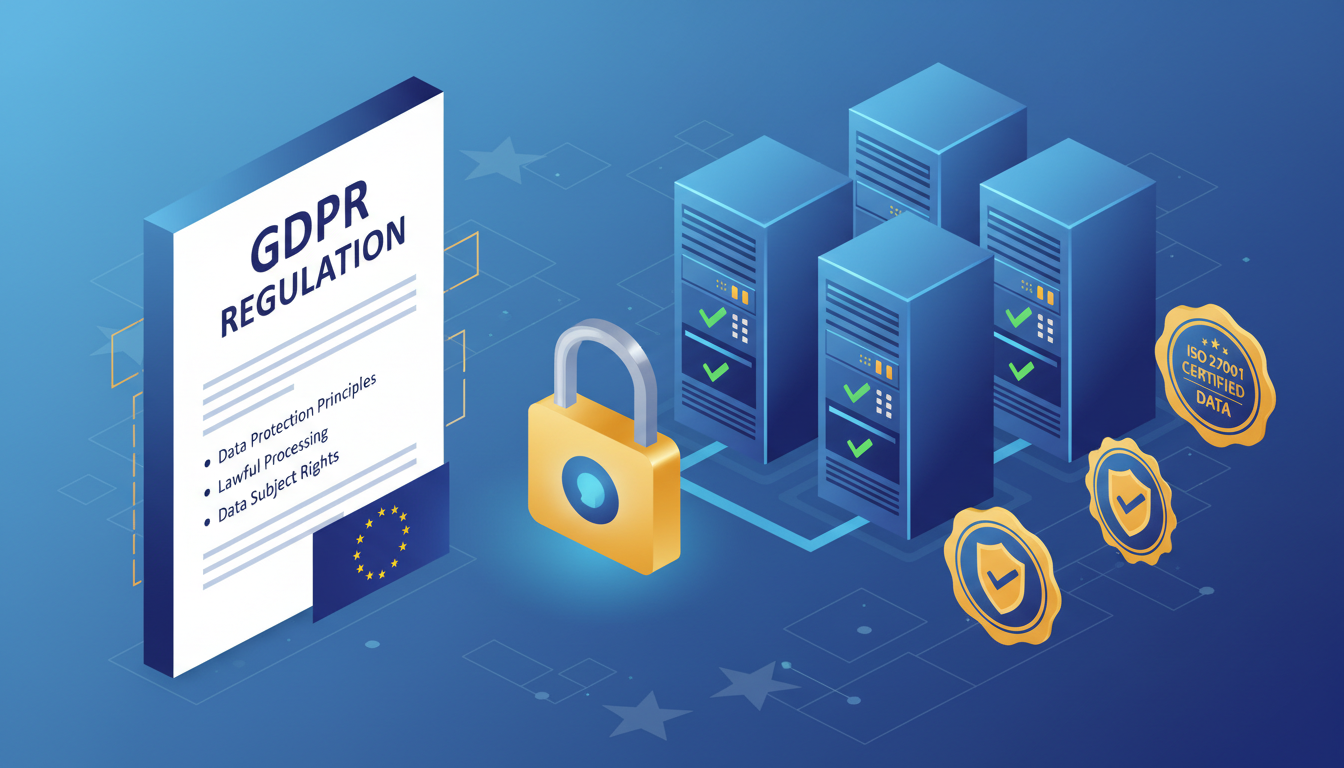
Backups are not just a technical safeguard - they are a legal obligation. For UK businesses processing personal data, GDPR Article 32 explicitly requires the ability to "restore the availability and access to personal data in a timely manner in the event of a physical or technical incident." This means your backup system is not simply an operational convenience; it is a compliance requirement that the ICO will examine if your business suffers a data breach or loss event.
Yet many UK organisations treat backups as a purely technical function, managed by IT without reference to legal, compliance, or regulatory requirements. The result is backup systems that may protect against hardware failure but fail to meet the specific demands of GDPR, industry regulations, or contractual obligations - leaving the organisation exposed to regulatory fines, contractual penalties, and reputational damage.
This guide examines the compliance landscape for business backups in the UK, covering GDPR requirements, industry-specific regulations, practical implementation strategies, and the documentation and testing regimes necessary to demonstrate compliance to regulators and auditors.
GDPR Backup Requirements
The UK GDPR (retained in UK law following Brexit) imposes several specific requirements that directly affect how you design, implement, and manage your backup systems. Understanding these requirements is essential for any organisation that processes personal data - which, in practice, means virtually every UK business.
Availability and Resilience
Article 32(1)(b) requires "the ability to ensure the ongoing confidentiality, integrity, availability and resilience of processing systems and services." Your backup system is your primary mechanism for ensuring availability and resilience. If your systems fail - whether through hardware failure, ransomware, human error, or natural disaster - your backups must enable you to restore services within a timeframe that is proportionate to the risk.
The ICO has consistently emphasised that availability is not merely about having data stored somewhere - it is about being able to access and use that data when needed. A backup archive that exists on tape in a warehouse but takes seventy-two hours to retrieve does not meet the availability standard for a business that processes customer orders in real time. The proportionality assessment is key: the more sensitive the data and the greater the impact of its unavailability, the faster your recovery capability must be. For UK businesses handling health records, financial transactions, or legal case files, this effectively mandates near-immediate recovery capability through cloud-based or hybrid backup solutions.
Timely Restoration
Article 32(1)(c) requires "the ability to restore the availability and access to personal data in a timely manner in the event of a physical or technical incident." The phrase "timely manner" is deliberately open to interpretation, as what constitutes "timely" depends on the nature of the data and the impact of its unavailability. However, the ICO's guidance makes clear that you must have a documented and tested process for restoration, and that the restoration timeframe should be defined in advance, not determined on an ad-hoc basis during a crisis.
| GDPR Article | Requirement | Backup Implication | Evidence Needed |
|---|---|---|---|
| Article 5(1)(f) | Integrity and confidentiality | Backups must be encrypted and access-controlled | Encryption certificates, access logs |
| Article 17 | Right to erasure | Deletion requests must propagate to backups | Erasure procedures, retention policies |
| Article 32(1)(b) | Availability and resilience | Backups must ensure data can be recovered | Backup schedules, success logs |
| Article 32(1)(c) | Timely restoration | Defined and tested RTO/RPO | Recovery test reports |
| Article 32(1)(d) | Regular testing | Backup recovery must be tested periodically | Test schedules, results documentation |
| Article 33 | Breach notification | Backup status affects breach severity assessment | Incident response procedures |
The Right to Erasure Challenge
Article 17 - the right to erasure, commonly known as the "right to be forgotten" - creates a particular challenge for backup systems. When a data subject exercises their right to erasure, you must delete their personal data from all systems, including backups. However, selectively deleting individual records from backup archives is technically impractical with most backup solutions, as backups are typically stored as monolithic images rather than individually addressable records.
The ICO's pragmatic position is that you do not need to delete data from backup archives immediately, provided you have a process to ensure that when a backup is restored, the erasure is re-applied. You must also ensure that backup retention periods are not excessive - holding backups indefinitely means personal data persists indefinitely, which is unlikely to be compatible with your data retention policy or the GDPR's storage limitation principle.
Your backup retention period must be justified and documented. Keeping 12 months of daily backups may be technically convenient, but can you justify retaining personal data in backup form for that long? The ICO expects organisations to balance the operational need for backup retention against the data minimisation principle. For most UK SMEs, a retention policy of 30 days for daily backups, 90 days for weekly backups, and 12 months for monthly backups provides a reasonable balance - but this must be documented in your data protection impact assessment and reviewed annually.
Industry-Specific Requirements
Beyond GDPR, certain UK industries impose additional backup and data retention requirements that must be considered in your backup strategy.
Financial services firms regulated by the FCA must comply with SYSC 13 (operational risk management) and MiFID II record-keeping requirements, which mandate retention of certain records for five to seven years. Your backup system must support these extended retention periods while maintaining data integrity and accessibility.
Healthcare organisations handling NHS patient data must comply with the NHS Data Security and Protection Toolkit, which includes specific requirements for backup encryption, geographic data residency (data must remain in the UK), and tested recovery procedures. The toolkit requires annual evidence that backup recovery has been tested successfully.
Legal firms must retain client files in accordance with the SRA (Solicitors Regulation Authority) requirements, which specify different retention periods for different types of legal matter - ranging from six years for general files to fifteen years for matters involving minors. Backup systems must accommodate these granular retention requirements.
Education institutions processing student data must comply with the Department for Education's data protection guidance, which requires backup systems to protect student records including examination results, attendance data, special educational needs documentation, and safeguarding records. The retention requirements for educational records can extend to 25 years for certain categories of safeguarding data, and backup systems must be capable of maintaining long-term archives that remain accessible and restorable throughout the entire retention period.
Data Processing Agreements and Third-Party Obligations
When you use a third-party cloud backup provider, that provider becomes a data processor under GDPR - they are processing personal data on your behalf. Article 28 requires a written Data Processing Agreement (DPA) with every processor, containing specific provisions defined in the regulation. This is not optional; it is a legal requirement that the ICO actively enforces and examines during investigations.
A compliant DPA with your backup provider must define the subject matter and duration of the processing, the nature and purpose of the processing (backup and disaster recovery), the types of personal data being backed up, and the categories of data subjects whose data is included. It must require the processor to process data only on your documented instructions, to implement appropriate technical and organisational security measures, to assist you in responding to data subject requests, and to delete or return all personal data at the end of the contract.
Pay particular attention to the sub-processor clause. Most cloud backup providers use underlying infrastructure from hyperscale cloud providers such as Microsoft Azure, Amazon Web Services, or Google Cloud Platform. Under GDPR, your backup provider must obtain your authorisation before engaging these sub-processors, and must pass down the same data protection obligations. Reputable providers maintain a published list of sub-processors and notify you of any changes, giving you the opportunity to object. If your provider cannot tell you where your data is stored and who has access to the infrastructure, that is a significant compliance risk that should disqualify them from consideration.
UK businesses should also verify that their DPA reflects the UK GDPR specifically, rather than only the EU GDPR. While the two are substantially similar, there are differences - particularly around international data transfers and the role of the ICO as the supervisory authority rather than EU data protection authorities. A DPA drafted solely for EU compliance may not adequately protect your position under UK law, and the ICO expects UK-specific provisions to be in place.
GDPR Backup Compliance Readiness
The following readiness scores reflect typical compliance levels observed across UK businesses, based on industry surveys and ICO enforcement data. Most organisations score well on basic technical measures but poorly on documentation, testing, and data subject rights procedures - the very areas the ICO examines most closely during investigations.
Compliant Backup Strategy
- Documented backup policy aligned to GDPR
- Defined and tested RTO and RPO
- Encryption at rest and in transit (AES-256)
- UK-based storage for personal data backups
- Regular recovery testing (at least quarterly)
- Documented retention periods with justification
- Erasure procedures for right-to-be-forgotten
- Access controls and audit logging
Non-Compliant Backup Approach
- No documented backup policy
- No defined recovery objectives
- Unencrypted backup media or transfers
- Storage outside UK with no legal basis
- Recovery never tested or verified
- Indefinite retention with no review
- No process for data subject erasure requests
- No access controls or audit trail
Testing and Documentation
GDPR Article 32(1)(d) requires "a process for regularly testing, assessing and evaluating the effectiveness of technical and organisational measures for ensuring the security of the processing." This means backup recovery testing is not optional - it is a legal requirement. The ICO will expect evidence that you test your backups regularly and that these tests confirm your ability to restore data within your stated timeframes.
A compliant testing regime should include automated daily verification that backup jobs completed successfully, monthly test restores of individual files and folders to verify data integrity, quarterly full system recovery tests to verify your ability to restore entire servers or environments, and annual disaster recovery exercises that simulate a realistic failure scenario and measure your actual recovery time against your stated RTO.
Every test must be documented. The documentation should record what was tested, when, by whom, the outcome (success or failure), the time taken to restore, and any issues encountered. This documentation serves as your evidence of compliance and is exactly what the ICO will request in the event of an investigation. A well-maintained testing log demonstrates that your organisation takes data protection seriously and has implemented appropriate technical measures - which can significantly influence the ICO's response to any incident.
Cross-Border Data Transfers and Post-Brexit Considerations
Since the United Kingdom's departure from the European Union, cross-border data transfers have become a more complex compliance consideration for UK businesses using cloud backup providers. The EU granted the UK an adequacy decision in June 2021 - meaning personal data can flow freely from the EU to the UK - but this decision is subject to periodic review and is not permanent. UK businesses that back up data originating from EU-based operations or EU-based clients must monitor the adequacy decision status and maintain contingency plans.
For UK businesses backing up data to cloud infrastructure located outside the United Kingdom, the transfer mechanism matters. Data stored in the EU benefits from the current adequacy arrangement. Data stored in the United States requires appropriate safeguards - typically Standard Contractual Clauses (SCCs) or reliance on the EU-US Data Privacy Framework for EU-origin data. The ICO has published its own International Data Transfer Agreement (IDTA) and an addendum to the EU SCCs, which UK businesses should use when transferring personal data internationally as the controller.
The practical implication for most UK businesses is straightforward: choose a backup provider that offers UK-based data centres for storing UK personal data. This eliminates the complexity of international transfer mechanisms entirely and provides the simplest possible compliance posture. If your provider stores data outside the UK, ensure you have the appropriate legal basis documented - whether that is an adequacy decision, SCCs, IDTA, or binding corporate rules - and that this is reflected in your Data Processing Agreement.
Preparing for Regulatory Change
The UK data protection landscape continues to evolve. The Data Protection and Digital Information Act introduced changes to the UK GDPR framework, including modifications to international transfer provisions and legitimate interest assessments. While the core backup compliance requirements remain largely unchanged, UK businesses should review their backup compliance posture annually to ensure alignment with current legislation and ICO guidance. Build regulatory change monitoring into your compliance programme. Subscribe to ICO updates, review the annual ICO Tech Horizons report, and ensure your backup provider communicates any changes to their data processing practices, sub-processors, or data centre locations. Proactive monitoring is far less costly than retrospective remediation after a regulatory change has already taken effect.
ICO Enforcement Trends and Lessons for UK Businesses
Examining the ICO's enforcement actions provides valuable insight into how the regulator views backup and data recovery obligations. While the ICO does not typically fine organisations solely for inadequate backups, backup failures feature prominently as aggravating factors in enforcement actions related to data breaches and data loss incidents.
In several notable enforcement actions, the ICO has considered the adequacy of backup and recovery measures when determining the severity of penalties. Organisations that could demonstrate robust, tested backup systems and rapid recovery capability received lower penalties than those without such measures. Conversely, organisations that suffered data loss and could not recover because their backups were untested, incomplete, or non-existent faced significantly harsher treatment. The ICO's published enforcement notices frequently reference the absence of "appropriate technical measures" - a category that explicitly includes backup and recovery capabilities.
The ICO's approach to ransomware incidents has become increasingly nuanced. In its published guidance on ransomware and data protection, the regulator distinguishes between organisations that had reasonable security measures in place but were still compromised, and organisations whose security failings - including inadequate backup - contributed to the severity of the incident. Having immutable, tested, offsite backups that enable recovery without paying a ransom is one of the most powerful mitigating factors an organisation can demonstrate during an ICO investigation. It shows not only technical competence but also a proactive approach to data protection that the ICO views favourably.
Building a Defensible Compliance Position
The goal of backup compliance is not merely to avoid fines - it is to build a defensible position that demonstrates your organisation takes its data protection obligations seriously. This means maintaining contemporaneous records of your backup operations, testing results, policy reviews, and incident responses. It means having clear ownership of backup compliance within your organisation - whether that is your Data Protection Officer, IT Manager, or managed IT provider. And it means conducting and documenting annual reviews of your backup strategy against current ICO guidance and regulatory requirements.
A defensible compliance position also means being transparent about limitations. No backup system is perfect, and the ICO does not expect perfection. What the regulator expects is that you have identified the risks, implemented proportionate measures, tested those measures regularly, and documented the entire process. If you can demonstrate this cycle of risk assessment, implementation, testing, and review, you are in a strong position to defend your backup practices to any regulator or auditor who may examine them.
Backup compliance is not glamorous, and it rarely gets attention until something goes wrong. But for UK businesses processing personal data, it is a non-negotiable aspect of your GDPR compliance programme. The investment in proper backup procedures, testing, and documentation is a fraction of the cost of a regulatory fine or the reputational damage of an unrecoverable data loss.
Is Your Backup Strategy Compliant?
Cloudswitched provides GDPR-compliant backup solutions for UK businesses, including encrypted cloud backup, regular recovery testing, and full documentation for regulatory compliance. Get in touch for a free backup compliance assessment.
Explore Cloud Backup Solutions
CloudSwitched
London-based managed IT services provider offering support, cloud solutions and cybersecurity for SMEs.


