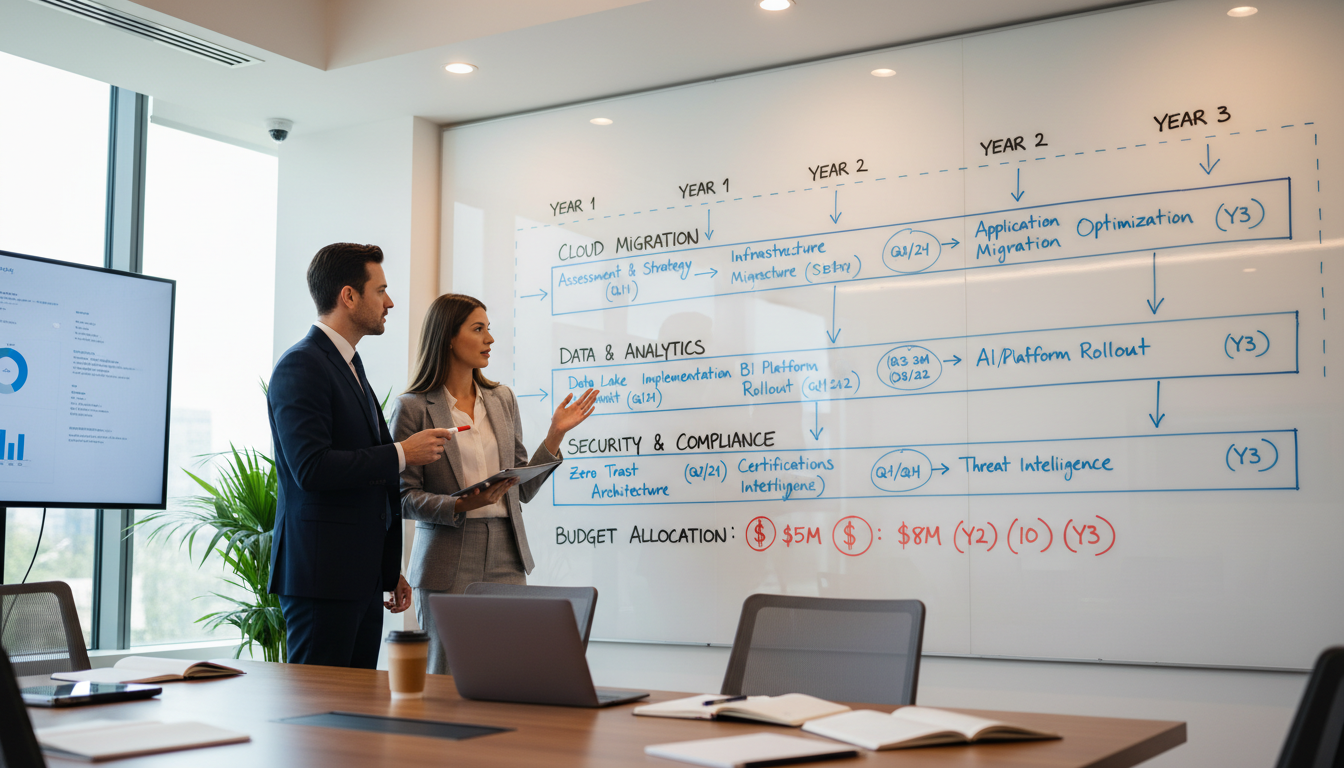
Technology is no longer a back-office function that ticks along quietly in the background. For small and medium-sized enterprises across the United Kingdom, it is the engine that powers growth, protects revenue, and determines whether you can compete with larger, better-resourced rivals. Yet the vast majority of UK SMEs have no formal plan for how their technology will evolve over the next three years.
The result is predictable: reactive spending on whatever breaks next, a patchwork of incompatible systems accumulated over years of ad hoc purchases, mounting cybersecurity risk, and a persistent feeling that technology is holding the business back rather than propelling it forward.
A 3-year IT roadmap changes that equation entirely. It gives you a structured, prioritised plan for investing in technology that aligns directly with your business objectives - transforming IT from a cost centre into a genuine competitive advantage. This guide walks you through every stage of building one, from assessing where you stand today to measuring the return on your investment at the end.
Why Every SME Needs an IT Roadmap
An IT roadmap is not a luxury reserved for large enterprises with dedicated technology departments. It is arguably even more critical for smaller businesses, where every pound of expenditure must be justified and where a single poor technology decision can set you back by years.
Without a roadmap, businesses tend to fall into one of two traps. The first is chronic underinvestment - putting off technology upgrades until systems fail, leaving staff battling slow equipment, outdated software, and security vulnerabilities that grow more dangerous by the month. The second is unfocused overspending - jumping on every new tool, platform, or trend that a sales rep pitches, ending up with a bloated technology stack where half the licences go unused and nothing integrates properly.
A well-constructed roadmap prevents both. It gives you a clear sequence of investments, each building on the last, each tied to a measurable business outcome. It ensures that your limited budget is directed where it will generate the greatest impact, and it provides the discipline to say "not yet" to technologies that may be valuable in future but are not the priority today.
An IT roadmap is a strategic document that maps out your technology investments, upgrades, and initiatives over a defined period - typically three years. It covers infrastructure, software, cybersecurity, cloud services, automation, and digital transformation projects, all aligned to your business goals and sequenced according to priority, budget, and dependencies. Think of it as a business plan for your technology - not a wish list, but a costed, phased, actionable programme of work.
Step 1: Assess Your Current IT Maturity
Before you can plan where you are going, you need an honest assessment of where you are today. This is not about listing your hardware - it is about understanding how effectively your current technology supports your business operations, your people, and your growth ambitions.
A comprehensive IT maturity assessment examines six key dimensions. Rate your organisation honestly against each one.
The progress bars above represent where a typical UK SME scores before undertaking strategic IT planning. Most businesses find they are reasonably functional in day-to-day collaboration but dangerously weak in cybersecurity, automation, and governance - the areas that determine long-term resilience and efficiency.
A thorough maturity assessment should also include a full audit of your hardware estate (age, warranty status, performance), software licences (usage, renewal dates, compliance), network infrastructure (bandwidth, reliability, redundancy), data backup and disaster recovery capabilities, and any technical debt - the accumulated cost of past shortcuts and deferred maintenance.
Step 2: Set IT Goals Aligned with Business Objectives
The single most important principle in building an IT roadmap is this: technology goals must derive from business goals, not the other way around. You do not invest in cloud migration because cloud is fashionable. You invest in it because your business needs to reduce property costs, enable hybrid working, improve resilience, or scale without proportional infrastructure investment.
Start by identifying your top three to five business priorities for the next three years. Common objectives for UK SMEs include:
- Revenue growth - expanding into new markets, launching new products, or increasing capacity
- Operational efficiency - reducing manual processes, cutting overheads, improving margins
- Talent attraction and retention - offering modern, flexible working environments
- Risk reduction - strengthening cybersecurity, ensuring regulatory compliance, building resilience
- Customer experience - faster response times, better self-service, smoother interactions
For each business objective, identify the technology capabilities required to achieve it. This creates a direct line of sight between every IT investment and a tangible business outcome - which makes budgeting conversations with the board far more productive.
| Business Objective | IT Capability Required | Example Investment |
|---|---|---|
| Grow revenue by 30% over 3 years | Scalable infrastructure, CRM system | Cloud migration, Salesforce/HubSpot deployment |
| Reduce operational costs by 15% | Process automation, paperless workflows | Power Automate, document management system |
| Enable hybrid working for all staff | Cloud collaboration, secure remote access | Microsoft 365 E3/E5, VPN or Zero Trust |
| Achieve Cyber Essentials Plus | Endpoint protection, patching, access controls | EDR platform, MFA, vulnerability scanning |
| Improve customer satisfaction by 20% | Faster systems, self-service portal | Cloud-hosted line-of-business app, chatbot |
Step 3: Budget for a 3-Year Technology Plan
Budgeting is where many IT roadmaps stall. Business owners either baulk at the perceived cost or have no framework for determining what "reasonable" IT expenditure looks like. Let us provide some clarity.
Industry benchmarks suggest that UK SMEs should allocate between 4% and 7% of annual revenue to technology, depending on the sector and the level of digital maturity they are targeting. Businesses in highly regulated or technology-dependent sectors (financial services, legal, healthcare) typically sit at the upper end. Those in less digitally intensive industries may be comfortable at the lower end.
For a UK SME with annual revenue of £2 million and 30 employees, a realistic 3-year IT budget might look like this:
Year 1 typically demands the heaviest investment as you address accumulated technical debt, replace aging hardware, and establish foundational capabilities like cloud infrastructure and cybersecurity. Years 2 and 3 shift towards optimisation and strategic initiatives, with lower capital expenditure but continued operational spending on licences, support, and managed services.
Factor in the shift from capital expenditure (CapEx) to operational expenditure (OpEx) as you move to cloud services. A £25,000 server purchase becomes a £500-per-month cloud subscription - lower upfront cost but an ongoing commitment. Most SMEs find OpEx models easier to manage, as costs are predictable and spread evenly throughout the year.
Key Technology Investments to Consider
Every business is different, but certain categories of technology investment appear on virtually every SME roadmap in 2026. Here are the five pillars that your plan should address.
1. Cloud Migration
If your business still relies on on-premise servers for file storage, email, or line-of-business applications, migrating to the cloud should be a top-tier priority. Cloud infrastructure eliminates the capital cost of server hardware, removes the risk of on-site failures, and provides the scalability and remote accessibility that modern businesses demand.
For most UK SMEs, Microsoft 365 combined with Azure provides a comprehensive cloud platform covering email, file storage, collaboration, identity management, and application hosting. A typical migration for a 30-user business costs between £8,000 and £20,000, depending on complexity, and delivers annual savings of £5,000 to £15,000 in hardware maintenance, energy, and reduced downtime.
2. Cybersecurity
Cyber threats facing UK SMEs have intensified dramatically. The UK Government's Cyber Security Breaches Survey 2025 found that 43% of UK businesses experienced a cyber incident in the preceding 12 months, with the average cost of a breach for an SME reaching £9,200. For businesses handling sensitive client data or subject to regulatory requirements, the reputational damage can be far more costly than the direct financial loss.
A robust cybersecurity programme should include endpoint detection and response (EDR), multi-factor authentication (MFA) across all systems, regular vulnerability scanning and patching, email security with anti-phishing protection, security awareness training for all staff, a documented incident response plan, and - ideally - Cyber Essentials Plus certification.
3. Collaboration and Productivity Tools
With hybrid working now standard practice across most UK industries, investing in collaboration tools that enable seamless teamwork regardless of location is essential. Microsoft Teams, SharePoint, and OneDrive form the backbone for most SMEs, but the value comes from proper configuration, governance, and user adoption - not just purchasing licences.
4. Business Process Automation
Automation represents the greatest untapped efficiency opportunity for UK SMEs. Research from McKinsey suggests that 45% of work activities can be automated with existing technology, yet most small businesses still rely on manual data entry, paper-based approvals, and email-driven workflows that consume hours of productive time every week.
Tools like Microsoft Power Automate, Zapier, and industry-specific workflow platforms can eliminate repetitive tasks across finance, HR, sales, and operations - freeing your team to focus on activities that actually generate revenue.
5. Data and Business Intelligence
As your digital maturity grows, so does the volume of data your business generates. Investing in the ability to analyse that data - through tools like Power BI, bespoke dashboards, or AI-assisted analytics - transforms raw information into actionable insights that drive better decision-making.
| Investment Area | Typical Cost (30-User SME) | Expected ROI Timeline | Priority Level |
|---|---|---|---|
| Cloud migration (Microsoft 365 + Azure) | £10,000 – £25,000 | 6 – 12 months | Critical |
| Cybersecurity programme | £8,000 – £18,000/year | Immediate risk reduction | Critical |
| Collaboration platform deployment | £5,000 – £12,000 | 3 – 6 months | High |
| Business process automation | £6,000 – £15,000 | 6 – 18 months | High |
| Data analytics / Power BI | £4,000 – £10,000 | 12 – 24 months | Medium |
| Hardware refresh (laptops, networking) | £15,000 – £40,000 | Immediate productivity gains | High |
The Phased Implementation Approach
Attempting to transform your entire IT environment in one go is a recipe for disruption, overspending, and change fatigue. A phased approach spreads the investment, manages risk, and allows each initiative to stabilise before the next begins.
Year 1: Foundations and Remediation
The first year is about getting the basics right. Address the most pressing risks, replace equipment that is actively impeding productivity, and establish the foundational platforms that everything else will build upon.
- Complete IT maturity assessment and gap analysis
- Replace end-of-life hardware (laptops over 4 years old, unsupported networking equipment)
- Migrate email and file storage to Microsoft 365 if not already cloud-based
- Implement multi-factor authentication across all systems
- Deploy endpoint detection and response (EDR) on all devices
- Establish automated backup and disaster recovery
- Achieve Cyber Essentials certification
- Engage a managed IT service provider or Virtual CIO for ongoing governance
Year 2: Optimisation and Growth
With foundations in place, Year 2 focuses on efficiency, user experience, and enabling growth. The investment shifts from remediation to optimisation.
- Migrate remaining on-premise applications to cloud or hosted environments
- Deploy business process automation for key workflows (finance, HR, sales)
- Implement a CRM platform to improve customer management and sales visibility
- Upgrade to Cyber Essentials Plus; begin security awareness training programme
- Optimise Microsoft Teams deployment - governance, channels, integrations
- Begin data consolidation and introduce Power BI dashboards for leadership reporting
- Review and renegotiate vendor contracts to reduce unnecessary licence spend
Year 3: Innovation and Competitive Advantage
By Year 3, your IT environment should be stable, secure, and efficient. Now you can invest in technologies that differentiate your business and create genuine competitive advantage.
- Explore AI-assisted tools for customer service, content, or operational decision-making
- Implement advanced analytics and predictive modelling on business data
- Develop customer-facing digital services (self-service portals, mobile apps)
- Conduct a full penetration test and refine cybersecurity posture
- Evaluate emerging technologies relevant to your sector (IoT, machine learning, blockchain)
- Plan the next 3-year cycle based on lessons learned and evolving business strategy
A 3-year roadmap is a strategic guide, not a rigid contract. Technology evolves, business priorities shift, and external factors - from new regulations to economic conditions - can alter your trajectory. Review and adjust your roadmap quarterly, moving initiatives forward or back as circumstances dictate. The value is in having a plan to adapt, not in following it blindly.
Common Pitfalls When Planning IT Strategy
Even well-intentioned IT roadmaps can fail. Understanding the most common mistakes helps you avoid them.
Pitfalls to Avoid
- Planning in isolation: IT strategies built without input from department heads, end users, and finance invariably miss the mark
- Ignoring change management: New technology fails when people are not trained, consulted, and supported through the transition
- Underestimating cybersecurity: Treating security as a one-off project rather than an ongoing programme leaves you exposed
- Chasing trends over substance: Investing in AI, blockchain, or the latest buzzword without a clear business case wastes limited budget
- No ownership or accountability: A roadmap without a named owner - someone responsible for driving execution - gathers dust
- Failing to budget for ongoing costs: Licences, support, training, and maintenance often exceed the initial implementation cost
Success Factors
- Executive sponsorship: The roadmap must have visible support and commitment from senior leadership
- Business-first thinking: Every initiative is justified by a measurable business outcome, not technology for its own sake
- Phased delivery: Break the plan into manageable chunks with clear milestones and review points
- User involvement: Engage the people who will use the technology at every stage, from requirements to rollout
- Regular review cycles: Quarterly reviews ensure the roadmap stays relevant as circumstances change
- Professional guidance: A Virtual CIO or experienced IT partner provides objectivity and market knowledge
The Role of a Virtual CIO in Roadmap Development
Most UK SMEs lack the internal expertise to build a credible IT roadmap. The technical knowledge required to assess maturity, evaluate vendors, estimate costs, sequence dependencies, and anticipate risks is simply not present in a business whose core competency lies elsewhere. This is precisely where a Virtual CIO (vCIO) adds transformative value.
A Virtual CIO is an experienced IT strategist who works with your business on a part-time or retained basis - typically for a fraction of the cost of employing a full-time Chief Information Officer. They bring the strategic thinking of a senior technology leader without the £90,000-to-£150,000 salary that a permanent CIO commands.
A Virtual CIO's role in roadmap development includes:
- Conducting the maturity assessment - an objective, expert evaluation of your current IT environment with benchmarking against industry standards
- Facilitating strategy workshops - bringing together business leaders and department heads to define technology priorities
- Building the costed roadmap - a detailed, phased plan with budget estimates, timelines, and dependencies
- Vendor selection and management - leveraging market knowledge to select the right platforms and negotiate the best terms
- Ongoing governance - chairing quarterly reviews, tracking progress against the roadmap, and adjusting the plan as needed
- Budget advocacy - presenting the business case for technology investment to the board in language that resonates with financial decision-makers
For UK SMEs spending £30,000 to £150,000 per year on technology, a Virtual CIO typically costs between £1,000 and £3,000 per month - an investment that consistently pays for itself through better vendor negotiations, avoided mis-purchases, and faster realisation of technology benefits.
Measuring ROI on IT Investments
A roadmap without measurement is just a wish list. Every initiative in your plan should have defined metrics that allow you to assess whether the investment is delivering the expected return. ROI on IT can be measured across four dimensions.
| ROI Dimension | What to Measure | Example Metric |
|---|---|---|
| Cost reduction | Direct savings from replaced or eliminated systems | Server hosting costs reduced by 40% after cloud migration |
| Productivity gains | Time saved through automation and better tools | Invoice processing time reduced from 25 minutes to 4 minutes |
| Risk mitigation | Reduction in incidents, downtime, and compliance gaps | Unplanned downtime reduced from 28 hours/year to 4 hours/year |
| Revenue enablement | New capabilities that directly support revenue growth | CRM deployment contributing to 15% increase in sales pipeline |
Establish baseline measurements before each initiative begins, set targets for 6 and 12 months post-implementation, and report progress to leadership quarterly. This discipline not only validates past investments but builds confidence and appetite for future ones.
Bringing It All Together
Building a 3-year IT roadmap is not a one-off project - it is the beginning of a disciplined, strategic approach to technology that will serve your business for years to come. The process can be summarised in six steps:
- Assess your current IT maturity honestly and thoroughly
- Align technology goals with your core business objectives
- Budget realistically, using industry benchmarks and phased investment
- Prioritise investments based on business impact, risk, and dependencies
- Execute in phases - foundations first, optimisation second, innovation third
- Measure outcomes against defined metrics and adjust the plan quarterly
The businesses that thrive over the next three years will not be those with the largest IT budgets. They will be those with the smartest IT strategies - the ones who invest deliberately, execute methodically, and adapt continuously. A 3-year IT roadmap is the tool that makes that possible.
Ready to Build Your IT Roadmap?
At Cloudswitched, our Virtual CIO service helps UK SMEs develop and execute technology strategies that drive real business results. From maturity assessments and roadmap development to vendor management and quarterly governance - we provide the strategic IT leadership your business needs without the cost of a full-time hire. Get in touch to start the conversation.
BOOK A FREE CONSULTATION
CloudSwitched
London-based managed IT services provider offering support, cloud solutions and cybersecurity for SMEs.


