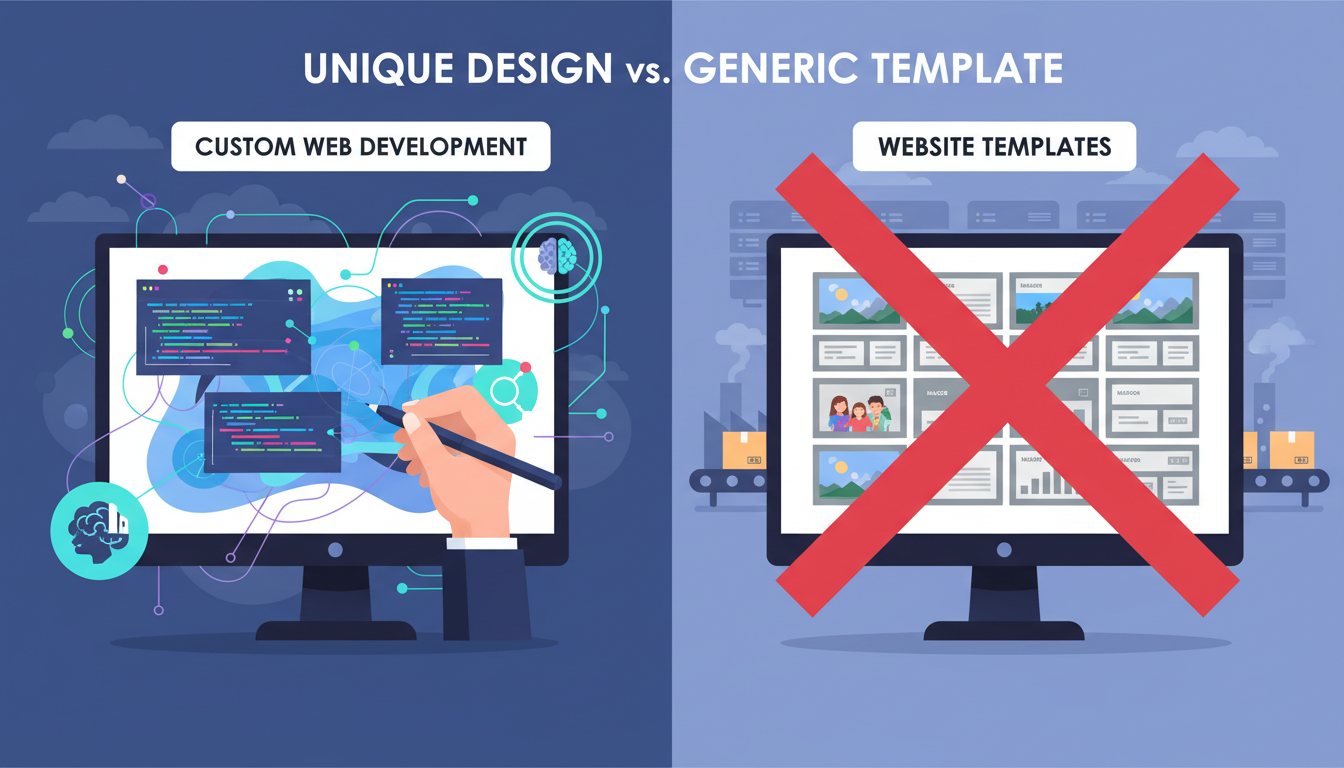
Every UK business that needs a website, web application, or digital platform faces a fundamental decision early in the process: should they build something custom from scratch, or should they use a pre-built template or platform? This is not a trivial question. The choice between custom development and templates affects your budget, timeline, functionality, scalability, security, and long-term total cost of ownership. Getting it wrong can mean either wasting tens of thousands of pounds on unnecessary custom work, or being constrained by a template that cannot support your business as it grows.
The web development industry has a vested interest in pushing you towards custom development - it generates higher revenue for agencies. Conversely, template and platform providers have an equally strong interest in convincing you that templates can do everything you need. The truth, as with most things, lies somewhere in between and depends entirely on your specific circumstances.
This guide provides an honest, balanced assessment of both approaches, helping you make an informed decision based on your business needs, budget, timeline, and long-term ambitions.
The UK digital landscape has evolved dramatically over the past decade. According to the Office for National Statistics, over ninety-five per cent of UK businesses now have a website, and digital channels account for an ever-growing share of revenue across virtually every sector. The sophistication of what businesses expect from their web presence has grown in tandem - a simple brochure website that sufficed in 2015 may no longer meet the expectations of customers who have become accustomed to seamless digital experiences from the likes of Amazon, Deliveroo, and Monzo.
This rising bar of expectation is precisely what makes the template-versus-custom decision so consequential. Choose a template when you need custom, and you will find yourself fighting against platform limitations, bolting on workarounds, and delivering a compromised user experience. Choose custom when a template would suffice, and you will haemorrhage budget on engineering that delivers no additional business value. The web development industry in the UK is worth over £6 billion annually, and a significant portion of that spending is misdirected by businesses making the wrong choice at this fundamental juncture.
To make the right decision, you need to understand not just what each approach involves today, but how it will serve your business over the next three to five years. Technology decisions have long tails - the website or application you build now will shape your digital capabilities, your maintenance burden, and your ability to adapt to market changes for years to come.
Understanding Template-Based Development
Template-based development means using a pre-built framework, theme, or platform as the foundation for your website or application. The most common platforms in the UK market include WordPress (which powers approximately 43 per cent of all websites globally), Shopify (for e-commerce), Squarespace, Wix, and various industry-specific platforms.
Templates provide a pre-designed layout, navigation structure, and visual framework that you customise with your own content, branding, colours, and imagery. Modern templates are highly flexible - you can change layouts, add pages, integrate third-party services, and extend functionality through plugins or apps. A skilled developer can make a template-based site look entirely unique, bearing no resemblance to the original template.
The key advantage of templates is speed and cost. Because the underlying structure, design patterns, and core functionality are already built and tested, you are not paying for hundreds of hours of development time to create these from scratch. Your developer's time is spent on customisation, content integration, and configuration rather than building foundational components.
Templates are typically the right choice when your requirements align closely with what the template or platform provides out of the box. Brochure websites, blogs, standard e-commerce stores, portfolio sites, and basic membership sites are all well-served by templates. If your requirements can be met by an existing platform with minimal customisation, spending £50,000 on custom development would be wasteful. A well-implemented template-based site delivers the same business outcome at a fraction of the cost and in a fraction of the time.
The Template Ecosystem in Detail
The template and platform ecosystem has matured significantly in recent years, and it is worth understanding the breadth of what is available before dismissing templates as a viable option. WordPress alone offers over 60,000 plugins, covering everything from SEO optimisation and caching to e-commerce, membership management, booking systems, and customer relationship management. With the right combination of theme and plugins, a skilled WordPress developer can build remarkably sophisticated websites without writing bespoke code from scratch.
Shopify has become the dominant platform for e-commerce in the UK, powering online stores for businesses ranging from sole traders to major national brands. Its app ecosystem provides inventory management, subscription billing, multi-currency support, and integration with virtually every payment provider, shipping carrier, and accounting package used in the UK market. For straightforward e-commerce - selling physical or digital products with standard checkout flows - Shopify is exceptionally difficult to beat on value.
Squarespace and Wix occupy the lower end of the market, offering drag-and-drop website builders that enable non-technical users to create presentable websites without any developer involvement. Whilst these platforms are limited in functionality compared to WordPress or Shopify, they serve a genuine need for very small businesses, freelancers, and sole traders who need a basic web presence without the ongoing cost of developer support.
Where Templates Hit Their Limits
Despite their versatility, templates have real limitations that become apparent as your requirements grow in complexity. Performance is often the first casualty - a WordPress site loaded with fifteen plugins will typically be slower than a well-built custom application, because each plugin adds its own database queries, CSS files, and JavaScript. Whilst caching and content delivery networks can mitigate this to some extent, there is an inherent performance ceiling with heavily customised template sites.
Security is another area where templates carry risk. WordPress sites are the most frequently targeted by automated attacks precisely because of their popularity and the prevalence of vulnerable plugins. Keeping a WordPress installation secure requires diligent updates of the core platform, theme, and every installed plugin - a maintenance burden that many small businesses underestimate or neglect entirely.
Customisation limits become apparent when your requirements diverge from what the template or platform was designed to do. Whilst you can customise a great deal within WordPress or Shopify, there comes a point where you are working against the platform rather than with it. Complex multi-step forms, custom data models, sophisticated search functionality, or tight integration with proprietary business systems can push a template-based solution to breaking point, resulting in fragile workarounds that are expensive to maintain.
Understanding Custom Development
Custom development means building your website or application from scratch (or near-scratch), writing bespoke code that implements exactly the functionality you need. This approach uses programming languages and frameworks such as React, Next.js, Laravel, Django, or Ruby on Rails, with a database designed specifically for your data model and business logic coded to your exact specifications.
The key advantage of custom development is unlimited flexibility. There are no constraints imposed by a template or platform - if you can define it, it can be built. Complex business logic, unique user workflows, integration with proprietary systems, high-performance requirements, and novel user interfaces are all achievable with custom development.
The trade-off is cost, time, and complexity. Custom development requires more skilled (and more expensive) developers, takes longer to deliver, and creates a codebase that needs ongoing maintenance. Every feature that a template provides for free - responsive design, accessibility, SEO fundamentals, security patching - must be built and maintained as part of your custom project.
| Factor | Template-Based | Custom Development |
|---|---|---|
| Initial cost | £3,000 - £15,000 | £15,000 - £100,000+ |
| Delivery timeline | 4-8 weeks | 12-24 weeks |
| Design flexibility | High (within platform limits) | Unlimited |
| Functionality | Standard features + plugins | Anything technically feasible |
| Ongoing maintenance cost | £50 - £300/month | £500 - £3,000/month |
| Security patching | Platform manages core updates | Your responsibility entirely |
| Scalability | Limited by platform architecture | Designed for your scale requirements |
| Vendor dependency | Dependent on platform provider | Dependent on development team |
Understanding Total Cost of Ownership
One of the most common errors in the template-versus-custom decision is focusing exclusively on the initial build cost. The true cost of a website or web application is the total cost of ownership over its useful life - typically three to five years for a business website. This includes the initial build, hosting, domain registration, SSL certificates, content updates, security patching, plugin or dependency updates, performance optimisation, and any feature additions or modifications over that period.
For a template-based WordPress site, the total five-year cost typically breaks down as follows: initial build (£5,000 to £12,000), premium theme and plugin licences (£200 to £800 per year), hosting (£600 to £2,400 per year), ongoing maintenance and updates (£1,200 to £3,600 per year), and occasional feature additions or redesigns (£2,000 to £5,000 over the period). The five-year total typically falls between £15,000 and £35,000.
For a custom-built application, the picture is different: initial build (£25,000 to £80,000), hosting and infrastructure (£1,200 to £6,000 per year), ongoing maintenance and security patching (£6,000 to £24,000 per year), and feature additions (£5,000 to £20,000 over the period). The five-year total typically falls between £50,000 and £170,000.
These figures make it clear why the decision matters so much. Choosing custom development when a template would suffice does not just waste the initial budget difference - it commits your business to higher ongoing costs for the entire life of the project. Conversely, choosing a template that cannot support your requirements leads to escalating maintenance costs, workaround expenses, and eventually a costly rebuild - often at a higher total cost than building custom from the outset.
Technical Debt and Long-Term Maintenance
Both approaches carry the risk of technical debt - shortcuts and compromises that save time now but create maintenance burdens later. With template-based development, technical debt typically manifests as plugin sprawl (installing too many plugins to cover gaps in functionality), outdated dependencies (falling behind on updates because they risk breaking the site), and customisation hacks (modifying core template files rather than using proper extension mechanisms).
With custom development, technical debt appears as insufficient documentation (making the codebase harder for future developers to understand), missing test coverage (making changes risky and time-consuming), architectural shortcuts (building quick solutions that do not scale), and vendor lock-in to specific developers or agencies who understand the bespoke codebase. A custom application is only as maintainable as the quality of its code and documentation, and many custom projects are built by agencies who prioritise speed of delivery over long-term maintainability.
Decision Framework: Choosing the Right Approach
Rather than starting with a preference for one approach over the other, start with your requirements and let them guide the decision. Answer the following questions honestly:
What is your budget? If your total budget including design, development, and first-year maintenance is under £15,000, custom development is unlikely to be a viable option. A template-based approach will deliver far more value within this budget. If your budget is £30,000 or above, both options are on the table.
What is your timeline? If you need to launch within six weeks, custom development is extremely risky. Templates can be configured, customised, and launched within this timeframe. Custom development typically requires three to six months for even a moderately complex project.
How unique are your requirements? If your needs are largely standard - a professional website with information pages, a blog, a contact form, and perhaps e-commerce - a template handles this excellently. If you need a custom booking system that integrates with your proprietary scheduling software, or a client portal with complex role-based permissions, custom development may be necessary.
What are your growth plans? If you expect your requirements to evolve significantly over the next two to three years - adding complex features, integrating with multiple systems, or handling substantial traffic growth - consider whether a template platform can accommodate that growth or whether you will hit its limitations.
What are your team's technical capabilities? Consider who will manage the website or application after it launches. If you have an internal marketing team comfortable with WordPress or Shopify, a template-based solution empowers them to make content updates, publish blog posts, and manage products without developer involvement. If updates will always require a developer, this ongoing dependency should factor into your cost calculations regardless of which approach you choose.
How critical is performance? If your website is your primary revenue channel - for example, an e-commerce store where every hundred milliseconds of load time affects conversion rates - performance requirements may push you towards custom development, where every aspect of the stack can be optimised for speed. For a professional services firm where the website primarily generates enquiries through a contact form, the marginal performance difference between template and custom is unlikely to affect business outcomes meaningfully.
What integrations do you need? If your website must integrate with existing business systems - your CRM, ERP, accounting software, stock management system, or bespoke internal tools - the availability and quality of existing integrations should heavily influence your decision. WordPress and Shopify have extensive integration ecosystems, but if your systems are unusual or proprietary, custom API development may be necessary regardless of the front-end approach.
What are your content management needs? Virtually every business needs to update website content regularly. Template platforms like WordPress provide mature, user-friendly content management interfaces that non-technical staff can use with minimal training. Custom applications require a bespoke content management system to be built as part of the project, adding significant cost and complexity. If content management is a primary requirement, the built-in CMS capabilities of template platforms represent substantial value that should not be overlooked.
Choose Templates When
- Budget is under £15,000
- Timeline is under 8 weeks
- Requirements are standard (brochure, blog, shop)
- No complex custom business logic needed
- Internal team can manage content updates
- Standard integrations are sufficient
- SEO and content marketing are primary goals
Choose Custom Development When
- Budget exceeds £30,000
- Requirements cannot be met by existing platforms
- Complex business logic or workflows required
- Integration with proprietary or legacy systems
- High-performance requirements (speed, scale)
- Unique user experience is a competitive advantage
- Long-term ownership and control are priorities
The Hybrid Approach
Many UK businesses find that the optimal solution is neither purely template-based nor purely custom, but a hybrid of both. This approach uses a platform or template for the parts of the project that are standard (content management, blogging, basic pages) while building custom components for the parts that require unique functionality.
For example, a UK professional services firm might use WordPress for their main website - handling the homepage, service pages, team profiles, blog, and contact forms - while building a custom client portal as a separate application that integrates with WordPress for authentication. This gives them the speed and cost efficiency of WordPress for 80 per cent of their needs, with the unlimited flexibility of custom development for the remaining 20 per cent.
The hybrid approach requires careful architecture to ensure the template-based and custom components integrate smoothly, share data where necessary, and present a consistent user experience. This is where working with an experienced development team is essential - they can identify the right seams between template and custom functionality and design the integration to be robust and maintainable.
When the Hybrid Approach Works Best
The hybrid approach is particularly effective for businesses in professional services, financial services, education, and healthcare - sectors where the public-facing website needs to be content-rich and SEO-optimised (well-served by WordPress or a similar CMS), whilst internal tools, client portals, or data-driven applications require custom functionality that no template can provide.
Consider a UK accountancy firm as an example. Their main website - with service descriptions, team profiles, blog articles about tax changes, and a contact form - is perfectly suited to WordPress. However, their client portal, which allows clients to upload documents, view their accounts, communicate securely with their accountant, and sign engagement letters digitally, requires custom development. Building the entire site custom would waste budget on the brochure content; using WordPress for the portal would compromise security and functionality.
A well-architected hybrid solution uses each technology where it excels: WordPress for content management, search engine optimisation, and rapid content publishing; custom code for business logic, data processing, and authenticated user experiences. The key to success is clean separation between the components, with well-defined APIs connecting them and consistent visual design ensuring users experience a seamless transition between template and custom sections of the site.
Evaluating Your Requirements Honestly
The single most important step in the template-versus-custom decision is an honest, thorough assessment of your actual requirements - not your aspirational requirements, not what your competitor has, and not what the latest industry blog post recommends. Write down every feature and capability your website or application must have at launch, then categorise each as either standard (available in templates) or bespoke (requiring custom code). If more than seventy per cent of your requirements are standard, a template-based approach almost certainly offers better value. If more than thirty per cent are genuinely bespoke, custom development - or at minimum, a hybrid approach - deserves serious consideration.
Be particularly sceptical of requirements that sound bespoke but are actually standard. A claim that you need a unique design does not require custom development - a skilled designer can create a completely unique visual identity within a template framework. Needing a booking system does not require custom code - mature booking plugins exist for every major platform. Reserve custom development for requirements that genuinely cannot be met by existing tools, and you will make far better use of your budget.
It is also worth speaking to businesses similar to yours about their experiences. A fellow professional services firm, retailer, or manufacturer who has been through the template-versus-custom decision recently can offer invaluable practical insight that no blog post or agency pitch can match. Industry associations and business networks in the UK are excellent sources for these peer recommendations, and the candid perspective of someone who has lived with their decision for two or three years is worth more than any theoretical analysis.
Common Mistakes to Avoid
Over-engineering with custom development: The most expensive mistake is building custom solutions for problems that templates solve perfectly well. If your requirements can be met by WordPress with a few plugins, spending £50,000 on a custom build is not sophisticated - it is wasteful. Every pound spent on unnecessary custom development is a pound not invested in marketing, content, or business development.
Under-investing with templates: Conversely, trying to force a complex application into a template framework leads to frustration, compromises, and often a higher total cost than building custom from the start. If you find yourself needing dozens of plugins, custom PHP code within WordPress, and workarounds for template limitations, you have probably outgrown the template approach.
Ignoring total cost of ownership: The initial build cost is just the beginning. Templates require ongoing updates, plugin maintenance, and hosting. Custom applications require developer time for bug fixes, security patches, feature additions, and infrastructure management. Compare the five-year total cost, not just the initial project cost, when making your decision.
Choosing based on technology preference: Some business owners are swayed by a developer's enthusiasm for a particular technology. The choice should always be driven by business requirements, not by what the developer finds technically interesting. A boring, well-implemented WordPress site that meets your needs is infinitely more valuable than an exciting custom build that exceeds your budget and timeline.
Working with a UK Development Partner
Regardless of whether you choose templates or custom development, working with a competent UK-based development partner dramatically increases your chances of success. A good partner will honestly assess your requirements and recommend the approach that delivers the best value for your specific situation - even if that means recommending a simpler (and less profitable for them) template-based solution.
When evaluating potential partners, look for a portfolio that includes both template-based and custom projects. A firm that only does custom development may be biased towards recommending custom solutions. A firm that only works with WordPress may be biased towards templates. The best partners are platform-agnostic and choose the right tool for each project.
Ask potential partners about their process for gathering requirements and making the template-versus-custom recommendation. A thorough discovery process - involving stakeholder interviews, requirements documentation, and technical feasibility assessment - is a strong indicator of a mature, client-focused partner. If a firm recommends a solution before fully understanding your requirements, treat that as a red flag.
Need Honest Web Development Advice?
Cloudswitched provides web development services across both template-based and custom approaches, always recommending the solution that delivers the best value for your business. We will never push custom development when a template would serve you better. Contact us for an honest assessment of your project.
GET IN TOUCH
CloudSwitched
London-based managed IT services provider offering support, cloud solutions and cybersecurity for SMEs.


