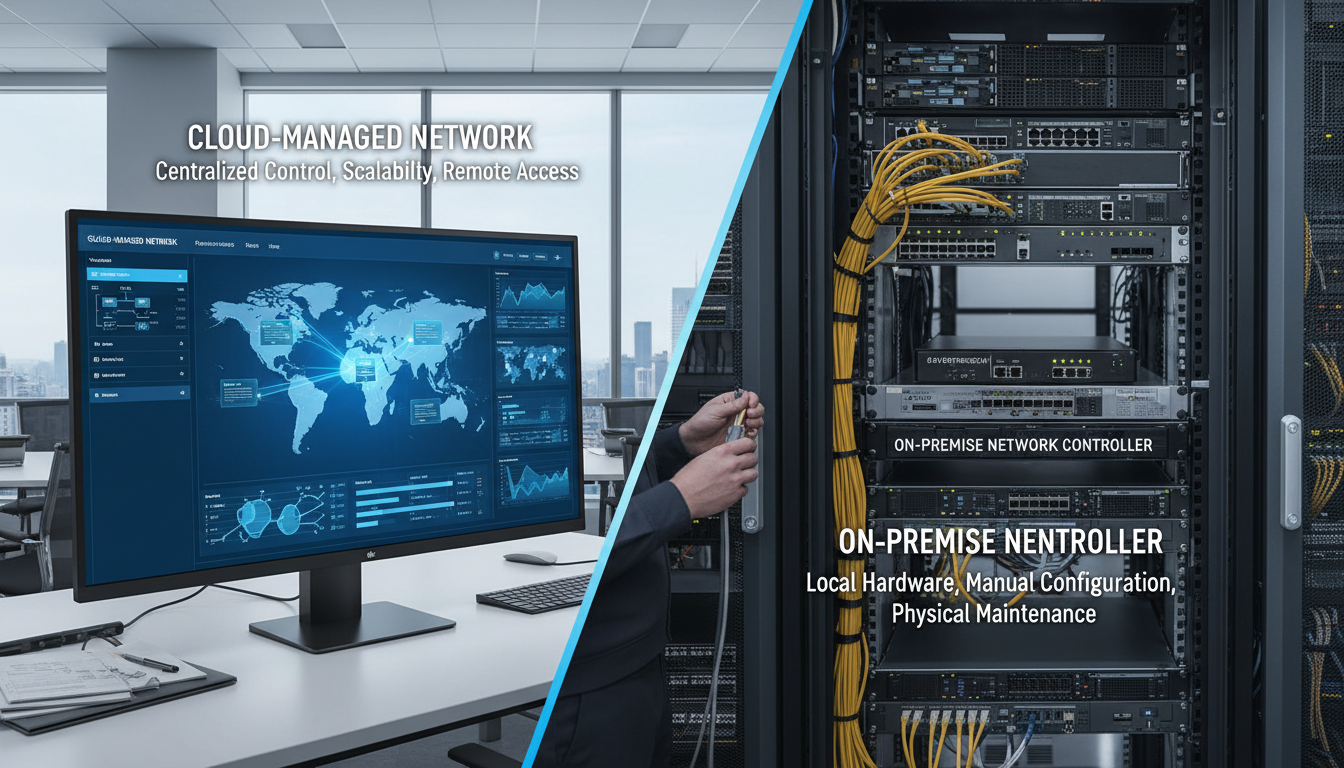
The network controller is the brain of your business network. It is the centralised management platform that configures, monitors, and optimises your switches, access points, firewalls, and other network devices. Without a controller, each device must be configured individually - a time-consuming, error-prone process that becomes unmanageable as your network grows beyond a handful of devices. With a controller, your entire network can be managed from a single interface, with consistent policies applied across every location.
For UK businesses, the choice between a cloud-managed controller and an on-premise controller has become one of the most consequential networking decisions of the past decade. Cloud-managed platforms such as Cisco Meraki, Aruba Central, and Ubiquiti UniFi Cloud have gained enormous market share by offering simplicity, remote management, and subscription-based pricing. On-premise controllers from vendors like Cisco DNA Centre, Aruba AirWave, and HPE Intelligent Management Centre continue to offer advantages in environments that demand maximum control, low latency, and data sovereignty.
Neither approach is universally superior. The right choice depends on your organisation's size, technical capabilities, regulatory requirements, multi-site footprint, and budget model preferences. This guide provides an honest, detailed comparison of both approaches to help UK businesses make an informed decision.
The evolution of network management over the past decade mirrors the broader shift in enterprise IT towards cloud-delivered services. In the early 2010s, on-premise controllers were the only serious option for businesses that wanted centralised network management. Cloud-managed networking was in its infancy, limited to basic Wi-Fi management with minimal features. By the mid-2010s, platforms like Cisco Meraki had matured considerably, offering feature parity with many on-premise controllers for common use cases. Today, cloud-managed platforms have surpassed their on-premise counterparts in several areas - particularly in user experience, AI-driven analytics, and multi-site management - whilst on-premise solutions retain advantages in customisation depth and data sovereignty.
Understanding this trajectory is important because it shapes the vendor roadmap. Major networking vendors are investing disproportionately in their cloud platforms, which means the feature gap between cloud and on-premise controllers is likely to widen further in favour of cloud. Businesses choosing an on-premise controller today should consider whether the platform they select will continue to receive meaningful development investment over the next five to ten years.
How Cloud-Managed Controllers Work
A cloud-managed network controller is a software platform hosted in the vendor's cloud infrastructure that communicates with your on-site network devices over the internet. Your switches, access points, and security appliances maintain a persistent, encrypted connection to the cloud controller, sending telemetry data (performance metrics, client information, security events) and receiving configuration updates in return.
The key characteristic of this model is that the management plane - the configuration, monitoring, and analytics functions - is hosted in the cloud, whilst the data plane - the actual forwarding of network traffic - remains entirely local. This means that if the internet connection to the cloud controller is interrupted, your network continues to function normally. Users can still connect to Wi-Fi, traffic continues to flow between switches, and firewall rules remain in effect. What you lose during an internet outage is the ability to make configuration changes and view real-time monitoring from the cloud dashboard.
Cisco Meraki is the most widely deployed cloud-managed networking platform in the UK and serves as a useful reference point. Meraki's dashboard provides a single-pane-of-glass view across all network devices - switches, access points, security appliances, cameras, and mobile device management - across every site. Configuration changes made in the dashboard are pushed to devices within seconds. Firmware updates are managed centrally and deployed automatically on a schedule you define. And because the dashboard is accessible from any web browser, your network can be managed from anywhere - a significant advantage for businesses with multiple UK locations or for managed service providers supporting many clients.
Vendor Ecosystem and Platform Capabilities
Beyond Cisco Meraki, several other cloud-managed platforms have established a significant presence in the UK market. Aruba Central, part of Hewlett Packard Enterprise, offers a particularly strong wireless management capability and integrates well with existing HPE infrastructure. Ubiquiti UniFi, whilst positioned at a lower price point, has gained traction among cost-conscious SMEs and smaller managed service providers. Juniper Mist uses artificial intelligence to automate network troubleshooting and optimisation, representing the next generation of cloud-managed networking.
Each platform has its strengths and limitations. Meraki excels in simplicity and breadth of product coverage across networking, security, and IoT. Aruba Central offers more granular wireless configuration options and stronger integration with enterprise authentication systems. UniFi provides excellent value but lacks the enterprise support structure and feature depth of Meraki or Aruba. The choice between platforms should be driven by your specific requirements, existing vendor relationships, and the capabilities of your support provider.
A significant advantage shared by all major cloud-managed platforms is their API-first architecture. These platforms expose comprehensive REST APIs that enable automation, integration with third-party tools, and custom reporting. For businesses adopting infrastructure-as-code practices or integrating network management with their IT service management platforms, API access is a valuable capability that many on-premise controllers either lack entirely or implement inconsistently.
This is the most common concern about cloud-managed networking, and it is largely unfounded for well-designed platforms. Cloud-managed devices cache their configuration locally, so all routing, switching, Wi-Fi, and security functions continue operating normally during an internet outage. What you cannot do during an outage is modify configurations, view real-time dashboards, or receive alerts. For most businesses, this is an acceptable trade-off - you were not going to be making network changes during an internet outage anyway. However, for environments where local configuration changes during an outage are a genuine requirement (such as hospitals or emergency services), this limitation should be carefully considered.
How On-Premise Controllers Work
An on-premise network controller runs on hardware or virtual machines within your own data centre or server room. All communication between the controller and your network devices occurs over your local network, with no dependency on internet connectivity. Configuration, monitoring, and analytics are performed locally, and all network management data remains within your physical premises.
On-premise controllers offer maximum control and customisation. They typically expose more granular configuration options than cloud-managed platforms, support more complex network architectures, and provide deeper integration with existing on-premise infrastructure such as RADIUS servers, LDAP directories, and SIEM platforms. For large enterprise environments with dedicated network engineering teams, this level of control is valuable and often necessary.
The trade-off is complexity and cost. On-premise controllers require server infrastructure (physical or virtual), ongoing maintenance, regular software updates, backup and disaster recovery planning, and specialist technical staff to operate. The initial capital expenditure is typically higher than the first year of a cloud-managed subscription, and the ongoing operational costs - including the staff time required for maintenance - can be significant. For UK SMEs without dedicated network engineering resources, the operational burden of an on-premise controller often outweighs its technical advantages.
Staffing and Operational Requirements
The staffing implications of choosing between cloud-managed and on-premise controllers are often underestimated in the decision-making process. An on-premise controller requires staff who can manage the underlying server infrastructure - applying operating system patches, managing backups, monitoring disk space and memory utilisation, and troubleshooting server-level issues in addition to the network management tasks themselves. This effectively doubles the skill set required compared to a cloud-managed platform where the vendor handles all platform infrastructure.
For UK businesses that rely on external IT support providers, the choice of controller also affects the pool of available support partners. The majority of UK managed service providers have standardised on cloud-managed platforms, particularly Cisco Meraki, and can offer competitive support rates because they manage many similar deployments. Finding an MSP with deep expertise in a specific on-premise controller platform can be more challenging and typically commands a premium. Businesses should factor support availability and cost into their decision, particularly if they do not have in-house networking expertise.
Cloud-Managed Controllers
- No on-site server infrastructure required
- Accessible from anywhere via web browser
- Automatic firmware updates and security patches
- Ideal for multi-site management from one dashboard
- Subscription model - OpEx rather than CapEx
- Built-in analytics and reporting
- Rapid deployment - minutes not days
- Vendor handles platform availability and scaling
On-Premise Controllers
- Full data sovereignty - nothing leaves your premises
- No internet dependency for management functions
- More granular configuration options available
- Deeper integration with existing on-prem systems
- No recurring subscription (perpetual licence model)
- Custom reporting and data retention policies
- Works in air-gapped or restricted environments
- No vendor lock-in to cloud platform availability
Cost Comparison: Cloud vs On-Premise
The cost models for cloud-managed and on-premise controllers are fundamentally different, and a fair comparison requires looking at Total Cost of Ownership (TCO) over a multi-year period rather than just the initial purchase price.
Cloud-managed networking operates on a subscription model. You pay an annual or multi-year licence fee per device, which covers the cloud management platform, firmware updates, technical support, and (typically) hardware warranty. There is no separate cost for server infrastructure, software maintenance, or backup - these are all included in the subscription. The trade-off is that if you stop paying the subscription, your devices lose cloud management functionality. Some platforms (like Meraki) will reduce devices to basic functionality without an active licence; others allow continued operation in a limited mode.
On-premise controllers involve higher upfront capital expenditure - server hardware or virtual machine resources, software licences, and implementation professional services - followed by annual maintenance fees for software updates and technical support. You also need to factor in the ongoing cost of staff time for maintenance, patching, backup, and troubleshooting. However, the per-device cost is typically lower over a five-year period for larger deployments, and there is no risk of losing functionality if you discontinue the maintenance contract (though you will lose access to updates and support).
Hidden and Indirect Costs
Beyond the direct costs outlined in the table below, several hidden and indirect costs should inform your decision. Cloud-managed platforms eliminate the need for change management processes around controller software updates - the vendor handles this transparently. With on-premise controllers, each software update requires planning, testing in a lab environment (ideally), scheduling a maintenance window, executing the update, and verifying functionality afterwards. For a busy IT team, these update cycles can consume several days per year.
Training costs also differ significantly. Cloud-managed platforms are designed for intuitive use and typically require minimal formal training. On-premise controllers often have steeper learning curves and may require vendor-specific certification courses for staff to operate them effectively. Cisco DNA Centre, for example, is a powerful platform but has a complexity level that demands dedicated training investment. These training costs recur whenever staff turnover occurs, which for UK businesses averaging 15 to 20 percent annual IT staff turnover, represents a meaningful ongoing expense.
Opportunity cost is perhaps the most overlooked factor. Time that your IT team spends maintaining controller infrastructure is time they cannot spend on strategic initiatives that drive business value. For growing businesses, this opportunity cost can be substantial and should weigh heavily in favour of platforms that minimise operational overhead.
| Cost Element | Cloud-Managed (50 devices) | On-Premise (50 devices) |
|---|---|---|
| Year 1 Hardware & Licencing | £22,500 | £35,000 |
| Year 1 Server Infrastructure | £0 | £8,000 |
| Year 1 Implementation | £3,000 | £7,500 |
| Annual Subscription/Maintenance | £9,000/yr | £5,500/yr |
| Annual Staff Time (management) | £3,000/yr | £9,000/yr |
| 5-Year TCO | £73,500 | £108,500 |
Multi-Site Management
For UK businesses with multiple office locations - whether two sites or twenty - cloud-managed controllers offer a decisive advantage. Every site is visible and manageable from a single cloud dashboard, regardless of where the administrator is physically located. Configuration templates can be applied across all sites simultaneously, ensuring consistency. Performance metrics from every location are aggregated into unified reports, making it easy to identify underperforming sites or emerging issues.
With on-premise controllers, multi-site management is more complex. You either need a controller at each site (multiplying your infrastructure and management overhead) or a centralised controller that communicates with remote sites over WAN links (introducing latency and dependency on inter-site connectivity). Some on-premise platforms support a hierarchical controller architecture for large multi-site deployments, but these are complex to design, implement, and maintain.
For managed service providers (MSPs) supporting multiple UK business clients, cloud-managed platforms are particularly attractive because they allow a single operations team to manage hundreds of client networks from one dashboard, with each client's network logically separated. This efficiency is a major reason why most UK MSPs have standardised on cloud-managed platforms like Meraki or Aruba Central for their client base.
Remote and Hybrid Workforce Implications
The shift to hybrid working patterns since 2020 has added another dimension to the multi-site management discussion. Cloud-managed platforms have adapted quickly to support distributed workforces, offering features such as remote VPN client management, teleworker gateway deployment, and integration with cloud security platforms like Cisco Umbrella and Zscaler. Administrators can deploy a pre-configured access point or security appliance to an employee's home, and it will automatically connect to the cloud controller, apply the correct policies, and appear in the central dashboard alongside office-based equipment.
This capability is transformative for UK businesses that have adopted permanent hybrid working arrangements. Rather than treating home workers as outside the network perimeter, cloud-managed platforms allow you to extend corporate network policies to home offices seamlessly. On-premise controllers can achieve similar outcomes, but the configuration is typically more complex and requires VPN connectivity back to the central controller, which introduces additional latency and points of failure.
The practical effect for IT teams is significant. A network administrator managing a hybrid workforce through a cloud-managed platform can see every device - whether in the head office, a branch location, or a staff member's spare bedroom - in a single unified view. Troubleshooting a connectivity issue for a remote worker becomes no different from troubleshooting an issue in the main office. This level of visibility and control is increasingly essential as UK businesses settle into permanent hybrid working models.
Security and Data Sovereignty Considerations
For UK businesses handling sensitive data - particularly those in regulated sectors such as financial services, healthcare, legal services, and government - data sovereignty is an important consideration when evaluating cloud-managed networking. When you use a cloud-managed controller, your network configuration data, device telemetry, client connection information, and analytics data are stored in the vendor's cloud infrastructure. You need to understand where that infrastructure is located and whether the data handling practices comply with UK GDPR and any sector-specific regulations.
Major cloud networking vendors have invested heavily in EU and UK data residency capabilities. Cisco Meraki, for example, stores dashboard data in its European data centres for EU and UK customers. However, the specifics vary between vendors, and you should verify the data residency arrangements before committing. Request a Data Processing Agreement (DPA) from the vendor and review it against your GDPR obligations.
For businesses that absolutely cannot have any network management data leave their premises - such as certain defence, intelligence, or critical national infrastructure organisations - on-premise controllers remain the only viable option. For most commercial UK businesses, however, the data sovereignty concerns around cloud-managed networking are manageable with appropriate due diligence and contractual safeguards.
Compliance Frameworks and Audit Requirements
UK businesses operating under regulatory frameworks such as the FCA's operational resilience requirements, the NHS Data Security and Protection Toolkit, or ISO 27001 information security management need to consider how their network controller choice affects compliance. Cloud-managed platforms simplify compliance in several ways - they provide built-in audit logging that records every configuration change with timestamps and user attribution, they maintain consistent security policies across all sites automatically, and they generate compliance-ready reports without requiring additional tooling.
On-premise controllers can also meet compliance requirements, but the burden of proof falls more heavily on the organisation. You must demonstrate that your controller infrastructure is patched and maintained, that configuration backups are performed regularly, that access controls are properly enforced, and that audit logs are retained for the required period. With cloud-managed platforms, much of this evidence is available directly from the vendor's compliance documentation and SOC 2 reports, significantly reducing the effort required during audits.
For businesses pursuing Cyber Essentials or Cyber Essentials Plus certification - increasingly a requirement for UK government contracts and a mark of credibility for commercial clients - the network controller is a key component of the assessment scope. Cloud-managed platforms with automatic firmware updates and centralised policy management make it considerably easier to demonstrate compliance with the patching and configuration management controls that Cyber Essentials requires.
Making the Right Choice for Your Business
For the majority of UK SMEs - businesses with between 10 and 250 employees, one to ten office locations, and limited or no dedicated network engineering staff - cloud-managed networking is the clear recommendation. The simplicity of management, the elimination of on-site server infrastructure, the built-in multi-site capability, and the predictable subscription cost model align perfectly with the needs and resources of smaller organisations. Cisco Meraki, in particular, has become the de facto standard for UK SME networking and is the platform most commonly deployed by managed service providers.
For larger enterprises with dedicated network operations centres, complex integration requirements, strict data sovereignty mandates, or very large device counts where per-device subscription costs become significant, on-premise controllers may offer a better fit. These environments have the technical resources to operate and maintain the platform, and the additional control and customisation options justify the operational overhead.
A growing number of organisations are adopting a hybrid approach - using cloud-managed controllers for standard office sites and on-premise controllers for data centres or specialist environments. This allows them to benefit from the simplicity of cloud management for the majority of their network whilst retaining maximum control where it is genuinely needed.
Planning a Migration Between Platforms
For businesses currently running an on-premise controller that are considering a move to cloud-managed - or vice versa - the migration process itself requires careful planning. A phased migration, where you transition one site at a time whilst maintaining the existing controller for unmigrated sites, is almost always preferable to a wholesale cutover. This approach limits risk, allows you to validate the new platform's functionality in a production environment, and provides fallback options if issues arise.
The migration timeline depends on the size and complexity of your network. A single-site SME with 20 to 30 network devices can typically complete a migration in a single weekend maintenance window. A multi-site organisation with hundreds of devices should plan for a phased migration over several weeks or months, with each site representing a discrete migration phase. Budget for professional services to support the migration - even experienced IT teams benefit from vendor or partner expertise during platform transitions, particularly for the initial design and configuration phase.
Data migration is another consideration. Your existing controller contains historical performance data, client analytics, and configuration baselines that may be valuable for ongoing operations. Not all of this data can be migrated between platforms, so you should export and archive any historical data you wish to retain before decommissioning the old controller. Configuration migration tools vary in quality between vendors, so validate that your network policies, VLAN configurations, firewall rules, and quality-of-service settings have been accurately translated to the new platform before going live.
Need Help Choosing the Right Network Controller?
Cloudswitched designs and deploys network infrastructure for UK businesses, with expertise in both cloud-managed platforms like Cisco Meraki and on-premise solutions. We will assess your requirements and recommend the approach that best fits your organisation.
GET IN TOUCH
CloudSwitched
London-based managed IT services provider offering support, cloud solutions and cybersecurity for SMEs.


