Most businesses approach content creation backwards. They write what they think their audience wants to read, publish it, and then wonder why nobody finds it. The truth is that content which ranks on Google is planned long before a single word is written. It starts with understanding what your audience is actually searching for, identifying the gaps your competitors have left open, and building a strategic content calendar that systematically captures organic traffic over time.
For UK businesses competing in crowded markets, a well-executed content strategy is the difference between a website that generates leads and one that gathers dust. This guide walks you through the entire process of planning content that ranks, from initial keyword research through to publication and performance measurement.
Why Content Strategy Matters More Than Content Volume
There is a common misconception that publishing more content leads to better SEO results. Many businesses churn out weekly blog posts with little strategic thought, hoping that quantity will compensate for a lack of direction. This approach rarely works and often wastes significant resources.
Google's algorithms have evolved dramatically. The search engine now prioritises content quality, topical authority, and user satisfaction over sheer volume. A single, comprehensive, well-researched article on a topic can outperform dozens of thin, unfocused posts. What matters is that your content genuinely answers the questions your target audience is asking, and that it does so better than anything else currently ranking.
The businesses that win at content marketing are those that treat content as a strategic asset. They plan methodically, publish purposefully, and measure relentlessly. Everything else is just noise.
Step 1: Define Your Content Goals and Audience
Before you touch a keyword research tool, you need absolute clarity on two things: what you want your content to achieve, and who you are creating it for.
Setting Measurable Content Goals
Vague goals produce vague results. Instead of aiming to increase website traffic, set specific, measurable targets. For example, increase organic traffic to service pages by 40 percent within six months, generate 25 qualified leads per month from blog content, rank in the top three positions for ten target commercial keywords, or reduce cost per lead from paid advertising by supplementing with organic content.
Each piece of content you create should map to one of these goals. If a proposed article does not clearly contribute to a business objective, it should not be on your content calendar.
Building Detailed Audience Personas
Understanding your audience goes far deeper than basic demographics. You need to understand what problems they face that your services solve, what language and terminology they use when searching, what stage of the buying journey they are in when searching, what objections or concerns they have about solutions like yours, and what other solutions they are considering.
For a UK managed IT services company, for example, one persona might be a finance director at a 50-person professional services firm who is frustrated with unreliable IT and concerned about cybersecurity but unsure whether outsourcing IT makes financial sense. This persona will search for very different things than an office manager at a 15-person startup who just needs someone to set up their network.
Step 2: Conduct Thorough Keyword Research
Keyword research is the foundation of content that ranks. It reveals exactly what your target audience is searching for, how competitive those searches are, and where the opportunities lie.
Finding Seed Keywords
Start with the obvious terms related to your services. If you provide managed IT services in London, your seed keywords might include managed IT services London, IT support London, outsourced IT, and similar variations. These are your starting points, not your final targets.
Expanding with Long-Tail Keywords
Long-tail keywords are longer, more specific phrases that individually have lower search volume but collectively drive significant traffic. They are also far less competitive and often indicate stronger buying intent. For example, rather than targeting the extremely competitive phrase IT support, you might target how much does IT support cost for a small business UK or managed IT services for accountancy firms London.
Use tools like Google's People Also Ask sections, Google Autocomplete suggestions, Answer the Public, SEMrush, and Ahrefs to expand your seed keywords into hundreds of long-tail variations. Group these variations by topic to identify content clusters.
Analysing Search Intent
Every search query has an intent behind it. Understanding that intent is crucial for creating content that ranks and converts.
Informational intent means the searcher wants to learn something. Queries like what is Cyber Essentials certification or how does cloud backup work indicate informational intent. Content targeting these queries should educate and build trust.
Commercial investigation intent means the searcher is researching options before making a decision. Queries like best managed IT services London or Cyber Essentials Plus vs ISO 27001 indicate commercial investigation. Content here should compare options and position your offering favourably.
Transactional intent means the searcher is ready to take action. Queries like managed IT support quote or Cyber Essentials certification apply indicate transactional intent. Content targeting these queries should make it easy to convert.
Long-tail keywords (four or more words) account for approximately 70 percent of all search traffic. They convert at nearly three times the rate of head terms because searchers using specific phrases are further along in their buying journey and know exactly what they need.
Step 3: Analyse Your Competition
Before creating content for any keyword, examine what currently ranks. This competitive analysis reveals the quality bar you need to exceed and identifies gaps you can exploit.
Content Gap Analysis
A content gap analysis identifies keywords that your competitors rank for but you do not. This is often the quickest path to results because you are targeting proven demand rather than guessing. Use SEMrush's Keyword Gap tool or Ahrefs' Content Gap feature to compare your domain against three to five competitors. The resulting list shows you exactly where your competitors are capturing traffic that should be coming to you.
Evaluating Existing Content Quality
For each target keyword, manually review the top five ranking pages. Ask yourself how long and detailed they are, what subtopics they cover, what questions they answer, what format they use (lists, guides, case studies, videos), and what they miss or do poorly. Your content needs to be demonstrably better than what currently ranks. This might mean being more comprehensive, more current, better structured, more visually engaging, or more practically useful. Ideally, it means all of these things.
Step 4: Build Topic Clusters
Modern SEO favours topical authority. Rather than writing isolated articles, build clusters of interlinked content around core topics. This signals to Google that your site is a comprehensive authority on the subject.
How Topic Clusters Work
A topic cluster consists of a pillar page that provides a broad overview of a major topic, supported by cluster content pages that dive deep into specific subtopics. All cluster pages link back to the pillar page, and the pillar page links out to each cluster page.
For example, a managed IT services company might build a topic cluster around cybersecurity for small businesses. The pillar page would be a comprehensive guide to small business cybersecurity. Cluster pages might cover specific topics like Cyber Essentials certification, email security best practices, ransomware prevention, employee security training, BYOD security policies, and incident response planning. Each cluster page links to the pillar page and to related cluster pages, creating a web of topically relevant content that Google recognises as authoritative.
Mapping Your Clusters
Identify three to five core topics that align with your primary services. For each topic, brainstorm 10 to 15 subtopics that could each support a dedicated article. Map the relationships between these topics and identify where natural internal links can be created. This cluster map becomes the backbone of your content calendar.
Build your topic clusters in a visual tool like Miro or even a simple spreadsheet. Place the pillar topic in the centre with subtopics radiating outward. This visual map makes it easy to spot gaps in your coverage and identify natural linking opportunities between cluster pages.
Step 5: Create Your Content Calendar
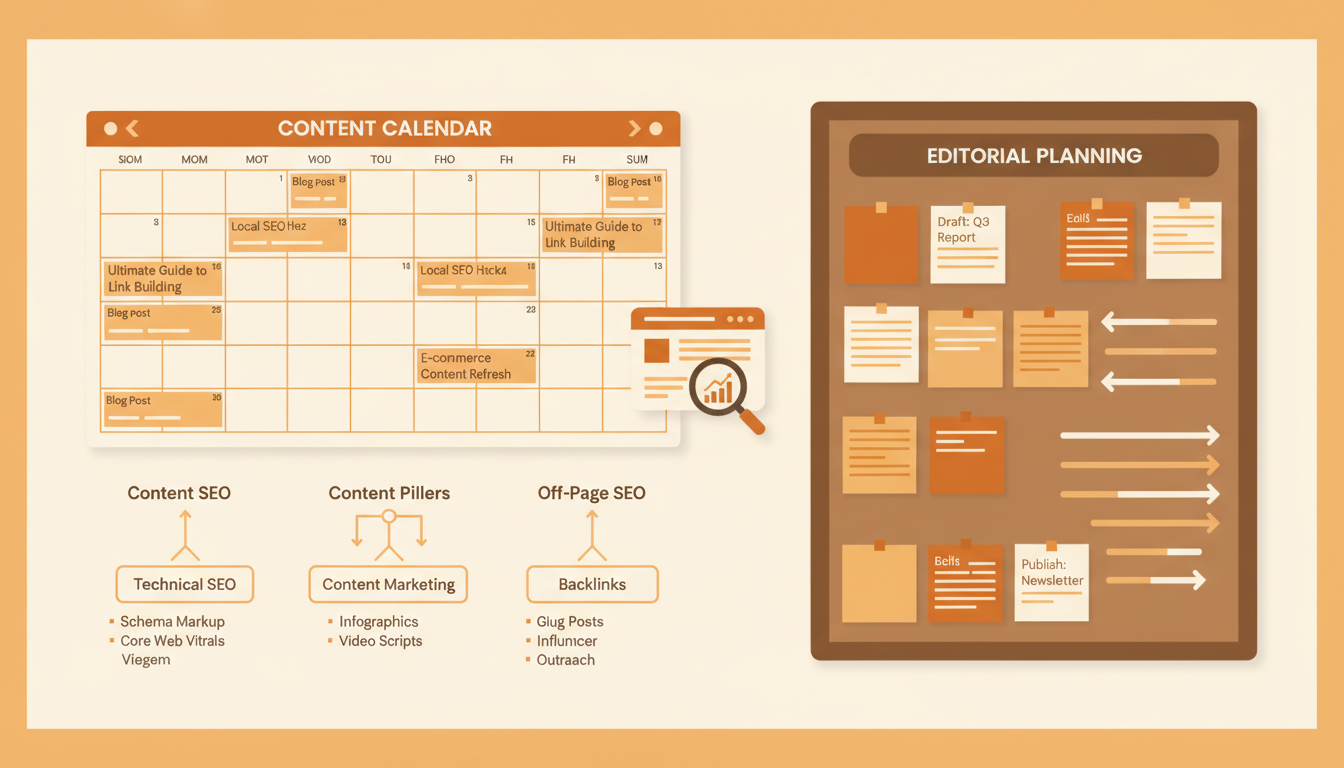
A content calendar transforms your strategy from a plan into an executable schedule. It ensures consistent publication, balances content types, and keeps your team accountable.
Publication Frequency
For most UK small and medium businesses, publishing two to four high-quality articles per month is more effective than daily low-quality posts. Quality always trumps quantity. Each article should be thoroughly researched, well-written, properly formatted, and genuinely useful to the reader. If you can only maintain that standard with two articles per month, publish two articles per month.
Content Mix
Vary your content types to appeal to different audience segments and search intents. A healthy content mix includes how-to guides and tutorials that target informational keywords and build trust. Comparison and best-of articles target commercial investigation keywords and help readers evaluate options. Case studies and success stories provide social proof and target bottom-of-funnel prospects. Industry news and analysis demonstrate thought leadership and attract backlinks. Checklists and templates provide practical value and encourage shares and return visits. Each content type serves a different purpose in your marketing funnel, so ensure your calendar includes a balanced mix.
| Content Type | Search Intent | Funnel Stage | Example |
|---|---|---|---|
| How-to Guides | Informational | Top of Funnel | How to choose a CRM for your business |
| Comparison Articles | Commercial Investigation | Middle of Funnel | HubSpot vs Salesforce for SMEs |
| Case Studies | Commercial Investigation | Bottom of Funnel | How we increased leads by 200% |
| Checklists and Templates | Informational | Top of Funnel | Website launch SEO checklist |
| Industry Analysis | Informational | Top of Funnel | UK digital marketing trends 2026 |
Seasonal and Trend Planning
Some content opportunities are time-sensitive. In the UK, financial year end in April drives searches related to accounting, tax, and IT budgeting. Back-to-school periods affect education sector businesses. The January new year period sees spikes in business improvement and planning searches. GDPR anniversary dates trigger compliance-related searches. Plan these seasonal pieces well in advance so they are published and indexed before the search demand peaks.
Step 6: Write Content That Outperforms Competitors
With your strategy, keywords, and calendar in place, it is time to write content that deserves to rank.
Structure for SEO and Readability
Use a clear hierarchical structure with H2 and H3 headings that include relevant keywords naturally. Break long sections into digestible paragraphs of three to four sentences maximum. Use bullet points and numbered lists where appropriate to improve scannability. Include a table of contents for articles over 2,000 words to help readers navigate and improve your chances of earning sitelinks in search results.
Writing for Featured Snippets
Featured snippets appear above the standard organic results and can dramatically increase your click-through rate. To target them, identify questions your audience asks and answer them concisely within your content. Use a clear question as a heading, then provide a direct answer in the first paragraph below it, ideally in 40 to 60 words. Follow the concise answer with a more detailed explanation. This format gives Google exactly what it needs for a featured snippet while still providing depth for readers who want more detail.
On-Page SEO Essentials
Every article should include an optimised title tag of 50 to 60 characters that includes your primary keyword. Write a compelling meta description of 150 to 160 characters that encourages clicks. Use your primary keyword in the first 100 words of the article naturally. Include relevant secondary keywords and semantic variations throughout the content without forcing them. Add descriptive alt text to all images. Use internal links to connect related content within your site, and include outbound links to authoritative sources where they add value.
Step 7: Promote and Distribute Your Content
Publishing is not the finish line. Even excellent content needs promotion to build initial traction and earn the signals Google uses to determine rankings.
Email Marketing
Share new content with your email subscribers. These are people who have already expressed interest in your business, and their engagement with your content sends positive signals. Include a brief summary and a compelling reason to click through to the full article.
Social Media Distribution
Share content across your active social media channels, but tailor the message for each platform. LinkedIn works well for B2B content with a professional angle. Twitter is effective for quick insights and linking to detailed articles. Facebook groups related to your industry can drive targeted traffic if you contribute genuinely rather than just promoting.
Link Building
Backlinks from other reputable websites remain one of the strongest ranking signals. Create content that naturally attracts links by including original research or data, unique insights or expert perspectives, comprehensive resources that others want to reference, and visual assets like infographics or charts that other sites want to embed. Supplement natural link building with targeted outreach to journalists, industry publications, and complementary businesses who might find your content valuable for their audience.
Step 8: Measure, Learn, and Optimise
Content strategy is iterative. The data from your published content informs and improves your future content decisions.
Key Metrics to Track
Monitor these metrics for every piece of content. Organic traffic shows how many visitors find the content through search. Keyword rankings reveal your position for target keywords over time. Engagement metrics including time on page, scroll depth, and bounce rate indicate whether the content satisfies visitor intent. Conversions track how many visitors take a desired action such as filling in a contact form or downloading a resource. Backlinks earned show whether the content attracts links from other websites.
Content Auditing and Refreshing
Review your content library every six months. Identify articles that are declining in traffic and update them with fresh information, new data, and improved structure. Content refreshing is often more effective than creating entirely new content because existing articles already have established authority and backlinks. Google rewards content that is kept current and comprehensive.
Strategic Content Programme
Ad-Hoc Blog Posts
Case Study: A UK Professional Services Firm
To illustrate these principles in action, consider the experience of a 30-person accountancy firm in Bristol. Before implementing a content strategy, their website received approximately 400 organic visits per month, with no blog content ranking in the top 10 for any commercial keywords.
The firm worked with an SEO agency to build a content strategy focused on three topic clusters: small business tax planning, cloud accounting software, and making tax digital compliance. Over six months, they published 18 articles following the methodology described in this guide. Each article was thoroughly researched, targeted specific long-tail keywords, and linked strategically to the pillar pages and related cluster content.
After six months, organic traffic had increased to 1,800 visits per month. After twelve months, it reached 4,200 visits per month. More importantly, the firm was generating eight to twelve qualified leads per month from organic content alone, reducing their reliance on paid advertising. The pillar page on making tax digital ranked in the top three for multiple high-value keywords and continued to attract backlinks from industry publications.
The lesson is clear: strategic content planning delivers compounding returns. Each new article strengthens the topical authority of the entire cluster, making it easier for subsequent articles to rank. The earlier you start, the greater the long-term advantage.
Common Content Strategy Mistakes
Even well-intentioned content strategies can go wrong. Avoid these common pitfalls.
Targeting keywords that are too competitive. A 20-person business cannot outrank multinational corporations for head terms like IT support. Focus on long-tail keywords where you can realistically compete and build authority gradually.
Ignoring search intent. Creating a sales page when the searcher wants educational content (or vice versa) results in high bounce rates and poor rankings. Always match your content type to the search intent behind your target keyword.
Publishing and forgetting. Content marketing is not a set-and-forget activity. Regular updates, promotion, and internal linking are essential for sustained performance. Schedule time for content maintenance, not just creation.
Writing for search engines instead of people. Keyword stuffing, unnatural phrasing, and robotic writing might have worked a decade ago. Today, Google rewards content that reads naturally and genuinely helps the reader. Write for humans first, then optimise for search engines.
Not measuring results. Without tracking performance, you cannot know what is working and what is not. Set up proper analytics from day one and review your content performance monthly.
Ready to Build a Content Strategy That Ranks?
Our SEO team creates data-driven content strategies for UK businesses. From keyword research and competitor analysis to content creation and ongoing optimisation, we handle every step of the process to drive measurable organic growth.
EXPLORE OUR SEO SERVICESFrequently Asked Questions
How long does it take for content to rank? New content typically takes three to six months to reach its ranking potential, though this varies based on domain authority, competition, and content quality. High-authority sites may see results faster, while newer sites should expect closer to the six-month mark.
How long should articles be? There is no magic word count. The right length is however long it takes to comprehensively cover the topic. That said, research consistently shows that longer, more detailed content tends to rank better. For most topics, aim for 1,500 to 3,000 words, but let the topic dictate the length rather than forcing a word count.
Should we use AI to write content? AI tools can assist with research, outlines, and first drafts, but content that ranks well typically requires human expertise, original insights, and brand voice that AI alone cannot provide. Use AI as a productivity tool, not a replacement for strategic content creation.
How much does a content strategy cost? Costs vary significantly based on scope and quality. A basic content strategy with keyword research and editorial calendar might cost one thousand to three thousand pounds. Ongoing content creation and management typically ranges from one thousand to five thousand pounds per month depending on volume and complexity. The key is to view content as an investment with measurable returns rather than an expense.
Can we do this in-house? Absolutely, if you have team members with SEO knowledge, strong writing skills, and the time to dedicate to it consistently. Many businesses start in-house and bring in specialist support as they see the value content delivers. The critical factor is consistency. An in-house team that publishes sporadically will underperform a managed programme that maintains a reliable schedule.

CloudSwitched
London-based managed IT services provider offering support, cloud solutions and cybersecurity for SMEs.


