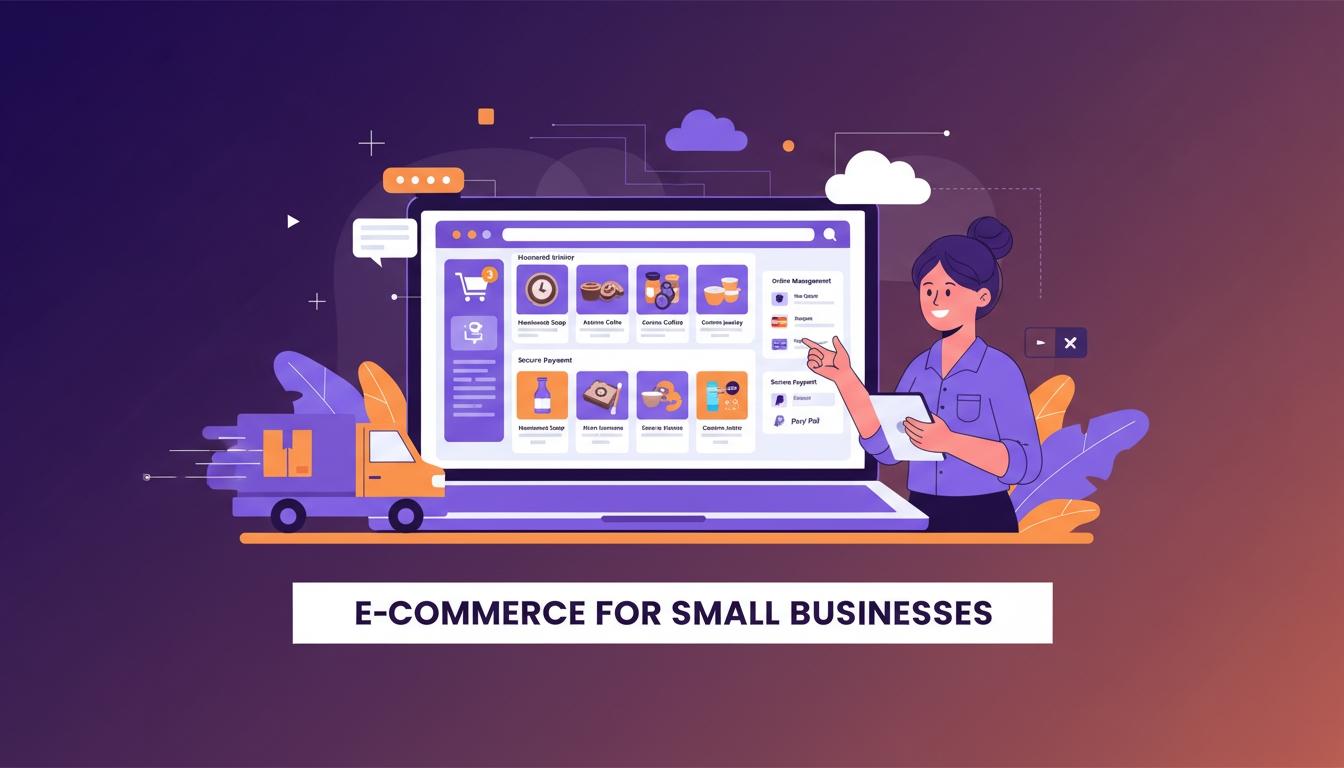
The UK e-commerce market is one of the largest and most mature in the world, with online retail sales exceeding £100 billion annually. Yet many small businesses across the United Kingdom have not yet made the leap to selling online - deterred by perceived complexity, cost, and technical barriers that, in reality, are far more manageable than they appear.
Whether you run a boutique in Brighton, a craft workshop in Cardiff, a specialist food business in Edinburgh, or a professional services firm in Manchester, e-commerce opens your business to customers far beyond your local high street. The pandemic accelerated the shift to online purchasing, and consumer expectations have permanently changed - many customers now expect to be able to browse, order, and pay online, even from businesses they might also visit in person.
This guide provides a practical, step-by-step introduction to e-commerce for UK small businesses, covering platform selection, payment processing, legal requirements, and the technical foundations you need to get your online shop up and running.
The good news is that the barrier to entry for e-commerce has never been lower. A decade ago, launching an online shop required significant technical expertise and thousands of pounds in upfront development costs. Today, a range of platforms, tools, and services have democratised online selling to the point where a small business can have a professional, fully functional online shop operational within weeks rather than months. The key is making informed decisions at each stage of the process and understanding which aspects of your e-commerce setup deserve investment and which can be approached more economically.
It is also worth recognising that e-commerce is not simply a matter of replicating your physical shop online. The most successful small business e-commerce operations treat their online presence as a distinct channel with its own characteristics, customer behaviours, and operational requirements. Customers who buy online expect detailed product information, transparent pricing, reliable delivery timescales, and responsive customer service through digital channels. Meeting these expectations requires thoughtful planning, but the rewards make the effort worthwhile: access to a nationwide or even international customer base, the ability to trade around the clock, and valuable data on customer preferences and buying patterns that can inform every aspect of your business strategy.
Choosing Your E-Commerce Platform
The platform you choose for your online shop is the most important decision you will make, as it determines your capabilities, costs, and scalability for years to come. For UK small businesses, there are three main categories of platform to consider.
Hosted Platforms (Shopify, Squarespace, Wix): These are all-in-one solutions where the platform provider handles hosting, security, and technical maintenance. You design your shop using templates and built-in tools, add products, and start selling. The main advantage is simplicity - you do not need any technical expertise to get started. The trade-off is limited customisation and ongoing monthly fees that increase as your business grows.
Self-Hosted Platforms (WooCommerce, Magento): These are software packages that you install on your own web hosting. WooCommerce, which runs on WordPress, is the most popular choice for UK small businesses. You have complete control over design, functionality, and data, but you are responsible for hosting, security updates, and technical maintenance. This approach requires more technical involvement but offers greater flexibility and often lower long-term costs.
Marketplace Platforms (Amazon, eBay, Etsy): Rather than building your own shop, you sell through an established marketplace. This gives you immediate access to millions of potential customers but comes with higher transaction fees, less brand control, and dependency on the marketplace's rules and algorithms. Many businesses use marketplaces alongside their own shop to maximise reach.
Evaluating Your Specific Business Requirements
Before committing to a platform, it is worth taking time to assess your specific requirements carefully. Consider the nature of your products: do you sell a small number of high-value items with detailed specifications, or a large catalogue of lower-priced goods? The former may benefit from the design flexibility of a self-hosted platform, whilst the latter demands strong inventory management and search functionality that some hosted platforms handle better out of the box.
Think about your growth trajectory and technical resources. If you have no technical staff and limited budget, a hosted platform like Shopify provides the quickest route to market with the least ongoing maintenance burden. If you anticipate needing custom functionality such as bespoke pricing rules, integration with existing business systems, or highly tailored customer journeys, a self-hosted WooCommerce installation provides the flexibility to build exactly what you need, though at the cost of greater technical complexity. Many small businesses start with a hosted platform to validate their online proposition, then migrate to a more flexible self-hosted solution as their requirements become clearer and their revenue justifies the additional investment.
| Platform | Monthly Cost | Transaction Fees | Technical Skill Required | Best For |
|---|---|---|---|---|
| Shopify | £25 - £269 | 1.5% - 2% + card fees | Low | Beginners wanting simplicity |
| WooCommerce | £5 - £30 (hosting) | Card fees only | Medium | Businesses wanting flexibility |
| Squarespace | £23 - £49 | 0% - 3% + card fees | Low | Design-focused brands |
| Amazon Marketplace | £25 (Pro plan) | 7% - 15% referral fee | Low | Volume sellers, commodity products |
| Etsy | Free (with listing fees) | 6.5% + card fees | Low | Handmade, vintage, craft items |
Payment Processing for UK Businesses
Accepting payments online requires a payment gateway - a service that securely processes credit and debit card transactions between your customer and your bank. For UK businesses, the most popular options are Stripe, PayPal, and Worldpay, each with different fee structures and features.
Stripe is the most developer-friendly option, with clean APIs, excellent documentation, and transparent pricing at 1.4% + 20p for UK cards and 2.9% + 20p for international cards. It integrates seamlessly with virtually every e-commerce platform and supports Apple Pay, Google Pay, and Strong Customer Authentication (SCA) as required by UK payment regulations.
PayPal remains widely trusted by UK consumers and can increase conversion rates simply by offering it as a payment option. Standard transaction fees are 1.99% + 30p for UK transactions above £10. PayPal also offers buyer protection, which gives customers confidence when purchasing from unfamiliar businesses.
Worldpay (now part of FIS) is commonly used by UK businesses and offers competitive rates, particularly for higher-volume merchants. It supports a wide range of payment methods and provides robust fraud prevention tools. Pricing is typically negotiable based on transaction volume.
Beyond the core payment gateways, consider what additional payment methods your customers might expect. Buy Now, Pay Later services such as Klarna and Clearpay have become increasingly popular with UK consumers, particularly for purchases above fifty pounds. Offering these options can increase your average order value and conversion rate, though they come with their own fee structures and integration requirements that need to be weighed against the potential uplift in sales.
If your business involves recurring payments such as subscription boxes, memberships, regular supply orders, or service retainers, ensure your chosen payment gateway supports subscription billing natively. Stripe excels in this area with its Billing product, whilst PayPal offers subscription buttons and recurring payment agreements. Setting up subscription billing correctly from the outset avoids the painful process of migrating customers between payment systems later, which often results in failed payments and customer churn.
Since September 2019, UK online payments are subject to Strong Customer Authentication requirements under the Payment Services Regulations 2017. This means that most online card payments must be authenticated using at least two of three factors: something the customer knows (password/PIN), something they have (phone/card), or something they are (fingerprint/face). Your payment gateway must support 3D Secure 2.0 to comply with SCA requirements. All major payment gateways (Stripe, PayPal, Worldpay) handle SCA compliance automatically, but ensure your integration is up to date.
Legal Requirements for UK Online Sellers
Selling online in the United Kingdom involves several legal obligations that you must comply with from day one. Ignorance is not a defence, and Trading Standards officers regularly check online businesses for compliance.
Consumer Contracts Regulations 2013: These regulations give online customers the right to cancel their order within 14 days of receiving goods (the "cooling-off period") and receive a full refund. You must clearly inform customers of this right before they complete their purchase. Certain items are exempt, including perishable goods, sealed items opened for hygiene reasons, and personalised products.
Consumer Rights Act 2015: All goods sold must be of satisfactory quality, fit for purpose, and as described. This applies equally to online and in-store sales. Customers have 30 days to return faulty goods for a full refund, with additional rights for repair or replacement thereafter.
Electronic Commerce Regulations 2002: Your website must clearly display your business name, geographic address, email address, and company registration number (if applicable). Prices must include VAT where applicable, and the buying process must be clear, with an opportunity to review and correct orders before payment.
GDPR and Data Protection: You must have a privacy policy explaining how you collect, use, and store customer data. You need a lawful basis for processing personal data, and you must implement appropriate security measures to protect it. If you use cookies (which virtually all e-commerce sites do), you need a cookie consent mechanism that complies with the Privacy and Electronic Communications Regulations (PECR).
Accessibility Requirements: Whilst not yet a strict legal obligation for all UK small businesses, the Equality Act 2010 requires that services, including online services, be accessible to people with disabilities. In practice, this means your e-commerce site should follow the Web Content Accessibility Guidelines (WCAG) 2.1 at a minimum Level AA standard. Ensuring your site is navigable by keyboard, compatible with screen readers, and uses sufficient colour contrast is not only the right thing to do but also expands your potential customer base. The proportion of UK adults with a disability that affects their internet use is approximately 22 per cent, representing significant purchasing power that inaccessible websites simply cannot reach.
VAT Registration and Digital Record-Keeping: If your business turnover exceeds the VAT registration threshold (currently ninety thousand pounds), you must register for VAT and comply with Making Tax Digital requirements, which mandate digital record-keeping and quarterly submissions through compatible software. Even below the threshold, voluntary VAT registration can be advantageous if you sell primarily to other VAT-registered businesses, as it allows them to reclaim the VAT on their purchases from you. Your e-commerce platform should be capable of generating VAT-compliant invoices and integrating with your accounting software to simplify quarterly reporting.
Essential Legal Compliance Checklist
- Full business name and address on website
- Clear refund and returns policy (14-day cooling off)
- Privacy policy and GDPR compliance
- Cookie consent mechanism (PECR compliant)
- VAT-inclusive pricing displayed
- Terms and conditions accessible before purchase
- Delivery timescales clearly stated
- Order confirmation emails sent automatically
Common Legal Mistakes to Avoid
- No physical address or contact details on site
- Missing or unclear returns policy
- No privacy policy or outdated one
- Cookie banner that does not allow rejection
- Prices shown excluding VAT without clear notice
- Hidden delivery charges revealed only at checkout
- No order confirmation or receipt process
- Claiming items are non-refundable when law says otherwise
Building Your Product Catalogue
Your product pages are where customers make purchasing decisions, and their quality directly impacts your conversion rate. For each product, invest time in creating compelling, informative listings.
Photography: Product images are the single most important factor in online purchasing decisions. For physical products, invest in professional photography or learn to take high-quality photos yourself. Show products from multiple angles, in context (being used or worn), and at sufficient resolution for customers to zoom in on details. A white background is standard for primary product images, but lifestyle shots showing the product in use are equally important.
Descriptions: Write detailed, honest product descriptions that answer every question a customer might have. Include dimensions, materials, care instructions, and any relevant specifications. Use natural, conversational language rather than marketing jargon. For SEO purposes, include relevant keywords naturally within your descriptions - think about what a customer would search for when looking for your product.
Pricing: Research competitor pricing to ensure your prices are competitive. Remember to factor in all costs - materials, labour, packaging, shipping, platform fees, and payment processing fees - when setting your prices. VAT-registered businesses must display VAT-inclusive prices to consumers (you can show the VAT breakdown separately if you wish).
Inventory Management and Stock Control
Effective stock management is essential once you begin selling online, particularly if you also sell through physical premises or multiple online channels. Overselling, which means accepting an order for an item that is no longer in stock, is one of the most damaging mistakes an e-commerce business can make, leading to cancelled orders, refund processing, and significant reputational harm. Your e-commerce platform should provide real-time stock tracking that updates automatically as orders are placed, and ideally syncs with any other sales channels you use.
For businesses with a larger product range, consider whether you need a dedicated inventory management system that integrates with your e-commerce platform. Tools such as Linnworks, Brightpearl, and Veeqo are popular among UK small businesses and provide centralised stock management across multiple sales channels, automated reorder alerts, and warehouse management features. Even for smaller operations, maintaining accurate stock records from the outset establishes good habits and provides valuable data on product performance, seasonal trends, and reorder patterns that inform your purchasing decisions as the business grows.
Shipping and Fulfilment
For UK small businesses selling physical products, shipping is often the most operationally complex aspect of e-commerce. Getting it right is essential - delivery experience is consistently cited as one of the most important factors in customer satisfaction and repeat purchasing.
Royal Mail remains the most popular carrier for UK small businesses, offering a range of services from standard second class (£1.50-£3 for small parcels) to guaranteed next-day Special Delivery (£7-£10). For businesses shipping more than a few parcels per week, Royal Mail's business account offers discounted rates and collection from your premises.
Consider offering free delivery above a minimum order value. This is a proven strategy for increasing average order values - if your average order is £20 and delivery costs £3.50, setting a free delivery threshold of £30 encourages customers to add items to their basket. The increased sales volume typically more than compensates for the absorbed delivery cost.
International shipping opens up additional revenue opportunities but introduces complexity around customs declarations, import duties, and longer transit times. Since the United Kingdom left the European Union, shipping to EU countries requires customs documentation that was not previously necessary. If you anticipate significant EU sales, investigate services such as Global-e or Passport Shipping that simplify cross-border e-commerce by handling customs duties, local tax calculations, and returns processing on your behalf. Alternatively, start with UK-only delivery and expand internationally once your domestic operation is running smoothly.
Returns handling is another critical aspect of e-commerce fulfilment that deserves careful planning from the outset. UK law requires you to accept returns within fourteen days under the Consumer Contracts Regulations, but offering a more generous returns window of thirty days, which is increasingly standard, can actually increase sales by reducing purchase hesitation. Establish a clear, simple returns process before you launch, including pre-printed return labels, clear instructions on your website, and an efficient workflow for inspecting returned items, processing refunds, and restocking where appropriate. The returns experience is often what determines whether a first-time buyer becomes a repeat customer.
Security and PCI Compliance
If you accept card payments online, you must comply with the Payment Card Industry Data Security Standard (PCI DSS). The good news for small businesses is that if you use a hosted payment gateway like Stripe or PayPal - where card details are entered on the payment provider's page rather than your own - your PCI compliance obligations are significantly reduced. You would typically qualify for the simplest Self-Assessment Questionnaire (SAQ A), which involves answering a short questionnaire confirming that you do not store, process, or transmit card data on your own systems.
Beyond PCI compliance, your e-commerce site needs robust general security. Ensure your site uses HTTPS (SSL/TLS encryption) on every page, not just the checkout. Keep your platform, plugins, and themes updated to patch known vulnerabilities. Use strong, unique passwords for all administrative accounts and enable two-factor authentication wherever possible. Regularly back up your site and database so you can recover quickly if anything goes wrong.
Fraud Prevention and Monitoring
Online fraud is an unfortunate reality of e-commerce, and UK small businesses are not immune. Card-not-present fraud, where stolen card details are used to make purchases online, costs UK businesses hundreds of millions of pounds annually. Your payment gateway provides baseline fraud protection, but additional measures are worthwhile. Enable Address Verification Service (AVS) checks, which compare the billing address provided by the customer with the address registered to their card. Use Card Verification Value (CVV) checks to confirm the customer has the physical card. Consider implementing velocity checks that flag unusually large orders, multiple orders to the same address in a short period, or orders where the billing and delivery addresses are in different countries.
Monitor your transactions regularly for suspicious patterns. Fraudsters often test stolen cards with small purchases before making larger ones, so a sudden spike in low-value orders can be an early warning sign. Most payment gateways provide fraud scoring and configurable rules that allow you to automatically flag, review, or block suspicious transactions. Investing time in configuring these tools properly can save you from significant financial losses and the considerable administrative burden of managing chargebacks and dispute resolution processes.
Marketing Your Online Shop
Building an online shop is only half the challenge - you also need to drive traffic to it. For UK small businesses, the most effective marketing channels are typically search engine optimisation (SEO), social media, email marketing, and Google Shopping.
SEO: Optimise your product pages and category pages for relevant search terms. Think about what your customers would type into Google when looking for your products. Use these terms naturally in your page titles, descriptions, and headings. Create useful content - blog posts, buying guides, how-to articles - that attracts search traffic and establishes your expertise.
Social Media: Instagram and Facebook are particularly effective for product-based businesses, allowing you to showcase products visually and engage directly with potential customers. Both platforms offer shopping features that allow customers to browse and purchase directly from your social media posts.
Google Shopping: If you sell physical products, Google Shopping ads display your products with images, prices, and your business name directly in Google search results. These ads typically deliver strong return on investment because they reach customers who are actively searching for products like yours.
Email Marketing: Building an email list from your very first customer is one of the most valuable long-term marketing investments you can make. Unlike social media, where algorithm changes can dramatically reduce your reach overnight, your email list is an asset you own and control. Use your e-commerce platform to collect email addresses at checkout and through newsletter sign-up forms, then send regular communications including new product announcements, exclusive offers, seasonal promotions, and useful content related to your products. Tools such as Mailchimp, Klaviyo, and Brevo integrate directly with most e-commerce platforms and allow you to create automated email sequences including welcome series for new customers, abandoned basket reminders, post-purchase follow-ups, and win-back campaigns for lapsed customers.
Customer Retention and Lifetime Value: Acquiring a new customer typically costs five to seven times more than retaining an existing one, yet many small businesses focus almost exclusively on acquisition at the expense of retention. Implement loyalty programmes, personalised recommendations based on purchase history, and proactive customer service to encourage repeat purchases. Request product reviews from satisfied customers, as these serve as powerful social proof that increases conversion rates for future visitors. A structured approach to customer retention, even a simple one, can transform the economics of your e-commerce business from marginal to highly profitable within the first year of operation.
Ready to Launch Your Online Shop?
Cloudswitched builds professional e-commerce websites for small businesses across the United Kingdom. From platform selection and design through to payment integration, SEO, and ongoing support, we handle the technical complexity so you can focus on your products and customers. Contact us to discuss your e-commerce project.
Explore Our Web Development Services
CloudSwitched
London-based managed IT services provider offering support, cloud solutions and cybersecurity for SMEs.


