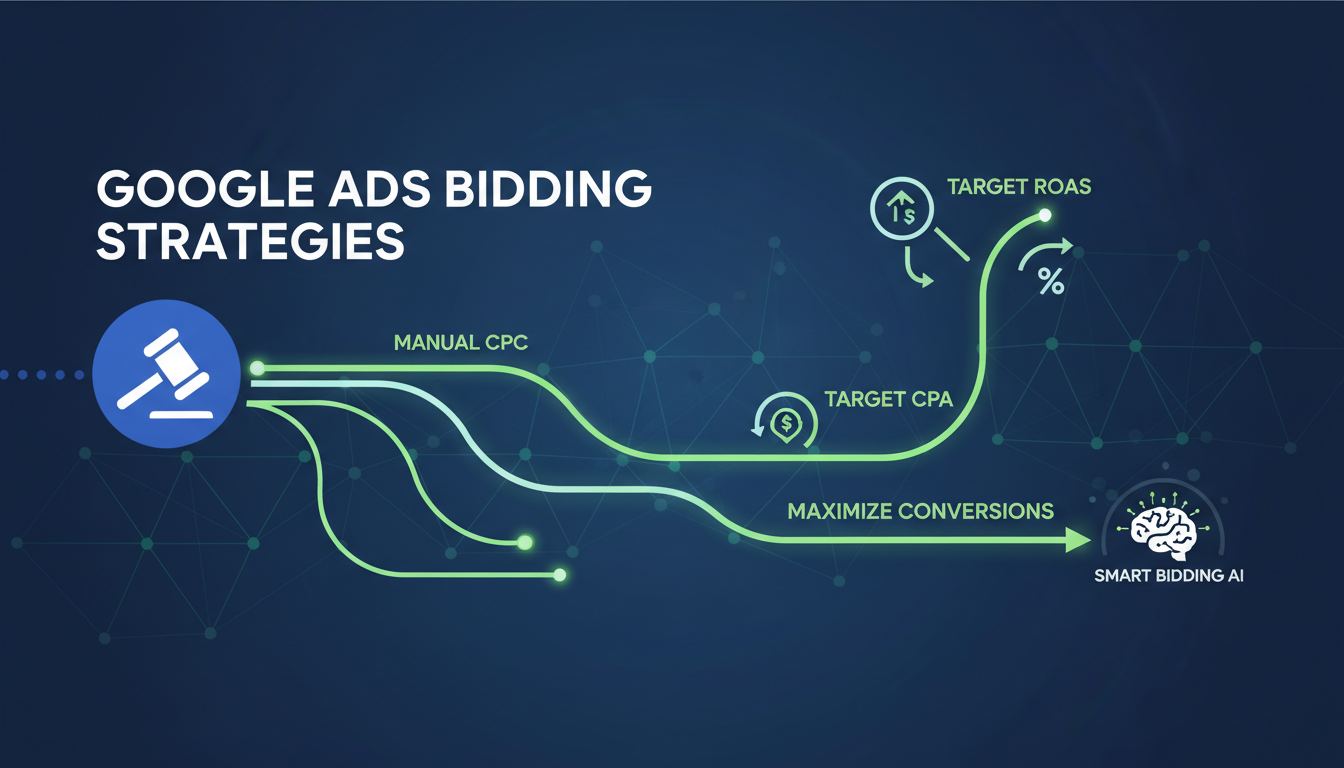
Bidding is the mechanism that determines when your ads appear, where they are positioned, and how much you pay for each click. It is arguably the most technically complex aspect of Google Ads management, and getting it right can transform your campaign performance. For UK businesses investing in paid search, understanding the full spectrum of bidding strategies - from manual control to sophisticated automated options - is essential for making informed decisions about how your budget is deployed.
Google has invested heavily in machine learning-powered bidding over the past several years, and the platform now offers a range of automated strategies that can optimise bids in real time based on hundreds of signals. However, automation is not a magic wand. Each strategy has specific requirements, strengths, and limitations, and choosing the wrong one for your situation can waste budget just as effectively as choosing the wrong keywords. This guide explains every major bidding strategy available in Google Ads, when to use each, and how to transition between them as your campaigns mature.
How Google Ads Bidding Works
Before diving into specific strategies, it is worth understanding the fundamental mechanics of Google Ads bidding. Every time a user performs a search that matches one of your keywords, an auction takes place. Your bid - along with your Quality Score and the expected impact of your ad extensions - determines your Ad Rank, which in turn determines whether your ad appears and in what position.
The amount you actually pay per click is typically less than your maximum bid. Google uses a second-price auction model (with modifications), meaning you pay just enough to beat the advertiser below you. This is why improving your Quality Score is so valuable - it allows you to achieve the same position whilst paying less per click.
Understanding this auction dynamic is crucial because it means that bidding is not simply about outspending your competitors. A well-optimised account with strong Quality Scores can consistently win auctions against higher-spending competitors, making the quality of your campaigns just as important as the size of your budget.
Manual CPC Bidding
Manual CPC (cost-per-click) bidding gives you full control over the maximum amount you are willing to pay for a click on each keyword. You set individual bids at the keyword level, and Google will never charge you more than your specified maximum (though it will frequently charge less).
This strategy offers the greatest level of control but demands the most time and expertise. You are responsible for analysing performance data and adjusting bids accordingly - raising bids on high-performing keywords, lowering bids on underperformers, and responding to competitive changes in real time. For accounts with hundreds or thousands of keywords, this becomes a substantial management burden.
Manual CPC is best suited for new accounts with limited conversion data, where automated strategies lack the historical signals they need to optimise effectively. It is also appropriate for accounts with very low budgets, where the cost of automated inefficiency during the learning phase could consume a significant proportion of the available spend. Additionally, some advertisers prefer manual bidding for brand campaigns, where they want absolute control over positioning.
Google has been gradually de-emphasising manual bidding, and some newer campaign types (such as Performance Max) do not support it at all. While manual CPC remains available for standard Search campaigns, the platform is clearly moving toward automated solutions. UK advertisers should view manual bidding as a transitional tool rather than a long-term strategy, using it to build the conversion data needed to switch to more sophisticated automated options.
Enhanced CPC (ECPC)
Enhanced CPC is a semi-automated strategy that builds on manual bidding by allowing Google to adjust your manual bids up or down based on the likelihood of a conversion. When Google's algorithms detect that a click is more likely to convert (based on signals such as device, location, time of day, and search query), it may increase your bid. Conversely, it may reduce your bid for clicks deemed less likely to convert.
ECPC serves as a useful stepping stone between fully manual and fully automated bidding. It provides some of the benefits of machine learning-driven optimisation whilst still giving you a baseline level of control through your manual bid settings. The adjustments Google makes are bounded - it will not increase your bids by more than a certain percentage, which limits the risk of runaway costs.
For UK businesses that are comfortable with manual bidding but want to test the waters of automation, ECPC is an excellent starting point. It requires the same conversion tracking setup as fully automated strategies, so it also serves as a validation step - if your conversion tracking is working correctly with ECPC, you can be more confident in transitioning to a fully automated strategy later.
Maximise Clicks
The Maximise Clicks strategy does exactly what the name suggests - it automatically sets your bids to get as many clicks as possible within your daily budget. Google's algorithms determine the optimal bid for each auction to maximise click volume, and you can optionally set a maximum CPC limit to prevent individual clicks from exceeding a certain cost.
This strategy is useful in several specific situations. For new campaigns where the primary objective is generating traffic to gather initial data, Maximise Clicks provides an efficient way to build volume quickly. It is also appropriate for awareness campaigns where the goal is maximising visibility rather than direct conversions, and for keyword research campaigns where you want to test a broad set of terms to identify which ones warrant further investment.
| Bidding Strategy | Control Level | Best For | Min. Conversion Data |
|---|---|---|---|
| Manual CPC | Full control | New accounts, small budgets | None required |
| Enhanced CPC | Semi-automated | Transitioning from manual | Some conversions helpful |
| Maximise Clicks | Automated (volume) | Traffic and data gathering | None required |
| Maximise Conversions | Automated (conversions) | Lead generation | 15-30 conversions/month |
| Target CPA | Automated (efficiency) | Stable cost per lead | 30+ conversions/month |
| Target ROAS | Automated (revenue) | E-commerce, revenue focus | 50+ conversions/month |
| Maximise Conversion Value | Automated (value) | Variable-value conversions | 30+ conversions/month |
The primary risk of Maximise Clicks is that it optimises purely for volume, with no regard for click quality or conversion potential. It will happily spend your entire budget on clicks that never convert if those clicks happen to be the cheapest available. For this reason, it is generally not recommended as a long-term strategy for accounts focused on lead generation or sales.
Maximise Conversions
Maximise Conversions is a fully automated strategy that sets bids to generate the maximum number of conversions within your daily budget. Unlike Maximise Clicks, this strategy considers the likelihood of each click converting and prioritises those with higher conversion potential, even if they cost more per click.
This strategy works best when your campaign has a consistent history of conversions and your conversion tracking is accurate and reliable. Google's algorithms need sufficient data to learn which combinations of signals predict a conversion, and campaigns with fewer than 15-20 conversions per month may not provide enough data for effective optimisation.
A critical nuance of Maximise Conversions is that it will spend your entire daily budget. If you set a daily budget of £100, the algorithm will find ways to spend all £100, even if the marginal conversions come at a significantly higher cost than your average. This makes budget management important - set your daily budget at a level where you are comfortable with all of it being spent, and monitor cost per conversion closely to ensure it stays within acceptable bounds.
Target CPA (Cost Per Acquisition)
Target CPA is one of the most popular automated strategies for lead generation campaigns. You specify the average amount you are willing to pay for each conversion, and Google's algorithms set bids to achieve that target across your campaign. Some conversions will cost more than your target and others will cost less, but the average should converge toward your specified CPA over time.
Setting the right target CPA is crucial. Set it too low and Google will struggle to find enough conversions, dramatically reducing your traffic volume. Set it too high and you will overpay for conversions that could have been acquired more cheaply. The best starting point is typically your current average CPA plus a small margin (10-15%) to give the algorithm room to operate. You can then gradually lower the target as the system optimises.
Target CPA requires a minimum of approximately 30 conversions per month per campaign to function effectively. Below this threshold, the algorithm does not have enough data to make reliable predictions, and performance can be erratic. If your campaigns are not yet hitting this volume, consider using Maximise Conversions first to build up data before transitioning to Target CPA.
Target ROAS (Return on Ad Spend)
Target ROAS is the value-focused counterpart to Target CPA. Instead of targeting a specific cost per conversion, you specify the return you want to achieve for every pound spent on advertising. For example, a Target ROAS of 400% means you want to generate £4 in revenue for every £1 spent on ads.
This strategy is particularly powerful for e-commerce businesses and any advertiser that can assign accurate monetary values to different conversion types. It allows Google's algorithms to prioritise high-value conversions over low-value ones, which can significantly improve overall profitability compared to strategies that treat all conversions equally.
Target ROAS demands more data than Target CPA to function well - Google recommends at least 50 conversions per month with consistent value reporting. It also requires accurate conversion value tracking, which means integrating your Google Ads account with your e-commerce platform or CRM to pass back actual revenue data. If your conversion values are estimated or inconsistent, the algorithm will struggle to optimise effectively.
Maximise Conversion Value
Maximise Conversion Value is to Target ROAS what Maximise Conversions is to Target CPA. It sets bids to generate the maximum total conversion value within your daily budget, without a specific return target. This strategy is useful when you want to maximise revenue and are willing to accept whatever return on spend the algorithm achieves.
Like Maximise Conversions, this strategy will spend your entire daily budget. It is best used when your primary constraint is budget rather than efficiency, and when you have confidence that the conversion values being reported to Google Ads are accurate. If your conversion tracking assigns incorrect or inflated values, Maximise Conversion Value will optimise toward misleading data.
Impression Share Bidding Strategies
Google also offers bidding strategies focused on visibility rather than clicks or conversions. Target Impression Share automatically sets bids to achieve a specified impression share - the percentage of eligible auctions in which your ad appears. You can target a specific percentage and choose where on the page your ad should appear (anywhere, top of page, or absolute top of page).
This strategy is primarily used for brand protection campaigns, where appearing for every search of your brand name is a strategic priority regardless of cost efficiency. It can also be useful for awareness campaigns where visibility is the primary objective. For performance-focused campaigns, impression share bidding is generally not recommended, as it optimises for visibility rather than conversions or value.
Automated Smart Bidding vs Manual Control
One of the most significant decisions UK advertisers face is whether to trust Google's automated smart bidding or maintain manual control over their bids. Both approaches have compelling advantages, and the right choice depends on your account maturity, data volume, and comfort level with algorithmic decision-making. Understanding the trade-offs in detail helps you make an informed transition at the right time for your specific business situation.
Automated Smart Bidding
Manual CPC Bidding
In practice, most successful UK advertisers follow a progression from manual to automated bidding as their accounts mature. The critical factor is data volume - automated strategies need a steady stream of conversion signals to make intelligent decisions. Without this data, they are essentially guessing, and their guesses can be expensive. Once you have accumulated sufficient conversion history, however, the sheer processing power of automated bidding - analysing hundreds of signals for every single auction in real time - is virtually impossible to replicate manually, regardless of how skilled your account manager might be.
It is also worth noting that Google continues to enhance its automated bidding capabilities with each platform update. Features such as cross-campaign data sharing, broader audience signal integration, and improved seasonal adjustment handling mean that the performance gap between automated and manual bidding widens over time. UK businesses that delay their transition to smart bidding may find themselves at an increasing disadvantage compared to competitors who have already embraced these tools and given the algorithms time to learn and optimise.
Choosing the Right Strategy for Your Business
Selecting the optimal bidding strategy depends on several factors: your campaign maturity, conversion volume, business model, and specific objectives. There is no universally "best" strategy - the right choice depends on your unique circumstances.
For new campaigns or accounts with limited conversion history, start with Manual CPC or Maximise Clicks to build initial data. Once you have accumulated 15-20 conversions per month, transition to Maximise Conversions. When volume reaches 30 or more conversions per month with stable performance, consider moving to Target CPA or Target ROAS for more precise control.
When transitioning between bidding strategies, use portfolio bid strategies to group related campaigns together. This aggregates conversion data across campaigns, giving the algorithm a larger pool of signals to learn from. A portfolio strategy combining three campaigns that each generate 15 conversions per month gives the algorithm 45 data points to work with, which is more than enough for effective optimisation. This approach is particularly valuable for UK SMEs where individual campaigns may have limited volume.
The Learning Phase: What to Expect
Every time you change a bidding strategy (or make significant changes to a campaign using automated bidding), Google enters a "learning" phase. During this period - typically 7 to 14 days - the algorithm is calibrating to the new parameters, and performance may be volatile. Cost per conversion might spike, volume might fluctuate, and overall results may look worse than before the change.
This learning phase is normal and expected. The worst thing you can do is panic and switch strategies again before the learning period completes, as this resets the process and prevents the algorithm from ever fully optimising. Plan your strategy changes during quieter periods when temporary performance dips will have the least business impact, and resist the urge to intervene during the learning window.
Monitor the "Bid strategy status" column in your campaigns table to track learning progress. Once the status changes from "Learning" to the strategy name (for example, "Target CPA"), the algorithm has completed its initial calibration and should begin delivering more stable results.
Bidding Strategy Readiness Assessment
Before transitioning to a new bidding strategy, it is essential to assess whether your account meets the prerequisites for success. Each strategy has different requirements in terms of conversion volume, data quality, and tracking infrastructure. The readiness scores below provide a general framework for evaluating whether your campaigns are prepared for each approach, based on a typical UK advertiser account with basic conversion tracking in place. A higher score indicates greater likelihood of successful implementation without significant performance disruption during the transition period.
These readiness assessments reflect the typical UK advertiser starting from a newly created account. As your campaigns accumulate conversion data and your tracking infrastructure matures, the readiness scores for more advanced strategies will improve. The key takeaway is that rushing into a sophisticated strategy before your account is ready can actually harm performance - the algorithm needs data to learn effectively, and insufficient data leads to erratic bidding that wastes budget. Patience and methodical progression through the bidding strategy hierarchy typically yields the best long-term results for UK businesses of all sizes.
To improve your readiness for advanced strategies, focus on three core areas: first, ensure your conversion tracking is comprehensive and accurate, capturing all meaningful customer actions including phone calls, form submissions, and online purchases. Second, work on increasing your conversion volume through improved landing pages, ad copy testing, and keyword expansion. Third, establish a clean account structure with well-defined campaign goals, as automated strategies perform best when campaigns have clear, consistent conversion objectives rather than a mixed bag of different conversion types competing for the same budget.
Advanced Bidding Tactics
Beyond selecting a primary bidding strategy, several advanced tactics can further improve your bidding performance. Bid adjustments for device, location, audience, and time of day allow you to modify your bids based on specific conditions. For example, if your data shows that mobile users convert at half the rate of desktop users, a -30% device bid adjustment for mobile can improve your overall efficiency.
Seasonal bid adjustments are another powerful tool for UK businesses. If you know that demand for your product or service peaks during certain periods (summer holidays, Christmas, tax year-end), you can proactively inform Google's algorithms using the "Seasonality adjustments" feature. This tells the system to expect a temporary change in conversion rates, preventing it from over- or under-reacting to seasonal patterns.
Regularly review your bid strategy reports in Google Ads. These reports show how the automated strategy is performing against its targets, which auctions it is winning and losing, and which signals it is using to make bid decisions. This data can inform both your bidding approach and broader campaign optimisation - for example, if the report shows that conversions are disproportionately concentrated in certain geographic areas, you might increase your budget for those regions or create dedicated campaigns targeting them.
Bidding strategy is not a set-and-forget decision. As your campaigns evolve, your conversion volume changes, and the competitive landscape shifts, your optimal bidding approach will evolve too. The most successful UK advertisers treat bidding as an ongoing discipline of testing, measurement, and refinement - continually seeking the strategy that delivers the best possible return on their advertising investment.
Need Help Optimising Your Google Ads Bidding?
Our team helps UK businesses select and implement the right bidding strategies for their goals. From manual CPC setup to advanced automated bidding with portfolio strategies, we ensure your budget works as hard as possible. Let us review your current approach.
Optimise Your Bidding Strategy
CloudSwitched
London-based managed IT services provider offering support, cloud solutions and cybersecurity for SMEs.


